Jason S. DeRouchie's Blog, page 5
March 28, 2024
Our Young Earth: Arguments for Thousands of Years
At stake in the question of the earth’s age is faithful exegesis of the biblical text aligned with a faithful interpretation of the scientific data. Because no one but God was present at the beginning, and because the Bible is God’s inerrant word, Scripture holds highest authority in answering questions of time and space. Scripture’s teaching on a subject must bear guiding weight in assessing all matters related to the created sphere.
Let us be clear: God’s role as creator, his purpose for creation, and the historicity of Adam and Eve as the first parents are non-negotiable for Christian belief. Furthermore, evolutionary creationism (i.e., theistic evolution) of any form is unwarranted biblically. Nevertheless, while there is much at stake, the age of the earth is not among the central doctrines that should divide. Conservative Christianity has remained broad enough for both young-earth and old-earth creationism (akin somewhat to credo- versus paedo-baptism or varying millennial views). I remain a convinced young-earth creationist because of the overwhelming biblical data. However, there is no single silver-bullet biblical or scientific argument for my position, and old-earth creationists can craft legitimate, thoughtful responses to each of my claims. The weight of my case is cumulative, and I question whether every argument I make can be legitimately falsified.
Humanity in the First WeekArgument 1: Genesis 1:1–2:3 places the creation of humanity within the first week of creation. The most natural reading of the Bible’s introduction points to a young earth.
The use of Hebrew yôm (meaning day) with the refrain “there was evening and there was morning” (Gen. 1:5, 8, 13, 19, 23, 31)—along with the mention of light and darkness, day and night, and the one-week structure—strongly suggests that the communicator of this revelation was portraying the equivalent of 24-hour calendar days, even though the sun is not created until day four (Gen. 1:14–19). Mankind is here portrayed as being created on day six of God’s first workweek. The day-age theory (wherein God created all of physical creation out of nothing in a chronological progression of ages spanning an indefinite period of time) does not seem to fit this context. And the gap theory (which posits a very long span between Genesis 1:1 and 1:2) does not appear to be allowed by the Hebrew text.
While later meditations on creation (e.g., Ps.104) never refer to the “days,” the fact that Yahweh built Israel’s 6+1 pattern of life upon the pattern of the creation week (Exod. 20:11) seems best understood only if Israel was already aware of the 6+1 pattern of the creation week (see Exod. 16:23–29; compare Gen. 7:4, 10; 8:10, 12) and viewed it as an actual reality as opposed to figurative or analogical reality. Specifically, Israel’s call to keep the Sabbath is grounded in God’s original workweek, which is difficult to read analogically (Exod. 20:10–11): “The seventh day is a Sabbath to the Lord your God. On it you shall not do any work. . . . For in six days the Lord made heaven and earth, the sea, and all that is in them, and rested on the seventh day.”
In the BeginningArgument 2: The New Testament closely associates the history of Genesis 2–4 with the beginning of the world. Old-earth models require either that mankind’s creation be separated from the “beginning” by millions or even billions of years (Gap Theory), or that the Genesis 1:1 “beginning” stretched out for a period of time massively longer than all the time that has followed (Day-Age Theory). The former discounts the New Testament link between the “beginning” of Genesis 1:1 and the creation of mankind in 1:26–28, and the latter forces a strange use of the term of “beginning,” wherein what happens in the ninth inning is still the “beginning.”
In the New Testament, we read that Jesus saw the institution of marriage as being closely linked to the beginning of creation (Mark 10:6; cf. Matt.19:4, 8; see Gen.2:21–25). He declared that Satan’s murderous activity (not just his tendencies) through his deception of Eve was closely associated with the beginning of creation (John 8:44). He linked this murderous, sinful activity with the promise that the offspring of the woman would stand in friction with the serpent and his offspring (1 John 3:8; cf. Gen. 3:1–6, 15). He saw the first human experience of tribulation as being located near the beginning of creation (likely referring to Cain’s killing of Abel) (Mark 13:19; cf. Matt. 24:21; see Gen. 4:8). He placed the martyrdom of Abel near the foundation of the world (Luke 11:49–50; cf. Matt. 23:35; see Gen. 4:8).
The writer of Hebrews also considered the “foundation of the world” to be the conclusion of the sixth day, placed humanity’s rebellion (for which Jesus suffered) very near this time, and contrasted this foundation with the “end of the ages” realized in the work of Christ (Heb. 4:3–4; 9:25–26).
Linear GenealogiesArgument 3: The linear genealogies in Genesis 5 and 11 point to a recent humanity. While some biblical genealogies are clearly selective (e.g., Matt. 1:1; 1:2–17), the genealogies in Genesis 5 and 11 are so specific that they resist a selective reading and thus require that humanity has existed for a relatively short time.
The linear genealogies in Genesis 5 and 11 are unique in all of Scripture with respect to the age detail they provide (see, e.g., Gen. 5:3–11). Even if “son” at times means grandson or great-grandson (as can happen in Scripture), the specificity of the ages counters the likelihood of gaps. Moreover, a number of the seemingly “father-son/grandson/great-grandson” relationships are shown elsewhere to be just that—e.g., Adam with Seth (Gen. 4:25), Noah with Ham, Shem, and Japheth (6:10), Terah with Abraham (11:31).
A solid explanation for the presence of specific ages in these genealogies is the messianic and missiological purposes of Genesis. Moses seems to have gone out of his way to show that God preserved the line of hope in every generation from Adam to Noah, from Shem to Terah, and from Abraham to Israel. The specified years all highlight the faithfulness of God to preserve his line hoping in the offspring promise of Genesis 3:15. As such, leaving out generations would have gone against the apparent purpose.
Adding the ages in the genealogies points to humanity being around 6,000 years old.
Climax of CreationArgument 4: Adam’s high role as head of the first creation and mankind’s station as the climax of creation and image of God both support a young earth. It makes less sense to think that God allowed the bulk of creation to exist for millennia without its overseers.
Genesis 1:1–2:3 associates all major “rulers” of the first creation with humanity. The luminaries separate day and night and establish the earth’s calendar (Gen. 1:14), but they also serve as “signs” for humans that stress the surety of God’s promises (Gen. 15:5; Jer. 33:22). Humans are called to “fill the earth and subdue it” and to “have dominion over the fish . . . birds . . . and every living thing that moves on the earth” (Gen. 1:28).
Humans are the climax of creation and sole representatives of God on the earth, with some being chosen “in Christ before the foundation of the world, that we should be holy and blameless before him, having been predestined in love for adoption as sons through Jesus Christ . . . to the praise of his glorious grace” (Eph. 1:4–6). Only on the sixth day is the definite article “the” added to the day-ending formula (“a first day, a second day, a third day, . . . the sixth day”). Day six gets the most literary space and includes the longest speeches. Only at the end of day six does God declare creation “very good” (Gen. 1:31). Only at day six does God declare something he makes to be “in his image,” giving humanity oversight in the world. Scripture portrays the first man, Adam, as representative covenantal head over the first creation (Gen. 2:15; Rom.5:18–19; 1 Cor. 15:45).
In addition, God’s oversight, provision, and protection of animals (Pss. 104:14, 21, 24, 27; 145:14–16; 147:9; Matt. 6:26; Luke 12:24) is significantly manifest through mankind (Gen. 1:28; 2:15; Ps. 8:6–8[7–9]).
Animal Suffering and DeathArgument 5: Scripture usually portrays the suffering and death of living creatures, including animals, as part of the curse, so millions of years of animal death and suffering pre-fall seems unlikely. God initially curses the world on account of human sin, so death and suffering in land animals and birds most likely resulted from mankind’s fall and were not present before it, as all old-earth models require.
The principal consequence of humanity’s garden rebellion was human death both physically and spiritually (Gen. 2:17; 3:16–19; Rom. 5:12). Humanity’s sin in the garden brought negative consequences not only on humanity, however, but also to the created world at large: God cursed the animals (Gen. 3:14). God cursed the ground (Gen. 3:17–19). God subjected the whole world to futility (Rom. 8:20–21).
Scripture regularly associates animal death with curse and animal life with blessing. Both realities suggest that death and suffering in land animals and birds would have resulted from the fall and not been present before it.
First, the fact that the serpent is cursed “more than/above” (= Hebrew min of comparison) all livestock and beasts of the field implies that the land animals were indeed impacted directly and negatively by humanity’s fall (Gen. 3:14; cf. 3:1).
Second, the curse on the ground (Gen. 3:17) shapes the backdrop to Noah’s birth (Gen. 5:29), and the judgment curse of the flood includes the death of all beasts, birds, and creeping things (Gen. 7:21–23), save those on the ark, which were set apart to preserve non-human land creatures after the flood (Gen. 6:19–20; 7:3).
Third, eight of the ten judgment plagues on Egypt included animals becoming pests to humans or the mass suffering and death of livestock in a way that negatively impacted human existence (Exod. 8–12).
Fourth, the penal substitutionary blood of the Passover lamb alone secured the lives of Israel’s firstborn among both humans and beasts (Exod.12:12–13).
Fifth, under the blessings of the Mosaic (old) covenant, mankind would live in safety from animal predation (Lev. 26:6) and cattle and herds would flourish and increase (Deut. 7:13–14; 28:4, 11). In contrast, under curse, humans would stand in fear of animal predation (Lev. 26:22), cattle and herds would languish (Deut. 28:18), and dead human flesh would be the food of beast and bird (Deut. 28:26). These realities are all affirmed in the prophets (e.g., Jer. 7:20; 12:4, Hag. 1:9–11, Mal. 3:9– 12; 4:6).
Sixth, in the context of his wars of judgment, Yahweh called Israel to slaughter everything that breathes, including the animals (Deut. 13:15; 20:16; 1 Sam. 15:3).
Seventh, the Preacher in Ecclesiastes associates the death of animals with that of humans (Ecc.c3:19–20) and unhesitatingly connects the reality of both deaths with the curse at the fall: “All are from the dust, and to dust all return” (see Gen. 3:19–20). This link strongly points to the death of both animals and humans as beginning at the same time.
Old-earth creationists struggle to clarify what actually changes in the non-human world at the curse, for they believe an extended period (even millions of years) of animal suffering and death already existed pre-fall. In contrast, Scripture points to God’s curse of the world as a decisive turning point and then commonly associates animal death with curse.
Eating Meat and the Curse’s EndArgument 6: The limiting of animal death in the eternal state as a restoring of Eden suggests that all terrestrial death began after the fall. Specifically, because eating meat likely symbolizes Jesus’s victory over the curse, the limiting of animal death in the eternal state to redeemed humanity’s consuming of meat likely signals the restoring of Eden rather than an escalation beyond it and suggests that all terrestrial death began after the fall and that, therefore, the earth is young.
Scripture explicitly connects sin, suffering, and death in all its forms only to the fall (Gen. 3:14–15; Rom. 1:24, 26, 28; 8:18–23). It also highlights Christ’s death and resurrection as the only solution to the problem of human rebellion and its consequences, which appears to include all earthly evil, both natural evils like cancer and car accidents and moral evils directly related to rebellion against God. Specifically, the Bible teaches that Christ’s work was designed to restore all things (Acts 3:21), to unite all things (Eph. 1:10), to reconcile all things to God (Col. 1:17), to do away with death, tears, and pain (Isa. 25:8; Rev. 21:4), and to eradicate the curse and all that is unclean (Rev. 21:27; 22:3).
This eternal redemptive reality is portrayed both as restoring the garden of Eden (pre-fall) and as escalating beyond it by completing what the first Adam failed to secure. This new/re-creation will bear elements that are similar to the original creation pre-fall (Ezek. 36:35; Isa. 51:3; Rom. 8:20–21; Rev. 2:7; 22:1–5, 14, 19), but it will be absent of any past or potential influence of evil or curse (Rev. 21:27; 22:3), save the sustained reminder of the former rebellion of the elect in order to sustain their awe of the saving work of King Jesus. Examples of such reminders will include lament over sin (Ezek. 36:31), the presence of salt in the bogs around the once-Dead Sea (47:11; cf. Gen. 13:10; 19:24–26), the presence of transformed multiple tongues rather than a single language (Zeph. 3:9; Rev. 5:9; 7:9; cf. Gen. 11:6–9), and the visual identification of Christ as both sacrificial and conquering Lamb (Rev. 5:5–6, 12–13; 7:10, 14; 17:14; 19:9; 21:22–23; 22:1, 3).
In such a context of restoration, reconciliation, and eradication, it is important to recognize that predatory activity among the animal kingdom will cease and that death will be present only in relation to humans eating meat. In the present fallen age, animals’ predatory activity is part of God’s revealed purposes (Ps. 104:21; Job 38:39–41), so long as it does not threaten humans (Ps. 104:23; Deut. 7:22; Judg. 14:5; 2 Kings 17:25) or domesticated animals (1 Sam. 17:34–35; Isa. 31:4; Amos 3:12). Only after mankind’s fall and the global curse did humans become a target for animal predatory activity and did God grant people permission to consume animal meat, partly in order to cause the animals to fear them (Genesis 9:2–3; cf. 1:30). In this cursed world, eating meat affirms mankind’s call to reflect, resemble, and represent God by exerting dominion (1:26, 28; cf. Ps.8:6–8[7–9]), and it also testifies to God’s curse-overcoming power.
Specifically, from the earliest days after God exiled humanity from the garden, humans distinguished clean animals from unclean ones (Gen. 7:2–3, 8). After God allowed humans to consume animal flesh, he allowed his people to eat only the clean (Lev. 20:25–26). Scripture treats as unclean all animals that in some way symbolically look like the serpent in the garden—whether due to their crafty, predatory, killing instincts (Gen. 3:1–5 with 2:17; cf. John 8:44; 10:10) or due to their dust-eating association with death and waste (Gen. 3:14). And it is because Christ overcomes the evil one at the cross (Eph. 2:16; Col. 2:15; cf. Luke 10:18; John 12:31; Rev. 12:9) that all foods are now clean (Mark 7:19; Acts 10:10–15, 28; Rom. 14:14, 20; 1 Tim. 4:4). That makes the eating of all foods a testimony of Christ’s curse-overcoming power.
In view of the full redemptive work of Christ, the restored new creation and new covenant will extend to the beasts, birds, and creeping things, resulting in global safety (Hos. 2:18; Isa. 35:9), as the once-predatory animals (perhaps a picture of hostile nations) become vegetarian and dwell peacefully alongside lamb and the child king, so that no creature need fear them (Isa.11:6–9; 65:25; cf. 9:6–7). In that day of consummation, God will put down all enemy oppression, abolish all human disease, suffering, and death, and make an end of the curse (Isa. 25; 65:17–25; Rev. 21:3–5; 22:3). In the new heavens and new earth, humans will never fear predators, and terrestrial creatures will not be the diet of one another. These realities are part of Christ’s fixing what went wrong at the fall and help identify the return to the pre-fall state rather than an escalation beyond it.
Furthermore, as a sustained testimony that Christ has fully overcome the curse, humans will continue to eat animals in the new heavens and new earth (e.g., Isa. 25:6, 8; Ezek. 47:9–10; Matt. 22:2–4; Luke 22:15–18, 29–30; Rev. 19:7, 9; 21:1, 4, 10; cf. Luke 24:41–43; John 21:12–13). Because God allowed humans to eat meat only post-fall, and because eating that meat testifies to Christ’s curse-overcoming victory, which culminates in Jesus’s triumph over the unclean serpent at the cross, the restriction in the eternal state of animal death to redeemed humanity’s meat-consumption points to the absence of animal death before the fall and, therefore, to a young earth.
Conclusion: Young EarthThe biblical data supports the belief that the earth is young. We see this (1) in the way Scripture portrays creation as a literal work week, (2) in the way the New Testament links the early history of mankind with the beginning, (3) in the unlikelihood that there are time gaps in the linear genealogies of Genesis, (4) in the way the Bible consistently portrays humanity as head of terrestrial creation, (5) in the fact Scripture regularly associates animal death and suffering with curse and makes it unlikely that such was happening before the fall, and (6) in the way human meat consumption in the eternal state testifies to Jesus’s curse-overcoming work.
****
Editor’s Note: This article was originally published at Desiring God as part of a larger friendly debate between young-earth and old-earth creationism. It has been republished here with kind permission.
****
This post originally appeared at Christ Overall All.
The post Our Young Earth: Arguments for Thousands of Years appeared first on Jason DeRouchie.


March 25, 2024
Podcast: Relating Moses’s Law to Christians
I recently appeared on the Theology for the Church podcast. Caleb Lenard and I discussed a progressive covenantalist perspective on how Christians should apply Moses’s law today. We discuss whether the tripartite division of the law should be adopted, what laws apply to Christians today in what ways, how to read the law through the lens of Christ’s fulfillment of it, and more. Listen to the podcast here.
The post Podcast: Relating Moses’s Law to Christians appeared first on Jason DeRouchie.
March 18, 2024
Does the Law of Moses Matter for Christians Today?
 Instruction through the Lens of Christ
Moses matters for Christians, and yet he spoke in a context that’s very different from our own. The old covenant is not the covenant we’re under. We are under the new covenant. So all of Moses’s instruction matters but only through the person of Christ. That is, none of Moses—none of the laws—are directly binding and guiding for Christians, but all of Moses’s laws guide and direct us through the person of Christ.
We have to consider how Jesus actually fulfills the law in order to understand how particular laws apply to us. Sometimes Jesus’s fulfilling of Moses’s law means that he maintains that law in much the same form that it looked like before. “Don’t commit adultery” stays “Don’t commit adultery.” It’s a maintaining of the law through Jesus’s fulfillment. But other laws get transformed.
With a firm grasp of the progress of salvation history, this accessible guide helps Christians interpret the Old Testament, see how it testifies to Jesus, believe that Jesus secured every divine promise, and understand how Moses’s law still matters.
“Keep the Sabbath.” Jesus ultimately comes, fulfilling the Sabbath. Six days plus one, six days plus one—that’s how Israel lived. They lived for the goal of seeing Sabbath rest realized not only for themselves but also for the whole world, just like it was at the original creation. Jesus comes as Israel and fulfills the Sabbath. He brings the rest to all who are in him. He declares himself the Lord of the Sabbath and he says, “Come unto me all you who labor and are heavy laden, and I will give you rest.” And in Jesus that rest is realized, not just one day a week but seven days a week.
And we gather often on Sunday because that was the definitive day that Sabbath went public, that rest became realized. So Jesus transforms the Sabbath, not that we’re keeping the Sabbath one day a week (we gather for worship one day a week) but to remind ourselves what he has given us seven days a week. The law has transformed.
And then we get laws like “Don’t eat pork,” and then we have “Delight in your bacon as victory food.” He annuls other types of laws. So Jesus maintains, he transforms, and he annuls. And so we need to consider at every stage and with every single law—when we’re asking, How does Moses matter for us?—we ask it in light of what the New Testament clarifies about Jesus’s person and work. And then we take the essence of what the law was pointed to and we apply it in a new redemptive context this side of Jesus.
This article originally appeared on Crossway’s blog.
The post Does the Law of Moses Matter for Christians Today? appeared first on Jason DeRouchie.
February 26, 2024
What I Learned the Day I Almost Killed J. I. Packer
Great men inspire greatness, both in their lives and in their deaths. Such is true of James Innell Packer (1926–2020), whose life and ministry has forever marked my own. He and I only met once, and I have only read a handful of his books. But in this age, he is one who has shown me what it means to share in Christ, having held on to his original confidence firm until the end (Heb 3:14). J. I. Packer ever exerted a bold yet restful confidence in the authority and veracity of holy Scripture. He also loved Jesus deeply and cherished and proclaimed his substitutionary atoning work on our behalf. In a sea of contemporary voices, his stood out to me because it was ever matched by a gentle and lowly spirit that longed for holiness and that embraced weakness. I so deeply pray that, if God keeps me into my 50s, 60s, 70s, 80s, and 90s, I can humbly embrace Christ and remain faithful to his Word as Packer did unto his death.
For Packer, what was not yet has become more the already, as he passed from death to lasting life in the presence of his Savior on Friday, July 17, 2020, at age 93. But for the grace and purposes of our sovereign God, he could have died at age 70 as a result of my own youthful distraction. As a tribute to Packer’s enduring faithfulness, I want to thank the Lord for what he taught me through him that day so long ago.
It was the late 90s, and I was a young seminary student at Gordon-Conwell. Dr. Packer gave a series of lectures at the school, and I remember celebrating that the Lord would let me meet the author of Knowing God (1973, 1993). I don’t recall his message topic or text, but I do remember his humility was of a type that embraced God’s absolute bigness and treasured Christ’s atoning work on his behalf. My wife helped organize conferences and set up that I would drive Packer back to the airport. What an honor; I was excited. But I was also a little embarrassed….
This leader of the faith was going to ride for twenty-five minutes in our red, two door Ford Escort that had a lightning bolt on the side. Nevertheless, when I pulled up and greeted him, Packer did not hesitate but hopped into the car and, with his ever-present British accent, expressed gratitude for the ride. I was in the midst of my ministry training; he had already been training men like me for at least four decades.
“Dr. Packer, as one in the latter half of your ministry, what would you say to one like me who is early on in my ministry training?” This seemed like a good start. I had twenty-five minutes with him, and I wanted them to count.
He began to share about his early years of training and ministry, and I found myself completely captivated. I was fully engaged, mulling over every word…. Then at some point while he was sharing, red flashed under my visor. Then four lanes of traffic, pointed at us from the left and right, bolted our way. Breaks screeched, and horns rang out, as we swerved and sailed through the stop light of a major intersection.
Both Dr. Packer and I were stunned; I sat in silence, trying to take in what just happened … and what could have been. “I am so sorry,” I said. “Well,” he responded, “at least we’re still alive!”
After both of us made a few deep breaths, he continued with words like these, which have ever stuck with me: “Early on in my ministry, I committed to two things that have guided me all my years: First, I decided to write and teach only things that the church requested or that I believed the church needed. Second, I determined to say, ‘Yes,’ to invitations to speak or write only when I believed God had given me a unique or distinctive contribution to make. If someone else could do it as well or better than me, then he or she should, and I should say, ‘No.’”
Packer embodied a life lived for the church, and he knew both his limits and his God-given purpose. When we read Scripture or journey through this life, the lives we should seek to emulate are those that reflect that wonder and greatness of God as revealed in Jesus (Matt 11:29; 1 Cor 11:1; 1 John 2:5–6). For me, Packer was such a man. And while his two guidelines have not always been easy to follow, they have served my wife and me well over the last quarter century in helping us determine when and what to write and speak.
I think that the first book I ever read of Packer’s was during my college days––Rediscovering Holiness: Know the Fulness of Life with God (1992). The Lord used it to awaken within me a greater hunger and thirst for living in a way that honored him. Then I read Knowing God, and the object of my highest pleasure became clearer. The latest book I read of Packer’s was just last year––Weakness Is the Way: Life with Christ Our Strength (2013). I went here after my wife directed me to some humble reflections he made after going blind. These books encapsulate what I have seen in the life of this man, whom I have sought to emulate from a distance and who now knows God more fully, even as he has been fully known (1 Cor 13:12).
The following words capture what I long to see realized in my life and what now has been realized in a greater way in Packer’s: “I count everything as loss because of the surpassing worth of knowing Christ Jesus my Lord. For his sake I have suffered the loss of all things and count them as rubbish, in order that I may gain Christ and be found in him, not having a righteousness of my own that comes from the law, but that which comes through faith in Christ, the righteousness from God that depends on faith—that I may know him and the power of his resurrection, and may share his sufferings, becoming like him in his death, that by any means possible I may attain the resurrection from the dead” (Phil 3:8–11). J. I. Packer is now truly resting in peace, reigning with Christ and enjoying the first resurrection (Rev 20:6). Because Christ overcame death on his behalf, Packer will not face the second death but will ever enjoy the crown of life in presence of his King (Jas 1:12; Rev 2:10).
The post What I Learned the Day I Almost Killed J. I. Packer appeared first on Jason DeRouchie.
Book Announcement: Delighting in the Old Testament
All Christians can enjoy Jesus and the hope of the gospel in the Old Testament. I argue this in my book, Delighting in the Old Testament: Through Christ and for Christ (Wheaton, IL: Crossway, 2024). Here is a basic overview of the book:
Introduction: Ten Reasons the Old Testament Matters for Christians
Part 1––READING WELL: HOW JESUS HELPS CHRISTIANS INTERPRET THE OLD TESTAMENT
Part 2––SEEING WELL: HOW JESUS’S BIBLE TESTIFIES ABOUT HIM
Part 3––HOPING WELL: HOW JESUS SECURES EVERY DIVINE PROMISE
Part 4––LIVING WELL: HOW JESUS MAKES MOSES’S LAW MATTER
Conclusion: Tips for Delighting in the Old Testament
Here is a video and some blogs posts that overview parts of the book:
MBTS Promo VideoThe Story of God’s Glory in Christ (FTC, Feb 13, 2024)Help! I Don’t Enjoy Reading the Old Testament (Crossway Blog, Feb 13, 2024)4 Ways Jesus Fulfills Every Old Testament Promise (Crossway Blog, Feb 18, 2024)10 Reasons the Old Testament Matters for Christians (Crossway Blog, Feb 25, 2024)Alongside the book’s release, For the Church has posted summaries of each chapter. In this series, we explore how Jesus helps Christians read the Old Testament faithfully, see Jesus there with believing eyes, hope through Christ in Old Testament promises, and live wisely and uprightly by benefiting through Jesus’s fulfillment from Moses’s instructions. Here are the 15 abridgements:
Introduction: Ten Reasons the Old Testament Matters for Christians
1. New Testament Reflections on Grasping the Old Testament’s Message
2. Old Testament Reflections on Grasping the Old Testament’s Message
3. Christ as the Light and Lens for Reading the Old Testament Well
4. KINGDOM: The Story of God’s Glory in Christ
5. Treasuring Christ in All of Scripture
6. Jesus in Genesis: A Case Study
7. Should Christians Hope in Old Testament Promises?
8. The Christian’s Connection to Old Testament Promises
9. How to Hope in Old Testament Promises through Christ
10. The Christians’ Connection to Moses’s Law
11. Other Views on the Christian and
Old Testament Law
12. How Jesus Maintains Some Old Testament Laws
13. How Jesus Transforms or Annuls
Some Old Testament Law
Conclusion: Tips for Delighting in the Old Testament
The Old Testament is God’s gift to the Church, and through and for Christ we all can delight in it by God’s grace.
PDF Sample: Introduction and Chapter 1 from Delighting in the Old Testament.
The post Book Announcement: Delighting in the Old Testament appeared first on Jason DeRouchie.
February 25, 2024
10 Reasons the Old Testament Matters to Christians
Is Christ really part of the Old Testament message? Should I, as a believer in the twenty-first century, claim Old Testament promises as mine? Do the laws of the Mosaic covenant still matter today for followers of Jesus? In short, is the Old Testament Christian Scripture, and if so, how should we approach it?
To understand the Old Testament fully, we must start reading it as believers in the resurrected Jesus, with God having awakened our spiritual senses to perceive and hear rightly. As Paul notes, Scripture’s truths are “spiritually discerned” (1 Cor. 2:14) and only through Christ does God enable us to read the old covenant materials as God intended (2 Cor. 3:14). This, in turn, allows our biblical interpretation as Christians to reach its rightful end of “beholding the glory of the Lord” and “being transformed into the same image from one degree of glory to another” (2 Cor. 3:14–18). Thus, we read for Christ.
Some Christians may query, if we are part of the new covenant, why should we seek to understand and apply the Old Testament? I will give ten reasons here why the first word in the phrase “Old Testament” must not mean “unimportant or insignificant to Christians.”
With a firm grasp of the progress of salvation history, this accessible guide helps Christians interpret the Old Testament, see how it testifies to Jesus, believe that Jesus secured every divine promise, and understand how Moses’s law still matters.
1. The Old Testament Was Jesus’s Only Bible and Makes Up 75 Percent of Our Christian ScriptureIf word count says anything, the Old Testament matters to God, who gave us his word in a book. In fact, it was his first special revelation, and it set a foundation for the fulfillment we find in Jesus in the New Testament. The Old Testament was the only Bible of Jesus and the earliest church (e.g., Luke 24:44; Acts 24:14; 2 Tim. 3:15), and it is a major part of our Scriptures. Jesus said, “Do not think that I have come to abolish the Law or the Prophets; I have not come to abolish them but to fulfill them” (Matt. 5:17). “The Law and the Prophets” to which he refers is the Old Testament.
2. The Old Testament Influences Our Understanding of Key Biblical TeachingsWithout the Old Testament, we wouldn’t understand the problem for which Jesus and the New Testament supply the solution. “As one trespass led to condemnation for all men, so one act of righteousness leads to justification and life for all men” (Rom. 5:18). Similarly, we would miss so many features of God’s salvation story without the Old Testament. Just consider how Paul speaks regarding the Israelites: “To them belong the adoption, the glory, the covenants, the giving of the law, the worship, and the promises. To them belong the patriarchs, and from their race, according to the flesh, is the Christ, who is God over all, blessed forever. Amen” (Rom. 9:4–5). Finally, without the Old Testament, we wouldn’t grasp the various types and shadows that point to Jesus. The Old Testament alone clarifies what John meant when he said of Jesus, “Behold, the Lamb of God, who takes away the sin of the world!” (John 1:29). And the Old Testament indicates what Jesus meant when he said of his body, “Destroy this temple, and in three days I will raise it up” (John 2:19, 21).
Finally, the New Testament worldview and teachings are built on the framework supplied in the Old Testament. In the New Testament we find literally hundreds of Old Testament quotations, allusions, and echoes, none of which we will fully grasp apart from saturating ourselves in Jesus’s Bible.1
3. We Meet the Same God in Both TestamentsNote how the book of Hebrews begins: “Long ago, at many times and in many ways, God spoke to our fathers by the prophets, but in these last days he has spoken to us by his Son” (Heb. 1:1–2). The very God who spoke through Old Testament prophets like Moses, Isaiah, and Malachi speaks through Jesus!
Now you may ask, “But isn’t the Old Testament’s God one of wrath and burden, whereas the God of the New Testament is about grace and freedom?” God is as wrathful in the New Testament as he is in the Old, and the Old Testament is filled with manifestations of God’s saving grace. Certainly, there are numerous expressions of Yahweh’s righteous anger in the Old Testament, just as there are massive manifestations of blood-bought mercy in the New Testament. Indeed, in Jesus all saving grace reaches its climax. Nevertheless, what is important is to recognize that we meet the same God in the Old Testament as we do in the New. In the whole Bible we meet a God who is faithful to his promises both to bless and to curse. He takes both sin and repentance seriously, and so should we!
4. The Old Testament Announces the Very “Good News” We EnjoyGospel means “good news” and refers to the truth that, through Jesus’s life, death, and resurrection, God reigns over all and saves and satisfies sinners who believe. Paul states that “the Scripture, foreseeing that God would justify the Gentiles by faith, preached the gospel beforehand to Abraham, saying, ‘In you shall all the nations be blessed’ ” (Gal. 3:8). Abraham was already aware of the message of global salvation we now enjoy. Similarly, in the opening of Romans, Paul stresses that the Lord “promised beforehand through his prophets in the holy Scriptures” (i.e., the Old Testament prophets) the very powerful “gospel of God . . . concerning his Son” that he preached and in which we now rest (Rom. 1:1–3, 16). Foremost among these prophets was Isaiah, who anticipated the day when Yahweh’s royal servant (the Messiah) and the many servants identified with him would herald comforting “good news” to the poor and broken—news that the saving God reigns through his anointed royal deliverer (Isa. 61:1; cf. Isa. 40:9–11; Isa. 52:7–10; Luke 4:16–21). Reading the Old Testament, therefore, is one of God’s given ways for us to better grasp and delight in the gospel (see also Heb. 4:2).
5. Both the Old and New Covenants Call Us to Love and Clarify What Love Looks LikeWithin the old covenant, love was what Yahweh called Israel to do (Deut. 6:5; Deut. 10:19); all the other commandments clarified how to do it. This was part of Jesus’s point when he stressed that all the Old Testament hangs on the call to love God and neighbor: “You shall love the Lord your God with all your heart and with all your soul and with all your mind. This is the great and first commandment. And a second is like it: You shall love your neighbor as yourself. On these two commandments depend all the Law and the Prophets” (Matt. 22:37–40). Christ emphasized, “Whatever you wish that others would do to you, do also to them, for this is the Law and the Prophets” (Matt. 7:12). Similarly, Paul notes, “The whole law is fulfilled in one word: ‘You shall love your neighbor as yourself’” (Gal. 5:14; cf. Rom. 13:8, 10).
6. Jesus Came Not to Set Aside the Old Testament but to Fulfill ItMoses said that those enjoying circumcised hearts in the new covenant age would “obey the voice of the Lord and keep all his commandments that I command you today” (Deut. 30:8). Moses knew that the laws he was proclaiming in Deuteronomy would matter for those living in the days of restoration. Similarly, far from setting aside the Old Testament, Jesus stressed that he came to fulfill it, and he highlighted how the Old Testament’s instruction was lastingly relevant for his followers.
7. Jesus Said That All the Old Testament Points to HimDo not think that I have come to abolish the Law or the Prophets; I have
not come to abolish them but to fulfill them. For truly, I say to you, until
heaven and earth pass away, not an iota, not a dot, will pass from the Law
until all is accomplished. Therefore whoever relaxes one of the least of
these commandments and teaches others to do the same will be called
least in the kingdom of heaven, but whoever does them and teaches them
will be called great in the kingdom of heaven. (Matt. 5:17–19)
After his first encounter with Jesus, Philip announced to Nathanael, “We have found him of whom Moses in the Law and also the prophets wrote” (John 1:45). Do you want to see and celebrate Jesus as much as you can? The Old Testament authors wrote about him! As Jesus himself said, “You search the Scriptures because you think that in them you have eternal life; and it is they that bear witness about me” (John 5:39; cf. John 5:46–47). Then, following his resurrection, “beginning with Moses and all the Prophets, he interpreted to them in all the Scriptures the things concerning himself ” (Luke 24:27). Abner Chou notes, “The text does not say Jesus read all the Scriptures as about himself. It states he expounded the things concerning himself that are throughout the Scriptures.”2 This distinction is important, for the Old Testament addresses many things other than Christ—an array of experiences, persons, powers, and perspectives. Nevertheless, we must not limit Jesus’s meaning to a handful of “specific messianic prophecies” or to his affirmation that he is “the embodiment of YHWH” and “embodies the fulfillment of the whole promise of the Hebrew Bible” as the biblical story climaxes in Jesus.3
Indeed, as the use of Scripture in Luke and Acts illustrates, the phrase “all the Scriptures” in Luke 24:27 points not only to these elements but also “to patterns and prefigurements that anticipate the arrival of David’s greater Son.”4 If you want to know Jesus more, read the Old Testament through believing eyes!
8. New Testament Authors Expect Us to Read the Old TestamentThe New Testament often cites the Old Testament in ways that call us to look back at the original context. For example, Matthew 27–28 portray Christ’s tribulation and triumph at the cross by recalling Psalm 22 many times. Jesus quotes Psalm 22:1 when he declares, “My God, my God, why have you forsaken me?” (Matt. 27:46). In stating, “And when they had crucified him, they divided his garments among them by casting lots” (Matt. 27:35), Matthew alludes to Psalm 22:16, 18, which reads, “They have pierced my hands and feet . . . They divide my garments among them, and for my clothing they cast lots.”5 To fully understand their words, the New Testament authors call us back to the Old Testament through their quotations and allusions.
9. New Testament Authors Recognized That God Gave the Old Testament for ChristiansRegarding the Old Testament prophets, Peter explains, “It was revealed to them that they were serving not themselves but you” (1 Pet. 1:12).6 Similarly, Paul was convinced that the Old Testament authors wrote for new covenant believers—those following Jesus on this side of his death and resurrection. “For whatever was written in former days was written for our instruction, that through endurance and through the encouragement of the Scriptures we might have hope” (Rom. 15:4; cf. Rom. 4:23–24). “Now these things happened to [the Israelites] as an example, but they were written down for our instruction, on whom the end of the ages has come” (1 Cor. 10:11).
In the Old Testament we find many “profitable” things that call for “repentance toward God” and “faith in our Lord Jesus Christ” (Acts 20:20–21). Indeed, in the Old Testament we find the very “gospel of the grace of God” (Acts 20:24).
10. Paul Demands That Church Leaders Preach the Old TestamentPaul was a herald of the good news of God’s kingdom in Christ (e.g., Acts 19:8; Acts 20:25; Acts 28:30–31), which he preached from the Law of Moses and the Prophets—the Old Testament (Acts 28:23; cf. Acts 26:22–23). He testified to the Ephesian elders, “I am innocent of the blood of all, for I did not shrink from declaring to you the whole counsel of God” (Acts 20:26–27). The whole counsel of God refers to the entirety of God’s purposes in salvation history as revealed in Scripture. Luke wants us to know that, had the apostle failed to make known the Lord’s redemptive plan of blessing overcoming curse through the person of Jesus, he would have stood accountable before God for any future doctrinal or moral error that the Ephesian church carried out (cf. Ezek. 33:1–6; Acts 18:6). With the New Testament, Scripture is complete, and we now have “the faith that was once for all delivered to the saints” (Jude 3). This “faith,” however, is only understood rightly within the framework of “the whole counsel of God.” So may we be people who guard ourselves from blood guilt by making much of the Old Testament in relation to Christ.
Paul believed Christians needed to preach the Old Testament to guard the church from apostasy. While we now have the New Testament, we still must study, practice, and teach the Old Testament like Jesus and his apostles did for the good of God’s church.
Notes:
See, e.g., G. K. Beale and D. A. Carson, eds., Commentary on the New Testament Use of the Old Testament (Grand Rapids, MI: Baker Academic, 2007); G. K. Beale et al., eds., Dictionary of the New Testament Use of the Old Testament (Grand Rapids, MI: Baker Academic, 2023); cf. Gary Edward Schnittjer, Old Testament Use of Old Testament: A Book-by-Book Guide (Grand Rapids, MI: Zondervan Academic, 2021).Abner Chou, The Hermeneutics of the Biblical Writers: Learning to Interpret Scripture from the Prophets and Apostles (Grand Rapids, MI: Kregel, 2018), 133; see also I. Howard Marshall, The Gospel of Luke: A Commentary on the Greek Text, NIGTC (Grand Rapids, MI: Eerdmans, 1978), 897; Daniel I. Block, “Christotelic Preaching: A Plea for Hermeneutical Integrity and Missional Passion,” SBJT 22, no. 3 (2018): 12Against Block, “Christotelic Preaching,” 13.Brian J. Tabb, After Emmaus: How the Church Fulfills the Mission of Christ (Wheaton, IL: Crossway, 2021), 24. Tabb’s entire book shows how “Luke 24:44–47 summarizes the essential message of the Scriptures and offers disciples a hermeneutical model or lens for reading the Bible with the proper focus” (36–37).“They have pierced my hands and feet” is the preferred reading in all the major English versions except the NET Bible. For justification of this majority reading, see DeRouchie, How to Understand and Apply the Old Testament, 129–31; cf. Conrad R. Gren, “Piercing the Ambiguities of Psalm 22:16 and the Messiah’s Mission,” JETS 48, no. 2 (2005): 283–99.In chap. 2 we’ll see evidence from the Old Testament that the prophets knew they were writing for those associated with the Messiah at the end of the age.This article is adapted from Delighting in the Old Testament: Through Christ and For Christ by Jason S. DeRouchie. It originally appeared at Crossway.org.
The post 10 Reasons the Old Testament Matters to Christians appeared first on Jason DeRouchie.
February 18, 2024
4 Ways Jesus Fulfills Every Old Testament Promise
When Jesus fulfills the Old Testament Law and Prophets, he is actualizing what Scripture anticipated and achieving what God promised and predicted (Matt. 5:17; 11:13; Luke 16:16; 24:44). Truly every promise in Scripture is “Yes” in Christ (2 Cor. 1:20), and in him God secures every blessing for believers (Gal. 3:14; Eph. 1:3).
Yet Jesus fulfills the Old Testament’s promises in more than one way, and this means Christians cannot approach Old Testament promises all in the same manner. Believers must claim Scripture’s promises using a salvation-historical framework that has Jesus at the center. Christ is the lens that clarifies and focuses the lasting significance of all God’s promises for us.
With a firm grasp of the progress of salvation history, this accessible guide helps Christians interpret the Old Testament, see how it testifies to Jesus, believe that Jesus secured every divine promise, and understand how Moses’s law still matters.
1. Christ maintains some Old Testament promises with no extension.Christ maintains certain promises without extending them to further beneficiaries. Many of these are explicit restoration promises that include a vision of a global salvation after Israel’s exile. Consider, for example, Daniel’s prediction: “And many of those who sleep in the dust of the earth shall awake, some to everlasting life, and some to shame and everlasting contempt” (Dan. 12:2). Alluding to this passage, Jesus associated this same resurrection with his second coming: “An hour is coming when all who are in the tombs will hear [the Son of Man’s] voice and come out, those who have done good to the resurrection of life, and those who have done evil to the resurrection of judgment” (John 5:28–29; cf. John 11:11, 25; 1 Cor. 15:51–52).
Jesus noted that the Old Testament indicates that the Messiah’s resurrection would precede and generate our own: “Thus it is written that the Christ should suffer and on the third day rise from the dead, and that repentance and forgiveness of sins should be proclaimed in his name to all nations, beginning from Jerusalem” (Luke 24:46–47; cf. 1 Cor 15:3–5).1
The resurrection from the dead and eternal judgment are two of “the elementary doctrine[s] of Christ” (Heb. 6:1–2). Christians should claim the promise of resurrection in Daniel 12:2 as our own. We do so, however, recognizing that we will only rise because Christ was first raised. “Christ has been raised from the dead, the firstfruits of those who have fallen asleep. . . . Christ the firstfruits, then at his coming those who belong to Christ” (1 Cor. 15:20, 23). As Jesus said, “I am the resurrection and the life. Whoever believes in me, though he die, yet shall he live” (John 11:25; cf. Rom. 6:5). This resurrection has an already-but-not-yet dimension, as the redeemed saints from both the Old and New Testament epochs benefit from it. Jesus maintains the Old Testament promise without altering those profiting from it.
2. Christ maintains some Old Testament promises with extension.When Christ fulfills some Old Testament promises, he extends the promise to all parties related to him. For example, consider how the Messiah’s promised mission gets extended to the church. Isaiah portrayed the coming royal deliverer as speaking in first person and declaring that Yahweh called him from the womb, named him “Israel,” and told him that his mission as God’s servant was to save some from the people of Israel and the rest of the nations:
It is too light a thing that you should be my servant
to raise up the tribes of Jacob
and to bring back the preserved of Israel;
I will make you as a light for the nations,
that my salvation may reach to the end of the earth. (Isa. 49:6 cf. Isa. 49:1, 3)2
By this act God would fulfill his earlier promises to Abraham (Gen. 12:3; 22:18; cf. Isa. 51:1–4; 54:1–3).
Paul saw Jesus as the most immediate referent to Isaiah’s servant-person, for he said he was “saying nothing but what the prophets and Moses said would come to pass: that the Christ must suffer and that, by being the first to rise from the dead, he would proclaim light both to our people and to the Gentiles” (Acts 26:22–23). Yet Paul also saw the Old Testament promises reaching further to the mission of all who are in Christ:
We are turning to the Gentiles. For so the Lord has commanded us, saying,
“I have made you a light for the Gentiles,
that you may bring salvation to the ends of the earth.” (Acts 13:46–47)
A promise related to the messianic servant’s work has now become a commission for all the servants identified with him.
3. Christ himself completes or uniquely realizes some Old Testament promises.Some Old Testament promises Christ has already completed or uniquely realized. Such fulfillments prove that God will certainly keep the rest of his promises (Deut. 18:22; Ezek. 33:33; cf. Rom. 8:32). For example, the prophet Micah predicted that a long-prophesied ruler in Israel would rise from Bethlehem (Mic. 5:2), and Christ exclusively fulfilled that promise at his birth (Matt. 2:6). There is only one Christ, and he was born only once. Nevertheless, his birth was to spark a global return of “his brothers,” and as King he would “shepherd his flock in the strength of the Lord,” thus establishing lasting security and peace and enjoying a great name (Mic. 5:3–5). All these added promises continue to give Christians comfort and hope, and Christ’s birth in Bethlehem validates for us the certainty of his permanent and global exaltation.
Another example is Yahweh’s promise to Solomon that, because he asked for wisdom rather than long life, riches, or punishment on his enemies, God would give him wisdom, as well as riches and honor (1 Kings 3:11–13). This promise was “yes” in Christ in that on the cross Jesus purchased every divine bestowal of kindness, forbearance, and patience experienced in the realm of common grace (Gen. 8:20–21; Rom. 2:4; 3:25–26).
Nevertheless, because the promise was contingent on one man’s request and included blessing related to one man’s specific reign, the promise’s specificity indicates that this is not a promise that every believer always enjoys. Unlike Yahweh’s promise to never leave nor forsake Joshua (Deut. 31:8; Josh. 1:5), which was true for all who followed him (Deut. 31:6), this promise was unique to Solomon himself, with others benefiting only from the wisdom, riches, and honor he himself enjoyed.
4. Christ transforms some Old Testament promises.At times, Jesus transforms or develops the makeup and audience of an Old Testament promise. These promises relate most directly to shadows that clarify and point to a greater substance in Christ—that is, to Old Testament patterns or types that find their climax or antitype in Jesus.3 The land that Yahweh promised to Abraham and his offspring as a lasting possession is of this kind (cf. Gen. 13:15; 17:8; 48:4; Ex. 32:13). The patriarch would serve as a father of a single nation who would dwell in the land of Canaan (Gen. 17:8) and oversee an even broader geopolitical sphere (Gen. 15:18). These realities are initially fulfilled in the Mosaic covenant (Ex. 2:24; 6:8; Deut. 1:8; 6:10; 9:5; 30:20; 34:4) and realized in the days of Joshua (Josh. 11:23; 21:43) and Solomon (1 Kings 4:20–21). Nevertheless, Genesis already foresees Abraham becoming the father of not just one nation but nations (Gen. 17:4–6) and anticipates his influence reaching beyond the land (singular) to lands (plural) (Gen. 26:3–4; cf. Gen. 15:18; Gen. 17:8). This would happen when the singular, royal offspring rose to possess the gate of his enemies and when, in him, all the earth’s nations counted themselves blessed (Gen. 22:17–18; 24:60; cf. Ps. 2:7). Paul cites the Genesis lands promise (Gen. 26:3) and its allusion (Gen. 22:17–18; cf. Gen. 13:15; Gen. 17:8; Gen. 24:7; Gen. 28:4) when he identifies Christ as the offspring to whom the promises were made (Gal. 3:16). The apostle then declares that all in Christ, whether Jew or Gentile, slave or free, male or female, “are Abraham’s seed and heirs according to the promise” (Gal. 3:28–29). Paul also stresses that the Christian’s inheritance (Gal. 3:18) was not the present Jerusalem associated with the Mosaic covenant but was instead the heavenly Jerusalem (Gal. 4:24–26), which both Isaiah and John associate with the new earth (Isa. 65:17–25; Rev. 21:1–22:5; cf. Heb. 12:22).4
In the new covenant, Christ transforms the type into the antitype by fulfilling the original land promise in himself and by extending it to the whole world through his people. In Paul’s words, God promised “Abraham and his offspring that he would be heir of the world” (Rom. 4:13); at the consummation the new earth will fully realize the antitype. By extending the promised land to lands, Jesus transforms Israel’s “everlasting possession” (Gen. 17:8; 48:4), realizing what God had already foretold to the patriarchs.
ConclusionGod’s promises are often associated with life or death and conditioned on whether his covenant partner obeys. Whereas the old Mosaic covenant was conditional and revocable (and thus temporarily considered Israel’s disobedience), the Abrahamic covenant was conditional and irrevocable. This means that God would indeed realize all the promises but would do so only through an obedient Son (cf. Gen. 12:3; 18:18–19; 22:17–18). Representing Abraham and Israel, Jesus actively obeyed and secured Old Testament promises for all who are in him. Christ maintains some promises without extension, maintains others with extension, completes some, and transforms others.
Isaiah declares that throughout the ages no ear has heard nor eye has seen a God like ours “who acts for those who wait for him” (Isa. 64:4). The call of the biblical text, therefore, is that we would trust in the promises of God. Just before Paul asserts that “all the promises of God find their Yes in [Christ]” (2 Cor. 1:20), he declares, “God is faithful” (2 Cor. 1:18). As the psalmist declares,
The Lord is faithful in all his words
and kind in all his works. (Ps. 145:13; cf. 2 Thess. 3:3; 2 Tim. 2:11–13;
1 Pet. 4:19; 1 John 1:9)
One day, God will complete all his promises to us in Christ. And we will say in that day,
Behold, this is our God; we have waited for him, that he might save us.
This is the Lord; we have waited for him;
let us be glad and rejoice in his salvation. (Isa. 25:9)
Notes:
For more on the Old Testament predictions of Christ’s third-day resurrection, see Mitchell Lloyd Chase, “Resurrection Hope in Daniel 12:2: An Exercise in Biblical Theology” (PhD diss., The Southern Baptist Theological Seminary, 2013); Mitchell L. Chase, “The Genesis of Resurrection Hope: Exploring Its Early Presence and Deep Roots,” JETS 57, no. 3 (2014): 467–80; Mitchell L. Chase, “ ‘From Dust You Shall Arise’: Resurrection Hope in the Old Testament,” SBJT 18, no. 4 (2014): 9–29; Nicholas P. Lunn, “ ‘Raised on the Third Day according to the Scriptures’: Resurrection Typology in the Genesis Creation Narrative,” JETS 57, no. 3 (2014): 523–35; Stephen G. Dempster, “From Slight Peg to Cornerstone to Capstone: The Resurrection of Christ on ‘the Third Day’ according to the Scriptures,” WTJ 76, no. 2 (2014): 371–409; Joel R. White, “ ‘He Was Raised on the Third Day According to the Scriptures’ (1 Corinthians 15:4): A Typological Interpretation Based on the Cultic Calendar in Leviticus 23,” TynBul 66, no. 1 (2015): 103–19; Jason S. DeRouchie, “Why the Third Day? The Promise of Resurrection in All of Scripture,” Midwestern Journal of Theology 20, no. 1 (2021): 19–34.Within Isa. 40–53, the term “servant” occurs twenty times, always in the singular. Sometimes it refers to God’s sinful “servant-people” (e.g., Isa. 42:19, 22; 43:8, 10), but within the Servant Songs it always refers to the eschatological Messiah, God’s “servant-person” (Isa. 42:1–9; 49:1–13; 50:4–11; 52:13–53:12). For arguments that the servant of Isaiah’s Servant Songs is the promised messianic deliverer, see G. P. Hugenberger, “The Servant of the Lord in the ‘Servant Songs’ of Isaiah: A Second Moses Figure,” in The Lord’s Anointed: Interpretation of Old Testament Messianic Texts, ed. Philip E. Satterthwaite, Richard S. Hess, and Gordon J. Wenham (Grand Rapids, MI: Baker Academic, 1995), 108–11; Walter C. Kaiser Jr., “The Identity and Mission of the ‘Servant of the Lord,’ ” in The Gospel According to Isaiah 53: Encountering the Suffering Servant in Jewish and Christian Theology, ed. Darrell L. Bock and Mitch Glaser (Grand Rapids, MI: Kregel Academic, 2012), 89–92; Jason S. DeRouchie, “Redemptive-Historical, Christocentric Approach,” in Five Views of Christ in the Old Testament, ed. Andrew M. King and Brian J. Tabb, Counterpoints: Bible and Theology (Grand Rapids, MI: Zondervan Academic, 2022), 208–9. For a specific argument that the servant in Isa. 49:1–6 refers to the eschatological Messiah, see G. K. Beale, A New Testament Biblical Theology: The Unfolding of the Old Testament in the New (Grand Rapids, MI: Baker Academic, 2011), 656–57.For an exceptional overview of typology and transformation as argued for here, see Brent E. Parker, “The Israel-Christ-Church Relationship,” in Progressive Covenantalism: Charting a Course between Dispensational and Covenant Theologies, ed. Stephen J. Wellum and Brent E. Parker (Nashville: B&H Academic, 2016), 39–68.Paul’s explicit language of “inheritance” in Gal. 3:18 is most likely rooted in the Old Testament land promise (e.g., Num. 26:53–56; Josh. 11:23). So Thomas R. Schreiner, Galatians, ZECNT (Grand Rapids, MI: Zondervan, 2010), 230; cf. Ronald Y. K. Fung, The Epistle to the Galatians, NICNT (Grand Rapids, MI: Eerdmans, 1988), 155. Cf. Num. 18:20; 32:18–19; 33:54; 34:2; Deut. 4:21, 38; 12:9; 15:4; 19:14; 20:16; 24:4; 25:19; 26:1; Josh. 13:6–8; 24:28.This article is adapted from Delighting in the Old Testament: Through Christ and for Christ by Jason S. DeRouchie. It originally appeared at Crossway.org.
The post 4 Ways Jesus Fulfills Every Old Testament Promise appeared first on Jason DeRouchie.
February 16, 2024
Help! I Don’t Enjoy Reading the Old Testament
The Old Testament (OT) is big and can feel daunting, especially because it is filled with perspectives, powers, and practices that seem so far removed from Christians today. While we know that the psalmist found in it a perfect law that revives the soul, right precepts that rejoice the heart, and true rules that are altogether righteous (Ps. 19:7–9), we can struggle to really see how spending time in the initial three-fourths of the Christian Scriptures is really “sweeter than honey and dripping of the honeycomb” (Ps. 19:10). How can we nurture delight in the OT?
1. Remember that the Old Testament is Christian Scripture.What we call the OT was the only Scripture Jesus had, and the apostles stressed that the prophets wrote God’s word to instruct Christians. Paul says, for example, that God’s guidance of Israel through the wilderness was “written down for our instruction, on whom the end of the ages has come” (1 Cor. 10:11). Indeed, “whatever was written down in former days was written for our instruction, that through endurance and through the encouragement of the Scriptures we might have hope” (Rom. 15:4).
With a firm grasp of the progress of salvation history, this accessible guide helps Christians interpret the Old Testament, see how it testifies to Jesus, believe that Jesus secured every divine promise, and understand how Moses’s law still matters.
Peter emphasized that “it was revealed to them [i.e., the OT prophets] that they were serving not themselves but you”—the church (1 Peter 1:12). This means that Moses and the prophets recognized that they were writing for a future community that would be able to know, see, and hear in ways most of Israel could not (Deut. 29:4; Deut. 30:8; Isa. 29:18; Isa. 30:8; Jer. 30:1–2, 24; Jer. 31:33; Daniel 12:5–10). In short, the OT is Christian Scripture that God wrote to instruct us. As Paul tells Timothy, these “sacred writings . . . are able to make you wise for salvation through faith in Christ Jesus,” and it is this “Scripture” that is “profitable for teaching, for reproof, for correction, and for training in righteousness” (2 Tim. 3:16). Old in OT does not mean unimportant or insignificant, and we should approach the text accordingly.
2. Interpret the Old Testament with the same care you would the New Testament.To give the same care to the OT as to the NT means that we treat it as the very word of God (Mark 7:13; Mark 12:36), which Jesus considered authoritative (Matt. 4:3–4, 7, 10; Matt. 23:1–3), believed could not be broken (John 10:35), and called people to know so as to guard against doctrinal error and hell (Mark 12:24; Luke 16:28–31; Luke 24:25; John 5:46–47). Methodologically, caring for the OT means that we establish the text, make careful observations, consider the context, determine the meaning, and make relevant applications. We consider genre, literary boundaries, grammar, translation, structure, argument flow, key words and concepts, historical and literary contexts, and biblical, systematic, and practical theology.1 We study each passage within its given book (close context), within salvation history (continuing context), and in relationship to Christ and the rest of Scripture (complete context).
Many Christians will give years to understanding Mark and Romans and only weeks to Genesis, Psalms, and Isaiah, while rarely even touching the other books. When others take account of your life and ministry, may such realities not be said of you. We must consider how the OT bears witness about Christ (John 5:39; cf. Luke 24:25–26, 45–47) and faithfully proclaim “the whole counsel of God” (Acts 20:27), ever doing so as those rightly handling “the word of truth” (2 Tim. 2:15).
3. Treat properly the covenantal nature of the Old Testament.The two parts of the Bible are called the Old and New Testaments because they each principally address the old and new covenants, respectively. We call Jesus’s Bible a testament because of its covenantal quality (testamentum is Latin for “covenant”). The OT addresses how God establishes and enforces his Mosaic covenant. And unlike the NT, which addresses a multinational church and was written in the common language of Greek, the OT was written to Hebrews in Hebrew. The OT bears a historical particularity that requires us to observe, understand, and evaluate carefully before application. To engage the OT as a testament requires that we recognize the distinct covenantal elements in the text and then consider how Christ’s coming influences our understanding of every passage.
4. Remember why the Old Testament is called old.Building on the previous point, the OT details the Mosaic covenant of which Christians are not a part and that has been superseded by the new (Jer. 31:31–34). This fact requires that Christians carefully consider how Christ fulfills every OT story, promise, and law before establishing its relevance. Indeed, all history (Mark 1:14), every promise (2 Cor. 1:20), and the entire law-covenant (Rom. 10:4) point to him. While Moses’s instructions still have value for Christians, they do so only through Christ (Deut. 30:8; Matt. 5:17–19). Similarly, while every promise is yes for Christians, it is so only in Jesus (2 Cor. 1:20). He is the seed of Abraham (Gal. 1:16), and we become Abraham’s offspring only in Christ (Gal. 3:29).
As Christians, we must interpret the OT in light of Jesus’s coming. His person and work realize what the OT anticipates (Matt. 5:17–18; Luke 24:44; Acts 3:18), he stands as the substance of all OT shadows (Col. 2:16–17), and he embodies every ethical ideal found in both the law and wisdom (Rom. 5:18–19; 1 Cor. 1:30). We need to recognize that one of the OT’s fundamental purposes is to help us celebrate Christ and all God would accomplish through him. We must consider God’s whole counsel (Acts 20:27) in relation to the cross (1 Cor. 2:2).
5. Read the Old Testament through the light and lens of Christ.Jesus supplies both the light and lens for reading the OT rightly. “Light” indicates that interpreting the OT properly is possible only for those who have seen “the light of the gospel of the glory of Christ” (2 Cor. 3:4). Only spiritual people can read a spiritual book (1 Cor. 2:13–14). “Lens” stresses that Jesus’s life, death, and resurrection disclose truths in the OT that were always there but not yet clear, at least to the majority (Rom. 16:25–26; 1 Cor. 3:14). Christians must recognize that there are significant continuities between the Testaments, such that many righteous people saw Christ from a distance (Matt. 13:17; Luke 10:24; John 8:56; 1 Peter 1:10–12). On the other hand, there are also significant discontinuities, in that the rebel population was not given a heart to understand (Deut. 29:4; Isa. 6:9–10), nor did God disclose the mystery of the kingdom until Christ came (Daniel 12:8–10; Mark 4:11–12).
The NT provides both the answer key and the algorithm for reading the OT in its fullness. By elevating Christ’s person and work, the NT signals the substance of all previous shadows, realizes the hopes of all previous anticipations, and clarifies how the various OT patterns and trajectories find their resolve. Through Jesus, God enables and empowers us to read the OT as he intended. Jesus is both our light and lens, and we read the OT rightly only through Christ and for Christ.
6. Consider how faithfully to see and celebrate Christ in the Old Testament.Christians must seek to analyze and synthesize how the whole Bible progresses, integrates, and climaxes in Christ. Following the lead of Scripture itself, we can see and celebrate Christ from the OT in numerous ways.
Consider how Christ stands as the climax of the redemptive story.Identify how Christ fulfills messianic predictions.Recognize how Christ’s coming creates numerous similarities and contrasts between the old and new ages, creations, and covenants.Determine how Christ is the antitype to OT types.Reflect on how Yahweh’s person and work anticipates Christ.Contemplate how Christ embodies every ethical ideal from OT law and wisdom.Instruct from the OT through Christ’s mediation—both through the pardon he supplies, which secures both promises and power, and the pattern of godliness that he sets.7. Assess how the New Testament authors are using the Old Testament.The early church devoted itself to the apostles’ teaching (Acts 2:42), and the whole church is built on the foundation of the apostles and prophets, with Jesus as the cornerstone (Eph. 2:20). Yet what Bible were the apostles using? They were using the OT, and they were making much of Christ from it. The NT is loaded with quotations of and allusions to the OT, and we should note the significance of these citations.
When Paul asserted to the Corinthians, “I decided to know nothing among you except Jesus Christ and him crucified” (1 Cor. 2:2), he did so as an OT preacher. And when he claimed that “all Scripture . . . is profitable” (2 Tim. 3:16), the “Scripture” he principally had in mind was the OT. You will help yourself and your people to cherish the whole counsel of God (Acts 20:27) and to appreciate the whole Bible when you take the time to wrestle with the NT’s citations of the Old.
ConclusionThe OT is Christian Scripture, and we can enjoy it best when we approach it through Christ and for Christ. The OT magnifies Jesus in numerous ways, and his person and work clarify how to rightly discern the continuities and discontinuities of salvation history. Through the light and lens that Christ supplies, Christians can enjoy the same God and the same good news in both Testaments. We can also embrace all God’s promises and rightly apply Moses’s law as revelation, prophecy, and wisdom. Start delighting in the OT through Christ and for Christ!
****
This post originally appeared at the Crossway blog. For more, see Jason S. DeRouchie, Delighting in the Old Testament: Through Christ and for Christ (Wheaton, IL: Crossway, 2024).
The post Help! I Don’t Enjoy Reading the Old Testament appeared first on Jason DeRouchie.
February 13, 2024
The Story of God’s Glory in Christ
“When the fullness of time had come, God sent forth his Son” (Gal. 4:4), and now we are living at “the end of the ages” (1 Cor. 10:11; cf. Rom. 13:11). Jesus opened his ministry by “proclaiming the gospel of God, and saying, ‘The time is fulfilled, and the kingdom of God is at hand; repent and believe in the gospel’ ” (Mark 1:15). Isaiah anticipated the good news of God’s end-times reign through his royal servant and anointed conqueror (Isa. 40:9–11; 52:7–10; 61:1–3), and Jesus saw his own ministry realizing it. His kingdom message continued after his resurrection (Acts 1:3) and was shaped by the testimony that to faithfully “understand the Scriptures” means that we will see the Old Testament forecasting the Messiah’s death and resurrection and his mission to save the nations: “Thus it is written, that the Christ should suffer and on the third day rise from the dead, and that repentance for the forgiveness of sins should be proclaimed in his name to all nations, beginning from Jerusalem” (Luke 24:45–47; cf. Acts 1:3, 8; 3:18, 24; 10:43).
Paul, too, believed the Old Testament announced God’s kingdom in Christ and the church he would build (Acts 26:22–23; cf. 20:25; 28:23).
The apostle proclaimed “the gospel of God . . . concerning his Son,” and he recognized that God “promised [it] beforehand through his prophets in the holy Scriptures” (Rom. 1:1–3; cf. Gal. 3:8). The Old Testament first anticipated, foreshadowed, and foretold the good news that we now enjoy—that the reigning God would eternally save and satisfy sinners who believe through Christ’s life, death, and resurrection (cf. John 1:45; 5:39, 46; 8:56; Heb. 11:13; 1 Pet. 1:10–11). The progress from creation to the fall to redemption to consummation is in a very real sense his-story, and it is this kingdom program that provides the framework for exalting Christ in the Old Testament.
Christ Is Central to God’s Creative and Salvation-Historical Purposes
Salvation history is the progressive unfolding of God’s redemptive purposes disclosed from Genesis to Revelation, all of which grow out of and culminate in God’s commitment to glorify himself in Christ. Scripture progresses through five distinct but overlapping covenants and through various peoples, events, and institutions, all of which culminate in Jesus’s person and work. Indeed, all God’s purposes in space and time begin and end with Christ. We thus read,
By [the Son] all things were created, in heaven and on earth, visible and invisible. . . . All things were created through and for him. And he is before all things, and in him all things hold together. And he is the head of the body, the church. He is the beginning, the firstborn from the dead, that in everything he might be preeminent. (Col. 1:16–18)
Furthermore, we learn that “the mystery of [God’s] will” is “according to his purpose, which he set forth in Christ as a plan for the fullness of time, to unite all things in him, things in heaven and things on earth” (Eph. 1:9–10). God’s creative and salvation-historical purposes climax in Christ.
The Old Testament’s laws, history, prophecy, and wisdom point to Jesus (Matt. 5:17–18; Mark 1:15; Acts 3:18; 1 Cor. 1:23–24), and the entire storyline pivots on him. He thus declared, “The Law and the Prophets were until John; since then the good news of the kingdom of God is preached” (Luke 16:16). Paul, too, noted, “For Christ is the end of the law for righteousness to everyone who believes” (Rom. 10:4). “The law was our guardian until Christ came. . . . But now that faith has come, we are no longer under a guardian” (Gal. 3:24–26; cf. Heb. 8:6, 13). “All the promises of God find their Yes in him” (2 Cor. 1:20).
By disclosing Christ as the Old Testament’s goal, the Father also illuminates his intent for the earlier parts. And in turn, those earlier parts then clarify the meaning of Jesus’s person and work. In Christ, all the problems the Old Testament raises find their solution (Eph. 1:10; Col. 1:20), and all that the Old Testament anticipates is fully and finally realized. In Christ, shadow gives rise to substance (Col. 2:16–17), types move to antitype (e.g., Rom. 5:14; 1 Cor. 10:6, 11), and what God promised he now fulfills (Luke 24:44; 2 Cor. 1:20). In Christ, light triumphs over darkness (Matt. 4:15–16; 2 Cor. 4:6). The new creation, new age, and new covenant overcome the old creation, old age, and old covenant.
The flow of God’s saving purposes in history demands that Christian Old Testament interpretation starts and ends with Christ. He is the hub around which all else turns and the measure upon which all else is weighed. As the means and focus of God’s self-revelation through his Scriptures, the divine Son must operate as the heart of all exegesis and theology. Because Jesus stands at the beginning and end of all God’s creative and redemptive purposes, we must interpret the Old Testament through Christ and for Christ.
Content taken from Delighting in the Old Testament by Jason S. DeRouchie, ©2024. Used by permission of Crossway, a publishing ministry of Good News Publishers, crossway.org.
On the central role of these verses for the theology of Luke-Acts, see Brian J. Tabb, After Emmaus: How the Church Fulfills the Mission of Christ (Wheaton, IL: Crossway, 2021).
This post originally appeared at FTC.co.
The post The Story of God’s Glory in Christ appeared first on Jason DeRouchie.
January 8, 2024
A Month in Deuteronomy
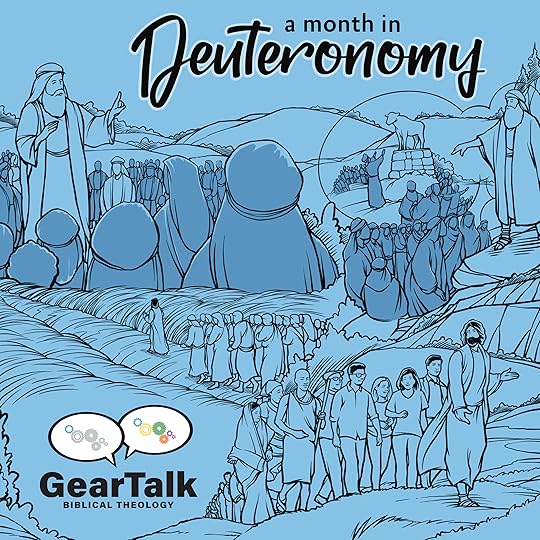
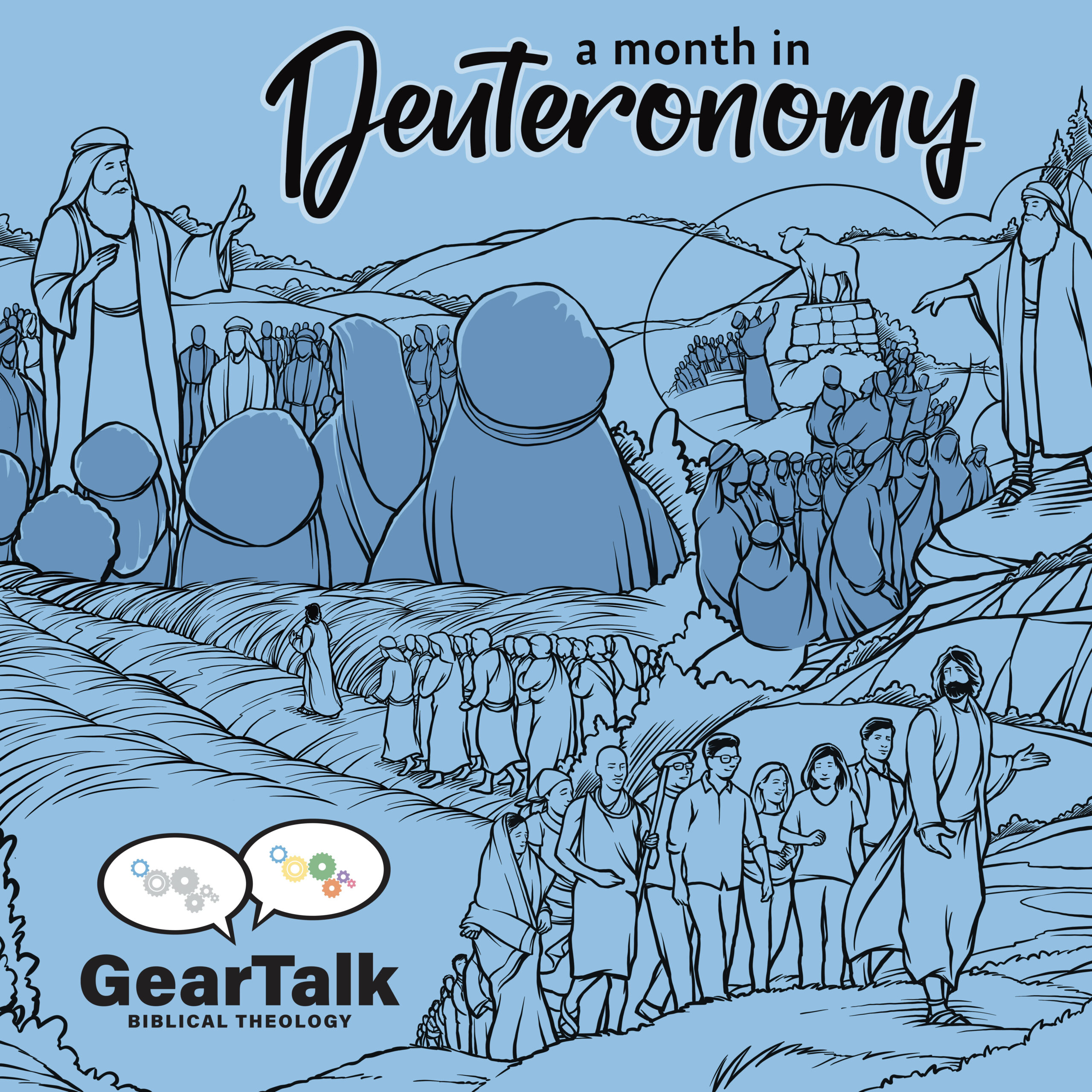
Over the next several weeks, the GearTalk Biblical Theology podcast will enjoy A Month in Deuteronomy. Hands to the Plow’s Creative Director, Mark Yaeger, has also designed some great cover art that may serve your ministry as you teach through this amazing book. Deuteronomy occurs in the Bible’s first division (= the Law), so the first gear is in blue in the first speech balloon; yet all Scripture’s gears (= Law, Prophets, Writings, Gospels and Acts, Epistles, and Revelation) influence or draw on Deuteronomy, which is why all the gears are colored in the second speech balloon.
The Images: PDF / JPG
The Images with Scriptures Callouts: PDF / JPG
The album cover includes four images.
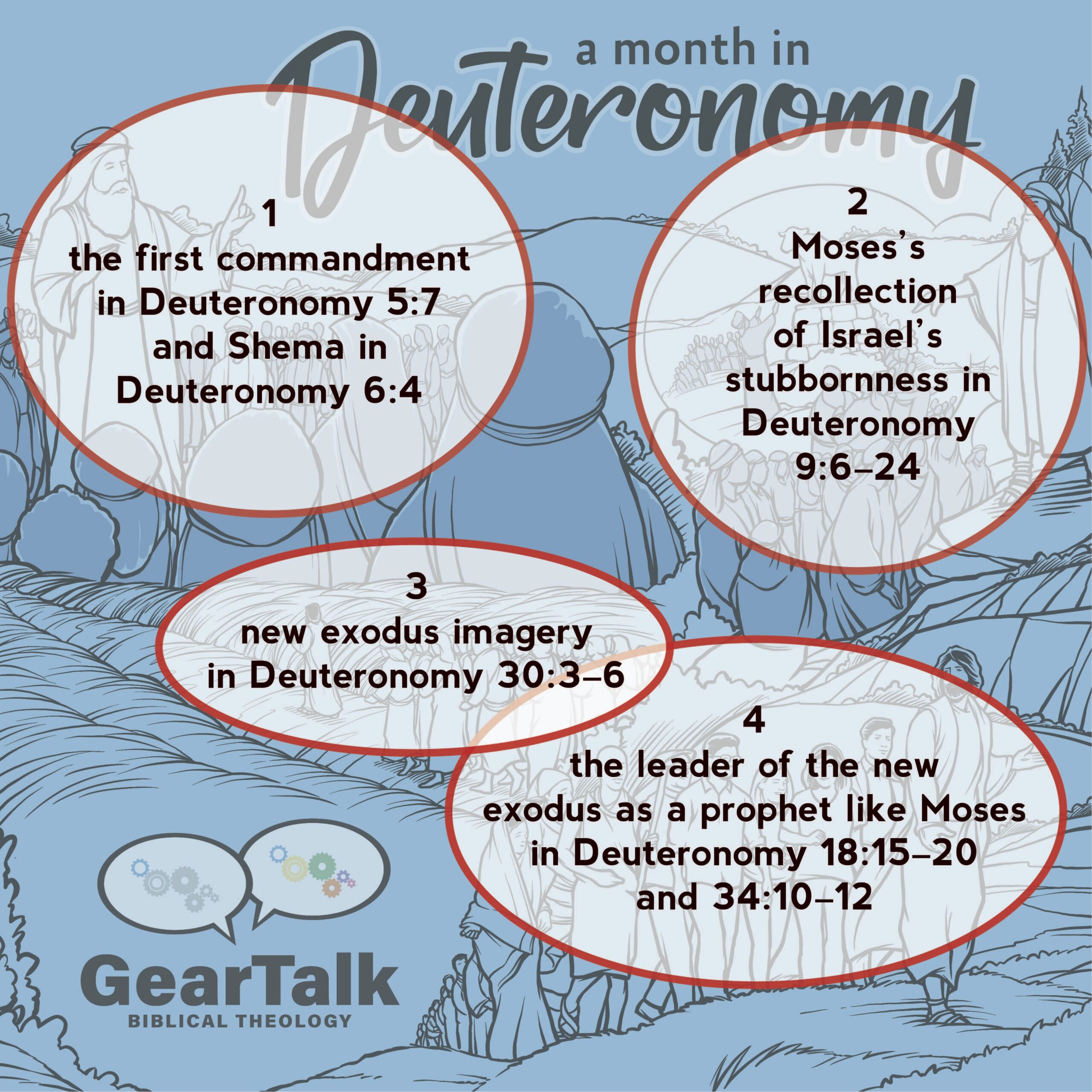
I hope your heart is moved to worship our living and reigning God through these images and weeks of reflective conversations!
Be sure to tune in to the GearTalk Podcast the receive from A Month in Deuteronomy.
The post A Month in Deuteronomy appeared first on Jason DeRouchie.