Jason S. DeRouchie's Blog, page 12
February 26, 2019
Preaching Deuteronomy
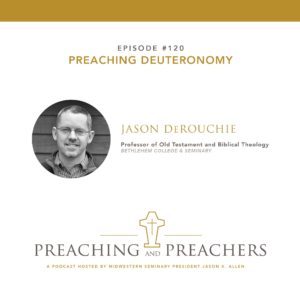
Recently I was invited to share on the topic of “Preaching Deuteronomy” with Dr. Jason K. Allen, President of Midwestern Baptist Theological Seminary, on his Preaching and Preachers podcast.
In this episode I had the chance to share why preachers should preach through Deuteronomy, what theological challenges we face in the book, how we can make much of Christ from this law. I also give some starting points for preachers who want to begin preaching Deuteronomy, along with helpful resources. The specific topics are as follows:
A brief introduction to my ministry at Bethlehem College & Seminary
A brief discussion on my love for the Old Testament
Why pastors should preach through Deuteronomy
How Deuteronomy shapes the trajectory of salvation history
Key exegetical or theological difficulties that preachers should be aware of before preaching through Deuteronomy
How preachers can Preach Christ from Deuteronomy
Helpful resources pastors can use when they preach through Deuteronomy
Concluding encouragement for pastors concerning preaching through Deuteronomy
For more on my approach to Deuteronomy, see the following:
“From Condemnation to Righteousness: A Christian Reading of Deuteronomy,” Southern Baptist Journal of Theology 18.3 (2014): 87–118.
Lectures on Deuteronomy and other resources
For preachers who would like to preach the Old Testament, along with anyone who wants to feel more equipped studying the Old Testament and applying it to their life, see my How to Understand and Apply the Old Testament: Twelve Steps from Exegesis to Theology (P&R Publishing, 2017), a great place to start your study. For an in-depth look at each book in the Old Testament, check out What the Old Testament Authors Really Cared About: A Survey of Jesus’ Bible (Kregel, 2013).
You can download the audio from the podcast here:
(Preaching Deuteronomy)


January 29, 2019
Lectures on HOW TO UNDERSTAND AND APPLY THE OLD TESTAMENT
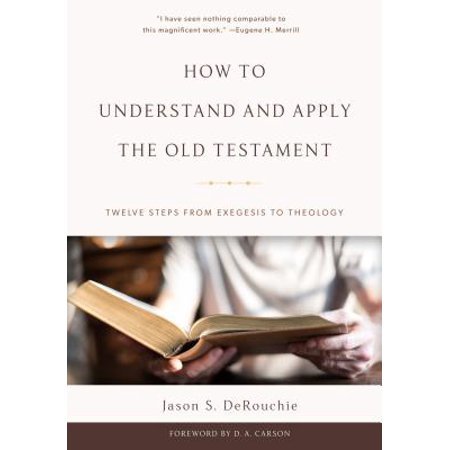
This 13-session series is for anyone who wants to learn how to interact with God’s Word, especially as revealed in the Old Testament, the only Bible Jesus ever used. Many people feel overwhelmed and intimidated understanding and applying the Old Testament, even though 75% of our Scriptures are found in its pages.
Based on his book by the same title, in this series Dr. DeRouchie unpacks how to study, practice, and teach the Old Testament as Christian Scripture. If you are a Christian, you find that these lectures magnify the Messiah and will nurture your hope in the gospel. Take this journey into discovery and encounter!
Lecture 1: Introduction (Audio/
Handout /
Powerpoint)
Lecture 2: Genre (Audio/
Handout /
Powerpoint)
Lecture 3: Literary Units and Text Hierarchy (Audio /
Handout /
Powerpoint)
Lecture 4: Text Criticism (Audio)
January 22, 2019
Great Are Your Works

A Prayer of Praise from Psalm 111
We praise you, O Yahweh,
through Christ who makes our prayers possible! With the psalmist, I give thanks
to you with my whole heart, in this company of the upright, in the congregation
that you have purchased through Jesus’s blood. Great are your works, O LORD, studied
by all who delight in them. From creation through the fall to redemption and
unto consummation, full of splendor and majesty is your work, and your
righteousness endures forever. From east to west, from north to south, from the
deepest depths to the highest peaks, you have caused your wondrous works to be
remembered; you, O Yahweh, are gracious and merciful, saving sinners and
sustaining all who look to you. You provide food for those who fear you; you
remember your covenant forever, your commitment to remain faithful to all you
have redeemed.
You have shown your people
the power of your works, in giving us the inheritance of the nations, all
through Christ and for Christ. The works of your hands are faithful and just––every
finger, every heart valve, every chromosome count you have ordained, and no
purpose of yours can be thwarted. All your precepts are trustworthy; they are
established forever and ever, to be performed with faithfulness and uprightness
by those to whom you supply strength and dependence. You sent redemption to your
people through the person of your Son; you have commanded your covenant forever,
and all of your purposes will stand. We rest knowing not what tomorrow holds,
but knowing the One who holds every moment, every breath, and meets it with
fresh mercy at dawn.
Holy and awesome is your
name! “Jesus!” Yahweh saves! “Immanuel!” God with us! “Rock, Refuge, Healer,
Helper, Servant, Savior, Shepherd, Shield, Anointed One, Holy One, Teacher, Tower,
Counselor, King, Father, Friend, Light, Life, Hope of Israel, Lord of Armies,
Protector, Fortress, the True God.” The fear of Yahweh is the beginning of
wisdom; all those who practice it have a good understanding. Your praise
endures forever! And we thank you that this day, this moment, in this place you
are here, never to leave and never to forsake those who are yours.
In
Jesus’s exalted name we pray. Amen.
––Jason S. DeRouchie (1/20/2019)
November 25, 2018
The Incomparable One (Isaiah 40:12–31)

A Prayer of Praise
No one can measure the waters in your hand;
None else can mark the heavens with a span.
No other captures earth’s dust in a measure;
Only you weigh hills in scales like treasure.
Your Spirit’s greatness none can assess.
Perfect justice is yours; none can contest.
No one teaches, guides, or counsels you;
You know all things––your understanding true.
Like a drop in a bucket or dust on a scale,
Like nothing are the nations; before you they pale.
Your beauty is supreme and holy your name;
Incomparable greatness, your praise we proclaim.
To whom then should we liken God?
All idols of wood or fame will rot;
No likeness in creation does compare.
So we look to you and cast our cares.
Above the earth’s circle you sit enthroned.
From beginning to end your purpose sewn.
You raise up kings; for a season they grow.
Then like stubble in wind, away they blow.
You are the Holy One; to none you compare––
Everlasting, never weary, always there.
How can we think our way is hidden from your care?
You give power to the faint, and you hear our prayer.
You know our global partners by name,
Whether challenge, burden, honor, or shame,
They remain yours––unchained and unstained.
Your presence remains; their lives you’ve claimed.
There are many here living in fear;
Their hearts are cold and eyes prone to tears,
Life’s shadows make the next steps unclear.
They need you close; they need you to hear.
Some marriages present need healing today;
The sun’s rays seem distant; the skies of life gray.
Bring help; bring hope; come without delay.
Renew; restore; overcome dismay.
Merciful one, help the sick to stand;
Relieve their pain; make their hope expand.
Let them trust your purposes and your plan,
Wrapped in love, awaiting your healing hand.
Everlasting God, on you help us wait,
Keep us from stumbling, and make our paths straight.
With strength renewed, on wings help us mount
With thankful hearts, your works to recount.
In the name of the Incomparable One we pray. Amen.
––Jason S. DeRouchie (11/25/2018)
//PDF//
November 9, 2018
The Importance of the Old Testament for Christians

Is the Old Testament still important for Christians? Some professing Christians like Andy Stanley are saying, “No,” but in a recent TGC post, I unpack a number of reasons why Christians must not see the Old Testament as irrelevant, unimportant, or insignificant. Instead, we must treat Jesus’s Bible like Jesus and the apostles did––as the word of God for the church, when read in the light and through the lens of Christ. Books like Leviticus, Judges, and Psalms point to Christ and are a foundational part of the Scripture that is “profitable for teaching, for reproof, for correction, and for training in righteousness” (2 Timothy 3:16). In the Old Testament we meet the same God as in the New, and through it we can magnify the hope of the gospel. See my “Ten Reasons the Old Testament Is Important for Christians” to learn how the initial three-fourths of the Christian Scripture was written for us.
Once Christians affirm the lasting value of the Old Testament, the natural question is “What next?” In a follow-up TGC post, I overview three key resources for understanding the OT’s plot-line, for meeting Jesus on its pages, and for understanding the message and contribution of the whole and each individual book. See “Three Books for Staying ‘Hitched’ to the Old Testament.”
For the sake of thoroughness, I will add two other books that I edited or wrote because I believe they too can serve the church of the 21st century. See my What the Old Testament Authors Really Cared About: A Survey of Jesus’ Bible (Kregel, 2013) and my How to Understand and Apply the Old Testament: Twelve Steps from Exegesis to Theology (P&R Publishing, 2017).
Two other recent TGC posts that can help catch you up on the conversation about the present-day significance of the Old Testament: Michael Kruger argues against the impulse to “unhitch” from the Old Testament, and Thomas Schreiner reestablishes the authority of the Old Testament and helps to show the lasting relevance of the Old Testament as Christian Scripture.
October 22, 2018
“King of Israel” and “Do Not Fear, Daughter of Zion”
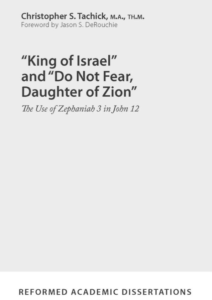
Tachick, Christopher S. “King of Israel” and “Do Not Fear, Daughter of Zion”: The Use of Zephaniah 3 in John 12. Reformed Academic Dissertations. Phillipsburg, NJ: P&R Publishing, 2018.
As a professor, I so delight when I see my former students reach milestones. Christopher S. Tachick received his MA at Gordon-Conwell Theological Seminary and his ThM at Bethlehem College & Seminary, and he is a member of Wycliffe Bible Translators, where he serves as a translation consultant with Seed Company. Recently, Chris published his exceptional ThM thesis, and I am thrilled to endorse it as model of a study in the New Testament’s use of the Old Testament.
Interpreters commonly recognize the citations of Psalm 118:25–26 and Zechariah 9:9 in John 12:13–15, where we read:
“So they took branches of palm trees and went out to meet him, crying out, ‘Hosanna! Blessed is he who comes in the name of the Lord, even the King of Israel!’ And Jesus found a young donkey and sat on it, just as it is written, ‘Fear not, daughter of Zion, behold, your king is coming, sitting on a donkey’s colt.”
However, as Tachick rightly observes, the psalmist did not include the phrase “King of Israel,” and Zechariah’s opening charge is actually “rejoice” rather than “fear not.” What, therefore, is John doing in these citations? Tachick suggests that he is intentionally alluding to Zephaniah 3:13–15, which is the only place in the Old Testament where we find the grouping “King of Israel,” “Fear not,” and “daughter of Zion”:
“Sing aloud, O daughter of Zion; shout, O Israel! Rejoice and exult with all your heart, O daughter of Jerusalem! The LORD has taken away the judgments against you; he has cleared away your enemies. The King of Israel, the LORD, is in your midst; you shall never again fear evil.”
I advised Chris on this thesis, and Andreas Köstenberger served as his external reader. In Chris’s study, he employs the rigorous methodology set forth in works like G. K. Beale and D. A. Carson, eds., Commentary on the New Testament use of the Old Testament (Baker, 2007) and G. K. Beale, Handbook on the New Testament Use of the Old Testament: Exegesis and Interpretation (Baker, 2012). You can read my foreword to his book here.
From the Back Cover:
This thoroughly researched, groundbreaking examination of John 12:13–15 demonstrates the seminal role that Zephaniah 3:14–15 plays in John’s portrayal of Jesus as the King of Israel, the Lord whose return Zephaniah prophesied and the righteous King who brings salvation to Jew and Gentile and whose presence teaches us not to fear.
Table of Contents:
Introduction
John 12 and the Zephaniah Proposal
Literary and Thematic Context of Zephaniah 3:14–15
The Use of Zephaniah 3:14–15 in Early Jewish Literature
Hermeneutical and Theological Use of Zephaniah 3 in John 12
Conclusion
From My Foreword:
“Tachick’s formal training as a linguist, exegete, and theologian, his grasp of the biblical languages, along with English, French, and German, and his years of service with Wycliffe Bible translators have supplied him with key skills for this task. But even more, he knows the God of Scripture, and he is convinced of the Bible’s overarching unity and of the way the whole progresses, integrates, and climaxes in Christ. I celebrate the publication of this work, which faithfully engages in the discipline of biblical theology for the glory of Christ and the good of his church.” ––Jason S. DeRouchie, Bethlehem College & Seminary
What Other Scholars Are Saying:
“I heartily commend Tachick’s careful, skillful, and convincing exegetical work.” –– Ardel B. Caneday, University of Northwestern––St. Paul
“Tachick’s methodology is sound, his research is thorough, and his argumentation is careful. He makes a compelling case for his ‘Zephaniah proposal’ and at the same time provides important insights into the study of both Zephaniah and John’s Gospel.” –– E. Ray Clendenon, B&H Publishing
“Tackick’s exploration exemplifies best practices in intracanonical, intertextual studies.” –– Dennis E. Johnson, Westminster Seminary
“Tachick clearly articulates and capably defends his thesis, excelling in both in-depth analysis and theological synthesis.” –– Andreas J. Köstenberger, Southeastern Baptist Theological Seminary
“This is an exemplary study of the use of the Old Testament in the New that sheds fresh light on Jesus’s triumphal entry in John.” –– Brian Tabb, Bethlehem College & Seminary
“The author’s expertise in discourse linguistics together with his keen theological eye makes this study an excellent example of solidly grounded whole-Bible interpretation.” –– Daniel C. Timmer, Puritan Reformed Theological Seminary
“The author uses a wide range of data and skills, resulting in an exemplary piece of biblical scholarship. Among all the details, the reality of the King’s coming to take his rightful place shines through.” –– Andy Warren-Rothlin, United Bible Societies
/PDF/ DeRouchie “Foreword”
October 20, 2018
How To See and Savor the Divine Son in All of Scripture
Bethlehem College & Seminary celebrates the rigorous life of the mind for the glory of the divine Son, by whom, through whom, and for whom all things were created (Col 1:16). Ten years ago John Piper catapulted the school into existence with his message “‘The Earth Is the Lord’s’: The Supremacy of Christ in Christian Learning,” which became Appendix 1 in Think: The Life of the Mind and the Love of God (Wheaton, IL: Crossway, 2010). At this 10th anniversary, the school recently hosted a conference titled Think Revisited, and during it I presented a message titled “Thinking How to See and Savor the Divine Son in All of Scripture.”
Video / Audio / PowerPoint
https://jasonderouchie.com/wp-content/uploads/2018/10/DeRo-How-to-See-and-Savor-the-Divine-Son.mp3
Here is the overall flow of the message:
A. Jesus’s relationship to the Old Testament (2:12)
The OT first promised the good news embodied in the person and work of Jesus Christ. (2:32)
A proper understanding of the Old Testament will move us to identify a unified message focused on the Messiah and the mission he would spark. (13:55)
God created all things (including the Old Testament) by the Son, through the Son, and for the Son, so the Old Testament was written for the glory of the divine Son. (16:16)
B. Seven ways to see and savor the divine Son in the Old Testament: (19:07)
When you read the OT’s direct messianic predictions, see and savor the realization of the divine Son. (21:24)
When you consider the OT’s salvation-historical story and trajectories, see and savor how the divine Son stands as the goal and climax of all Scripture’s progress and integration. (24:46)
When you recognize similarities and contrasts between the old and new ages, creations, and covenants, see and savor how the divine Son influences all reality. (32:56)
When you identify OT characters, events, and institutions or objects that clarify and anticipate the person and work of Christ, see and savor the divine Son as the substance of all earlier shadows. (38:18)
When you revel in Yahweh’s identity and activity, see and savor the person of the divine Son. (44:49)
When you observe how the old covenant law characterizes the nature of perfect righteousness and wisdom, see and savor the justifying work of the divine Son. (54:02)
When you use the OT to instruct or guide others or when you experience the power to love and thus fulfill the law, see and savor the sanctifying work of the divine Son. (57:11)
C. Conclusion (1:03:01)
October 7, 2018
For the Glory of the Trinity

A Prayer of Praise
Holy Father, you know best,
Sowing rest. Though we are pressed,
You still bless and only test
To make us more true.
You never tire or expire.
Your fire purifies desire.
You require but ever inspire.
We admire our supplier
Who replaces old with new.
Holy Son, all that is created
You predated, dictated, mandated.
Our story you’ve narrated;
You’ve deflated our pride and made us whole.
You indict, smite, and fight the night,
Doing right, setting shadows to flight,
Giving heat and light, might for the fight.
Supplying sight, you’re our delight,
Melting away the coldness of our souls.
Holy Spirit, ever present,
In our lament and torment.
The Son’s advent brings your descent
And gives us hope anew.
You’ve decreed that we proceed;
You feed, lead, and know our need.
No misdeed; you don’t mislead.
You intercede; we will succeed.
We cast our cares on you.
We praise you Holy Trinity,
Supreme divinity and for infinity
Fix our gaze, burning away the haze.
With hearts ablaze for endless days,
Let us celebrate your election,
No rejection or objection.
Let us heighten our affection,
Following your direction and
praising your perfection.
For the glory of the Father, Son, and Spirit, we pray. Amen.
September 3, 2018
An Invitation to the Old Testament

In this 1 hour 45 minute lecture, DeRouchie invites the listener to see Jesus through the lens of the Old Testament, reviewing the scope of the entire Bible and then encouraging the listener to pursue Jesus in the pages of the Scriptures he used while on earth.
Audio / PowerPoint / Handout PDF
https://jasonderouchie.com/wp-content/uploads/2018/09/DeRouchie-Invitation-to-the-Old-Testament.mp3
July 24, 2018
An Invitation to the Book of Ruth

In this 1 hour lecture, DeRouchie invites the listener into the beauties of the Book of Ruth and shows how the drama anticipates the work of Christ. DeRouchie’s says:
The book of Ruth’s placement before Psalms in Jesus’s Bible adds a messianic stamp to the book’s whole message of redemption, for Ruth is now read after the stories of Israel/Judah’s exile (Former Prophets) and after the prophetic voices (in the Latter Prophets) that extend into the period following initial restoration when there was once again no king in Israel and so many were doing what was right in their own eyes (so Haggai, Zechariah, Malachi). Thus, Ruth’s focus on Boaz of Bethlehem as a pointer to David of Bethlehem gives rise to the hope of a royal deliver from Bethlehem whose own life and work are then portrayed in the Psalms––a Davidic king who will restore people from exile and triumph over evil, though only through great tribulation.
In the whole lecture, DeRouchie covers:
Ruth’s Setting in Time
The days that the judges ruled (1:1)
There was a famine in the land (1:1)
The significance?
Ruth’s Moabite Background
Introductory matters
The significance of Ruth’s Moabite descent
Key Themes in Ruth
Yahweh treasures covenant faithfulness.
Yahweh is a redeeming God.
Yahweh will fulfill his promise to redeem and restore Israel, ultimately through the line of David.
Audio / PDF Handout / PowerPoint
https://jasonderouchie.com/wp-content/uploads/2018/07/DeRouchie-Invitation-to-Book-of-Ruth.mp3
For more lectures and written material on Ruth by DeRouchie, go here.
NOTE: Due to a technical fault, the output sound quality from 54:50–58:40 is quite low; we are sorry.