Amy Julia Becker's Blog, page 119
May 28, 2020
Chapter 4: Prayer
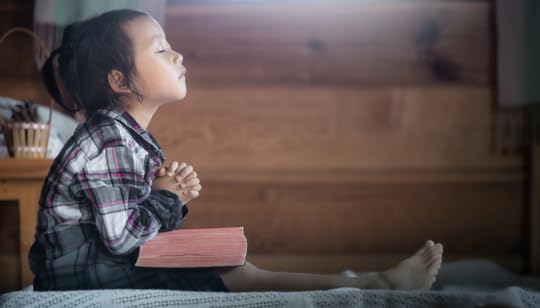 Image courtesy of canva.com
When I was deciding what chapters to record for this Reading Small Talk podcast, I skimmed through the whole book. But when I got to the chapter on Prayer, I lingered. I thought back to those days when it felt impossible to connect with God without interruption, and when I felt like a failure as a spiritual leader to our children because I couldn’t manage to teach them even something as simple as the Lord’s Prayer.
My favorite scene comes when William ends up praying in gibberish from inside a laundry basket. His antics prompt Penny to move from sincerity to humor in prayer. It’s at that point that one of us asks them, in exasperation, “Do you think God likes jokes?” Of course they both say, “Yes!”
It was painful and hard to learn about prayer from our children. It also opened me up to a bigger understanding of God.
God as a parent who wants to hear what I need, even if it is trivial.
God as a Spirit who uses us to communicate love.
God as the one who listens, patiently, to whatever we want to say.
God as a friend who enjoys jokes.
Our kids somehow picked up the Lord’s Prayer along the way. I’m back to having regular quiet times of prayer every morning. I hope they remember what happened in between, and that they know their God is one who listens and laughs and always loves.
You can listen to this episode via the player above or wherever you get your podcasts.
Want to read more? Here are some suggestions:
Penny’s Prayer for Church During COVID-19 Crisis
The Lord’s Prayer is Not for ME
When Your Enemy is Yourself
If you haven’t already, please subscribe to receive regular updates and news. You can also follow me on Facebook , Instagram , and Twitter, and you can subscribe to my Love is Stronger Than Fear podcast and my Reading Small Talk podcast on your favorite podcast platforms.
The post Chapter 4: Prayer appeared first on Amy Julia Becker.


May 27, 2020
Choosing to Be Present in Suffering
For people like me—for people who are white and live in affluence and stability—stories like that of George Floyd are easy to ignore. In the past, I have told myself that it is voyeuristic to enter into a story about a man who lived far away in a context I won’t ever know personally. I have told myself that there are countless tragedies and moments of injustice that occur around the globe every day, and I just cannot get involved. I have told myself that there is nothing I can do.
The truth is that I can’t do much, as an isolated individual, to bring healing to this situation or to change the circumstances that led to George Floyd’s death. And I can’t pretend to understand or experience the pain his family feels or even the pain and fear and anger my African-American friends feel every time yet another story comes out about a terribly similar injustice.
I cannot heal the wounds of social divisions. I cannot repair hatred. I cannot reverse time and restore the lives of Eric Garner or Tamir Rice or Freddie Gray or George Floyd or the many other beloved human beings who have died in similar ways. But I also refuse to continue to make excuses for the distance I keep in my heart. And I refuse to continue to look away.
Present in Suffering
I believe in a God named Emmanuel, God-with-us. I believe this same God who came to live with us and to suffer with us, gives us this same capacity to love one another.
I can enter into this suffering. I can extend compassion, which at its root means to suffer with.
One of the most powerful gifts we can give one another in a time of suffering is the gift of presence. When we cannot fix, cannot cure, cannot change the circumstances. When we feel helpless and hopeless and powerless. When we want to make everything right and nothing is right. We can still choose to be present in suffering. We can choose to not look away, not walk away, but to stay.
I did not know George Floyd or his family. But I know that my African-American friends are hurting and grieving today. I know they are tired and angry and scared. I know that many of them have felt abandoned by many of us who call ourselves their “brothers and sisters.”
By naming the injustice of this reality, the grievous injustice—I can participate in this suffering. I can pray for repair. Pray for what Austin Channing Brown calls “the shadow of hope.” Pray for healing. I can learn to listen, to lament, and to love.
Companions in Suffering
There are no quick fixes for injustice. And for those of us who do not live out the daily experiences of injustice and the heartbreak it brings, it is easy to turn our faces away precisely because of how powerless we feel in the face of historic and systemic problems. We are called instead to offer ourselves as companions in the suffering, to be present to the pain, to touch the powerlessness and hopelessness and despair, and to hold fast to the power of love to rectify, to bless, and to heal.
………
Want to read more: Here are some suggestions:
Defining Privilege Part One: What Privilege Is Not
Defining Privilege Part Two: What Privilege Is
How Disability Helped Me Understand Privilege | Washington Post
Hope and the Spiritual Imagination
If you haven’t already, please subscribe to receive regular updates and news. You can also follow me on Facebook , Instagram , and Twitter, and you can subscribe to my Love is Stronger Than Fear podcast and my Reading Small Talk podcast on your favorite podcast platforms.
The post Choosing to Be Present in Suffering appeared first on Amy Julia Becker.
The Ordinary Goodness of a Life with Down Syndrome, Even Now
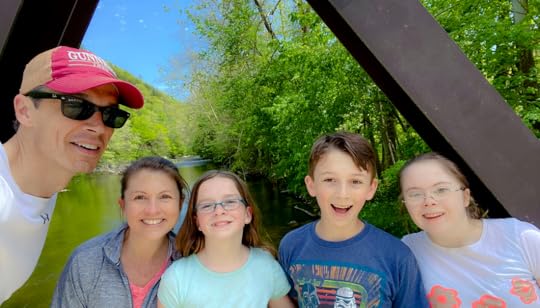 A family walk this week
Our daughter Penny is 14. She loves Taylor Swift and Fuller House and the Yankees. She betrays many signs of becoming a typical teenager: she groans when I wake her up at 8 am, rolls her eyes when I suggest she do her homework before checking her phone, begs me for more access to social media, and offers blank stares accompanying a dismissive, “Mom!” when I push her to go into detail about her feelings.
Ordinary Life
She’s in 8th grade, and right now that means she sits down in front of her school-provided Chromebook every morning and spends the next five hours on and off of Zoom calls and Google meets, with frequent breaks for snacks from the nearby kitchen.
Our daughter Penny also has Down syndrome.
Good News, Even Now
A lot of work remains to ensure that the most vulnerable people are welcomed and supported in the manner they deserve. Still, even in the midst of this pandemic that has unearthed prejudice and injustice, there is good news. The state of Alabama, for instance, planned to deny people with disabilities access to ventilators if they came in short supply, but those guidelines changed once it became apparent that they broke the law and discriminated against people with disabilities. Despite the major obstacles to teaching kids with disabilities remotely, this pandemic has also shone a spotlight on the relatively recent reality that we live in a nation where kids with intellectual disabilities are guaranteed access to education.
Generations of parents before me advocated and spoke up and believed in their kids. We stand on the backs of these parents and kids who have refused to be sidelined, refused to be invisible, who have insisted upon the tremendous value every human being brings to their community, to all of us.
Bearing Witness to Ordinary Goodness
Yesterday, Penny baked her first chocolate lava cake, from a recipe one of her school therapists sent her way.
 Penny’s chocolate lava cake
Today, she shared with me her excitement that she gets to write an essay about middle school in anticipation of her eighth-grade graduation.
I tell these stories of the ordinary goodness in our daughter’s life in order to bear witness. She shows me what is true not just about kids with intellectual disabilities but about myself and about everyone else I encounter. She shows me the possibilities inherent in every fragile, unpredictable, messy, beautiful human life.
This pandemic exposes the ugliness of underfunded school districts and overcrowded nursing homes. It exposes the pain of people who are isolated and vulnerable. It also magnifies the work that has been done to open doors for people like our daughter. And it magnifies the truth of what can happen when a system of people decides to honor the humanity in their midst.
…….
Want to read more? Here are some suggestions:
When I Slammed the Refrigerator Door
Podcast: Reading Small Talk with Amy Julia Becker
What Having a Baby with Down Syndrome Taught Me About Distraction, Fear, and Love
If you haven’t already, please subscribe to receive regular updates and news. You can also follow me on Facebook , Instagram , and Twitter, and you can subscribe to my Love is Stronger Than Fear podcast and my Reading Small Talk podcast on your favorite podcast platforms.
The post The Ordinary Goodness of a Life with Down Syndrome, Even Now appeared first on Amy Julia Becker.
May 25, 2020
Hope and the Spiritual Imagination
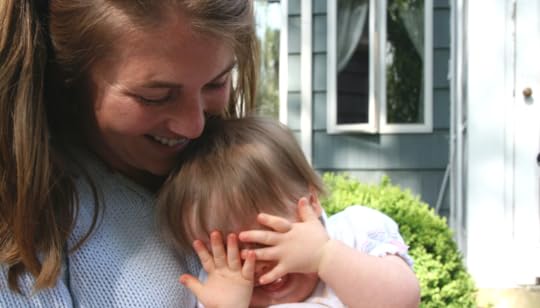
“I suspect every pregnant woman imagines a hypothetical life for her child. And every pregnant woman knows that child’s life won’t work out exactly as she imagined it. Life will have more bumps and bruises than the imagination holds. On a more trivial level, her daughter’s hair might be brown instead of blonde. Or her son’s favorite pastime might be playing the drums instead of soccer. The specifics don’t really matter. But the ability to continue to envision a positive future, the ability to hold onto hope for that child—that does matter. For parents, the imagination is a vehicle for hope. And when I heard the words Down syndrome, I didn’t know how to imagine anymore, which is one of the reasons I didn’t know how to have hope for my daughter.”
I spoke these words eight years ago in Richmond, Virginia, after I was asked to tell our story of living with hope after Penny’s diagnosis of Down syndrome. I ended up talking about the nature of hope, the vehicle of hope, and the source of our hope. Today on the Love is Stronger Than Fear podcast, as a follow up to last week’s episode about hope (What to Do When You’re Feeling Hopeless), I recorded that talk.
These thoughts have helped me to consider day by day how to pull the future promises into the present pain and loss. They have also helped me to hold on to the current beauty, joy, and gratitude and connect them to the promised future.
I ended that talk, and I will end this post, with a prayer:
Hope is as fragile as a thread and as strong as steel.
Hope, when it acknowledges pain, looks ahead to promise, and is rooted in God’s creative goodness, can overcome our fears and lead us into love.
So this morning, let us go forth with hope in a God who leads us out of fear and into love, for ourselves, our neighbors, and our world.
Amen.
To listen to the whole talk, listen to this episode of the Love is Stronger Than Fear podcast via the player above or wherever you get your podcasts.
…….
Want to read more? Here are some suggestions:
AJB Recommends: Resources for Hope
Reading Hope in Trying Times Interview
How the Spiritual Imagination Moves Us Towards Hope
If you haven’t already, please subscribe to receive regular updates and news. You can also follow me on Facebook , Instagram , and Twitter, and you can subscribe to my Love is Stronger Than Fear podcast and my Reading Small Talk podcast on your favorite podcast platforms.
The post Hope and the Spiritual Imagination appeared first on Amy Julia Becker.
May 24, 2020
AJB Recommends: Resources for Hope
I talked about hope on my podcast last week (and tomorrow’s episode will be a bonus episode, also about hope), so I wanted to offer a few other recent podcasts and articles that have been helpful to me as resources for hope—helping me in cultivating hope in a challenging time.
For the Life of the World podcast
One, I’ve enjoyed Miroslav Volf’s thoughts and conversations on the For the Life of the World podcast lately where he has talked about how hope in the God who raises the dead is different from optimism or reasonable expectation. I realized from listening to him how often I want my hope—even my Christian hope—to make sense. He helped me consider what it takes to acknowledges the reality of pain and suffering while also holding out for healing and restoration.
NPR Story
Two, this story on NPR about Palestinian Muslims and Israeli Jews in quarantine together and what happens when it is time to celebrate Passover gave me hope for humanity.
Encountering Silence podcast
Three, it shouldn’t be surprising that the author of books like Dakota, The Cloister Walk, and Acedia and Me would be able to speak about hope in a time of isolation and uncertainty, and Kathleen Norris does not disappoint. In parts one and two of the Encountering Silence podcast, Norris speaks about how silence and stillness and solitude often expose what we are “really suffering from.” She also speaks about the habits she’s formed that help her not to fall into acedia, an ancient word that she has brought back into our language, that is some combination of depression, boredom, and meaninglessness. Norris says, “the opposite of acedia is love,” so in many ways this whole conversation is a call to consider how we can walk the path of love through this pandemic
Owl Moon
And four, Owl Moon, my favorite picture book, which reads to me as a poem about hope.
………
Want to read more? Here are some suggestions:
AJB Recommends
How Love Brings Power in the Midst of Powerlessness {Ep 109}
It Doesn’t Have to Be Groundhog Day
If you haven’t already, please subscribe to receive regular updates and news. You can also follow me on Facebook , Instagram , and Twitter, and you can subscribe to my Love is Stronger Than Fear podcast and my Reading Small Talk podcast on your favorite podcast platforms.
The post AJB Recommends: Resources for Hope appeared first on Amy Julia Becker.
May 21, 2020
Chapter 3: Beauty
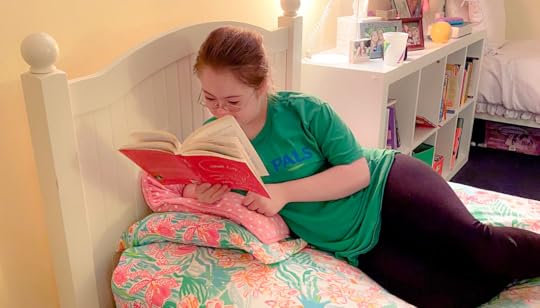
It was over a decade ago—a few months after William was born—that I caught a glimpse of my body in a full-length mirror and worried about what I saw. And it was over a decade ago that Penny, age three, happened to catch my eye in that mirror. While I was critiquing my body for not looking like it had before the two children, while I was bemoaning the crinkles on my face, Penny saw something else. She looked up at me and said, “Booful, Mama.” Beauty.
Have you ever looked in the mirror and felt old? Have you noticed the lines on your face or the extra roll around your middle? This week’s Reading Small Talk podcast explores that all-too-common experience. Instead of looking with critical eyes at ourselves, what if we looked with eyes of love? What if we could see ourselves as beautiful? What if we see beauty when we look in the mirror.
Listen to the Reading Small Talk podcast wherever you get your podcasts or download the abridged audiobook of Small Talk. This podcast is especially for those of you who are at home with little ones in this season of isolation and social distancing.
{Small Talk: Learning From My Children About What Matters Most is a series of reflections from my past few years of parenting. It is not a how-to guide. It is not filled with advice. It is, I hope, a word of encouragement that good things can emerge out of the hard but ordinary everyday moments.}
……
Want to read more? Here are some suggestions:
On World Down Syndrome Day, Some Thoughts on Beauty, Vulnerability, and Love
Hope and the Spiritual Imagination
If you haven’t already, please subscribe to receive regular updates and news. You can also follow me on Facebook , Instagram , and Twitter, and you can subscribe to my Love is Stronger Than Fear podcast and my Reading Small Talk podcast on your favorite podcast platforms.
The post Chapter 3: Beauty appeared first on Amy Julia Becker.
May 18, 2020
It Doesn’t Have to Be Groundhog Day
I’ve heard our moment compared to Groundhog Day again and again and again. If you missed it, Groundhog Day is a great movie from the 1990s in which Phil Connors (played by Bill Murray) is a newscaster who gets stuck in a loop reporting about Groundhog Day day after day after day. Every day repeats. It’s February 2nd. Again and again and again.
Lots of people—myself included—have felt like Phil Connors in this movie. There’s the existential angst: What’s the point of living if I can’t get out of this unpleasant situation? There’s the monotony and boredom. There’s the lethargy that borders on despondency.
When I realize that lifting the “stay-at-home” orders won’t make much of a functional difference in the life of our family, when I hear that the earliest we can hope for a vaccine is 18 months from now, when I read predictions of multiple waves of outbreak and disease—it is easy to slide into hopelessness.
The Stages of Groundhog Day
The thing about the movie Groundhog Day, however, is that although the day is the same, over and over and over, Phil changes. First, he changes for the worse. He realizes there are no consequences for his actions, so he behaves like an even worse version of himself. Second, he despairs and tries to take his own life. Finally, he decides to live with purpose and care for other people. It’s this last set of behaviors—the purposeful life—that eventually breaks him out of the endless cycle.
Groundhog Day suggests that even in our current situation, we can cultivate hope, experience love and joy, and live with purpose.
Reality and Hope
Now, I for one have not been living in this reality. I realized last week that I have placed a lot of hope in things that cannot satisfy or fulfill me: in the school calendar, for instance, and in our summer vacation plans. In a secure bank account. In predictability. Right now, I’ve been hanging my hope on the glass of wine I look forward to at the end of the day. I’m grateful for the glass of wine, but I’m also achingly aware of how insufficient it is as a source or provider of hope.
So I’ve turned again to the Bible, and to the words of Paul in his letter to the Philippians, to consider how we can live with hope in the midst of this ongoing reality. That’s what I’m talking about on today’s episode of the Love is Stronger Than Fear podcast—What to Do if You’re Feeling Hopeless.
I do not want to live the same grumpy, achy, lethargic day over and over again. So I am asking the Spirit to enliven my spiritual imagination and give me hope.
Listen to episode 110, What to Do if You’re Feeling Hopeless, via the player above or wherever you get your podcasts.
Love is Stronger Than Fear Episode 110 Show Notes:
Philippians 3:12-4:1
Yale Insights, The Language We Speak Predicts Saving and Health Behavior
….
Want to read more? Here are some suggestions:
Reading Hope in Trying Times
How Love Brings Power in the Midst of Powerlessness {Ep 109}
Raise Your Hand if Your Back Hurts
If you haven’t already, please subscribe to receive regular updates and news. You can also follow me on Facebook , Instagram , and Twitter, and you can subscribe to my Love is Stronger Than Fear podcast and my Reading Small Talk podcast on your favorite podcast platforms.
The post It Doesn’t Have to Be Groundhog Day appeared first on Amy Julia Becker.
May 17, 2020
Raise Your Hand if Your Back Hurts

I knew all spring there was a good chance our kids wouldn’t return to school. It still felt like a blow when the news came. Then Penny’s week at Camp PALS was canceled. Then William’s summer overnight camp was canceled. Then I read more and more about how we could be living without gatherings of more than 50-100 people for the next one to two years. In the midst of this string of cancellations and stress, I experienced back pain.
My back became a board. Not a rubber band stretched a bit too tight for comfort. Not a lumpy sweater with a few knots to work out. A flat sheet of wood that felt like it might crack open if I moved the wrong way.
As it happened, I heard from a friend in the midwest who was in bed because she had thrown her back out. My sister called and said, “I’m walking instead of running because I did something to my back.” My own running partner canceled because she needs to see the chiropractor and, of course, can’t do such a thing at this moment. My husband started using a battery-powered massage tool to try to get the knots out of his neck. And then the Wall Street Journal ran an article with the title, “Working at Home Is Taking a Toll on Our Backs and Necks.”
Stress, Loss, and Physical Pain
I’m not convinced that it’s the ergonomics of sitting on a couch instead of at a desk that’s causing all this pain. Our chairs and beds didn’t hurt us before the pandemic started. Yes, we are working in different spaces. But we are also working with a different perspective on the world, with different questions about our lives and our future. Perhaps a new chair or an ice pack or some stretches will help. And also, perhaps we need to acknowledge that stress and confusion and heartache lead to pain in our bodies.
I’ve learned in recent years that when tightness or pain comes up in me without any obvious precipitating physical action, I need to pay attention and ask where that pain is coming from. In the case of my severe and all-of-a-sudden back pain, it was pretty clear that I was reacting to the news of school closures extending for a long time and summer plans being uncertain at best. Of course, I can’t change the school closures or the summer camps or the path of the coronavirus. All I can do is try to understand why this uncertainty brings such stress into my body.
My yoga teacher tells me that any time the back gets tight it indicates “bracing” for something hard in the future. This makes sense to me–I’m bracing for the loss of time, of speaking engagements, of my job, of my introverted days. But I don’t want to walk through these next many months with a hurting back and a heart that is bracing for impact. I want to walk through it with an acknowledgment of hurt and loss and an openness to possibility and love.
Prayer and Pain
So, for a few days of pretty significant pain, I prayed for a way to bring that pain to God, to address the place of emotional and spiritual pain both so that the bodily pain could dissipate and so that the deeper work of healing could take place. I came upon Psalm 18 (verses 16-19):
God reached down from on high and took hold of me; he drew me out of deep waters. He rescued me from my powerful enemy, from my foes, who were too strong for me. They confronted me in the day of my disaster, but the Lord was my support. He brought me out into a spacious place; he rescued me because he delighted in me.
This passage gave me a way to pray for help, and it also gave me a promise. That God was my support, but that God also would bring me into spaciousness and not confinement.
So every time my back started to tighten up or ache again, I prayed, “He brought me out into a spacious place; he rescued me because he delighted in me.”
My back pain has dissipated. Now my knees are acting up. I’m sure there will be tense shoulders, tight hips, strained hamstrings and achilles tendon at some point in the near future. Maybe you’re experiencing some of these same physical woes, or maybe it’s stomachaches or headaches or eye twitches.
An Invitation
I’m trying to take each one as an invitation to wonder what I’m afraid of, what I’m sad about, why I’m angry, where I feel hurt in my soul. And then to invite that pain into God’s presence and live into the promise of healing and wholeness to come.
…..
Want to read more? Here are some suggestions:
What Training for a Half Marathon Teaches Me about my Soul
How Our Kids are Coping During Coronavirus Crisis
When Your Enemy is Yourself
If you haven’t already, please subscribe to receive regular updates and news. You can also follow me on Facebook , Instagram , and Twitter, and you can subscribe to my Love is Stronger Than Fear podcast and my Reading Small Talk podcast on your favorite podcast platforms.
The post Raise Your Hand if Your Back Hurts appeared first on Amy Julia Becker.
May 13, 2020
When I Slammed the Refrigerator Door
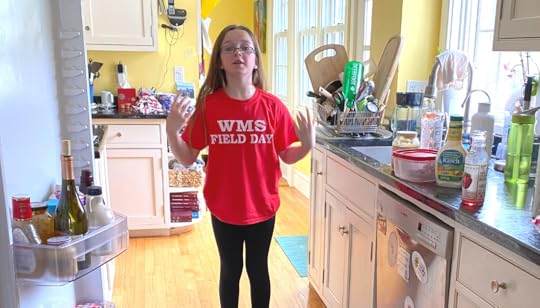
This is a picture of what happens when:
You realize that you are out of granola and decide to make a really quick trip to the market even though it is going to make the morning a little bit more cramped than you intended.
And then when you get home, and you are unloading the three bags of groceries that somehow ended up in your cart when all you wanted is granola, you have a little tiff with your 14-year old daughter about being on Instagram at 11:00 in the morning.
And then when that daughter doesn’t put the phone away speedily enough and you speak harshly to her and she sulks out of the room.
And then when you kick the refrigerator drawer closed and slam the door and storm after her.
And then when you see that her eyes have pooled with tears and she is trying to hold in the sobs and you hold her close and say I’m sorry. And you both sigh and laugh a little and feel better.
And then you go to put away the last of the groceries. And the shelf on the door of the refrigerator that has broken when you slammed said door in anger collapses. And two full bottles of salad dressing break and cover the floor alongside the maraschino cherries, ketchup, and applesauce.
I share this photo of the aftermath of that moment for two reasons.
One, because it reminds me of things that happened almost every day when I was the mom of small children, and those are the stories I recorded in Small Talk which are now available as a free audiobook or podcast that I hope will bring encouragement to anyone else in the same situation.
Two, because this picture disrupts the loveliness of my social meed feed, and it feels important to do that every so often. Our kids are beautiful and loving. Our family has a lot of laughter and joy. I’m really grateful. And yet the flowers and sunshine and calm vistas are not the fullness of our real life. Our real life has cozy hugs, reading by the fire, and daffodils. It also has temper tantrums and sulkiness and expletives and just ordinary bad days.
The first chapter of Small Talk includes words I need to remember daily: “It is the pattern of our life together. In the midst of snow days and sickness, in the midst of yelling and tears, grace enters in.” Again and again and again.
Listen to today’s episode of Reading Small Talk!
………
Want to read more? Here are some suggestions:
Reading Small Talk: Behind-the-Scenes
A Mother’s Day Gift: Reading Small Talk Podcast
Love in the Midst of the Mess
If you haven’t already, please subscribe to receive regular updates and news. You can also follow me on Facebook , Instagram , and Twitter, and you can subscribe to my Love is Stronger Than Fear podcast and my Reading Small Talk podcast on your favorite podcast platforms.
The post When I Slammed the Refrigerator Door appeared first on Amy Julia Becker.
May 12, 2020
When Your Enemy is Yourself

Does anyone else ever feel like your enemy is yourself? Does anyone else have a voice inside their head saying nasty things about you right now?
The voice that asks why your jeans don’t fit anymore. The voice that berates you for skipping out on the Zoom version of book club or Bible Study or game night with the extended family. The one that sneers at you for watching Survivor reruns instead of reading something with substance. The one that can’t believe you haven’t exercised even with all this extra time on your hands. The one that wonders if you’ll ever amount to anything, ever be good enough, ever make up for past mistakes.
I’m a One on the Enneagram (a spiritual personality system which I find really helpful). Ones are traditionally called Perfectionists, though recently people have taken to calling us “Improvers.” Either way, we live with an ideal version of how everything can be made right. The world. Our email inboxes. The messy cubby area. And ourselves.
There are two telltale signs of being a One. The first is that we rearrange the dirty dishes in the dishwasher if someone else loads it. The second is that we have an “inner critic,” a voice inside our heads that tells us what’s wrong with us (and with other people, and with people in general, but primarily us). It’s not a nice voice, and my personal inner critic became quite vocal a few weeks ago. Thankfully, just as that nasty voice became louder, a friend mentioned that we can use the Psalms to pray against the enemies inside our heads.
When Your Enemy is Yourself
“Enemies” come up a lot in the Psalms—this ancient prayer book from the Bible. For me, this talk of enemies has usually really foreign and somewhat irrelevant. But enemies inside my head—enemies that tell me lies about myself and lies about God’s love—well, those are quite familiar.
So in this time of social distancing, I have been using the Psalms as a guide to pray against that inner critic and the lies she tells me about myself and other people and God. I have been using the Psalms to pray for God to protect me from those lies and to fill me to overflowing with the truth that I am loved, provided for, secure.
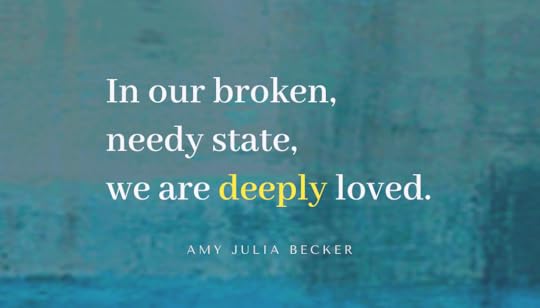
Whether or not you are a One on the Enneagram, this time of forced isolation/semi-isolation may well bring up the negative voice inside your head. I hope it also brings up the voice of love that whispers the deeper truth, that in our broken, needy state, we are deeply loved.
Want to read more? Here are some suggestions:
Three Heroes of 2019
5 Bible Passages for Parents of Children with Down Syndrome
Praising God in Sorrow, Just Like Jesus
If you haven’t already, please subscribe to receive regular updates and news. You can also follow me on Facebook , Instagram , and Twitter, and you can subscribe to my Love is Stronger Than Fear podcast and my Reading Small Talk podcast on your favorite podcast platforms.
The post When Your Enemy is Yourself appeared first on Amy Julia Becker.