Ronald H. Clark's Blog, page 7
September 4, 2023
Humor: How Bungle Trial Visuals

Chapter 15 of Visual Litigation and Today’s Technology focuses on the six prerequisites for an effective courtroom presentation. Those requirements are described as follows:
Six prerequisites must be fulfilled before you can effectively display visuals in a courtroom. First, if the courtroom is not fully technologically equipped, counsel will need to provide the required hardware, such as a computer, tablet, screen, projector, cords and so on. Second, counsel will need to adhere to the court’s rules and procedures. Third, counsel will need backups in case of a technological failure. Fourth, the person who is going to operate the technology needs to test the equipment and practice using it. Fifth, the courtroom must be staged properly so the audience can see and hear what is being shown. Sixth, courtroom communication between the trial lawyer and operator of the equipment must produce a smooth presentation of the visual.
The video clip from Jury Duty, which is a truly hilarious movie, is a perfect illustration of a violation of the fourth and fifth prerequisites. Watch it and enjoy


August 29, 2023
10 Dos & Don'ts for Writing a Legal Brief or Motion
.png)
10 DOS AND DON’TS FOR WRITING LEGAL BRIEFS AND MOTIONS
Ross Guberman, author and the president of Legal Writing Pro, after interviewing over 1,000 federal and appellate judges about dos and don'ts for writing motions and briefs, came up with the following 10 does and don’ts:
1. Do a name check. The judges prefer words to acronyms, and one wrote, “I absolutely detest party labels (plaintiff, debtor, creditor, etc.). Name names, for God’s sake!” Another likes to see names so as not to forget who’s who.
2. Stay classy. The judges agree briefs should show, not tell. “Avoid phrases and sentences that reflect a lack of civility. Don’t belittle the other side’s arguments but rather focus on your own strengths,” wrote one judge. Another warned that “words such as ‘clearly,’ ‘plainly,’ ‘obviously,’ ‘absurd,’… are crutches intended to prop up weak arguments that lack logical force.”
3. “Slash windups and throat clearing.” The judges do not look fondly on long introductions, and words that “waste space” such as, “it should be noted that…” and “it is beyond doubt that….”
4. Use graphics effectively. Timelines, maps, graphs, diagrams, tables, headings and generous margins all get a thumbs-up from the judges on the basis of clarity and as a counterweight to “dry legal analysis.”
5. Avoid clunky legalese. The judges agreed phrases such as “for the foregoing reasons…,” “heretofore,” “aforesaid” and “to wit” “should go the way of the dodo bird.”
6. Don’t be cloying. As much as phrases such as “defendant respectfully submits” sound respectful, the judges would rather just see “defendant contends.”
7. Assume the judge understands the finer points of usage and write accordingly. The judges unloaded on their pet peeves, including using “impact” as a verb, improper use of “that” and “which” and misuse of the subjunctive.
8. Explain why you should win in the introduction. The judges want to read a first page that says something like “The Court should deny Defendant’s Motion for Summary Judgment for the following three reasons.”
9. Be succinct when citing cases. One exasperated judge opined, “Skip the long description. Just state the damn proposition, cite the damn case and be done with it.”
10. Put citations in the text, not in the footnotes. Judges are reading your work on an iPad, and most would rather not scroll to the end to read a footnote. “This is a show-your-work gig, and I need to see your work there – not go hunting for it,” one wrote.
Source: “Judges Speaking Softly: What They Long for When They Read” that was published in the Summer 2018 issue of Litigation Journal.
For more see Pretrial Advocacy 6th Edition.
August 16, 2023
Another Well-Crafted Indictment of Trump - Georgia This Time

As with the prior Post of the indictments against Trump, setting politics aside, the Fulton County indictment filed by prosecutor Fani Willis is a well-drafted masterpiece telling the story of a Trump enterprise under the RICO law in Georgia. Read the indictment here
August 4, 2023
Jack Smith's Two Indictments of Trump are Masterpieces

Setting aside politics, law students should read the two indictments of Trump because they are masterfully drafted, showing how to lay out allegations with a compelling narrative. Indeed, every American should read them. Read the Documents Indictment here and the Conspiracy Indictment here.
July 21, 2023
New Book Launch: Management and Leadership Handbook

Here's something a little different--my new book, which was just launched. If you’re looking for guidance on how to achieve excellence and job satisfaction as a manager and leader in your law office or other organization and you want excellence and job satisfaction for the people in your organization, this Management and Leadership Handbook may be for you.
This concise yet comprehensive Handbook is jammed with practical instructions on how to develop and exercise your management and leadership strategies and skills. The advice and wisdom in this book are derived not only from my 27-years of experiences in a prosecutor's office, two years with the National College of District Attorneys, six years with the National Advocacy Center and almost twenty years with Seattle University Law School but also from the best-of-the-best literature and teachers on management and leadership.
This Handbook contains:
• A discussion of the distinction between a manager and leader and guidance on how to perform the roles and functions of both
• Ways to prevent and eradicate the root causes of burnout—the stress builders and job changers
• Strategies for setting realistic goals for yourself and your colleagues
• Concrete advice on how to make people matter—to show appreciation and give support
• Insights into the importance of participative decision making and how to put it into play
• How to apply the variety and a manageable workload principles to the workplace
• Guidance regarding these keys to excellence—hiring and training
• How to stay in touch with the action and have fun
• A methodology for managing your personal and professional time and priorities
.To achieve excellence for yourself, your colleagues, and your organization and to find satisfaction in your professional and personal life, this book may be for you. Click here to read the book today.
June 21, 2023
Trial--Cross-Examination: What Not to Say.

In this month's issue of the Bar Bulletin there is an article by Dr. Kevin Boully and Thomas M. O'Toole (my co-author on the Jury Selection Handbook) focusing on what not to say in trial. Regarding cross-examination, the article discusses the important advice given in the Cross-Examination Handbook about not asking one question too many, and amplifies on why the axiom makes sense:
“The classic advice of not asking one question too many is consistent with the overarching goal of letting your jury reach the conclusion on their own, without you cramming it down their throat. In cross-exam, we still find far too often that trial lawyers want to ask the extra question, or worse, ask about the topic and areas of inquiry that dilute the overall effectiveness of the exam.
“During cross, pick your topics and areas of focus wisely and with discretion. There are few occasions a “scorched earth” approach is warranted and far more times when the most economical and effective approach is to be surgical, targeting those areas where the cross exam can score, simple, direct, useful points. A few criteria to consider for what not to say in cross exams include:
• Does the jury need the answer or its implication to make their decision? If not, you probably don't need it.
• Does the jury know how the answer fits into your overall trial message? If not, you may not need it, or you may need to make it more clear before the jury can use it.n
• Will the jury receive the answer as consistent with the witnesses message? If the jury feels you want them to trust the witness on some things, but not others, you may need to pick an approach and stick to it.
• Has the jury heard the same thing from another witness already? If so, you may want to consider whether the answer creates a positive cumulative effect (i.e., carries the power. of multiple voices) or creates unnecessary repetition (i.e., feels redundant).
“Have the courage to be decisive about what not to say and what to leave out of your case presentation at these key moments. These approaches empower the jury to reach their own conclusion and use their own experiences and perceptions to fill the gaps for you leave for them. These approaches appeal to the egocentrism of processing information through their own lens (which can engage in the gaps you left for them), their penchant for efficient and economical decision making, as well as symbolic processing that is often based on the scenes, moments, and events that you give them the freedom to envision and complete.”
May 23, 2023
New Edition of Trial Advocacy:
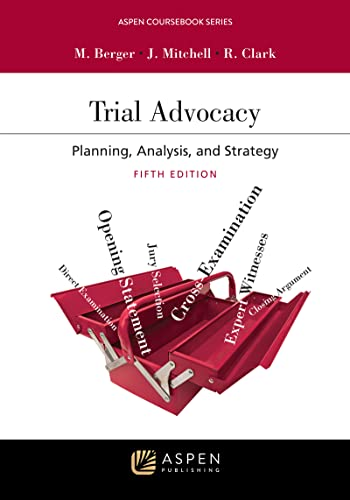
Nothing makes us happier than the release of a newly published edition of an advocacy book, and Aspen Publishing has just launched the 5th edition of Trial Advocacy.
The three of us--Marilyn Berger, John Mitchell and I--have been at this for some time, and when we set out our goal for both Pretrial and Trial Advocacy books was to impart real-world approaches to litigation. We also wanted to provide not only a textbook but also, thanks to Marilyn’s expertise in filmmaking, demonstration videos (such as a trial demonstration video and videos showing how to take and defend depositions) and practical experiences through role-play assignments (such as performing trial activities from jury selection through closing argument).
Additional materials for performance are an inclusive aspect of the books: realistic case files containing documents, witness statements, photographs, and so forth. Teacher materials for both books include sample syllabuses and an extensive Teacher Manual for both Pretrial and Trial courses.
It’s great to see how the books have progressed, keeping pace with the best in litigation advocacy. Together we have worked to make sure the new editions are right up to date, for examples covering changes in response to COVID-19, electronically stored information (ESI), trial technology, and persuasive litigation visuals. Most exciting is that new editions are now available on the popular Aspen Publishing CasebookConnect online platform.
Each book and companion materials can be used for a stand-alone Trial Advocacy or Pretrial Advocacy course, or they may be paired together and taught over, for instance, two semesters because they have a common nomenclature as well as the same analytical framework and civil and criminal casefiles.
If you are teaching trial advocacy or want a complete resource about trial advocacy, this book may be for you. The best way to decide on a textbook is to see for yourself. If you teach trial advocacy, to get obtain a complimentary review copy of Trial Advocacy click here for a complimentary review copy of Pretrial Advocacy, click here
We truly hope that you like the new editions and will adopt one or both. If you have any questions, contact me at clarkrh@comcast.net.
May 22, 2023
New to Trial and Pretrial Advocacy Books: CasebookConnect
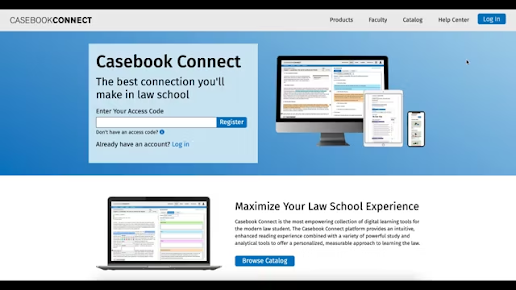
A most exciting addition to the new editions of Trial Advocacy 5th Ed. and Pretrial Advocacy 6th Ed. is that they are now available with the popular Aspen Publishing CasebookConnect online platform. CasebookConnect provides many supplemental materials. Let’s take a look at some of them in the Trial Advocacy CasebookConnect platform.
First on the CasebookConnect Platform is the Professor or instructor materials that are only accessible to the instructor and will assist the instructor in teaching, and these materials include a Teacher’s Manual and Actor’s Guide that contains role-play instructions that the teacher can give to students who will play a roles in a performance assignments, such as instructions to a student who is assigned to play the role of a witness during a cross-examination exercise. Here is a screenshot of the contents of the Professor’s materials.
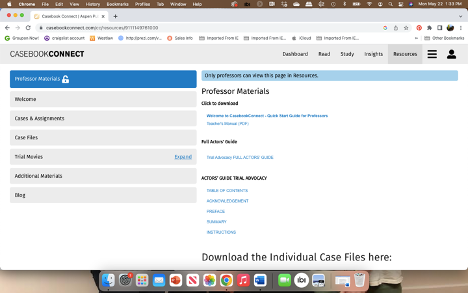
As can be seen in the above screenshot, following the Professor Materials, is a Welcome Tab with resources welcoming students to CasebookConnect and its functions. Next is Cases and Assignments Tab where the assignments for student performances are located. By clicking on the Case Files Tab, student can access the full case files for both the criminal and civil cases that are utilized for the performance assignments.

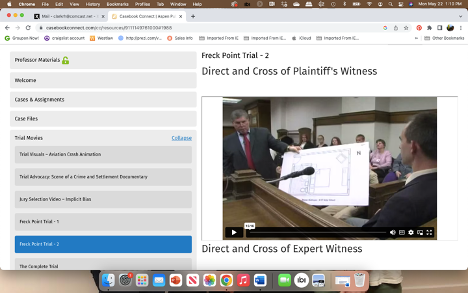
Unique to the Pretrial and Trial Advocacy books are movies that show how to perform everything from taking and defending a deposition to closing argument. Below is a screenshot of the list of movies for the Trial Advocacy book that can be accessed under the Movies Tab in the Trial Advocacy book’s CasebookConnect. Under that tab, students can access the following: an animation of an aviation crash; visuals in a settlement documentary; a video on implicit bias; and both a full movie of a demonstration trial as well as movie clips demonstrating trial advocacy skills.
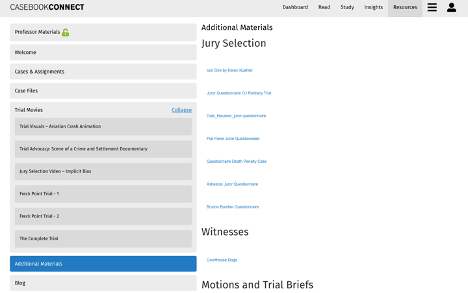
Under the next Additional Materials Tab are a variety of supplemental materials, such as juror questionnaires, trial brief, motions and more.
May 2, 2023
Cross Examination of Jean Carroll in Alleged Trump Sex Assault and Defamation Case
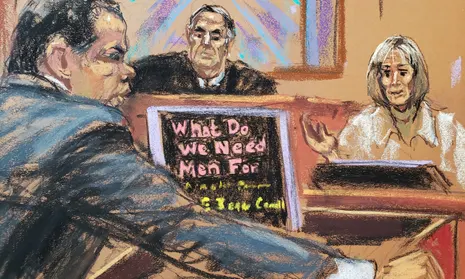
Donald Trump's lawyer, Joseph Tacopino was tasked with the cross-examination of 79-year old Jean Carroll who claims that Donald Trump raped her in a Manhattan department store in 1996. Tacopino attacked her credibility contending that she came forward in 2019 because she did not like his politics and wanted to sell copies of her book. That’s fair game.
A cross-examiner needs to beware of the different expectations of each of the audiences the cross-examiner is playing to during the cross-examination. The cross-examiner needs to be constantly aware of the jurors’ role in applying the law to the facts as they find and reach a verdict. The jurors’ job is to determine the truth, and the cross-examiner's demeanor and conduct should be designed to help the jurors meet their responsibilities.
While it may be satisfying to the cross-examiner Tacopino to challenge Carroll, the real test is what the jury thinks. Jurors may perceive his conduct in a negative light—as an abuse of her—particularly if they're not convinced that she deserved it. If she were patently lying, the situation shifts in favor of a rigorous cross-examination.
In the aftermath of his cross questioning her about why she didn’t act the way some might think a rape victim should—scream, call the police and so on, the jury will hear from two other women who say Trump raped them, Trump’s own words about how he groped women, and expert testimony that women don’t react as Tacopino suggests. And, this is not a he-said-she-said trial because it’s likely Trump won’t testify. The prosecutor’s closing probably will shred any argument by Tacopino to the effect that she wasn’t sexually assaulted.
Defense counsel Tacopino’s approach is a lesson is what not to do—he forgot his audience. For instance, Tacopino pressed Carroll about why she did not scream for seek help when Trump attacked her in the department store. Carroll's reaction was to respond to the suggestion that rape victims are supposed to act in a certain way was incorrect by saying that such thinking deters women from coming forward. She said, “I'm telling you, he raped me, whether I screamed or not.” News reports say that her voice rose and broke at this point. It was a step too far on cross.
April 26, 2023
The Abby Grossberg Saga: Botched Deposition Review and More
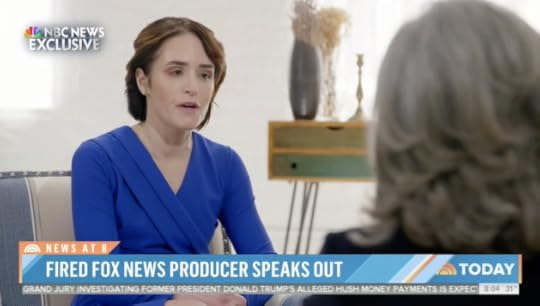
Abby Grossberg, the Fox News producer who was fired after filing a law suit against the network alleges that the Fox legal team coerced her into giving misleading answers during her deposition and not providing her with the deposition to review and correct. If true, it provides lessons on how not to behave when preparing a deponent and that the deponent should be given an opportunity to review and correct the deposition.
Doing It Right
The following is an excerpt from Pretrial Advocacy, 6th edition describes what should happen after the deposition is taken:
“After the deposing officer (reporter) who took the deposition delivers the transcript or recording to the attorney who defended the deposition, the deponent has the next 30 days to review the transcript, correct it, and sign it. Fed. R. Civ. P. 30(e). Under Rule 30(e)(1), the deponent is not limited to correcting mistakes in form made by the transcriber and can make changes in substance, too. The Rule requires that the changes be listed and be accompanied by reasons for the changes. In the absence of a reason, opposing counsel could move to strike the correction.
“Ordinarily, when the defending lawyer receives the transcript, the lawyer will have the deponent review it either on her own, making notes as she goes, or with the lawyer. Then, the lawyer and deponent complete an errata sheet listing the corrections as well as the reasons for them.
“An example of a correction on the errata sheet of a transcriber error might read: Page 37, l. 5 ‘I have an idea when my secretary received the memorandum. You’d have to ask her.’ should read ‘I have no idea when my secretary received the memorandum. You’d have to ask her.’
“An example of a correction as to substance on the errata sheet might read: Page 37, l. 5 “I have an idea when my secretary received the memorandum. You’d have to ask her.” should read “It arrived June 5.” Reason: The deponent was mistaken and recalls that his secretary received the memorandum on June 5.
“The errata sheet is returned to the deposing officer, who attaches it to the officer’s certificate that the witness was duly sworn and that the deposition accurately records the deposition testimony. The officer packages the deposition, labels and seals it, and sends it to the attorney who ordered the transcript.
“When changes are made, it is as though defending counsel had examined the witness. Changes may cause the lawyer who originally ordered the deposition to seek a court order to allow further examination on the changed matter. At trial, the deposing attorney can utilize the uncorrected transcript, and the defending attorney can offer into evidence the correction under the rule of completeness. Fed. R. Evid. 106.”
Doing It Wrong
According to Abby Grossberg’s account, the Fox lawyers botched it. They didn’t provide the deposition, which would have allowed her to change what she said during her deposition. According to news reports, Grossberg later did fill out the errata sheet with the answers that she says were the correct answers to her questions and explained how she was coached into giving inaccurate responses.