Ronald H. Clark's Blog, page 2
December 24, 2024
Biden's Clemency Blitz: Why Commuting 37 Death Row Sentences was the Right Decision"
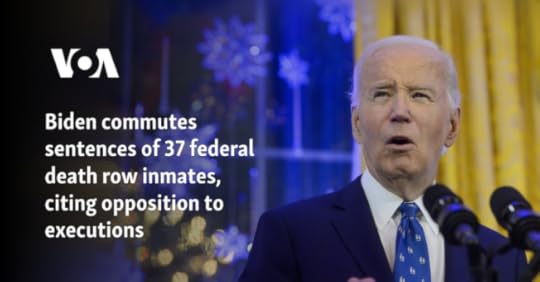
On December 23, 2024, President Biden commuted 37 federal death row sentences, leaving just three people facing the death sentence under federal law. Reaction by some was vehement. A Trump spokesperson calling it “abhorrent.”
Biden did the right thing, and I hope you will consider the reasons why I hold this belief. I come at this decision as not only a former career prosecutor but also one of the few prosecutors who has gone to trial prosecuting death penalty cases and made the decisions as to whether or not the death penalty should be considered in numerous other cases.
What follows is my position on the death penalty as I explained it in Roadways to Justice: Reforming the Criminal Justice System. As you will see from the text of the following chapter, Roadways was written before Biden took office.

Roadways to Justice: Reforming the Criminal Justice System
No one else in the King County Prosecutor’s Office since 1971 has taken two death penalty cases to trial. This is not a distinction I sought; I was assigned to prosecute the cases. I mention this not to brag, but rather to note that I have experience with death penalty cases. I know all about Washington’s history of hangings and then the option of hanging or lethal injection. I’ve argued the issue of whether the death penalty constitutes cruel and usual punishment.
Further, later in my career when I served as Chief Deputy of the office’s Criminal Division, I reviewed and reported on every potential death penalty case for the duly elected prosecutor. My report laid out the facts of the case, the evidence, and both the aggravating and mitigating circumstances. Those reports never contained a recommendation that we pursue the death penalty on a case. That decision rested with the elected prosecutor, Norman K. Maleng. Norm alone made the decision on whether we should seek the death penalty, saying he was the one who must take that responsibility as the people’s elected representative.
While I have prosecuted two and reviewed many more potential death penalty cases, I have never been a proponent of the death penalty for reasons that I will cover here. This is something that I have in the past only disclosed to family and close friends in whom I could confide.
If I had a distaste for the death penalty, why did I prosecute death penalty cases? As a deputy prosecuting attorney, I saw my role as a public official whose job it was to follow the law. My role was much like a juror in a death penalty case. One distinguishing feature of a death penalty case is death-qualifying the jury. In the seminal U.S. Supreme Court case on juror qualification for a death penalty case, Witherspoon v. Illinois, the prosecutor had successfully challenged for cause jurors who expressed general reservations about imposing the death penalty. The Supreme Court reversed, holding that the Sixth Amendment requirement of an impartial jury was violated when prospective jurors were excused merely because they “voiced general objections to the death penalty or expressed conscientious or religious scruples against its infliction.”
Witherspoon evolved and was modified by a later Supreme Court decision, Wainwright v. Witt. Ultimately, for the prosecutor to meet the requirements for a challenge for cause, the prosecution must show that the “juror’s views would prevent or substantially impair the performance of his or her general duties as a juror in accordance with his instructions and his oath.” I could have been seated on a death penalty jury panel, and I would have been able to abide by the court’s instructions. Therefore, if, like a juror, I did not harbor a religious or moral belief that would keep me from enforcing the law, I should do my job.
Although I did not favor the death penalty, at the time I did not advocate for its abolition. However, I certainly understood why others would do so. In the Flowers case (one of the cases I prosecuted), the medical examiner described the excruciating way in which Joseph Gunther died. Having been immolated by fire involves having your lungs contract. The medical examiner described it as looking very much like the way the skin on a burnt turkey looks. Seeing such an infliction of pain, suffering, and murder upon a loved one, you understand the feelings and desire that a survivor of a murder victim would have for the ultimate punishment—life for a life. This rationale in support of the death penalty is that the defendant should get his “just deserts.” An eye for an eye.
Another argument that has been advanced in favor of the death penalty is that it is a deterrent. Certainly, it is a specific deterrent—the execution of the murderer will stop him from future acts of violence. However, is it a general deterrent? Research studies have found that the death penalty has about the same effect as long-term imprisonment on homicide rates. Indeed, a consensus among America’s top criminologists is that scholarly research has demonstrated that the death penalty does, and can do, little to reduce rates of criminal violence.
On the other side, compelling arguments can be made against the death penalty. First, an innocent person may be executed. In his book, Just Mercy: A Story of Justice and Redemption, Bryan Stevenson, renowned attorney and founder of the Equal Justice Initiative, wrote this about his client Anthony Ray Hinton, who had been on Alabama’s death row:
After we presented test results that confirmed his innocence in 2000, I begged prosecutors to retest the evidence, but for fifteen years they refused. The state continued trying to execute Mr. Hinton until we won a ruling in the United States Supreme Court in 2015 that required prosecutors to finally reexamine the evidence. The evidence confirmed his innocence and Mr. Hinton became the 152nd person in America exonerated and proved innocent after having been wrongly convicted and sentenced to death.
When over 152 people have been proven to have been innocent after being sentenced to death, the evidence is irrefutable that mistakes can be made. Why risk killing an innocent person?
Second, the costs of a death penalty case can be astronomical. The Howard Flowers’ trial was estimated to have cost $1 million in 1978, which is an equivalent of $3 million today. Over the years, the costs of a death penalty case have increased. A 2007 death penalty case, State v. Michele Anderson, in King County cost nearly $5 million for the defense alone. The jury in that case was unable to reach a unanimous decision in favor of the death penalty, and, as a result, the defendant was sentenced to life in prison without parole.
Third, the death penalty, for some inexplicable reason, awards the offender not only attention but also, in some instances, celebrity status. Ted Bundy was given national notoriety, and, as was mentioned before, he was the subject of a book, The Stranger Beside Me, by Ann Rule. Gary Gilmore is another case in point. Gilmore got international attention when he demanded a death sentence for himself for the two murders he had committed in Utah. Norman Mailer wrote a nonfiction novel, The Executioner’s Song, about Gilmore, which was later made into a movie starring Tommy Lee Jones. By contrast, defendants who have been sentenced to life in prison without the possibility of parole rarely gain any notoriety.
Fourth, the death penalty has not been consistently applied. Since 1849, a total of 110 executions have taken place in Washington when it was a territory and later a state. From the beginning, executions were by hanging, and the first two men hung were Native Americans. In 1914, the death penalty was abolished in Washington, but then the death penalty was reinstated in 1919 and remained unchanged until 1972. Then, in 1972, in Furman v. Georgia, the U.S. Supreme Court ruled that the death penalty constituted cruel and unusual punishment given the procedures then in use in Georgia, Washington, and other states.
Three years after the Furman decision, the people of the state of Washington by a 69 percent margin reenacted the death penalty law by a citizen’s initiative, with detailed procedures for imposing the death penalty. It was that new death penalty law that governed the Flowers case. In a historical context, I prosecuted the last death penalty case—Lydell Baker—before Furman invalidated Washington’s death penalty law and the first case—Howard Flowers—after Washington reinstated the death penalty in 1975.
Consider, for example, the James Ruzicka case. Ruzicka murdered two teenage girls in the course of raping them but was not charged with a capital crime. Under Washington’s capital crimes statute, two aggravating circumstances existed in the Ruzicka case: (1) there was more than one victim, and the murders were part of a common scheme or plan, and (2) the murder was committed in the course of, in the furtherance of, or in immediate flight from rape in the first or second degree. Ruzicka was not charged with a capital crime because, at the time, the death penalty law was not in effect.
In 2014, Governor Jay Inslee announced a moratorium on capital punishment in the state of Washington. On October 11, 2018, the Washington Supreme Court in State v. Gregory held the death penalty unconstitutional on the ground that it violated Article I, Section 14 of the state constitution because it was administered in an arbitrary and racially biased manner. The evidentiary basis for the holding was a statistical report showing that Black defendants in Washington were 4.5 times more likely to be sentenced to death than similarly situated White defendants. Twenty-two states and the District of Columbia and Puerto Rico have abolished the death penalty.
Likewise, on the federal level, the death penalty has not been consistently applied. The year 2020 was one of the deadliest in history for federal capital punishment since 1927. In 2020 alone, while Donald Trump was president, thirteen federal executions took place. This record of executions is in sharp contrast to the three executions over the prior fifty years. Looking ahead, President Joe Biden has said that he will work on “legislation to eliminate the death penalty at the federal level, and incentivize states to follow the federal government’s example. These individuals should instead serve life sentences without probation or parole.”
Between 1975 and 2014 when the death penalty statute was still operative in Washington, the law was not applied equally to all defendants who could have received capital punishment. During the time that I was in the King County Prosecutor’s Office, our policy was to not plea bargain with the death penalty under any circumstances. In other words, if the case merited a death sentence under the law, we were not to plea bargain it down. The rationale was that the threat of the death penalty was irrefutably coercive and that the defendants’ cases should be handled fairly under the law.
Then came the “Green River Killer” case, and the policy of not bargaining with the death penalty was abandoned. Gary Leon Ridgway, also known as the “Green River Killer,” was initially charged with forty-eight murders. The September–October 2002 issue of The Prosecutor magazine, a publication of the National District Attorneys Association, described the Ridgeway case and the position of Prosecutor Norm Maleng and the King County Sheriff on the death penalty as follows:
Maleng announced he would seek the death penalty in the case of Gary Leon Ridgeway, 53, a married man who worked in a Seattle truck-manufacturing plant. Police believe that the Green River Killer brutally murdered and mutilated at least 49 women since August 15, 1982, when the first victim was found. Some investigators think he killed as many as 90, which, if true, would make him the number one serial killer in U.S. history. The arrest of Ridgeway brought special satisfaction to David Reichert, who, as a Seattle detective, discovered the first victim in 1982 and continued the investigation even when he later became county sheriff. DA Maleng has indicated that he is not interested in any plea bargain. Sheriff Reichert is, as Time magazine put it, “torn between wanting to know the whole story and wanting to inflict the ultimate punishment.” The Sheriff told Time magazine: “I would love to have the opportunity to visit with him and learn the what, where, why, when, who and how in each case.... But if anyone deserves to get the death penalty, it would be the person responsible for this series of murders.”
Nevertheless, the King County prosecutor bargained with the death penalty, exchanging it for Ridgway’s guilty pleas to forty-nine murders, making him the second most prolific serial killer in U.S. history according to confirmed murders. Ridgeway is rivaled only by the other Washington serial murderer—Ted Bundy.
King County Prosecutor Norm Maleng explained his decision to plea bargain away the death penalty in the Ridgeway case:
We could have gone forward with seven counts, but that is all we could have ever hoped to solve. At the end of that trial, whatever the outcome, there would have been lingering doubts about the rest of these crimes. This agreement was the avenue to the truth. And in the end, the search for the truth is still why we have a criminal justice system.... Gary Ridgway does not deserve our mercy. He does not deserve to live. The mercy provided by today’s resolution is directed not at Ridgway, but toward the families who have suffered so much.
On December 18, 2003, King County Superior Court Judge Richard Jones sentenced Ridgway to forty-eight life sentences with no possibility of parole and one additional life sentence to be served consecutively. He was also sentenced to an additional ten years for tampering with evidence for each of the forty-eight victims, adding 480 years to his forty-eight life sentences. If the state did not seek the death penalty in the Ridgeway case, how could it in any other?
Washington State’s law on the death penalty issue has swung back and forth like a pendulum. Abolished in 1914. Reinstated in 1919. Held to be cruel and unusual punishment in 1972. Reinstated in 1975. A moratorium in 2014. In 2018, the Washington Supreme Court held the death penalty to be unconstitutional in State v. Gregory.
Will the Washington Supreme Court’s decision in the Gregory case finally stop the pendulum from swinging in Washington State? A time may come when a heinous murder case causes an uproar, and the Washington Supreme Court is differently constituted—one more inclined to hold that the death penalty is constitutional. Or, a new death penalty law could be passed, and the Washington Supreme Court could rule differently because the State v. Gregory decision did not rule out the possibility that a state legislature could enact a constitutional death penalty statute in the future. The Gregory decision explicitly states, “We leave open the possibility that the legislature may enact a ‘carefully drafted statute,’ ... to impose capital punishment in this state, but it cannot create a system that offends constitutional rights.” Notably, the death penalty is still in effect in over twenty-five states, the federal government, and the military.
In January 2019, Daniel Satterberg, whom I hired and who later became the Chief of Staff under Norm Maleng and succeeded Norm as the elected King County prosecutor, called for the abolition of Washington’s death penalty statute. Satterberg argued that instead of the death penalty, the law should make the punishment for aggravated murder life in prison without the possibility of parole. I couldn’t agree more.


December 22, 2024
The Art of Closing Arguments

Click here to get your copy of Addressing the Jury
Closing arguments stand as a pivotal moment in any trial, offering trial lawyers an opportunity to synthesize the evidence, engage the emotions of the jurors, and drive home their case theory. Unlike opening statements, where lawyers are bound to present facts without argumentation, closing arguments allow for a broader palette of persuasive language and rhetorical devices. The careful selection of words and the deployment of persuasive techniques can significantly influence jurors' perceptions and decisions.
Selecting Persuasive Language
The foundation of a compelling closing argument lies in the words chosen to convey the message. The adage by Mark Twain highlights the importance of precision in language: “The difference between the almost right word and the right word is really a large matter.” This principle is especially significant in the context of closing arguments, where the emotional weight and connotative power of words can sway jurors.
Using emotionally charged language can evoke empathy and understanding. For example, when discussing a defendant’s actions, instead of simply stating “he acted poorly,” a lawyer might say “he acted out of desperation,” suggesting a deeper human element. This shift not only frames the narrative but also invites jurors to consider the complexities of human behavior.
Moreover, the connotation of words can drastically change the perception of the evidence. In a case where the defendant's alibi is in question, calling the witness a “friend” rather than a mere “associate” can imply a bias, while the term “story” may suggest fabrication rather than testimony. This subtle yet powerful choice of language sets the tone for how jurors perceive credibility and intention.
Rhetorical Devices: Enhancing Persuasive PowerIncorporating rhetorical devices can elevate a closing argument beyond mere facts, making it resonate more deeply with jurors. Here are several techniques that can enhance persuasion:
1. Postponement
Postponement keeps jurors engaged by teasing critical points for later discussion. A lawyer might state, “The crux of this case hinges on whether the defendant was present at the scene. I will address this pivotal issue shortly.” This approach maintains interest and underscores the importance of the topic.
2. Concession
Acknowledging weaknesses in one’s case can actually strengthen credibility. By conceding that “What happened to the victim is tragic,” a lawyer validates the jury's emotions while redirecting attention to the defendant's lack of responsibility. This technique demonstrates honesty and can diminish the impact of adverse evidence.
3. Antithesis
Using antithesis highlights contrasts, making the argument clearer. For example, a lawyer might say, “The prosecution asks you to believe the defendant is a monster, but I urge you to see him as a flawed human being, capable of error but not of malice.” This stark juxtaposition encourages jurors to reflect on their perceptions and the complexities of human nature.
4. Metaphors, Similes, and Analogies
Analogies can simplify complex legal concepts, making them relatable. For instance, likening the prosecution's argument to “a smoke screen” can vividly illustrate attempts to obscure the truth. Such figurative language not only clarifies but also engages jurors’ imaginations, making the argument memorable.
The Emotional Appeal
Beyond logic and evidence, closing arguments must engage the jurors' emotions. Stories and relatable analogies can humanize the parties involved, drawing jurors into the narrative. For instance, sharing a personal anecdote about the defendant can evoke compassion, prompting jurors to consider not just the legal implications but the human story behind the case.
Conclusion
Mastering the art of persuasive language in closing arguments is essential for any effective lawyer. By carefully selecting words, employing rhetorical devices, and tapping into the jurors' emotions, attorneys can craft compelling narratives that resonate and persuade. The closing argument is not merely a summary; it is a chance to connect, to inspire, and ultimately, to influence the outcome of a case. In this arena, the right words can indeed make all the difference, illuminating the path to justice.
December 3, 2024
THE PERFECT HOLIDAY GIFT: LAWYER JOKE BOOK

Tis the season to be jolly. ‘Tis the season to recite lawyer jokes. Seems we bump into lawyer jokes everywhere this holiday season. Lawyer jokes are ubiquitous right now.
Because you might enjoy them, I’m passing along a couple humor books with places you can find them. They make outstanding gifts or maybe you just want to expand your lawyer joke repertoire.
First, there is the perfect stocking stuffer for a lawyer or someone with a dear lawyer in their life and it is Lawyer Humor Handbook: The Complete Tome of Lawyer Jokes, Stories, Amusing Transcripts, Puns, and Witticisms. It’s only $9.29 and click here to read more and get your copy.
Second, there is a book for anyone who dislikes lawyer jokes, and it is entitled Comebacks for Lawyer Jokes: The Restatement of Retorts, by Malcolm Kushner, Museum of Humor.com Press (2015) This will arm your lawyer friend for those lawyer jokes that inevitably get told at cocktail parties. This book provides retorts to insert before the punch line at the end of the lawyer joke.
Examples:
“Why are lawyers so good at racquetball?”
Before they say: “Because they stoop so low.”
You say: “They know their way around a court.”
..........
“What’s the difference between a lawyer and a skunk?”
Before they say: “Nobody wants to kiss a skunk.”
You say: “With a lawyer, nothing is ever black and white.”
November 27, 2024
Deliver a Persuasive Opening Statement

Opening statement is a trial lawyer’s best time to persuade the jury. It is a best opportunity for three reasons.
First, you can provide the jurors with the story of your case in your own words. Opening statement will aid jurors in organizing and understanding the evidence as it is presented during trial, creating a sketch on the jurors’ mental canvas. Brushstroke by brushstroke, the sketch gains color, and the jury can visualize the picture you want them to see.
Jurors want a story. Our history is a history of storytelling. We pass on our culture with storytelling. Our stories are told online, in newspapers, in plays, in movies. It’s all storytelling. If you don’t provide a story, opposing counsel’s case narrative may control the jurors’ perception of the case. Alternatively, if opposing counsel does not supply a convincing case narrative, the jurors are likely to concoct their own, and this story may not be in your favor.
Second, opening statement provides a first impression on the jury. For the first time, jurors hear your full message. According to the rule of primacy, an audience is likely to remember what they hear first.
Third, because you deliver the message, you control how it is crafted and presented. During the rest of the trial until closing argument, the evidence will necessarily be presented in fragments, and it will often be introduced out of chronological order. But, throughout your opening, your message should be clear and convincing. During the rest of the trial until closing argument, however, your messengers will be witnesses. Although you have some control over how witnesses impart information, you do not have complete control.
Inside this accessible and comprehensive handbook, you’ll learn:
• How to structure a persuasive opening statement
• Compelling storytelling techniques for a “golden opportunity” opening statement
• Attention-grabbing beginnings for an opening statement
• How to deal with case weaknesses in an opening statement
• Strong concluding remarks for an opening statement
• Pitfalls to avoid
• How to be a great persuader utilizing Aristotelian arguments and speech devices
• How to bring your opening statement alive with visual aids
• 8 techniques for being a great persuader—having a winning delivery
• Trial attorney role models for you to consider emulating
• Triumphing over nervousness.
Get your copy of Addressing the Jury: Opening Statement and Closing Argument - only $9.29. Just click here.
November 20, 2024
5 TIPS FOR A WINNING OPENING STATEMENT

Storytellers have techniques that they use to bring the story to life and make it persuasive, engaging, and interesting. These are techniques you can employ when crafting and delivering an opening statement. Here are five tips:
1. Viewpoint
To be effective, a story should be told from a viewpoint. When the story is told from a viewpoint it is more likely that jurors will connect with it. There are at least three viewpoints to select from: (1) Your client’s viewpoint or the victim’s viewpoint if you are a government lawyer; (2) the third person’s or reporter’s viewpoint - like the Greek Chorus looking down on the play’s action, and (3) the omniscient viewpoint – the shifts from one viewpoint to another.
2. Language
The language you use in opening should be clear, simple, and devoid of any legalspeak. Don’t do this:
• “The decedent walked into the room.”
• “Let’s consider the points of impact between my client’s vehicle and the adverse vehicle.”
• “The aforementioned party subsequently was wrongfully terminated.”
3. Details
Give the jurors too many details and the story gets lost. Give them and too few details, and the story isn’t real. Eliminate unnecessary details that clutter the story. Include details that make the story come alive and become real.
4. Word Pictures
If you want to evoke emotion, paint word pictures. Look at this paragraph and read it as fast as you can:
Aocdcrnig to a rsereearch at Cmabrigde Uinervtisy, it dse-no’t mtaetr in what oerdr the ltteres in a word are, the olny iproamtnt thing is that the frsit and lsat ltteer be in the rghit pclae. This is bcuseae the human mind deos not raed ervey lteter by istlef, but the word as a wlohe. Olny 57% of plepoe can do it.
Interesting—isn’t it? Our brains don’t think in words or numbers—we convert them into pictures. We convert words into pictures and emotions. Language does this. We see words. Go right to it – paint pictures and create emotions.
5. Word Choice
The words you select can be ones that y reach the mind and move the heart. There is a big difference between “she said” and “she begged.” When the story calls for it, pick the right words to express emotion.
If you found these storytelling tips useful, you could get a copy of my new book Addressing the Jury: Opening Statement and Closing Argument. This short book is reasonably priced at $8.99 for the Kindle ebook and $9.29 for the paperback. Click here to get your copy.

November 12, 2024
Part 3: STRATEGIES & SKILLS FOR EXTRACTING THE TRUTH ON CROSS-EXAMINATION

In case you haven't read Part 1, just click here. In case you haven't read Part 2, just click here.
BOOK: The Pizza Connection: Lawyers, Money, Drugs, Mafia
As has been previously stated here and in Cross-Examination Handbook, the primary goal of cross-examination is to capture the truth from the witness. On cross, you shouldn’t be trying to discover anything; you shouldn’t ask any interrogatory questions. You know the truths that the witness has to offer, and you aim to extract those known truths. If the witness fails to provide the truths that you can prove by direct or circumstantial evidence or by common sense, the witness will suffer the consequences.
The Pizza Connection case provides a stark example of how a witness’s testimony can be exposed as comical if the witness refuses to provide the truthful answers. The Pizza Connection case was a mega-trial involving 18 defendants who were charged with a $1.6 billion heroin smuggling and money laundering that stretched from Brazil to small pizzerias in the the Midwest. Trial lasted from October 24, 1985 to March 2, 1987.
The following is an excerpt from Shanna Alexander’s book The Pizza Connection: Lawyers, Money, Drugs, Mafia 318-320 (Weidenfeld & Nicholson) (1988) in which she describes United States Attorney Robert Stewart’s cross-examination of an alibi witness and it’s a gem of a cross:
(Defense counsel) Larry Bronson’s defense of (defendant) Sal Greco is focused on his client’s need to prove that he was not in a Bagheria farmhouse in early March 1980 watching a heroin quality-control test. Bronson will show he [Greco] was quietly, busily at home in New Jersey. He calls Greco’s good friend and tax accountant, Justin Pisano, a man who keeps detailed date books.
Under patient examination by Bronson, the witness goes through a precise account of driving to the Jersey Shore three Sundays in March to go over Greco’s accounts and to visit nearby pizzerias with his client in order to compare their business with that of the Greco pizzeria in Neptune City.
Stewart’s cross-examination of Pisano becomes this prosecutor’s finest hour. He concentrates on the March date-book entries.
“On March 2, yes, I drove down to see Greco,” Pisano says, “and we had a leisurely dinner.”
“You told us yesterday you were in no rush, right?” “Yes.” “And that’s the truth, the whole truth, and nothing but the truth?”
‘Yes.” “Then what is this appointment for 7:00 p.m., with Troviatta?” “Just a tax appointment. Early March is income tax time, and I made many Sunday and night appointments to service all my tax clients.” “What is Troviatta’s first name? Where does he live?” “I don’t remember. I don’t even think I do their taxes anymore.” Stewart remembers. He says Pisano was thirty-five miles away from Greco’s pizzeria that night, in the heart of Manhattan, at Lincoln Center, at the opera. Pisano emphatically denies this. He has only been to Lincoln Center once in his life, to hear Pavarotti. “Are you an opera fan?” “Nope. Only been to one opera in my life, when I was in high school.” Stewart shows the witness, and the jury, the Sunday-evening newspaper opera listing for March 2, 1980, at the New York State Theater at Lincoln Center: La Traviata. Bronson objects. “Misleading the witness, your Honor. His witness’s tax client is named Troviatta—with two t’s.” “And the advertisement for the opera is spelled T-R-A-V-I-A-T-A, right?”Stewart asks. “No. It’s La Traviata,” says Pisano gamely. “La Traviata?” “Right. I don’t see the comparison to Troviatta.” “Except for the time. That’s a coincidence. Isn’t it?” Pisano agrees, and Stewart directs him to look at the entry for two Sundays ahead,
March 16, at one in the afternoon. “Are you referring to Carmen? Carmen Sangari, who I no longer do?” “Carmen Sangari?” Stewart produces the New York Times, and asks him to read aloud the opera listing for that Sunday afternoon. Pisano looks, and agrees that this is truly an amazing coincidence.
Spectators have begun to giggle. But Stewart is not finished. He directs the wit- ness’s attention to his diary entry for the following Sunday at 7:00 p.m. “Is that a tax client of yours?”
The giggling turns to guffaws. The notebook says, “Barber of Seville.”
This cross illustrates that no matter which way the witness responds, the cross-examiner wins when the question require that the witness concede the truth or suffer the consequences.
Another striking example of how to catch the truth on cross-examination occurred during the manslaughter trial of Conrad Murray who was Michael Jackson’s doctor. That cross illustrates the axiom that a cross-examiner must know the answer before asking the question on cross. The answer sought is the truth that either supports the examiner’s case theory or undermines the other side’s case theory. The proposition holds true for lay witnesses and, as the following example shows, for expert witnesses as well.

Conrad Murray, Michael Jackson’s doctor, was prosecuted for involuntary manslaughter. The defense called Dr. Paul White to testify to, among other things, that Jackson self-medicated with his own stash of propofol thereby causing his own death. Prosecutor David Walgren relied on concession-seeking cross-examination to build his case against Dr. Conrad. Walgren asked questions to which he knew the defense expert had to answer in a way that was favorable to the prosecution. They included:
"Do you agree that there are instances where Dr. Murray deviated from the standards of care in his treatment of Michael Jackson on June 25, 2009?"
"And would you agree that there were instances where Dr. Murray deviated from the standards of care in the preceding two months of treatment, as relayed by Dr. Murray in his statement to police?"
“Have you ever used propofol in someone’s bedroom?”
“Have you ever heard of anyone doing that prior to this case?”
Murray’s expert Dr. White had to make these concessions because they comported with common sense and the standard of care for medical treatment of a patient.
Cross-Examination Handbook covers this concession-seeking cross-examination technique, including how to identify the content of this type of cross – what the truth that the witness must concede - and how to construct and conduct a smooth flowing and effective cross to elicit the truth.
November 6, 2024
Part 2: STRATEGIES & SKILLS FOR EXTRACTING THE TRUTH ON CROSS-EXAMINATION
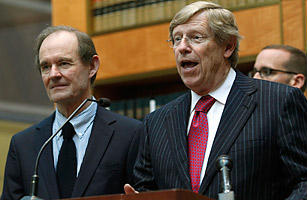
David Boies Ted Olson
BOOK: Redeeming the Dream: Proposition 8 and the Struggle for Marriage Equality
In case you haven't read Part 1, just click here.
In the book Redeeming the Dream, the authors David Boies and Theodore Olson recount their battle as trial lawyers to bring marriage equality to gay and lesbians. It is a superb insider’s look at the case, and a must read for trial lawyers. In an earlier piece here, David Boies’s methodology for preparing and conducting cross-examination in the case against Proposition 8 was examined. Redeeming the Dream provides even more information about Boies’s approach to cross, which centers on revealing the truth or exposing the witness’s mendacity or misconception, and examples of how it works in practice. Co-counsel and co-author Ted Olson provides even more in the book when he describes Boies’s manner when examining witnesses.
CONCEDE THE TRUTH OR SUFFER THE CONSEQUENCES
As we have explained in Cross-Examination Handbook and in my Cross-Examination blog, the primary goal of cross-examination should be to seize the truth that the witness must concede or suffer the impeachment. In Redeeming the Dream, Olson describes David Boies’s approach in this way:
“David has said that cross-examination is the true test during a trial. A witness is alone up there on a witness stand. He or she does not know what to expect, has sworn to tell the truth, and must answer question after question. The right to confront adverse witnesses in a criminal case is guaranteed by the Sixth Amendment to the Constitution for a very good reason: It is the acid test of the adversary system, which is at the heart of our system of justice. It is one thing to make assertions; it is quite another to have to defend them on a witness stand.”
The following is one of the examples of David Boies mastery of the concession-seeking strategy. In this instance, he cross-examines a defense expert David Blankenhorn. Olson describes the examination as follows:
“David’s cross-examination continued the theme of his voir dire, emphasizing that Blankenhorn’s direct relied virtually exclusively on work done by other people, and that Blankenhorn was merely reporting on what selected scholars had said. The witness was initially reluctant to further admit his own lack of qualifications:
“Q: You’re just a transmitter of the findings of scholars, correct?
“A: Well, you’re putting words in my mouth now.
“Q: No, sir.
“David then read Blankenhorn what the witness had admitted at his deposition:
“I’m simply repeating things that they say. I can assure you, I’m not making any of this up on my own. These are not my own conclusions. I’m a transmitter here of findings for these eminent scholars.’
“The court, of course, did not need Blankenhorn to summarize what others had said. That such was the case was bad enough. That he initially resisted admitting it further reduced his credibility.”
Perfect cross. Boies knows the truthful answer that the witness must give, and thus, Boies testifies: “You’re just a transmitter of the findings of scholars, correct?” Blankenhorn must say “yes.” However, Blankenhorn failed to concede the truth of Boies’s testimony, and the witness paid the consequences.
THE PATIENCE, FOCUS AND STYLE OF THE CROSS-EXAMINER
Co-counsel and co-author Olson is effusive in his praise of Boies patience, focus and style as a cross-examiner, describing it in these words:
“. . . (A)mong his most notable skills are patience and focus. He can’t be brushed aside or worn down by an evasive witness. He will calmly persevere, certain of what he is going for and he will remember exactly, literally verbatim, what a witness said in an answer to a prior question an hour before, several hours earlier, or even the previous day. He has an avuncular style- gracious, polite, respectful-but intense and relentless nevertheless.
“He can change the subject suddenly, catch a witness off balance, and yet return to that subject at a point when the witness has gone on to think about something else. He is adroit, quick, and hypnotic, and is so disarmingly easygoing, agreeable and charming that it is easy to see, in retrospect, how a witness could slip or slide into a position from which there is no escape. But if you are that witness, even if you sense it is coming, it is like sinking into quicksand. The harder one struggles, the more powerful the undertow.”
“David Boies serves as an excellent role model for any cross-examiner. As the saying goes, “You don’t have to be cross to cross-examine.”
David Boies (preeminent trial lawyer in such cases as the Microsoft antitrust case and the Gary Shandling case) and Theodore Olson (former Solicitor General and opposing counsel to Boies in Bush vs. Gore) served as co-counsel in the California Proposition 8 case. Olson commented on how Boies cross-examined and deposed the defense experts in that case as follows:
“People think it happens all the time because it happens on television. What we used to call a ‘Perry Mason moment’ when the witness breaks down and confesses. That does not happen. But it sort of does happen when David does it.”
What does David Boies have as his goal when he examines opposing witnesses to elicit concessions? Regarding his goal for examining witnesses, he made this observation regarding how he approached the experts in the Proposition 8 case: “Before you can get a witness to admit the truth you have to get the witness to understand what the truth is.”
In essence, when Boies deposes an adverse witness or cross-examines a witness, he seeks to have the witness admit the truth.
This is neither a new nor novel concept. In Francis L. Wellman’s Art of Cross-Examination, which was published in 1903 and is still in print, a New York trial lawyer Emory Buckner wrote: “More cross-examinations are suicidal than homicidal.” He attributed this to a mistake in conception as to the purpose of cross. Buckner explained: “The purpose of cross-examination should be to catch the truth, ever an elusive fugitive.”
The following is an example of Boies extracting the truth from a defense expert witness Katherine Kay Young in the case against Proposition 8:
Boies – Q: Do you believe that children are advantaged by increasing the durability of the relationship of the couple raising them?
Young – A: Yes
Q: And you believe allowing gay couples to marry will increase the durability of the gay couple’s relationships?
A: Okay, I’d say yes.
Q: And increasing the durability of these relationships is beneficial to the children they’re raising, correct?
A: On that one factor, yes.
Boies has put it this way: “Cross-examination is probably the best we have to really get at the truth. We put somebody on the witness stand, call them to answer questions and it takes an extraordinary person to be able to successfully lie without being tripped up.”
November 2, 2024
New Evidence in Practice Second Editiion Coming Soon

We now have both the front and back covers for the second edition of Evidence in Practice: Skills and Strategies for Pretrial and Trial with Practice Exercises. In February of next year, Aspen Publishing will publish our new edition and we are excited. The back cover explains what this new edition offers and why we are so excited about this book and its companion website that offers videos and much more.
Here is the description of the book on the back cover:

Here is the back cover in larger type so it is easier to read:
EVIDENCE IN PRACTICESkills and Strategies for Pretrial and TrialWith Practice Exercises
Second Edition
Marilyn J. BergerJohn B. MitchellRonald H. Clark
Evidence in law school focuses on legal theory and doctrine. Bridge the gap between classroom and courtroom with EVIDENCE IN PRACTICE: Skills and Strategies for Pretrial and Trial, with Practice Exercises, Second Edition. Designed for law students, paralegals, and trial lawyers, this versatile go-to guide provides clear instructions and examples for making and meeting objections, introducing exhibits, laying evidentiary foundations, and much more. The updated and streamlined Second Edition clearly explains all the evidentiary law and procedure that applies to mock trials, moot court, pretrial litigation, and trials.
The updated Second Edition features essential content, insights, and resources:
• Making and meeting evidentiary objections • Anticipating when opposing counsel will offer inadmissible evidence • Quick-reference lists of objections that may be raised at each stage of a trial • Wording and phrasing for each type of objection • How to protect the record when raising or meeting an objection • Counteracting unscrupulous behavior by opposing counsel • Considering the ethics of making or meeting an objection • Drafting and arguing motions and responses to motions • Laying evidentiary foundations for exhibits and witness testimony • Using predicate questions to establish the admissibility of evidence • Introducing and displaying exhibits
With the online videos, case files, and practice exercises available with this text, you can develop or hone the full range of skills and strategies that consummate trial lawyers apply in pretrial and trial to all matters of evidence.
_________________________________________________________
We are very excited and happy about this new edition. It will be a real gift to trial lawyers and future trial lawyers.
October 30, 2024
STRATEGIES & SKILLS FOR EXTRACTING THE TRUTH ON CROSS-EXAMINATION – Part 1
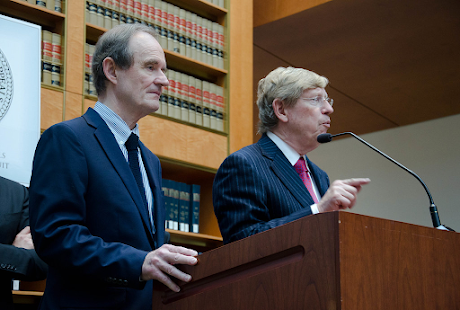
David Boies Ted Olson
BOOK: Redeeming the Dream: Proposition 8 and the Struggle for Marriage Equality
In the book Redeeming the Dream: Proposition 8 and the Struggle for Marriage Equality, the authors David Boies and Theodore Olson recount their battle as trial lawyers to bring marriage equality to gay and lesbians. It is a superb insider’s look at the case, and a must read for trial lawyers. In an earlier piece here, David Boies’s methodology for preparing and conducting cross-examination in the case against Proposition 8 was examined. Redeeming the Dream provides even more information about Boies’s approach to cross, which centers on revealing the truth or exposing the witness’s mendacity or misconception, and examples of how it works in practice. Co-counsel and co-author Ted Olson provides even more in the book when he describes Boies’s manner when examining witnesses.
CONCEDE THE TRUTH OR SUFFER THE CONSEQUENCES
As we have explained in Cross-Examination Handbook and in my Cross-Examination blog, the primary goal of cross-examination should be to seize the truth that the witness must concede or suffer the impeachment. In Redeeming the Dream, Olson describes David Boies’s approach in this way:
“David has said that cross-examination is the true test during a trial. A witness is alone up there on a witness stand. He or she does not know what to expect, has sworn to tell the truth, and must answer question after question. The right to confront adverse witnesses in a criminal case is guaranteed by the Sixth Amendment to the Constitution for a very good reason: It is the acid test of the adversary system, which is at the heart of our system of justice. It is one thing to make assertions; it is quite another to have to defend them on a witness stand.”
The following is one of the examples of David Boies mastery of the concession-seeking strategy. In this instance, he cross-examines a defense expert David Blankenhorn. Olson describes the examination as follows:
“David’s cross-examination continued the theme of his voir dire, emphasizing that Blankenhorn’s direct relied virtually exclusively on work done by other people, and that Blankenhorn was merely reporting on what selected scholars had said. The witness was initially reluctant to further admit his own lack of qualifications:
“Q: You’re just a transmitter of the findings of scholars, correct?
“A: Well, you’re putting words in my mouth now.
“Q: No, sir.
“David then read Blankenhorn what the witness had admitted at his deposition:
“”I’m simply repeating things that they say. I can assure you, I’m not making any of this up on my own. These are not my own conclusions. I’m a transmitter here of findings for these eminent scholars.’
“The court, of course, did not need Blankenhorn to summarize what others had said. That such was the case was bad enough. That he initially resisted admitting it further reduced his credibility.”
Perfect cross. Boies knows the truthful answer that the witness must give, and thus, Boies testifies: “You’re just a transmitter of the findings of scholars, correct?” Blankenhorn must say “yes.” However, Blankenhorn failed to concede the truth of Boies’s testimony and the witness paid the consequences.
THE PATIENCE, FOCUS AND STYLE OF THE CROSS-EXAMINER
Co-counsel and co-author Olson is effusive in his praise of Boies patience, focus and style as a cross-examiner, describing it in these words:
“. . . (A)mong his most notable skills are patience and focus. He can’t be brushed aside or worn down by an evasive witness. He will calmly persevere, certain of what he is going for and he will remember exactly, literally verbatim, what a witness said in an answer to a prior question an hour before, several hours earlier, or even the previous day. He has an avuncular style- gracious, polite, respectful-but intense and relentless nevertheless.
“He can change the subject suddenly, catch a witness off balance, and yet retun to that subject at a point when the witness has gone on to think about something else. He is adroit, quick, and hypnotic, and is so disarmingly easygoing, agreeable and charming that it is easy to see, in retrospect, how a witness could slip or slide into a position from which there is no escape. But if you are that witness, even if you sense it is coming, it is like sinking into quicksand. The harder one struggles, the more powerful the undertow.”
David Boies serves as an excellent role model for any cross-examiner. As the saying goes, “You don’t have to be cross to cross-examine.”
October 23, 2024
IMPROVING YOUR LEGAL WRITING SKILLS and FREE CHAPTER
In a book I edited, titled The Appellate Prosecutor: A Practical and Inspirational Guide to Appellate Advocacy, the Honorable Paul Turner, who when the book was published was Presiding Justice of the California Court of Appeals Second Appellate District of Los Angeles, California, contributed a chapter. Judge Turner’s chapter focuses on the art of writing, specifically on crafting the short declarative sentence, which he referred to as “The Declarative Sentence: The Key to Good Legal Writing.”
Here is an excerpt from Judge Turner’s chapter:
“The most important way to improve your lega writing is to develop the skill of writing the short declarative sentence. Some people do not need to use short declarative sentences. In 1995, the Houston Chronicle reported that Alan Greenspan, the Chair of the Federal Reserve Board, said, “I spend a substantial amount of my time endeavoring to fend off questions and worry terribly that I might end up being too clear.” In 1992, the Wall Street Journal reported that one wag suggested that Alan Greenspan’s tombstone should read, “I am guardedly optimistic about the next world but remain cognizant of the downside risk.”
“But as an appellate advocate, your job is to be clear; not to be uncertain like Mr. Greenspan. Your task is to develop the skill of writing the short declarative sentence so that words march promptly in proper order towards a logical conclusion. That statement of your mission warrants repeating. Your task is to develop the skill of writing the short declarative sentence so that words march promptly in proper order towards a logical conclusion.
“Here is an example of this important way of communicating, and it is from the famous case of Palsgraf v. Long Island Railroad Company 248 N.Y.339, 340–341 (1928). It is the first paragraph of Chief Judge Benjamin Cardozo’s famous opinion. In law school, professors use the Palsgraf opinion to discuss proximate cause and negligence. More importantly, it is the example of great legal writing utilizing the short declarative sentence as a way to communicate. Here, with minor bracketed interruptions, is the first paragraph of Palsgraf:
‘Plaintiff was standing on a platform of defendant’s railroad after buying a ticket to go to Rockaway Beach. [Stop reading now. How many words were the in the first sentence? 18. Now keep reading.] A train stopped at the station, bound for another place. Two men ran forward to catch it. [Stop reading again—how many words in this sentence that describes the hurried conduct of two different human beings in relation to a train leaving a station? Seven words—that is all; now start reading again.] One of the men reached the platform of the car without mishap, though the train was already moving. The other man, carrying a package, jumped aboard the car, but seemed unsteady as if about to fall. A guard on the car, who had held the door open, reached forward to help him in, and another guard on the platform pushed him from behind. In this act, the package was dislodged, and fell upon the rails. It was a package of small size, about fifteen inches long, and was covered by a newspaper. In fact it contained fireworks, but there was nothing in its appearance to give notice of its contents. The fireworks when they fell exploded. The shock of the explosion threw down some scales at the other end of the platform many feet away. The scales struck the plaintiff, causing injuries for which she sues.’
“The longest sentence in this first paragraph of Palsgraf is 27 words, the one that begins, “A guard on the car...” That sentence consists of a series of short phrases strung together. Look at them: “A guard on the car, [5 words and a comma] who had held the door open, [6 words and a comma] reached forward to help him in, [another 6 words and a comma] and another guard on the platform pushed him from behind” [10 words and a period].
“The most important thing about this whole passage is a reader knows exactly, yes, exactly what happened. This accident happened on August 24, 1924, at the East New York Station in Brooklyn and everybody who reads the first paragraph of Palsgraf knows what happened 80 years later. That is communication, that is the power of the written word.”
The Appellate Prosecutor: A Practical and Inspirational Guide to Appellate Advocacy is not just for prosecutors who are appellate advocates; it’s for all appellate advocates.
 For a Free Copy of Turner’s Chapter,
“The Key to Good Legal Writing.” Click here.