Collins Hemingway's Blog, page 9
November 8, 2015
Reflections on JASNA AGM
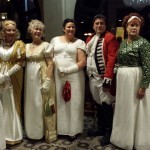
As one of 150-plus first-time attendees to the 2015 Annual General Meeting (AGM) of the Jane Austen Society of North America (JASNA), I found the event to be as educational as I had hoped and more charming than I expected. Here are a few of my JASNA reflections.
The AGM was hosted by the Louisville, KY, region, led by Alana Gillett and Bonny Wise, who put on an event that drew the largest number of newcomers and, according to old-timers, a record turnout of people dressed in period clothes. There’s something about Southern culture that encourages locals put on their Sunday best when nice people come to town.
My main interest in attending was the seminars, particularly those related to health, medicine, and childbirth. These topics play an important role in the second and third volumes of “The Marriage of Miss Jane Austen.” The seminars ended up spanning talks by Albert Roberts, on the work of a naval surgeon; Sharon Lathan, a nurse (RNC) and novelist, on medical practice and practitioners; mathematician Dr. Jo Ann Staples on household remedies of the day; and Kelly M. McDonald on childbirth in Regency times, with examples involving Austen’s own relatives.
Some of the medical treatments, including surgery without anesthetics, were brutal. A modern person cowers at the knowledge that Austen’s fellow author Fanny Burney underwent a mastectomy for breast cancer without anesthetic—and lived another thirty years. Other treatments, such as medicines containing mercury, were dangerous. Laudanum—opium dissolved in gin or wine—was the day’s equivalent of aspirin.
The medical practice of every era will suffer from historical perspective. Two hundred years from now, people will consider us barbaric for cutting open people—even with anesthetics—to heal them, and for dumping poison in their veins to stave off cancer.
My convention-going days have involved business—meetings with partners, customers, the press—and the typical attendee was a burned-out yuppie. It’s refreshing to see people who enjoy working the booths, and people in the hallways who are conversing with others because they want to, rather than have to. And to attend seminars out of genuine interest–in addition to a business imperative.
For a newbie, there were not as many opportunities to meet others as I would have liked. Everyone was friendly, but the singleton had to push forward, usually into long-time friends, to make connections. It was worthwhile, to be sure. I met a number of fellow authors, and members of regions outside of Oregon whose interests ranged from the erudite to the fun. It would have been nice to have meetings specifically designed to introduce people to those from other parts of the country.
Of course, I declined the one social event I might have joined in, the Saturday evening ball. Too concerned that the dance steps would be too complicated, though from what I then saw from the sidelines the more experienced dancers were quite patient and encouraging to the newcomers.
I learned that the card game Speculation was as popular among the Rogers clan (explorers of the Ohio valley and the Great Northwest) in Locust Grove, KY, as it was among the Bertrams in Mansfield Park, England. I could not claim, as Fanny Price did, to be a mistress (master?) of the rules within three minutes, for the youngest lady at the table roundly trounced me in the half-dozen hands I played.
The post Reflections on JASNA AGM appeared first on Austen Marriage.


October 9, 2015
Diana Jordan podcast interview with Collins Hemingway

http://austenmarriage.com/wp-content/uploads/2015/10/JaneAustenCollinsHemingway100815.wav
An interview with Author Collins Hemingway
The post Diana Jordan podcast interview with Collins Hemingway appeared first on Austen Marriage.
Jane Austen – Collins Hemingway
http://austenmarriage.com/wp-content/uploads/2015/10/JaneAustenCollinsHemingway100815.wav
Initial Podcast for Austen Marriage
The post Jane Austen – Collins Hemingway appeared first on Austen Marriage.
October 8, 2015
booksworld.com

October 9
Collins Hemingway Pens Novel About Jane Austen
The post booksworld.com appeared first on Austen Marriage.
October 7, 2015
GeekWire

October 8, 2015
Former Microsoft exec, who co-authored a book with Bill Gates, tackles the world of Jane Austen
The post GeekWire appeared first on Austen Marriage.
September 10, 2015
Clarkson, Anning, Austen Ring

Of Jane Austen’s known jewelry, her topaz cross came from her younger brother, Charles, who bought one each for his sisters with his first navy prize in 1801. Her turquoise bracelet probably came from another brother, Edward, as a memento relating to the death
of his beloved wife Elizabeth in 1808. (Photo by Michael Maggs, Wikimedia Commons)
But what is the provenance of the turquoise ring, the one that American singer Kelly Clarkson sought to buy at auction in 2013? And could that ring have drawn Jane Austen into a search for fossils along the cliffs of Lyme Regis?
The possible loss of the Austen ring—to an American!—a rock star!—set off a controversy unlike any since Lord Elgin spirited the Parthenon marbles out of Greece and into England during Austen’s day. Pooling their farthings in 2013, England’s Janeites raised £152,450 ($232,836) to secure the ring for posterity.
But whence the ring originally? The only reference I have been able to find to a Jane Austen ring during her lifetime is her Stoneleigh Abbey inheritance of a “Single Brilliant Centre Ring.” This came when her aunt and uncle Leigh-Perrott accepted a financial settlement in exchange for any claim to the Stoneleigh estate when the last of the direct Leigh line died in 1806.
That settlement, even with a ring or other trinkets, was a bitter disappointment to the Austens. In a letter, Jane called it a “vile compromise.” If the Leigh-Perrots had pressed their claim—and won—the oldest Austen brother, James, would have eventually inherited the magnificent estate from the childless Leigh-Perrots.
Could this brilliant centre ring from Stoneleigh be the same brilliant turquoise that now rests, safe from marauding Americans, at Jane Austen’s House Museum in Hampshire?
Even if the ring originated elsewhere, its composition raises fascinating questions in itself, for it could provide a new perspective on a paleontological family in Lyme Regis whom Austen knew. The blue stone is odontolite: fluorophosphate infiltrated by hydrous ferrous phosphate. In plain language, it is an ancient tooth that has been stained blue by the soil. In plainer language still, a fossil.
Fossils were contentious science in the early 1800s and for long after because they contravened the officially accepted age of the Earth. Bishop Ussher in 1650 had set Creation at precisely 6 p.m. on October 22, 4004 B.C.—5,779 B.J. (Before Jane). Though only one-sixth of his sources were biblical, the Church adopted his estimate as fact.
Yet here were these cliffs, composed of layers and layers of soil, deposited slowly over time, each layer containing its own collection of life as shown in the fossilized remains. A calculation based on God’s rocks rather than on Man’s generations would put the age of the Earth—and its lifeforms—at many, many millions of years (185 million is today’s estimate of the Lyme deposits).
Fossil exploration in the Regency era was part of a drumbeat of discoveries pouring out of studies in astronomy, chemistry, and geology that put the literalness of Scripture—and ecclesiastical authority—at risk. Though this was half a century before the theory of evolution, Erasmus Darwin, Charles’ grandfather, had already postulated the existence of a mechanism by which one species might turn into another. Fossils supported that view.
Consider then that Austen knew a cabinetmaker named Richard Anning, who came to the family quarters in Lyme Regis at least once, to provide a bid for a furniture repair in 1804. Anning also sold fossils, dug from the nearby cliffs, to tourists. He used the proceeds to supplement his meager wages and to fund more serious excavations.
Because the Anning family sold the more common fossils at the small village market, Austen must have seen Anning from time to time. If she had the ring then, he might have recognized the stone as a fossil and perhaps discussed its origins with her. A woman who loved to walk the cliffs, Austen would have been fascinated by the natural philosophy involving the ground beneath her feet.
Very likely, Austen met the family’s young daughter, Mary, peddling those same wares at the market. Could Austen have resisted buying a modest fossil from the scruffy but precocious girl? Would Jane’s interactions with the Anning family have led her to scrape out a fossil here and there along her walks?
Mary Anning grew up to become one of the leading paleontologists in the world. Among her finds, mostly at Lyme Regis, were the first complete skeletons of the ichthyosaur and plesiosaur. As a woman and religious dissenter, she seldom received full recognition for her work, was denied membership in the Geological Society of London, and lived most of her life in poverty. She once wrote: “The world has used me so unkindly, I fear it has made me suspicious of everyone.”
Two centuries later, the Royal Society named Anning one of the ten most important British women in the history of science. Lyme Regis now has a fossil festival and celebrates an annual Mary Anning day.
One supposes that, years later, Austen might have slipped away from Chawton to travel back to her beloved Dorset coast—to refresh her memory of the Cobb, perhaps, for Persuasion?—and have come upon Mary Anning once again. In 1815, Mary would have been sixteen and as mature in her science as Jane had been in her writing at the same age.
It is tantalizing to imagine that there could have been a day along the cliffs when one of the greats of English literature joined with one of the greats of English science—both largely unrecognized in their time—to dirty their petticoats in a hunt for the elusive pterosaur hidden within the Blue Lias.
(This article was originally published in Jane Austen’s Regency World.)
The post Clarkson, Anning, Austen Ring appeared first on Austen Marriage.
August 11, 2015
Strong Female Film Characters
Strong female film characters: Will they ever consistently appear?
Movies with strong female leads have proven exceedingly popular. Consider only the success and variety of The Hunger Games, Wild, Kill Bill, Gravity, and Frozen. Yet the entertainment industry has had to be dragged—if not kicking and screaming, at least whining—into making films about strong women.
Women in the field, including the respected Emma Thompson, complain that sexism is as prevalent today in the entertainment industry as at any time in the past. “Some forms of sexism and unpleasantness to women have become more entrenched and indeed more prevalent,” Thompson says. “When I was younger, I really did think we were on our way to a better world, and when I look at it now, it is in a worse state than I have known it.”
The situation has caused Hollywood actresses, including Jennifer Aniston, Drew Barrymore, Jessica Biel, Jane Fonda, Queen Latifah, and Reese Witherspoon to found their own production companies to create films with strong female leads.
“My daughter was 13, and I wanted her to see movies with female leads and heroes and life stories,” Witherspoon explains. She and her business partner, Bruna Papandrea, through their company Pacific Standard, have already produced Wild, Gone Girl, and Don’t Mess With Texas.
Though some film heroines have used moxie and physical strength to take on a hostile world, more often women use their brains and character to hold their own in a society set against them. The source for the one consistent line of such strong, thoughtful women? Jane Austen.
At least ninety Austen-based movies, miniseries, and television shows have been done, including twenty-five or so major movies/miniseries. Most are relatively recent. The only early major movie was the Olivier-Garson Pride and Prejudice in 1940.
The Austen breakout began in 1995 with four popular Austen adaptations. Emma Thompson, quoted above, won awards as both an actress and screenwriter for Sense and Sensibility. Alicia Silverstone won accolades for the Emma-based Clueless. Jennifer Ehle battled Colin Firth until he surrendered to her charms in a Pride and Prejudice miniseries. Gwyneth Paltrow followed as Emma in 1996.
Another two dozen major productions have come along in the next twenty years, including four scheduled for release in 2015. Sarah Seltzer provides a thoughtful look at most of them, ranking the Ehle-Firth Pride and Prejudice the best and the two 1999/2007 Mansfield Parks as the worst. Even Austen’s minor books are being filmed—Love and Friendship and Lady Susan.
Why would a traditional author such as Austen be so appealing to the modern age? Perhaps women find the quiet perseverance and hope of a Liz Bennet, Catherine Morland, or Fanny Price closer to their reality than an avenging female gladiator.
There’s also a life richness often missing in action movies. Emma Thompson captures the bittersweet essence of Austen’s books when she says, “In all the great stories, even if there’s a happily-ever-after ending, there’s something sad.”
On the twentieth anniversary of the 1995 Austen emergence in film, such roles resonate today with ordinary women who face many of the same issues: a lack of respect, general economic disadvantage, and less opportunity than their male counterparts.
The same thing, of course, that females in the entertainment business face.
The post Strong Female Film Characters appeared first on Austen Marriage.
July 6, 2015
‘Slow Love’ for Darcy

John Tierney’s recent article on “mate value” confirms a long-held notion that people tend to marry others like themselves in terms of looks, wealth, and education. He holds out hope for mismatched couples, however, through a process called “slow love.”
Studies show that the longer someone spends with a potential but mismatched mate, the higher they rate the other in sex appeal. Over time, an individual has the opportunity to uncover the other person’s strengths, which can outweigh the initial impression. (See for couples time can upend the laws of attraction.)
This phenomenon of “slow love” accounts for what Tierney calls the “schlub-gets-babe” movie formula, such as “Knocked Up,” in which the unkempt Seth Rogen lands the gorgeous Katherine Heigl.
Tierney may be off the mark, however, in his other example, “Pride and Prejudice,” which he cites lovingly throughout. Based on Darcy’s initial negative reaction to Elizabeth’s looks, several productions have made Liz a plain young woman. But Jane Austen describes Elizabeth only from Darcy’s eyes, never objectively.
One of the charms of Austen’s sly prose is that the reader can never know whether Liz’s intelligence and wit eventually outweigh her poor looks, or whether her physical beauty becomes apparent to Darcy only when her many other attributes overwhelm his social bias.
After all, the book’s original title was not “Plain Jane and Hot Stud” but “First Impressions.”
The post ‘Slow Love’ for Darcy appeared first on Austen Marriage.
June 5, 2015
Why the Book

Whenever we travel, and happen to have a female pilot, I joke to my wife about my horror that they’re letting a “girl” fly the airliner. Knowing that my own flight instructor was a woman, my wife usually responds with nothing worse than a sharp elbow to the ribs. (I fly little planes—they’d never let me fly a big one.)
My primary physician, my dentist, and most other professionals in my life—women. My career—often one of collaboration with women. My most satisfying professional times—a company run by women. The loveliest person in my life—a woman.
It seems only natural that I should write a novel that has as its protagonist a strong female character, in the form of Jane Austen, respected for her intelligence, her wit, and her demand that women be treated with respect.
No doubt this empathy for women involves my own personal history. I and my two brothers were raised by a single mother after our father ran away from home. This was in the conservative South, when being a divorcee had the whiff of the disreputable about it, and the highest rung on the corporate ladder for a woman was that of office secretary.
We survived, but I would not romanticize the experience. My mother struggled her entire life to earn a living—and respect. We had food on the table, but not much. We often fell behind on our account with the grocer. But she never missed a day of work, and she eventually paid every bill. Absorbing her work ethic, we boys clawed our way up and out.
But that life and experience was not ennobling. It largely broke my mother. She achieved modest comfort in retirement, but she was never really happy.
Because of the timing of my career, I witnessed the rise of women in the workplace. When I began working for newspapers in high school, ninety percent of newsrooms were male, and the women were largely relegated to the Society section. By my mid-twenties, half the newsrooms were female. When I moved into high-tech ten years later, communications had shifted from largely male to largely female. Many women avoided the glass ceiling by founding their own firms.
By and large, I have prospered more under the collegial atmosphere fostered by women than by the tiresome competitiveness that is too often a part of male culture. I successfully swam with the sharks, but it wasn’t a lot of fun.
These are all the personal reasons that I’ve been drawn to Jane Austen as a character. In so many ways, she represents an intelligent woman’s fight for independence in a society structured to keep her dependent.
In writing this book, I can liberate her to become a whole woman capable of fulfilling her life’s dreams. I can engage her in issues from which she otherwise would have been excluded. I can throw the worst of the Regency era at her and see how she responds. By testing her mettle, I can draw a deeper and more honest portrait of her character than is otherwise possible.
And, by making her the first woman in Bath to fly, I can have her life soar. …
The post Why the Book appeared first on Austen Marriage.
Tough World for Austen
I knew I had my Jane Austen novel when I read a seemingly unrelated work: Richard Holmes’ The Age of Wonder. This history of scientific and industrial developments during the period spanning Austen’s life went far beyond “three or four families in a country village” to show a panorama of fervent intellectual activity across sprawling Regency England.
I already had the major plot points for the central love story—including, curiously enough, the technological marvel referenced in Chapter 1 and deployed in Chapter 4. However, I needed much more than that to avoid replicating what Austen—not to mention her many imitators—had already done. I did not want still another parlor-room romance in a quaint English setting. I wanted to rip that tranquil world apart and send the lovers out into a complex, dangerous world that would test them as human beings.
That world had two major components: the rapid and destabilizing changes in business and society, and the brutal, never-ending stalemate that was the war with France.
The Age of Wonder demonstrated the scientific and industrial advances that were providing the literal and figurative engines for the Industrial Revolution. These changes undermined traditional craft industries to create substantial labor unrest and demands for political reform.
The other part, the military, was equally important. Several characters in Austen’s novels have military backgrounds. Wickham, the deceitful Militia officer in Pride and Prejudice, is the most infamous. Yet from the repartee of Austen’s social gatherings, today’s readers would never be able to guess that England and France were locked in a death struggle for twenty-nine years of Austen’s forty-one-year life. Or that England was torn with dissent and often teetering on financial collapse.
Her adulthood paralleled the Napoleonic wars, with horrifying death tolls from combat and disease, press gangs that shanghaied civilian sailors into the Royal Navy, food shortages created by military demands, and the constant threat of French invasion.
In The Marriage of Miss Jane Austen, the real world continually complicates characters’ lives, and the devastating war comes home in direct and fearful ways.
Well aware that she fashioned miniatures—comparing her books to intricate two-inch ivory carvings—Austen deflected any suggestions that she work on a larger scale. My own view is that, had she lived to old age like most of her siblings, Austen would have ventured far beyond her rural settings. Her unfinished Sanditon shows hints—a book about a crass real-estate developer who wants to turn a sleepy village into a tourist trap!
The Marriage of Miss Jane Austen strives to do what she might have done had she had the chance. It paints a love story across a broad canvas that shows what the Regency era was really all about: great explorations, scientific discovery, industrial advances, labor and political unrest, and an unceasing, bloody war.
The post Tough World for Austen appeared first on Austen Marriage.