Collins Hemingway's Blog, page 7
September 8, 2016
News Release
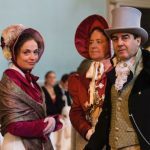
Author Collins Hemingway Hosts Book Launch for The Marriage of Miss Jane Austen: Volume II at Jane Austen Festival in Bath, England
BATH, England, 7 Sept., 2016 – Author Collins Hemingway will officially launch Volume II of The Marriage of Miss Jane Austen Trilogy, a new historical novel based on Austen’s life, on the opening day of the Jane Austen Festival on Saturday, 10 September, in the beautiful UNESCO World Heritage city of Bath, England. During the event, Hemingway will give a lecture about the history, politics, and science of the greater Regency world that framed Austen’s novels and give a reading from his newest novel.
The Marriage of Miss Jane Austen tells a spirited, affecting love story during an exciting, turbulent time. Set in the “lost years” of her twenties – a period of which historians know virtually nothing – the trilogy reveals the story of a talented, passionate woman fully engaging with a man who is very much her equal. The series resolves the biggest mysteries of Austen’s life:
Why the enduring rumors of a lost love or tragic affair?
Why, afterward, did the vivacious Austen prematurely put on the “cap of middle age” and close off any thoughts of love?
Why, after her death, did her beloved sister destroy her letters and journals?
Reviewers have praised The Marriage of Miss Jane Austen for the quality of the writing, its compelling love story, its sensitive treatment of the historical Austen, and its meticulous research.
Readers have called the series as “a magical tale,” “one of the best love stories I have read in a long time,” and “wickedly clever!” Critics have described the content as “an imaginative journey of the soul.”
“The book launch in Bath, Jane Austen’s one-time home during the early 1800s, is a ‘full-circle’ milestone for me,” said Hemingway. “It was nearly 10 years ago when I was visiting Bath that I was inspired to write a story about Austen which respectfully reimagined her life during the Regency era. A decade later, I’m returning to Bath to launch the second volume of the trilogy that, I hope, does justice to her voice.”
Event details
The lecture and book reading are open to the public.
Date: 10 September, 2016 from 2:00 p.m. to 3:00pm
Location: The Kingston Room at The Pump Room
The Roman Baths, Stall Street, Bath BA1 1LZ
Tel: 1225 477785
RSVP to info@austenmarriage.com
Availability
The novel is now available at Amazon and Jane Austen Books and information about The Marriage of Miss Jane Austen trilogy can be found at the Austen Marriage website.
About The Marriage of Miss Jane Austen
The Marriage of Miss Jane Austen examines how a serious romantic relationship would have changed Jane Austen as a person and a writer, using historical fiction to provide a thoughtful, in-depth look at what life was really like for women in the early 1800s. The trilogy plunges the protagonist into the period’s scientific advances, political foment, wars that were among the longest and most devastating in European history—and into a serious relationship with a man very much her equal.
Austen achieved success as an author during the years of 1811 to 1816 with her novels Sense and Sensibility (1811), Pride and Prejudice (1813), Mansfield Park (1814) and Emma (1815), and the joint publication of Northanger Abbey/Persuasion shortly after her death in 1817.
For more formation about The Marriage of Miss Jane Austen and author Collins Hemingway, please visit www.austenmarriage.com. If you would like to “Like” our Facebook page, please do so here: www.facebook.com/pages/The-Marriage-of-Miss-Jane-Austen/364335963764558.
Media contact:
Megan McKenzie
McKenzie Worldwide
meganm@mckenzieworldwide.com
The post News Release appeared first on Austen Marriage.


September 1, 2016
News Release
 The Marriage of Miss Jane Austen
Trilogy’s Volume II Now Available for Pre-order
The Marriage of Miss Jane Austen
Trilogy’s Volume II Now Available for Pre-orderOfficial book launch at Jane Austen Festival in Bath, England, in September
PORTLAND, Oregon, August 30, 2016 – Volume II of The Marriage of Miss Jane Austen Trilogy, a new historical novel based on Austen’s life, is now available for pre-order on Amazon and Jane Austen Books.
The book is now available for pre-order from Amazon at https://www.amazon.com/s/ref=nb_sb_noss?url=search-alias%3Ddigital-text&field-keywords=the+marriage+of+miss+jane+austen+Volume+II.
It is also available at janeaustenbooks.net at http://janeaustenbooks.net/
The official book launch of the latest novel in the trilogy will take place on Saturday, Sept. 10, at the annual Jane Austen Festival (www.janeaustenfestival.co.uk) which celebrates her life and work in the beautiful UNESCO World Heritage city of Bath, England, her one-time home during the 1800s.
Reviewers have praised The Marriage of Miss Jane Austen for the quality of the writing, its compelling love story, its sensitive treatment of the historical Austen, and its meticulous research.
Readers have called the series as “a magical tale,” “one of the best love stories I have read in a long time,” and “wickedly clever!” Critics have described the content as “an imaginative journey of the soul.”
“The social and literary strictures of the day caused Jane Austen to end her novels where the real story ought to begin—with marriage,” Collins Hemingway said. “I wanted to explore the deepest issues of marriage as Austen—given the chance—might have, and I wanted to put a woman of her intelligence and character in the middle of the dangerous and complex world that was the Regency era.”
About The Marriage of Miss Jane Austen
The Marriage of Miss Jane Austen examines how a serious romantic relationship would have changed Jane Austen as a person and a writer, using historical fiction to provide a thoughtful, in-depth look at what life was really like for women in the early 1800s. The trilogy plunges the protagonist into the period’s scientific advances, political foment, wars that were among the longest and most devastating in European history—and into a serious relationship with a man very much her equal.
Austen achieved success as an author during the years of 1811 to 1816 with her novels Sense and Sensibility (1811), Pride and Prejudice (1813), Mansfield Park (1814) and Emma (1815), and the joint publication of Northanger Abbey/Persuasion shortly after her death in 1817.
For more formation about The Marriage of Miss Jane Austen and author Collins Hemingway, please visit www.austenmarriage.com. If you would like to “Like” our Facebook page, please do so here: www.facebook.com/pages/The-Marriage-o....
Media contact:
Megan McKenzie
McKenzie Worldwide
+1 503-625-3680
meganm@mckenzieworldwide.com
The post News Release appeared first on Austen Marriage.
August 12, 2016
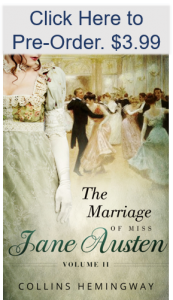
Pre-order Volume II — Just $3.99
I try to write interesting, thoughtful blogs on a semi-regular basis, so I hope readers will indulge the rare promotional notice. Especially when it involves eighteen months of hard work and relates directly to the existence of this website. Meaning, I’m very pleased to announce that Volume II in “The Marriage of Miss Jane Austen” trilogy is available for pre-order from Amazon—just $3.99!
See why readers have praised “The Marriage of Miss Jane Austen” as “a magical tale”—“one of the best love stories I have read in a long time”—“wickedly clever!” Find out why critics call it “an imaginative journey of the soul.”
Volume II will officially launch on Sept. 10, 2016, at the Jane Austen Festival in Bath, England. But you can pre-order the e-book today on Amazon! https://www.amazon.com/Marriage-Miss-Jane-Aus…/…/ref=sr_1_2…
“The Marriage of Miss Jane Austen” explores her twenties, a period of which historians know almost nothing, to present life as it would have been for an intelligent, independent, passionate woman who meets a man very much her equal. The trilogy answers the mysteries around those missing years: Why the rumors of a lost love? Why did Austen never seek love again? Why did her beloved sister destroy her letters and diaries of this time?
Volume I told the story of a tender romance. Volume II takes Austen and her husband into an intense and complex marriage, as the challenges of the Regency Era threaten their new life together.
You can get a sneak peek of the deep personal matters at stake in a preview of the book here:
https://www.createspace.com/Preview/1196773
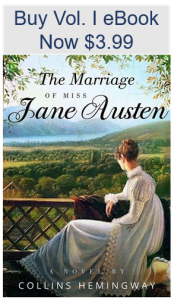
If you haven’t already read Volume I of “The Marriage of Miss Jane Austen,” you can get a copy at a special discount at www.janeaustenbooks.net, or an e-book at Amazon.
https://www.amazon.com/…/dp/B010DNSO74/ref=pd_sim_sbs_351_4…
Courtship becomes marriage. Life becomes real. Order now.
$3.99 for Volume II e-book
$3.99 for Volume I e-book
$11.99 for Volume I paperback

The post Pre-order Volume II — Just $3.99 appeared first on Austen Marriage.
July 7, 2016
Did Austen Speak Posh?
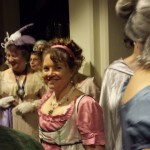
In our last blog, we heard how Shakespeare’s English much more resembled the accents of the provinces than the “proper” English favored today by actors and newscasters, the latter being an accent called “Received Pronunciation” or “RP.”
Jane Austen had knowledge of and appreciation for Shakespeare. There are parallels between her social comedies and his, Willoughby reads “Hamlet” in “Sense and Sensibility,” and Edmund Bertram discusses Shakespeare in “Mansfield Park.”
Austen has other passing references to the Bard, one of which, Sonnet 116, is given prominence in Emma Thompson’s screenplay for “Sense and Sensibility,” as explained here (with some additional theorizing).
Seeing that Austen, like Shakespeare, is considered one of the masters of impeccable English, the question naturally arises as to whether the speaking language in her sitting rooms was closer to RP or to the “Original Pronunciation” or “OP”–a rich, earthy, older dialect similar to Scottish, Irish, and American English.
Austen’s novels are set in different counties in south England. Each dialect would have varied somewhat, but there would have been many similarities. To pick one county to stand for all, let’s use Hampshire, Austen’s home for most of her life.
Tony Grant, a scholar from Hampshire, says the county’s sound “is a warm, gentle sort of accent with a soft burr to it … You could not mistake somebody speaking with a Hampshire accent … as coming from anywhere else but Hampshire.”
According to Grant, the famous first proposal by Darcy to Liz in “Pride and Prejudice” would have sounded much different if rendered in the Hampshire speech that Austen herself likely used. First, here is Austen’s graceful prose:
“In an unhurried manner he immediately began an inquiry after her health, imputing his visit to a wish of hearing that she were better. She answered him with cold civility. … He came towards her in an agitated manner, and thus began: ‘In vain I have struggled. It will not do. My feelings will not be repressed. You must allow me to tell you how ardently I admire and love you.’ ”
Once she overcomes her astonishment, Liz responds:
“In such cases as this, it is, I believe, the established mode to express a sense of obligation for the sentiments avowed, however unequally they may be returned. … If I could feel gratitude, I would now thank you. But I cannot—I have never desired your good opinion, and you have certainly bestowed it most unwillingly. … ”
Darcy’s plea and Liz’s response is transformed thus:
“Ize a bin struggling wi meslf, Lizzie. It won’t do nay more. Me feelins will not be [reprezz’d] nay mar. Yee mussle allowz me t’ tell yee ’ow, wi some power’ul emotion me admires and loves ee.”
“In sich as this, it is ’stablished thing t’express a sense a obligati’n fer the sen’imen’s avowed, ’owever unequalz they be. … If ay could feel grat’tude, I’d now thank ee. But ay can’t – I’ve ne’r wannered yer good thoughts like, and yee’ve cert’nly bin unwillin’ aven’t ee.”
Grant admits that this accent is exaggerated; he says he mixes in other accents from farther west. In addition to changing the pronunciation he also modifies much of Austen’s formal language to Hampshire colloquialisms. Even so, the dialog should make it clear that Liz would have spoken much differently than most of us assume. If she were to break into that dialect in a BBC episode, we would likely be as astonished as Liz was at Darcy’s unexpected proposal.
It does not appear that anyone has done a recording of Austen’s work in a Hampshire dialect. For comparison, though, here is a recording of a local Hampshire man born in 1898. The Austen accent, from eighty to a hundred years earlier, would have been at least as thick and likely thicker (one might say, “richer”).
Here is another one from the county, a woman born in 1920. In just one generation, the accent has become less distinct, but it’s still noticeable. To an untrained American ear, the woman’s accent sounds like the maid Rose from the series “Upstairs Downstairs” rather than from one of the gentry upstairs.
It would be fascinating to hear how the use of Austen’s native tongue might change the speed, rhythm, and emphasis of the dialogue. There is a very noticeable difference in Shakespeare plays, as comparison. The original accent is faster, spoken from the belly rather than the vocal cords, and brings out more puns in the text.
The International Dialects of English Archive includes accents from other locales in which Austen set her scenes. None of the accents resembles the posh English of today’s Shakespeare plays and Austen movies.
Both Austen and her characters would have been immediately recognized as being from the country when they went up to London, which then as now has its own distinct sound. Locals would not necessarily assume they were bumpkins; the country had too many regional accents to allow discrimination by sound; one could tell the “right sort” of people by their wealth and manners.
It was, however, during this time that the speech of the well-to-do in and around London began to assume its modern form. A major change was the loss of ‘rhoticity’—the ‘r’ sound after a vowel, so that “park” became “pahk.” There’s a chance that Londoners—and perhaps Darcy—would have begun to pick up the distinct RP accent that the modern listener associates with upper-crust England.
That accent is relatively easy to learn, according to a young woman who promises to teach us how to speak like Hermione from “Harry Potter.”
But what is posh is a matter of fashion rather than linguistics. At least one young London woman considers “RP”—as spoken by Dowager Countess Grantham in “Downton Abbey”—to be an accent that can be used credibly only by old people. She distinguishes between old-fashioned RP and modern “standard,” in which people are allowed to maintain their natural accents.
Under this definition, Jane Austen’s Hampshire accent would be perfectly acceptable because she always wrote proper English, no matter how she spoke it.
Note and tip of the hat: I came to the article about Austen’s accent through a long interest in Shakespeare’s tongue, which led to the previous blog post here. As I was working on both of these blogs, Vic at Jane Austen’s World published the blog by Tony Grant, which I cite here. I independently came upon several other links included in that blog. Jane Austen’s World is a lovely website, and I encourage everyone to visit it.
The post Did Austen Speak Posh? appeared first on Austen Marriage.
June 16, 2016
‘To Bay or Not to Bay’: Did Shakespeare Talk Country?

When I was in college, the drama department at the University of Arkansas wanted to do a bang-up job on Shakespeare’s “Hamlet.” Over the summer, they sent the actor playing the lead role off to study proper enunciation.
He returned with an impeccable rendition, but no one anticipated the disconnect for the audience caused by Hamlet speaking “proper” English and the rest of the cast speaking in their usual Arkansas accents. At times it sounded like a mashup of “Masterpiece Theatre” and the country comedy show “Hee-Haw.”
What’s ironic, though, is that the UA had it backward. Years later, I learned that Shakespearian English was not BBC English—known as the “Received Pronunciation” (RP), as if it had been handed down from God on high. Shakespeare’s English sounds like a regional version of English similar to Scottish and Irish, as well as Southern dialects in America.
Consider these lines from “Henry IV,” as Prince Harry challenges Falstaff for lying about his cowardice when set upon by “robbers”—one of whom was the Prince.
PRINCE: Why, how couldst thou know these men … when it was so dark thou couldst not see thy hand? Come, tell us your reason. …
FALSTAFF: … Give you a reason on compulsion? If reasons were as plentiful as blackberries, I would give no man a reason upon compulsion, I.
This is a pun, shown with my emphasis, that works only if “reason” rhymes with “raisin.” Where does this happen? In a thick American hillbilly accent.
Not convinced? Anthony Burgess, author of “A Clockwork Orange,” linguist, and Shakespeare scholar, describes in his novel “ABBA ABBA”–the rhyme scheme, not the rock band–what must have been his own epiphany about Shakespeare’s dialect.
“ABBA ABBA” is about the life of the poet John Keats as he’s dying of consumption in Rome. Keats receives a present–an English-Italian dictionary from 1611, edited by John Florio, a known friend of the Bard. In explaining the pronunciation of Italian words by comparing them with English, Florio also ends up showing the pronunciation of English words in Shakespeare’s day. Here is Burgess describing Keats’ reaction:
“He was being given a vision … of how Shakespeare spoke. He spoke like an Irishman. … He said not flea but flay. He pronounced reason as raisin. And now [Keats got] the joke in Falstaff ‘s words: ‘reasons are as plentiful as blackberries.’ Of course, raisins. With awe and something of fear, John felt that he was being instructed by … poets dead and gone.”
That’s not all. According to David Crystal, an expert on the Elizabethan tongue, Hamlet’s most famous soliloquy begins, “To bay or not to bay,” which is straight out of the Appalachians or the Ozarks.
If it seems outlandish to suggest that elements of Shakespeare’s tongue might show up among rustics in the U.S. South, remember that most of the early settlers in that region were English, Scottish, and Irish. A number of them headed into the hills and didn’t talk to anyone outside their small communities for hundreds of years.
The mainstream dialects continued to evolve on both sides of the Atlantic. Many linguists believe England’s English has changed more than American English. In particular, most Americans still pronounce the “r” after a vowel (“rhoticity”), as in “park the car,” whereas RP English tells us to “pahk the cah.” Linguist Gretchen McCulloch flatly states that the majority of British settlers “spoke much more like current Americans than current Brits.”
In short, Shakespeare’s English is not the RP accent Ben Trawick-Smith speaks of as heard “among Oxford professors and in Jane Austen films.” Instead, it is a rich, earthy tongue spoken from the gut rather than the vocal cords. When Shakespeare is performed in “Original Pronunciation” (OP), many more rhymes and puns materialize, the rhythms change—and the play moves faster. “Romeo and Juliet” is ten minutes faster in OP.
Controversy has emerged as to whether Shakespeare should be done in RP or OP. Traditionalists vote for RP because it’s what they know, though it’s a Johnny-come-lately accent. Nor can they get their heads around the idea of doing the glorious Bard’s soaring pentameters in what they perceive as a downhome country twang—Scottish, Irish, American–even Australian.
OP supporters believe it’s important to hear Shakespeare as he spoke it. The Globe theater in London has done several productions both ways. See what David Crystal and his son, Ben Crystal, an actor and writer, have to say about the difference. The main discussion begins three minutes in.
In a separate segment, Ben explains why OP resembles so many varieties of English—including “pirate”!
What are your thoughts? Should Shakespeare be played in modern RP tongue, the language of the aristocrats of our own day, and of the movers and shakers of modern London? Or should we take the Bard back to his roots?
Does Shakespeare belong to the posh or the people? Does democratizing Shakespeare mean dumbing him down?
As for the other famous and proper English author, we’ll talk about Jane Austen and her actual accent next time around. Watch this space!
The history of the English language is rich and varied. Here is just a sampling of information on the topic.
For no reason except fun, here’s actor Robin Williams doing a host of accents.
The post ‘To Bay or Not to Bay’: Did Shakespeare Talk Country? appeared first on Austen Marriage.
June 15, 2016
Chawton House Library Conversations: June Podcast
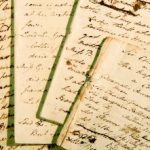
The Chawton House is very closely tied to Jane Austen’s history. In 1781, Thomas Knight II inherited the house. He and his wife Catherine had no children of their own, but through family connections with Jane Austen’s father, the Reverend George Austen, they eventually adopted Jane’s third brother, Edward, when he was 16 years old. Edward Austen eventually took over management of the estates at Godmersham and Chawton in 1797, living mostly at Godmersham and letting the Great House at Chawton to gentlemen tenants. In 1809 he offered a house in the village to his mother and two sisters Cassandra and Jane, and it was there that Jane Austen began the most prolific period of her writing life. Her career as a novelist took off with the publication of “Sense and Sensibility” in 1811, and she went on to publish a further three of her novels while at Chawton (two more followed shortly after her death). She lived in Chawton until her death in 1817, only moving to Winchester near the end of her life to be nearer medical care.
The Chawton House Library has a wonderful monthly podcast filled with interesting information. You should check it out and listen to their latest podcast here: http://www.chawtonhouse.org/?p=61772
The post Chawton House Library Conversations: June Podcast appeared first on Austen Marriage.
June 1, 2016
Help us pick the cover for Volume II
Volume II of The Marriage of Miss Jane Austen trilogy will be launched in September at the Jane Austen Festival in Bath, England. In the new book you will learn more about Jane Austen during the “lost years” of her life—seven years of which historians have little to no information. The period love story combines the charm and fierce wit of Austen’s comic masterpieces with a serious relationship set in the harsh realities and conflicts of the Regency period.
The trilogy answers the biggest mystery about the author: What did she do in her twenties, before she dedicated her life to writing? Tantalizing hints exist of a romance and possible scandal. Why were her letters and journals destroyed by her beloved sister? Why, afterward, did the vivacious Austen shut herself off from the world to write? Learn more of what really happened to Austen during the “missing” years of 1802 to 1809 during a turmultuous time in England’s history.
If you haven’t read the first book in the trilogy yet, pick up a copy today, offered at a special discount for a limited time, at www.janeaustenbooks.net. See why one critic called Volume I of The Marriage of Miss Jane Austen “an imaginative journey of the soul.“ You can find out more about Volume II when it is available this fall.
In the meantime…we’re asking for everyone’s input on a very important element for Volume II: the book cover. Below are two leading candidates for the cover of Volume II. Please indicate your preferences in comments.

Ballrooms were an important setting for romance in the Regency era. This cover treatment is intended to capture the excitement and intrigue of these important social events in Jane’s life which offered her so much good material to write about in her novels. Should this ballroom scene be the featured cover?

The beautiful English countryside nurtured Jane’s mind and soul, giving her the peace to contemplate the major events of her life. Should this outdoor scene be the featured cover?
Thanks for your input!
The post Help us pick the cover for Volume II appeared first on Austen Marriage.
May 19, 2016
North America Winner of Sweepstakes Announced
Please join me in congratulating Karen vanMeenen of Rochester, New York, the Grand Prize Winner from the US in The Marriage of Miss Jane Austen Sweepstakes 2016. She has won a fantastic Grand Prize trip for two to the beautiful UNESCO World Heritage City of Bath, England, to attend the Jane Austen Festival in September 2016.
K aren’s Grand Prize includes round-trip economy class air travel for two to London; a one-night hotel stopover in London; two round-trip train tickets to Bath; a three-night stay with daily breakfast for two at Three Abbey Green, a Four Star Gold Award guest house in the heart of Central Bath; free two-day admittance to the Jane Austen Festival in Bath, which is famous for being Austen’s one-time home; a tour of Bath and the surrounding countryside including Jane Austen’s house, the famous Bath Abbey, Roman Baths, the iconic Pulteney Bridge and Weir, Royal Crescent and King’s Castle among other sites.
Needless to say, I’m looking forward to sitting down for tea with Karen along with our UK winner Vicki Smith.
If you didn’t win one of our fantastic Grand Prizes, please don’t despair. As a special thank you to all of you who entered our sweepstakes we are offering a special discounted price ($11.50 for paperback; $19.50 for hardcover) for a limited time on your purchase of The Marriage of Miss Jane Austen from Jane Austen Books.
Photo: @Owen Benson
The post North America Winner of Sweepstakes Announced appeared first on Austen Marriage.
May 13, 2016
UK Winner of Sweepstakes Announced for Bath Festival

Drum roll, please!
It’s time to announce our Grand Prize Winner from Great Britain in “The Marriage of Miss Jane Austen” Sweepstakes 2016.
Vicki Smith of Manea in Cambridgeshire, England, is our lucky Grand Prize Winner! She has won an exciting Grand Prize trip for two to the beautiful UNESCO World Heritage City of Bath, England, to attend the Jane Austen Festival in September 2016!
We’ll be announcing our Grand Prize Winner from the U.S./Canada next week so stay tuned for that exciting news. You just could be our lucky winner!
Vicki’s Grand Prize includes two round-trip train tickets to Bath, three-night lodging with daily breakfast for two, and local tours and activities including the Jane Austen Festival.
In Bath, which is famous for being Austen’s one-time home, Vicki and her guest will enjoy exploring the cobblestone streets of the city and the picturesque valley of the River Avon. The city of Bath and the surrounding area is the setting for several pivotal chapters in “The Marriage of Miss Jane Austen,” Collins Hemingway’s new novel reimagining Austen’s life.
The Grand Prizes include free two-day admittance to the Jane Austen Festival, which begins Friday, Sept. 9; a three-night stay with daily breakfast for two at Three Abbey Green, a Four Star Gold Award guest house in the heart of central Bath; a tour of Bath and the surrounding countryside including Jane Austen’s house, the famous Bath Abbey, Roman Baths, the iconic Pulteney Bridge and Weir, Royal Crescent and King’s Castle among other sites; an exclusive tea with Collins Hemingway and signed copies of his novel.
If you didn’t win this fantastic Grand Prize, please don’t despair. As a special thank you to everyone who entered our sweepstakes we are offering a special discounted price ($11.50 for paperback; $19.50 for hardcover) for a limited time for your purchase of “The Marriage of Miss Jane Austen” on Jane Austen Books.
The post UK Winner of Sweepstakes Announced for Bath Festival appeared first on Austen Marriage.
May 4, 2016
Sweepstakes update, Austen movie fun
All–
Just a brief update to let you know that “The Marriage of Miss Jane Austen” Sweepstakes 2016 has concluded, and we’ll be announcing our Grand Prize Winners soon. Watch for updates here.
Also, Mary Jo Murphy in the New York Times ranked all the Austen movies done to date. More than sixty adaptations of Austen’s work, as I’ve mentioned before.
Note that the films are not listed in the order of rank; higher ranking ones are scattered throughout the article. The organization of the reviews is all the movies based on one book, then all the movies based on another, etc.
Murphy chooses the Jennifer Ehle/Colin Firth “Pride and Prejudice” as her favorite. I prefer the Emma Thompson “Sense and Sensibility.” Perhaps I’m not as enamored of the Colin Firth wet T-shirt contest as others may be–though he remains my favorite Darcy. Both movies are from 1995 and helped launch the modern Austen phenomenon.
Darcy’s shirt is coming to America, for those who are interested.
Note also that the critically well-received “Love and Friendship” will be officially released May 13. The movie, starring Kate Beckinsale and Chloë Sevigny, is confusingly named for one Austen story but is actually based on another, “Lady Susan.” I had always hoped that Austen might return to “Lady Susan,” an early unpublished work, and bring it up to the same level of quality as her major works. The main character, played by Beckinsale, is delightfully and unrepentantly evil.
The post Sweepstakes update, Austen movie fun appeared first on Austen Marriage.