Collins Hemingway's Blog, page 3
May 16, 2019
Pop Quiz for All You Students Suffering Spring Fever

Today brings a little fun and games in celebration of spring. (It comes late to the high desert in Oregon. Our trees are just now in bloom. See the dogwood by the headline.) Today’s blog features a quiz on a variety of Jane Austen topics. There’s no rhyme or reason to topics or order. The quiz has thirty questions. It’s so long I’m putting the answers just below each one. Otherwise, you’d spend all morning scrolling back and forth. It’s an honor system, but keep your score.
Let’s compare scores! Challenges to answers also welcome.
Ratings/Austen Equivalent:
0-12: Mr. Collins, who knows not what he does not know.
13-20: Edward Ferrars/Edmund Bertram, solid but not setting the world on fire.
21-25: Henry Tilney, learned on topics from muslin to crown lands to Udolpho.
26-30: Liz Bennet, fiercely demolishing all comers.
What American game does Jane Austen mention several decades before it was supposedly invented?
In listing the games that Catherine Morland likes to play as a 14-year-old, Austen mentions cricket, running around, riding on horseback, and—baseball.
What was Jane Austen’s pen name during her life?
“A lady.” She never published under her own name during her life.
What American rock star tried to buy Jane Austen’s ring in 2013, but was thwarted by English Janeites who raised £152,450 ($232,836) to keep the ring home?
Kelly Clarkson.
When did readers learn that Jane Austen was the author of “Sense and Sensibility” and “Pride and Prejudice”?
December 1817 or January 1818. Her brother Henry provided her name in a short biographical essay when he published “Northanger Abbey” and “Persuasion” after her death. The books became available in December 1817 but the official publication date was 1818.
How did Jane Austen’s sailor brothers make much of their money while in the service?
Through the sale of captured ships. Captains received one-fourth of the total prize money (reduced in 1806). Charles might have made £5,000. Frank might have made £10,000, which also included bonuses for escorting merchant ships home from India. Neither approached Captain Wentworth’s £25,000.
What item did her brother Charles buy Jane that is mirrored in “Mansfield Park”?
A cross and gold chain to be worn around the neck. Charles bought Jane a topaz cross, and another for his sister Cassandra. William Price buys his sister Fanny an amber cross.
John Murray published Scott, Goethe, Melville, Darwin, and Austen. But who was his most popular author?
Byron.
What Austen family members are known to have denounced slavery?
Jane’s oldest brother, James Austen, criticized slavery in a college periodical he produced, the Loiterer. Another brother, Frank, in a letter home while stationed on the island of St Helena in 1808, criticized slavery in any form.
Where does the Regency era get its name?
King George III of England, in his second madness, gave way to his son, who was named Prince Regent in 1811. The Regent had most of the powers of the king. Parliament wrestled with the legality of a regency because the King, now mad, would have had to sign off on the transition in power. The son became George IV on the death of his father in 1820.
Why do we know so little of the period between 1802 and 1809 in Jane Austen’s life (which is the time of my trilogy “The Marriage of Miss Jane Austen”)?
Jane’s sister Cassandra burned the vast majority of Jane’s letters and any diaries or journals she may have kept. No one knows why. Frank’s daughter, also named Cassandra, burned his large correspondence with Jane.
How many known proposals did Jane Austen receive during her life?
Only one, from a young, callow Harris Bigg-Wither, in December 1802. She was courted by several other men, including a mysterious clergyman in 1801, who died before he could propose. Though the Bigg-Wither proposal shows up in every biography, its provenance is sketchy. It was not reported until sixty-seven years after the fact, by a niece who was not alive when it allegedly occurred.
What is the most surprising thing about the last few years of the life of the great abolitionist William Wilberforce?
After giving away hundreds of thousands of pounds to charitable causes, Wilberforce died in poverty after an investment with one of his sons collapsed.
How could black slaves in English possessions in the New World earn their freedom?
By joining the British army, either to fight the American revolutionists in the 1770s on the mainland or later to fight the French in the West Indies.
What critical domestic device did Jane Austen have control of?
She had responsibility for the keys to the expensive luxuries: sugar, tea, and wine.
Once she settled in the village of Chawton, how did Austen keep her writing private?
A squeaky door would alert her to anyone coming her way; when it squeaked, she would put her writing aside.
In round numbers, how much money did Austen earn from her writing in her life?
£640. Her work earned another £700 or so after her death, all of which went to her heir, Cassandra.
After his high life as a banker came crashing down in bankruptcy in 1816, what career did Jane’s brother Henry pursue?
He became a clergyman like his father and oldest brother.
What is the most commonly cited reason for Jane Austen’s death in 1817 at age 41?
Addison’s disease, a disorder of the adrenal glands, though no one really can say for sure. This modern diagnosis is based on her complaints of skin discoloration, which could have been caused by a variety of illnesses.
Why were the officials at Winchester cathedral baffled by an increasing number of visitors to Jane Austen’s crypt over the years?
They knew her only as a clergyman’s daughter.
What was the sad truth about the lives of women in Austen’s time, as exemplified by her sisters-in-law?
Five of Austen’s six sisters-in-law died young, three of complications from childbirth.
Beyond showing that she had a tall, spare figure, what does a detailed examination of Jane Austen’s clothing tell us about her physique?
The shape of her torso indicates that the wearing of constrictive clothing when she was a young woman caused her ribs to flatten.
France’s power on land and England’s on the sea caused Napoleon to compare the two nations to which imposing animals?
Buonaparte said the long stalemate was a battle between an elephant (France, unbeaten on the continent) and a whale (England, unbeaten on the sea), because neither had a way to defeat the other.
Who is the only man in Austen’s novels to marry a woman older than he?
Mr. Collins is twenty-five when he marries Charlotte Lucas, twenty-seven, in P&P.
Who is the only female protagonist in Austen’s novels to marry “beyond her bloom”?
Anne Elliot in Persuasion, who is in her late twenties. Except for Emma, who had just turned twenty-one when she married, Austen’s other heroines were in their teens.
During the Regency era, what was the only way by which a husband and wife could divorce?
Through an act of Parliament. Only the wealthy and connected could afford divorce. Only two or three women obtained a divorce on their initiative.
In Austen’s six major novels, how many described kisses are there?
In all six novels, there are only five described kisses; one almost kiss; and one likely sneaked kiss, according to Austen scholar John Mullan.
What major character has the shortest time before becoming engaged in an Austen novel?
Catherine Morland becomes engaged to Henry Tilney in eleven weeks in Northanger Abbey. They married “within a twelvemonth.”
What secondary character has the shortest time before becoming engaged in a Jane Austen novel?
Charlotte Lucas becomes engaged to Mr. Collins after one day of courtship in Pride and Prejudice.
Who coined the term “Janeite”?
George Saintsbury coined the term Janeite in his 1894 introduction to a new edition of Pride and Prejudice.
Who popularized the term “Janeite”?
Rudyard Kipling popularized the phrase in his short story, “The Janeites,” about a soldier in World War I who believes there is a secret society of people, the Janeites, who read the author’s work.
—
The Marriage of Miss Jane Austen, which traces love from a charming courtship through the richness and complexity of marriage and concludes with a test of the heroine’s courage and moral convictions, is now complete and available from Amazon and Jane Austen Books.
The post Pop Quiz for All You Students Suffering Spring Fever appeared first on Austen Marriage.


April 18, 2019
Survey of Janeites, Thoughts on the Results

In 2008, the Jane Austen Society of North America took a survey of its membership about Austen’s characters. I’ve come across the results several times. I thought I’d recap them here and offer a few thoughts of my own.
Fully one-third of Janeites read three or more of Austen’s books in a year. Eleven percent read all six every year. By far (53 percent), Pride and Prejudice is the most popular book. Next is Persuasion (28 percent). Though it’s also my second favorite, most of my Janeite friends, plus several academics I respect, prefer Emma. I assume Persuasion carries the day because mature readers like the story of a mature woman having her “second spring.”
From Persuasion it’s a big drop down to Emma at 7 percent. Because of the popularity of the movie(s) made of Sense and Sensibility (especially Emma Thompson’s 1995 version, which set off the current Austen stampede), I was a little short of stunned that this book was so far down the list at 5 percent. I guess readers are more discerning than movie viewers; or, perhaps, the movie overcomes some of the book’s weaknesses.
Dragging their petticoats through the mud are Mansfield Park and Northanger Abbey at 4 percent each. I admire a lot of things about MP, especially the large cast of characters, but I don’t think Austen quite pulls off the multiple story lines. I always felt that Northanger was a nice first try, though I’ve gained more respect for it in recent close readings. When Austen gets away from the Gothic schtick, the writing in NA is, to me, better than that in S&S. I suggest that S&S was a more complete story in its original form of a novel-in-letters but that Austen did little in the way of revision beyond converting it to a direct narrative. On the other hand, NA seems much “younger” in some ways and limited by the Gothic framing device. Yet in other places, the writing is far crisper and more advanced than what seems to be the slightly more old-fashioned form in S&S.
Here’s a shock: The favorite heroine was Elizabeth Bennet (58 percent) over Anne Elliot (24 percent). Liz is the only heroine who goes toe to toe with every antagonist. I often wonder why Austen never came back to a similar strong lead character. No one else gets more votes than Elinor Dashwood’s 7 percent. Emma Woodhouse, whom I thought would poll higher, gets only 5 percent. Emma is strong, but she was born into a superior position. I feel a certain bemusement that Fanny Price would slightly outpoll Catherine Moreland, 3 percent to 2 percent. Fanny may have ramrod moral fiber, but Catherine’s a whole lot more interesting. Janeites feel no sympathy for the sensibility-laden Marianne Dashwood at 1 percent.
No surprise, either, for favorite hero: Fitzwilliam Darcy, 51 percent. Given the strong second position of Persuasion, it’s surprising that only 17 percent voted for Frederick Wentworth. I would have picked George Knightley as my leading man, but he polled only 14 percent. I guess a man’s being perceptive, kind, and hard-working doesn’t do it for the ladies (96 percent of survey respondents were female). Henry Tilney manages 10 percent and Colonel Brandon, 5 percent. I like Henry’s sense of humor, but he also does a lot of mansplaining to the ladies. I’m not sure I want to meet the 1 percent each who voted for Edward Ferrars and Edmund Bertram as the leading males. Austen must have liked them, but there’s no reason for anyone else to. I’ll qualify that by pointing out Edmund’s kindness to Fanny early on. But he’s oblivious to her feelings when it matters. His purloining of her horse for Mary Crawford is downright cruel. Edmund seems to marry Fanny because she’s the only female within sight at the end.
In the category of favorite bad boys, the top three were predictable: 33 percent chose Wickham; 28 percent, Willoughby; and 16 percent, Crawford. The rest of the list is puzzling. Frank Churchill, who polled 10 percent, is not a bad boy in the sense of an evil person with superficial charm. He’s an honest charmer and insensitive jerk. Flirting with another woman to disguise an engagement is not in the same league as seducing young women. William Elliot, on the other hand, is manifestly evil, yet he pulled fewer votes at 7 percent. Six percent went for General Tilney, who’s not a charmer or a boy. The General is nasty stuff, but Austen leavens him subtly by showing his continuing grief for his late wife. Catherine Morland misunderstands this as guilt over his having done away with her.
Here’s a survey question I’d have never thought of: Worst Parents. Sir Walter Elliot of Persuasion is the runaway winner at 54 percent. It’s sad to see Mansfield Park get all the other votes: 16 percent for Mr. and Mrs. Price and 15 percent for Sir Thomas and Lady Bertram.
I take exception to the votes against Sir Thomas. He takes in Fanny (and later her sister), he helps her brother get into the Navy and even pays to outfit him. It’s true that Sir Thomas angrily banishes Fanny to Portsmouth for rejecting Henry Crawford. But Sir Thomas doesn’t know she loves Edmund. He fears she is giving up a good man in Crawford and possibly the best offer she may ever receive. He thinks she’s being obstinate when she’s being true to her own beliefs. Fanny’s unpleasant stay at Portsmouth does teach her to appreciate Mansfield Park. Her absence, meanwhile, teaches Sir Thomas to appreciate Fanny.
Another fun category was four comic characters who delight us. P&P brings home the prize here, with Mrs. Bennet at 74 percent and Mr. Collins at 70 percent. The other two were Admiral Croft at 56 percent and Miss Bates at 50.
It’s understandable for Mrs. Bennet to lead the list. Being crass, she’s unintentionally funny. But she has also, I think, received more bad press than she deserves. Austen gives both sides of the story with her synopsis: “She was a woman of mean understanding, little information, and uncertain temper. When she was discontented, she fancied herself nervous. The business of her life was to get her daughters married.”
Unlike her husband, who seems content with whatever may happen with his brood, Mrs. Bennet is desperate to see them settled in a decent home. She lacks the natural joy of Jane or the intelligence and class of Liz, but she’s trying to take care of her children the only way she knows how. We sympathize, even as we chuckle.
 Admiral Croft is more than a funny guy. He’s astute enough to let Anne Elliot know that she’ll have another chance at Captain Wentworth: The Admiral’s wife, Sophy, is inviting him to Bath. Scene from the 1995 Persuasion movie directed by Roger Michell.
The Admiral is another puzzler. He has his amusing moments. He can navigate a 74-gun battleship around the world but can’t manage a one-horse gig on a country lane. Yet he is not a comic character. He’s a very wise one. Along, no doubt, with his wife, Sophy, Admiral Croft is a shrewd observer of people. His conversation with Anne Elliot on the streets of Bath is not that of a man oblivious to her situation but one very much aware of her feelings for Wentworth, and his for her. He lets Anne know she’ll get another shot at her man:
“Poor Frederick!” said he at last. “Now he must begin all over again with somebody else. I think we must get him to Bath. Sophy must write, and beg him to come to Bath. Here are pretty girls enough, I am sure. Do not you think, Miss Elliot, we had better try to get him to Bath?”
I have no idea if JASNA plans to update the survey. It’d be interesting to see if the responses have changed significantly over the last decade. About 4,500 people participated, a huge turnout. Janeites love their Austen characters, and love to offer their views on them.
—
The Marriage of Miss Jane Austen, which traces love from a charming courtship through the richness and complexity of marriage and concludes with a test of the heroine’s courage and moral convictions, is now complete and available from Amazon and Jane Austen Books.
The post Survey of Janeites, Thoughts on the Results appeared first on Austen Marriage.
March 21, 2019
How Do We Know Jane’s Stuff Is Really Hers?
A few weeks ago, Alexa Adams, a blogger on Austen Authors, wrote an interesting blog on the Rice portrait, which is believed by some to be a painting of a youthful, vibrant Jane Austen. Alexa was following up on an article in The Guardian newspaper claiming that a letter from Jane’s great-niece finally proves the painting is of Jane.
The newspaper article, and Alexa’s blog, brought a joyous reaction from many Janeites, who hoped that we finally have a good portrait of the author’s face. The puffy, dour image that “graces” the new ten-pound note and most books on Austen was not believed to be a good image of Jane by those who knew her. Alexa’s blog also received supportive comments from a member of the Rice family and from Ellie Bennett, a researcher who strongly supports the Rice claim. It also brought a not-so-fast response from a grumpy old man, namely me.
My point was not that the Rice family is wrong but that the evidence remains divided at best. I’d be tickled to death if the image of this animated and bright teenage girl is of our Jane. At present, the most knowledgeable Austen scholars and painting experts dispute the provenance of the Rice painting. In fact, in 2016 when I blogged about what Austen looked like, I did not even mention the Rice portrait because so many experts were lined up against it.
Nor am I here today to rehash that argument. Alexa’s blog has several good links, the comment section has a good back-and-forth, and a search on “Jane Austen Rice portrait” will lead to many more articles pro and con. (The Rice family has a website dedicated to their claims; The Guardian has more stories both positive and negative, Austen scholars weigh in, etc.)
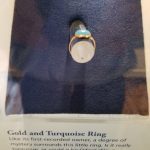
My point was that with anything related to Austen, or any important historical figure, the provenance of an object must be significant and largely undisputed. This is because of the need for historical truth, of course. And for the emotional response when people believe an object is related to a certain figure. If we’re going to practice an innocent form of idolatry with “religious” relics, they ought to at least be real. The love of Austen is so powerful that both regular Janeites and Austen scholars wear modern reproductions of her turquoise ring on their fingers.
Provenance also has a major financial value. The original of that small, inexpensive ring sold for £152,450 ($232,836) a couple of years ago. The watercolor of Jane by her sister Cassandra (which does not show her face) sold for £164,500 a few years ago. In 2007, the Rice portrait was estimated to be worth between £400,000 and £800,000 if it was of Jane. It failed to sell at auction in 2007 because of the uncertainty of its authenticity.
The issue also got me thinking about provenance. What should we expect in the way of accuracy with regard to historical objects? Is it enough that something “probably” or “likely” or “could have” belonged to Jane Austen (or William Shakespeare or Charlotte Brontë)? Should the information supporting the claim be something like a “preponderance of evidence,” which is used in civil cases? Should it approach the level of “beyond a reasonable doubt,” which is used in criminal cases? Must the object’s history meet the forensic quality of an “unbroken chain of custody” required in criminal cases? (This legal requirement ensures that evidence is not tampered with anywhere along the way.)
There are not many objects coming down from Jane. The provenance for Jane’s ring mentioned above is very, very good. It came with a note from 1869 listing the successive owners of the ring. This information was provided by the auction house when it was sold:
“PROVENANCE: Jane Austen (1775-1817); her sister Cassandra (1773-1845); given in 1820 to her sister-in-law Eleanor Austen (née Jackson), second wife of Rev. Henry Thomas Austen (d. 1864); given in 1863 to her niece Caroline Mary Craven Austen (1805-1880, the daughter of [Jane’s brother] Rev. James Austen); her niece Mary A. Austen-Leigh (perhaps first to her mother Emma Austen-Leigh, née Smith); her niece Mary Dorothy Austen-Leigh; given to her sister Winifred Jenkyns on 27 March 1962; thence by descent.”
American rock star Kelly Clarkson bought the ring at auction in 2014. The resulting uproar led to private donors in England raising the money to keep it within the country. It is now on display at Jane Austen’s House Museum (JAHM) in Chawton. It might be possible to claim that another ring was substituted over the years, but it appears that the jewelry was a beloved remembrance of Jane and Cassandra from the earliest days and the family has cared for it for 240-plus years.
Another Austen item is the two topaz crosses given by Charles Austen to his sisters Jane and Cassandra with naval prize money in 1801. According to JAHM, the provenance of the crosses is significant but not as clear-cut as it is for the ring.
The crosses were presented to the Jane Austen Society (UK) by an American professor, Charles Beecher Hogan, in 1974, following his address at the AGM. Hogan was an expert on Austen and a collector of Austen first editions. He had purchased the crosses, along with Jane’s letter about them, from a bookseller. He gave them to his wife, CC, as a wedding present. When they visited renowned Austen scholar R. W. Chapman, his first words to her were: “In case of divorce the crosses and letter stay together.”
The two crosses are now at JAHM, on loan from the Society, along with the Jane Austen letter of 26-27 May 1801 in which they are mentioned. This is the letter in which, writing to Cassandra, Jane playfully admonishes their youngest brother Charles for spending his prize money on gifts to his sister. “He must be well-scolded,” she says.
When Hogan announced his donation of the crosses to the Jane Austen society, he casually pulled them out of his pocket to wow the audience. No heavy security here! The museum has a letter from Hogan to Sir Hugh Smiley that states: “I bought them (the crosses) a great many years ago, along with the letter that corroborates them. The bookseller told me that he had acquired them from a member of the family of Charles Austen, the original donor.”
 Charles Austen bought a topaz cross for each of his sisters. For years, this one, the shorter and “fatter” of the two, was believed to be Jane’s. Now, it’s not clear which sister received which cross.
There’s not, technically, an unbroken chain of references for the crosses, nor apparently any written authentication from the family member who sold it. However, the fact that it comes with the original letter in which the crosses are mentioned is also “probative,” as a lawyer might say—providing proof.
It’s also noteworthy that the crosses came to Hogan via Charles’s family. It would have made sense that Cass, who survived Jane—and like Jane was childless—would have bequeathed the crosses back to one of Charles’s descendants. Cassandra destroyed most of Jane’s correspondence, but the letters she kept were given back to the family members whom they involved. For example, Jane and Cass wrote each other regularly when one or the other was staying with their brother Edward’s family at Godmersham in Kent. Cass left a large selection of those letters to Edward’s daughter, their niece Fanny. This correspondence was eventually published by her son, Lord Brabourne, in 1884. These letters, plus several others previously published in the family Memoir of 1870 by the Steventon branch of the family, form the core of what now totals 161 known Austen letters.
With the topaz crosses, we have a contemporary reference to the topaz crosses as gifts in Jane’s letter—in her handwriting. After the death of Jane and Cass, we have two crosses that match the description of the simple topaz crosses ending up in Charles’s family. We also have a photo at JAHM of one of the Austen descendants wearing what appears to be the shorter, “fatter” cross of the pair. For many years, it was thought to be Martha Lloyd, the lifelong friend of Jane and Cass who eventually married their brother Frank. Thus, Martha may have received the cross first, after Jane’s death; further, that meant the “short, fat” cross was Jane’s. However, it was discovered a couple of years ago that the photo had been made with technology that did not exist until after Martha’s death, so the woman was a later relative. This fact means that the museum now has no way of knowing which cross belonged to which sister—the shorter, fatter cross and the longer, slimmer cross.
In summation, the provenance of the crosses has a clear starting point in 1801 from Charles in Jane’s own hand. Both the crosses and the original letter “corroborating” the crosses came down through Charles’s family. We have them being sold to and through a bookseller specializing in Austen material, which is a logical connection, to an expert in Austen. The price is not known, but Jane was not the rock star that she is today. It likely was not ridiculously high.
Jane’s ring shows an unbroken chain of possession through the family descendants. The provenance of the crosses begins during Jane’s life, but there are also “gap years,” when the ownership is not documented. The assumption is that it stayed in the family until being sold to the bookseller. If that’s true, it’s likely that no one bothered to write down each handoff. Having the original letter in which Austen herself mentions the topaz crosses, the family may not have felt any more proof was necessary.
It seems that the information supporting the crosses meets the standard of a “preponderance of evidence.” Do we have enough information to believe there was also an “unbroken chain of custody”? Would that matter here, since we also have the corroborating letter? Should we require the evidence to be “beyond a reasonable doubt”? Do the topaz crosses meet that requirement?
—
The Marriage of Miss Jane Austen, which traces love from a charming courtship through the richness and complexity of marriage and concludes with a test of the heroine’s courage and moral convictions, is now complete and available from Amazon and Jane Austen Books.
The post How Do We Know Jane’s Stuff Is Really Hers? appeared first on Austen Marriage.
February 21, 2019
Sailing the Seas on a Family Ship
Last month, we saw how Jane Austen’s family used connections to help promote the careers of her two sailor brothers, Frank and Charles. When we left them, the Napoleonic wars were ending, causing a glut of naval officers. The Austen brothers’ lack of connections—their few sponsors had fallen out of favor—stymied both brothers’ advancement.
Both stayed in service, however, for they really had no other way to make a living. Frank remained in service and received promotions and awards, but had no sea command for twenty-nine years. Only after attrition thinned the senior ranks, when he was seventy-one, did he get another ship. In 1844, he became commander in chief of the North American and West Indies Station. Eventually, his longevity made him Admiral of the Fleet.
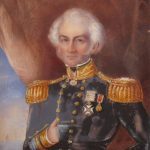
Charles (above, as senior officer, by headline) had spent most of the war on the North American Station, alternating between Bermuda and Nova Scotia. He took a number of prizes, though none was substantial. After an assignment on a guardship at the mouth of the Thames, he returned to sea in the Mediterranean. There, however, he lost his ship, the Phoenix, when a local pilot drove it upon the rocks near Smyrna, Turkey. Though he was cleared of wrongdoing, the loss could not have come at a worse time. With the war ending, and a surplus of captains, who was going to give a command to someone whose ship had sunk?
For nine years, Charles had a land position overseeing coast guard operations. Then one day, he saw the Aurora preparing to sail, but the captain’s flag was at half-mast. According to Brian Southam, Charles took a small boat over to the ship to confirm the captain’s death, presented his credentials to the Admiralty, and inquired about the opening. Asked when he could sail, he said: “tomorrow!” In fact, he sailed four days later. (Clive Caplan, another naval expert, discounts Southam’s story, claiming it was “bogus.”)
From 1826 until his death in 1852, Charles was again at sea; his only extended time on land was when he was invalided for a year after falling from a mast. He led the fleet capturing Rangoon and died of cholera in Burma at the age of 73.
Giving preferment to a family member created what was known as a “family ship.” Having lacked the family or wealth to advance their own careers, Frank and Charles did not hesitate to use nepotism to help their own relatives when they were finally in a position to do so.
On Frank’s flagship Vindictive in North America in 1845, his officers included George, his third son, as chaplain; and Herbert, his fourth son, as flag lieutenant. Frank sought to have his namesake oldest son named flag captain, but the Admiralty vetoed the idea. When Frank promoted Herbert to be commander of the Vesuvius, he named Charles’ namesake son to replace Herbert as flag lieutenant. Frank also had on board his daughters Cass and Frances. Cass apparently was not well-liked; crewmembers christened her “Miss Vindictive.”
Brother Charles also packed his family ship when he took command of East India and China in 1847. His son Charles was an officer, and his nephew, Frank, was his flag captain (this appointment passed Admiralty scrutiny). He had three great-nephews aboard, one via Frank and two from the family of the wife of his brother Edward. Another of his officers was Tom Fowle. This was the nephew of the Tom Fowle who had been the fiancé of sister Cassandra and who had died at sea years before. The younger Tom had previously served under both Austen brothers.
Charles’ first wife, Fanny, had sailed with him before she died young as a consequence of childbirth. Later, he married Fanny’s sister Harriet, who after Fanny’s death had cared for his children when he was away. On this trip, he took Harriet and his daughters Cassy, Harriet, and Fanny. Like Charles’ two wives, as well as Persuasion’s Mrs. Croft (and possibly Anne Elliot after marriage), daughter Fanny was onboard as a navy wife—she had married her cousin Frank.
By sheer tenacity, Austen’s sailor brothers rose to the highest ranks of their profession. Beyond post-captain, promotion was based on seniority, and the Austen boys outlived—and eventually out-sailed—their better-connected competitors. They brought along for the ride as many of their family as they could.
—
The Marriage of Miss Jane Austen, which traces love from a charming courtship through the richness and complexity of marriage and concludes with a test of the heroine’s courage and moral convictions, is now complete and available from Amazon and Jane Austen Books.
The post Sailing the Seas on a Family Ship appeared first on Austen Marriage.
January 24, 2019
Networking in the Age of Sail

Unlike Army officers, members of the Royal Navy could obtain commissions without purchasing them. This difference created opportunities for the penurious sons of gentlemen like Jane Austen’s father, the Rev. George Austen. Two of his younger sons, Frank and Charles, joined the Navy when they were barely into their teens.
Getting ahead in the Navy was another matter. That required connections and an occasional greased palm. The Austens did not hesitate to use both to advance the cause of their sons.
To help Frank, Mr. Austen in 1794 wrote Warren Hastings, the former governor-general of India and godfather of Jane’s cousin Eliza. Hastings wrote to First Naval Lord Affleck. On Jane’s mother’s side, the Leighs, were two captains, Stanhope and Chamberlayne, who became rear admirals after Frank and Charles entered service. Jane’s cousin, Jane Cooper, married Captain (later Admiral) Thomas Williams, who became Charles’ patron.
Of all the relatives, the strongest connection came through Anne Mathew, the first wife of Jane’s oldest brother, James. Married to James only a few years before her death, she was the daughter of General Edward Mathew. Mathew had two nieces; each sister married a Gambier brother: James, future Lord of the Admiralty; and Samuel, Secretary of the Navy Board.
James Gambier was instrumental in Frank’s early promotions and Frank served him in several captaincies. Gambier was also called upon to help Charles. In a letter of 18-19 December 1798, Jane jokes to Cassandra that Gambier “will be delighted” to have another Austen to help. Jane adds that Charles “would be very right” to address Sir Thomas Williams as well.
A week later, Jane updates Cass to say that Gambier has replied that Charles will be transferred to a larger ship “when a proper opportunity offers & it is judged that he has taken his Turn in a small Ship.” As for Frank, Gambier says: “I can give you the assurance that his promotion is likely to take place very soon.” Later in the letter, Jane adds that Charles has told her that he has directly written Lord Spencer of the Admiralty. Spencer has now received so many applications from the Austens, Jane says, that he “might order some of our heads to be cut off.”
Just two days later, she exults at the success of the letter-writing campaign: “Frank is made.—He was yesterday raised to the Rank of Commander, & appointed to the Petterel sloop … and Lieut. Charles John Austen is removed to the Tamer frigate.” (Jane misspells the name of the Peterel and Tamur. But the navy itself spelled the Peterel four different ways until settling on Peterel. In a later letter, when Charles is reassigned to his earlier ship Endymion under Captain Thomas, she corrects that name to Tamar.)
Through the Gambiers, the family also became connected with Lord Moira, a senior military figure and an influential companion to the future prince regent and king, George IV. Brian Southam, in his 2005 book Jane Austen and the Navy, documents the ways that Moira helped Frank.
The conventional belief is that Charles moved up largely because of Sir Thomas Williams. Stuart Bennett, however, in a 2013 Persuasions article, reveals correspondence at the Huntington Library that also ties Moira to Charles’ advancement. The letters illuminate a quid pro quo in which Henry’s bank lent Moira money in exchange for letters of support to naval authorities. In 1803-4, Moira received loans totaling at least £2,000 from Henry, with Moira’s patronage leading to Charles receiving his first command, the sloop Indian in Bermuda. Another exchange of loans for letters in 1805 attempted to obtain Frank a frigate—the most potentially lucrative ship for winning prize money—but that effort failed.
Eventually, Lord Moira and James Gambier both fell out of favor politically and ceased to be able to provide much help. Also, Moira’s inability to repay the original loans left Henry unable to lend more. His financial negligence was a major cause of Henry’s bankruptcy in 1816, which devastated the finances of the entire Austen family. Conservative Jane lost only £13; most of the £640 she had earned as a writer was invested—where else?—in safe Navy stock paying 5 percent annually.
Most of Frank’s commands involved old, slow vessels, and he didn’t make much prize money from capturing enemy ships. Typical of these was the Canopus (above, by headline), which was so slow it was the last to engage the enemy in a major battle at San Domingo in the West Indies. But once there, Frank’s broadsides dismasted two enemy ships.
Only once did Frank receive a modern ship, the Caledonia, the newest and finest in the fleet, a first-rater with 120 guns. This was the flagship of his patron, now Admiral Lord James Gambier. (On a flagship, the admiral would command the fleet while the flag captain would command the ship.) When Gambier was replaced a few months later, the new admiral took the captaincy from Frank and gave it to his son-in-law.
Jane’s letter of 18-20 April 1811 shows her alarm at his loss: “Saturday.—Frank is superseded in the Caledonia. Sir Edwd Pellew succeeds Lord Gambier … & some Captain of his, succeeds Frank; … what will he do? & where will he live?” Frank ended up in command of the seventy-four-gun Elephant, a solid warship but no prize-taker. It was his last sea command for nearly three decades.
Next month: What happens when the sailor brothers take command.
—
The Marriage of Miss Jane Austen, which traces love from a charming courtship through the richness and complexity of marriage and concludes with a test of the heroine’s courage and moral convictions, is now complete and available from Amazon and Jane Austen Books.
The post Networking in the Age of Sail appeared first on Austen Marriage.
November 28, 2018
Does Henry Tilney Speak of a Modern Riot?

Last month, this blog covered the confusing conversation between Catherine Morland and Eleanor Tilney in Northanger Abbey, when Catherine is talking about the horrors of a new Gothic novel but Eleanor thinks she’s describing rioters about to descend upon Bath. Henry Tilney sees what’s happening but eggs on the confusion. Finally, he tells Eleanor that the only riot is in her brain, that Catherine is talking of nothing more dreadful than a scary new book featuring tombstones and lanterns.
Henry makes fun of Eleanor’s gullibility, which has her picturing “a mob of three thousand men assembling in St. George’s Fields, the Bank attacked, the Tower threatened, the streets of London flowing with blood, a detachment of the Twelfth Light Dragoons (the hopes of the nation) called up from Northampton to quell the insurgents, and the gallant Captain Frederick Tilney, in the moment of charging at the head of his troop, knocked off his horse by a brickbat from an upper window.”
It is intriguing that Henry gives a detailed description that could stand for any one of the many riots in Britain in those days. The militia or army was regularly called out to quell dissent and just as regularly fired on crowds of citizens. Even brickbats are described as weapons for the common man, being cited in use against 10 Downing Street in 1794 and against a high-priced corn dealer in 1800.
R. W. Chapman, who put together the first authoritative edition of Austen in 1923, identifies Henry’s event as the Gordon Riots. This is puzzling in the extreme, since the Gordon Riots occurred in 1780, when Austen was only five years old, and did not happen at the named location. Chapman seems to have picked the largest disturbance—some 50,000 people, in which about 285 people were killed. Yet, unlike the general protests over food and wages, the Gordon Riots were a massive anti-Catholic disturbance. It’s also possible that Chapman confused the Gordon Riots with the Massacre of St. George’s Fields in south London, in which about a dozen people were killed. However, that more typical protest occurred 10 May 1768, before Austen was even born.
It seems unlikely that Austen would have referenced riots from decades earlier, when there were ongoing upheavals that would have been known to her audience, including a massacre in Scotland and riots in Bristol in 1793, mass protests and a militia mutiny in 1795, a naval mutiny in 1797-98, and regular rebellions in Ireland in which thousands died. One such conspiracy, the Pentrich rising, occurred as Austen lay on her deathbed in June 1817.
There is also a very good possibility that Henry Tilney is identifying a specific riot of surprisingly late date. In mentioning the thousands “assembling in St. George’s Field,” he may not have been referring to the London site but to St. George’s Field in Manchester, where a major riot occurred in May 1808. This riot is important not only for its social commentary but also for being at least five years after the last acknowledged revision to the text.
 Was Henry Tilney in “Northanger Abbey” talking about an actual riot in England, an event that happened years after Jane Austen supposedly finished the novel?
Manchester, a major cotton-weaving area, had been a source of dissent and revolt for years. Significant layoffs in textile factories and the lack of work for home textile workers brought 6,000 weavers to St. George’s Field in Manchester on 24 May 1808 to demand a minimum wage. City officials sent in the dragoons and the crowd fled, but 15,000 people returned the next day. Dragoons opened fire, killing one man and injuring others. Jenny Uglow recounts in her book In These Times that protests and riots spread into nearby towns, along with strikes and the sabotage of weaving looms and cloth. Ultimately, weavers received a small pay increase, though work remained scarce.
In her “Advertisement” for Northanger Abbey, Austen says the novel was finished in 1803, which is when she sold it as Susan to the publisher Crosby. After reclaiming the rights and changing the name of the main character (another novel Susan had since been published), Austen apologized to readers in 1816 for subject matter that after thirteen years was now “comparatively obsolete.” She may not have considered that comment to include minor edits she might have made along the way. Her 13 March 1817 letter to her niece Fanny says that Catherine has been “put upon the Shelve for the present,” implying that she may have worked at it around the edges after finishing Persuasion.
Janine Barchas, Margaret Doody, and others have made a convincing case that Austen uses names for characters and locales that have special meaning for her, as well as for her alert readers. This is why Henry’s riot description may be an important late addition. The St. George’s Field Riot of 1808 in Manchester, combined with the London references, gives readers the same north-south combination that typified the most dangerous threats to the government. The big conspiracies involved one set of rebels capturing important people and sites in London, while another group would start an uprising in the north.
Dragoons also played a crucial role in Manchester, as opposed to several different military units in earlier London riots. In actual history, these dragoons could have been local, but Henry’s naming of the Twelfth Light Dragoons would have had resonance. The unit was formed nearly a hundred years earlier to help put down the Scottish rebellion of 1715 and was stationed in Ireland until 1793 as a bulwark against Irish unrest. To that date, the Twelfth had been the instrument of repression for England. Also, when Henry says that the regiment was “called up from Northampton,” he could mean more than their mustering. He could mean they came up from Northampton to Manchester—north. If they had gone to London, he logically would have said that they “came down”—south.
A final point may have had significance to Austen. After the riot, the dragoons apologized to the weavers for their actions and took up a collection for the family of the man who was killed. Of the dozens of unprovoked attacks on civilians in the Regency period, this may have been the one time the military apologized for what it did. Austen may have felt that this small, contemporary gesture of kindness—civility in otherwise uncivil public affairs—was worth a modest update to her otherwise finished work.
The Marriage of Miss Jane Austen, which traces love from a charming courtship through the richness and complexity of marriage and concludes with a test of the heroine’s courage and moral convictions, is now complete and available from Amazon and Jane Austen Books.
The post Does Henry Tilney Speak of a Modern Riot? appeared first on Austen Marriage.
November 3, 2018
London Run Riot: The Overt Politics of Austen’s Gothic Romp
During Jane Austen’s life and beyond, England was beset with constant internal strife—labor protests, political riots, and military mutinies. These came as the result of falling wages–caused by increasing mill automation–high-priced food, and the harsh conditions and poor pay of military life. From the mid-1790s through the end of Austen’s life, a major insurrection would boil up at least once every couple of years.
These rebellions, coupled with the revolutions in the United States and France—the latter disintegrating into the wholesale slaughter of the aristocracy—left Tories deathly afraid that they, the King, and traditional British order would be overthrown as well, either by the demon Democracy or la Terreur.
Yet one must read Jane Austen carefully to find topical mentions of these big issues of the day. Northanger Abbey, her least mature work—completed first, published last—turns out to contain the most overt references to political dissent.
The first such reference involves General Tilney’s reading material. During Catherine Morland’s stay with the family, he says to her one evening: “I have many pamphlets to finish before I can close my eyes, and perhaps may be poring over the affairs of the nation for hours after you are asleep.” Catherine is not impressed by his pompous self-regard. She assumes that his late-night activities relate instead to her Gothic vision of wanton cruelty to a wife rattling about in hidden rooms of the abbey: “To be kept up for hours, after the family were in bed, by stupid pamphlets was not very likely. There must be some deeper cause.”
We never learn the details of the pamphlets, but we can presume that the Tory general, who by age would have fought against the Americans in the Revolutionary War, is not reading the latest tract on the freedom of man by the firebrand Thomas Paine. More likely, he is reading a pamphlet published by the Bath Loyal Association (BLA), which he would have picked up while in the resort town. Set up under the auspices of the Bath mayor at the time of the French revolution, the BLA was an “Association for preserving Liberty and Property and the Constitution against the Levellers and Republicans.”
Among other things, it published a declaration pledging undying loyalty to the King. Signed by hundreds of people, the pledge declared that “the wild doctrine of equality, newly propagated, is unknown to the English Constitution, is incompatible with Civil Society, and only held forth as a Delusion to mislead the lower ranks of the people, to poison the minds of his Majesty’s subjects … and to substitute Anarchy in the place of our mild and happy Government.”
By equating equality and a republican form of government with anarchy, conservatives created a deadly self-fulfilling cycle. The government put down nonviolent pleas for reform as ferociously as insurrections, driving more people into the folds of the rebels and creating more anti-government plots.
Most of the insurgencies had the same game plan. One set of conspirators in London would try to seize the king, key members of Parliament, funds from the Bank of England, and weapons from the Tower of London. Another set of revolutionaries would simultaneously start a revolt in one of the northern counties, areas that seethed with unhappy factory workers, or in Ireland, which hated English rule. The hope was that a general uprising would bring in disgruntled soldiers. The northern militants would march south and join forces with the London cadre, and Liberté would reign.
Unfortunately for the rebels, England’s extensive spy network exposed the larger plots before they could be carried out. As detailed in Sue Wilkes’s Regency Spies: Secret Histories of Britain’s Rebels and Revolutionaries, the typical result would be local outbreaks of violence that were quickly put down, the execution of two or three leaders, and transportation (exile) for another dozen or so conspirators to the penal colony of Australia. The government and Tory press played up these intrigues to justify further harsh suppression of any protest.
 In Henry Tilney’s condescending view, the women in “Northanger Abbey” are not aware of the bigger social and political matters of the day–though his sister, in fact, is very much up on current events.
This—a succession of threatened and failed revolts—is the historical context for one of the funniest scenes anywhere in Austen, when Catherine Morland and Eleanor Tilney talk past each other on current events and Henry Tilney eggs on their confusion. The exchange begins as Henry is “mansplaining” to the ladies about various important topics. When he pauses, Catherine solemnly says: “I have heard that something very shocking indeed will soon come out in London. … It is to be more horrible than anything we have met with yet. … It is to be uncommonly dreadful. I shall expect murder and everything of the kind.”
The last subject having been politics, Eleanor is startled, thinking Catherine is talking about a new uprising when instead she means the usual wild, horrific events sure to be part of a soon-to-be-released Gothic novel. Believing that the working classes are marching down from London to terrorize Bath, Eleanor reacts: “Good heaven! … You speak with astonishing composure! But … if such a design is known beforehand, proper measures will undoubtedly be taken by government to prevent its coming to effect.”
Henry sees what is going on but decides to join in the joke at his sister’s expense. “Government,” he says, “neither desires nor dares to interfere in such matters. There must be murder; and government cares not how much. … ” Eleanor responds: “Miss Morland, do not mind what he says; but have the goodness to satisfy me as to this dreadful riot.”
“Riot! What riot?” Catherine exclaims, now equally confused.
Henry then tells Eleanor that the only riot is in her brain, that Catherine is talking of nothing more dreadful than a scary new book featuring tombstones and lanterns. But he criticizes Eleanor’s gullibility, which leads her to picture “a mob of three thousand men assembling in St. George’s Fields, the Bank attacked, the Tower threatened, the streets of London flowing with blood, a detachment of the Twelfth Light Dragoons (the hopes of the nation) called up from Northampton to quell the insurgents, and the gallant Captain Frederick Tilney, in the moment of charging at the head of his troop, knocked off his horse by a brickbat from an upper window.”
Henry’s jocular but condescending point is that Eleanor, Catherine, and women in general have no understanding of public issues or other weighty subjects. Given Catherine’s rapid switch of topic and lack of clarification, however, Eleanor has every reason to be alarmed at the very real possibility of public violence—especially if the army is involved. Eleanor insists on an apology for his affront to her, which he gives in his usual half-serious manner.
This is Henry’s typical treatment of his sister, and even to Catherine, to some degree. As the scene ends, we’re unsure whether he has actually apologized or is still laughing at them rather than with them.
Next time: Does Henry’s riot reference change our understanding of when Austen finished Northanger Abbey?
The Marriage of Miss Jane Austen, which traces love from a charming courtship through the richness and complexity of marriage and concludes with a test of the heroine’s courage and moral convictions, is now complete and available from Amazon and Jane Austen Books.
The post London Run Riot: The Overt Politics of Austen’s Gothic Romp appeared first on Austen Marriage.
October 4, 2018
Persuasion–and Anne Elliot!–Comes to Kansas City

The 2018 annual general meeting of the Jane Austen Society of North America in Kansas City focused on Persuasion, Jane Austen’s last and most poignant novel. The AGM featured numerous insights into both the book and issues related to it, including my own talk on the influence of Jane Austen’s naval brothers on the text.
 Traditional promenade on Saturday night featured the usual assortment of lovely gowns and officers’ uniforms
Hazel Jones gave a fascinating lecture on Steel’s List of the Royal Navy and the Naval Chronicle. These were the publications that people at home would follow as to the location, leadership, and activities of naval vessels during the long war with France. Frank and Charles, the naval officers who were Jane’s brothers, show up from time to time for their exploits and postings.
Jones also showed several notations, including the loss of a sloop, that would have rated the bare mention that Captain Wentworth speaks of, had he gone down in the weather-beaten, nondescript Asp. I’d wondered before why the Royal Navy allowed so much information to be published about its warships, as it provided the French—and later, Americans—detailed description of military dispositions. It was not until 1813 that the Navy got wise and began to reduce its public information.
 A lady on her evening stroll with her gallant captain
Janine Barchas gave a well-illustrated talk on the importance of the cheapest and most overlooked editions of Jane Austen. Most of these were printed under new and sometimes garish covers with the general idea of “new and improved!” But most of them went back to Richard Bentley’s early editions, using the same plates, and sold for much less than the “authoritative” editions. The cheap offspring would sell for three to six shillings—eventually even less—compared to eighteen to twenty-one shillings for a “proper” book.
Bentley’s page plates lasted as the source for most Austen editions for at least fifty-eight years! The takeaway from Barchas’s talk was that the cheap editions were in fact responsible for Austen’s growing popularity, as they were the source for most of the books that the general public read. And also that various editions can be traced back to the original plates by the wear shown on the printed pages. Like fingerprints, each of Bentley’s plates suffered unique wear and each printed copy was traceable to its source.
So Jane Austen was a major part of the original pulp fiction.
John Mullan gave his usual charming, funny, and innovative take on a particular topic. His plenary was about the self-delusion shown by all the characters. Sir Walter deludes himself about his self-worth, but Anne also deludes herself—at least, suppresses herself and her reactions to the world, and Wentworth. The Captain, of course, deludes himself at first that he no longer has any feelings for Anne.
 Erna Arnesen and Jeanne Talbot of the San Diego region enjoy the promenade
James Nagle provided all that anyone would want to know about prize money for naval captains, including a fact I did not know—that if someone died, his share went not to his family but to the Crown for a naval hospital.
The most emotionally satisfying talk was not by a scholar but by an actress–Amanda Root, who played the quintessential Anne Elliot in the 1995 movie of the novel. First there was a filmed interview of her by Gillian Dow of Chawton House (in case Amanda could not attend because of her work schedule), then there was Amanda herself. She read some of the most memorable excerpts from the book as well as her own journal from the 1995 filming, when she would write, as Anne, responding to things Austen had written in the novel. In between, she answered questions from the audience.
 The youngest attendee with her proud mother
Amanda in person came across very much like Anne Elliot–thoughtful, self-effacing, and quiet (until she laughed). The conference was proclaimed as the largest JASNA AGM in history. It was certainly a very well-organized event under Julienne Gehrer and her team. The hotel conference area was sufficiently large but reasonably compact, so that it was easy to move from session to session. The emporium was also in one room, which was nice for the shoppers and vendors both.
—
The Marriage of Miss Jane Austen, which traces love from a charming courtship through the richness and complexity of marriage and concludes with a test of the heroine’s courage and moral convictions, is now complete and available from Amazon and Jane Austen Books.
The Trilogy is also available in a single “boxed set” e-book.
The post Persuasion–and Anne Elliot!–Comes to Kansas City appeared first on Austen Marriage.
September 6, 2018
Balancing Historical Figures and the Story

Recent posts have been about the best way to use history in historical fiction. The goal is to use as much history as possible without burying the story in unnecessary details or derailing the story with unnecessary asides. You want to have history support your story. You don’t want the story to become just travelogue in which the characters watch history parade by.
In previous blogs, I’ve given examples of writers who used history well (and sometimes didn’t), and I’ve given examples of fascinating history I chose not to use because it didn’t meet the criteria. Today, I want to give examples of history I did use, and why.
The Marriage of Miss Jane Austen involves the “missing years” of Austen’s late twenties. We know little of this period, for Austen’s family destroyed virtually all the documentation of it. But there have always been rumors of a lost love or tragic affair. Vague family references to this possible romance or that possible romance are confusing and smack of disinformation. It makes inquiring minds wonder whether her uptight Victorian relatives didn’t want the world to know about a particular romance. …
This time of her life was also appealing because Austen was no ingenue. By September 1802, she was nearly twenty-seven. In a phrase of the time, she had “lost her bloom,” and in her own phrase she was approaching the “danger years” for a single woman looking to marry.
What would have happened if she, as a mature woman, had married in those years to a man who would be seen as perhaps disreputable for her Victorian nieces and nephews? Regardless, I wanted to see how a strong, intelligent woman would handle the slings and arrows of outrageous fortune, which was life for women in the 1800s.
Jane lived in Bath in 1802, so that became the setting. I wanted to honor the city and its social life by beginning the novel with a ball. I also gave a tip of the hat to the city’s legendary masters of ceremony by making oblique references to these two great social arbiters. The first was Mr. Beau Nash, who was the mediator of taste for decades in the generations before Austen. After Nash, Mr. James King was master of ceremonies of the Lower Rooms from 1785 to 1805 and the Upper Rooms after that. It was common for the MC to make introductions. In Northanger Abbey, the real Mr. King introduces the fictional Catherine Morland and Henry Tilney.
I wanted the entrance of the male protagonist, Mr. Ashton Dennis, a bright but uncouth young man, to cause a stir. I was delighted to find that Mr. Nash had once confronted another ill-dressed young man who wanted to attend one of “Nash’s” balls. I used Nash’s challenge to open the book, though my leading man fared better than the original.
In The Marriage of Miss Jane Austen, Mr. Shanking is an amalgam of two MCs (his name, in particular). Physically, the character is based on a portrait of Nash as an older man (above, by headline). This fact led to a near-mistake of overdoing things in a small but meaningful way. In my desire to be historically correct, my detailed description of Mr. Shanking, a minor character we never see again, made him as prominent as the main character, Mr. Ashton Dennis. (Ashton physically resembles real-life Harris Bigg-Wither and sartorially resembles the real-life Tom Lefroy, both beaus of Austen.)
But I had to shrink Mr. Shanding into the background. Deleting one’s transcendent prose is like disinheriting one’s children. Nonetheless I whacked back the description of the MC until his existence was confined to “looking more French than English in his powdered wig and a florid velvet outfit.” It was a small but important victory for editing and context.
The novel being about Austen, I routinely slipped in a phrase here and there from one of her letters or novels (seldom one of her more memorable lines). In Chapter 1, Jane looks out on the dance floor and sees women “with the same broad face, bandeau, white shoes, pink husbands, and fat necks.” Jane used a similar phrase to describe a Mrs. Blount at a ball, Letters, 20-21 November, 1800.
The rest of the scene involves Ashton seeking to entice Jane into a dance, while her sister Cassandra, and Ashton’s sister, Alethea (the name taken from a Bigg-Wither sister), look on. When Jane refuses, Ashton heads out to dance with other eligible women.
I had read numerous articles on Georgian-Regency dances. I understood the kinds of dances, the general flow, the look of ballgowns, etc. Ditto with the description of the Upper Rooms. I could even point out the actual orchestra conductor, Mr. Rauzzini, who wore a tied-on wig. But I did not have enough information to feel comfortable with any detailed rendering of dance protocol. My early drafts “vagued up” the actual performance.
 Susannah Fullerton’s book “A Dance with Jane Austen” provides the ordinary reader and a fiction writer with everything they might want to know about dance during Austen’s day.
Then I came upon a wonderful book by Regency expert Susannah Fullerton, A Dance with Jane Austen: How a Novelist and Her Characters Went to the Ball. This work had every detail that anyone would want about the specifics of ball-going in Austen’s day. It also corrected a couple of errors and misreadings on my part. (The book is also graced with beautiful artwork.)
The biggest “save” was to learn that, if a woman refused a man’s request to dance, she could not later accept an offer from someone else. This elevated the importance of Jane’s initial refusal, for she would rather sit than dance with someone she thought was using her respectability to provide him an entrée to younger women. It also brought an addition, in which Ashton withdraws his offer so that Jane has nothing to refuse: “ ‘Then I rescind my invitation. His movement was that of a conjurer making a coin disappear. ‘It is invisible. It never happened.’ ” His response shows that, however rough he might be, Ashton is not unkind. That, in fact, he wanted to dance only with Jane.
Getting things right proved a way to make points about both of their characters.
The final version of the text uses two or three other small but important bits from Fullerton’s book to add the kind of specificity that brings a scene to life. This includes the exact number of chandeliers in the Upper Rooms, five, and the loveliest detail of all, that women in their beautiful gowns had to be mindful of the chandeliers to avoid the dripping wax.
Because these touches are woven unassumingly into the fabric, they will not detract from the story for the ordinary reader who does not know or care about minutiae. At the same time, the bits add a spark or recognition, or perhaps a chuckle, for those readers who do know the history—in this case, the history of Bath, of dance, and of Jane’s suitors. Having all these elements in hand gives the writer the confidence to fully elaborate the story without worry of hedging or making a mistake that would undermine the fiction’s credibility.
—
The Marriage of Miss Jane Austen, which traces love from a charming courtship through the richness and complexity of marriage and concludes with a test of the heroine’s courage and moral convictions, is now complete and available from Amazon and Jane Austen Books.
The post Balancing Historical Figures and the Story appeared first on Austen Marriage.
August 10, 2018
Judy O’Grady and the Purchased Lady
While researching The Marriage of Miss Jane Austen, my trilogy on the life of Jane Austen, I ran across a fascinating book called Judy O’Grady and the Colonel’s Lady: The Army Wife and Camp Follower Since 1660. The work is titled after a Kipling poem, in which he says the poor enlisted wife (“Judy”) and the well-to-do officer’s wife (Colonel’s lady) were “sisters under their skins.” This history of women following their soldiers into battle was written by Noel St. Johns Williams, a retired UK army officer, in 1988.
As the last of my trilogy involved a military expedition, I needed to understand the campaign from a woman’s point of view. I already knew that married women sometimes followed enlisted men off to war during Austen’s time, but I did not have any details. Nor did I know whether the wives of officers, as opposed to the lower ranks, went along. This was a critical question for my series.
Williams’ book explained the process by which women—and children—generally came along. There was a limit, usually six camp followers per hundred men, plus their kids. Women cooked, cleaned, did laundry, supported their husbands in all the other usual ways, and scoured battlefields for loot. They also sometimes clogged roads, slowing the army down, or created other trouble. Women were sometimes flogged for misbehavior.
The women received only half-rations. On difficult campaigns, they would be the first to starve. If a husband died on the campaign, the woman would need to remarry, or she would be left behind, as she was no longer a wife! Wives, however, were in great demand. New widows often had multiple marriage proposals. One woman received an offer from a sergeant, only to lament that she had already accepted a corporal. Williams confirmed that some ladies did accompany their officer husbands. Susanna Dalbiac, Lady Charlotte Harley, Colonel MacKenzie’s wife, and Lady Waldegreave are individuals known to have ridden alongside their men in the Peninsular campaign of 1808-12. Sometimes the sight of a woman on horseback on the front lines would motivate the soldiers to greater courage.
Following my rules of historical fiction, I was able to work these details in naturally over the course of a dozen scenes. My rules are three: 1) Start with as much actual history as you can. Absorb it all, enabling the information to flow naturally. 2) Use as few of the details of that history as possible so you don’t bury your story in historical asides. 3) Don’t string together historical events for their sake but create your characters’ story and use only those actual events that support it.
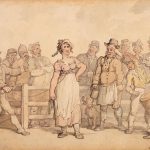
I also learned from Judy O’Grady another fascinating point that I felt compelled to work into my trilogy: It was legal and not uncommon to sell your wife. This point came up in an anecdote in which a military drummer stopped by the Hythe market and purchased a wife who was “not more than twenty years and of a likely figure.” We think of that time as being highly religious and marriage as being sacred. Divorce was practically impossible—it took an act of Parliament, limiting divorce to the wealthy. But women were also legally the property of their husbands. Couples from the “humbler classes” resorted to sales to end a marriage. The wife had to agree and often was as eager to shed the husband as he was to shed her.
In the illustration at the top of this post, Thomas Rowlandson shows a wife sale during the Regency era–evidently from a civilian to a soldier. The wife was brought in a halter (often a ribbon), which was handed to the purchaser as a symbol of the transfer. In this instance, the wife appears pleased with the exchange.
Though the practice was controversial, the legality was upheld more than once. The sale of wives carried on from the late 17th Century to at least 1901. Sales were usually conducted at the regular town markets to establish a large audience and increase the visibility and credibility of the actions. Notices were published in the local newspaper and the woman was auctioned off like any other stock. In July 1797, The Times apologized for failing to report “the average price for Wives for the last week” at the Smithfield market near London. The newspaper added, however, that the price had been rising at Smithfield and was now about three guineas and a half. Sales in the early 1800s showed prices ranging from about two to five shillings, indicating the relative poverty of those involved. One wife went for three shillings plus a quart of ale, showing a certain joie de vivre in the pricing structure.
Many times, the sale involved a lover and was arranged in advance. One quite expensive sale at Smithfield must have been prearranged and also must have involved people of some wealth. The woman sold for 50 guineas and a horse. She rode off with her new husband in a handsome curricle.
A fiction writer would love to juxtapose this wife-selling practice against the propriety and decorum of the courtships and marriage of the gentlemen and ladies about whom Austen wrote. It was such a juicy tidbit that I tried to find several spots to place it in my trilogy about Austen herself. As a complete scene, however, it was a wonderful but irrelevant detour. Much as he might have wanted to buy Jane for seven sheep and a goat, Ashton courted her the good old-fashioned way. As a passing reference, something that Jane might have seen out a carriage window, a wife sale was too out of context for the specific scenes in which it might have happened. It would have raised more questions than could be answered in the few words warranted by a momentary glimpse. (Imagine Austen dropping in such a reference as Catherine Morland or Anne Elliot promenaded past the market in Bath.)
Unhappy as I was at the decision, I had to leave it out. Wife-selling checked off Rule 1—not many people know about this practice—but it violated Rule 2 and 3—don’t force the story to follow history if it isn’t integral, and don’t add history just to show off your knowledge. I include it here because it’s interesting enough to carry a blog, as well as to make my points about using history in fiction.
—
The Marriage of Miss Jane Austen, which traces love from a charming courtship through the richness and complexity of marriage and concludes with a test of the heroine’s courage and moral convictions, is now complete and available from Amazon and Jane Austen Books.
The post Judy O’Grady and the Purchased Lady appeared first on Austen Marriage.