
Henry Jenkins's Blog, page 5
September 14, 2024
EMMYS WATCH 2024 – Curbeth Thou Enthusiasm: Is Larry David a 21st Century Shakespearean Fool?
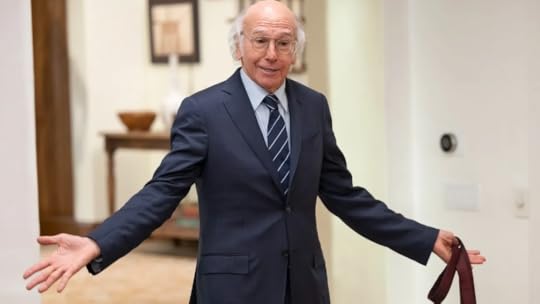
The 2024 Emmy Awards marks the end of an era in the nominations of Curb Your Enthusiasm (HBO/Max, 2000-2024) for its final season in the following categories: Outstanding Lead Actor In A Comedy Series (Larry David), Outstanding Casting In A Comedy Series (Allison Jones), Outstanding Sound Mixing For A Comedy or Drama Series (Half-Hour) (Earl Martin, Chuck Buch, Trino Madriz, and Sam C. Lewis), and Outstanding Comedy Series (Producers: Larry David, Jeff Garlin, Jeff Schaffer, Laura Streicher, Jennifer Corey, and Adam Feil). The series depicts cringey encounters and situations of former Seinfeld writer/producer Larry David (a fictionalized version of himself) as he endeavors to simply exist among his peers and their friends in Los Angeles. Curb Your Enthusiasm (and arguably Larry David himself) holds a unique place in television and cultural history; this series came on the heels of the multi-cam sitcom sensation, Seinfeld (of which Larry was co-creator/ writer) at a time when reality television was gaining significant traction. Although not quite mockumentary in style, Curb Your Enthusiasm skillfully plays with real-world conjunctures and Larry David not only holds a mirror (as most comics do) to our inner biases and repressed judgments, he shakes-out our cultural norms, puts them on a big flag, and runs around waving it our face like the finale of Act One in Les Misérables. Much can be written about Curb Your Enthusiasm in terms of form, production, and comedy writing more generally. However, in this piece I want to take the opportunity to frame and pose a question with which I’ve been grappling. When teaching media history to my students, I inevitably find myself contextualizing much of television performance, writing, and character in terms of Shakespeare’s works. I am acutely aware that my theatre background lends me to this position; I am drawn to Shakespeare’s joint use of wordplay with situation in heightening the stakes for both drama and comedy. Therefore, when I reflect on the last quarter century of Curb Your Enthusiasm, I see this long running comedy through lens of Shakespeare’s plays; or rather, I see Larry David as a Shakespearean clown: The Fool from King Lear, Bottom from A Midsummer Night’s Dream, or Touchstone from As You Like It. Like these characters, he states uncomfortable truth, finds himself in akward situations, and wryly comments on the absurdities of life. Also like these characters, who don’t incur the wrath of their superiors in the plays (or the audience), Larry David manages to squeak past mass criticism and controversy despite his uncouth comedy. What makes Larry David different than other comics in that he is essentially as safe as the “Shakespearean clown?”
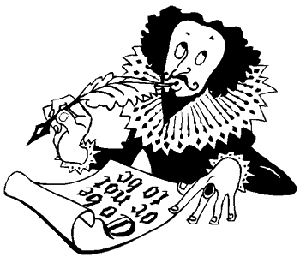
First, let’s get from Shakespearean characters/theatre to an HBO (or rather, Max – enter Amanda Lotz (2018) on the ever-shifting and continual consolidation of media companies) television show and quickly move through 500 years of Shakespearean influence on the masses. As a media and pop-culture researcher, I am interested in how certain art forms and platforms shift and transpire according to various historical conjunctures and the ways these art forms encompass a broad audience and impact “ordinary” culture (Williams, 1958). Shakespeare wrote his plays for a diverse audience. From the groundlings, made-up of the common folk, to Queen Elizabeth I (and later the King James), his plays transcended social and cultural boundaries. Historical scholar, Levine (1990), who wrote on the changing cultural status of Shakespeare in early nineteenth century America, explains that “the theatre, like the church, was one of the earliest and most important cultural institutions established in frontier cities. And almost everywhere the theater blossomed Shakespeare was a paramount force” (Levine, 1990, p. 18). Initially, there was a common and intimate knowledge that average Americans had of Shakespeare (Levine, 1990), and therefore his characters – such as the fool – were broadly present and understood. It wasn’t until the transformation that occurred during the end of the nineteenth century into the beginning of the twentieth century where, for Americans, the “theater no longer functioned as an expressive form that embodied all classes within a shared public space” (Levine, 1990, p.68). From then on, theatre (and by default, Shakespearean plays) transitioned away from the masses and was reserved for those wealthy enough to purchase tickets. Cue Bourdieu’s (1984) Distinction. A century later, we can identify screen media as the platform that provides a more democratizing access to entertainment (anyone else watch the Eras Tour on Disney+ instead of paying over $500 for tickets like many of my undergrads did?). There is, of course, still a monetary hurtle to access various streaming services, albeit less than tickets to live theatre. All this to say, HBO/Max sits somewhere in the middle as it was still a paid cable station when Curb Your Enthusiasm began its run in 2000 and has grown in popularity in recent years due to the surge in streaming platforms’ successful proliferation. Therefore, Larry David’s reach and influence on viewers and culture is noteworthy.
Curb Your Enthusiasm falls into a vast canon of centuries of tradition where pop culture uses humor to skillfully address our personal and societal flaws. In this way, Larry David has been “The Fool” to the audience’s “King Lear.” Shakespeare utilizes the character of “The Fool” (this is true for Touchstone in As You Like It) to critique the king, draw attention to his faults, and call him out on his misjudgments. This was often the role of fools in the royal court; under the guise of humor, the fool or court jester was allowed to (as they say) speak truth to power. So, while The Fool in King Lear is speaking to Lear in the context of the play, The Fool is also speaking to the audience in his narration and critique of the King’s errors. Now, The Fool is “punching up” when he blasts the king, which in comedy means he is making fun of those of a higher status. When you are a fool in a royal court you can only punch up. Comics tend to come under scrutiny when they “punch down” on different identities. Larry has seemingly found a way to make-fun of identities and situations that should in theory be off-limits to anyone wanting to avoid being canceled. Jerry Seinfeld and Dave Chapel are prime examples of comics who have recently come under serious scrutiny for questioning and/or pushing comedy to tackle sensitive and polarizing topics. Certainly, there is much to unpack regarding why these comics’ crossed boundaries for some audiences, but the fact remains that Larry David’s remains largely unscathed.
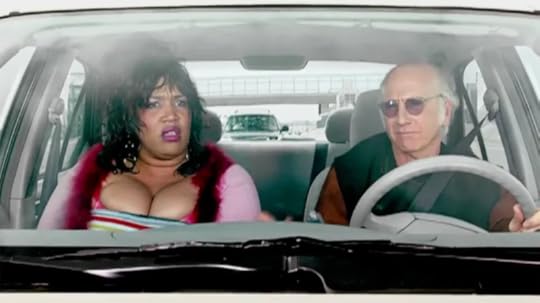
One reason could be that he is so likeably unlikeable. Much like Bottom from A Midsummer Night’s Dream, the audience forgives Larry David for his oblivion to social norms because the comedy that ensues is worth it, and his ignorance is far more innocent than sinister. As a plot point, and not so subtle metaphor, Bottom falls victim to a fairy-spell that transforms his head to that of an ass. Larry David is also - to put it bluntly - an ass. In one episode he picks up a sex-worker so he can beat the LA traffic by driving in the carpool lane, and in another he uses the handicap bathroom stall and justifies it by pretending to have a stutter.
But, he is also often wrongly accused of being an ass, when the situation just rolls out of control; he is caught in possession of a Black lawn jockey statue, but only because he needed to replace the one that he broke at a southern Air B&B where he was staying. Once he was kicked out of a hot yoga class for not saying namaste. Another possible reason he gets away with political incorrectness is that he is also the butt of many of his own jokes. Touchstone in As You Like It is full of dry wit, self-deprecation, and a hint of neurosis. This court jester who expresses cynicism through comedy as he comments on human interaction and the absurdity of social norms for the benefit of the audience is endearing. Such an outlook is essentially the theme that underpins every episode of Curb Your Enthusiasm. In addition to this, Larry David’s friends and family (with maybe only the exception of Jeff Green (Jeff Garlin) and Leon Black (JB SMOOVE)) admonish and baulk at his behavior. Perhaps, for the audience, this is enough retribution? The other characters can take on the role of human decency, and this allows the audience to laugh and relish in Larry David’s inappropriateness.
Curb Your Enthusiasm spans 12 seasons over 25 years. I wrote my dissertation on Law & Order: SVU, so I am a little too familiar with shows that run for multiple decades and address changing cultural landscapes. Unlike Seinfeld, which sits statically as a landmark piece of 90s television, Curb Your Enthusiasm absorbed cultural moments over a more expansive period. Or rather, Curb Your Enthusiasm actively dismantled the respect and reverence for serious historical incidents: At a dinner party, Larry (unawares) introduces two “survivors” to bond - one is a Holocaust survivor, and one is a contestant from the TV show, Survivor. Larry and his wife Cheryl (Cheryl Hines) took in the Blacks, a family of refugees from Hurricane Katrina, and Larry pointedly states to them, “You’re Black and your last name is Black. That’s like if my name was Larry Jew.” He incurred the wrath of Ayatollah Khomeini for announcing his intention to write a musical comedy called “Fatwa.” In the season directly following Me Too, Larry and the woman he was hooking-up with film their entire sexual exchange while loudly consenting in an over-the-top manner. And then there is the Palestinian chicken restaurant episode (Season 8, episode 3)… which no summary could really do justice. From Seinfeld, famously a show about nothing, Curb Your Enthusiasm is a show about … everything.
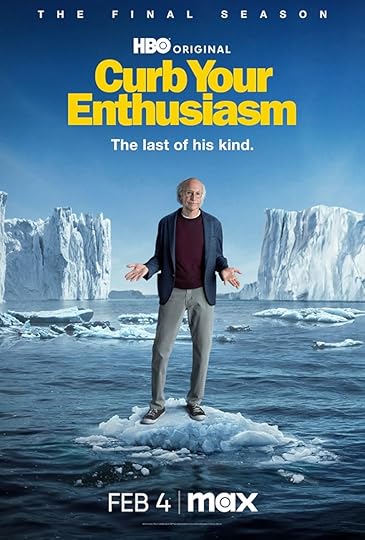
But now that we have reached the end, where will Curb Your Enthusiasm land in the context of pop-culture comedy history, and will it hold up? Feinberg (2024) states, “in a world in which social media has made us into a nation of Larry Davids platforming everybody’s microaggressions, Curb Your Enthusiasm didn’t have a place anymore.” I am not sure I fully agree, but it certainly is an interesting point. With the evolving and shifting space for performance, from theatre, to television, to social media, where does the Shakespearean fool currently reside? Feinberg implies that anyone with a gripe on Tik-Tok fills this void. Regardless of social media’s democratization and amplification of public voices, I think there is still a role reserved for designated court jesters, or at the very least, court jesters in scripted media. Larry David did more than just “platform microaggressions;” he took big risks with his social commentary and did so for a large, designated audience. Shakespeare’s relevance transcends centuries, and this longevity (along with the cultural shifts that relegated it to a higher status) is what immortalizes and pedestals his work. I wouldn’t be surprised if Larry David’s work will stand the test of time, especially as only his show, not him, is currently “canceled” (maybe we all just loved his Bernie Sanders impression too much). Going forward, I am sure new Shakespearean fools’ voices will emerge. Curb Your Enthusiasm may not always be culturally relevant, but like Shakespearean themes on humanity, Larry David’s display and comment on social annoyance, will most likely continue to ring “pretty, pretty, pretty” true.
Works Cited
Bourdieu, P. (1984) Distinction: A Social Critique of the Judgement of Taste. Cambridge, MA: Harvard University Press
Levine, L. (1990) Highbrow/Lowbrow: The Emergence of Cultural Hierarchy in America. Cambridge, MA: Harvard University Press
Lotz, A. D. (2018). We Now Disrupt This Broadcast: How Cable Transformed Television and the Internet Revolutionized it All. Cambridge, MA: MIT Press.
Williams, R. (1958). “Culture is Ordinary.” Raymond Williams on Culture & Society: Essential Writings, edited by Jim McGuigan. Sage Publishers, 1-18.
BiographyLauren Alexandra Sowa is a Visiting Assistant Professor of Communication at Pepperdine University. She recently received her Ph.D. from the Annenberg School of Communication and Journalism at the University of Southern California. Her research focuses on intersectional feminism and representation within production cultures, television, and popular culture. These interests stem from her several-decade career in the entertainment industry as member of SAG/AFTRA and AEA. Lauren is a proud Disneyland Magic Key holder and enthusiast of many fandoms.


September 13, 2024
EMMYS WATCH 2024 – 'The Bear'
“Jamie did this really tricky thing with her performance, which is to still be funny, it still gets scary, but there’s still some humanity.” — Christopher Storer in conversation with The LA Times (Yvonne Villarreal, 2023)
Maybe this is too personal an opinion to be definitively stated as fact, but The Bear, FX’s hit series that has swept awards seasons since it was first released on Hulu, is funny. The descriptor should be easily applied to the show, considering its status as a comedy, but there has been much debate in the years since its premiere as to whether the show is only a comedy in name, categorized as such thanks to its episodes’ 30-minute runtimes. More often than not, the show is categorized by viewers as “tense” and “exhausting,” with fans and detractors alike winded by the end of each episode (Glenn Whipp, The LA Times 2024). When awards season rears its ugly head, the show is rewarded with endless nominations and wins in the Comedy categories, and each time the internet becomes filled with the refrain “The Bear is not a comedy.” Despite fitting the runtime requirements, we have to ask after every season drops: is The Bear even funny? (John Koblin, The New York Times 2024) I believe it is, and I believe the key to the show’s balancing act comes in the form of “Fishes,” the sixth episode of its Emmy record-breaking second season (Koblin).
“Fishes” has received acclaim since its debut in 2023, including a 5-star review from Vulture writer Marah Eakin in which she also highlights the show’s exhausting nature, particularly in this episode: “‘Fishes’ is absolutely exhausting to watch. You leave it feeling drained emotionally and spiritually, not unlike the feeling so many of us get after our own combative family-holiday hangs” (Eakin). It’s spawned oral histories, interviews, and a plethora of Emmy nominations for its cast and crew — a surefire success in every sense of the word. Though the episode has garnered plenty of acclaim, it also stands as a unique episode of The Bear in that, on the surface, it looks to be the antithesis of everything the “comedy” category stands for in television. It’s over an hour long, with loads of long takes and uncomfortable close-ups, feeling (according to star Abby Elliott) “like a play,” and the word that guest star Jamie Lee Curtis most hears from fans regarding it is “triggering” (Whipp). If The Bear is so funny, where are the laughs in its most acclaimed episode?
The secret to the success of “Fishes” is that it is a perfect blend of drama and comedy in The Bear’s unique style. The show has continued to deviate from the norm of not just itself but the genre it occupies, with several episodes coming in at well over 30 minutes and, especially in its newest season, being comprised mostly of montages of a character’s past told in a non-linear fashion. With “Fishes,” the regular half-hour episode format that the second season had established is tossed aside for a Christmas Eve dinner that’s double the length of a typical episode—and feels like it.
The Feast of the Seven Fishes, an Italian Christmas Eve tradition, broils and bubbles in the kitchen of the Berzatto family, as the clan’s children, series regulars Carmy (Jeremy Allen White) and Natalie Berzatto (Abby Elliott), are joined by older brother Mikey (Jon Bernthal) outside the home for a smoke break away from the crowd. Of course, this is a flashback set five years before Carmy inherited The Beef restaurant after Mikey’s death, giving us a glimpse into the dynamic during the “most wonderful time of the year.” The siblings have a heart to heart about how to handle matriarch Donna (Jamie Lee Curtis), with Carmy dealing the first of many cutting blows in this episode to Mikey: “Kill you to pick up the phone?” The episode then establishes how it will pull off its juggling act of maintaining both its humor and its tragedy, as the siblings’ needed break ends and the three reenter the lion’s den, or, rather, the Mamma Bear’s cave. Inside, it’s quips and jokes and guest stars galore, with Uncle Lee (Bob Odenkirk) desperately trying to pass off a mini dutch oven that’s supposedly burning him. “Carol, what would you like me to do with this,” he asks, before getting the sarcastic reply from Carol (Maura Kidwell) “Bend over and I’ll show ya!” Lee does not remember Stevie (John Mulaney), who he’s met many times before, then finally passes the dish to Natalie, who delivers the final punchline — “Fuck, I don’t want to take this! It’s cold.” Quiet, intimate conversations in “Fishes” are revealed not to be the levity from the chaos, but rather the true emotional vulnerability everyone in the house fears, with the constant yelling and arguments acting as the comedic core of the episode.
The actors of The Bear have had many fans confess that the episode is relatable, with Jeremy Allen White noting “I was surprised at how relatable the episode was. I had so many people come up to me and say, ‘This was my Christmas in 2016’ or ‘That was my Thanksgiving’” (Whipp). Christmas with the Berzattos is achingly human, which is why it’s so sneakily comedic. Surely, none of this behavior or these conversations are funny in the moment for these characters, but five years later you might tell the story of your weirdo “cousins” trying to get you to invest in baseball cards, an example of the Faks (Matty Matheson as Neil and Ricky Staffieri as Ted) being used sparingly as comic relief in contrast with their overabundance in the third season. Of course, they have two perfect straight men to work off of for this running gag in Jimmy (Oliver Platt) and Stevie, who both listen to the whole spiel of $500 becoming $1500… “within a couple months,” with varying responses. Jimmy first asks how many Faks there could possibly be, then feigns excitement over a Mickey Morandini, then finally (in rule of threes fashion), hands his drink to Ted, then slaps him: “Stupidest fuckin’ idea I ever heard. Merry Christmas.” Stevie, meanwhile, is not convinced by the pitch but still promises $500 because “whatever you do with that is going to be very interesting to me.” Either way, Jimmy and Stevie have something to laugh about come next Christmas.
Outside of explicitly comic relief scenes, the episode maintains a kinetic comedic energy in every loud corner of the house. The first time we see Donna, her kitchen is a mess, her cigarette never leaves her sight, and she just has to know if Stevie, cousin Michelle’s (Sarah Paulson) partner, is gay. Carmy enters her kitchen and thus her flustered mind, caught between two conversations about the seven fishes and Stevie, neither providing clear answers. As the episode unfolds, Donna loses herself completely, going from kissing Jimmy on the cheek when he asks “Oh my God, what smells so good? Oh my God, is it you?” with a coy attitude, to grabbing Natalie by the chin and threatening to shoot herself because “I don’t think anyone would fucking miss me.” But, like Storer said, Curtis is not just scary and not just funny in the part, but human. The chaos of the kitchen is of her own making, and yet it’s the only place where she can make jokes or admonish her children the same way all mothers do. When Carmy says the quiet part out loud in the kitchen, “This is why I didn’t want to come home,” the boo’s it elicits are equally matched by Mikey and Donna demanding he “just say the words.” The words? “I love you,” uttered quietly and with a hint of guilt, the kind of delivery that would make you laugh at your own brother and laugh with your mother.
Each moment away from the storm, however, reveals the underlying sadness in each core member of the family. Cousin Richie (Ebon Moss-Bachrach) and his now ex-wife Tiffany (Gillian Jacobs), pregnant in the episode, hide away for a bit thanks to her morning sickness, allowing them the true freedom to love gently. Richie is a character we’d seen, up to that point, being needlessly aggressive and angry at the world, ready to fight anyone. Here, he’s afraid to lean on Tiffany, fearing he might hurt the baby, unwilling to let any harm or stress come to her. Tiffany kisses him over and over again, nurturing who she thinks is the love of her life, and before he leaves to reenter the storm downstairs, they share a wordless, loving exchange of goofy faces with their tongues out — something they passed on to their daughter. Richie then asks Jimmy for, no doubt, a job related to the mob business, lamenting his “potential” (that we come to realize he genuinely does have). It’s not the kind of admission he could make in front of more than one person. Later, Carmy finds Mikey in a closet while looking for saltines and gives him a Christmas present early — the same sketch of the restaurant now known as The Bear. They’re honest in their love, and all the digs about being “too fancy” or having 100 failed businesses are brushed aside, tears falling from Mikey’s face when he’s alone. As Jon Bernthal puts it, “Mikey absolutely knows where he’s headed and he’s horrified. He knows he can’t stop the train at this point. What a tragic thing to realize. ‘I’m doomed’” (Whipp). There’s no comedy to distract our main cast from their real problems and feelings here.
This all culminates in a showdown at the beautiful dinner table. Lee, who continuously gets on Mikey’s nerves and eventually shuts him down for telling a story he’s told before, can’t help but keep the pressure on the eldest son. Mikey throws a fork, and it terrifies everyone. Again, this builds to the kind of moment that is horrifying in the present and will be hilarious in the future, as the entire table begs him to stop. He throws another, but with enough pleading, calms down for Stevie to say grace, chosen by the family on the grounds that he is not angry with anyone at the table. Mulaney’s performance as Stevie may seem a bit like Mulaney playing himself, but he delivers in every scene he has, with even the most mundane lines getting a laugh. His speech is heartfelt, making Donna cry at first with a smile and then a terrible, long frown, and sprinkled with droll lines (“And is he still holding the fork?” “I’m very in love with Michelle. And I’m not gay like you guys asked a lot,” and of course “May God bless us and keep us safe in the New Year, and please give Michael the strength not to throw that fork. Amen.”). It puts into perspective that more than anything, “Fishes” is about how your family makes you laugh and cry in equal measure.
For you see, God did not give Michael the strength to not throw that fork after Donna erupts in tears post-saying grace. Her sadness builds and builds, and once she exits, a long silence is punctuated by Mikey chucking that last fork at Lee, who lunges out of his chair ready for a fight. Just as dinner had finally entered a calm, demure state, it’s all destroyed again with everyone out of their seats screaming back and forth at each other. The real kicker? Donna left not to go to her bedroom, but to her car, which she crashes into the house. All eyes leave Mikey and glue themselves to the hole in the wall Donna created, with the Christmas tree tipped over and snow flying into the home. Mikey runs to her door and slams his hand on the window, begging her to come out, but Donna just laughs and laughs. The private bubble of the car is the tragedy that interrupts the chaotic comedy of the home, Donna’s laughter born out of a genuine need for help. It’s so perfectly The Bear — caught in the middle of the worst day of your life that feels so catastrophic you can’t help but laugh.
Biography
Megan Robinson is a writer and editor based in New Jersey. She earned her bachelor’s degree in Culture and Communication at Ithaca College, with a concentration in film and media studies. Her work often explores film through a feminist lens, with particular focus on the reinforcement or subversion of gender roles within a text. She works as a staff writer for the websites Film Cred and MovieJawn, covering festivals such as the Chattanooga Film Festival, the Slamdance Film Festival, and the Tribeca Film Festival. You can find more of her work on Film Daze, Flip Screen, Polyester and more.
September 11, 2024
EMMYS WATCH 2024 – Frederik Cryns Interviewed by Henry Jenkins on ‘Shogun’
HJ: Can you tell our readers how you're connected to Shogun and how you came by this opportunity?
FC: My connection to Shogun is deeply rooted in my academic background and research interests. As a professor of Japanese history at the International Research Center for Japanese Studies in Kyoto, I've been immersed in the late Sengoku period for decades. This era, which serves as the backdrop for Shogun, has been my primary focus for the past 35 years.
The opportunity to work on Shogun came about quite organically. For the last decade or so, my research has centered on Tokugawa Ieyasu, William Adams, and Hosokawa Gracia – coincidentally, the three main characters of the show. My approach has always been to delve into original documents, letters, and diaries from the period, trying to understand the lived experiences of the samurai class. I believe it was this perspective that caught the producers' attention. They reached out to me during the early stages of script development, inviting me to oversee the historical aspects of the show. This gave me the unique opportunity to contribute from the ground up. I started by reviewing scripts for historical accuracy, but my role quickly expanded. A significant part of my contribution was helping the writers understand how members of the samurai class would authentically react in various situations, based on my research into their personal writings.
As the project evolved, especially with the decision to film in Canada due to the pandemic, my involvement grew exponentially. I found myself collaborating with nearly every department – from set design and costuming to visual effects and props. We worked tirelessly to recreate not just the physical world of Sengoku-era Japan, but also its language, customs, and social dynamics. It was a bit like running an intensive course in medieval Japanese culture for the entire production team. And I have to say, they were exceptional students. Watching them absorb and apply this knowledge, transforming modern perceptions of samurai culture into something far more authentic, was incredibly rewarding.
In essence, I had a hand in virtually all historical aspects of the show. It was an enormous undertaking, but also a labor of love. I was fortunate to have the support of my wife, Keiko, who lent her expertise in Japanese history and linguistics, which proved invaluable throughout the process. This project allowed me to bring years of academic research to life in a way I never imagined possible. It's been a unique and rewarding experience to see the world I've studied for so long recreated with such care and attention to detail.
HJ: Set the historical stage for this story. What is it important for viewers to know about this period in Japanese history and about Blackthorne as a historical figure?
FC: To answer your question about setting the historical stage for Shogun, it's crucial to understand that the story unfolds during a pivotal moment in Japanese history - the late Sengoku period, around 1600. This era was characterized by intense political upheaval among the warrior class. Japan had recently emerged from decades of civil war, thanks to three great unifiers: Oda Nobunaga, Toyotomi Hideyoshi, and Tokugawa Ieyasu. At the time of our story, Hideyoshi had passed away, leaving behind a young heir and a council of regents. Ieyasu, the most powerful among these regents, was poised to seize control as the last unifier, but he faced opposition from other warlords and factions loyal to the Toyotomi clan. This political powder keg was about to explode into the Battle of Sekigahara, a defining moment that would shape Japan's future. Adding to this volatile mix was the arrival of European powers - Portuguese merchants and Jesuit missionaries had been in Japan since the 1540s, bringing with them new technologies, religious ideas, and political complications. In this period, globalization had already reached Japan.
The arrival of a Dutch ship just six months before the Battle of Sekigahara effectively brought the religious wars of Europe to Japanese shores. The character of John Blackthorne is based on the real historical figure William Adams, who arrived on that Dutch ship. Adams' story is fascinating: initially facing execution as a pirate at the urging of the Portuguese, he not only survived but thrived in Japan. He eventually became a trusted advisor to Ieyasu and exerted considerable influence over Ieyasu's foreign policy. Here was an Englishman, thousands of miles from home, helping to shape the diplomatic direction of a nation on the brink of massive change.
What's fascinating about this period is how it blends domestic power struggles with international influences. You have the Tokugawa clan attempting to consolidate power, Toyotomi loyalists fighting to maintain their influence, and European factions pursuing their own agendas of profit and religious conversion. Clavell's Shogun takes these historical elements and weaves them into a compelling narrative, occasionally taking creative liberties to heighten the drama. For instance, the character of Ishido is given more prominence than his historical counterpart, which serves to intensify the political intrigue. The result is a complex web of personal ambitions, cultural clashes, and political machinations that keeps viewers on the edge of their seats.
HJ: The series has much to teach western viewers about the political and military structures of Japan during this period. How is this material introduced? Is there a danger of overwhelming the viewer?
FC: The series presents a nuanced portrayal of Japan's political and military structures during the early 17th century, introducing this material through a carefully balanced approach. I think that the presence of European characters, particularly Blackthorne, serves as an effective entry point for Western viewers. Through his experiences, the audience is gradually exposed to the complexities of Japanese society, politics, and military organization.
One of the show's strengths is its depiction of a multicultural Japan, which may surprise viewers accustomed to thinking of feudal Japan as isolated. This period, just before the country's self-imposed seclusion, saw significant interaction with Europeans. While this might initially challenge viewers' preconceptions, it ultimately provides a richer, more accurate historical context.
The series doesn't shy away from showcasing the cultural aspects of samurai life, moving beyond the common warrior stereotype. This multifaceted portrayal, while potentially overwhelming at first, offers a more comprehensive understanding of the period. The abundance of cultural details may not be fully grasped by all viewers, but it contributes to a more authentic atmosphere and can inspire curiosity about Japanese history and culture.
As for the political structures, it's important to note that Clavell's story, which forms the basis of our show, has significantly simplified the historical reality. In actual history, these structures were much more complex. For instance, there was a Council of Five Elders and another Council of Five Commissioners, which Clavell condensed into a single council. Additionally, a fierce rivalry between two factions within the ranks of the Toyotomi loyalists, which was a crucial element leading up to the Battle of Sekigahara, was omitted in Clavell's narrative. While these simplifications may not capture all the historical intricacies, they do make it easier for viewers without extensive knowledge of Japanese history to follow the plot.
There's always a risk of overwhelming the audience with too much information, but I believe we've struck a good balance. We're not just telling a story; we're inviting viewers into a different world. If they come away from the series with a broader, more nuanced understanding of this fascinating period in Japanese history, even if they feel a bit out of their depth at times, I'll feel we've done our job well. My hope is that Shogun will not only entertain but also spark curiosity and challenge preconceptions about samurai culture and feudal Japan.
HJ: As a consultant, your job is to advise and someone else makes the final decisions. So, can you identify something you felt strongly about that you convinced the show runner to include and a battle you felt strongly about that you lost.
FC: As a consultant for Shogun, I was incredibly fortunate to work with a team that was genuinely committed to historical accuracy. To my initial great surprise, about 90% of my suggestions were accepted. This high rate of acceptance was due to Justin, Hiroyuki, and the other producers being genuinely committed to making the story as historically accurate as possible. Of course, the core story itself is fiction, so there was flexibility in the script. However, I got the impression that the producers were keen on not deviating too much from the historical characters. Their understanding of "accuracy" was particularly insightful. The key question was always: "Is it possible for this situation to occur at the time?" This approach led to numerous adjustments. For instance, one of our first corrections was to change the names of some characters, as several of the original names in the novel weren't historically accurate for Japanese names of that period. Other examples of changes we made include depicting women fighting with naginata rather than swords, accurately portraying methods of suicide, and correcting the attire of the priests. In the novel, the priests wore orange robes, but in our period, they would have been obliged to wear traditional Jesuit cloaks. These are just a few examples from a much larger body of work. Over the three years I worked on the show, I compiled all my comments into a single file, which ended up being over 2,100 pages long. The fact that most of these suggestions were accepted means you can expect a very accurate depiction of Sengoku-era Japan in the show.
One of the most satisfying changes I was able to convince the showrunner to make was the inclusion of medieval Japanese language and poetry. We created a small grammar guide for the writers to reference, ensuring the dialogue was period-accurate. Even more exciting was the incorporation of poetry, particularly linked poetry, into the story. Poetry was integral to samurai culture - you weren't considered a true samurai if you couldn't compose good poetry. I had the privilege of composing most of the poetry for the show, striving to create verses that would have been acceptable to a samurai of that era.
Another highly satisfying aspect of my work on the show was the attention given to historical detail in costume and set design. It was a pleasure to collaborate with Helen on recreating the castle and city of Osaka as accurately as possible, and with Carlos on ensuring the costumes and armor were true to the Sengoku period. This level of detail was crucial because most Japanese period dramas depict a much later era, about 250 years after our setting. For instance, we made sure that courtesans were portrayed accurately for the year 1600, looking quite different from the geishas of the 19th century that audiences might expect. One of my favorite unexpected inclusions was a scene featuring Yabushige and a story about an earthquake and a catfish. I had shared this story with Justin outside of our script discussions, and was delighted to see it make its way into the final version.
As for a battle I lost - and it was really the only significant one - it involved the way women sat in the show. Seiza, which is now seen as the traditional Japanese way of sitting, involves kneeling and resting the posterior on the ankles and heels. However, this style of sitting actually developed much later, in the 18th century, when kimonos became tighter and seiza became the most practical way to sit. In the Sengoku period, the kosode, which was a precursor to the kimono, was much looser, allowing for more relaxed sitting positions. Seiza was primarily used to prostrate oneself before a lord. From a historical perspective, it would have been very unusual for someone of Lady Ochiba's status - essentially the highest-ranking woman in the realm as the mother of the heir - to sit in this humble position. People of her rank would typically sit in a more relaxed manner, often with one knee up. However, in modern times, this perception has been inverted. Seiza is now considered the traditional way of sitting for cultured individuals. Because of this shift in cultural perception, the Japanese staff was adamantly against depicting high-ranking ladies sitting in any way other than seiza. This situation exemplifies how sometimes the modern image of national culture takes precedence over historical accuracy. While it was disappointing from a historical standpoint, I understand the decision to prioritize what contemporary audiences would recognize and expect. It's one of those instances where the perception of tradition outweighs the actual historical practice.
Overall, my experience as a consultant on Shogun was incredibly rewarding. The level of detail and authenticity we were able to achieve, from language and poetry to costumes and set design, was remarkable. This attention to detail underscores the dedication of the entire team in bringing this fascinating period of Japanese history to life on screen.
HJ: The original Shogun has been criticized in recent years for being a white savior narrative. The recent version shifts perspective so that Blackthorne is understood from a Japanese perspective as a “barbarian.” What process did the production go through to foreground the Japanese characters?
FC: It's important to view the original Shogun within its historical context. In the 1980s, Japan was still largely unfamiliar to Western audiences, so the show naturally emphasized the exotic aspects of Japanese culture. This approach inadvertently positioned the Western protagonist as the central figure, though I wouldn't necessarily characterize him as a 'white savior.' Blackthorne was more of a witness to, rather than a shaper of, events – much like in the current adaptation. The key difference between the 1980 and 2024 versions lies in the narrative perspective. The original series primarily viewed events through Blackthorne's eyes, while the new adaptation offers multiple viewpoints, more closely aligning with James Clavell's novel.
As for Blackthorne being perceived as a 'barbarian' from the Japanese perspective, this was actually a contribution I made to the show. I pointed out to the production team that while some Europeans, particularly Jesuits, admired Japanese culture, the Japanese often viewed Europeans as barbarians. The Portuguese in particular were called 'Nanbanjin' which literally means the southern barbarians, southern because their ships came from the south.
Regarding the foregrounding of Japanese characters, this was a decision made early in the production process, even before I joined as a consultant. It reflects our contemporary global mindset and allowed for meaningful involvement of the Japanese cast and crew. This approach created a synergy between the two cultures, enhancing the authenticity and depth of the series. In my view, this cultural fusion and the emphasis on multiple perspectives, particularly those of the Japanese characters, is the strongest aspect of the new Shogun. It offers a more nuanced and balanced portrayal of this complex historical interaction between East and West.
HJ: The nature of women’s power in this patriarchal society is one of Shogun’s most interesting themes. What sources gave you the most useful insights into these dynamics, given that women’s history has not always been captured fully in historical accounts?
FC: The focus on women's power was a key aspect of Shogun from the outset, and it's a theme I was particularly passionate about developing further. My research into the role of women during the Sengoku period revealed a reality that often contradicts popular perceptions of Japanese history. One of the most valuable sources for understanding these dynamics are the rare surviving letters written to and from women of the era. While historical documents specifically about women's activities are scarce, these letters provide crucial insights into their influence and power.
One of the most fascinating aspects of the Sengoku period is how the constant state of warfare actually created opportunities for women to wield significant political power. When clan leaders fell in battle, it was often their wives who stepped in to rule until their sons came of age. These women essentially held all the political power that their husbands once did. A prime example of this is Yodo-no-kata, who served as the historical inspiration for Ochiba in our series. As the mother of the heir, she possessed tremendous influence and authority. Another key figure was Acha-no-tsubone, the real-life counterpart to Kiri. She not only managed Ieyasu's household affairs but also played a crucial role in conducting peace negotiations during the Siege of Osaka in 1614. Hosokawa Gracia, who inspired the character of Mariko, offers another interesting case. While she's often portrayed in modern times as an abused woman, my research revealed that she wielded considerable influence within the Hosokawa clan. For instance, she was instrumental in hiring former members of her father's Akechi clan, despite their notorious history of betraying Nobunaga. Their stories challenge the notion that women were always in the background. The later Edo period, with its prolonged peace, saw a rigidification of social structures that pushed women into more subservient roles – an image that has often been mistakenly applied to earlier periods.
Given these historical realities, the showrunner's decision to feature women in more prominent roles was incredibly valuable. It allowed me to present a more nuanced and accurate portrayal of women's power during this period. This approach not only enhanced the historical authenticity of the series but also helped to challenge common misconceptions about women's roles in feudal Japan.
It's crucial to emphasize that while women could exercise political influence during the Sengoku period, the battlefield itself remained exclusively the domain of men. Women of the samurai class were trained in the use of weapons, particularly the naginata, and some did engage in combat when circumstances demanded it. However, they were not part of the regular fighting forces. I worked closely with the producers to ensure that our fighting scenes remained grounded in realism. This commitment to authenticity is perhaps best exemplified in Mariko's notable combat scene in Osaka Castle. I'm particularly proud of this sequence, as I suggested the concept of a 'wall of spears' to create a realistic and historically plausible scenario for a woman of her status to engage in combat. This approach allowed us to showcase female strength and capability within the bounds of historical accuracy, without resorting to anachronistic or unrealistic portrayals of 'women warriors'.
HJ: The new series has been produced in the context of what I call the global shuffle – the ways that many countries have greater access to each other’s media content than ever before. How did this transnational market inform the choices made in the production of the series?
FC: The global shuffle, as you aptly call it, has indeed influenced the production of the new Shogun series, though perhaps in more organic ways than one might expect. Today, there's a wealth of information about Japan and samurai culture available in the West compared to 1980 when the original series aired. This increased awareness has naturally shaped the context in which the show was created. However, it also meant we were inadvertently dealing with certain stereotypes and misconceptions that have arisen from this abundance of information.
Interestingly, the approach to navigating this transnational landscape wasn't a deliberate strategy, but rather emerged naturally from the diverse perspectives within our team. We found ourselves organically blending three distinct viewpoints: My own research, spanning over 35 years, has focused on primary sources - letters, diaries, and documents from the period. This naturally gave us a perspective on samurai society that often differs from modern perceptions. Then there's the viewpoint of our Japanese team members, particularly Hiroyuki, who brought insights shaped by Japanese period dramas. These have influenced the modern image of samurai within Japan itself. Lastly, we had the perspective of our Western team, led by Justin, who came with a strong desire for objectivity and historical accuracy, while also being aware of how the period is perceived by international audiences. The merging of these viewpoints wasn't a calculated decision, but it naturally ensured that the content was historically accurate and original while still being accessible to our transnational audience. In the end this organic approach addressed the concerns and perceptions of various groups: Japanese viewers, international audiences, and even historians.
I was initially a bit anxious about how Western viewers would react to some of the lesser-known historical details we included. To my pleasant surprise, these elements have been generally well-received, probably because they're perceived as fresh and intriguing additions to the narrative. In retrospect, I believe this natural convergence of perspectives allowed us to create a multi-layered narrative that speaks to different audiences simultaneously, bridging cultural understandings while still pushing beyond established stereotypes. It wasn't a conscious strategy to tackle the transnational market, but rather an organic outcome of our diverse team's collaborative process.
HJ: Even though John Ford’s The Man Who Shot Liberty Valance was a revisionist western, it famously ends with the journalist deciding to print the legend. It occurs to me that you are in a similar situation in that the age of the samurai is a historical period but also an important genre in Japanese popular culture. How would you assess the balance Shogunachieves between printing the facts and printing the legend?
FC: That's an intriguing comparison to The Man Who Shot Liberty Valance. In the case of Shogun, we're dealing with a similar tension between historical fact and popular legend, but with an added layer of complexity. The challenge we faced in creating Shogun stems from the scarcity of readily accessible primary sources from the Sengoku period. Most of what exists are letters, diaries, and official documents written in medieval Japanese, which are often indecipherable to modern Japanese readers. This lack of direct historical material led to an interesting phenomenon in Japanese popular culture. When creators of period dramas sought to recreate the samurai world, they often turned to more accessible texts from the 19th century Edo period. This era saw a flourishing of book printing, providing a wealth of information. However, these sources viewed the Sengoku period through a nostalgic lens, idealizing it and projecting contemporary Confucian ideas onto it. This created a somewhat distorted image of the Sengoku samurai in popular culture. While the Edo period samurai were more like bureaucrats with rigid, institutionalized behaviors, the Sengoku samurai were likely more individualistic and unpredictable - more akin to characters you'd see in Hollywood movies.
In Shogun, we've tried to strike a balance. We've aimed to peel back some of the layers of idealization and present a more historically accurate portrayal of the Sengoku period. Characters like Yabushige, portrayed by Tadanobu Asano, reflect this attempt to capture the more colorful, unpredictable nature of Sengoku warlords. At the same time, we can't entirely escape the influence of the Japanese period drama tradition. It's deeply ingrained in how both creators and audiences understand this historical period. So while Shogun could be seen as revolutionary in some aspects, it still acknowledges and respects this legacy.
Ultimately, we must remember that Shogun is a work of fiction. We've done our best to reconstruct the samurai world of the time as accurately as possible, but the story itself is invented. In this sense, we're neither wholly 'printing the facts' nor wholly 'printing the legend.' Instead, we're trying to create a new narrative that respects historical accuracy where possible, while also engaging with the rich tradition of samurai stories in popular culture. So, to answer your question directly, I believe Shogun achieves its balance by being transparent about its nature as historical fiction, while still striving to bring fresh, more historically grounded perspectives to a genre that has long been shaped by later interpretations and idealizations.
Biography
Frederik Cryns is a professor of Japanese history at the International Research Center for Japanese Studies in Kyoto, Japan. His scholarly work recently extended to the entertainment industry, where he served as the historical consultant for the 2024 television adaptation of "Shōgun". He is also the author of In the Service of the Shogun: The Real Story of William Adams (Reaktion Books, 2024) which explores the life of the English navigator who became the model for John Blackthorne in the series.
September 10, 2024
EMMYS WATCH 2024 – Fit for a Queen: The Final Season of 'The Crown' and Its Royal Fans
We don’t often think about the Windsors, the British royal family, through the lens of fandom. Most of what is written about them is framed in terms of history, politics, and, increasingly in the past few decades, celebrity studies. Yet fandom is precisely what keeps them in their ceremonial positions of power. Without fandom, there is no celebrity. Without fans to consume photographs and gossip, there’s no point to tabloids. And so taking a fan studies approach to the Windsors, I argue, is paramount to understanding their continued influence on global popular culture.
Since its premiere, Netflix’s stylish period drama, The Crown (2016-2023), has been interested in how the Windsors can control their popular appeal. In season one’s “Smoke and Mirrors,” we see Elizabeth’s 1953 coronation in real time and on television, which allows the common people to experience the spectacular event. The first three episodes of this final season focus on the paparazzi’s relentless hounding of Diana (Elizabeth Debicki) and her companion Dodi Fayed (Khalid Abdalla), leading up to their deaths in a car crash in Paris in 1997 in the episode “Dis-Moi Oui.”
Diana’s death has been told many times over in various media. In 2006, the feature film The Queen portrayed the first fateful days in which Elizabeth (Helen Mirren), kept Princes William and Harry stashed away from the public eye at Balmoral Castle and refused to make public appearances herself. The film attempts to relate that the queen’s primary concern was the mental welfare of Diana’s children in an attempt to tell the inside history; the story outside the castle was that she was cold, untouched by Diana’s death and ignorant to the grieving of a nation. The film was written by Peter Morgan, who created and wrote most of The Crown, and both share a sense of peeking behind the curtain.
In the retelling of Diana’s death in The Crown, the Fayeds are portrayed as the villains. Dodi, Diana’s friend and lover, wants to marry her to please his father, Mohamed Al-Fayed (Salim Daw). Mohamed sees marriage into the extended royal family as a means of upward mobility for a family of Egyptian immigrants who have had to prove their way in British society. While vacationing on the Fayeds’ yacht in the Mediterranean, Diana decides she needs to return home to see her children, but Dodi stalls by taking her first to Paris, where he can purchase an engagement ring and propose. In Paris, the pair are quickly spotted by the paparazzi. A miserable Diana asks again to return to London or at least hide out in Dodi’s apartment for the night before they take a morning flight, but on the way to the apartment, they are again chased, and the car crashes, unseen to the viewer. Mohammed likes Diana, but he doesn’t seem to particularly care about his son’s feelings or her desire to be at home. Instead, he fixates on how to convince the world there is a romance between them and even tips off the press as to their whereabouts. Dodi is so desperate for Mohamed’s approval that he, too, trounces on Diana’s wishes, dragging her out in public when she begs to stay in and stalling her return to the UK, which gives the paparazzi time to find them.
The series gives us a few glimpses at some of the photographers who pursued Diana, including Italian paparazzo Mario Brenna, and a few scenes in which crowds of admirers recognize Diana in public and throng her. But, as in 1997, The Crown blames the Fayeds and a blood-thirsty paparazzi for her death. That those same fans motivated the paparazzi is left out of the conversation.
Instead, The Crown opts for a view of fandom with which we are more familiar: hordes of mourners leaving bouquets and other tributes at the crash site in Paris, outside Balmoral Castle, and along the funeral procession route in London. In “Aftermath,” the series even incorporates archival footage of these mourners. Not taking into account the role the public’s obsessive interest in Diana has had on her death, this familiar version of public interest in the late princess portrays a grief-stricken world who simply loved and admired her.
After Diana’s death, fandom again becomes the centerpiece of family life as young William’s (Ed McVey) appearance at her funeral brings him to global attention, and soon he finds himself the teenage heartthrob whose picture girls have taped to their bedroom walls. When he appears in public, he finds crowds of screaming girls waiting to get a glimpse of him (Figure 1). The episode is appropriately titled “Willsmania,” but, as fan studies has demonstrated with Beatlemania, the positioning of girls’ fandom as mere hysteria neglects the way girls use fandom to express their sexual and romantic desires, in contrast to social expectations of them being, as we might say today, demure.
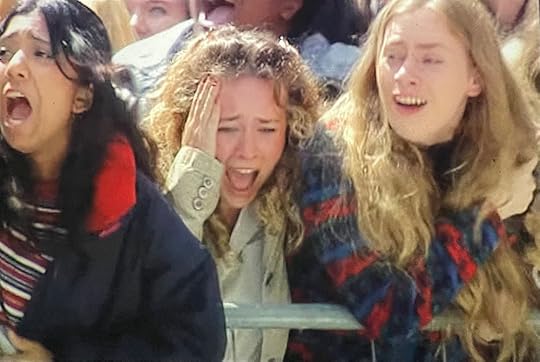
Figure 1
I’m roughly the same age as William and remember watching news of Diana’s death, interrupting a music festival my high school friends and I were attending. It was the first time any of us had noticed him, and suddenly half our ranks were declaring that they would, somehow, one day, marry him and become royal. This is, of course, what happens to young Kate Middleton (Meg Bellamy), prodded by her mother to get closer to William in a bit of symmetry with Dodi and Mohamed Al-Fayed.
Later in the season, Queen Elizabeth (Imelda Staunton) faces her Golden Jubilee and worries that, given William’s meteoric rise in celebrity, no one will want to celebrate her. When she steps onto the balcony at Buckingham Palace with her husband, Prince Philip (Jonathan Pryce), she is touched to see throngs of admirers waiting for her.
While the continued theme of this season is fandom, the royals’ relationship to fans at the beginning and end of the season are quite different. On the one hand, obsessive fandom encouraged a relentless media, which resulted in Diana’s death. In simpler and more cynical terms, we might see the message here as “Fans killed Diana,” an iteration of the argument that “fandom is ugly” Mel Stanfill makes in their latest book. On the other hand, a lucky fan might be able to wiggle into the inner circle, as Kate has done. William and Kate’s romance as portrayed in The Crown unfolds like so many self-insert real person fan fiction stories.
And that is the hitch about media like The Crown. It has been nominated for an Emmy Award for outstanding drama series every season, winning in 2021 for its fourth season. It’s also been nominated for and won a slew of other awards, from superior choice of location shooting to represent historical settings to numerous acting awards for its cast. The series gets so much attention because the Windsors are a subject of great fascination. Particularly in the U.S., they represent not only a form of icon we don’t explicitly have (movie stars are fun to worship, but they don’t have the lineage and history behind them that royals do) but also a cultured sophistication. We might be fans of the royal family, and that might be why we consume stories about them, whether fictionalized or not, but we don’t often call ourselves fans. We call it interest in history and tradition. The Crown might be painstakingly researched and lavishly produced, and part of the fun of watching and discussing it is determining what is fact and what is embellished fiction. (Nearly every episode prompts a slew of articles doing just that.) The Crown is prestige television, but it is also historical fiction about real people.
And that means at its core it is real person fan fiction (RPF). RPF is uncomfortable territory, often prompting ethical questions about fictionalizing (and often sexualizing) the lives of real people. But wrapped up in careful research and period-specific costumes and a multimillion dollar production budget, The Crown as RPF becomes a way of learning about that which we can’t access on our own. The Crown’s first two seasons, set from the mid-1940s to the mid-1960s, made tangible a distant past many viewers might not have been alive for. As I wrote a few years ago, as The Crown marched forward in time, the likelihood that it would begin to make more of us uncomfortable increased because we would start to perceive it less as a historical series and more as a fictionalizing of people we know and see regularly on television and in the news and of events we lived through.
This season, we watch a young William attend a party in the college dorms at which Portishead’s “Glory Box” plays – the same song my friends and I often listened to in our own college dorm parties. Watching the scene made me uncomfortable because this history is so recent and because I know it is fictionalized. No matter how much research the writers and producers have done, they can’t know everything. Real life never makes as good a story with clear conflict, climax, and resolution, and real conversations never make as compelling dialogue. Thus, I know I’m watching producers’ and writers’ accounts of who they want their versions of William and Kate to be. These producers and writers just get to tell that story in a way that is more culturally sanctioned than RPF on AO3.
My own experience with discomfort with The Crown is related to my age and generation, which always makes a difference in how we consume and understand media and shapes how we become fans and enact that fandom. Obviously someone older than me might have felt the same sense of discomfort mixed with nostalgia in earlier episodes that triggered young adult memories for them. A younger viewer might not find anything strange about this latest season, which concludes in 2005 with the marriage of Charles (Dominic West) and Camilla (Olivia Williams).
The series’ fifth season, its second to last, was released on Netflix in November 2022, less than two months after Elizabeth II’s funeral and the associated media coverage that depicted the two-mile long queue to view her body. Eight months later, the real-life Windsors were again flooded with media coverage during Charles III’s coronation. Instead of a queue, this time average citizens were encouraged to attend street parties, a veritable fan festival of the monarchy. This final season of The Crown was released in November and December 2023, before #WheresKate spread across social media in the absence of Kate Middleton at public-facing events (later known to be the result of her undergoing cancer treatments).
I mention these intersections to point out how the Windsors are never truly absent from media, neither in fictionalized nor nonfiction form. Between interest in them as characters and historic subjects in series like The Crown and as subjects of gossip in real-life news stories and social media posts, the Windsors are never long out of the public eye. A combination of a rigorous PR and comms team on their part and active fandom on ours ensures that. But what is telling is that lining the street for a glimpse at William and creating memes about #WheresKate are much more understood as fannish behaviors, and often framed as too emotional and too invasive of the royals’ privacy, than watching a historically-set prestige television series like The Crown. And yet these are all fandom behaviors. It doesn’t matter if they are organized by Buckingham Palace or fan-creators like Peter Morgan, and it doesn’t matter if the expected fannish reaction is crying (the queue), joking (#WheresKate), or quiet appreciation (The Crown). Ultimately, The Crown contributes to a wider textual universe about the Windsors and to royal fandom more generally.
This season marks the end of The Crown’s chronicling six decades of royal life. It concludes with Elizabeth contemplating stepping down from her role as queen to allow Charles to take the throne after his wedding to Camilla. Elizabeth doesn’t, of course, as we all know: she continues to reign until her death in 2022, the longest reigning female monarch in history. In the final moments of the series finale, Elizabeth recognizes that her place is to remain on the throne because she is good at it. She understands duty and service. It feels like a suitable conclusion to a narrative that is not about any particular royal but about “the crown,” the role itself and its history and future, something more eternal than any individual. The Crown is now concluded, but the crown continues, and so too will its fandom.
BiographyBridget Kies is Associate Professor of Film Studies and Production at Oakland University. Her research on royal fandom has been published in M/C Journal, and her other research on television and fans has been published in numerous academic journals and edited collections. With Megan Connor, she is co-editor of Fandom, the Next Generation (University of Iowa Press, 2022), the first academic book to study transgenerational fan communities and fan generations in the age of media reboots, revivals, and remakes. This blog post is part of a new, longer project on royal fandom.
August 30, 2024
Welcome to Aidensfield: Digital Fan Practices and Physical Tourism
Heartbeat (1992-2010, Yorkshire TV) was a staple of Sunday night television when I was growing up. Following Last of the Summer Wine (the topic of my last blog), the series with its 60s music, classic cars, and stories of crime on the North Yorkshire moors was both captivating and charming. And then I grew up and became interested in other things, and slowly drifted away from the sleepy village of Aidensfield. In fact, I only ever thought about it when my dad would send me photos of his classic motorbike parked up on the green outside the Goathland Post Office, which doubled as the centre of Aidensfield during filming. In choosing my case studies for this research project, I knew that Goathland was popular (its steam railway also doubled as the village of Hogsmeade in the first two Harry Potter films) but was surprised to discover that not only was a classic car rally featuring vehicles from Heartbeat held there every year, but its organisers were a good decade younger than I am.
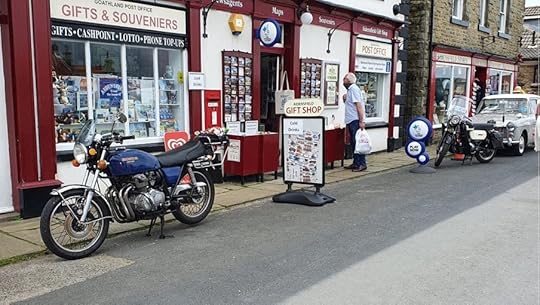
The Heartbeat Vehicle Rally is an annual event which sees vehicles that were used in Heartbeat, along with other classic cars and bikes, descend on Goathland for two days in the summer. Some of the show’s stars appear, signing autographs and taking photographs, and money is raised for charity through the sale of a Heartbeat calendar and donations taken by locals dressed as characters like Sergeant Blaketon and loveable rogue Claude Greengrass. The rally was created by Heartbeat fan Alan Coleman, who had bought the police minivan used in the show after filming finished in 2009 and made several trips to Goathland in it. Parking the van outside the Aidensfield Stores attracted a lot of interest from other fans, which gave him the idea of arranging a car rally featuring vehicles that appeared in Heartbeat. Phil Hopkinson, who owned the Aidensfield Stores, gave Alan contact details of the companies that had supplied the vehicles for filming, who in turn put him in touch with the new owners the vehicles had been sold to and who were happy to bring the cars to Goathland for the first Heartbeat Vehicle Rally in 2011. Alan set up a Facebook page for the event, on which he announced that a calendar and postcards of Heartbeat vehicles would be produced, with the proceeds going to two charities, and asked for fans to contribute digital photos of their vehicles.
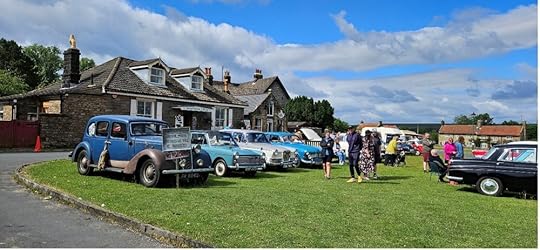
Ten Heartbeat vehicles were on display at the first rally, yet social media has played a role in increasing the number of cars that are exhibited, and the number of fans in attendance, in subsequent years. A Twitter account for the event was created in 2015, and nineteen vehicles – both ex-Heartbeat and vintage - attended in 2016. Alan also began sharing Periscope broadcasts and created an Instagram account in 2016, using the social media accounts to solicit ideas for encouraging other Heartbeat stars to attend. In one post he wrote:
Each year I get asked if any other Heartbeat actors will be attending, well the owner of the Aidensfield Stores has always arranged for David Lonsdale to attend and each year David has kindly agreed to do so. I would think that any Heartbeat actor would understandably (sp) at least expect to be paid their travel expenses to attend the rally, so I don’t think it would be fair to ask the Adensfield stores to stump up money for additional actors. It may be possible to raise money to pay actors to attend by raising money online using Gofundme or similar ? If people think it’s a good Idea, I will look into it.
Responses were positive, with interest from UK and overseas fan. Two fans set up Facebook groups for Heartbeat fans in Sweden, Denmark, and Norway while the President of the Scarborough Elvis Fan Club offered support in putting on an after-event social evening. Covid saw the 2020 Rally being cancelled but online events were offered to fans, including a Zoom quiz and Q&As with Tricia Penrose and David Lonsdale which were streamed live on Facebook. The Facebook live with Tricia took place on 17 September, 2021 and generated 45 comments, including questions about the show and the possibility of an official convention, while the event with David generated 77 comments including questions about the production of a Heartbeat audio show. Alan also set up a Facebook group linked to the Rally page for owners of ex-Heartbeat vehicles to share information, photos, and advice about finding, buying, and restoring screen-used vehicles. Members shared links to vehicles and other Heartbeat items they had seen for sale which, in some cases, led to ex-Heartbeat cars being bought by members and restored for exhibition in the rally at Goathland. The vehicle owners group currently has 5,056 members with regular posts about the show being contributed.
Alan stepped down from organising the rally in 2021 and the organising team now consists of Lee Jones, Kieran Reid, and Jason Bullard. In addition to taking over the running of the Facebook pages Lee and Kieran are also active on their own Twitter and Instagram accounts. Lee runs @TvHeartbeat, which shares favourite clips, photographs, and behind the scenes information, while Kieran runs the Molly the MGB GT Instagram account, featuring photos of his classic car. They also run the TV Heartbeat Podcast which features interviews with cast members and discussions of the show and its episodes.

Of course, we’re used to social media being discussed in relation to fans and fandom, but it generally seems to be thought of in relation to new(er) texts: Harry Potter fandom has an active social media presence and FOX used platforms like Snapchat and Twitter to generate hype for The X-Files revival season in 2016. It seems strange to think of a text about the 1960s, which ended in 2010, having an active social media presence but it clearly does, and moreover, it’s been an important tool in connecting Heartbeat fandom as well as facilitating physical events like the vehicle rally and encouraging visitors to Goathland. As Keiran said when he spoke to me, he has been approached by people who have attended the rally after seeing photos of his, Lee’s and Jason’s cars on Instagram - one attendee brought his Rolls Royce to the rally after seeing Kieran’s posts. Lee has also utilised his social media platforms to encourage people to attend the rally with their vehicles and forged connections with cast and crew which resulted in Vanessa Hehir attending the rally for the first time in 2023. As the Heartbeat Vehicle Rally shows, digital fan practices are just as important in encouraging screen tourism as physical ones are, no matter how old the source text.
This research was funded by the University of York.BiographyBethan Jones is a Research Fellow at the University of South Wales. She has written extensively about anti-fandom, media tourism and participatory cultures, and is co-editor of Crowdfunding the Future: Media Industries, Ethics, and Digital Society (Peter Lang) and the forthcoming Participatory Culture Wars: Controversy, Conflict, and Complicity in Fandom (under contract with University of Iowa Press). Bethan is on the board of the Fan Studies Network, co-chair of the SCMS Fan and Audience Studies Scholarly Interest Group co-editor of Popular Communication.
August 29, 2024
Who's Looking After the Cafe Then? Holmfirth and The Longevity of Screen Tourism
As a kid, one of my Sunday night rituals was sitting in my gran’s living room to watch Last of The Summer Wine (BBC, 1973-2010), a comedy about the escapades of three retired Yorkshire misfits. There was Foggy, the former soldier who often boasted about his exploits during World War Two despite spending it as a sign-writer; Clegg, a redundant lino salesman whose plans for a relaxing retirement get interrupted by the schemes of his friends; and Compo, the lovable rogue who – in between trying to get his neighbour Nora Batty to elope with him – can be found cooking up various ways to stave off boredom. Written by Roy Clarke, the show began in 1973 and ran on the BBC until it ended in 2010, though re-runs are a staple of Freeview channels like Yesterday. The series itself was set and filmed in Holmfirth, a town in West Yorkshire, which also played host to the 50th anniversary celebration weekend in June 2023.
Holmfirth has long embraced Last of the Summer Wine and its tourist legacy. A down-at-heel industrial town facing the loss of its woollen mill when the series first began filming there in the 1970s, it saw increasing numbers of tourists in the show’s first decade - 60,000 a year, according to Andrew Vine. As the show’s popularity increased so did the work opportunities for locals and the income from the rising number of visitors, transforming Holmfirth into a once-again prosperous town and cementing its position at the heart of “Last of the Summer Wine country”. As academics Lynne Hibberd and Zoe Tew-Thompson describe, the show has become “inscribed, embedded and appropriated into the town of Holmfirth and its people”, evidence of which was clear during the 50th anniversary weekend. A window display in one charity shop featured a walking stick, flat cap, and green knitted bobble hat – signature accessories of the main characters – along with a clapperboard announcing the 50th anniversary weekend while a flower shop peppered framed illustrations of key characters and locations among cacti and house plants. A local estate agent dedicated an entire window to the show, and bunting in the shape of frilly bloomers hung everywhere.

Last of the Summer Wine tourism isn’t limited to specific times of the year. The Summer Wine Magic bus tours, which take passengers on a 10-mile journey around the filming locations used in the show, run between 11-4 Wednesday to Saturday and the Wrinkled Stocking Tea Room, part of the building used as the filming location for Nora Batty’s cottage – which is now a self-catering cottage – serves cream teas in a room adorned with photographs, paintings, and memorabilia. In addition to these, the Summer Wine exhibition, located in Compo’s old house, is open year-round. Among the displays of screen-worn clothing and props is a TV showing a documentary about Summer Wine and its impact on the town, along with a plaque proclaiming that the show was Queen Elizabeth II’s favourite and stacks of condolence books filled with memories from fans following the death of Bill Owen (who played Compo) in 1999. I sat in the exhibition for a while, watching the documentary, and several families passed through while I was there. One wanted to sign a book of condolence – testament to the generational fandom of the show as adults who watched it as kids share the same ritual with their own children – while another told me how much they missed having something like Last of The Summer Wine on TV now.
Perhaps one of the most famous locations in Holmfirth, though, is Sid’s Café. Owned by Laura Booth, who was instrumental in organising the 50th anniversary celebration, the café is also an accessible filming location. And the transformation of the café perhaps epitomises the effect the show and its fans had on Holmfirth. When the series was filmed, the building was used as storage for the ironmonger’s next door, the exterior decorated for filming by the BBC. As fans began visiting the town, the building was bought and turned into a working café, which itself was then used as a filming location (as in the 1985 episode whose title has been used for this blog post). Although filming ended in 2010, when I arrived in Holmfirth, Sid’s café was full of fans who had arrived for the anniversary weekend. One couple, who travelled from Kentucky, were among the scores of viewers who had visited Holmfirth from overseas. As Laura Booth points out, visitors come “from all over the world - America, Australia, Corsica, Sweden" and people from a range of different countries were at the anniversary weekend.
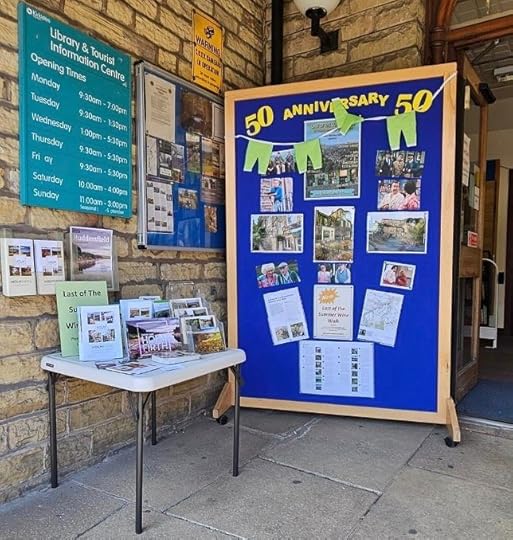
The weekend itself was co-organised by Bob Fischer and Andrew T. Smith, who set themselves the task of rewatching and blogging about Last of the Summer Wine following the airing of its final episode. Calling themselves the Summer Winos, they have since performed at the Edinburgh Fringe as well as at the celebration weekend. Speaking to Bob and Andrew, they highlighted the symbiotic relationship between the show and the town, pointing out that many of the prime filming locations are now businesses owned by locals: “the town itself, or the all the businesses of the town, have very much embraced the series and used the series as a focal point to bring people into the town” and one way of bringing people into the town while recognising and celebrating the show’s fiftieth anniversary was to hold an anniversary weekend.
Businesses and locals involved in the weekend’s events included: The Nook Brewhouse, which had also created a special anniversary ale, ‘Fill your boots with Blonde’; The Civic, which was the venue for ticketed events including an audience with Jonathan Linsley (who played Crusher in the show) and a charity screening of the feature-length episode “Getting Sam Home”; Imagine Toy Shop, which was a stop on the “Captain Clutterbuck’s Treasure Hunt” and played host to a giant matchbox similar to the one Compo carried around in the show; and local Greengrocer Andrew Bray, who gave a talk on his friendship with Bill Owen and other members of the cast and crew. In addition, Holmfirth Library and Walkers Are Welcome Group produced a Summer Wine walk, details of which were available from the library. Holmfirth embraced Last of The Summer Wine but did so without any involvement, funding, or partnerships with the BBC (although the broadcaster did give permission for the gala screening of “Getting Sam Home” to be shown, requesting all proceeds go to Children in Need). The ‘active presence’ of Last of The Summer Wine in Holmfirth is therefore established by locals, businesses and the fans who travel there to see the sights they’re familiar with from the screen. Although The Last of the Summer Wine ended thirteen years ago, Holmfirth is still a draw for fans, and the fiftieth anniversary weekend demonstrates how businesses, local council, and tourism organisations can work together to take advantage of screen tourism.
This research was funded by the University of York.BiographyBethan Jones is a Research Fellow at the University of South Wales. She has written extensively about anti-fandom, media tourism and participatory cultures, and is co-editor of Crowdfunding the Future: Media Industries, Ethics, and Digital Society (Peter Lang) and the forthcoming Participatory Culture Wars: Controversy, Conflict, and Complicity in Fandom (under contract with University of Iowa Press). Bethan is on the board of the Fan Studies Network, co-chair of the SCMS Fan and Audience Studies Scholarly Interest Group co-editor of Popular Communication.
August 27, 2024
Hordes of Lesbians Descending Upon Halifax: Fan Tourism, Identity and Pilgrimage
Gentleman Jack (2019-2022) is a historical drama created by Sally Wainwright and co-produced by BBC and HBO. Set in the 1830s, the series is based on the life of lesbian landowner and industrialist Anne Lister who lived at Shibden Hall near Halifax. The series takes its name from the derogatory epithet given to Lister by tenants and neighbours who ridiculed her appearance – she dressed entirely in black, which was normal for men at the time, rather than the pastel dresses worn by women – and sexuality. Lister defied expectations, becoming the first woman to be elected to the committee of the Halifax Literary and Philosophical Society, opening and owning a colliery, and travelling extensively throughout Europe and beyond. Lister kept a series of diaries throughout her life, many of which were written in a secret code as they recounted the range of lesbian relationships she had. The diaries were deciphered in the 1930s by one of Lister’s descendants, John Lister, and his friend, Arthur Burrell. On discovering what the code actually said, Burrell advised Lister to burn the diaries. Lister did not, but he did hide them behind a panel at Shibden Hall. Although various books and programmes have been written about Lister, including Helena Whitbread’s two books on the diaries, published in the late 1980s and early 1990s, Jill Liddington’s 1994 biography, and a 2002 radio play for BBC Radio 4, it wasn’t really until Gentleman Jack that her story became more well-known and fans began flocking to Halifax.

Calderdale Council reported on the impact of season one of the show, highlighting income for museums, local businesses, hotels, events and attractions (including a 40% increase in visitors over to Halifax Minster over the summer period (500 to 700 in a week) and a celebration of diversity. American author Janet Lea carried out research into “the Gentleman Jack effect”, receiving survey responses from over 500 women in 48 countries who talked about the impact of the show on their own self-perceptions, behaviours, and attitudes. 20% of those who responded to the questionnaire had already been to Shibden and 62% were planning to visit in the future. The emotional impact of the show, and its real-life locations, was evident when I visited Halifax.
I travelled to the market town for the 2023 Anne Lister Birthday Week, a celebration of the life of Anne Lister (and her wife, Ann Walker). The Anne Lister Birthday Week (ALBW) was created by American fan Pat Esgate after she saw Gentleman Jack in 2019. She visited Halifax for a weekend before returning a couple of weeks later to attend the Anne Lister Weekend (organised by Calderdale Council), which took place following the season one finale. The Anne Lister Weekend included an exhibition of costumers worn by the cast, talks about Anne Lister’s life, and a tour of Halifax Minster where she was buried. Pat was inspired by her second visit, writing:
That visit was even more amazing. Sitting in the Minster, surrounded by women every bit as inspired as me, hearing Helena Whitbread and Jill Liddington speak of the life of the real Anne Lister, was positively transformative. I felt seen, and heard, and understood in a way I’d never experienced in my life. And from what I saw in the tear-streaked faces of the rest of the audience, I wasn’t the only one who was having that moment.
The following month, she reached out to some of those involved in the Anne Lister Weekend and arranged a four-day event to take place in April 2020, including talks, tours, and visits. Of course, Covid put a spanner in the works, and the 2020 in-person event was postponed (eventually taking place over a week in April 2022). Many of those who attended the 2023 event were returners, having visited in 2022. For many it seemed like the visit was not only a form of screen tourism – during the two tours to York tours we were shown clips from Gentleman Jack while standing in the real-life filming locations – but also a sort of pilgrimage. I interviewed a representative from Calderdale Council prior to visiting Halifax who said:
women go to the Minster to sit and so on. So yeah, I mean they are pilgrims. They want to go to Halifax because they want to see where she lived and they want to, you know, walk where she was. I mean, you can literally walk from Shibden over Beacon Hill, you can drop down into town, and you can walk the streets that she used to walk. And that is just, you know, really, really powerful. You can walk in her footsteps so you can be a pilgrim and you can do it because that’s what she did. But you can also do it and, you know, sort of almost say thank you to her for that.
This idea of pilgrimage has also been suggested by ALBW’s founder Pat Esgate, referring to Halifax as a “Lourdes for lesbians”, and this certainly seemed evident during ALBW 2023.
An evening event in Halifax Minster Estate discussed the impact that Lister has had on Helena Whitbread, Jill Liddington, and series consultant Anne Choma before opening it up to the floor. The Minster was packed with attendees, mostly women, mostly lesbians, who shared their experiences. Many of the stories were similar – these were mainly older women who had grown up believing there was something wrong with them for their attraction to women; they had attempted to live ‘normal’ (read: heteronormative) lives, sometimes marrying and having children; they had been deeply unhappy. But after watching Gentleman Jack they had learned – or realised – that there was nothing wrong with them; and if Lister could accept and embrace who she was 200 years ago, there was no reason why they couldn’t now.
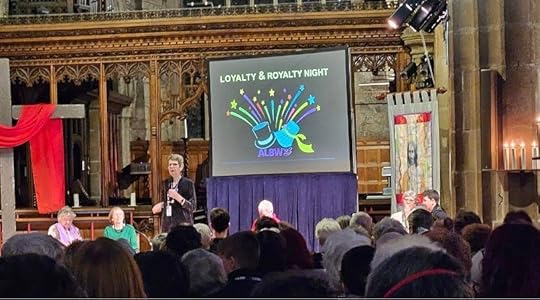
These stories were incredibly emotionally affective and spoke to the impact that a text can have on people as well as the importance of travelling to a location in order to connect with a history, a community, or oneself. While Shibden Hall has seen increasing visitor numbers, the Holy Trinity Church in York has also embraced Lister, displaying a rainbow plaque (commissioned in 2018) to mark Lister and Ann Walker taking the sacrament (which they saw as committing to each other for life) on Easter 1834. The church was a location on one of the tours I attended, and while no one knows which pew the two Ann(e)s sat in, several of my fellow tourists sat in the pew which was used in Gentleman Jack. Of course, Gentleman Jack is a dramatized account, while Lister was a very real woman. But for many ALBW attendees, their introduction to Lister came through the show, and the two are deeply intertwined. Visiting locations used for filming, many of which are places Lister would have known and visited during her life, enabled fans to get closer to the real woman and connect with “the first modern lesbian”.
This research was funded by the University of York.BiographyBethan Jones is a Research Fellow at the University of South Wales. She has written extensively about anti-fandom, media tourism and participatory cultures, and is co-editor of Crowdfunding the Future: Media Industries, Ethics, and Digital Society (Peter Lang) and the forthcoming Participatory Culture Wars: Controversy, Conflict, and Complicity in Fandom (under contract with University of Iowa Press). Bethan is on the board of the Fan Studies Network, co-chair of the SCMS Fan and Audience Studies Scholarly Interest Group co-editor of Popular Communication.
August 26, 2024
Visitors are Coming: Fan Tourism in Northern Ireland
Screen tourism, also referred to as media tourism or fan tourism, happens when visitors travel to a location because it appeared in, or was used in the production of, a film or television series. Although it’s been popularised by films like Lord of The Rings, screen tourism has been around for years. Peter Bolan and Mihaela Ghisoiu argue that it was the post-war decades of the 1940s and 50s that saw some of the earliest significant examples of film influencing a desire to travel, citing Carol Reed’s 1949 film The Third Man as a driver for tourism to Vienna, and of course The Sound of Music saw an almost 20% increase in American tourists to Salzburg after the film’s release in 1965.[1] Screen tourism has become a well-established area of academic research given the role that films and television shows play in driving visitors to specific locations, and this research project builds on that. Where scholarship has mainly focused on the way screen tourism is experienced by visitors[2], or the impact of screen tourism on local communities[3], industry and media reports have highlighted the role media tourism plays in economic and regional development. The Guardian reported that Birmingham’s visitor numbers increased by 26% between 2013 and 2018 as a result of the city being used in the filming of Peaky Blinders, while research by Visit Cornwall found Poldark and Doc Martin were responsible for an increased number visits to the county. Revenue from tourists visiting Highclere Castle after watching Downton Abbey helped fund repairs to the stately building while moving I’m A Celebrity… Get Me Out Of Here to north Wales during the pandemic led to an increasing number of tourists visiting the town. Screen tourism can clearly have a long-term impact on the regions where filming takes place, just as it can have a long-term impact on the fans who visit. In this blog post, I want to focus on the economic impact Game of Thrones had on Northern Ireland.
Immersive ExperiencesI travelled to Belfast to do some fieldwork on Game of Thrones fan tourism, which involved going on three tours (run by Game of Thrones Tours) and visiting the Game of Thrones Studio Tour. Established by Rob Dowling in 2014, Game of Thrones Tours offers tours around the Northern Ireland locations used in the series, run by guides who worked as extras on the show. Game of Thrones Tours bills itself as one of the largest Game of Thrones tours in the world, the company ran 30 buses a week at the height of the show’s popularity, though the COVID-19 pandemic had an impact and in the summer of 2022 the company only ran seven a week. When I travelled to Belfast in a cold March 2023, however, both bus tours I went on were well-attended with fans from the US and Portugal, as well as the UK.
The first tour I went on was the Winterfell trek, which is very Stark-oriented. There were around 32 of us there, plus Lar the tour guide, who was an extra in Game of Thrones, and Richard – another tour guide and extra who joined us for part of the day. Game of Thrones Tours provides costumes for attendees to wear so we all donned Stark cloaks, which were surprisingly warm and very welcome in the biting March wind. We of course had a group photo taken. In the first of what would be a continuing call-and-response, Lar shouted ‘who owns the north?’, the superfans in the group responded ‘we own the north!’ This became a common refrain throughout our photo opportunities, generating some strange looks from the non-Game of Thrones fans visiting the locations at the same time. Tollymore Forest itself featured as the wood north of the Wall where the Night’s Watch find the dismembered wildling bodies in the very first episode. We got to see the grove where this was filmed and heard some behind the scenes stories before making our way to the location used as the Wolfswood where the Starks find the direwolf puppies. Lar showed us clips from the episodes while we were standing at the locations, allowing us to see both real and fictional places at the same time. Tollymore is open to everyone, so we had some strange looks, striding through the forest dressed very literally as something out of a fantasy series, but it was fun and adds to the sense of immersion. Pine and Gilmore[4] argue that memorable experiences arise from immersion and the ‘reduction of the space’[5] between fan tourist and the text through cosplay in the filming location certainly created a memorable experience.
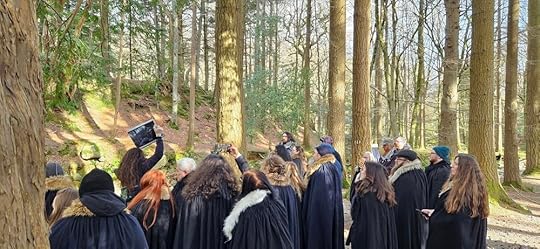
Game of Thrones Tours at Tollymore Forest
From Tollymore we went to Castle Ward and walked to Audley’s Castle, a 15th century tower that functioned as both one of Walder Frey’s Twins and the location of Robb’s Camp in the Riverlands. Other scenes filmed nearby include the spot where Brienne of Tarth killed three Stark bannermen while trying to escape with Jaime Lannister, and where Tyrion and Bronn were ambushed by the Stone Crows of the Vale. I took the opportunity to take some photos featuring my Brienne of Tarth Funko!Pop figure, merging material fandom with cosplay. Rebecca Williams has written about the use of para-textual objects such as merchandise in the fan-tourist experience, arguing that carrying these items around locations and inserting them not photographs “allowed fan identities to be performed and displayed and for the links between the narrative world and the ‘real’ locations to be mediated”.[6] As part of the research project I shared photographs from my fieldwork on Instagram, accompanied with hashtags relevant to the text and the academic framing of the visit. As a result, not only were links between the narrative and real locations mediated, but so was the academic study of screen tourism.
After Strangford Lough we walked back to Castle Ward, the original location of Winterfell in season one of Game of Thrones. Numerous green screens were set up throughout Castle Ward’s courtyard to allow for visual effects to be included in post-production. Other elements of the courtyard were physically adapted, such as thatching the roof of the toilets and disguising the building’s real purpose. Castle Ward and its grounds is owned by the National Trust and – unlike Tollymore – featured information boards stating Game of Thrones was filmed there. Similar boards were at the tower at Strangford Lough, this time put up by Newry, Mourne and Down District Council, suggesting that a range of organisations are aware of the opportunities filming locations can offer for tourism. Additional activities are on offer at Castle Ward, such as archery lessons that take place at the same spot the Stark children were practising during the show. A Winterfell Festival featuring jousting, falconry displays, displays of props, re-enactments and an immersive skirmish to Audley’s Castle was also held at Castle Ward in 2016, 2017 and 2018 and saw around 3,000 fans attend.
The final stop of the day was Inch Abbey, a crumbling 12th century ruin where Robb Stark became King in the North. The fans on the tour bus had taken part in a competition on their drive up, with whoever answering the most questions correctly getting the chance to choose the sword they wanted to use for the photo opp. As well as the cloaks, Game of Thrones Tours bring along replicas of the most famous swords (Kingslayer, Needle) as well as ordinary swords, shields and banners to use at the Abbey. It was fun to be wielding my, rather hefty, sword in the place where Robb was proclaimed King in the North and pretend that I too was a Stark bannerman. Rather appropriately, the wind and snow had picked up at this point, making it feel as though we really were in a Game of Thrones episode, so we took some quick photos in front of the Abbey before heading off.
Skills development and economic impactsIn addition to the Games of Thrones Tours offerings, other experiences were also developed: the Mulhall family, father William and his sons Ross, Caelan, and William Jr, who owned the Northern Inuit dogs used as direwolves in the show set up Direwolf Tours; Flip Robinson, who was a body double for Hodor and The Mountain, created Giant Tours; Peak Discovery Group expanded into Game of Thrones tourism with Winterfell Tours, offering immersive experiences including archery at Winterfell, a film locations cycle trail, a boat tour and Game of Thrones glamping. Offering a Game of Thrones experience meant that Peak Discovery Group could increase its business by nearly 40% between 2014 and 2019 and grow its team from 5 to 16. While figures show that 1 in 6 travel to Northern Ireland because of Game of Thrones, it’s not just the tourism industry that has benefited from the show. The second Game of Thrones Tour I went on was the Glass of Thrones tour, taking in six stained glass windows depicting key themes from Game of Thrones that had been placed around Belfast. The first window was unveiled the morning of the season 8 premiere, with subsequent windows being revealed as each episode aired. Designed to celebrate a decade of Game of Thrones filming in Northern Ireland and intended to “bring the destination to the attention of Game of Thrones fans around the world”, the windows were created by Tourism Ireland and Tourism NI in partnership with HBO and were stained by an artist in Bangor, County Down. Originally leading fans from Belfast City Hall to Titanic Studios, Tourism Ireland gifted them to the city of Belfast and they’re now on permanent display along the Maritime Mile. As with other Game of Thrones tours, my guide was a former extra and as I was the only person on the tour I got a load of behind-the-scenes information.
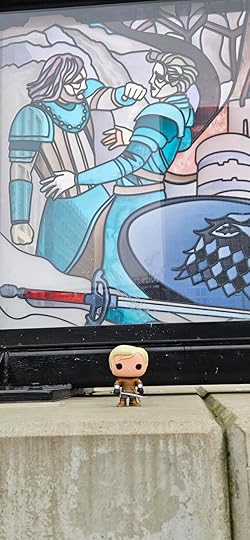
Brienne of Tarth Funko in front of the Brienne of Tarth glass window
What particularly interested me was the way the show involved a range of people and industries, both during the time it filmed in the country and afterwards. Andrew, my guide, told me how students who appeared as extras or were studying film and television production at college had picked up work experience on the show, and progressed from trainees or extras to experienced crew who could add working on a critically-acclaimed incredible show to their CV and have the pick of any job. As Carla Stronge, casting director, says “People who were extras are now heads of department in their own right: costume supervisors, armoury department co-ordinators and so on“. Since the series began filming, it’s created around 900 full-time and 5,700 part-time jobs in Northern Ireland, “funding and developing a brand new, multi-award winning skilled workforce – from carpenters and armourers to hair stylists and makeup artists”.
Northern Ireland’s film and television industry is growing, and recent productions include Dungeons and Dragons: Honor Among Thieves, Dalgliesh and Old Guy. HBO also continues to invest in the country. The Game of ThronesStudio Tour, which I also visited, opened in the show’s original filming location at Linen Mill Studios in Banbridge in February 2022. The Studio Tour, operated in conjunction with Warner Bros. Themed Entertainment, which also runs the Harry Potter Studio Tour, features original sets and props as well as interactive experiences and behind the scenes information on the production and filming of the show.
Game of Thrones Studio Tour
Around 180 staff are employed at the site, which also works with local businesses to bring in goods and services, and offers training opportunities in the creative industries, construction and tourism sectors to local schools and colleges.
ConclusionGame of Thrones and its associated screen tourism has had a huge impact on Northern Ireland. Not only has it brought money into the local economy and generated new jobs, but it has also helped change perceptions of the country. Northern Ireland has, historically, been associated with the Troubles – armed conflict between Catholic Irish Republicans and Protestant Loyalists between the 1960s and the late 1990s that cost over 3,600 lives. The Troubles have been intrinsically linked with Northern Ireland’s heritage and a tourism industry has been built up based around the conflict, with murals and sites commemorating the Troubles appearing on various bus tours around Belfast. Mention was made of this period of Ireland’s history on both Games of Thrones Tour tours, but these were usually followed by a comment on how people from Northern Ireland and the Republic of Ireland were coming together thanks, in large part, to Game of Thrones. Aligning Northern Ireland so closely with Westeros, as well as a sustained marketing campaign by Northern Ireland Screen and Tourism Ireland, means that the negative perceptions of the country and the Troubles have been superseded by the show and tourism is as much influenced by popular culture as it is history.[7]
The final season of Game of Thrones aired in 2019. While a prequel series was ordered by HBO, filming has mainly taken place in Spain, Cornwall and Derbyshire. Still, Game of Thrones remains a draw for visitors. On the tours I went on there were fans from Ireland, the UK, Spain and the US and while numbers have decreased from the height of the show’s popularly, caused in part by the effects of the COVID-19 pandemic, it would be no surprise if the series does for Northern Ireland what Lord of The Rings did for New Zealand and ensures a steady stream of fan tourists for years to come.
This research was funded by the University of York.[1] Bolan, P. and Ghisoiu, M. (2019). Film Tourism through the Ages: From Lumière to Virtual Reality. In I. Yeoman & U. McMahon-Beattie (eds.) The Future Past of Tourism: Historical Perspectives and Future Evolutions, pp. 236-252. Bristol: Channel View Publications.
[2] See, for example, Waysdorf, A. S. (2021). Fan sites: Film tourism and contemporary fandom. Iowa: University of Iowa Press; Reijnders, S. (2011). Stalking the count: Dracula, fandom and tourism."Annals of Tourism Research 38(1): 231-248; Kim, S. (2012). Audience involvement and film tourism experiences: Emotional places, emotional experiences. Tourism Management 33(2): 387–396.
[3] See, for example, O’Connor, N. & Kim, S. (2014). Pictures and prose: Exploring the impact of literary and film tourism. Journal of Tourism and Cultural Change 12(1): 1–17; Beeton, S. (2001). Lights, camera, re-action: How does film-induced tourism affect a country town? In: M.F. Rogers & Y.M.J. Collins (eds.), The future of Australia’s country towns, pp. 172–183. Bendigo: La Trobe University; Torchin, L. (2002). Location, location, location: The destination of the Manhattan TV Tour. Tourist Studies 2(3): 247–266.
[4] Pine, B. J. & Gilmore, J. H. (1999). The Experience Economy: Work is Theatre & Every Business a Stage. Boston, MA: Harvard Business School Press.
[5] St-James, Y., Darveau, J. & Fortin, J. (2018). Immersion in film tourist experiences. Journal of Travel & Tourism Marketing, 35(3): 273-284.
[6] Williams, R. (2019). Funko Hannibal in Florence: Fan tourism, participatory culture, and paratextual play. JOMEC Journal, 14: 72.
[7] See Doppelhofer, C. (2023). Overcoming the Troubles in Westeros: changing perceptions of post-conflict Northern Ireland through the diegetic heritage of Game of Thrones. Social & Cultural Geography: 1-21.
BiographyBethan Jones is a Research Fellow at the University of South Wales. She has written extensively about anti-fandom, media tourism and participatory cultures, and is co-editor of Crowdfunding the Future: Media Industries, Ethics, and Digital Society (Peter Lang) and the forthcoming Participatory Culture Wars: Controversy, Conflict, and Complicity in Fandom (under contract with University of Iowa Press). Bethan is on the board of the Fan Studies Network, co-chair of the SCMS Fan and Audience Studies Scholarly Interest Group co-editor of Popular Communication.
May 22, 2024
WrestleMania XL: The Greatest Story Ever Told (Part Three)
By Tara Lomax and Mark Williamson
This is the last of three parts on the recent WrestleMania XL and the current revival of WWE. It reviews the interconnected and multistrand storytelling that unfolded over two years leading into the recent event and highlights opportunities for further appraisal. Part One established the important role of audience and character in pro wrestling, and overviewed key moments for Roman Reigns leading into WrestleMania XL. Part Two introduced the story of Cody Rhodes and reflected on long form serialized storytelling in WWE. This final part explores the blurring of reality and fiction that drives pro wrestling storytelling and the role it played in the lead up to WrestleMania XL. Readers who might be interested in this piece include those new to pro wrestling within the context of popular culture and entertainment studies and those curious about WWE’s revival. Italicized text denotes wrestling terms.
As a multiplatform storyworld, WWE contains rules and protocols that creators, talent, and audiences understand and follow. In pro wrestling generally, these rules and protocols can work to maintain the illusion of reality that is known as kayfabe, whereby wrestlers continue their gimmick even when the show is over to protect the knowledge that pro wrestling is staged. The kayfabe illusion broke in the 1980s, but what remains is a rich storyworld on the border of fiction and reality where rules and protocols give well-booked matches meaning.
In WWE, these rules may involve adhering to brand distinctions between Raw, Smackdown, and NXT, honoring the status of each championship title, or maintaining the goal to plausibly simulate sports contest. Most relevant here is the rule that the pro wrestler who wins the Royal Rumble gets a WrestleMania title opportunity of their choice. On the road to WrestleMania XL, the potential disruption of this rule added a new dimension to an already long-running story.
Cody Rhodes’ win in the 2024 Royal Rumble made him one of only four WWE superstars to win back-to-back, including Hulk Hogan (1990 & 1991), Shawn Michaels (1995 & 1996), and ‘Stone Cold’ Steve Austin (1997 & 1998). This accomplishment gave him a second chance to defeat Roman Reigns and win the Undisputed WWE Universal Championship, but the threat of a returning WWE legend – The Rock – jeopardized this privilege. In response, the WWE Universe expressed disapproval.
The interference of The Rock in Rhodes’ story reflects key themes explored over these three parts: the important role of the audience in shaping story direction and character types; the serialized development of WWE storytelling; and the contemporary transformation of kayfabe. While kayfabe no longer exists as it used to – with a clear distinction between reality and fiction – it now drives a self-reflexive logic in the relationship between production and audience, whereby audience reception is now shaped and exploited by their awareness of pro wrestling conventions and booking.
This final part will focus on the last stage in the two-year (and beyond) story that culminated at WrestleMania XL, where Rhodes finally finished his story and became WWE Champion.
There’s always a bigger superstar. . .The surprise return of CM Punk at Survivor Series: WarGames (2023) was even bigger than Rhodes’ return in 2022. After almost ten years since leaving WWE, Punk returned in his hometown of Chicago to a resounding pop, both live and on social media. Like Rhodes, Punk came back to WWE via All Elite Wrestling (AEW), so they shared a similar recent trajectory (although Punk’s departure from AEW was far more controversial). They also share a ‘gift of the gab’ with exceptional mic skills. In the lead-up to the 2024 Royal Rumble, Rhodes and Punk exchanged words about their mutual respect and friendship before warning that the friendship stops short at the wrestling ring at Royal Rumble (video 1). On Raw (January 22, 2024), Punk tells Rhodes,
I know there’s no friends in the Royal Rumble. I’ve been in more than you have. But what about Sunday morning? Because I can separate business from personal — can you? Because I wasn’t born in this business. You very much were. You grew up in this business. Personal to you is this business.
With this speech Punk offers commentary on Rhodes that reflects a point we made in Part Two, where the blurring of the personal and professional is always at play for Rhodes’ story. Punk’s speech highlights a more complex expression of contemporary kayfabe that acknowledges a distinction between personal and business; historically, ‘keeping kayfabe’ meant that wrestlers would extend in-ring rifts or contest outside the ring, but here Punk asks Rhodes is he has what it takes to separate the two and maintain their friendship outside the in-ring contest.
Video 1: Punk and Rhodes face-off on Raw (January 22, 2024)
While Rhodes offered a positive reception to Punk’s return – essentially, this is great for business so “welcome aboard” – the return of Punk had implications for Rhodes’ story going into the 2024 Royal Rumble. This would be yet another challenge to overcome, which Punk also clearly articulates on Raw (January 22, 2024):
Cody Rhodes, you have carried this company on your back for a soul-crushing 2 years . . . And right when you’re about to cross the finish line and finish your story – oh what, what’s that in the distance? It’s a much bigger superstar who hasn’t been around in a very long time trying to take it away from you and I’m talking about me!
Unsurprisingly, Rhodes and Punk are the last two competitors left in the 2024 Royal Rumble match and for a moment it seemed as though Punk might win as he boasted, “I didn’t wait 10 years to lose to Dusty’s kid” – that is exactly what happened as Rhodes threw Punk out of the ring and finished victorious. As is custom with a Royal Rumble win, Rhodes climbed onto the turnbuckle and pointed to the WrestleMania sign; since Rhodes already knew which title he wanted, he pointed straight at Reigns sitting in the stands (video 2). After the Royal Rumble, news emerged that Punk had sustained a severe tricep injury during the match and would need to take time off, thus ruling him out of WrestleMania XL – but the threat of a bigger superstar was not over.
Video 2: Rhodes wins the 2024 Royal Rumble
Despite all clear indications that Rhodes would choose Reigns for his title opportunity at WrestleMania XL, on Raw (January 29, 2024) Rollins tried to entice Rhodes to challenge him for his World Heavyweight Championship instead – a title without the long history or connection to Rhodes’ father. This was the first signal of a potential storyline pivot.
This shift was confirmed on SmackDown (February 2, 2024) when Rhodes revealed that, after reaching out to past WWE legends for advice, he would delay his goal: “I am coming for you Roman Reigns, but not at WrestleMania.” This was the queue for The Rock to enter the arena and take Rhodes’ place in the ring, and at WrestleMania XL (video 3).
Video 3: The Rock disrupts Rhodes’ story on SmackDown (February 2, 2024)
Despite the positive reaction from the live audience, the full segment of this exchange became WWE’s most disliked video; it was unsurprising that there would be a big pop from the live audience – The Rock showed up on SmackDown unannounced. However, for the bigger story, Rhodes’ decision to step away from his goal was out of character and undermined the audience’s commitment to his story over two years.
The WWE Universe made their thoughts on this story pivot very clear on the next Raw (February 5, 2024) where #WeWantCody chants and signs (image 1) dominated the show (although there were rumors that WWE handed out the signs). This raised questions about WWE’s story intentions regarding Rhodes, Reigns and The Rock: was this all part of the planned story, or audience-driven cause and effect? Another notable aspect of contemporary kayfabe is that, now the audience knowns this is a scripted story, there is more opportunity to play with their expectations and demands.
Image 1: Rhodes looks out to a sea of #WeWantCody signs on Raw (February 5, 2024)
By the WrestleMania XL Kickoff show (February 8, 2024), the “WeWantCody” movement had gained so much traction that Reigns’ challenger was still not yet officially announced. When Rollins introduced Rhodes to the stage as the only one “who can make that decision,” Reigns entered and chose The Rock – to which Rollins cried, “that’s not how this works!” The Rock entered the stage, and the audience made their thoughts very clear with booing and chanting, “we want Cody – Rocky sucks!” When The Rock finally got a word in, he revealed an image on screen of two family trees – the Anoa’i’s and the Maivia’s – bonded by blood oath (image 2).
Image 2: ‘The Bloodline’ family trees on WrestleMania XL Kickoff (2024).
For The Rock, this segment was intended to hype a match-up between him and Reigns to make, what he claimed would be, the biggest WrestleMania Main Event of all time. However, just as he and Reigns embraced to confirm the match-up, Rhodes emerged on stage and called “bulls**t.” He reminded Reigns and The Rock that, as the 2024 Royal Rumble winner, it is his right to choose his opponent at WrestleMania XL: “I choose you, Roman Reigns” (video 4). This decided the WrestleMania XL Main Event to be Rhodes versus Reigns for the Undisputed WWE Universal Championship, but this did not resolve the other emerging feud that Rhodes had provoked with The Rock and this segment concluded with The Rock slapping Rhodes.
Video 4: WrestleMania XL Kickoff (2024)
The addition of The Rock on the “Road to WrestleMania”, especially its potential disruption of Rhodes’ story, emphasized the critical role of the audience in shaping story direction. While a large contingent of the WWE Universe and the general audience wanted to see The Rock return to WWE, many did not want it to be at the expense of the long-form story they had been invested in over more than two years. The Rock versus Reigns might have been good for business, but Rhodes versus Reigns was good for the story. This disruption proved Punk to be right when he warned Rhodes “there will always be a bigger superstar”. It also gave the WWE Universe an opportunity to voice their support of Rhodes.
Rhodes personified the champion without a belt. He had motivated a team of babyfaces against Reigns who offered to help him finish his story, most especially Rollins. As we mentioned in Part One, Rollins’ part in this story extends back to 2014 when he was part of ‘The Shield’, together with Reigns and Dean Ambrose, and betrayed Reigns by hitting him in the back with a steel chair. On Raw (February 12, 2024), Rollins recounts this history (video 5):
The man Roman Reigns is, is partly my fault. We were brothers forged from the same fire. I taught him everything I know. I am partly responsible for the man that he is, but I could never have imagined the monster that he has become. And now that monster has got two heads. . . But when it comes to fighting ‘The Bloodline’, when it comes to fighting The Rock, when it comes to fighting Roman Reigns, there is only one man on Earth who is uniquely suited to be your shield.
In hindsight, Rollins’ offer to be Rhodes’ shield is the ‘Chekhov’s gun’ of WrestleMania XL and places Rollins in the most valuable role in the story.
Video 5: Rollins offers to be Rhodes’ shield on Raw (February 12, 2024)
The Final BossAt Elimination Chamber: Perth (2024), Rhodes challenged The Rock to a one-on-one match “any time, anywhere”. On SmackDown (March 1, 2024), The Rock refused the offer but counter-challenged Rhodes and Rollins to a tag match with him and Reigns on Night 1 of WrestleMania XL, with stipulations: if Rhodes and Rollins win the tag match on Night 1, then Rhodes’ match with Reigns on Night 2 will be uninterrupted by ‘The Bloodline’; if Rhodes and Rollins lose on Night 1, then the Main Event on Night 2 will be “Bloodline Rules” – if Rhodes loses on Night 2, he can never challenge for the championship again (video 6). Rhodes and Rollins accepted The Rock’s challenge on SmackDown (March 8, 2024) (video 7).
Video 6: The Rock makes his offer to Rhodes and Rollins on SmackDown (March 1, 2024)
Video 7: Rhodes and Rollins accept The Rock’s challenge on SmackDown (March 8, 2024)
When The Rock returned to WWE on Raw Day One (January 1, 2024) and confronted anti-USA heel Jinder Mahal, he was ‘The People’s Champ’; he thought himself to be the rightful ‘Head of the Table’ and, in hinting his opposition to Reigns, he presented himself as the babyface hero. As much as The Rock disrupted Rhodes’ story, Rhodes also destabilized the The Rock’s impression of his current status in the WWE Universe. The Rock saw himself as the savior returning to help WWE defeat Reigns but misjudged the degree to which Rhodes had already taken on that role in the fandom’s eyes. The #WeWantCody movement was so strong that it not only influenced the direction of the story, but it also forced The Rock to reconnect with his historically popular heel gimmick; however, this time he added the twist of being ‘The Final Boss’ who was also on the board of TKO with a disregard for current WWE management (Image 3).
Image 3: The Rock’s entrance as ‘The Final Boss’ on Raw (March 25, 2024)
The Rock was so committed to this heel turn against Rhodes and Rollins that he posted a 21-minute video rant on social media, to which Rhodes confidently downplayed with his own social media response, “i ain’t watching all that / i’m happy for u tho / or sorry that happened”. This exchange emulates traditional kayfabe, where the character types of heel and babyface extend into the personal and social sphere so much so that they also characterize the pro wrestler as a real person.
A message from The People’s Champ @wwe @tkogrp pic.twitter.com/s2yy6gYTTz
— Dwayne Johnson (@TheRock) March 1, 2024
The Rock posts a 21-min heel promo on social media
— Cody Rhodes (@CodyRhodes) March 1, 2024
Rhodes’ social media response to The Rock's 21-minute promo.
The Rock’s heel gimmick as ‘The Final Boss’ controlled most of the hype in the last couple of weeks leading into WrestleMania XL; however, with two high profile Main Event matches locked in, episodes of Raw and SmackDown interweaved non-match segments between Rhodes, Reigns, The Rock and Rollins that took on their own Main Event status in weekly programing. On Raw (March 18, 2024), Rhodes delivered a promo about The Rock that questioned his status as a heel and suggested that he was merely Reigns’ sidekick: “Rock referred to himself as our favorite heel . . . I’ve known some heels. . . Rock, I don’t think you’re a heel, I think you’re an ar**hole” (video 8).
Video 8: Rhodes calls out The Rock on Raw (March 18, 2024)
This promo undermined the validity of The Rock’s role as heel and thus his threat as an opponent; it also emphasized the new era for WWE branding that allowed the use of such terms as ‘heel’, ‘babyface’, ‘pro wrestling’ or ‘pro wrestler’ (previously, ‘superstar’ and ‘sports entertainment’ were to be used instead). The use of this language reflects WWE’s reconnection with pro wrestling as a distinctive medium with conventions, protocols and principles that shape storytelling and that audiences also understand. This promo signaled how the final stage in the “Road to WrestleMania XL” would play with this shared knowledge between storytelling and audience by testing the definition of what would historically be considered kayfabe.
On Raw (March 25, 2024) a week before WrestleMania XL, a match between Jey Uso and Shinsuke Nakamura was interrupted by ‘The Bloodline’ that quickly escalated into an arena fight outside the ring. Embodying ‘The Final Boss’ persona, The Rock took over the fight and dragged Rhodes out into a raining backlot to beat him up beside the ‘American Nightmare’ Tour Bus (image 4).
Image 4: The Rock beats up Rhodes beside the ‘American Nightmare’ Tour Bus on Raw (March 25, 2024)
There is much to say about this encounter, especially based on the maturity level of its violence and profanity, but what is especially interesting is how it plays with the audience’s awareness of kayfabe. Following the episode, The Rock posted a video on social media the revealed behind the scenes of this beating, where he refused to stop after the segment was ‘officially’ over because “just because the show is over, doesn’t mean that it stops”. This typified classical kayfabe, whereby feuds continue into the private and personal sphere and is meant to give the impression that this is a real feud; however, the contemporary twist here is that the persistence of this conflict was still staged, recorded, posted on social media, and then edited and aired in a highlights video on the next SmackDown (video 9). There was something more personal at work in the feud between The Rock and Rhodes, which reactivated the threshold between real and fiction that is crucial to storytelling in pro wrestling.
Video 9: Highlights of The Rock’s beatdown of Rhodes from Raw aired on SmackDown (March 29, 2024)
Going into Night 1 of WrestleMania XL, Rhodes and Rollins had just been beaten up, flagellated and left splayed in the ring on Raw (April 1, 2024). This segment reinforced the brutality of ‘The Bloodline’ and ensured that Rhodes and Rollins went into WrestleMania XL at a disadvantage (image 5).
Image 5: ‘The Bloodline’ beat up Rhodes and Rollins on Raw (April 1, 2024)
Night 1: The Rock and Reigns vs Rhodes and RollinsThe Tag Team Main Event on Night 1 of WrestleMania XL was hyped as the “biggest tag team match of all time” (image 6). It was The Rock’s first match in a decade and the outcome would determine the conditions of the Night 2 Main Event between Reigns and Rhodes. The babyface team – Rhodes and Rollins – entered the match as underdogs and this disadvantage was exploited and intensified by The Rock and Reigns. Both Rhodes and Rollins would follow this tag match with their own solo championship matches on Night 2 (Rollins v McIntyre and Rhodes v Reigns), so there was a lot of focus on the personal and physical cost of this match – especially for Rollins who had only recently been medically cleared to return to the ring after injury.
Image 6: Night 1 Tag Team Main Event at WrestleMania XL (2024)
It was unsurprising that The Rock and Reigns would defeat Rhodes and Rollins in this tag match on Night 1 – the tease of a “Bloodline Rules” championship match for Night 2 was too hyped not to be realized. While this match is a culmination of The Rock’s interference in Rhodes’ story and thus builds on past storytelling, it is most interesting as a seeding match for future feuds. Two notable moments of this match could fuel future high-profile matches: Reigns accidently spearing The Rock (video 10) and The Rock pinning Rhodes to win the match (video 11). Both these moments have the potential to fuel continued storylines involving The Rock, Reigns and Rhodes.
Video 10: Reigns accidently spears The Rock on Night 1 of WrestleMania XL (2024)
Video 11: The Rock pins Rhodes on Night 1 of WrestleMania XL (2024)
Night 2: Bloodline Rules – Reigns vs RhodesThe three parts of this piece have charted the multistrand extended storytelling that led to the championship match on Night 2 of WrestleMania XL (image 7), which we go so far to say is the greatest WrestleMania Main Event of all time. This event engaged storytelling conventions, techniques and development strategies – such as audience-driven characterization, long-form serialization, and the blurring of reality and fiction – that reflect the distinctiveness of pro wrestling as an entertainment medium and its relationship with audience.
Image 7: Reigns vs Rhodes for the Undisputed WWE Universal Championship at WrestleMania XL (2024)
The “Bloodline Rules” match conditions guaranteed there would be heel interferences, but any appearance of ‘The Bloodline’ was countered by a WWE babyface that reflected the team support that Rhodes had developed since his return (image 8). Jimmy Uso was speared off the stage by his brother, Jey Uso. Solo Sikoa’s appearance triggered the arrival of John Cena (another rival of ‘The Bloodline’), who threw Sikoa out of the ring and hit his finisher on him and Reigns. The Rock confronted Cena in the ring and performed a Rock Bottom. ‘The Shield’ entrance music played as Rollins entered the ring in his old gimmick attire and with a steel chair in hand, only to be speared by Reigns. Finally, a blackout was triggered by the sound of The Undertaker’s gong and when the lights returned The Rock was Chokeslammed by The Undertaker, before they both disappeared during a second blackout. The Undertaker has often served as the steward of WWE who dealt with egotistical wrestlers – he also retired at WrestleMania 36 (2020) in a cinematic “Boneyard Match” with no audience – so his return was not really part of a storyline as much as it celebrated a WWE icon.
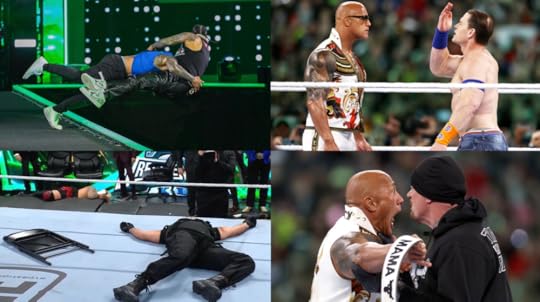
Image 8: Heel interferences and babyface support in the Main Event of Night 2 at WrestleMania XL (2024)
The success of this match worked on multiple levels for audience engagement. On its own, this was a dynamic match that told a story through the psychology of physical combat in the ring. As a part of WrestleMania XL, it provided a climax to a two-day event with reappearances of supporting superstars, such as Jey and Jimmy Uso, Sikoa, The Rock, and Rollins. For lapsed fans of previous WWE eras, the return of legends such as The Rock, Cena, and The Undertaker added an element of nostalgia to the 40th anniversary celebration. For the current committed audience, it was a culmination of multiple years of serialized storytelling that involved Reigns, Rhodes, The Bloodline, and Rollins.
Although Rhodes was the babyface superstar in this Main Event, Rollins emerged as its most valuable participant. Ultimately, Rollins sacrificed himself to enable Rhodes’ victory. He entered the match already worn down after defeat in the Night 1 tag team match and his own solo match that opened Night 2 (in which he lost the World Heavyweight title to Drew McIntyre). Back on Raw (February 12, 2024), Rollins promised Rhodes that he will be his shield because he knew that, despite Reigns’ persistent strength, only he could expose Reigns’ vulnerabilities.
In Part One, we traced the beginning of this story back to 2014 when Reigns and Rollins were part of ‘The Shield’ and Rollins betrayed Reigns with a steel chair to the back. Reigns’ domination as ‘The Tribal Chief’ seemed to overcome that betrayal, but a key moment in this WrestleMania XL Main Event revealed that this domination was achieved despite a deep-seated vulnerability regarding Rollins. Indeed, Rollins is the only WWE superstar to not be pinned by Reigns as ‘The Tribal Chief’ – at the 2022 Royal Rumble, Rollins also wore his old gear from ‘The Shield’ and defeated Reigns by disqualification. When Rollins told Rhodes he is the “one man on Earth who is uniquely suited to be your shield,” he knew he could break Reigns.
This played out towards the end of the match when Reigns was faced with a choice to use the steel chair on Rhodes, and secure his win, or on an already injured Rollins, and get payback for his 2014 betrayal (video 12). Reigns chose Rollins, which gave Rhodes time to recover and ultimately secure his win.
Video 12: Reigns makes a choice to hit Rollins with a steel chair instead of Rhodes at WrestleMania XL (2024)
Rollins’ involvement in this Main Event highlighted that this was a culmination of Reigns’ story as much as it was Rhodes’ story. It exposed Reigns as a man broken by betrayal and rejected by the audience, who found the acknowledgement he desired in the subservience of his family, ‘The Bloodline’. As the fourth longest reigning WWE Champion (after Bruno Sammartino, Bob Backlund and Hulk Hogan), Reigns and ‘The Bloodline’ represented constant strength during a time of instability in WWE. In the end, it was decade-long grudge with Rollins that set him up for defeat (image 9).
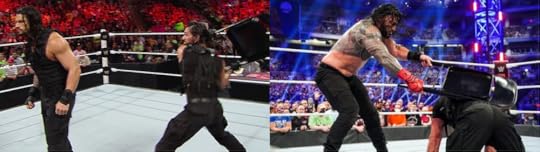
Image 9: (LEFT) Rollins hits Reigns with a steel chair in 2014 (see Part One); (RIGHT) Reigns hits Rollins with a steel chair in 2024.
Finishing the Story
Since his return to WWE in 2022, Rhodes was committed to “finishing the story” his father started in the 1970s. In this time, he overcame injury, WrestleMania defeat, and repeated heel inferences to ultimately win the Undisputed WWE Universal Championship at WrestleMania XL (video 13). When referee Charles Robinson handed Rhodes the championship title, it formed a historical throughline back to the moment that Dusty Rhodes had the title taken away in 1977, thus solidifying the finishing of a story (image 10).
Video 13: Rhodes wins the Undisputed WWE Universal Championship at WrestleMania XL
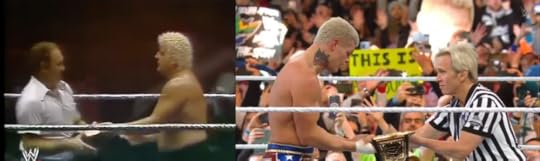
Image 10: (LEFT) Championship title is taken from Dusty Rhodes, despite winning (1977); (RIGHT) Referee Robinson presents Cody Rhodes with the championship title at WrestleMania XL (2024)
Even though the “Road to WrestleMania” traditionally begins at the Royal Rumble in January, it is possible to trace the story of WrestleMania XL further back through history:
‘The Bloodline Civil War’ (2023)
Rhodes losing WrestleMania 39 (2023)
Reigns becoming Undisputed WWE Universal Champion (2022)
Rhodes’ return at WrestleMania 38 (2022)
Reigns becoming ‘The Tribal Chief’ (2020)
Rhodes leaving WWE (2016)
Rollins’ betrayal of Reigns (2014)
Dusty Rhodes being denied the WWE Championship (1977).
The extended history of the WrestleMania XL story helped celebrate the event’s 40th anniversary but also reconnected with the long form serialization of storytelling in pro wrestling. Rhodes’ drive to “finish the story” and win the Undisputed WWE Universal Championship also represented a historical transition for WWE as Rhodes has now become the face of a new era (image 11).
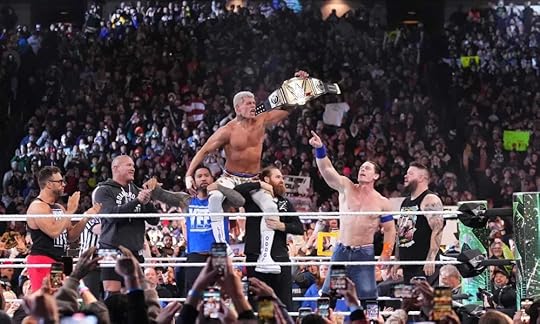
Image 11: Rhodes celebrate his win at WrestleMania XL
Tara Lomax is the Discipline Lead of Screen Studies at the Australian Film Television and Radio School (AFTRS). She has expertise in blockbuster franchising, multiplatform storytelling, and contemporary entertainment and has a PhD from the University of Melbourne. She has published on media franchising, the superhero and horror genres, entertainment industries, transmedia storytelling, and stardom. Her work can be found in publications that include the Journal of Cinema and Media Studies (2024, forthcoming), Senses of Cinema and Quarterly Review of Film and Video, and the edited books Starring Tom Cruise (2021), The Supervillain Reader (2020), The Superhero Symbol (2020), Hannibal Lecter’s Forms, Formulations, and Transformations (2020), The Palgrave Handbook of Screen Production (2019), and Star Wars and the History of Transmedia Storytelling (2017). She is on the Pop Junctions editorial committee.
Mark Williamson has over twenty years of experience as a performer, promotor, producer and commentator in Australian professional wrestling. He has booked wrestling promotions including International Wrestling Australia (IWA) and Warzone Wrestling, and produced the series Underworld Wrestling (2018-2019), which streamed on Amazon Prime Video (2018-2022) and is now available on Tubi. As a pro wrestling manager, he worked with former pro wrestler and now WWE Raw General Manager Adam Pearce. More recently he has explored the creative opportunities of pro wrestling storytelling through comic books and audio platforms.
May 21, 2024
WrestleMania XL: The Greatest Story Ever Told (Part Two)
By Tara Lomax and Mark Williamson
This is the second of three parts on the recent WrestleMania XL and the current revival of WWE. It reviews the interconnected and multistrand storytelling that unfolded over two years leading into the recent event and highlights opportunities for further appraisal. The first part established the important role of audience and character in pro wrestling, and overviewed key moments for Roman Reigns leading into WrestleMania XL. This second part introduces the story of Cody Rhodes and reflects on long form serialized storytelling in WWE. The third part will explore the blurring of reality and fiction that drives pro wrestling storytelling and the role it played in the lead up to WrestleMania XL. Readers who might be interested in this piece include those new to pro wrestling within the context of popular culture and entertainment studies and those curious about WWE’s revival. Italicized text denotes wrestling terms.
In Part One, we established some of the historical context for what makes WrestleMania XL so significant, highlighted some of the distinct aspects of storytelling in professional wrestling – most notably the importance of audience in shaping the roles of the babyface and heel – and reviewed key moments in the story of heel, ‘The Tribal Chief’ Roman Reigns. In Part Two, we overview the story of the babyface, ‘The American Nightmare’ Cody Rhodes, before exploring the ways that serialized storytelling worked to strengthen Rhodes’ resilience and destabilize ‘The Bloodline’.
Cody Rhodes: Babyface, Challenger, ‘The American Nightmare’Cody Rhodes is the son of pro wrestling legend and Hall of Famer, ‘The American Dream’ Dusty Rhodes, and brother of ‘Goldust’ Dustin Rhodes. The Rhodes are one of the many ‘royal families’ of pro wrestling. Despite his lineage, Rhodes’ first term in WWE (2006–2016) comprised of a string of midcard (and borderline embarrassing) gimmicks, including ‘Dashing’, ‘Undashing’, and ‘Stardust’ (image 1). While he exuded potential as a WWE superstar, his early personas lacked uppercard status.
Image 1: The many early gimmicks of Cody Rhodes in WWE (L-R: ‘Dashing’, ‘Undashing’, and Stardust’)
In 2016, Rhodes left WWE to reinvent himself through the independent pro wrestling circuit and other promotions, such as Total Nonstop Action Wrestling (TNA), Ring of Honor (ROH), and New Japan Pro Wrestling (NJPW). The decision to leave WWE to develop himself as a pro wrestler is a significant aspect of Rhodes’ story: it is as a member of the ‘Bullet Club’ in NJPW that he introduced the heel gimmick, ‘The American Nightmare,’ and in 2019 his involvement with the ‘Young Bucks’ led to the formation of All Elite Wrestling (AEW). AEW was the first pro wrestling promotion large enough to compete with WWE since the collapse of World Championship Wrestling (WCW) in 2001. The AEW fanbase enjoys a strong rivalry with the WWE Universe. In AEW, Rhodes transformed ‘The American Nightmare’ gimmick into a babyface, until he refused to let the audience’s heat turn him heel; ironically, through his refusal to turn heel at the audience’s demand, he effectively turned heel (video 1). This is an example of how a heel can still be ‘morally good’ but ‘turn heel’ through audience response.
Video 1: Rhodes turns heel on AEW Dynamite (October 23, 2021)
Rhodes took a big professional gamble when he left WWE in 2016; he took another gamble when he left AEW and returned to WWE in 2022. The return alone is notable, but what made this more significant is that he returned using his “indie gimmick” ‘The American Nightmare’, who enters the ring to the song “Kingdom” by Downstait, not as his previous WWE gimmicks, ‘Dashing’ or ‘Stardust’ (video 2). Historically, pro wrestlers who join WWE from another promotion will transform their gimmick to ensure the promotion maintains control and ownership of relevant trademarks, including name, costumes, and entrance music. Rhodes’ surprise entrance as ‘The American Nightmare’ at WrestleMania 38 (2022) realized a historical and creative continuity across promotions.
Video 2: Rhodes returns to WWE at WrestleMania 38 (2022)
Rhodes’ return to WWE was most defined by his goal to “finish the story”: to do what his father never did and win the WWE Championship. On the “Raw after Mania” (2022), his return promo tells the story of how in 1977 his father was handed the WWWF Heavyweight Championship after winning by count-out, but did not win the title belt on technicality (video 3). This established the motivation for Rhodes’ return to WWE and was a story the audience could support. While the “Road to WrestleMania” usually starts at the Royal Rumble each year, Rhodes’ goal to finish his father’s story revealed a narrative lineage that even preceded the first WrestleMania in 1985.
Video 3: Rhodes tells the story of why he returned to WWE on Raw (April 4, 2022)
As his first feud back at WWE, Rhodes’ defeat of Seth “Freakin” Rollins at WrestleMania 38, WrestleMania Backlash (2022), and Hell in a Cell (2022) set the tone of his return. While training in the gym for the Hell in a Cell Main Event, Rhodes tore his right pectoral muscle completely off the bone; advised that the injury could not get any worse, he still wrestled Rollins and emerged victorious. The image of Rhodes wrestling (and winning) with a bruised body exemplified his resilience and determination (video 4); this was not an everyman like Zayn, but an übermensch – the larger-than-life superhuman babyface that WWE has needed.
Video 4: Rhodes wrestles with a torn pectoral muscle at Hell in a Cell (2022)
There is a lot that can be (and has been) said about associations between pro wrestling, the superhero genre, and heroism in storytelling. Rhodes’ match against Rollins at Hell in a Cell reinforced this relationship while also demonstrating its distinct expression through the staged sports dimension of the medium. The image of an injured Rhodes defeating Rollins is an icon of the contemporary pro wrestler as a symbol of human resilience and perseverance (image 2). His bruised body proved that the injury was indeed real and so the narrative of determination challenged the common commentary around pro wrestling’s perceived “fakeness.”
Image 2: An injured Rhodes wins Hell in a Cell (2022)
Rhodes had only been back in WWE for two months before his injury, so his return after surgery and months of rehabilitation came with further urgency and resolve to achieve his goal. The pieces began to fall into place when he won the 2023 Royal Rumble and earned a title opportunity at WrestleMania 39 (2023) (image 3). As commentator Michael Cole summated after Rhodes’ win: “undesirable, undeniable, uncrowned, but the goal still remains the same – this is just one more step in the journey to finish the story” (Royal Rumble, 2023) – this would be credited as the first reference to the phrase “finish the story”.
Image 3: Rhodes wins the 2023 Royal Rumble.
The road to WrestleMania 39 involved Rhodes crossing paths with ‘The Bloodline’ for the first time. With Zayn preparing to take on Reigns at Elimination Chamber (2023), after having just left ‘The Bloodline’ at the 2023 Royal Rumble (as mentioned in Part One), Rhodes made an ally in the ex-Bloodline member. Eager to cement the phrase “finish the story” into WWE parlance, Rhodes offered it to Zayn in a motivational pep talk in a first effort to activate the babyface roster against ‘The Bloodline’ (video 5).
Video 5: Rhodes motivates Zayn to finish his story in the lead up to Elimination Chamber (2023) on Raw (February 13, 2023).
Rhodes’ goal to “finish the story” is a professional pursuit wound up in personal signification. The dynamic between the professional and the personal is constantly at play for Rhodes and has the potential to be a strength or a weakness in any given moment. This is highlighted on an episode of Raw when ‘The Wise Man’ Paul Heyman, Reigns’ manager, exploits this vulnerability by recounting the cost of being a champion, only for Rhodes to deliver his most meme-worthy ‘I have to finish the story’ promo (video 6).
Video 6: Rhodes vows to ‘finish the story’ on Raw (February 20, 2023)
Pro wrestling is often so focused on feuds and rivalries – whether between individuals or factions – that it overshadows its potential for comradery, sportsmanship, and leadership. Although Rhodes had a strong individual goal, he was also focused on forging alliances. After helping to repair the broken friendship between with Zayn and Kevin Owens (image 4), Rhodes became a babyface for the WWE roster, not just the WWE Universe.
Image 4: Rhodes helps Zayn and Owens reunite on Smackdown (March 17, 2023)
At the time, WrestleMania 39 seemed like the logical climax to Rhodes’ story: he had come back from injury to win at the 2023 Royal Rumble and would finally meet Reigns in the Main Event (image 5). There was strong momentum for Rhodes’ story, but this was not yet the time for his fairytale finish. Rhodes was defeated for the first time since his return to WWE one year prior: despite help from Zayn and Owens, interference from ‘The Bloodline’ allowed Reigns to spear Rhodes and win the match (image 6).
Image 5: Night 2 Main Event at WrestleMania 39 (2023)
Image 6: Rhodes is defeated in the Main Event after interference from ‘The Bloodline’ at WrestleMania 39 (2023)
In hindsight, WrestleMania 39 was a midpoint event in the development of Rhodes’ story. The Main Event loss raised the stakes for Reigns’ domination of WWE and further tested Rhodes’ resilience. Rhodes had won the respect and support of the WWE Universe but winning the championship would require more work. WrestleMania 39 launched a period of vulnerability for Rhodes that he would have to overcome before his next match with Reigns. Rhodes’ loss at WrestleMania 39 reinforced the long form nature of WWE storytelling: this signaled a genuine commitment to giving meaning to Rhodes’ and Reigns’ stories and the symbolic significance of the WWE Championship.
Serialized StorytellingBeyond Reigns and Rhodes, the road to WrestleMania XL involved multiple interconnected stories, rivalries, and alliances that would complicate the narrative. WWE is a form of serialized storytelling told over two weekly shows – Raw and SmackDown (not including NXT) – and several ‘premium live events’ (PLEs) per year. WWE claims that Raw is the longest-running episodic series in the US, with SmackDown taking second place; the accuracy of these claims is debatable, but the significance of these shows compared to other long-running series is the lack of seasonal hiatuses or re-runs. With Raw and SmackDown, WWE produces new weekly content all year round.
WWE storytelling typically develops across these weekly shows and is punctuated with major rivalry matches in PLEs. For this reason, it is challenging to distil the extensive canvas of interrelated storytelling into this piece, but there are several key moments to highlight before Rhodes and Reigns meet again: Rhodes’ feud with Brock Lesnar, the fragmenting of ‘The Bloodline’, and the growing alliance of the babyface roster against ‘The Judgment Day’.
Rhodes’ feud with Lesnar built Rhodes’ resilience and strength as a future champion. WrestleMania 39 proved that Rhodes did not yet have what it takes to defeat Reigns, and so defeating the greatest adversary of ‘The Tribal Chief’ would prove his might and provide a minor redemption for Rhodes’ loss at WrestleMania 39. On “Raw after Mania” (April 3, 2023), Lesnar was expected to join Rhodes in a tag match against Reigns and Solo Sikoa, but instead brutally attacked and shamed Rhodes. Rhodes’ weakened body splayed over ring stairs produced an image reminiscent of primitive gladiatorial combat (image 7).
Image 7: Lesnar attacks Rhodes on Raw (April 3, 2023)
This attack provoked a feud with Lesnar over three PLEs: Rhodes defeated Lesnar at Backlash (2023); Lesnar defeated Rhodes at Night of Champions (2023); and Rhodes defeated Lesnar at SummerSlam (2023) (image 8). These matches reflect the serialization of match-based storytelling, where conflict and character dynamics are negotiated through combat through repetition and continuation. The four-month feud resulted in Lesnar eventually respecting Rhodes as a worthy face of WWE. Lesnar has since been an inactive member of the roster and not appeared on any WWE program.
Image 8: Rhodes and Lesnar’s feud across Backlash (2023), Night of Champions (2023), and SummerSlam (2023)
The Bloodline Civil WarThe popularity of ‘The Bloodline’ is responsible for the current revival of WWE. Over multiple years of WWE programing, the story of the heel faction made up of Reigns, Sikoa, Jey and Jimmy Uso, Zayn and Heyman developed into a melodramatic gangster saga. The dominance of ‘The Bloodline’ was maintained by a brutal treatment of their opponents and their control of the championship titles: Reigns held the Undisputed WWE Universal Championship, while Jimmy Uso and Jey Uso possessed the Undisputed Tag Team Championship. Although Reigns won and retained his title on Night 2 of WrestleMania 39, The Usos lost the tag titles to Zayn and Owens in the Main Event of Night 1. With this loss, Cole asked on commentary, “is the Bloodline disintegrating before our eyes?” Retrospectively, yes, this loss indeed signaled the destabilization of ‘The Bloodline’ that would eventually impact WrestleMania XL.
Reigns resented The Usos after losing the tag belts, particularly Jey who took the defeating pin. His punishment involved denying The Usos a rematch and announced that he and Sikoa would instead face Zayn and Owns at Night of Champions to bring the tag championship back to ‘The Bloodline’ (image 9).
Image 9: Reigns and Sikoa v Zayn and Owens in the Main Event on Night of Champions (2023)
In contrast with the mostly match-driven storytelling of Rhodes versus Lesnar, ‘The Bloodline’ story unfolded through non-match segments as much, if not more, than the match-based conflicts. As such, weekly SmackDown programing around ‘The Bloodline’ embraced the soap operatic nature that drives WWE storytelling, as demonstrated by the following segments (videos 7-10).
Video 7: Reigns wants an apology from The Usos on SmackDown (May 12, 2023)
Video 8: Reigns punishes The Usos on SmackDown (May 12, 2023)
Video 9: Jimmy attacks Reigns at Night of Champions (2023)
Video 10: The Usos retaliate against Reigns on SmackDown (June 16, 2023)
Stronger than threats from outside opponents, The Usos’ retaliation against Reigns was a pivotal moment of disruption for ‘The Bloodline’ as a dominant force on SmackDown. This feud within the faction culminated in a “Bloodline Civil War” match in the Main Event on Money in the Bank (2023), where Jey Uso pinned Reigns to win the match. This was the first time that Reigns took a pin since 2019 and revealed that he was indeed beatable. As Cole said on commentary, “Jey Uso has done the unthinkable. Roman Reigns is not unbeatable. Roman Reigns is indeed human” (image 10).
Image 10: Reigns is pinned by Jimmy in a “Bloodline Civil War” match at Money in the Bank (2023)
To correct Reigns’ momentary vulnerability against Jey Uso, Reigns defeated him in the Main Event at SummerSlam (2023) after interference by a mysterious figure who was revealed to be Jimmy Uso (image 11). On SmackDown after, Jimmy Uso explained that he held his brother back from the victory to prevent him turning into the next Reigns. In response, Jey Uso turned on his brother before announcing his departure from ‘The Bloodline’, SmackDown, and WWE (video 11). Jimmy Uso subsequently renewed his loyalty to Reigns and ‘The Bloodline’.
Image 11: Jimmy interferes in the match between Jey uso and Reigns at SummerSlam (2023)
Video 11: Jey Uso quits WWE on SmackDown (August 11, 2023)
Unsurprisingly, Jey Uso’s departure was short-lived when, less than a month later on Payback (2023), Rhodes announced Jey will join the roster on Raw. His return is welcomed by Zayn who could relate to the experience of breaking free from ‘The Bloodline’ and finding sanctuary on Raw, away from Reigns (video 12).
Video 12: Zayn welcomes Jey Uso to Raw (September 4, 2023)
This ‘civil war’ phase in ‘The Bloodline’ saga established two important shifts that would lead to WrestleMania XL: the destabilization of Reigns as an unstoppable heel and Jey Uso joining ‘Team Cody’ on Raw.
The Judgment Day vs ‘Team Cody’As a heel opponent, ‘The Judgment Day’ played an instrumental role in the formation of an alliance between the superstar babyfaces of Rhodes, Rollins, Jey Uso, Zayn, and Owens, which would eventually shape the story leading into WrestleMania XL. ‘The Judgment Day’ is a heel faction made up of Damien Priest, Rhea Ripley, Finn Bálor, ‘Dirty’ Dominik Mysterio, and JD McDonagh. Its dominance of Raw is comparable to ‘The Bloodline’ on SmackDown, although there is no narrative connection between the two factions except for their feud with Rhodes. The babyface alliance developed on Raw when Rhodes, Rollins and Zayn united to defeat Priest, Bálor and Mysterio in a six-man tag match (video 13).
Video 13: Rhodes, Rollins and Zayn unite against ‘The Judgment Day’ on Raw (August 7, 2023)
The feud between the babyfaces and ‘The Judgment Day’ unfolded over three months on weekly episodes of Raw and PLEs, Payback (2023), Fastlane (2023), and Crown Jewel (2023). During this period, both opponents enjoyed victories and defeats, with the tag team titles moving between Priest/Bálor and Rhodes/Jey Uso and Rollins’ newly formed World Heavyweight Championship under threat from Priest’s guaranteed title opportunity he secured at Money in the Bank (2023). Culminating in the Main Event at Survivor Series: WarGames (2023), Rhodes, Rollins, Jey Uso, and Zayn united with a returning Randy Orton to defeat ‘The Judgment Day’ and Drew McIntyre (who joined the match only to enact his own revenge on Jey Uso) (image 12).
Image 12: ‘Team Cody’ defeat ‘The Judgment Day’ and Drew McIntyre at Survivor Series: WarGames (2023)
The rivalries and events at the heart of Rhodes’ and Reigns’ stories were supported by the secondary relationships between Rhodes, Rollins, and Jey Uso established through this feud with ‘The Judgment Day.’ There is a lot that can be said about how WWE’s serialized and multistrand narrative works to enrich character relationships and conflicts inside and outside the ring. Even though ‘The Judgment Day’ plays no role in the Main Event of WrestleMania XL, it is otherwise difficult to appraise the significance of its interweaving storytelling.
It is also worth re-emphasizing the importance of audience expectations and unpredictability in pro wrestling storytelling. By all accounts, Survivor Series: WarGames cemented Rhode’s clear path back to Reigns, until just before the live stream ended and the entrance music of estranged WWE legend CM Punk welcomed him back (video 14). This would further complicate the road to WrestleMania XL, as will be discussed in Part Three.
Video 14: CM Punk returns to WWE at Survivor Series: WarGames (2023)
BiographiesTara Lomax is the Discipline Lead of Screen Studies at the Australian Film Television and Radio School (AFTRS). She has expertise in blockbuster franchising, multiplatform storytelling, and contemporary entertainment and has a PhD from the University of Melbourne. She has published on media franchising, the superhero and horror genres, entertainment industries, transmedia storytelling, and stardom. Her work can be found in publications that include the Journal of Cinema and Media Studies (2024, forthcoming), Senses of Cinema and Quarterly Review of Film and Video, and the edited books Starring Tom Cruise (2021), The Supervillain Reader (2020), The Superhero Symbol (2020), Hannibal Lecter’s Forms, Formulations, and Transformations (2020), The Palgrave Handbook of Screen Production (2019), and Star Wars and the History of Transmedia Storytelling (2017). She is on the Pop Junctions editorial committee.
Mark Williamson has over twenty years of experience as a performer, promotor, producer and commentator in Australian professional wrestling. He has booked wrestling promotions including International Wrestling Australia (IWA) and Warzone Wrestling, and produced the series Underworld Wrestling (2018-2019), which streamed on Amazon Prime Video (2018-2022) and is now available on Tubi. As a pro wrestling manager, he worked with former pro wrestler and now WWE Raw General Manager Adam Pearce. More recently he has explored the creative opportunities of pro wrestling storytelling through comic books and audio platforms.
Henry Jenkins's Blog

- Henry Jenkins's profile
- 184 followers

