Gretchen Rubin's Blog, page 8
August 22, 2023
25 Tips to Boost Your Productivity
We’ve all heard the reminder to “Work smarter, not harder”—but that’s easier said than done. How do we boost our productivity?
While the word “productivity” is associated with the workplace, we can use productivity” for any aim. Being productive might mean writing a certain number of words each day, practicing a musical instrument regularly, or completing tasks needed for an ambitious DIY project.
Hacks for a quick boost of productivityClarify your objective. What do you want to accomplish? Be able to fit the car in the garage, finish a project that’s hanging over your head, streamline your work day?Make a list. If you feel overwhelmed by tasks and obligations, write them down. Break down big projects into smaller, more manageable tasks, separate today’s tasks from tomorrow’s, and “Must-Dos” from “Could-Dos.” Anything you can get done in a few minutes for a quick win?Track your energy. At what times of day do you feel most productive? Our natural energy levels fluctuate throughout the day. How might you adjust your routine or plan activities for times you feel more focused or creative?Eliminate distractions. When you’re preparing for a period of productivity, get your coffee, put your phone in airplane mode, and set boundaries with your colleagues or others in your household.Find accountability. Many people wonder, “Why can’t I get myself to do something I want to do?” The answer may be that you need accountability. Try finding a mentor or accountability partner, taking a class, joining a group, or giving yourself a deadline with consequences if you don’t meet it.Think about identity. If you resist forms of accountability, like deadlines and supervision, consider how your productivity aims reflect an identity or lifestyle you’d like to cultivate, such as “I’m a writer,” “I’m a successful business owner,” “I enjoy living in a neat and organized home.”Keep a commonplace book. Use the book to keep track of anything you’d like to remember: quotations, anecdotes, observations, data—anything. You never know what might spark an idea, make an unexpected connection, or come in handy later. Try writing “morning pages.” In Julia Cameron’s book The Artist’s Way , she suggests starting every day by filling three pages with stream-of-consciousness writing to get your creativity flowing. If you’re more of a night owl, you might try “evening pages.” Can’t manage three pages? Start with one sentence.Allow yourself to play. To engage your brain in new ways, you might sculpt with clay, write a limerick, color in a coloring book, browse in an art supply store, or stop by a thrift shop.Know yourself. We won’t make ourselves more productive by copying other people’s habits, even the habits of geniuses. We must know ourselves, our preferences, our tendencies, our limitations, and what habits serve us best. What works for you?
Remember to slow down. Play and rest are essential to productivity. Revisit an activity you enjoyed when you were ten years old. Sometimes, to keep going, we have to allow ourselves to stop.
Fill the well. We can’t make progress on our aims when we’re depleted. To replenish yourself, you might set aside time to read a book, visit an art museum, explore a hardware store, attend a live performance, spend time in nature, or talk to someone who inspires you.Pair your habits. Pair an activity you’re struggling to do with one that you want to do. You might try only watching your favorite tv shows when you’re working out, or always taking your medication with your morning coffee.Keep up a streak. Use the Don’t Break the Chain tool in the Happier app or a Habit Tracker to mark each day you accomplish your aim. The chain that gets stronger with every link you add as you build momentum.Tidy up for ten minutes. Schedule time every day for regular clutter-clearing. It’s easier to keep up than to catch up, so it’s easier maintain a clear space than to tackle clutter once it’s built up. Tidy up for ten minutes every evening, clear off your desk at the end of your work day, put away dishes before bed.Steer clear of quicksand. Quicksand is something that draws you in, drags you down, and holds you there. Bags of chips, online shopping, Netflix, slot machines—all can be quicksand for people.Schedule a Power Hour. Keep a running list of things you need to do (get a prescription filled, return library books), and then spend one hour, once a week, crossing items off the list.Start now. The best time to start is now. Instead of focusing on getting it perfect, just get it going.Suit up. Signal to yourself that you’re “working” by putting on some kind of appropriate outfit. If you plan to tackle yard work, put on gardening gloves. If you’re sitting down in front of your computer, change out of your pajamas first.Give yourself transitions. If you’re having trouble concentrating, give yourself an intermediate step between tasks. After you’ve checked the news, tackle something work-related, but low effort—like answering straightforward emails—before moving on to a high-intensity project.Think about your environment. Look for ways to make a space you use regularly more efficient and attractive—whether that’s a desk, kitchen, car, garden, or bedroom. Clear clutter, add pillows or more comfortable furniture, eliminate unpleasant sounds or smells, improve your light.Stretch. Taking a moment to stretch can help boost mindfulness and creativity, and relieve stress. Stretching is also a great way to relax before bed.Track your hours. We manage what we monitor. If you want to make progress on an aim (like learning Spanish or running three times a week), track the hours you put in using the Numbers Tracking tool in the Happier app. Tackle dreaded tasks first thing. The night before, commit to do the dreaded task. And the next day, at the first possible moment—as soon as you walk into work, or when the office opens, or whenever—just do it. Don’t allow yourself to reflect or procrastinate. Enjoy the fun of failure. Many things worth doing are worth doing badly. Doing something badly is often a necessary stage toward doing it well.Build your productivity toolkit with the Happier app
The Happier app recommends habit-change tools tailored to your Tendency, but you can add any tool to your toolkit that works for you and your aims.
In his Journal, painter Eugène Delacroix observed, “When one’s mind is refreshed by work, a sense of happiness pervades one’s whole being.”
When we work productively, we don’t waste time, energy, or money; we have the refreshing sense of efficient execution. What tips do you use to make sure that you’re being productive with your efforts?
The post 25 Tips to Boost Your Productivity appeared first on Gretchen Rubin.


August 17, 2023
How To Say “No”
In my “Four Tendencies” personality framework, each of the Four Tendencies—Upholder, Questioner, Obliger, Rebel—has its strengths and its weaknesses.
And the strengths are the weaknesses, and the weaknesses are the strengths—just depending on the context.
(Want to learn your Tendency? Take the short quiz here.)
Many people, especially Obligers, have a hard time saying “no” to other people. If someone presents an Obliger with an expectation, by definition, an Obliger feels the weight of that request—because the definition of an Obliger is “Meets outer expectations, resists inner expectations.”
Obligers often make observations about themselves such as:
“I struggle to set boundaries”“I always go the extra mile, and people take advantage of that”“I keep my promises to other people, but I have trouble keeping my promises to myself”“I’m not good at self-care”
This pattern can lead to burnout, feelings of resentment, or even “Obliger-rebellion.” Saying “no” to someone else’s expectation is an important skill to help you achieve your aims and focus on what’s important to you.
But it’s usually not as simple as “just saying no,” especially when someone else’s request or demand weighs heavily on you.
If you face this challenge, you might…
Say “yes” with conditions:“Can I start this project next week when I can give it more attention?”
“I’m going to finish writing these emails first, then I’ll draft that caption for you if I have time.”
“If you’d like me to do this report, what else can come off my to-do list?”
“Can you finish putting the groceries away for me while I make you that snack?”
“I can play with you for 20 minutes, and then I have to get back to work until lunchtime.”
Delegate:“I’m not the best person for this task right now.”
“This person also knows how to do this and may have more bandwidth.”
“Why don’t you try it on your own first and I’ll check in with you when you’re done?”
Say “no” so you can say “yes” to someone else:“I can’t stay late tonight, I have dinner plans with a friend.”
“If I take on this project, I’m going to risk missing an important deadline.”
“I can’t come out tonight, I promised myself an evening at home to rest.”
“I’m taking a week off to spend time with my family.”
Consider your duty as a role model, or to your future-self:“If I get burnt out, I won’t be helpful to anyone.”
“If I stay late, my teammates might feel like they have to stay late too.”
“I want my kids to see what healthy boundaries look like.”
“If I get a good night’s sleep, I’ll be more productive tomorrow.”
Upholders, Questioners, and Rebels are often unhelpful when Obligers say they feel overwhelmed by the weight of expectations. Those Tendencies say things like, “If you don’t want to do it, well, don’t do it,” “If you get clear on what’s important to you, then you’ll do it,” “Set a rule for yourself and stick to it,” or “Just it ignore what they say.” That advice doesn’t work well for Obligers.
For an approach to resonate with someone, it has to reflect the perspective of their Tendency. Using an Obliger-specific approach makes it far easier for Obligers to say “no” when they want to.
The post How To Say “No” appeared first on Gretchen Rubin.
August 15, 2023
Tips for Building a Writing Routine
One habit that many people want to start? The habit of regular writing.
When I was working on Better Than Before, my book about how to make and break habits, I was surprised by how many people want to cultivate the habit of writing regularly. They have different reasons:
for creative expression—working on a novel, writing family newsletters, keeping “morning pages”for preserving memories—keeping a journal for a new baby, making “five-senses portraits” for relatives who have diedfor gaining clarity—writing daily priority lists, keeping track of a major project using a one-sentence journal
But even when we see the value of writing regularly, it can be a difficult habit to acquire. (Because many habits are difficult to acquire!)
Here are some steps to consider:
Select time and frequency. Decide what time of day you will write, and how often. For some people, such as me, writing every day works best. Others may choose to write on Saturday mornings or during weekday lunch breaks. As you think about when to schedule your writing, pay close attention to your energy level. If you’re a morning person, schedule your writing time early; if you’re a night person, use a later time. For many people, putting an activity on the calendar means that it happens. (Upholders, that’s especially true for you.)But if the idea of scheduling your writing sounds extremely unappealing, don’t do it! (Rebels, I’m looking at you.) Think about your identity as a “writer,” and remember, the one thing that writers do is…write. See #12.Consider your space. Figure out where you do your best work, and make that space as convenient and comfortable as possible. Corner of the sofa? Kitchen table? Public library? Bed? Do what you can to put yourself in an environment that suits you.Adjust your sound environment. To do deep work, some people (such as me) prefer silence. Other prefer music with words, music with no words, one song on a loop (!), white noise, or the busy clatter of a coffee shop. Create the sound surroundings that suit you.Upgrade your tools. Beautiful tools make work a joy, and bad tools make work unnecessarily irksome. If you’re putting up with poor tools—inadequate light, an ancient laptop—make the effort to upgrade.
Start a focus ritual. Maybe you light a candle, or walk around the block, or make your favorite coffee drink, or sit next to the same window when it’s time to begin. By repeating that action, you’re signaling to your brain that it’s time to enter a creative, associative state.Articulate your why. Why do you want to establish a writing routine? To make progress on your book manuscript? Carve out space for self-reflection? When you understand why you’re pursuing a habit, it’s easier to keep it up. (Questioners, this is a crucial step for you.)If you need accountability, get it. Join a writers’ group or class where you’re expected to hand in work; work with a writing coach; post a schedule where your family members will see it; recruit a friend to read your drafts. (Obligers, you know you need it! Do not skip this step!) One writer told her son, “You have your homework, and I have my homework—which is working on my novel. When you’re working on your homework, I’ll work on my homework. If I’m not doing my homework, you don’t have to do yours.” Her son watched her every day, hoping to get a day off.Choose a metric. How do you know when you’ve completed your writing time? Is your metric a word count, minutes spent in the chair, or a completed draft? Perhaps your metric is to keep writing for the duration of your toddler’s nap time. Pick a marker that’s concrete, measurable, and realistic. Note : While many writers use word count, this approach has a risk: it encourages some people to write in a padded, verbose way. As a former lawyer, I never give myself an incentive to write long.
Don’t forget to read. The best writing routine includes reading. As Randall Jarrell wrote, “Read at whim! read at whim!”
Set up safeguards against loopholes. Put guardrails in place for the days you’re tempted to abandon your writing practice, and anticipate challenges. What will you do when you go on vacation? If you’re traveling? If you have house guests? If you don’t have any ideas? Make a plan.MOST IMPORTANT: Never forget that to write, we must write. These things are not writing: research, interviews, formatting, outlining, daydreaming, talking about writing. These things may be absolutely necessary for writing, but they aren’t writing.
As with all habits, remember, we gain the benefit of that habit day by day. With writing, it’s easy to get overwhelmed by the enormity of the task, but day by day, we make progress.
As novelist E. L. Doctorow observed about writing: “It’s like driving at night: you never see further than your headlights, but you can can make the whole trip that way.”
The post Tips for Building a Writing Routine appeared first on Gretchen Rubin.
August 9, 2023
“I Quit!” Identifying and Dealing with Obliger-Rebellion
In my book The Four Tendencies, I describe my personality framework that divides people into four “Tendencies”: Upholder, Questioner, Obliger, and Rebel.
Want to learn your Tendency? Take the free quiz (more than three million people have taken it), or learn more about the framework here.
Here, I’m going to explore a very particular—and very important—pattern of behavior seen in Obligers. It’s a phenomenon that seems very mysterious if you don’t know about the Four Tendencies—but once you understand the framework, this pattern is very easy to understand and spot.
It’s the pattern of Obliger-rebellion.
It’s important to understand this phenomenon because 1) Obliger is the biggest group, for both men and women, so anything that affects Obligers affects many people and 2) while Obliger-rebellion can sometimes be positive force, it’s often quite destructive.
What is “Obliger-Rebellion?”When Obligers feel exploited, over-taxed, unappreciated, neglected, ignored, or disrespected, or when the weight of expectations feels unbearable, they begin to feel mounting anger and resentment. If expectations continue to press, the Obligers’ anger builds to the bursting point. Then they rebel.
So Obligers will meet, meet, meet, meet expectations, and then suddenly they snap. They say, “This, I will not do!” and they refuse to meet an expectation. Obliger-rebellion kicks in to give the Obligers an exit.
This rebellion can be small and symbolic (refusing to answer someone’s emails, refusing to cook dinner for a week, being deliberately late for work) or it can be huge and fateful (ending a twenty-year friendship, quitting a job, getting a divorce).
Signs that people are approaching Obliger-rebellion:they act out of character—for instance, they waste time, when they’re usually very focused and productive. In fact…they will often observe of themselves, “I’m not myself, I’m acting out of character”they seem listless and apathetic, without motivation or energythey do things that aren’t in their best interest; self-sabotage—for instance, fail to prepare for an interview; stay up late binge-watching TV during a busy timethey feel burdened by activities they usually enjoy, such as organizing an office birthday partythey don’t answer even simple requests, such as answering a text—they go “on strike”they may waste a lot of time, with activities such as scrolling or online browsingthey may feel a feeling of constriction or discomfort in their bodies: tight jaw, tense shoulders, upset stomach, bad headache, back or neck pain, grind their teeththey procrastinate with tasks they’d usually complete promptlythey’re resentful, snappish, curtthey isolate themselves, they pull away, they “ghost”—in part, to protect themselves from further expectationsthey may begin to think about change—whether through fantasy (move to an island, work on a farm) or actual preparation (polish a resume, scroll through job postings)Signs that people have indeed entered Obliger-rebellion:they explode, they blow up, they snaptheir anger seems to come out of the blue and may seem disproportionate to the situation (to someone who hasn’t noticed the warning signs listed above)they refuse to meet their responsibilitiesthey announce a break: quit a job, end a relationship
Here are a few examples:
“A friend called me to say she had no time to make a charcuterie board for her husband’s birthday party. This is my area of expertise, so I would normally say, ‘I’ll do it,’ as I know she was hoping—but instead I refused.”
“I do things to deliberately push the envelope in breaking whatever rule annoys them.”
“After realizing that the workload in my household was way unbalanced, my resentment has sent my Obliger-self into full rebellion. I refuse to cook anything and just pick up take-out. This was accompanied by extreme fatigue, low mood, migraines, and zero desire to do “all the things.” I am not good at confrontation. I honestly was waiting to see if my husband would get a clue and start doing some of the things I usually do. No luck yet. I probably need to find a better way to deal with all of this.”
“I’ve long suffered from ‘perceived’ obligations that eventually lead to resentment and obliger-rebellion. For example, when the in-laws visit, I feel an obligation (unspoken and truly not expected by my in-laws) to prepare gourmet breakfasts, home-cooked dinners, and in general to be the ultimate host. When these gestures go unnoticed, I feel resentful, turn mean, and rebellion ensures. Whether it’s meals, free babysitting, running errands, etc., I go the extra mile and then start feeling resentful as I am doing it. What is my problem? How can I reconcile these desires to serve others without resentment? Maybe it’s the lack of praise and outward thanks that is missing, but why should I even need that?”
Sometimes, Obliger-rebellion is aimed at the self.
If Obligers don’t feel safe directing the rebellion outward, they may turn it inward.
This can look like self-sabotage. An Obliger refuses to prepare for an interview, when it really matters. An Obliger won’t complete schoolwork that could easily have been done.
It may emerge in the area of health. An Obliger refuses to exercise, even though exercise would help manage his back pain. An Obliger refuses to cut back on sugar, even though her diabetes is out of control.
The consequences fall directly on the Obliger, so this is a “safe” way to rebel (as compared to Obliger-rebellion at work, say, which might have significant consequences involving other people).
How to avoid Obliger-rebellion for yourself and others:Here are some ways to take action or re-frame expectations to try to avoid Obliger-rebellion:
remind the Obliger that to say “yes” to one person means saying “no” to othersencourage everyone to speak up for Obligers—is work being unfairly divided? are a few people picking up the slack or the drudge work?keep a journal to identify patternsconsider the “future-self”—”My future-self will be really angry that I agreed to accept this responsibility; I need to say no to protect my future-self”remember, “If I don’t do it, someone else gets the opportunity”think of the duty to be role model for others for setting boundaries, working reasonable hours, etc.ask, “Are these outer expectations real? Is anyone actually expecting me to do this—plan the icebreaker activity, host the holiday party—or am I assuming this?”remember that if you want to care for others, you have to care for yourself; as the cliche goes, put on your own oxygen mask first! Here’s a story I told about that challenge.How to deal with Obliger-rebellion once it starts:In general, once it starts, Obliger-rebellion needs to run its course. During that time, if you’re an Obliger in rebellion, it can be helpful to:
tell people that you feel overworked, unappreciated—or both!explain the phenomenon of Obliger-rebellion to others, so they understand why a puzzling behavior actually makes sense—you didn’t explode after one simple comment; that your resentment had been building for a long timekeep a journal to identify responses and patternstake a vacation, turn off all devices for a weekend, play hooky—sometimes, to keep going, we have to allow ourselves to stopconsult with a friend—do they think you should ask for a break, tell people “no,” etc? If they advise you to draw a boundary, ask them to hold you accountable for doing soFrequently Asked Questions:Do Upholders, Questioners, or Rebels also experience their own form of Obliger-rebellion?
Some Upholders, particularly UPHOLDER/Obligers, sometimes experience Upholder-rebellion, but it’s far rarer. Upholders are usually good at drawing boundaries, taking time for rest, and saying “no,” because it’s so important to them to meet inner expectations.
Sometimes, too, Upholders may seem to rebel, when in fact they’ve decided that the rules have changed. For instance, one Upholder told me, “During the pandemic, I decided that every contract I had with myself was voided by force majeure and stopped doing everything.” So they are, in fact, meeting outer and inner expectations.
Questioners don’t fall into rebellion because they don’t do anything that doesn’t make sense to them, and Rebels don’t fall into rebellion, because they don’t do things they don’t want to do.
Can Obliger-rebellion lead to positive outcomes?
Absolutely! While it can sometimes have destructive effects, Obliger-rebellion is meant to be a constructive phenomenon—it’s the emergency parachute that allows an Obliger to escape from a situation where expectations are just too high.
Obliger-rebellion can allow someone can get out of a bad marriage, a bad job, or a bad relationship. If you want an example of how Obliger-rebellion might have saved someone, read The Remains of the Day by Kazuo Ishiguro. If the main character Stevens had been an Obliger instead of an Upholder, Obliger-rebellion might have made his life much happier.
Here’s what one Obliger said:
Eleven years ago before I knew anything about the Four Tendencies, I quit my job of 19 years and left a 4 year toxic relationship. This happened in a span of a few months. I wanted to share the message that I don’t think every obliger rebellion is a bad one and perhaps trying to prevent them from happening is not always the best course of action. In my case, I went on to find a job that I love and also met the man who’s now my husband. If I had just continued obliging and tried to suppress what I was feeling, I would not be in the happy place that I am today.
What are some things not to say to someone in Obliger-rebellion?
“You need to learn to take better care of yourself.”“Nobody asked you to do it.”“If something’s important to you, just do it.”“I don’t want to help. If you want to do it, knock yourself out. But don’t expect me to play a part.”“You just need to cut yourself some slack.”
I would love to see other examples of Obliger-rebellion. Can you point me anywhere?
Even if the creators aren’t aware of the term “Obliger-rebellion” or don’t know the Four Tendencies framework, it’s very common to see the Tendencies depicted in movies, TV, and books. Because people act according to these patterns all the time!
See if you can spot the pattern of Obliger-rebellion in these movies and novels:
It’s a Wonderful Life 27 Dresses Kramer vs. Kramer The Devil Wears Prada My Struggle: Book Six by Karl Ove Knausgaard Family Happiness by Laurie Colwin Who Is Rich? by Matthew Klam (read my discussion) Us by David Nicholls Wayward by Dana Spiotta
Here’s a striking description of Obliger-rebellion from Who Is Rich?
I attempted to interpret my irrational action. Had I ever done this kind of thing before? No. A life in the arts requires vigilance and restraint. Was my behavior out of character? Yes, technically, and also terrifyingly, although it was possible that this was merely the culmination of a period of interior deadness and anger, that something had been building for months, or years, that the recent and ongoing stresses had pushed me over the edge.
If you’ve ever experienced or witnessed Obliger-rebellion, does this description ring true to you? How have you realized that Obliger-rebellion was brewing, and what have you done to handle it?
The post “I Quit!” Identifying and Dealing with Obliger-Rebellion appeared first on Gretchen Rubin.
August 2, 2023
How Regret Can Make Us Happier
Do you have any regrets? I sure do.
We feel regret when we feel sad, disappointed, or repentant about something we did or didn’t do in the past.
Regret is a painful emotion, but because it is painful, it can spur us to identify opportunities for greater happiness.
For instance, in college I didn’t pursue any extracurricular activities, and by senior year, I regretted it. This regret was painful, but it meant that when I got to law school, I pushed myself hard to get involved in activities—which ended up making me very happy.
Often, we feel the most intense regret when there’s still time to change, so by admitting to feelings of regret, we may find opportunities for growth.
Regret can make us happier by helping us make better decisions:
by reflecting on past regret, we can learn how to do better moving forwardby anticipating future regret, we can make better choices in the present
We can learn from our own regrets, and also others’ regrets. For instance, someone told me, “I regret not having more professional photos taken of my family when my children were young,” and once my daughters were born, I’ve made sure to get professional photos taken regularly.
In the Very Special Episode 440 of the Happier with Gretchen Rubin podcast, my sister Elizabeth and I shared some of our own regrets, and we asked listeners about their regrets. It was absolutely fascinating to see the range of actions and inactions that people discussed.
Also, we heard from some listeners who didn’t like to use the term “regret.” They preferred to think of the subjects as “lessons learned” or “things I learned the hard way.”
Some themes that emerged:
Regret over missed opportunities: Not pursuing relationships, not taking a job, not finishing college, not stepping out of their comfort zone.Regret over not expressing feelings or communicating effectively: Not talking to loved ones before they died, not addressing mental health issues sooner.Regret over parenting decisions: Not spending enough time with their children, feeling too influenced by their spouse in bringing up their child.Regret over trusting or caring about the wrong opinions.
In his thought-provoking book, The Power of Regret, Dan Pink points out that regret falls into two categories:
He explains that we tend to have more regrets related to inaction. I’m reminded of one of my favorite traditional proverbs: “It is more painful to do nothing, than to do something.”
Knowing what you know now, what would you have done differently? On the podcast, Elizabeth talked about how she wished she’d volunteered for more school committees when her son was in grade school. This regret reflects her desire to be very involved in their school community—a realization that could shape her actions in the future.
Is there silver lining? You regret something, but it also made a positive difference in your life. “I regret my bad marriage, but I have my children.”
What important lessons have you learned from a challenging situation? A friend regretted taking a job where she had to do a lot of pointless, time-wasting tasks, but, she told me, “I learned a lot about what makes a workplace productive or not.”
What’s the best possible outcome? The worst?
Do you feel like other people or processes are moving events forward, and you’re just passively carried along? Regret may come from not mindfully making a choice—and not choosing is a choice.
Is there something you’ve always wanted to do, but haven’t yet? For instance, you want to live in a different city or switch careers. At a certain point, often, change becomes harder. To put it another way…
Imagine yourself five years from now, looking back on this time. What will your future-self wish you’d done now?
What do you lie about? When we lie about or hide something, we often reveal the way in which our life doesn’t reflect our values.
Is your life “on hold” in any aspect? Until you finish your thesis, get married, get a promotion? If so, ask yourself whether you really need to wait, or whether you can move forward now.
What action will help you to “Choose the bigger life?”
Tools to help you understand and avoid regretWe can use tools for self-reflection to help us recognize patterns, organize our thoughts, and get perspective. Depending on what approach you prefer to take, consider:
Know Yourself Better Journal Memento Keepsake Journal Don’t Break the Chain Habit Tracker —Many people regret failing to work on good habits, such as getting regular exercise, quitting smoking, getting enough sleep, or making time for friends. This journal can help you stay on track.“Are You Drifting?” Quiz The Power of Regret by Dan Pink
While we may want to avoid the sharp, poignant pain of regret, acknowledging this emotion can help us to make our lives happier. What lessons have you learned the hard way, and how will those lessons influence your future behavior? I’d be fascinated to hear your experiences.
The post How Regret Can Make Us Happier appeared first on Gretchen Rubin.
July 11, 2023
Lessons Learned from Halfway Day
July 2 was Halfway Day, and to celebrate, I’ve been giving gold stars to readers and listeners who have been sharing their progress on their aims on social media.
Progress looks different for everyone. For some people, it might mean checking off items on their “23 for 23 list” in their 2023 Happiness Trifecta. For other people, it might mean regularly going outside for the annual challenge to “Go outside for 23 in ’23.”
It’s important to celebrate our accomplishments—and also to notice what doesn’t work. Halfway Day is a great time to reflect on our aims and to adjust our approach.
Also, because we can all learn from each other, it’s helpful to consider other people’s observations about their progress.
Lessons learned:As I write about in my book Outer Order, Inner Calm, one way to complete an aim is to abandon it:
@organisingqueen: “I abandoned one (go outside 23 mins in 2023) because I was swept up in new-year energy. If you know me at all, you’ll know my body does not respond well to being outside (heat headaches and the like)”
To keep going, sometimes we have to allow ourselves to stop:
It’s easy to focus on the to-do and forget the ta-da—in fact, we should give ourselves credit for what we do:
When we find ways to make tasks more fun, more convenient, or more pleasant—for instance, in ways that I explore in my book Life in Five Senses–we’re more likely to stick to them:
How are you doing on your aims for 2023? I’ve completed only four of the items on my “23 in 23 list,” but hey, I’ve still got almost six months to go.
The post Lessons Learned from Halfway Day appeared first on Gretchen Rubin.
June 29, 2023
A Five-Senses Portrait of My Dog, Barnaby
In doing the research for my book Life in Five Senses, I tried a bunch of different exercises.
I went to Flavor University. I tried making a non-Newtonian fluid out of cornstarch. I went to “Dinners in the Dark” to eat a meal blindfolded.
One of my most enjoyable and thought-provoking exercises, however, was to write a “Five-Senses Portrait.”
I decided to make a five-senses portrait of my husband Jamie. Crafting that portrait helped me to focus on the concrete reality of Jamie’s presence and also on my favorite memories of him; it helped me to appreciate both the present and the past.
After reading my five-senses portrait of Jamie in my book draft, my editor said, “Gretchen, I think you should write a five-senses portrait of yourself, as part of your author bio for Life in Five Senses.” So I did! It appears at the end of the book.
Since that time, I’ve made several five-senses portraits.
Make a Five-Senses PortraitWith a five-senses portrait, we tap into each of our five senses to create a detailed portrait of a person, pet, place, or experience we love. It’s simple. For seeing, hearing, smelling, tasting, and touching, list five favorite or notable associations. I’ve written my portraits by myself, but I’ve heard from many people who have created a five-senses portrait as a group activity.
Elizabeth and I talked about this idea in episode 387 of the Happier with Gretchen Rubin podcast, and readers reported on many additional ways they’ve used this idea:
to preserve concrete details of a person who has diedto give someone a gift that shows how carefully they’ve been observedto preserve memories of a beloved place or time—one family did a five-senses portrait of a camping trip; another family, of a cottage in Maine they visit each summerMy Five-Senses Portrait of BarnabyIn honor of my dog Barnaby’s eighth birthday, I decided to make a five-senses portrait of him. It’s a snapshot of my experience of him, right now.
Seeing
His beloved Abominable Snowman toy that’s falling to piecesHis second-favorite Jumpy toyHis puppy tooth marks on the Fisher Price Tumble Tower that I’ve kept from my own childhood
His black fur that’s slowly turning grayThe red metal bucket that says “Good Dog” filled with his chew toys
Hearing
Smelling
Tasting
Touching
One advantage of the five-senses portrait is that while it’s creative and powerful, it’s easy to execute.
One feature of the new Five-Senses Journal is that it gives space for several five-senses portraits, as well as places to record daily impressions. (I’m really thrilled with this new journal! I’ve never seen anything like it.)
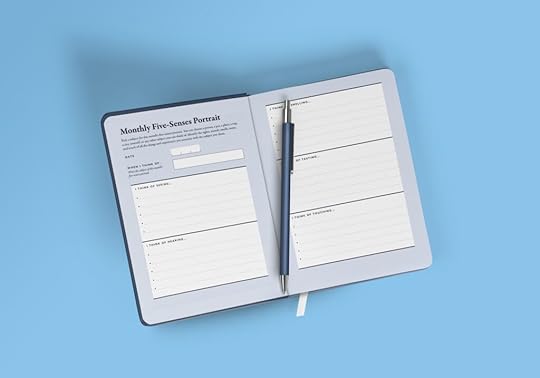
Let me know how you’ve adapted the idea of the five-senses portrait. It’s a surprisingly flexible and satisfying creative endeavor.
The post A Five-Senses Portrait of My Dog, Barnaby appeared first on Gretchen Rubin.
June 20, 2023
Why Everyday Luxuries Help Make Us Happier
In her memoir Plant Dreaming Deep, poet May Sarton wrote: “If someone asked me what my idea of luxury is, I think my answer would be: flowers in the house all year round.”
This question caught my imagination: What’s my idea of luxury?
For me, luxury means buying books instead of getting them from the library, ordering a soft drink in a restaurant, splurging on a terrific set of magic markers or book of stickers (like this John Derian book), using a lotion warmer, and spending more for a fancy face lotion (my favorite is Embryolisse Lait-Crème Concentré, because it has a beautiful smell and great texture).
I was curious to hear from other people about their favorite everyday luxuries, so I asked readers and listeners to weigh in.
In reviewing the list, it struck me that many of the answers don’t cost much—or anything at all—yet enjoying a modest “luxury” can dramatically boost our feelings of comfort and pleasure.
I was also struck by the fact that I also took a lot of satisfaction in suggestions such as crushed ice, an electric kettle, and frothy milk, but I’d never thought of them as luxuries. Now that I’ve them the label of “luxuries,” I enjoy them more.
In my book Better Than Before, I describe the 21 strategies we can use to make or break our habits—and the most popular strategy is the “Strategy of Treats.”
When we give ourselves treats, we feel energized, cared for, and contented, which boosts our self-command—and self-command helps us maintain our healthy habits.
When we don’t get any treats, we begin to feel burned-out, depleted, and resentful. We start to feel deprived, which isn’t a good frame of mind for good habits.
For that reason, it’s helpful to identify healthy treats to give ourselves, and luxuries (chosen wisely) are a form of healthy treats.
They also make great gift ideas!
Especially if you’re buying a present for under-buyers who, if they’re anything like me, often resist buying things, especially items with very specific purposes (I would never buy myself a lotion warmer; my sister Elizabeth gave me it as a gift).
One more striking fact about luxuries: they delight our five senses with beautiful fragrance, flavors, textures, sounds, and sights. In my book Life in Five Senses, I write about how we can tap in to our senses—and by giving us luxury, they give us a sense of vitality.
Because these are luxuries we experience every day, it can be easy for them to fade out of awareness. We need to remind ourselves how much we love the view from our big window, or how much we appreciate the convenience of our electric kettle, so we won’t take everyday luxuries for granted.
Readers and listeners enjoy these everyday luxuries:
Humidifier in the bedroomHigh-quality body lotionSilk pillowcases or sleeping maskElectric kettleInsulated water bottle in a favorite colorCandlesticksMonogrammed handkerchiefSilenceBig windows, natural lightEnjoying good food, a glass of wine, and deep conversation with a loved oneBeing in nature, near water or in a forestA chocolate chip cookie at the end of the dayPortable or wearable fanA cup of coffee or tea in a favorite mugAn end-of-day ritual, such as reading or watching the sun setCrushed ice–many people reported ice-related luxuries!A walk alonePlans made by someone elseFresh, homemade bread (and the time to make it)Good wine glasses and cloth napkinsPre-washed, pre-cut fruitMilk frotherSitting by a fire (or lighting candles) with a glass of wine or hot chocolateListening to classical music while cleaning houseBig, soft, fluffy hotel-style towelsClean sheetsGood cheese and chocolateHigh-quality kitchen toolsMassageHeated blanketNapsReal, fresh butter and good olive oilCoffee-table booksLying by the pool or on the beachNew perfumeA day tripPaying to rent a movie you want to see rather than choosing one that’s freeNotebooks and pensCar seat and steering wheel warmersHiring a house cleanerAttending a live concert or playLipstickEating outsideBuying plane tickets based on convenience rather than costA fridge with an ice and water dispenserGrocery or meal deliveryUsing the silver, china and crystal reserved for special occasionsShoes that fit properlyGrinding coffee beans and brewing coffee at homeStaying at a bed-and-breakfastA farmers market splurgeHandmade soapBeing able to afford to donate to a causeSleeping in—not waking up to the sound of an alarmEating something you grew yourselfThe perfect reading lightKeyless entry on your houseArt suppliesHaving multiples of essentials like phone chargers and reading glassesCloth napkinsPaying for a friend’s meal
Is there a modest splurge or upgrade that might make (or has already made) your routine easier? A small luxury that makes your day more enjoyable?
When we give more to ourselves, we can ask more from ourselves. For that reason, everyday luxuries can help us to live happier, healthier lives. And note: this doesn’t mean reckless consumerism! Many people’s luxuries cost little or nothing.
Because of the helpful role that luxuries can play, it’s a good idea to find a way to give ourselves everyday luxuries—and not expect other people to supply them.
I’m reminded of some lines from the poem “You Learn” by Jorge Luis Borges:
So you plant your garden and decorate your own soul,
Instead of waiting for someone to bring you flowers.
If for me—like May Sarton—my idea of luxury is “flowers in the house,” I can buy myself a bouquet.
Which reminds me of another quotation, from Émilie du Châtelet: “Let us choose for ourselves our path in life, and let us try to strew that path with flowers.”
Let us strew our path with flowers, or naps, or crushed ice.
The post Why Everyday Luxuries Help Make Us Happier appeared first on Gretchen Rubin.
The Practical High-School Commencement Address I Didn’t Give
Recently, I was thrilled and honored to be invited to give the commencement address for my daughter’s high-school graduation.
For that occasion, I wanted to explore transcendent, timeless themes, I wanted to tell a few good stories—and I wanted to be brief. So there were many concrete, useful suggestions that didn’t make it into the actual commencement address.
Nevertheless, I couldn’t resist writing up everything I wanted to say, even if I couldn’t include it.
On June 15, I delivered the profound commencement address; here’s the practical commencement address.
After introductory remarks, here’s how I would have continued…
+
For years I’ve been collecting my “Secrets of Adulthood,” the lessons I’ve gleaned with time and experience. This is wisdom that I gained the hard way, through trial and error; I hope that perhaps I can save you graduates from making the mistakes I’ve made.
Out of my hundreds of Secrets of Adulthood, I wanted to suggest some that seem particularly relevant to your stage of life, when you’re grappling with a lot of change and a lot of decisions.
I offer these observations for your consideration.
Working is one of the most dangerous forms of procrastination.The place that hurts isn’t always the place that’s injured.If you can’t find something, clean up.It’s okay to ask for help.You can choose what you do, but you can’t choose what you like to do.If you don’t know what to do with yourself, go outside or go to sleep.Be polite and be fair.What you do every day matters more than what you do once in a while.Never ask for an extension on an assignment.Every day, ask: “What’s something can I do to put my values into the world?”Happiness doesn’t always make you feel happy.Try by 25—many lifelong preferences are set by young adulthood, so try new things now.Don’t treat a gift like a burden.One of the best ways to make yourself happy is to make other people happy; one of the best ways to make other people happy is to be happy yourself.Something that can be done at any time is often done at no time.When packing an item that might leak, put it in a plastic bag.The things that go wrong often make the best memories.If you accept the blame when you deserve it, people will give you responsibility.The more you put in, the more you get out.Get your driver’s license.Don’t do something to make yourself feel better if it just ends up making you feel worse.By doing a little bit each day, you can get a lot accomplished.Somewhere, keep an empty shelf; somewhere, keep a junk drawer.Buy any ingredients you want from the grocery store; eating at home is almost always cheaper than eating out.When you can’t decide between two courses of action, choose the bigger life.Sometimes, to keep going, you have to allow yourself to stop.
And finally:
Some credit for that last Secret of Adulthood goes to Jean-Paul Sartre, and he’s right: Hell is other people. I remember my mother once remarking—without any rancor, just matter-of-factly—“Everything would be so easy if it weren’t for people.” True!
But what Jean-Paul Sartre didn’t write, and what’s also true, is that Heaven is other people. As we go through life, what matters most are our relationships with other people.
Ancient philosophers and contemporary scientists agree: To be happy, we need enduring bonds; we need to belong; we need to get support, and just as important, we need to be able to give support. We must cultivate relationships with the people close to us, and we must cultivate relationship to the people of the larger world.
That is why, graduates, in your next stages of life, when you’re deciding how to spend your precious time, energy, and money, anything that broadens or deepens your relationships is probably a good choice. That’s why we must treat other people with respect.
+
…Then I would have given the same conclusion as the profound version.
I enjoyed writing both the Profound and the Practical. What did I miss?
The post The Practical High-School Commencement Address I Didn’t Give appeared first on Gretchen Rubin.
I Gave a High-School Commencement Address: Five Essential Paradoxes
Recently, I was thrilled to be asked to give the commencement address for my daughter Eleanor’s high-school graduation.
(I worried that Eleanor might not be enthusiastic about this development, and I was surprised and pleased that she was really happy about it.)
One note, so the conclusion makes sense: The school song begins “We go forth unafraid/Strong with love and strong with learning” and the song’s final line is “Here we have learned to go forth unafraid.”
In writing it, I wanted to explore transcendent themes, and I did. But I have a very practical side, and without quite meaning to do it, I wrote two commencement addresses: The Profound and The Practical.
Here’s the version I gave, about five essential paradoxes:
+
Thank you, I’m so honored to be here. Congratulations to the Head of School, teachers, proud families and friends, and, above all, to the class of 2023.
It’s deeply moving to me to be here as a parent, to see all of you up on stage, dressed in your caps and gowns. I remember taking a photo of Eleanor outside Little Dalton on the first day of kindergarten. I thought, “She’s already so big!” and comforted myself by thinking, “She’s only in kindergarten, senior year will never come.”

Yet here we are, at that impossible milestone. The days are long, but the years are short.
Now, graduates, whatever you’re doing next, you’re entering a new stage of life. Your friends, your schedule, your city, your relationship to your family, what you eat for breakfast, all may change.
That’s exciting, and also scary.
You may worry, “How do I make sense of what’s coming next, if all I know is high school?” If you’re anything like me, over and over in life, you’ll find yourself thinking, “Gosh, this is just like high school!” Life is high school; it’s just that high school is the first time we notice it.
Again and again, we have to start over—find our place, find our friends, find our way to be in the world.
I study happiness and human nature, and I’ve discovered something surprising: The opposite of a profound truth is also true. So the study of happiness is often the study of paradoxes.
We grapple with these paradoxes throughout our lives, and graduates, you’ve probably faced them many times already. Now you’re at a time of transition, when they become particularly urgent.
So I offer five essential paradoxes that may help you make sense of your experiences—what you’ve experienced in the past and what you’ll experience in the future. Because life is high school, and high school is life.
Paradox #1: Be selfish, if only for selfless reasons, and be selfless, if only for selfish reasons.When it comes to happiness, many people ask, “In a world full of suffering and injustice, is it morally appropriate for individuals to seek to be happier?”
In fact, research shows—and experience confirms—that when we’re happier, we’re more likely to engage with the problems of the world, to give our time and money, to vote, and to be compassionate; and we’re more interested in making change. Happiness doesn’t make people stay out late and party; it helps them decide, “Let’s start a campus-wide rooftop solar program.”
Working on our own happiness strengthens us to tackle the challenges of society. That airline reminder has become a cliché because it’s true: We each need to secure our own oxygen mask first, if we’re going to help other people.
So, if it is selfish to try to be happier, we should be selfish, if only for selfless reasons.
At the same time, we should be selfless, if only for selfish reasons. One of the best ways to make ourselves happy is to make other people happy. Do good, feel good—it really works! I remember talking to a friend who, in her twenties, had gone through a very tough time: her boyfriend broke up with her, she got fired, and she was rejected from a graduate-school program. I asked her how she got through it, and she told me, “I was practically addicted to volunteering and doing good deeds. They were the only things that made me feel better.”
We should be selfish, if only for selfless reasons, and be selfless, if only for selfish reasons.
Paradox #2: You’re unique, exactly like everyone else.You’re one of a kind, a singular combination of abilities and interests, and the same thing is true of the people around you.
We’re all unique, and we’re also very ordinary. For instance, one of the most universal emotions is the feeling that you don’t belong. So when you feel like you don’t fit in—say, on your first day of freshman year—you fit right in.
Even when you think, “No one feels the way I do,” probably they do. Drummer Ringo Starr told a funny story about the summer that the Beatles were recording the White Album, when he briefly left the group. He visits John Lennon and says, “I’m leaving the group because I’m not playing well and I feel unloved…and you three are really close.” John says, “I thought it was you three!” Then Ringo visits Paul McCartney and says, “I’m leaving the band. I feel you three guys are really close and I’m out of it.” Paul replies, “‘I thought it was you three!” Ringo doesn’t even bother to visit George Harrison.
Because we’re unique, exactly like everyone else, one great challenge of our lives is to know ourselves.
You might think, “I know myself, I hang out with myself all day long,” but it’s hard to know ourselves. We get distracted by the way we wish we were, or what other people want us to be, or we take our strengths for granted.
Because I write about happiness, people sometimes say to me, “Give me the short answer. What’s the best, the most scientifically proven way to become happier?”
And I explain, “There’s no one right way. We each have to figure it out for ourselves.”
They say, “Sure, sure. Just give me the best way.”
For a long time, this question stumped me, but now when they ask, “What’s the best way to create a happy life?” I respond, “What’s the best way to cook an egg?” They say, “Well, it depends on how you like your eggs.” I answer, “Right! We each have the answer that’s right for us.”
There can’t be a one-size-fits-all answer to tell you how to achieve your aims. Other people can suggest possibilities, but they can’t figure it out for you—and you can’t figure it out for them.
You’re unique, exactly like everyone else.
Paradox #3: Not choosing is a choice.During times of change, such as the one you graduates are entering, we need to figure what we want—and that’s daunting. Because that question is so hard, when we’re faced with choices, it’s easy to drift.
“Drift” is the decision we make by not deciding.
We drift when we feel like other people or processes are moving events forward, and we’re just being carried along. We drift when we find ourselves doing or getting something because the people around us are doing it or want it. You go to medical school because both your parents are doctors. You take a job because someone offers you that job.
We drift because we want the respect of the people around us, or we want to avoid a fight or a bout of insecurity, or we want to end uncertainty, so we take the path of least resistance.
I drifted into law school. I didn’t know what else to do, and I told myself, “This will keep my options open,” “I can always change my mind later,” and “I can’t turn down this terrific opportunity.”
The word “drift” has overtones of laziness or ease. Not true! Drift is often disguised by a huge amount of effort. For me, law school was drift, and it was hard every step of the way, from studying for the LSAT to clerking for the Supreme Court.
Looking back, I’m glad I went to law school—and that’s another confusing thing about drift! Sometimes drift does make you happy; bad decision-making can lead to good outcome. But don’t count on it.
Drift is dangerous, because when we drift, we’re not mindfully choosing. As writer James Baldwin noted: “If you don’t live the only life you have, you won’t live some other life, you won’t live any life at all.”
In the end, we must choose. Because not choosing is a choice.
Paradox #4: Accept yourself, and also expect more from yourself.One great challenge is to be true to ourselves, yet also push ourselves. This is a very tricky paradox. And you, at the end of your high-school years, are probably very familiar with it.
Sometimes it can be hard to know when to accept, “Hey, that’s not me, that’s not my thing,” or when to push ourselves toward a goal that’s uncomfortable.
In one of my first jobs, a work friend told me that he’d gotten a great promotion, but as part of it, he had to give weekly presentations to a large group—and he hated public speaking. When he told his boss, his boss said, “It’s okay, if you don’t want to do it, I’ll assign that role to someone else.”
So my friend had to decide: Accept himself, or expect more from himself? He pushed himself to give the presentations.
As you consider a difficult aim, only you can decide whether it’s the right aim for you. Should you take Statistics, join the intramural basketball team, audition for the improv group, launch a start-up, run for office?
Accept yourself, and also expect more from yourself.
Just as we can use Paradox #4 to help us understand how we can consider ourselves, we can use Paradox #5 to help us understand how others consider us.
Paradox #5: Love is unconditional, and love is demanding.Graduates, I’m sure you’ve felt the weight of this paradox—probably, quite recently! Love accepts you just as you are, and love expects the best from you.
I heard a great example of this paradox from musician Rosanne Cash, about a conversation she had with her husband and musical collaborator, John Leventhal.
The two were in Nashville, where Rosanne did a guest session on another band’s album; John came along to hang out during the recording. After the session, he didn’t say anything, so Rosanne asked, “How did you like it?” He answered, “I would have pushed you harder.”
Love says, “You’re the best,” and love says, “You can do better.”
Graduates, sometimes, the people around you—parents, teachers, bosses, coaches, friends—may get this wrong; because we see so much good, we don’t realize when we’re pushing too hard. But when you think about all the reminders, to-do lists, and lectures you’ve received, remember, our insistence that you live up to your potential is an expression of our boundless love.
Love is unconditional, and love is demanding.
So those are five paradoxes for this day, which celebrates both an ending and a commencing.
And here’s a bonus paradox: I’m sad to see the years at Dalton come to an end, and I’m happy, too. I’m sad to say farewell to an institution that my family loves, and happy to see all you graduates, ready to go out into the world, strong with love and strong with learning. Now it’s time to go forth unafraid.
Thank you.
The post I Gave a High-School Commencement Address: Five Essential Paradoxes appeared first on Gretchen Rubin.