Gretchen Rubin's Blog, page 5
August 26, 2024
Five Reflections from Dropping Off My College Freshman
My husband Jamie and I recently drove our younger daughter Eleanor up to college, to help her move in for her freshman year.
It’s a huge family milestone.
In the weeks before, we went to Target, washed the new sheets, jammed stuff into plastic drawers, labeled towels, and finally loaded up the trunk. Because we had a four-hour drive ahead of us, we left the day before and spent the night in a nearby hotel.
Here are some of my observations and reflections:
1. On the long drive, Jamie and I kept thinking of more words of wisdom to impart to Eleanor. “Ask for help!” “Make conversation with people, don’t look at your phone all the time!” “Don’t do anything unsafe or stupid!” But we said these things mostly to relieve our own feelings. For Eleanor, it’s probably too late; she’s either learned those lessons from us—or not. At one point, Jamie actually said, “Just take advantage of everything that college offers,” and we all burst out laughing. It’s such a cliche. It’s true, but it’s also such a cliche. But it’s true!
2. Once we got settled in the hotel, we walked around campus to find her dorm, the gate where we’d drive in, etc. When we arrived at her dorm, an obliging student let us inside, so even though Eleanor couldn’t look in her room (she didn’t have a key yet), she was able to explore the building, walk through the basement, find the laundry machines, etc., when there were almost no students around. On the Happier podcast episode 457, we talk about why visiting a place ahead of time can reduce anxiety. This familiarity made the next morning much easier.
3. Eleanor had to choose a time slot for us to unload the car, and I was surprised that she chose 8 a.m., because usually she prefers to sleep later if possible. When the morning arrived, I was very glad she had the forethought to choose the first possible time. From the moment we arrived, she felt restless and uneasy. She wouldn’t have enjoyed a leisurely breakfast, morning walk, or sleeping in. She just wanted to get unpacked and settled.
4. I kept reminding myself, “People are more important than process.” Meaning, meeting people or being attentive to Eleanor was more important than getting unpacked as fast as possible. For instance, at one point, Eleanor said, “Can we just go get a cup of coffee?” Part of me thought, “Let’s get this done!” but I realized, no, we’re not in a hurry, let’s take a caffeine break. That respite really calmed her down. Also, I kept reminding myself not to get so focused on the to-do list that I didn’t make conversation with the other families. People are more important than process.
5. At a certain point, I could see that Eleanor was starting to have trouble bridging the new and old worlds. There wasn’t much for Jamie and me to do. Probably our most important decision was recognizing the right time to leave.
At the very end, I gave Eleanor a long, tight hug, and when Jamie asked me a question, I couldn’t speak. “Oh, Mom, are you crying?” she asked tenderly. “I never see you cry! It’s okay!” I tried to put into that hug everything I couldn’t say.
After we gave our last, bittersweet good-byes, and as we headed back to the parking garage to start the long drive home, Jamie took my hand.
Fittingly, I was reminded of something I’d read during my own college years, the final lines of Milton’s Paradise Lost:
Some natural tears they drop’d, but wip’d them soon;
The World was all before them, where to choose
Thir place of rest, and Providence thir guide:
They hand in hand with wandring steps and slow,
Through Eden took thir solitarie way.
On the drive home, I wasn’t sobbing (I’ve heard from many people who say that they sobbed the entire way home), but I was overwhelmed by waves of emotions.
Jamie reached over and took my hand again. “She’ll do great,” he said reassuringly.
“I know,” I answered. “She’ll do great, and we’ll do great, but it’s the end of an era.”
I’m not really sure what I’m feeling. A friend emailed me, “You may still be processing those emotions for a long time.” I think she’s right.
As I was preparing for this milestone, I felt dissatisfied with the metaphor of “Empty nest.” “Empty” has a bereft feel and signifies loss and absence; I don’t want to define the next decades of my life by what’s missing.
Instead, I’m using the metaphor of “Open door.” I like this metaphor because it emphasizes that family members are going and returning. Jamie and I can take an impulsive trip, because our door is more open than when we had children to care for; and Eliza and Eleanor can come and go as they please. Our door is always open! The metaphor reminds me that I want to cultivate an atmosphere of freedom, possibility, welcome, and tenderness.The post Five Reflections from Dropping Off My College Freshman appeared first on Gretchen Rubin.


July 31, 2024
Insights and Hacks from an English Hiking Adventure
My sister Elizabeth and I just returned from a wonderful guided hiking trip in Northumberland and the Lake District, in partnership with Wilderness England.
We hiked to various summits, we visited museums and gardens, we walked around cities and towns, we marveled at historic castles, we stood at Hadrian’s Wall, we took a ferry across a lake. So many terrific adventures.
Before we left, we read books to help us get in the spirit of our trip—books such as You Are Here, The Shepherd’s Life, and The Hollow Land.
If you want to hear live updates we recorded every day, you can listen here.
Also, along the way, we took notes of insights and hacks that we learned. If you want to hear us talk about these ideas, you can listen to episode 493 of the Happier with Gretchen Rubin podcast.
Insights we gained:Just a few days away from our usual routines is enough to feel like we’ve had a refreshing adventureTaking a vacation really does invigorate the mind and help us generate creative ideasWhen we articulate a dream, we’re more likely to spot a way to achieve that dream“Loose ties” are very valuable, because those people bring us new informationThe quiz for the Four Tendencies personality framework is a fun icebreakerHacks we learned (sometimes the hard way):Wear a bandana; they come in handy in many waysHit the down-volume button on your phone to take a photoWear layersCheck your pockets every night as you put away your layersIf you love a giant cup of coffee or tea, pack a travel mugReally make sure your hiking boots fitTo prevent blisters, try Body Glide Foot Glide and KT Blister Prevention TapeTo prevent blisters or chafing, try Neat 3 B Body Saver anti-chafe and sweat rash creamFollow the recommended-gear listTake photos of place names, restaurants, hotels, or shops, if you think you might forgetDon’t get careless as you near the end of a hike; that’s when people get hurtPack a travel laundry packet so you can wash items overnightRemember that YouTube is a terrific resource for information; I was very happy I’d watched video about how to lace on hiking bootsWhen you’re packing a day pack, don’t pack up the night before, because in the morning, you won’t be sure if you put in X or Y. Instead, the night before, lay out everything next to the pack, and in the morning, pack them inFive-senses portrait of our trip:To help us remember all our experiences during our sisterly adventure, on our last evening together, we created a five-senses portrait:
Seeing
Hadrian’s Wall—something Gretchen has wanted to see ever since reading The Eagle of the Ninth and Memoirs of Hadrian Dangerous plants growing in cages in the Poison Garden by the Alnwick CastleFields of purple heather growing on hilltopsThe shadows of clouds passing over Buttermere LakeOur guide Jeremy running up the stairs carrying both our heavy suitcases at once.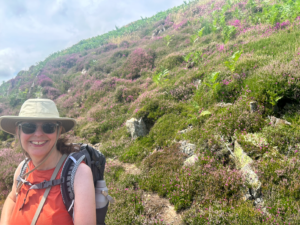
Hearing
Smelling
Tasting
Touching
Here’s the quotation we mention:
The fleeting hour of life of those who love the hills is quickly spent, but the hills are eternal. Always there will be the lonely ridge, the dancing beck, the silent forest; always there will be the exhilaration of the summits. These are for the seeking, and those who seek and find while there is still time will be blessed both in mind and body. —Alfred Wainwright, A Pictorial Guide To The Lakeland Fells: The Western Fells

The post Insights and Hacks from an English Hiking Adventure appeared first on Gretchen Rubin.
May 28, 2024
A Fun New Way to Have a Happier Summer
Have you ever reached the end of summer and wished you’d done more to enjoy the season?
For many of us, summer is marked by longer days, looser schedules, and opportunities for time off from work or school. But taking advantage of that time requires reflection and planning.
It’s easy to tell ourselves “Next week,” “We missed it this year, but we’ll plan ahead next year,” or “I can’t think of anything I want to do,” and let the summer months slip away.
Every year on the Happier podcast, Elizabeth and I dedicate an episode to “Design Your Summer” to help us and listeners make the most of the season. The idea comes from Robertson Davies who says, “Adventures are what make a summer.” What makes a summer for you?
Also, when a particular season feels distinctive, time feels more rich, and our experiences are more memorable. If every month is exactly like the month before, time speeds up and blurs—so by doing lots of summery activities, we’ll make that part of the year stand out. (Of course, it’s a good idea to do the same thing for winter!)
I’ve created a new way to use the “Spin the Wheel” tool in the Happier app to help you design your summer and do more of the things that make you happier. For the month of June, every Spin the Wheel challenge will suggest something to add to your summer bucket list, an idea to spark a new tradition, or an activity that will help the season feel distinct.

Whether you want to rest and recharge, travel and have adventures, connect and deepen your relationships, or play and explore your creativity, you’ll find concrete ideas to help you plan ahead or get in-the-moment inspiration. You can spin the wheel and get up to three new ideas per day.
The Happier app is free to download, and you can use the Spin the Wheel tool with or without a subscription.
Want to make progress on your aims over the summer? Here are more ways you can use the Happier app this season.
The post A Fun New Way to Have a Happier Summer appeared first on Gretchen Rubin.
May 8, 2024
How to Be Happier: 16 Tips for Being a More Lighthearted Parent.
One of my Twelve Commandments is “Lighten up,” and I have a lot of resolutions aimed at trying to be a more lighthearted parent: less nagging, more laughing. We all want a peaceful, cheerful, even joyous, atmosphere at home—but we can’t nag and yell our way to get there.
Tips for Young Children:Here are suggestions I followed when my children were younger (and most of them I still try to follow, even now):
1. At least once a day, make each child helpless with laughter.
2. Sing in the morning. It’s hard both to sing and to maintain a grouchy mood, and it sets a happy tone for everyone—particularly in my case, because I’m tone deaf and my audience finds my singing a source of great hilarity.
3. Get enough sleep yourself. It’s so tempting to stay up late, to enjoy the peace and quiet. But morning comes fast. Along the same lines…
4. Wake up before your kids. That means I can get myself organized, check my email, and get some work done before they get up.
5. Most messages to kids are negative: “stop,” “don’t,” “no.” So I try to cast my answers as “yes.” “Yes, we’ll go as soon as you’ve finished eating,” not “We’re not leaving until you’ve finished eating.”
6. Look for little ways to celebrate. My “holiday breakfasts” and April’s Fool Day pranks are a big source of happiness. They’re quick, fun, and everyone gets a big kick out of them.
7. Repetition works. A friend told me he was yelling at his kids too much, so he distilled all rules of behavior into four key phrases: “Keep your hands to yourself”; “Answer the first time you’re asked”; “Ask first”; and “Stay with us” (his kids tended to bolt). I often use school mantras: “Sit square in your chair;” “Accidents will happen,” “You get what you get, and you don’t get upset” (i.e., when cupcakes are handed out, you don’t keep trying to switch).
8. Say “no” only when it really matters. Wear a bright red shirt with bright orange shorts? Sure. Sleep with your head at the foot of the bed? Fine. Samuel Johnson said, “All severity that does not tend to increase good, or prevent evil, is idle.”
9. When I find myself thinking, “Yippee, soon we won’t have to deal with all these Legos,” I remind myself how fleeting this is. The days are long, but the years are short.
Tips for teenagersOnce my children became teenagers, I added more items to my list for lighthearted parenting:
10. Try to join one of their enthusiasms. If they love a TV show, watch it. If they love a sports team, follow it. If they love a type of music, listen to it. It will give you a shared interest—and show that you respect their opinion. I’ve watched New Girl and Claim to Fame because my daughters love those shows.
11. To reduce conflict, as much as possible, let them arrange their personal space to suit themselves, with whatever decorations or level of messiness they want. I’m a simplicity-lover, and my younger daughter is such an abundance-lover that it stresses me out. Oh, well!
12. Find the humor in situations as much as possible. (Which includes being willing to laugh at myself.)
13. Figure out whether your child is an Obliger, Questioner, Upholder, or a Rebel, and adapt your parenting style accordingly. Read more about the “Four Tendencies” personality framework here. If you want suggestions about how to apply the framework as a parent, look here.
14. Don’t take on the horrible job of rousting a teenager out of bed in the morning. Use technology or some other system.
15. Be quick to point out a child’s strengths and gifts. “You’re so resourceful,” “You have such an original imagination,” “I wish I had your ability to remember names and faces.”
16. Say hello and good-bye with genuine attention and warmth, and if possible, add a hug or some kind of physical touch. I’ve found that this is such a quick, easy way to add more tenderness and attentiveness to the atmosphere of my home.
Have you found any good strategies to cut back on the shouting and to add moments of laughing, singing, and saying “yes”?Updated May, 2024. Originally published April, 2009 on The Happiness Project Blog.
The post How to Be Happier: 16 Tips for Being a More Lighthearted Parent. appeared first on Gretchen Rubin.
May 1, 2024
Hacks for Facing Life’s Challenges: Proverbs of the Professions
Something that makes us happier? Having clarity on how to move ahead—how to make a decision, how to size up a problem, how to deal with other people.
Elizabeth and I love a hack, and in episode 480 of the Happier with Gretchen Rubin podcast, we highlighted these are a special kind of hack: “Proverbs of the Professions.”
Many of these proverbs are literally true, and also metaphorically true, or just as true in another context as in the originating context.
Note: we’re not saying we agree with all these proverbs.
From the Workplace:Share the praise, accept the blame.
You can manage for just in time or just in case.
Credit doesn’t get smaller when you share it.
Your email inbox isn’t your to-do list.
Don’t let the urgent drive out the important.
The difference between “try” and “triumph” is a little “umph.”
You pay for your vacation the week before vacation.
From Parents:Says yes when you can, and no when you must.
Little kids, little problems. Big kids, big problems.
You’re only as happy as your least happy child.
Nap when the baby naps.
You wake the baby, you take the baby.
You can have quiet or clean; you can’t have both.
Let them go to watch them grow.
Nothing good happens after 1:00 a.m.
The more they sleep, the more they sleep.
Nothing changes if nothing changes.
Don’t try to make a happy baby happier.
From Job Seekers:It’s not what you know, it’s who you know.
Leap, and the net will appear.
Never look for a job without having a job.
From the Military:Flexibility is the key to air power.
If you aren’t five minutes early, you’re five minutes late.
Slow is smooth and smooth is fast.
You can volunteer for an assignment, or you can be voluntold.
If you find yourself in a fair fight, your tactics suck.
Generals tend to fight the last war.
It’s almost always costlier to attack a position than to defend a position.
From Actors:You can’t make a living in the theater, but you can make a killing.
The only person more unhappy than an out-of-work actor is a working actor.
Acting is reacting.
From Photographers:The best camera is the one you have with you.
Zoom with your feet.
You can take a photo or make a photo.
From Musicians:Practice makes permanent.
Perfect practice makes perfect.
It’s never the fault of the audience.
Hard work beats talent if talent won’t work.
From Chefs:Make it nice or do it twice.
Use your head or use your feet.
If you have time to lean, you have time to clean.
From Poker Players:You can’t win the hands you don’t play.
If you can’t spot the patsy at the table, you’re the patsy.
Play the hand you’re dealt.
You can win with the worst hand, and you can lose with the best hand.
The house always wins.
Play the opponent, not the cards.
Big raises make big pots.
From Hikers:Don’t sit for too long.
The last person to reach the top of the hill needs time to rest, too.
There’s no bad weather, just bad clothing choices.
No one ever promised you warm and dry.
Don’t step on anything you can step over; don’t step over anything you can walk around.
From Veterinarians:First, all bleeding must stop.
When you’ve got nothing left, try steroids.
Every pet comes with a person.
Never name a dog Lucky.
There’s no such thing as a free horse.
From Ski Instructors:The first turn is the hardest.
If you don’t go, you don’t know.
Move your feet, not your skis.
See the line, not the trees.
The best skier is the one having the most fun.
A bad day on the slopes beats a good day at work.
You can’t buy happiness, but you can buy a lift ticket.
If you’re not falling, you’re not learning.
No friends on a powder day.
Ski good or eat wood.
If you choose not to find joy in the snow, you’ll have less joy in your life but just as much snow.
From Dog Trainers:It’s never the dog’s fault.
If you don’t wipe muddy paws at the door, you’ll cleaning mud tracked over the whole house.
A tired dog is a happy dog.
The only thing two dog trainers can agree on is what the third trainer is doing wrong.
From Therapists:It’s never about what it’s about.
Act different to feel different.
“No” is a complete sentence.
Under stress, we regress.
Clear is kind.
If you don’t reveal it, you can’t heal it.
What you resist persists.
People go to therapy because of the people in their lives who don’t go to therapy.
What we permit, we promote.
Acceptance precedes change.
Tell me what you’re afraid of, and I’ll tell you what’s happened to you.
There’s no settling down without settling for.
People who are unavailable attract people who are unavailable.
Hurt people hurt people.
You spot it, you got it.
Intimacy means, “In to me, see.”
Don’t just do something, sit there.
All behavior makes sense in context.
You can’t change the people around you, but you can change the people around you.
Name it to tame it.
If you’re tired of the battles, lay down your weapons.
Your vibe attracts your tribe.
Feeling is healing.
It’s not an excuse, but it’s a reason.
Don’t get furious, get curious.
From Physical Therapists and Fitness Trainers:Motion is the lotion.
The issue isn’t always the tissue.
Use it or lose it.
Pair your scrolling with your strolling.
If you want to do it later, you’d better be doing it now.
Sometimes quit beats grit.
Exercise for sanity, not vanity.
Movement is medicine.
Only move the muscles you want to keep.
A little movement is better than no movement.
No pain, no gain is a lie.
Exercise adds 20 degrees to the weather.
It’s better to be patient than to be a patient.
From Doctors and Nurses:When you hear hoof beats, don’t look for a zebra.
First, do no harm.
Start low and go slow.
If the gut works, use it.
Sometimes the best medicine is the tincture of time.
There’s no such thing as a good tan.
If you don’t make time for your wellness, you’ll be forced to take time for your illness.
Care for the caregiver
A dog can have ticks and fleas.
If it’s not documented, it’s not done.
Your actions today will change someone’s tomorrow.
If your patient isn’t pooping, your patient isn’t doing anything else either.
The shift will always end.
Write legibly, save a life.
Civility saves lives.
From Librarians:A great library contains something to offend everyone.
Books are both mirrors and windows.
A book for every person, and a person for every book.
You don’t have to know all the answers, you just need to know where to find them.
From Martial Arts:Your strength is in your stance.
Your greatest opportunity for influence comes from your willingness to yield.
Every block is a strike; every strike is a grab; every grab can be a throw.
One does not stay safe by controlling others, but by controlling oneself.
There’s nothing but basics.
If you do it correctly, it will feel true in your body.
You can also read proverbs of the professions from teachers.
These proverbs are endlessly thought-provoking, and they’re fun to collect.
The post Hacks for Facing Life’s Challenges: Proverbs of the Professions appeared first on Gretchen Rubin.
April 22, 2024
How a Book Club Can Make You Happier
Ancient philosophers and contemporary scientists agree: Strong relationships make people happier. We need enduring, intimate bonds; we need to feel like we belong; we need to be able to confide; we need to be able to get support—and just as important, give support.
Ancient philosophers and contemporary scientists also agree: Reading makes people happier. Reading regularly boosts creativity, reduces stress, fosters empathy and understanding–and it’s fun.
A great way to combine relationships+reading is through a book club!
Any kind of group or organization can help us form and strengthen our relationships, but I do think we get a special boost from a book club.
How a “book” club can make you happierMany people want to cultivate the habit of reading. Belonging to a book club means that you don’t neglect this aim. And, especially if you’re someone who benefits from outer accountability and deadlines—Obligers, I’m thinking of you—belonging to a book club means that reading doesn’t get pushed to the bottom of the to-do list.
A book club is a terrific way to meet new people who share similar interests.
I’m in three (yes, three) book groups, and through them, I’ve met people I would never have otherwise met, and made strong friendships.
A book club creates a feeling of community and exposes you to new perspectives and ideas. Meeting on a regular basis ensures you’re connecting consistently and have something on the calendar you look forward to with pleasure.
Shape the book club to suit your interestsPeople often assume that a book club has to be organized one way. There’s no right way!
You can start or join a book club for whatever topic or genre interests you. For instance, for a long time, I didn’t admit my passionate interest in children’s literature. It didn’t fit with my ideas of what I wished I were like. But when I acknowledged what I found fun and made this activity a major pastime by starting a “kidlit” reading group, I dramatically ramped up the fun I got from it.
I now belong to two kidlit groups. To be clear, these groups are for adults who have a taste as adults for children’s and young-adult literature—no actual children are involved. Just as some adults like mysteries, sci-fi, or experimental fiction, some enjoy kidlit.
I also belong to a “regular” book club where we read adult books—mostly fiction.
Creative book club ideasNot everyone wants to join a classic book club, but there are many ways to structure a book club to make it as enjoyable as possible. Consider:
Silent book club—people get together to read to themselves, in quiet companionship.No-homework book club—everybody reads whatever they want, then all swap notes about what they recommend or not. (Great solution for Rebels)Social-issues book club—people read books to become more educated on pressing issues of social policy; my sister Elizabeth joined this kind of book groupCategory book club—for instance, I highly recommend the kidlit book club! Or it could be biography, history, sci-fi, romance, horror, mysteries, thrillers, cookbooks…Subject-matter book club—for people who want to go deep on World War II, gardening, Napoleon, the Tudors, Japan, entrepreneurship, or whatever fascinates the group (we can get a real happiness boost from becoming a minor expert)Life-stage book club—people read books about parenting, divorce, or whatever is happening in the group’s lives (we can gain insights and support by reading about a life stage, and also from the discussions sparked in the group)Single-author book club—I know members of a Proust book club and an Anthony Trollope book clubOne-off book club—This can be a super-fun way to meet and spend time with people, though it doesn’t offer the same ongoing relationship-building. Last year, I went to a one-off book club to discuss the work of Laurie Colwin, and we had a terrific time.Prize-winner book clubs—I’ve heard of book groups that select their choices from looking at winners of prizes such as the Pulitzer Prize, Booker Prize, and the National Book AwardAdaptation comparisons—the group reads the book, watches the movie or TV show, and discusses the decisions made in adaptationRead-then-experience—the group reads books in preparation for an experience they’re going to have together. For instance, the group reads book about a place, then travels to that place, or reads books about an artist, then goes to see a major exhibition. One of my Secrets of Adulthood is: The more we know, the more we notice.Guided-discussion reading group—some groups enjoy inviting an expert to lead their discussion; I’ve never belonged to a group like that, but I’ve heard that it’s really great
Discussion Ideas
Because book clubs are so popular, many bookstores, celebrities, and others offer book suggestions. If you need ideas for a book to choose, you can look at:
Barnes & Noble Book ClubReese’s Book ClubZibby’s Book ClubRead with JennaGoodreads Choice Awards Book ClubBelletristOprah’s Book ClubAlso, many writers offer discussion guides to their books. I always do! (If you’re looking for a discussion guide for The Happiness Project, Life in Five Senses, or my other books, look here.) If you’re worried about the actual discussion, you may find those guides helpful.
Ground Rules
If you’re starting a group, it’s good to be explicit about the expectation for the group. People may have different assumptions, and those different perspectives can cause friction if they aren’t discussed. For instance:
Can people attend even if they haven’t read the book? The motto of my kidlit groups is “No guilt.” People are encouraged to come even if they haven’t read the book.Should the conversation stay focused on the book, or is it okay for people to talk about other topics? Is the discussion highly structured? In my groups, we don’t have a very structured conversation.If you take turns hosting, what’s expected of the host? the guests?How often will you meet? I have a group that aims to meet once a month, and two groups that aim for once every six weeks.The only thing I enjoy as much as reading is talking about reading. If you’re not part of a book group, and the idea appeals to you, consider starting one yourself, or looking for a group to join.
It will boost your happiness in so many ways.
The post How a Book Club Can Make You Happier appeared first on Gretchen Rubin.
March 26, 2024
What I Learned From My No-Spend Month
This year, for our “24 for 24” lists, my sister Elizabeth and I decided to observe a “No-Spend February.” For the month of February, we didn’t make any unnecessary purchases.
Why?
A brief period of deprivation can help us learn about ourselves and our patterns. It can re-set our tolerances, so that going forward, we indulge less.
Also, it may show us that we’d be happier if we engaged less in a habit such as spending, drinking wine every night, or scrolling in bed.
Setting up a successful No-Spend MonthIf you’re considering a “No-Spend Month,” setting a few ground rules ahead of time can help you stick to it:
Set a timeline—if a whole month seems daunting, try one week or one day per week.Decide what “counts”—you might choose to focus on a particular category of spending or rule out anything you deem “non-essential.”If you rule out anything “non-essential,” what is essential? Tooth paste, a birthday gift, a meal with friends?Set up safeguards—for instance, if you tend to shop when you’re bored, decide what you’ll do instead.Identify your “why”—clarifying what you hope to gain from the experience, whether it’s breaking a habit, saving for a bigger investment, or aligning your behavior with your values, will help you stick to it.Consider whether you’re an Upholder, Questioner, Obliger, or Rebel—the “Four Tendencies” personality framework will help you set up the challenge in the way that’s right for you (learn your Tendency by taking the quiz here).
Elizabeth and I decided that for one month, we’d spend money only on necessary household items—also gifts. We could eat at a restaurant for a social occasion, but we couldn’t pay for prepared food otherwise.
For some people, it might work better to cut back on spending, without declaring something extreme like a “No-Spend February.”
But both Elizabeth and I are Abstainers about many things—all or nothing. Many people are surprised to find that when it comes to temptation, it may be easier to give something up altogether than to indulge moderately. (Read more about abstainers vs. moderators.)
It’s also true that often, when we don’t feed our cravings, they don’t build up; instead, they fade away.
Also, a bold gesture sometimes feels more fun than a more modest effort.
Of course, we both realized that we’re extraordinarily fortunate to have the financial comfort to choose not to spend in this way. That’s not something ever to take for granted.
What we learned from our No-Spend FebruaryElizabeth:
Elizabeth hadn’t realized how much time and energy she spent browsing online, looking through emails about sale items, and checking websites. So she gained back that time and energy in February.
However, to her surprise, she came out of the month with more desire to buy. In ordinary life, she usually looked without buying, but by the end of February, she felt more urge to go shopping than usual, so she thought she might go on a shopping spree. But, in fact, she didn’t.
Gretchen:
Because I couldn’t impulsively buy books that I wanted, I ended up buying far fewer—which is good, because these days I feel oppressed by my huge piles of unread books.
Also, I want to learn to watercolor, but my desire to buy art supplies outstrips my actual use of those supplies. It was good that I couldn’t buy a Chinese brush or gouache. This delay reminded me that I shouldn’t indulge in the pleasure of buying supplies; I should be focusing on regularly painting with watercolor.
Another benefit: I wanted to buy a small water-sprayer for watercolor, but because I couldn’t buy one, I realized I could re-purpose a sprayer that had held lens cleaner.
In general, delay is good. After I saw a YouTube ad for fire blankets, and doing a little inconclusive research, I know I would have bought them. But I waited to see if I really thought they were a good idea.
Along the same lines, when I spotted sun gloves in an REI store, I know I would’ve bought them—I didn’t know such things existed. But I waited. When summer comes, I’ll see if I really need them (doubtful).
Tips from listenersAfter we talked about No-Spend February in episode 472 of the Happier with Gretchen Rubin podcast, listeners who joined in the challenge reported on what they learned and used.
Some highlights:
Many people emphasized the usefulness of belonging to a Buy Nothing group.Many recommended budgeting tools such as YNAB (You Need a Budget) or Simplifi.If a child is begging for a toy, take a picture of it. That gesture often satisfies them.Save the money you’d otherwise spend to invest in yourself, with savings.A true under-buyer realized that she’d actually benefit from a Big-Spend February, to push her to buy needful things such as prescription sunglasses and hole-free t-shirts. (Read about under-buyers and over-buyers.)A listener pointed out that people should use the Four Tendencies framework to figure out how to handle a No-Spend February. I absolutely agree—Upholders, Questioners, Obligers, and Rebels would approach the challenge in a different way.Only buy “treats” with cash.Customize settings in social media to receive fewer ads.In Amazon, “proceed to check out” just once a week, to get another chance to review purchases before making them.Most amusing: Every January, a listener and her husband observe “Survivor Pantry Island.” They buy very few groceries for the month, and instead eat from their pantry and freezer.Final insightsOne listener pointed out that while Elizabeth and I often describe ourselves as under-buyers, we buy plenty! That’s one thing we learned from No-Spend February; we underestimated how much purchasing we do.
If you’re interested in this subject, Ann Patchett has a wonderful essay in the New York Times, “My Year of No Shopping.” We did a book club with Ann in episode 283.
I’m very happy that I did No-Spend February; it was a very useful exercise. The more intentional we are about our actions, the more our lives can reflect our values.
The post What I Learned From My No-Spend Month appeared first on Gretchen Rubin.
February 27, 2024
What Type of Gold Star Works for You?
We all love a good self-discovery question. Are you a morning person or a night person? An over-buyer or an under-buyer? A simplicity-lover or an abundance-lover? Do you prefer competition or cooperation?
When we know ourselves, we can tailor our surroundings, our schedules, and our choices to suit our own nature. It’s easier to change our environment than to change ourselves.
Self-knowledge is especially useful when we’re trying to make progress on our aims—so we can set ourselves up for success.
Here’s a useful question: When you do something right, what type of gold star do you appreciate most?
Different types of rewards and recognition work for different people.
This matters, because feelings of recognition and accomplishment help us to continue to strive.
It’s gratifying to reflect on the progress we’ve made.It’s gratifying to have others recognize our efforts.
If we’re always thinking about our to-do list, we can feel discouraged and overwhelmed. If we take a moment to revel in our ta-da list, we get the energy to keep going.
But people differ in the kinds of gold stars that work for them.
When you identify what gratifies you the most, you can set yourself up to get it.
When you’ve made progress on an aim, what form of gold stars gratifies you most?
Praise-seeker: If you’re a fan of the “Five Love Languages,” you know about “Words of Affirmation” (which is my personal love language)Badge-accumulator: You seek outward recognition of mastery, such as a job title, a certificate, a diploma, a publicationTrophy-hunter: You want an actual gold star, a physical trophy, Scout badges, a medal, a deal toyChain-Builder: You get satisfaction from seeing your streak get longer as you “don’t break the chain”Keepsake-collector: You collect a keepsake from something you’ve crossed off the list, such as keeping a playbill from every play you attend or a matchbook from every restaurant where you ate on vacationLikes-gatherer: You want engagement on social mediaParty-planner: You love to celebrate with a social event, celebratory dinner, partyPat-on-the-backer: You enjoy a literal pat on the back, handshake, fist bump, high-fiveRewards-taker: Rewards are very, very tricky! Rewards often backfire! instead, I recommend giving yourself…Treats-taker: Give yourself plenty of healthy treats, whenever you feel like you need a little boost as you make efforts to keep an aim; don’t wait until you deserve it. Here are some suggestions for healthy treats)
Once you identify your favorite kind of gold star, you can make sure you get it.
For instance, if you’re a Chain-Builder, you could get the Don’t Break the Chain Tracker to track an important action, such as taking your medication every day.
If you’re a Badge-Accumulator, you could use the Happier app and get badges for different kinds of challenges and aims. Getting those badges will help you stick to an important habit such as writing every day in 2024 for #Write24in24.
If you’re a Party-Planner, you could remind yourself that even though it’s a lot of work to plan that celebratory dinner after you run the 5K, it will energize you to train for another race.
The more we know ourselves, the more effectively we can set up our lives to help us become happier, healthier, more productive, and more creative.
And when we understand that other people might prefer different kinds of recognition, we can tailor our approach to suit them. For instance, if I know my child is a Trophy-Hunter, I could make some kind of “trophy” to award “Great positive attitude during a vacation when he got sick and couldn’t do anything fun.”
What category of “gold star” works for you? What categories have I overlooked?
The post What Type of Gold Star Works for You? appeared first on Gretchen Rubin.
February 8, 2024
My Visits to the Met Reminded Me of This Profound Truth
For more than four years, I’ve been visiting the Metropolitan Museum every day. (I skip when it’s closed or I’m traveling.)
I started this practice for my book Life in Five Senses. I hoped this daily visit would help me to learn more about my five senses and myself, and how an experience changes with familiarity.
I’d planned to make daily Met visits for one year, but I love going so much that I can’t imagine ever stopping.
And to me, it’s important to go every day. It’s so different to do something every day rather than some days or even most days. As Andy Warhol observed, “Either once only, or every day. If you do something once it’s exciting, and if you do it every day it’s exciting.”
I’ve gained so much from the daily visits, and on a recent visit, I was reminded, yet again, of a vital and transcendent truth.
The days are long, but the years are short. Gather ye rosebuds while ye may. Nothing gold can stay.
Nature’s first green is gold,
Her hardest hue to hold.
Her early leaf’s a flower;
But only so an hour.
Then leaf subsides to leaf.
So Eden sank to grief,
So dawn goes down to day.
Nothing gold can stay. —Robert Frost
I’ve learned to appreciate each beautiful object in the Met, every time I visit—and not to assume that it will be there tomorrow.
It’s funny: Before I went to the Met every day, I expected that the Met would seem like a bulwark against time. So many treasures preserved and safe in their cases; each masterpiece standing in the same place, every time I looked for it.
For someone like me, who loves familiarity, routine, and re-reading, re-watching, and re-looking, this constancy was immensely appealing.
But that’s not what I’ve found.
The Met changes all the time.
Of course, special exhibitions come and go, but I assumed that the permanent collection was, well, more or less permanent.
At first, when I noticed changes, I thought my memory was playing tricks. Hadn’t the bullfighter painting been placed on a different wall? Where was that beautiful ceramic piece? One of my favorite galleries is American Wing Gallery 771—but wasn’t the display of portraits slightly different?
Slowly, I started to realize how much artwork slides around or disappears at the Met.
Certain collections—such as Chinese art, Japanese art, contemporary art—rotate very often. There was a hanging scroll of a carp that I loved, and visited many times, and then—gone.
Also, entire sections vanish without warning. (Well, probably I miss the warnings.) One day, I walked in, and the Rockefeller Wing, which I love, was closed for renovation—for years. This was especially jarring, because it held an Oracle Figure (kafigeledjo) that I viewed on almost every visit. Now that piece is out of sight—perhaps forever, if it doesn’t go back on display at the re-opening.
The same thing happened with the Ancient Near Eastern and Cypriot Art Galleries. One day, I turned a corner and—poof. Closed. Ditto, the European Paintings 1300-1800 Galleries.
Then one day, just as I was thinking wistfully about how much I wanted to visit Portrait of a Carthusian, to look at the “fly” sitting on the painted frame, I passed by the top of the Great Hall Steps and saw that the European Paintings were on view again.

I raced through the galleries to get a sense of what had changed. So much. Paintings hung in different rooms, in different contexts, and with better light. The El Grecos had moved upstairs from the Robert Lehman collection. The Vermeers were here, too.
But would I still be able to see my favorites? I hurried from one room to another. With relief, I spotted Ancient Rome and Modern Rome, The Fortune-Teller, Hermann von Wedigh III, and The Penitence of Saint Jerome Triptych (I like the way a demon tries to catch Saint Anthony the Hermit’s attention by pulling on his book, like a little kid).

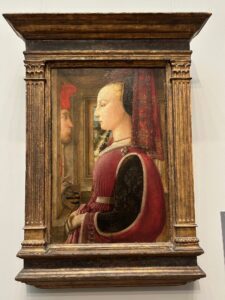
Because I’d written about some artworks in Life in Five Senses, I felt as though these were “mine” in some way, so I was relieved to see The Penitent Magdalen and The Harvesters. And Portrait of a Woman with a Man at a Casement, which always made me laugh.
I was thrilled to see that a series of Hubert Robert paintings had been moved from the first floor; my favorite is The Bathing Pool, and it’s much easier to examine it closely in this new spot.
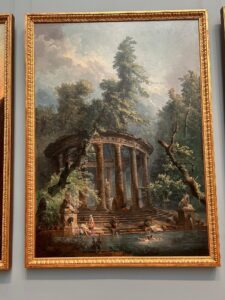
There were also many unfamiliar paintings, and it was exciting to have so much to see and explore. But it made me sad, too. I’d loved these rooms the way they were, and now I could never return to that previous configuration.
Each time I go to the Met, I think about how extraordinarily fortunate I am: to live within walking distance to the Met; to have the time, health, and freedom to visit; to be the beneficiary of so many people’s time, energy, money, learning, and genius; and to be in a place full of people from all over the world, who are enjoying beauty together in peaceful companionship. I never take the Met for granted.
And I no longer take any individual artwork for granted, either.
I never hurry past my beloved God Horus Protecting King Nectanebo II without stopping to look. One day, it may disappear—and even if something beautiful takes its place, nothing can replace those pure, stern lines.
Nothing gold can stay.

The post My Visits to the Met Reminded Me of This Profound Truth appeared first on Gretchen Rubin.
January 23, 2024
The Benefits of Looking Back and Looking Forward
For more than a decade, each year, I’ve been meeting with two friends to do a “look back/look forward” exercise.
Sometimes we break this exercise into two meetings; this year, we did both parts in the same meeting.
How do we conduct this “look back/look forward” exercise?
Meet in person, if possibleHave a pad of good paper and good markers at handBring look back/look forward pages from previous years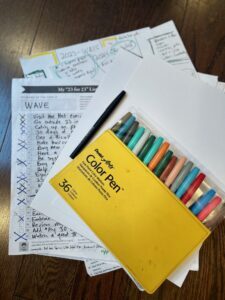
I find this exercise extraordinarily valuable, but if I’m being honest, I don’t think I’d do it on my own. It takes several hours, a lot of hard thinking and soul-searching; I’m not sure I’d carve out the time to do it year after year if I wasn’t doing it with friends. Accountability!
Because the three of us do it together, we don’t forget to do it, and we make time for it. Also, we take time to talk about our insights and observations, about ourselves and each other. That conversation is also extremely valuable.
Each of us does this exercise slightly differently, so I’ll describe how I do it.
For instance, I use this exercise to explore my work life. I note very important personal milestones, but for context, rather than to closely track what happened.
Look Back at 2023To do the “look back,” to jog my memory, I reviewed my “23 for 23” list and my digital calendar.
On one page of good paper, in separate boxes, I noted:
My one-word theme for the year: for 2023, “Wave”My annual challenge: #GoOutside23in23Personal milestones: such as celebrating my in-laws’ anniversary, giving the commencement address for my daughter’s high-school graduation, jury duty, Justice O’Connor’s deathTravel: both personal and work, including vacations and conferences
Most of my entries are related to creative projects I’ve worked on, so they each have their own box; for instance:
appPartnerships and collaborations
Some of my boxes are more idiosyncratic, for instance:
At the end of the “look back” half of this exercise, I always say, “Wow, I can’t believe everything that happened this year.”
Creating this kind of “ta-da” list is really valuable. I’ve found that I can become very focused on everything that I want to do in the future, or on the things that I’ve been struggling to accomplish.
I get very energized by reminding myself of all the things I have done.
Look Forward to 2024No surprise, my “look forward” is less specific and more aspirational.
For 2024, on another page of good paper, I included all the major categories that I used to “look back”—also my one-word theme of “Revisited” and challenge of #Write24in24—as well as categories such as:
Anniversaries: 2024 marks a milestone date for my marriage, my children’s literature reading groups, and The Happiness Project bookPaperback: the paperback of Life in Five SensesAdventures: My “24 for 24” list includes “Go on 2+4 adventures” so I have a box with possible adventuresAdmonitions: I wrote certain words in big letters, such as GROW ALL and CONVENE and WATERCOLORMajor to-dos: I listed items such as “Update my office” “New product”Big Goals: for instance, doing something for TV, writing occasionally for outside outlets, picture book Secrets of Adulthood : I want to make progress on this next big book project
Just as the “look back” helps remind me of what I’ve accomplished in the previous year, the “look forward” helps me articulate what I want to accomplish in the new year.
Putting it all on one page, in the briefest possible form, keeps this exercise manageable. It also means it’s easy to keep a file handy of all the previous years’ sheets.
I’m struck by how often a theme will repeat year after year before it finally gets resolved; on the other hand, sometimes a theme that seemed important at one point will vanish.
These pages give me a real feeling of both continuity and change—in my interests, values, strengths, and weaknesses.
How do you look back and look forward on your work life?
The post The Benefits of Looking Back and Looking Forward appeared first on Gretchen Rubin.