Gretchen Rubin's Blog, page 7
October 25, 2023
Spending With Purpose: Ramit Sethi on Using Your Money as a Tool for Happiness
We often hear that “Money can’t buy happiness,” and while it’s true that money can’t buy happiness, money can buy things that contribute mightily to happiness.
For one thing, money gives us freedom from worrying about money, which is certainly one of the greatest luxuries that money can buy.
We can use money to put our values out in the world—by giving to causes we believe in, and supporting our communities and the people we love.
We can buy experiences, because sometimes when we’re buying a thing, we’re also buying an experience: a bicycle, a camera, a plane ticket.
We can buy possessions that make our lives easier, richer, healthier, and that allow us to project our identity into our surroundings.
Money is tool. It can be used to support our happiness, or not, depending on our choices.
For aims relating to Mindful Investment—how we mindfully spend our time, money, and energy—it can be difficult to know where to start, and how to distill aims into concrete steps.
For the “money” part of the Mindful Investment equation, I wanted to talk to a finance expert, so I got in touch with my longtime friend Ramit Sethi.
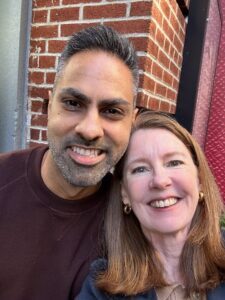
Ramit Sethi is a personal finance adviser, author of the New York Times bestseller I Will Teach You to Be Rich, and founder of GrowthLab and I Will Teach You To Be Rich.
I don’t even remember how Ramit and I first met. We’re interested in many of the same subjects; at some point, our paths crossed.
I was so happy for him when he recently hosted his own Nextflix series: How to Get Rich. Thrilling! Here’s the show: “Money holds power over us—but it doesn’t have to. Finance expert Ramit Sethi works with people across the U.S. to help them achieve their richest lives.”
One thing I admire about Ramit’s approach is that he’s very concrete, and he has a strong point of view. I couldn’t wait to talk to him about using money as a tool to help us make our lives happier, healthier, more productive, and more creative.
He had many ideas about specific, practical steps for people working toward Mindful Investment aims.
Gretchen: You talk a lot about cultivating a “rich life”—what is a “rich life?” How does it go beyond money and possessions?
Ramit: Your Rich Life might be traveling for 3 months per year. Or buying a beautiful cashmere coat. Or it might be picking up your children from school every afternoon.
Your Rich Life is yours! And yours will look very different from mine. That’s the beauty of designing your Rich Life like a painting—it will be personal and fit you like a glove.
At this point in my life, my Rich Life is traveling for 2-3 months per year, working with people I like and respect, and spending extravagantly on beautiful hotels and convenience while cutting costs on things like my 18-year-old car that I still drive.
Of the 10 categories of habit loopholes I’ve identified, which ones do you see people employing most often, in an unhelpful way, when it comes to their finances?
False choice loophole—or, “I can’t do this, because I’m so busy doing that.” With money, we say: “I don’t want to have to track how much I spend on carrots for the rest of my life” (you don’t).
Tomorrow loophole—or, “It’s okay to skip today, because I’m going to do this tomorrow.” With money, we say: “I’ll start investing later” and “My Rich Life is traveling once I retire” (even though we would never say “I’ll wait until I retire to start making friends”).
Lack of control loophole—or, “I can’t help myself.” With money, we say: “I’m not good at investing” (even though money is a skill we can learn).
You emphasize the value of automating finances. In the context of spending with purpose, is there room for spontaneity?
Automation gives us room to be spontaneous! For example, if I’ve set aside money for a vacation, I’ve added an extra 15% to account for unexpected things that come up. When I sit down for dinner, I’m not thinking about how much an extra appetizer costs—that’s already been saved for months before! If we decide to take a spontaneous food tour or even extend our trip, automation allows that to happen.
You talk a lot about setting up simple money systems and routines. What are some regular habits, practices, or “money rituals” you’ve heard of people using that reinforce mindful, intentional investing and spending?
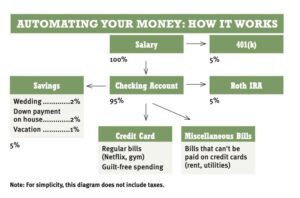
For people feeling overwhelmed by their finances, what’s one small, concrete step they could take today to address their situation?
There are 4 key numbers that really matter in your finances. You can come up with these in about 15 minutes and get 85% accuracy. Here they are:
By looking at your finances with this bird’s-eye view, you can see how you stack up. And then you can start to be intentional about where your money goes. You can use this template to make your tracking easier.
How might you approach spending, saving, and investing money in a way to achieve your aims for yourself? It’s an important question.
The post Spending With Purpose: Ramit Sethi on Using Your Money as a Tool for Happiness appeared first on Gretchen Rubin.


October 24, 2023
“Plants Are the New Pets” and Other Observations
For my growing collection of Secrets of Adulthood, in addition to writing my own original aphorisms, I’ve been amassing a hodgepodge of observations, proverbs, paradoxes, and sayings.
As we all know, orange is the new black, and pork is the new white meat. I’ve always loved this kind of observation, so I started making my own list of all my favorites.
Of course, many observations quickly become outdated. Brussels sprouts are no longer the new kale, but it’s still a funny idea to consider.
This kind of collection doesn’t have any great significance, but I do get a real happiness boost from finding new additions to my list. I take a magpie delight in collecting ideas that please me.
Here’s my current list:
September is the other January.
5:00 p.m is the new 7:00 p.m.
Sleep is the new sex.
Now is the real New Year.
Plants are the new pets.
Monday is the new Thursday.
Breakfast is the new lunch.
Ubiquity is the new exclusivity; exclusivity is the new ubiquity.
Bowls are the new plates.
“No” is the new “yes.”
Sitting is the new smoking.
Alcohol is the new cigarettes.
Marijuana is the new alcohol.
Self-expression is the new entertainment.
Friends are the new family.
Curiosity is the new genius.
January is the Monday of months.
August is the Sunday evening of the months.
Forties are the new thirties, and eleven is the new thirteen (age).
Survival is the new success.
Halloween is the new Christmas.
90% is the new perfect.
The kitchen is the new living room.
9:30 p.m. is the new midnight.
Brussels sprouts are the new kale.
JOMO (joy of missing out) is the new FOMO (fear of missing out).
Mindfulness is the new productivity.
Vintage is the new new.
Vulnerability is the new strength.
What would you add?
The post “Plants Are the New Pets” and Other Observations appeared first on Gretchen Rubin.
October 18, 2023
My 30 Days of Culture
One item on my “23 for ‘23” list was “30 Days of Culture.” Culture binge!
I aimed to attend thirty cultural events, for thirty straight days. It was challenging to figure out exactly when the thirty days should start, but I landed on September 5. (To me, the day after Labor Day always feels like the other January 1.)
I created a few rules for myself:
Discussion with a group counted as culture, so a networking dinner “counted”; also, a book-club meeting—I’m in three book clubs. (I didn’t count something like a lunch date or dinner with friends.)Engaging with people trumped watching a performance, so when I was invited to a book party that conflicted with a stand-up show for which I’d bought a ticket, I went to the book party.When I traveled, the count paused, and I traveled a lot in September, so my thirty days extended well into October.I could go alone or with others.
Spoiler alert: I LOVED IT. For so many reasons.
It nudged to do things that I wouldn’t ordinarily do, exposed me to culture that I would otherwise miss, gave me adventures, helped me draw closer to other people, and took me to places that I love.
For instance, I love a great indie bookstore, and the McNally-Jackson indies are among my very favorites—such great curation of titles, presented in such enticing ways. So for my 30 days, I looked for interesting book events (book-related culture is my favorite culture), and I checked the McNally-Jackson calendar.
My daughter Eliza has many thoughts about the brand Glossier, so I got us tickets to the event for Marisa Meltzer’s new book Glossy: Ambition, Beauty, and the Inside Story of Emily Weiss’s Glossier. I spent an evening with Eliza, I learned something about a new subject, I engaged in book culture, I visited one of my favorite parts of New York City.

Here are some things I learned:
When we look, we find. Because I had to identify thirty cultural events, I had to search for things to do—and it turns out that when I looked, I found many terrific events that I hadn’t heard about. I signed up for some newsletters, such as the 92NY newsletter, to help me hear about great events in the future. In the future, I’m going to pay more attention to listings.Things that can be done at any time are often done at no time. I’d been very eager to go to the immersive theater experience Sleep No More since the very day it opened, but somehow, I’d never gone. Eleanor and I went, and we loved it, and we want to go back.I could use someone else’s expertise. I wanted to go to the ballet—but which performance should I attend? A friend knows a lot about the ballet, so I consulted with her, and then we went together. Good things happen when we go outside. My apartment is bursting with culture—so many books, movies, TV shows, performances, lectures, discussions, all on my shelves or on my screens. But it’s different when I’m experiencing something in the company of other people.Living in an atmosphere of growth boosts happiness. When I’m learning, pondering, enjoying, or criticizing, culture gives me the feeling of growth that’s a key to a happier life.
Of course, I recognize that I’m enormously fortunate to have the money and the freedom to attend these events (some were free, some were inexpensive, some were very expensive). I’m thankful for that every time.
Also, I live in New York City, which has so much culture. How I love New York City! But here’s the thing: I don’t take advantage of that culture nearly as much as I want to.
One summer during college, when I lived in New York City for a few months, I saw a public-service poster on the #6 subway, and I’ve never forgotten it.
It was a black-and-white photograph of a container of Chinese food sitting on two white opaque cases of movies rented from Blockbuster. (This was back when people rented videotapes.) Underneath, the poster said, “If this is how you spend your time, why are you living in New York City?”
I’m haunted by this question. It reminds me how much I want to push myself to experience the treasures of my city and the world—not to just sit at home, even though that can also be a great experience.
I am where I am. I want to experience it for myself, in New York City, Kansas City, North Platte, or wherever I might be.
As I write about in Life in Five Senses, I had a similar realization about the Metropolitan Museum. It was right there, within walking distance of my apartment (yes, I realize how fortunate I am)—but I almost never went. Now I go every day to the Met, and that habit is one of the great joys of my life.
When I told a friend about “30 Days of Culture,” she laughed. “You and your projects,” she said. Very true! If something’s important to me, I do much better when I make it a habit or a specific project, with a structure, an expectation, and often, even a name. (Upholders, right?)
A person might ask, “In a world full of suffering and injustice, is it morally appropriate to spend time, energy, and money on culture?”—Meaning the kind of cultural experiences I sought for my thirty days.
But culture isn’t some bonus feature of human life. It’s an essential part of our existence.
Culture gives us our sense of identity and belonging; it helps us understand the past, present, and future; it helps us grasp different ways of acting, believing, and deciding; it gives us ways to make sense of our lives; it puts us in touch with transcendent ideals; it gives us the exquisite pleasures of ideas, beauty, story, music; it awakens us to our responsibilities as citizens of the world; it educates us…I could go on and on.
Next up for “24 for 24”: 30 Days of Policy. I want to attend lectures and panel discussions, watch documentaries, see exhibits that are related to policy. Send in your suggestions.
The post My 30 Days of Culture appeared first on Gretchen Rubin.
October 10, 2023
To Get Things Done, Consider Your Future-Self
There are two Gretchens.
I have myself at the present moment, and I have my future-self. I’ve found that it’s very, very helpful to keep this future-self in mind.
I stick to tasks and habits that I’d rather avoid in the present, because I’m mindful of how they’ll pay off in the future: “My future-self won’t want dental work, so I’d better floss now.” (As the old saying goes, “You don’t have to take care of all your teeth, just the ones you want to keep.”) “My future-self will be so happy if I take photos every day on this trip, I’ll remember all our adventures.”
In this way, thinking of future-Gretchen makes my life happier, healthier, more productive, and more creative.
In terms of my Four Tendencies personality framework, the thinking of the future-self is a tool that’s useful for all four Tendencies:
you can create accountability for any aim, without needing anyone else’s cooperation—particularly useful for Obligersyou remind yourself of the good or bad consequences that will follow from your actions or inactions—particularly useful for Rebelsyou remind yourself of the reasons that you’re doing something—particularly useful for Questionersyou remind yourself of the pain of letting yourself down or the satisfaction of accomplishment—particularly useful for Upholders
When deciding how to spend our time, energy, or money, thinking of our future-selves can help us to avoid feelings of regret and set ourselves up for feelings of satisfaction.
I can reflect on what regrets future-Gretchen may feel. Regret is an unpleasant emotion, but it’s helpful: because it’s so unpleasant, I want to do the things that will mean I won’t suffer it.
If I don’t exercise now, future-Gretchen will regret it, because she’ll be frail.If I don’t get my shingles vaccine now, future-Gretchen could get a terrible case of shingles.If I don’t wear my seat belt now, future-Gretchen could get seriously injured in a car accident that otherwise wouldn’t be very serious.If I don’t stay in close touch with my high-school friends now, future-Gretchen will feel lonelier.If I don’t take the trouble to upgrade my laptop now, future-Gretchen may have to deal with a crash.If I don’t make an effort to read widely now, future-Gretchen’s ideas will start to feel stale.If I don’t make an effort to give myself recess everyday, future-Gretchen may start to feel drained and overwhelmed.If I don’t buy plane tickets early, future-Gretchen will pay more and have fewer choices.
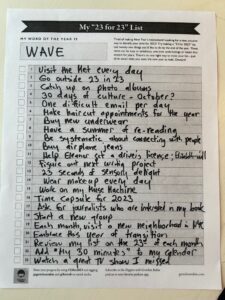
As part of my 23 for 2023 Trifecta, I made a list of 23 things that I want to accomplish in 2023. Future-Gretchen will feel a lot of regret if I don’t get a lot of those things done by December 31; they’re important to me. I need to take action now, for future-Gretchen’s benefit.
Also, if we’re stuck in analysis-paralysis or struggling to do something, regret can help us decide what aims to abandon. We can ask, “Will my future-self care if I do this—or not?” If future-Gretchen won’t feel any regret, probably now-Gretchen doesn’t need to worry about it.
Another strategy for using the regrets of our future-self to make ourselves happier? Conduct a pre-mortem. Imagine yourself in the future: You’ve failed to achieve an important aim. What went wrong? Why did you fail? What will your future-self wish that your now-self had done differently? I’ve done pre-mortems several times, and they’ve always helped me to take action in the present.
SatisfactionThe flip-side of regret is satisfaction.
I can also remind myself of how gratified future-Gretchen will feel with what now-Gretchen has done.
It’s easy to focus on the “to-do,” and it can be energizing to remind ourselves instead of the “ta-da”—how great our future-self will feel when we look back on how far we’ve come.
If I read twenty minutes each day now, future-Gretchen will finish many books by the end of the year, which feeds my creativity.If I take the time to clean out my office now, future-Gretchen will feel calmer and spend less time looking for misplaced items.If I follow the “Go Outside 23 in ’23” challenge, future-Gretchen will consistently spend time in nature this year, a source of energy and happiness.If I make lots of lunch plans now, future-Gretchen will feel more connected to old friends and have new friends.If I do a weekly Power Hour, future-Gretchen will feel the relief and satisfaction of crossing dreaded tasks off the list.If I keep a running list of gift ideas throughout the year, future-Gretchen will find gift-buying easy and fun at holiday time.
An interesting twist on using a “ta-da” approach to the future self? Write a letter of congratulations to your future-self, in which you praise future-you for all the specific steps successfully done to achieve a difficult aim. Visualizing the satisfaction of the victorious finish line may give you energy to persist—and to identify, with anticipatory hindsight (oxymoron alert!), the steps you took to achieve it.
How do you invoke your future-self to help your present-self to get things done? I’d love to hear more ideas and insights about how to use this concept to make our lives happier.
The post To Get Things Done, Consider Your Future-Self appeared first on Gretchen Rubin.
October 4, 2023
Want to Spend Your Time, Energy, and Money More Wisely?
When it comes to happiness, often we know what would make us happier, we just don’t do it. It’s not an identification problem, it’s an execution problem.
We know we’d be happier if we exercised, read more, yelled at our children less, got more sleep, volunteered…but somehow, those things don’t happen.
That’s why understanding the 21 strategies of habit change is so important. When we change our habits, we can change our lives.
Because I wrote a book about habit change, Better Than Before, I’ve had countless conversations with people about their habits. I’ve found that most habits and actions that people want to pursue fall into nine categories:
Energy: exercise and sleepProductivity: focus, work, progressRelationships: connect and deepenRecharging: relax and restOrder: clear and organizePurpose: reflect, identify, engageMindful Consumption: eating, drinking, spending, scrollingMindful Investment: save, support, experienceCreativity: learn, practice, play
“Mindful Investment” is one of the most interesting categories.
This category includes habits and actions related to the wise investment of our time, energy, and money. Are we spending those resources purposefully, in a way that reflects our values and support our long-term happiness?
Sometimes, a mindful investment requires a single action; sometimes, a consistent habit.
Some investments make our current lives better—buying an upgraded laptop, joining a monthly potluck dinner group with the new neighbors.
Some investments set us up for a better future—taking a weekly online course needed for a promotion, saving for a big trip.
Some investments relate to ourselves, such as investing money in a new bike, and others put our values out into the world, such as investing time in composting.
Some investments relate to things, such as buying a reading light, and others related to experiences, such as planning a day of rock-climbing. (Note that the line between “things” and “experiences” is often hard to draw—a reading light is a thing, but it’s really about the experience of reading.)
Other examples of mindful investment:
Upgrading a frequently-used toolInvesting in gear to support a hobbyVolunteering to support a causeSetting aside time to pursue an aimGiving yourself everyday luxuries and healthy treats—when we give more to ourselves, we can ask more of ourselvesTaking a classParticipating in a Freecycle groupSetting aside time to clear out crowded or cluttered areasPlanning a tripHaving a buy-nothing month
In my own life, I’ve found that if I don’t pay attention, I tend to drift away from mindful investment. For instance:
Money: I’m an under-buyer, so often I don’t buy things that would improve my work life or home life
Time: I’m focused on my to-do list, so I work on answering all my emails instead of doing the research I’ve been meaning to do, to figure out the best organizations to which to donate
Energy: I’m a homebody, so sometimes I miss opportunities to push myself to have the adventures that will energize me and enrich my life
So I often remind myself to invest my money, time, and energy wisely.
In writing my book Life in Five Senses, about exploring the world through my senses, I realized the importance of investing in my sensory surroundings. For instance, I bought earplugs to protect my ears from noise, I spent two days at “Flavor University” to train my sense of taste; I’ve been doing “Go Outside 23 in ’23” (spend 23 minutes outside every day in 2023). These mindful investments in my senses have made my life much richer.
As you think about your own aims for “mindful investment,” consider:
If, by the end of the year, you’d accomplished one thing, what’s the one accomplishment that would make the biggest difference to your happiness?Think big. What would you do if you had more time? More energy? More money?As you move through your ordinary routine, what people and activities energize you? What people and activities deplete your energy?What are some activities that take up your time, but aren’t particularly interesting or useful? Of all the work you do, what task would you most like to stop doing? Can you delegate it?What aspect of your life fills you with the most purpose?Imagine yourself five years from now, looking back on this time. What will your future-self wish you’d done now?Consider the items you use every day. Would upgrading any of these items improve your experience? Pay special attention to anything related to sleep and exercise—they’re very important for happiness, so worth the investment. Healthy treats and everyday luxuries make us happier and boost our feeling of self-command. What are your healthy treats?Is there a skill you’ve always wanted to learn, for work or for fun?Could you make a small investment that would unlock a big benefit? For instance, if you bought an outdoor chair, you could have coffee on your porch; if you bought some graphic-design software, you could do better work on a creative project.What values are important to you, and how might you use your time, energy, or money to support them? For instance, you could donate money to a voter-registration organization, and volunteer your time to help register people get registered.
If we want to make our lives happier, healthier, more productive, and more creative, it’s crucial to spend our time, energy, and money wisely.
The post Want to Spend Your Time, Energy, and Money More Wisely? appeared first on Gretchen Rubin.
October 3, 2023
Finding Outer Order in Your Digital Life: Tips from Bublup CEO Alain Cohen
Alain Cohen is the CEO and co-founder of Bublup, a digital organizational platform that provides a simple solution to digital clutter. Before Bublup, Alain’s business ventures included co-founding Cobro Ventures and, later, OPNET Technologies, which he led through its IPO and eventual sale to Riverbed Technologies. As an electrical engineer, computer scientist, and software designer, he holds more than sixty issued or pending patents.
I couldn’t wait to talk to Alain about virtual clutter, organizational habits, and living happier digital lives.
Q: You’ve talked about how each of your entrepreneurial successes (OPNET, Cobro, and now Bublup) arose from finding solutions to problems that you experienced first-hand. What problem did you set out to solve with Bublup and how did the idea come about?
Invention and creation continue to motivate me.
After selling OPNET Technologies in 2014, I was already thinking of my next idea. With my background in electrical engineering and technology, I’m constantly on my phone or computer. I started to realize that the tools that I’m using aren’t connected to each other and found myself using different web browsers, search engines and other digital tools, but it all felt disjointed.
Our stuff is a collection of local and cloud-based documents, emails, to-dos, bookmarks to related sites and topics, and discussions with others on that topic. I wanted to see all that in one place—not scattered, not fragmented, but easily accessible in a nice visual manner. Clutter aside, this was an important problem to solve—i.e., to organize all my content in one place.
That sparked creating a platform to address a fundamental problem that not only I was having, but many others were looking to solve.
Q: Most of us have experienced physical clutter — papers, mementos , clothes we no longer wear, etc. What is digital clutter , and why is it so challenging to tackle?
Digital clutter is the accumulation of disorganized digital content—whether that be files, folders, emails, documents, notes, links, or other digital information scattered on our devices, mobile and desktop. Like clutter in your home, digital clutter slows you down and can add to frustration and stress.
It’s challenging to tackle because it never stops! In today’s age, we generate and receive a massive amount of content daily. Managing and organizing the sheer volume of information can be overwhelming. Also, the interconnected nature of our digital content, involving multiple devices, platforms, and services, complicates matters further. And, of course, sorting through and organizing our digital stuff is a daunting challenge that takes time. Time we often don’t have.
Q: What have you found to be some of the most common problem areas when it comes to difficult-to-organize digital clutter? What are 3-5 tips practical tips you can share that people can use starting today?
Addressing digital clutter requires a commitment to start fresh. While a set of new practices will enable you to get a handle on your stuff, it’s important to remember that organization is an ongoing process, so I also suggest that you use tools that make this process easier. Here are a few problem areas that I’ve encountered and a few practical tips :
Scattered content: Many of us have files and folders scattered in various places, with unclear naming conventions. First, create a centralized folder system and clear descriptive folder names, avoiding catch-all’s like “Introduction” or “Must-do’s.” Too many tabs: I have seen friends afraid of rebooting their machines because they have tens, if not hundreds, of tabs open and lots of stuff on their desktop! That’s one of the reasons I founded Bublup as a content management platform that allows you to save your tabs (bookmarks) along with other documents all in one place. Duplicative tools: Use a single note-taking app or platform to consolidate your activity and avoid wasting time switching from one to the nextOverflowing inbox: An inbox filled with unread emails and a mix of personal and work-related messages can be overwhelming. Create filters or rules to automatically categorize them. For example, Bublup lets you send and store relevant emails in project folders, along with your other documents so you can automatically file incoming emails in the same place as your project stuff.Offline access: Make sure you’re able to access your important stuff even when you are offline. Photo overload: You will thank yourself later if you take the time to organize your photos today into folders by date, event, or category. Consider using a photo storage app that offers organization and sharing.Weekly clean-up: Set aside time to review and delete unnecessary email, content, and to-do lists. These should be short but effective periods of time where the sole focus is to declutter and organize. Be ruthless!
Q: Over the years, one of the most common questions that I’ve been asked when it comes to organization and clutter is how to deal with photos and keepsakes. It can be tricky to consider getting rid of items that have sentimental value. How can digital tools help?
I agree! Just like we hold onto physical mementos for sentimental reasons, we do the same with digital photos. Our sentimental attachment to photos can make it really difficult to delete or organize, and can also lead to procrastination and digital hoarding.
This is one of the reasons I developed Bublup. I needed a way to organize photos and videos so that I can find them easily. With automatic backup and synchronization, it’s easy to upload your photos and videos without even thinking about it. Physical photos can also be scanned and added right next to your digital photos, letting you declutter your junk drawer at the same time!
Q: I find that for most people, outer order leads to inner calm. Have you found that to be true in your experience? Any examples you can share?
Absolutely. Just consider how much better it feels to walk into a clean and tidy room vs one in disarray. The same applies to our digital lives: clutter on your computer or phone can make you feel frustrated and scattered.
For example, when the files on my desktop start to pile up, or I keep opening more and more browser tabs while working, I find myself task-switching and wasting time, leading to the exact opposite of inner calm. Digital clutter can be digital chaos!
I find that when my outer world is in order, it provides calm because there’s nothing distracting me from what I need to focus on.
Q: What digital clutter challenges do you see as most universal – affecting all of us regardless of age or tech savviness? Are there any skills or tools you think everyone needs to manage their digital lives?
When your digital content is scattered and fragmented, it takes a mental toll every time you have trouble finding something you saved somewhere.
One of the easiest ways to manage your digital life, regardless of age or comfort level with tech, is to find a simple tool where you can house everything in folders that are visual and easy to organize. That’s the beauty of technology. Bublup is handy because you can save any type of digital content in one place. That means you don’t need separate apps for notes, bookmarking, and photos. It gives you one place to safely store everything you need.
Q: For those overwhelmed by digital clutter, what’s the best place to start? Should they tackle files first, emails, photos? What’s the minimum effort that can lead to a big impact?
The best place to start is where you need the most “help.” Tackle the biggest problem first. For example, if you have 60 browser tabs open that you’re saving for later, start there. If your inbox gives you anxiety every time you see that giant unread number, t start there.
I think people will find that once they get the ball rolling, they’ll instantly feel a weight lift from their shoulders. That sense of satisfaction will motivate them to continue to work at it and stay on top of their clutter and soon a feeling of accomplishment will follow.
Disclaimer: This is a sponsored post in partnership with Bublup. I only endorse products or tools that I think are useful, fun, or interesting.
The post Finding Outer Order in Your Digital Life: Tips from Bublup CEO Alain Cohen appeared first on Gretchen Rubin.
September 14, 2023
Quick, Easy Ways to Build Friendships
Ancient philosophers and contemporary scientists agree: strong relationships are a key—perhaps the key—to a happy life.
But one of the most common challenges of adulthood is making and maintaining friendships. Friendships take time and energy, which can be in short supply, and it can be hard to meet new people if you move to a new city or a new job.
As you consider ways to connect, there’s one important principle to keep in mind: Lower the bar!
Many people think, “Well, if I can’t do ____, it’s not worth doing anything.” No. Small gestures can do a lot.
Frequent contact, even fleeting, is better than infrequent contact. Call, or if you don’t want to call, send an email. If you don’t want to send an email, send a text. If you don’t want to write a text, send a photo with a few words, such as “thought of you” “can you believe it?” “last year at this time.” Whenever I see someone mentioned in the press, or I come across an old photo of them in my phone, or I see an article that I think would interest them, I send a text. It’s very effective to let the world remind you to get in touch with a friend.
Also, some contact, even infrequent contact, is better than no contact. Having a 90-minute dinner with a friend I haven’t seen in two years is enough to re-ignite our friendship.
Sometimes we feel uncomfortable reaching out: “This person will think I’m weird for getting in touch after we haven’t talked for nearly two years.”
In fact, research shows, we underestimate how much people will welcome attempts to reconnect. Humans are social creatures; we value connection; we appreciate people’s efforts; and we feel good when we know that someone is interested in us.
Here are some ideas to start or strengthen a friendship:
Text a friend you haven’t been in touch with recentlyEmail a former co-worker to ask how they’re doingWrite a postcardWrite a “This article/book/TV show made me think of you” noteExpress gratitude to someoneBuy a surprise small gift for someone in your lifeDo a good deed for someone in your life—set up a blind date, make a useful introduction, lend a handMake a list of three friends you want to connect withMake a list of three acquaintances you’d like to have a deeper relationship withSet up an “errand date” with a friend or neighborUse a regular activity—walking, gardening, laundry—as time to catch up over the phoneSend a care packageSearch today’s date in your phone’s camera app and share a memory with a friendAsk someone for a book/TV show/podcast recommendationSchedule regular times to catch up with friends—put it on the calendarChoose an activity to do with a friend—take up a hobby, watch a TV show, read a bookSend a fun photo or update to a long-distance friendTell someone your favorite jokeGive someone a warm hello or goodbyeIf there’s an activity you do regularly—go to the gym, take your dog to the dog park, go to the office—try to do it at the same time every day, so you see the same people; it can be a great way to make friendsTake a few minutes to chat with a neighbor or co-workerFollow someone’s recommendation, and tell them your response—a co-worker recommends a movie, so you watch it and tell that person what you thought
I recently wrote down all the people I’ve been meaning to get in touch with. I plan to work my way down the list.
Click here to download the Happier app.
app.
I love aphorisms, and among my favorites are William Blake’s “Proverbs of Hell” from The Marriage of Heaven and Hell. He writes: “The bird a nest, the spider a web, man friendship.” Humans are among the most social creatures on the planet. We thrive on connection.
Or to put it another way, when I was in kindergarten, we sang a song with the line, “Make new friends, but keep the old. One is silver, the other is gold.” Friendships are a vital part of a happy life, so it’s worth our effort and energy to keep them strong.
The post Quick, Easy Ways to Build Friendships appeared first on Gretchen Rubin.
August 31, 2023
What Changes to Your Routine Might Make Your Work Life Happier?
This year, in the United States, Labor Day falls on September 4, and for many of us, that holiday signals the post-summer return to the regular routine of work and school. Even though autumn doesn’t really start until September 23, Labor Day marks the shift from “end of summer” to “beginning of fall.”
The holiday offers an opportunity to reflect on our relationship to our own “labor”—whether paid or unpaid. We can re-examine our routines and focus on our aims.
What does a happier Labor Day look like for you? If you’re looking for ways to make your work life happier, healthier, more productive, and more creative, consider these suggestions:
Deepen your work relationships. Could you turn a work acquaintance into a friend? Could you repair any strained relationships? Could you re-connect a work friend whom you haven’t seen in a while?
Improve your tools. Work is easier when we have good tools. Do you need a new laptop, updated software, better headphones? Even something as simple as a better pen can make a difference. I love my extra monitors; they save me so much time and effort.
Tailor your surroundings to suit yourself. Figure out if you need more light, a better chair, less noise, etc. If you’re feeling overwhelmed by clutter, my book Outer Order, Inner Calm has dozens of suggestions for easy ways to create order.
Create a list of healthy treats to give you a boost of energy or cheer when you need it. Listening to new music, playing Wordle, taking a quick walk outside…what works for you?
Cultivate an atmosphere of growth. We’re happier when we’re growing, so learn a new skill, challenge yourself to do something intimidating (such as public speaking), or start a side hustle.
Acknowledge your preferences. Are you a finisher or opener? Marathoner or sprinter? Morning person or night person? Abundance-lover or simplicity-lover? Abstainer or moderator? Try to adjust your schedule and surroundings to suit yourself, as much as possible. Because I know I’m a morning person, I schedule all my most difficult tasks first thing in the day.
Use tracking tools. We manage what we monitor, so to make progress, consider tools that will help you maintain momentum. You might try the Happier app, a physical journal like the Don’t Break the Chain Habit Tracker, or a worksheet.
Tackle digital clutter and distractions. Unsubscribe from unwanted newsletters, write any emails you can draft in less than a minute, delete unneeded messages, delete unused apps.
Schedule a weekend Power Hour to stay on top of personal chores and errands. Little by little, we can get a lot accomplished.
In the tumult of everyday life, it can be hard to step back to ask, “What changes might make my work life easier? How might my habits or routines improve?”
By using Labor Day as a catalyst for reflection, we can spot opportunities to change our work lives for the better.
The post What Changes to Your Routine Might Make Your Work Life Happier? appeared first on Gretchen Rubin.
August 29, 2023
Ask Us Anything: Elizabeth and I Answer Questions About Writing
In episode 438 of the Happier with Gretchen Rubin podcast, Elizabeth and I answered listener questions about writing in an “Ask Us Anything.” Here are some highlights:
How does writing a novel differ from writing TV? Is doing one preparation for doing the other, or are they really different?
Elizabeth: They’re very different, very challenging in different ways. Writing a novel right now feels harder, because I haven’t done it as often as I write TV. It’s a lot of fun, but I find it extremely intimidating, because I think it’s hard to keep someone’s attention. It feels like a big responsibility.
Writing TV is all about using as few words as possible, being brief. In novel writing, you can use a lot of words, and I wonder “How am I going to fill up all these pages?” Then I find myself overwriting, and I have to go back and cut.
In television, everything has to be in dialogue, whereas in a novel, you can really get into the interior monologue, which I love.
And also, one thing that’s fun about writing a novel is that you don’t have to think about the cost. Something can explode, you can have five hundred characters, you can travel the world, because it all costs the same amount to print the page. When we’re writing TV, we spend so much time thinking about production.
Do you sit at your desk at a prescribed writing time even if you don’t have a clear idea of what you’ll write?
Gretchen: Yes, I do. If I don’t know what I’m going to write, I’ll putter around with something. I’ve always got a lot of stuff to write.
Elizabeth: I don’t, but I probably should. When I’m working, I have so many things to do that writing gets fit in wherever I can. That’s part of what I struggle with writing the novel, I don’t have these prescribed times.
How do you restart a project that’s been languishing for a while?
Gretchen: I would say: Get back into it. Set aside some time every day. Use all your habit-formation strategies to make consistent time for it. Read through the whole thing without editing it, and figure out how you want to start engaging. Do you want to pick up and start writing again? Do you want to start at the beginning and edit?
This could be a situation where “It’s not a bug, it’s a feature.” If they can, many writers will put something away for six months, so that when they come back to it, they’ll have a fresh eye. In the end, it might benefit your creative project that you have a bit of distance from it.
What tips do you have for solo writers who need inspiration, collaboration, accountability, and just plain help to keep going or get through a rough patch?
Gretchen: Both of us are big fans of being in writers’ groups, but this to me sounds like a straight-up accountability problem. Unfurl the list of accountability strategies, use the Happier app, the Don’t Break the Chain Habit Tracker—there are lots of tools you can use once you realize you need external accountability.
Elizabeth: And the ultimate accountability: Take an online writing class where you have to turn stuff in. Most of us want to be good students.
How do you take your work from a single idea into a full fleshed-out piece?
Elizabeth: That’s the million-dollar question. For me, because I work with a partner, it’s a lot of talking. We go from an idea, to notes for a pitch, to a pitch, to an outline. We’ll talk about a scene and go off and write the outline for that scene, taking turns, and then go to script. It’s a long, many-step process, and I think it’s similar for the novel as well.
Gretchen: For me, often I’ll have an idea or a question I want to answer, and I always start with the research. Tons of reading and note-taking, often throwing spaghetti against the wall: anything that appeals to me, anything that strikes my interest, anything that surprises me. I take a lot of notes that never end up paying off, because they represent dead-ends. At a certain point, I’ll know the subject well enough to have a theory—for instance, with with habit-formation.
And there’s the problem of the structure, which is always very difficult to figure out. If you look at any of my books, you might think I just picked the most obvious structure, but every time, it was months of labor–and then I’ll realize I need to do more research. Then there’s often a huge amount of cutting. For my book Life in Five Senses, I cut out probably three times as much finished material as what appears in the book. People often ignore that part when talking about writing: a lot of it is cutting.
How do you approach writing about a personal experience that close friends or family might be offended by?
Elizabeth: One thing I know people do is change more than the name. Change other details—job, gender, where the person lives—so that you really can’t tell who it is. That person, depending on the story, still might recognize themselves. You have to ask yourself, “Am I okay with this?”
Writers feel very differently about this. Some people feel, “This is my lived experience and I’m going to write what I want to write,” and other people will show someone a chapter of their book and ask if they’re okay with publishing it. It really comes down to your personal philosophy.
More questions I’m often asked:
What’s my process for taking notes?
How does a person become a published author?
The post Ask Us Anything: Elizabeth and I Answer Questions About Writing appeared first on Gretchen Rubin.
August 24, 2023
Surprising Insights from the Five-Senses Quiz
Do you love to listen to music, but don’t care much about how things smell? Are you a real foodie, but don’t pay much attention to the texture of clothes?
I’m the rare person who rarely listens to music and doesn’t care much about food. But I have a giant collection of perfume samplers, and I visit the Metropolitan Museum every day.
When I was working on my book Life in Five Senses, I became intrigued by how each of us lives in our own sensory world. For one thing, most of us have a special appreciation for one or two of the five senses, and we also tend to neglect one or two of the senses.
With an appreciated sense, we pay attention; we seek new experiences; we enjoy talking and learning about that sense; we turn to it for comfort and pleasure; we use it to connect with other people.
With a neglected sense, we’re much less interested; we rarely turn to it for pleasure or comfort, we don’t spend time exploring or cultivating it. We may be more concerned with avoiding the negative than appreciating the positive.
It can be hard to know ourselves, so to help people (including myself), identify their most neglected sense, I created a free, short quiz: “What’s Your Most Neglected Sense?”
I’ve been fascinated to see the results.
Now, to be sure, these results aren’t scientifically valid. Selection bias! Nevertheless, nearly 50,000 people have taken the quiz, and it’s interesting to consider the patterns in the answers.
When I was developing the quiz for my “Four Tendencies” personality framework, to tell people whether they’re Upholders, Questioners, Obligers, or Rebels, from my observation of the world, I expected that many people would be Obligers and many fewer would be Rebels. This pattern was exactly reflected in the scientifically-validated results.
But with the “Neglected Sense” quiz, my initial hypothesis was wrong. I expected to see one or two senses in the lead as “most neglected.” (I guessed smelling and touching.)
Also, I figured that almost no one would get the result of “seeing.” In humans, the visual system is the most highly developed and occupies the most real estate in the brain. When a conflict arises among the senses, seeing usually trumps. So I thought that no one would neglect seeing.
Wrong! The answers are distributed surprisingly evenly.
One explanation for that result, I discovered, is that people might use a particular sense quite often, for utilitarian purposes, yet nevertheless—or perhaps because of that—they neglect that sense as a source of pleasure, comfort, engagement, or interest.
As one Hollywood producer told me, “I spend my whole day watching and editing. When I come home, I want to lie down, close my eyes, and listen to music.”
Also, I found, some people deliberately neglect a particularly sense. For instance, for some people, particular smells can trigger migraines or allergic reactions, so they avoid smelling as much as possible. Once we recognize that pattern, however, it’s often possible to find ways to tap into the neglected sense in ways that don’t cause problems. I heard from some quiz-takers:
When my result told me that I neglected my sense of smelling, I wasn’t surprised. I have bad allergies and most smells “tickle” my nose. Now I’m making an effort to appreciate the smells that don’t bother me, such as the smells of the ocean or food cooking. It’s such a joy.
I took the Neglected Senses quiz and wasn’t surprised when my result was taste. I have celiac disease which means that I have to avoid gluten while eating and follow strict rules around food-preparation areas and cross-contact. Since my diagnosis I’ve noticed that food, eating, and taste come with a measure of anxiety and stress for me. I’m excited to try to find ways to enhance my experience with taste. I love thinking about enjoying the senses within the limitations of health and/or finding those sensory experiences that can help us appreciate the senses that might feel limiting, etc.
I’m often overwhelmed loud, overlapping, high-pitched, or discordant noises. I think I neglect my hearing on purpose because focusing on it is overwhelming. I want to reclaim my hearing by appreciating the sound of silence, the soft sounds of nature, or wind chimes which I enjoy.
When I looked at the quiz results for the most appreciated sense, however, I found that a few senses dominated. Hearing and tasting clinched the top spots, but not by very much. As for me, those two senses are my most neglected senses—which is probably one reason I wanted to write Life in Five Senses! I could see that people were enjoying the world more than I was.
This revelation underscores a central theme of my book: We each live in a brew of our own sensations.
So here’s a challenge: This week, find ways to engage more fully with your most neglected sense. Click here to take the quiz.
The post Surprising Insights from the Five-Senses Quiz appeared first on Gretchen Rubin.