Anndy Lian's Blog, page 90
February 12, 2023
Binance Adds ZK-SNARKs to Improve Privacy of Proof of Reserves Report
Anndy Lian | Inter-Governmental Blockchain Adviser | Book Author | Investor | Board Member | Singapore
Binance Adds ZK-SNARKs to Improve Privacy of Proof of Reserves Report
 In BriefBinance introduces zk-SNARKs into Proof of Reserves to prove changes to user asset balances with greater anonymity.The exchange is also adding SHIB, DOT, CHZ, and SOL to the assets covered in future reports.Crypto VC Nic Carter suggests the zk-SNARKs add significant privacy value to Proof of Reserves reports, but reports must be backed by other regulations related to an exchange’s fidcuiary duties.
Binance announced that it would introduce zero-knowledge proofs to improve the quality of its Proof of Reserves report.
Zk-SNARKs will allow Binance users to securely and privately confirm nonnegative balances and changes of balances using information from its proof of reserves Merkle tree.
Binance Makes Progress in PoR Roadmap, But Auditors Are MissingAs part of the announcement, Binance said it added SHIB, DOT, CHZ, and SOL to the assets covered by its proof of reserves report. Additionally, the exchange will open-source the zk-SNARKs code to improve transparency and to help other exchanges improve their reporting. Binance has yet to reveal the frequency of forthcoming reports.
Zk-SNARKs, an abbreviation of zero-knowledge succinct on-interactive arguments of knowledge, confirms a statement’s truth without revealing any information about the statement.
The zk-SNARK will verify that each user’s asset balance set is part of a global state of user funds Binance maintains. Additionally, it will anonymously ensure that the user’s net balance is not negative by including collateral posted for margin trading. Customers can use zk-SNARKs to verify that the Merkle root hash in Binance’s Merkle tree reflects asset balance changes. The Merkle root hash is essentially a cryptographic summary of all user balances. Changes to a user’s asset balances will prompt an update of the Merkle root hash, which the zk-SNARK will confirm.
Binance’s addition of zk-SNARKs is the last step in a transparency roadmap outlined at the end of November 2022. Part of its roadmap involved securing the services of a third-party auditor to audit its proof-of-reserves. This initiative has been jeopardized by the exit of accounting firm Mazars from the crypto space. Mazars was the accounting firm that conducted an agreed-upon procedure for the exchange’s first proof-of-reserves report.Crypto VC Says Zero-Knowledge Proofs Only One Part of the PuzzleWhile the technical implementations of PoRs vary, crypto VC Nic Carter expects zero-knowledge methods to supersede the technical limitations of traditional Merkle tree reports.
However, while zk-SNARKs represent an important step in the right direction for the world’s largest exchange, it is still only one part of a broader toolkit that can prevent collapses like FTX. Blockchain expert Anndy Lian agreed, saying that while not perfect, zk-SNARKs provide a “big enhancement.”
According to Carter, exchanges need additional rules to segregate corporate and user assets and protect customer assets from bankruptcy. Additionally, U.S. lawmakers must create a viable market for accounting firms to invest in tools to oversee PoR attestations. Doing so would also encourage offshore exchanges to conduct PoR reports.
Because audits are expensive and done quarterly, Carter suggests that they accompany, rather than replace, more frequent PoR reports, which provide updated customer reassurances.
Source: https://beincrypto.com/binance-adds-zk-snarks-proof-of-reserves-report/

The post Binance Adds ZK-SNARKs to Improve Privacy of Proof of Reserves Report appeared first on Anndy Lian | Inter-Governmental Blockchain Adviser | Book Author | Investor | Board Member | Singapore by Anndy Lian.


February 7, 2023
Op-ed: What can we see in web4 that we’re missing in web3?
Anndy Lian | Inter-Governmental Blockchain Adviser | Book Author | Investor | Board Member | Singapore
Op-ed: What can we see in web4 that we’re missing in web3?
The more I speak and advise on crypto and blockchain matters, the more I think there is a gap between what decentralization is and reality. I do not doubt the feasibility of decentralization; I am just not sure if the current version of Web3 is decentralized enough. Maybe we are what everyone is saying, “we are merely in Web 2.5.”
Let’s begin.
WWWWWW stands for World Wide Web. It is a system of interconnected documents and other resources linked by hyperlinks and URLs. The World Wide Web is a way to access information over the internet; it is not the internet itself.
It was created by Sir Tim Berners-Lee in 1989 while working at CERN (the European Organization for Nuclear Research) in Switzerland. The World Wide Web is built on the internet, allowing users to access and share information through various platforms, such as web browsers, mobile apps, and other software.
It is based on HTTP (Hypertext Transfer Protocol) and HTML (Hypertext Markup Language), which allows for creating documents containing text, images, videos, and other multimedia content. The World Wide Web is constantly evolving, and new technologies are being developed to improve user experience, security, and accessibility.
Web1Web 1.0 refers to the first generation of the World Wide Web, primarily focused on providing static, read-only content to users. This phase of the web began in the 1990s and lasted until around the early 2000s.
Web 1.0 websites were typically simple, text-based pages with limited graphics and few interactive features. Individuals or organizations created and maintained them and were primarily used for sharing information, such as personal profiles, news articles, and research papers. Navigation was often limited to simple text links, and no search engines could help users find the information they needed.
Web 1.0 was characterized by its lack of interactivity and user-generated content. Users were mainly passive information consumers and could not interact with the web pages, leave comments, submit forms, upload files, and so on.
Web 1.0 was also limited in terms of accessibility, as many users were still using slow internet connections and older browsers that could not handle more advanced web technologies. As a result, web pages were often simple and limited in design.
In summary, Web 1.0 was the first phase of the World Wide Web. It was a time when the internet was still young, and the web was mainly used to share information, but with limited interactivity and user-generated content.
Web2Web 2.0 refers to the second generation of the World Wide Web, which emerged in the early 2000s. It is characterized by the emergence of user-generated content, social media, and the ability for users to interact and collaborate online.
Web 2.0 technologies include social networking sites, blogs, wikis, and video-sharing sites, which allow users to create and share their content, rather than simply consuming content created by others. These technologies also allow for greater collaboration and communication among users, increased accessibility, and the ability to share and access information from various devices.
Web 2.0 sites are more dynamic and interactive than their Web 1.0 counterparts. They include features such as comments, ratings, and the ability to share and promote content across multiple platforms. They also use advanced technologies such as AJAX, which allows for more responsive and interactive interfaces, and rich media, such as videos and images.
Web 2.0 also brought the concept of “crowdsourcing,” which was the idea of leveraging the collective knowledge of the internet to create and improve content.
In summary, Web 2.0 is the second generation of the World Wide Web, it emerged in the early 2000s, and it’s characterized by the emergence of user-generated content, social media and the ability for users to interact and collaborate online. Web 2.0 sites are more dynamic, interactive, and collaborative than their Web 1.0 counterparts.
Web3Web3, also known as Web 3.0, is the next evolution of the World Wide Web, characterized by the use of decentralized technologies, such as blockchain and smart contracts, to enable new forms of online interaction and commerce.
Unlike the current web, which is primarily controlled by centralized entities such as corporations and governments, the vision for web3 is to create a decentralized, open, and transparent network where users have more control over their data and online interactions. This includes using decentralized apps (dApps) and interacting with decentralized finance (DeFi) platforms, among other things.
Web4Web4 is not a widely used term nor a consensus definition, so it may refer to different things depending on the context. However, some people use the term “Web4” to refer to the next generation of the World Wide Web, which would be even more decentralized and more focused on artificial intelligence, the semantic web, and the internet of things, among other things.
It would be characterized by more dynamic, autonomous, and interconnected systems that can learn from data, communicate with each other and adapt to changing environments. This would allow for more dynamic and adaptable systems that can learn from data and improve over time.
Some of the advantages of a more decentralized web include the following:
Greater security and privacy, as users have more control over their data and online interactionsMore open and transparent systems, as there is no central point of control or failureGreater resilience and robustness, as the network can continue to function even if parts of it failMore innovation and competition, as there are fewer barriers to entry for new playersWeb4 is seen as the next evolution of the World Wide Web, building upon the decentralized technologies of Web3. In Web4, the user experience is streamlined and frictionless, with the underlying technical details abstracted away. This means that users won’t need to worry about the specific blockchain being used, the intricacies of ZK-Rollups, or setting the correct gas limit for transactions. The gas wars and transaction fees of the current web3 will be a thing of the past.
Moreover, Web4 has the potential to create a circular crypto-economy that transcends physical and digital boundaries, making the need for fiat on and off ramps obsolete. This would be a significant disruption in the current financial system.
There are other interpretations of what Web4 could be, such as the “symbiotic web,” which refers to a symbiotic relationship between humans and machines, possibly even utilizing direct brain-machine interfaces.
Overall, the transition from Web1 to Web2, and now from Web3 to Web4, is similar in that it is a gradual process that opens new doors and invites more people to participate. While Web3 is still in its early stages and considered experimental, Web4 is expected to be more accessible and user-friendly, making it more widely adopted by the general public.
Where are the opportunities?Web 4.0 offers a wealth of possibilities for companies and individuals. The symbiotic web will create more personalized experiences, allowing businesses to understand their customers better and provide tailored content.
AI-powered automation will improve efficiency, speed up time to market, and lower costs, giving businesses a competitive edge and better customer service.
The combination of hardware, software, and data will enable the development of new products and services, such as connected devices interacting with users and gathering data for personalization.
Web 4.0 also creates new revenue streams using data collected, like targeted advertising or subscription services.
Additionally, VR and AR applications will allow for new ways for businesses to engage with customers, for example, creating an AR application that allows customers to interact with products in a 3D space.
I will elaborate on this further below.
In summary, what do I see in Web4?1) Industry 4.0 full automationIndustry 4.0 full automation uses advanced technologies such as IoT, AI, robotics, and digital twins to automate industrial processes fully. This results in increased efficiency, reduced costs, and improved product quality, leading to a fully autonomous and connected smart factory. The concept of Industry 4.0 is focused on creating a highly automated and digitized production environment. To be fully autonomous, web4 adds a layer of trust.
2) Decentralised sustainable metaverse + AR + VRCombining a decentralized sustainable metaverse, AR, VR, and Web4 technologies creates a new dimension of the internet where users can experience a fully immersive and interactive virtual world. The decentralized aspect ensures that users have control over their data, and the virtual world operates sustainably.
AR and VR technologies enhance the experience by allowing users to interact with the virtual world more realistically and engagingly. Web4, also known as the Semantic Web, provides a decentralized and intelligent web infrastructure, enabling the metaverse to function seamlessly and intelligently. Together, these technologies create a new and exciting virtual experience accessible to many users.
3) AI making steps into the decentralized realmAI is making steps into the decentralized realm with Web4 by enabling the creation of decentralized AI systems that operate on a peer-to-peer network. This combination of AI and Web4 technology allows for the creation of decentralized and autonomous systems that can perform complex tasks without a central authority.
4) Real decentralized apps and economiesThis allows for creation of new business models and economic opportunities where transactions are secure, transparent, and tamper-proof. With Web4, dApps can be built and deployed on a decentralized network, providing users with greater control over their data and the ability to interact with the dApp in a secure and decentralized manner. This integration of Web4 in the decentralized app and economy development has the potential to create new and exciting opportunities for businesses and consumers alike.
5) Real power back to the usersThis was briefly mentioned above. Web4 technology aims to give real power back to users by creating a decentralized and secure network where users have control over their data. With Web4, applications can be built and deployed on a decentralized network, allowing users to interact with the application in a secure and decentralized manner. This eliminates the need for a central authority, giving users greater control and autonomy over their data and interactions.
Additionally, the decentralized aspect of Web4 enhances the security and privacy of user data, reducing the risk of data breaches and providing users with greater control over their personal information. By giving power back to users, Web4 has the potential to revolutionize the way we interact with technology and the internet.
Web5 and JackIn 2022, Jack Dorsey, the former CEO of Twitter, emerged as a leading figure in the development of Web5. He shared his vision for the next generation of the internet at the Consensus crypto and blockchain conference. Dorsey’s team at TBD, the Bitcoin-focused division of his fintech company Block (formerly known as Square), supports him in this endeavor.
According to Dorsey, Web5 is a solution to his issues with Web3, particularly his belief that it will never fully achieve decentralization.
“You don’t own ‘Web3.’ The [venture capitalists] and their [limited partners] do,” Dorsey said in a tweet, referring to the billions being poured into Web3. “It will never escape their incentives. It’s ultimately a centralized entity with a different label.”
“Know what you’re getting into,” he warned.
I do agree with Jack on this. The current practitioners often say that we are still in web2.5 is the same. It is not because we are not ready. We did not start this whole web3 era in the right foot and with the right decentralization model.
Ending noteYes, it’s important to note that true decentralization is a core principle of a decentralized economy. This means that no central authority or intermediary is controlling or managing the network or its transactions. I have repeated this many times in my article. Instead, power and control is distributed among the network’s participants, and decisions are made through consensus mechanisms such as voting or proof of work.
Decentralization ensures that the network is resistant to censorship, fraud, and other malicious activities and that its users have complete control over their assets. While this is still in an ideation stage and frankly somewhat idealistic, perhaps Web4 is the chance for us to redefine decentralization, reform and improve decentralization, and revalue the true meaning behind decentralization. I will speak at the TMRW Conference in Dubai from 8-10 February 2023 on Web4. I hope to take this chance to speak to all the tech experts at the venue too.
Source: https://cryptoslate.com/op-ed-what-can-we-see-in-web4-that-were-missing-in-web3/

The post Op-ed: What can we see in web4 that we’re missing in web3? appeared first on Anndy Lian | Inter-Governmental Blockchain Adviser | Book Author | Investor | Board Member | Singapore by Anndy Lian.
Playing Safe With India’s New VDA Tax Rules With Anndy Lian
Anndy Lian | Inter-Governmental Blockchain Adviser | Book Author | Investor | Board Member | Singapore
Playing Safe With India’s New VDA Tax Rules With Anndy Lian

Anndy Lian, book author of NFT: From Zero to Hero commented on India’s VDA rules.
India’s new tax rules for cryptocurrencies were introduced in the 2021 Union Budget and are known as the Voluntary Disclosure of Income Scheme (VDIS) rules. The rules require individuals who own cryptocurrencies to disclose their crypto holdings and pay taxes on any capital gains they may have earned. According to the new rules, if an individual has held cryptocurrencies for less than 36 months, any profits they make from selling the cryptocurrencies will be considered short-term capital gains and will be taxed at the individual’s marginal tax rate. If the individual has held the cryptocurrencies for more than 36 months, the profits will be considered long-term capital gains and will be taxed at a rate of 20% with indexation benefits.
Additionally, the new tax rules require individuals to pay taxes on any cryptocurrency income that is not from capital gains, such as mining or staking rewards. This income will be taxed as per the individual’s marginal tax rate.
The new tax rules are aimed at bringing greater transparency to the cryptocurrency market in India and ensuring that individuals who own cryptocurrencies pay the taxes owed on their crypto-related income.
Anndy’s humble advice is “Use regulated exchange and pay your taxes in India.”
Anndy continues to talk about ZK-rollups.
ZK-rollups (ZK-rollups) are a solution to scalability problems faced by many Ethereum developers. They allow faster and cheaper transactions on the Ethereum network while maintaining the security and decentralization of the blockchain. By aggregating multiple transactions into a single compressed transaction, ZK-rollups can significantly reduce the burden on the Ethereum network and increase overall efficiency in the system. The value of such a tool for the cryptocurrency industry is that it greatly reduces the cost of processing data, without compromising the security or decentralization that makes the monetary network unique.
The application of ZK technology allows blockchain networks to prove its authenticity of its operations in the most efficient way using the fewest possible steps. This has the power to be a transformational tool for Web3 development. In 2021, ZK-rollups are expected to be a major area of focus and growth.
Artificial intelligence (AI) is also a field that is gaining significant attention and investment globally, including in India. Web3 and blockchain technology have the potential to solve productivity issues with AI by creating a more secure and decentralized environment for AI data and models. In a traditional centralized setting, there are often concerns about privacy and security of sensitive AI data and models, as well as issues around data ownership and control. However, these issues can be addressed through greater transparency, security, and accountability in the AI ecosystem if the blockchain technology and web3 are used.
For example, AI models can be trained on decentralized data sources, and the ownership and control of the data can be managed through blockchain-based smart contracts. Additionally, web3 and blockchain can help create a more equitable distribution of rewards for AI model contributors, which can drive greater collaboration and innovation in the field.
The post Playing Safe With India’s New VDA Tax Rules With Anndy Lian appeared first on Anndy Lian | Inter-Governmental Blockchain Adviser | Book Author | Investor | Board Member | Singapore by Anndy Lian.
Understanding Blockchain Industry Intricacies With Anndy Lian
Anndy Lian | Inter-Governmental Blockchain Adviser | Book Author | Investor | Board Member | Singapore
Understanding Blockchain Industry Intricacies With Anndy Lian

The NFT (Non-Fungible Token) market has been growing in recent months, with a surge in sales observed in December 2022 and January 2023. The speaker has invited a special guest, Mr. Anndy Lian, to discuss the NFT sector and related events in the market. Mr. Lian is an author of “NFT: From Hero to Zero” and an intergovernmental advisor to the Mongolian government.
The speaker asks Mr. Lian about his thoughts on the cryptocurrency market, to which Mr. Lian responds that the market is in a healthier state with better physical policies around the world, and this is a positive for the crypto industry. He believes that the recent events like FTX implosion have helped to flush out bad actors, and the NFT market has picked up. Transactions made on Ethereum for NFTs have grown, and other chains like Polygon are also doing well, with traditional companies supporting them. Mr. Lian believes that the low-price strategy of Polygon is going to work well in the NFT space, and the market is going to grow as the NFT sector continues to develop.
The speaker then asks Mr. Lian about the liquidity tools and web3 infrastructure for NFT markets and whether they are being developed to stabilize the NFT markets and drive growth. Mr. Lian responds by saying that he thinks there is a lot of work being done in this area and it is an ongoing process. However, he believes that the low cost blockchain providers such as Polygon are getting traction and they are an important factor in driving the NFT markets.
The post Understanding Blockchain Industry Intricacies With Anndy Lian appeared first on Anndy Lian | Inter-Governmental Blockchain Adviser | Book Author | Investor | Board Member | Singapore by Anndy Lian.
India: Use Tax Compliant Platform To Comply With Budget
Anndy Lian | Inter-Governmental Blockchain Adviser | Book Author | Investor | Board Member | Singapore
India: Use Tax Compliant Platform To Comply With Budget

Union Budget 2023 had to offer very little for virtual digital assets (VDA) sector. In fact, the Finance Minister carefully avoided even mentioning about the VDA. However, the industry players took it in stride by acknowledging the fact that they need to abide by the current dispensation. They have advised using tax compliant platform while are hopeful of rise in Web3 & Crypto adoption.
The recent budget has brought gains from overseas cryptocurrencies / VDA under the tax purview. Non abidance of which invites Rs 10 lakh penalty or seven year imprisonment.
“I think the adoption of Web3 and crypto has grown a lot in India. But pertaining to this with the VDA industry, stakeholders are kind of disappointed by the Finance minister not mentioning the sector in her Union budget speech on 1st of February,” said Anndy Lian, Author & advisor for the Mongolian Productivity Organization.
While providing a perspective from across the border and being a staunch advocate of cryptocurrency, Lian believes that the budget 2023 has established its priority towards tax collection.
“I would just want to say that don’t try to avoid TDS by using offshore. You may be penalized as per section 271C of the income tax Act if you are investing in a Crypto,” Lian warned adding that, “Try to use a tax compliant platform, again the words used are fairly ambiguous”.
Similar views were aired by other experts tracking VDA sector.
According to a recent analysis, India’s cumulative trade volume in VDA changed by INR 32,000 crore between February and October 2022. “We expected that in the 2023 budget, the government would t alter VDA taxation, thereby reducing tax burden and eliminating uncertainties. But sadly we are still holding last years baby!,” says Raj Kapoor, founder, India Blockchain Alliance.
He went on to add that VDA taxes impact both residents and non-residents. Without a clear set of criteria to identify when NRs in India become subject to taxation, it has now become critical to understand the status of VDAs, especially when they are exchanged via or sold to Indian citizens. Clear standards in this sector are required to clear the air and promote international investment.
Joining the bandwagon in support of VDA traders is Tax Expert, Sonu Jain, who says “Many Indian users were purchasing crypto assets using International Credit cards or funds transfer. This will now reduce significantly since the TCS has been increased to 20%.”
Concerned by the tax imposition, Jain said, “So every funds transfer under LRS will be leviable to 20% TCS. For example, If a user wishes to buy crypto worth ₹100, then ₹20 will have to be paid as TCS.” This will significantly reduce direct International crypto purchases by Indians..
India assumed the presidency of the G20 summit, and there are hopes with regards to the country moving towards a more favorable ecosystem for crypto in general. Most importantly, India has started 450 web3 startups with an average inflow of 1.3 billion dollars in 2022 according to DYDX foundation. According to media reports there are over 75,000 blockchain employees working in India, raking 3rd in the global list of employers.

The post India: Use Tax Compliant Platform To Comply With Budget appeared first on Anndy Lian | Inter-Governmental Blockchain Adviser | Book Author | Investor | Board Member | Singapore by Anndy Lian.
February 5, 2023
The Future starts Tomorrow – Everything about NFT, Metaverse and Web3
Anndy Lian | Inter-Governmental Blockchain Adviser | Book Author | Investor | Board Member | Singapore
The Future starts Tomorrow – Everything about NFT, Metaverse and Web3
NFTs (Non-Fungible Tokens) are unique digital assets that use blockchain technology to prove their ownership and authenticity. NFTs can represent a wide range of digital content such as images, videos, audio files, virtual real estate, and more. They cannot be duplicated or divided, as each NFT is unique and represents a one-of-a-kind item.
The metaverse refers to a virtual universe or a collective space where users can interact with each other and with virtual objects, often in the form of computer-generated graphics and simulations. The metaverse is often seen as a decentralized and immersive alternative to the traditional internet, and NFTs play a crucial role in representing and transferring ownership of virtual assets within it.
Web3 refers to the next generation of the internet, where users have more control over their data and online identity. Web3 technologies, such as blockchain, aim to create a more decentralized, secure, and user-centric internet, where users can interact and transact without intermediaries. The metaverse is often seen as a crucial component of the web3 vision, as it provides a space for users to interact and transact using Web3 technologies.
I have mentioned the following during the event:
In 2023, there are several financial trends and challenges that people should pay attention to:
Interest rates: Interest rates are likely to remain low, which could have an impact on investments and the housing market. Defi could come back in the later part of the year as a form of hedge to the high interest rate.
Inflation: With the ongoing global economic recovery and increasing demand for goods and services, there is the potential for inflation to rise, which could affect the purchasing power of consumers.
Digital currencies: Digital currencies, such as Bitcoin and Ethereum, are likely to continue to gain popularity, and they may pose both risks and opportunities for investors. It’s important to understand the technology and the market before investing thoroughly. On the one hand, cryptocurrencies are often seen as a hedge against inflation, as they are decentralized and not controlled by a central authority. In times of high inflation, some investors may see cryptocurrencies as a safe haven for their wealth, which can drive up demand and increase the value of cryptocurrencies.
Environmental, Social, and Governance (ESG) Investing: ESG investing is becoming increasingly popular as people become more conscious of the impact their investments are having on the environment and society. This trend is likely to continue in 2023, and there will be opportunities for investors to put their money into companies that align with their values. We may see “green bitcoins” as a popular thing, or crypto with renewable/ alternative properties would be popular.
Emerging markets: Emerging markets eg Kenya, for example. are likely to present significant investment opportunities in 2023, particularly in areas such as technology, infrastructure, and consumer goods. I see gaming and the metaverse a big thing in emerging markets.
It’s important to keep in mind that these trends and challenges are subject to change based on global economic and political events, and it’s essential to consult with a financial advisor and thoroughly conduct research before making any investment decisions.
More insights can be found on the recording.
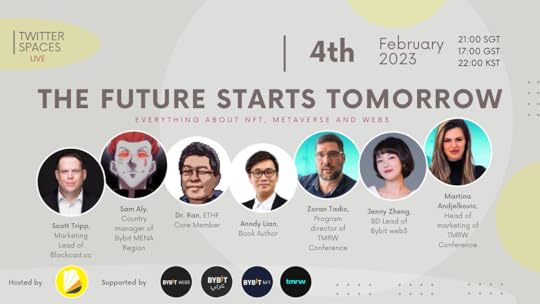
This event was organise on 4th Feb. 2023 21:00pm SGT (17:00pm Dubai Local Time)
Hosted by:
Tomorrow Conference (https://twitter.com/tmrwconf) and
Blockcast.cc (https://twitter.com/Blockcastcc)
Co-Host:
Bybit NFT (https://twitter.com/Bybit_NFT)
Bybit Web 3(https://twitter.com/Bybit_Web3)
Bybit MENA (https://twitter.com/BybitArabic)
Moderator:
Scott Tripp, Marketing Lead of Blockcast.cc
Guests:
Sam Aly, Country manager of Bybit MENA Region
Zoran Tadic, Program director of TMRW Conference
Martina Andjelkovic, Head of marketing of TMRW Conference
Jenny Zheng, BD Lead of Bybit web3
Dr. Ran, ETHF Core Member
Anndy Lian, Book Author of NFT: From Zero to Hero
To conclude, NFTs, metaverse, and web3 are interconnected concepts that together represent a vision for a decentralized, immersive, and user-centric digital world where ownership, authenticity, and interaction can be managed in new ways.
Listen to the event on Spotify: https://open.spotify.com/episode/7IeL6eHqNaruFjD1RPbUlJ
The post The Future starts Tomorrow – Everything about NFT, Metaverse and Web3 appeared first on Anndy Lian | Inter-Governmental Blockchain Adviser | Book Author | Investor | Board Member | Singapore by Anndy Lian.
February 2, 2023
Yahoo Finance: Donald Trump helps Polygon NFTs outsell Ethereum on OpenSea exchange for second month
Anndy Lian | Inter-Governmental Blockchain Adviser | Book Author | Investor | Board Member | Singapore
Yahoo Finance: Donald Trump helps Polygon NFTs outsell Ethereum on OpenSea exchange for second month

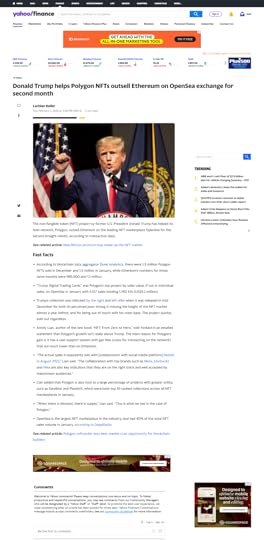
The non-fungible token (NFT) project by former U.S. President Donald Trump has helped its host network, Polygon, outsell Ethereum on the leading NFT marketplace OpenSea for the second straight month, according to transaction data.
Fast factsAccording to blockchain data aggregator Dune Analytics, there were 1.3 million Polygon NFTs sold in December and 1.5 million in January, while Ethereum’s numbers for those same months were 995,000 and 1.1 million.“Trump Digital Trading Cards” was Polygon’s top project by sales value, if not in individual sales, on OpenSea in January with 5,517 sales totaling 1,760 Eth (US$9.2 million).Trump’s collection was ridiculed by the right and left alike when it was released in mid-December for both its perceived poor timing in missing the height of the NFT market almost a year before, and for being out of touch with his voter base. The project quickly sold out regardless.Anndy Lian, author of the new book “NFT: From Zero to Hero,” told Forkast in an emailed statement that Polygon’s growth isn’t really about Trump. The main reason for Polygon’s gain is it has a vast support system with gas fees (costs for transacting on the network) that are much lower than on Ethereum.“The actual spike in popularity was with [collaboration with social media platform] Reddit in August 2022,” Lian said. “The collaboration with top brands such as Meta, Starbucks and Nike are also key indicators that they are on the right track and well accepted by mainstream audiences.”Lian added that Polygon is also host to a large percentage of projects with greater utility, such as Sandbox and PlanetIX, which were both top 10 ranked collections across all NFT marketplaces in January.“When there is demand, there is supply,” Lian said. “This is what we see in the case of Polygon.”OpenSea is the largest NFT marketplace in the industry, and had 40% of the total NFT sales volume in January, according to DappRadar.
Source: https://finance.yahoo.com/news/donald-trump-helps-polygon-nfts-060422995.html
The post Yahoo Finance: Donald Trump helps Polygon NFTs outsell Ethereum on OpenSea exchange for second month appeared first on Anndy Lian | Inter-Governmental Blockchain Adviser | Book Author | Investor | Board Member | Singapore by Anndy Lian.
Donald Trump helps Polygon NFTs outsell Ethereum on OpenSea exchange for second month
Anndy Lian | Inter-Governmental Blockchain Adviser | Book Author | Investor | Board Member | Singapore
Donald Trump helps Polygon NFTs outsell Ethereum on OpenSea exchange for second month
The non-fungible token (NFT) project by former U.S. President Donald Trump has helped its host network, Polygon, outsell Ethereum on the leading NFT marketplace OpenSea for the second straight month, according to transaction data.
Fast factsAccording to blockchain data aggregator Dune Analytics, there were 1.3 million Polygon NFTs sold in December and 1.5 million in January, while Ethereum’s numbers for those same months were 995,000 and 1.1 million.“Trump Digital Trading Cards” was Polygon’s top project by sales value, if not in individual sales, on OpenSea in January with 5,517 sales totaling 1,760 Eth (US$9.2 million).Trump’s collection was ridiculed by the right and left alike when it was released in mid-December for both its perceived poor timing in missing the height of the NFT market almost a year before, and for being out of touch with his voter base. The project quickly sold out regardless.Anndy Lian, author of the new book “NFT: From Zero to Hero,” told Forkast in an emailed statement that Polygon’s growth isn’t really about Trump. The main reason for Polygon’s gain is it has a vast support system with gas fees (costs for transacting on the network) that are much lower than on Ethereum.“The actual spike in popularity was with [collaboration with social media platform] Reddit in August 2022,” Lian said. “The collaboration with top brands such as Meta, Starbucks and Nike are also key indicators that they are on the right track and well accepted by mainstream audiences.”Lian added that Polygon is also host to a large percentage of projects with greater utility, such as Sandbox and PlanetIX, which were both top 10 ranked collections across all NFT marketplaces in January.“When there is demand, there is supply,” Lian said. “This is what we see in the case of Polygon.”OpenSea is the largest NFT marketplace in the industry, and had 40% of the total NFT sales volume in January, according to DappRadar.
Source: https://forkast.news/headlines/donald-trump-polygon-nft-ethereum-opensea/

The post Donald Trump helps Polygon NFTs outsell Ethereum on OpenSea exchange for second month appeared first on Anndy Lian | Inter-Governmental Blockchain Adviser | Book Author | Investor | Board Member | Singapore by Anndy Lian.
February 1, 2023
Anndy Lian Spoke at Kenya National Innovation Agency Webinar Series: Redecentralise, Revalue & Reform Blockchain businesses in 2023
Anndy Lian | Inter-Governmental Blockchain Adviser | Book Author | Investor | Board Member | Singapore
Anndy Lian Spoke at Kenya National Innovation Agency Webinar Series: Redecentralise, Revalue & Reform Blockchain businesses in 2023
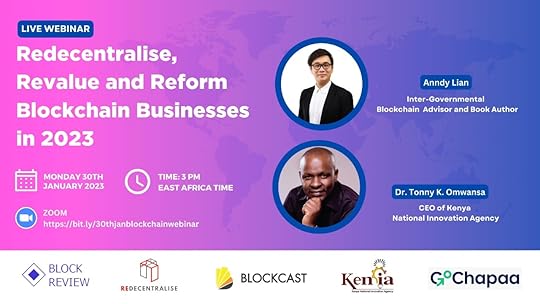
Kenya National Innovation Agency (KENIA) is the leading innovation organisation in Kenya. Dr Tonny Omwansa, CEO of KENIA hosted Anndy Lian to their Webinar Series. The topic is “Redecentralise, Revalue & Reform Blockchain businesses in 2023”.
In 2023, the blockchain business is expected to continue its growth and evolution. The widespread adoption of blockchain technology is likely to drive innovation in various industries such as finance, supply chain management, digital identity, and more. Decentralized finance (DeFi) is predicted to gain more traction, with more people investing in cryptocurrencies and decentralized platforms. The use of blockchain for secure and transparent voting systems is also expected to gain more attention.
Challenges such as scalability, interoperability, and regulatory issues still remain. Nevertheless, as the technology matures, it is likely that solutions to these challenges will emerge, further driving the growth of the blockchain business.
Anndy Lian shared that adopting blockchain technology in a business supply chain can bring numerous benefits such as improved transparency, enhanced security, reduced costs, and increased efficiency.
Here are some steps to follow when adopting blockchain technology in a business supply chain:
Identify the problem: The first step is to identify the pain points in the current supply chain and determine how blockchain technology can be used to address them.
Conduct a feasibility study: A feasibility study should be conducted to determine the potential benefits and costs of adopting blockchain technology in the supply chain.
Choose the right platform: Select a blockchain platform that is suitable for your business needs and that supports the features and functions required for your supply chain.
Develop a pilot project: Develop a small-scale pilot project to test the feasibility and effectiveness of the proposed solution.
Implement the solution: Implement the blockchain solution in the supply chain by integrating it with existing systems and processes.
Monitor and evaluate: Monitor and evaluate the performance of the solution and make adjustments as needed.
Expand the solution: Once the solution has been proven to be effective, expand it to the rest of the supply chain.
Continuously improve: Continuously monitor and evaluate the solution and make improvements as necessary to ensure its ongoing success.
Anndy Lian added: “It’s important to work with experts in blockchain technology to ensure a successful implementation. A well-designed and properly implemented blockchain solution can bring significant benefits to a business supply chain, making it more efficient, secure, and transparent.”
Dr Tonny concluded that blockchain innovation continues to drive new and exciting developments in the technology and its applications, offering new opportunities for businesses and individuals alike.
Dr. Tonny K. Omwansa is also the founding Director of the C4DLab, University of Nairobi’s Innovation Hub. He is also the founder and chairman of the Nairobi Innovation Week which brings numerous stakeholders shaping Kenya’s Innovation Ecosystem. He lecturers at the School of Computing and Informatics, University of Nairobi in Kenya and is the co-author of “Money, Real Quick: Kenya’s disruptive mobile money innovation”.
He holds a PhD in Information Systems in which he researched on the adoption of mobile financial services at the base of the pyramid in Kenya. Besides consultancy services in technology and innovation issues, he is very active in research and capacity building. His research interests are in the design, adoption and impact of innovative low-cost and appropriate technologies in developing countries.
Anndy Lian is a well-rounded business strategist based in Asia. He offers advice across multiple industries for both local and international companies, as well as public listed corporations and governments. With early involvement in the blockchain space, Lian is a seasoned entrepreneur, author, investor, board member, and keynote speaker.
His latest publication, “NFT: From Zero to Hero,” is a guide for anyone eager to explore the potential of NFTs. The book encourages readers to embrace the limitless possibilities of this new technology and to become “heroes” in their own right by taking advantage of its early stages. “NFT: From Zero to Hero” can be purchased on Amazon and Bybit, with over 8,000 copies sold.
In 2022, Lian received an Hon Doctoral Degree from Ulaanbaatar Erdem University, in recognition of his contribution to the advancement of productivity science in Mongolia.
This event is organised by Kenya National Innovation Agency (KENIA). And supported by Block Review, Redecentralise, Blockcast.cc and GoChapaa.
The post Anndy Lian Spoke at Kenya National Innovation Agency Webinar Series: Redecentralise, Revalue & Reform Blockchain businesses in 2023 appeared first on Anndy Lian | Inter-Governmental Blockchain Adviser | Book Author | Investor | Board Member | Singapore by Anndy Lian.
Web4, a vision of an intelligent, decentralised web
Anndy Lian | Inter-Governmental Blockchain Adviser | Book Author | Investor | Board Member | Singapore
Web4, a vision of an intelligent, decentralised web
 AI and the Symbiotic Web are key technologies that will drive the development of Web4, the next generation of the World Wide Web
Web4, also known as Web 4.0, is a term used to describe the next generation of the World Wide Web. It is a vision of an intelligent, decentralised web that is more secure, private, and equitable than the current web.
Web4 is built on the following key principles:
Decentralisation: power and decision-making are distributed among multiple participants rather than being centralised with a few large tech companies.Interoperability: devices and services can work together seamlessly, regardless of their underlying technology.Self-sovereignty: users have control over their data and identities and are able to use them across different services without the need for a central authority.Privacy: users’ data is protected and kept private, rather than being collected and sold by companies.Transparency: users are aware of how their data is being used and have the ability to control it.Web4 aims to provide a more secure and private web, where users have more control over their data and how it’s used. It also aims to create a more equitable web, where access to information and services is not limited by wealth or location.
Web4 is still a concept, and many experts believe that it is still in the development stage. Some of the technologies that are being developed to make Web4 a reality include blockchain, peer-to-peer networks, and decentralised AI.
The Symbiotic WebThe Symbiotic Web is a concept that envisions a decentralised and distributed web where users have more control over their data and privacy. The idea is to create a web where users can share their data with other users or services in a secure and mutually beneficial way rather than having their data controlled by a central authority.
The Symbiotic Web is based on the idea of a web of relationships between users, devices, and services, where each participant has their own autonomy and agency. The goal of the Symbiotic Web is to create a web that is more resilient, secure, and fair for everyone by giving users more control over their data and how it is used.
The Symbiotic Web is built on several key principles, including:
Decentralisation: power and decision-making are distributed among multiple participantsInteroperability: devices and services can work together seamlesslySelf-sovereignty: users have control over their data and identitiesPrivacy: users’ data is protected and kept privateTransparency: users are aware of how their data is being usedAI and the Symbiotic WebTo me, Web4 and the Symbiotic Web are relatively new concepts, and they are closely interlinked in many ways.
The Symbiotic Web is a concept that envisions a decentralised and distributed web where users have more control over their data and privacy. The idea is that users can share their data with other users or services on the web in a secure and mutually beneficial way.
Artificial intelligence (AI) can play a role in achieving decentralisation in the Symbiotic Web by allowing for more sophisticated and decentralised decision-making. For example, AI algorithms can be used to analyse and make decisions on data shared by multiple users in a decentralised network without the need for a central authority.
One way that AI and the Symbiotic Web can work together is through the use of decentralised AI models. These models are trained on decentralised data and can be shared and used by multiple users in the network. This allows for more accurate and personalised AI services while also maintaining user privacy and control over their data.
Another way is through the use of decentralised AI protocols. These protocols allow users to share and collaborate on AI models and data in a decentralised network without the need for a central authority. This can lead to more accurate and robust AI models, as well as more equitable access to AI services for all users.
Final thoughtsAI and the Symbiotic Web are considered to be key technologies that are driving the development of Web4, the next generation of the World Wide Web.
AI has the potential to enable more sophisticated and decentralised decision-making on the Symbiotic Web by allowing for the analysis of data shared by multiple users in a decentralised network without the need for a central authority. This can lead to more accurate and personalised services while also maintaining user privacy and control over their data.
Source: https://e27.co/web4-a-vision-of-an-intelligent-decentralised-web-20230130/

The post Web4, a vision of an intelligent, decentralised web appeared first on Anndy Lian | Inter-Governmental Blockchain Adviser | Book Author | Investor | Board Member | Singapore by Anndy Lian.