David B. Williams's Blog, page 18
May 16, 2013
Official National Rock
As usual, Gail Collins has written a fine editorial today but for perhaps the first time she addresses a key issue to geologists: an official national rock. Here is what she wrote. ”The United States has a few of these items, like a bird and an anthem, but there’s plenty of territory to cover. The president could demand that Congress pick an official national rock. Committees could hold hearings about the relative merits of slate and granite. Senate Minority Leader Mitch McConnell would threaten to filibuster unless his colleagues considered coal. But, in the end, I believe everybody would rally around a grand compromise for marble. And the country would feel much, much better.
Baby steps. Then we can get to the debt ceiling.”
Personally I favor limestone, at least from a building stone point of view. As I have written before, the Salem Limestone from Indiana is the most widely used building stone in the USA, particularly in official buildings such as court houses and post offices. It is rock that everyone would have the chance to see.
I could also see focusing on another favorite of mine, the Morton Gneiss. It, too, is widely used, plus it is part of the original craton of what is now the North American craton, thus an original American rock.
Or what about the puddingstone of Boston. One could compare it to the United States in that the puddingstone is a conglomerate made of diverse bits of pieces, which together give it its distinctive look.
In contrast, corporate interests might favor marble for its use in places of power, such as board rooms and elegant offices; salt, because of the salt domes rich in oil and gas; or shale and its new found prominence due to fracking.
Slate also can make a claim, at least an historic one. For many years, it as ubiquitous as plastic, finding use in billiard-table beds, steps and risers, wainscoting, moldings, lintels, laundry tubs, cisterns, urinals, blackboards, headstones, counter tops, brewer’s vats, greenhouse shelves, chimney tops, switch boards, and panels for electric work, to name just a handful of its many uses. It can also make a claim for the geologic term most used in our language. We wipe the slate clean or start over with a clean slate. We refer to a tabula rasa, literally a scraped tablet, but more often defined as a clean slate. We vote for one of a slate of candidates. We are slated to do something and those who had a debt were formerly said to be on the slate.
Any thoughts? And, should we have an Official National Stone?


April 25, 2013
Naturalist Walk in Seattle
This Sunday, one of Seattle’s great natural historians, Arthur Lee Jacobson, is leading a walking tour titled “Old Trees of Seattle.” It should be a wonderful tour as Arthur Lee knows more about Seattle’s plants than anybody, has a great historical feel for the local fauna, and has strong opinions about those plants. The walk will run from 10am to noon. Go to Arthur Lee’s web site to sign up.
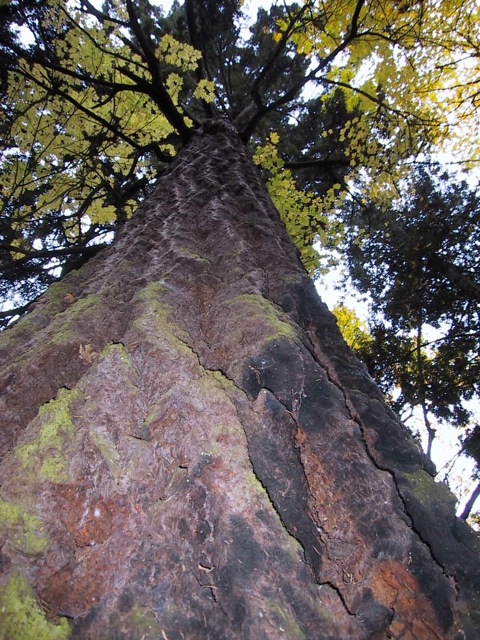
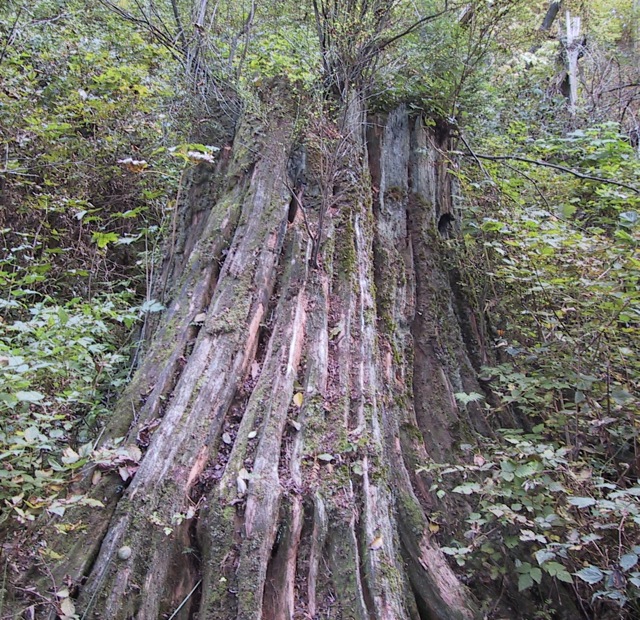
Below are photos of two of my favorite big Seattle trees and one big old stump. The trees are a Garry Oak and a Douglas Fir. The stump was a Western Red Cedar.

April 22, 2013
Best Cairns Video
A pal sent me this outstanding video that stars two animated cairns. It’s from the German short film Das Rad. It’s about 8 minutes long and is somewhat surreal. The movie was nominated for an Academy Award in 2002 for Animated Short Film. It really shows the potential for cairns as movie stars, though I recognize that if it hasn’t happened in the 10 plus years since the release of the film, it probably won’t happen. But I can always hope. Enjoy.
Das Rad Video
April 12, 2013
Sea of Galilee Cairn
The big news in the world of cairns, which as you can imagine is truly mind-boggling in scale, scope, and power, is the discovery of the giant cairn found at the bottom of the Sea of Galilee. Archaelogists report (International Journal of Nautical Archaeology Vol 42, pg. 189-193, March 2013) that the pile of basalt cobbles and boulders has a diameter of 230 feet and rises more than 30 feet off the floor of the lake (the sea is actually a lake, in fact the lowest freshwater lake on Earth). The “Monumental Structure” was found in 2003 during a detailed mapping of the lake’s bottom morphology. With boulders up to a meter long, the rock pile provides good habitat for Tilapia fish. Other possibly similarly aged structures are found nearby in the water, though not enough research has been done to determine if they date from the same time.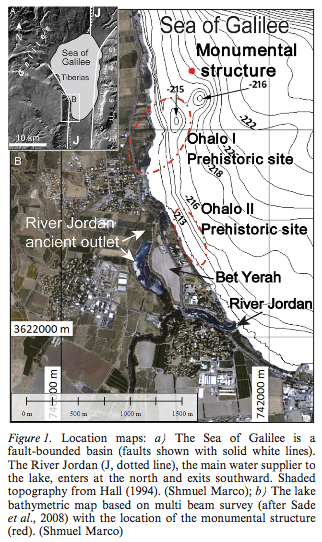 Archaeologists offer several interpretations for the cairn. The first, and the one I like best, is that it was built underwater to attract fish. Other similar structures described as fish nurseries occur throughout the Sea of Galilee, though they are smaller. It is also possible that it was built on land and that either rising water or a lowered ground surface, due to tectonics, lead to cairn’s present subaqueous location. There is evidence for the latter from a 23,000-old-site that apparently was buried during rapid subsidence. I like this theory, too.

Dating the structure is also challenging. People did live in the area between the 4th and 1st centuries BCE, with active building of megalithic structures over the first 1,000 years of that era. These include stone circles, menhirs and dolmens, now found in the Jordan Valley. Archaeologists hope that further study will shed light on the cairn.
Pretty cool story.
April 11, 2013
Operation Mother Goose
Today is the 45th anniversary of an unusual experiment. On April 11, 1968, biologists working in cooperation with the Washington state Department of Game and the U.S. Bureau of Sport Fisheries and Wildlife collected 1,200 Canada goose eggs. Their goal was to use the eggs to build up the populations of these birds, which had been on a steady decline for years. They were successful, particularly so in the Puget Sound lowland, and they may be the source population for the thousands of Canada geese living year in the area now.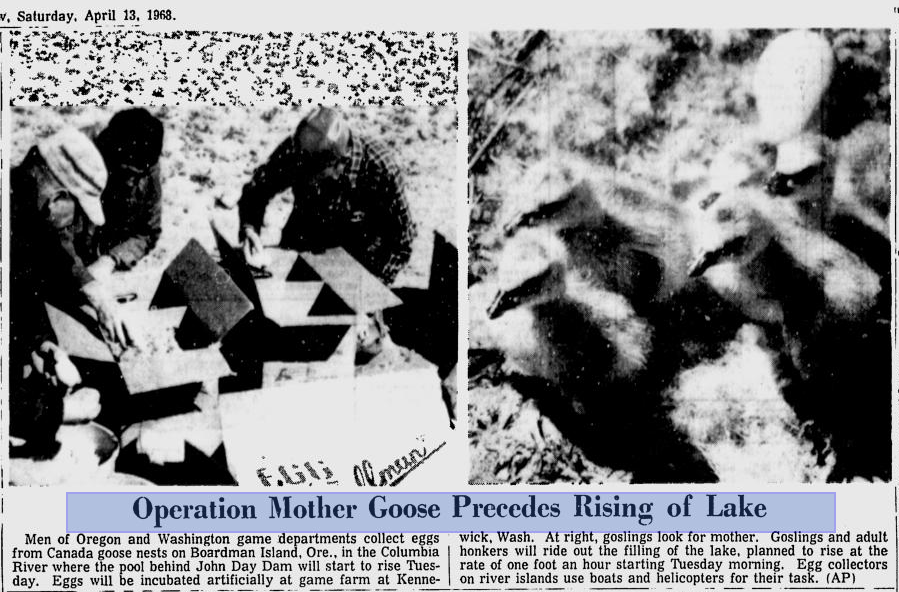
Operation Mother Goose, as the project was dubbed by Kennewick Game Farm Superintendent Curt Hedstrom, focused on collecting eggs on the Columbia River. The biologists knew that the eggs would soon be flooded out by the water rising by the nearly complete John Day Dam. After collecting the eggs, the men coddled them in goose down and put them in box, before flying them to Hedstrom’s game farm, which raised game birds for hunting. Most of the 1,200 eggs hatched and most of the young birds survived. Once the birds were old enough, the biologists planned to release them to wild flocks, where they hoped the youngsters would migrate with their elders.
More than 100 birds were released at two site, at the McNary Refuge and McNary Game Farm, near the confluence of the Snake and Columbia rivers. Other release sites include Arizona, Spokane, and the Couer D’Alene River, in Idaho. By mid-June, the biologists had transplanted more than 900 goslings. The releases were front page news for days.
But what these stories failed to report is that Operation Mother Goose youngsters most likely were released in the Seattle area. The record is not completely clear though biologists I talked with who were involved said that some were most release west of the Cascades. Hedstrom said that he thought that some were planted near Lake Washington, though he had no details. This would have been done to establish a population for hunters.
We cannot know if our modern geese are descendants of these original birds, or even if they really were released around Seattle. Canada geese would probably have eventually colonized this region. Historically they did not inhabit the forested west because they do not like this habitat but urban landscapes are goose heaven: no predators, lots of shoreline, and lots of wide open territory with a good food source, grass. And, of course, many people also feed them.
Many people though do not like the birds. They don’t like their poop. They believe the birds spread disease and are too aggressive. In response, thousands of Canada geese have been rounded up and killed. As I have written before, I am troubled by this response, that the solution to an animal problem is to kill them, and this for an animal whose main fault is pooping too much. This paradigm is one we have used far too many times before and what that we are now using again with wolves in eastern Washington.
When will we learn that we do not live in isolation, separate from the natural world around us. Too often we look for someone else to blame without looking at our actions. Regarding geese, we can make our urban habitat less friendly to the birds. We can be a bit more tolerant. The geese can be somewhat problematic but perhaps we can look for other solutions.
March 29, 2013
Crazy Book Price
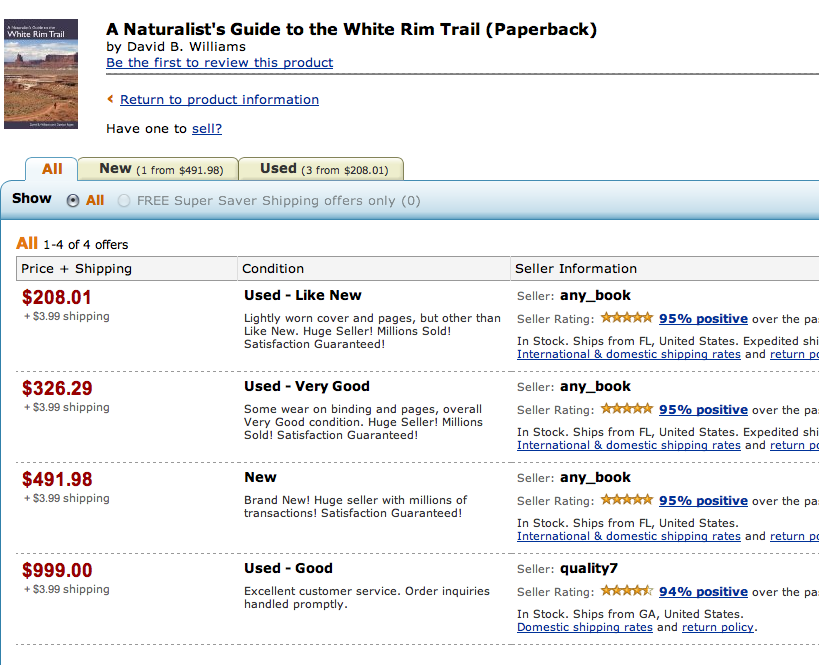
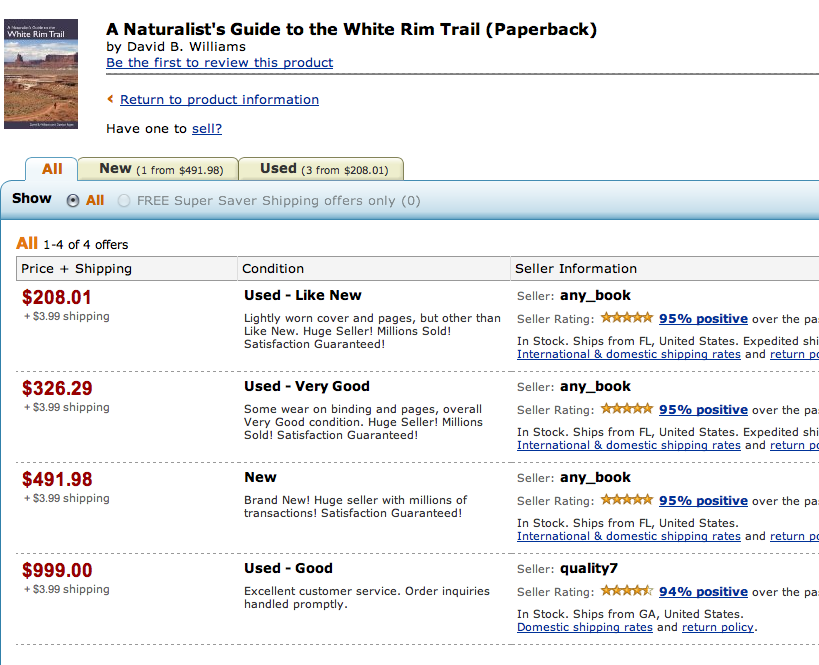
Nothing about geology in this post. I was doing some searching on Amazon when I came across this crazy page of prices for a book I co-wrote and co-published several years ago. I know for a fact that you can buy the book for $9.50 in Moab at Back of Beyond Books. But hey if you want to pony up the big bucks for it, I won’t stop you. Or if you are desperate, I can sell you one for the low, low price of $100. I’ll sign it if you want.
How does this happen? What are these people thinking? Do they have any connections with certain long exiled Nigerians who are very generous with their money, as long you send them your bank account number? I have to say I am honored that they think the book is so valuable but it really isn’t. The book is nice and helpful but certainly not worth much more than $9.50, even if it was signed. It’s crazy world.
March 25, 2013
The Tree and the Trolley Track
Wow, my wife, two friends, and I did a great urban walk the other day. Unusual views of Seattle. A nifty little Japanese garden from 1914. And, an unusual tree. As you can see from the photo, the tree has been pierced by a trolley car track.
 We found the tree on 13th Avenue South between Beacon Avenue and South Lander St, on the western edge of Beacon Hill. It’s a strange little street, which dips down to a low point from either end. I suspect that a stream once ran down the valley, flowing west off Beacon Hill to the former Duwamish River tide flats below. Judging from a flight of steps that drops to the west, the area is quite unstable. Unlike stairs on a stable slope, these tilt to the left as you descend. Plus, water flowed across the stairs, a sign of a seep, most likely a contact zone between the underlying Lawton Clay and Esperance Sand.
We also saw seeps near the strange tree. It was a Lombardy Poplar, a tree often planted as a wind block, shade tree, and ornamental. They grow quickly and very tall. On 13th Ave, they shared the slope with Bigleaf Maples, a common native tree that colonizes unstable slopes around Puget Sound. Someone also has tried to stabilize the slope by erecting a retaining wall at the bottom of it.
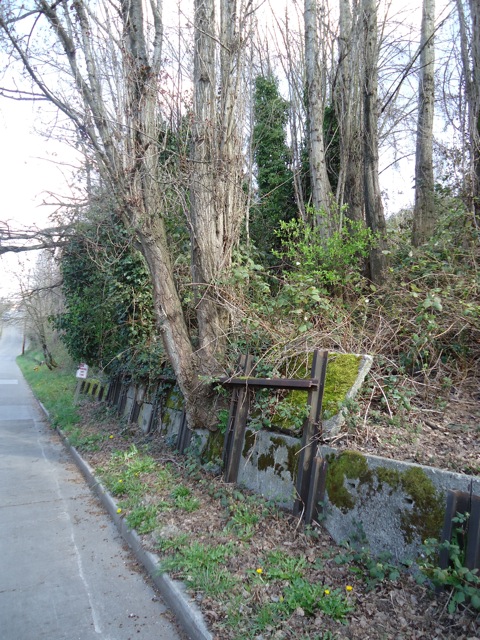 As happened in many green spaces in Seattle, the slope stabilizers took advantage of a change in Seattle’s once incredible system of street car trolleys. Twenty two different, independent trolley lines once plied the streets of Seattle. By 1936, after consolidation, there were 410 streetcars on 26 routes, but the system was not a moneymaker and much of it was eventually torn out of the streets. The rails and concrete slabs between them did not go to waste; they were used widely across Seattle to build stairways up and down city hills. The concrete slabs became the steps and the rails became handrails; it was quite an ingenious and resourceful way to use the abandoned material. According to the recently published Seattle Stairway Walks by Jake and Cathy Jaramillo, the city built about 130 flights of slab and rail stairs. The practice appears to have stopped about 1965.
On 13th, however, the slabs and rails were used for the retaining wall. So sometime after 1965, either someone planted several Lombardy poplars on 13th or several invaded “naturally.”As one of them thrived, it grew around the old trolley rail, making for quite a nifty illustration of urban natural history.
March 7, 2013
Cairns in the News
Seems like cairns are all over the place right now. First, they appeared in a New Yorker article (Feb 11 & 18; unfortunately the story is behind a pay wall) by Ian Frazier titled The Toll. The story focuses on the aftermath of Hurricane Sandy. In the story, Frazier reports on zookeeper Doug Schwartz, who erected cairns on the beaches of Staten Island, and has been doing so for many years. Sandy had destroyed Schwartz’s “sculptures or cairns or whatever you call them” but like many devoted to cairns he had vowed to rebuild. You go Doug!
And then in the March/April issue of AMC Outdoors the publication of the Appalachian Mountain Club, there is the article, Stone on Stone: A Natural and Social History of Cairns by Michael Gaige. Like the publisher of my book, Mountaineers Books, the AMC focuses on the “protection, enjoyment, and understanding” of wild places. In their case, it’s the forest, mountains, and trails of the northeast. Gaige’s article nicely weaves together many of the issues that concerned me in my book, Cairns: Messengers in Stone. As he writes “the tradition of stacking stones came not from building a monument to one’s self. It was to build for others–a memorial or a navigational aid. The intent lacked ego; it was just the opposite, an act of service.” It is always a pleasure to find someone else interested the deeper stories of cairns.
March 6, 2013
Of Douglas Firs and Bald Eagles
My wife and I bought our house for a simple reason: the massive Douglas firs in the backyards. We had been looking at houses for about two months when we came across the tree-rich yard and the nondescript house. We knew immediately that this was the place. Where else would be find such trees, the biggest of which we couldn’t put our arms around? Now, nearly 15 years later, we know that we made the right decision.
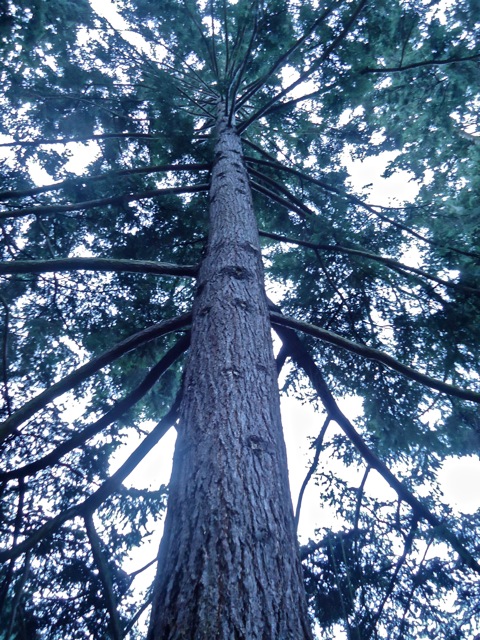 Recently, I have been reminded of our correct choice. For the past couple of weeks, an adult and an immature bald eagle have regularly visited our trees. My first not-so-subtle hint was an adult eagle flying about 30 feet over our heads in our front yard. The bird then turned abruptly and landed in a Douglas fir in our neighbors. And then every few mornings, at about 6:30, I heard two eagles calling in our back yard.
An eagle’s call is surprisingly squeaky, sort of a higher pitched call of a gull. The calls make me think of two pieces of hardwood being screwed together. In my mind, I see a wooden bolt being threaded into a wooden opening. (You can hear it at the the Cornell Lab of Ornithology site; just play the recording for typical voice.) The sound is not what I expected. For some reason, I figured that our national symbol should have a more majestic call. I guess I was being a typical citizen of the USA thinking that if it stands for our country, it must be mighty. Oh well, wrong again. Still the bald eagle’s unctuous call is a pretty cool sound to hear as a wake up alarm.
But eagles are not the only exciting animal in our big Doug firs. I often find owl pellets at the base of the trees; I have heard an owl but have never seen who coughs up the boluses of fur, bone, and feather. In contrast, I have seen Coopers hawks sitting on the trees’ branches ripping apart unidentified birds. My wife and I once saw three of the hawks sitting in the trees. And, then there are the less sexy but equally intriguing avian visitors, such as red-breasted nuthatches, red-breasted sapsuckers, varied thrushes, and brown creepers. This doesn’t include the two mallards that I saw one day paddling around the top of our garage, which regularly floods. The garage is directly under the firs so I decided that I can connect the ducks to the Dougs.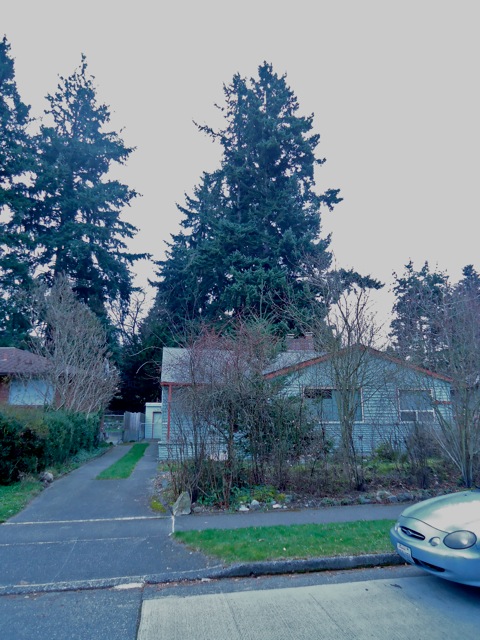
We in Seattle are fortunate that we have so many big native trees in the urban environment. Seeing the effects of having Douglas firs in our backyard reiterates why we need to protect as many of them as we can. And not just tall native trees but big trees of any kind, even if they do block the views of retired baseball players. The trees are essential as habitat for a wide array of life, and a wonderful asset for an urban naturalist.
(This piece originally appeared at the Seattle P-I Urban Naturalist Reader’s Blog.)
March 1, 2013
Shaking Brownstones, Not
An interesting study on how brownstones would perform in an earthquake was posted recently on NBC Science. The study shows an unreinforced brick wall falling apart during a typical earthquake. In contrast, a reinforced brick wall remains standing. The only problem with the study is that the brownstones referred to were not typically made of brick. Those rowhouses in New York, and Boston and Philadelphia, got the name brownstone from the 200-million-year old sandstone used in many of the buildings. That stone, quarried most commonly in Portland, Connecticut, is a sandstone with a small amount of oxydized iron, which gives the rock its brown, or rusty color. (It’s the same type of rock that is found in southern Utah, where it’s known as red rock.) In addition, brownstone was often used as curtain wall, or a thin exterior material that served little structural purpose. Also, how often do earthquakes hit New York City? I am guessing that there is more to the study than reported on NBC but it does make me question its importance.