David B. Williams's Blog, page 21
October 5, 2012
Cairn A Day 11
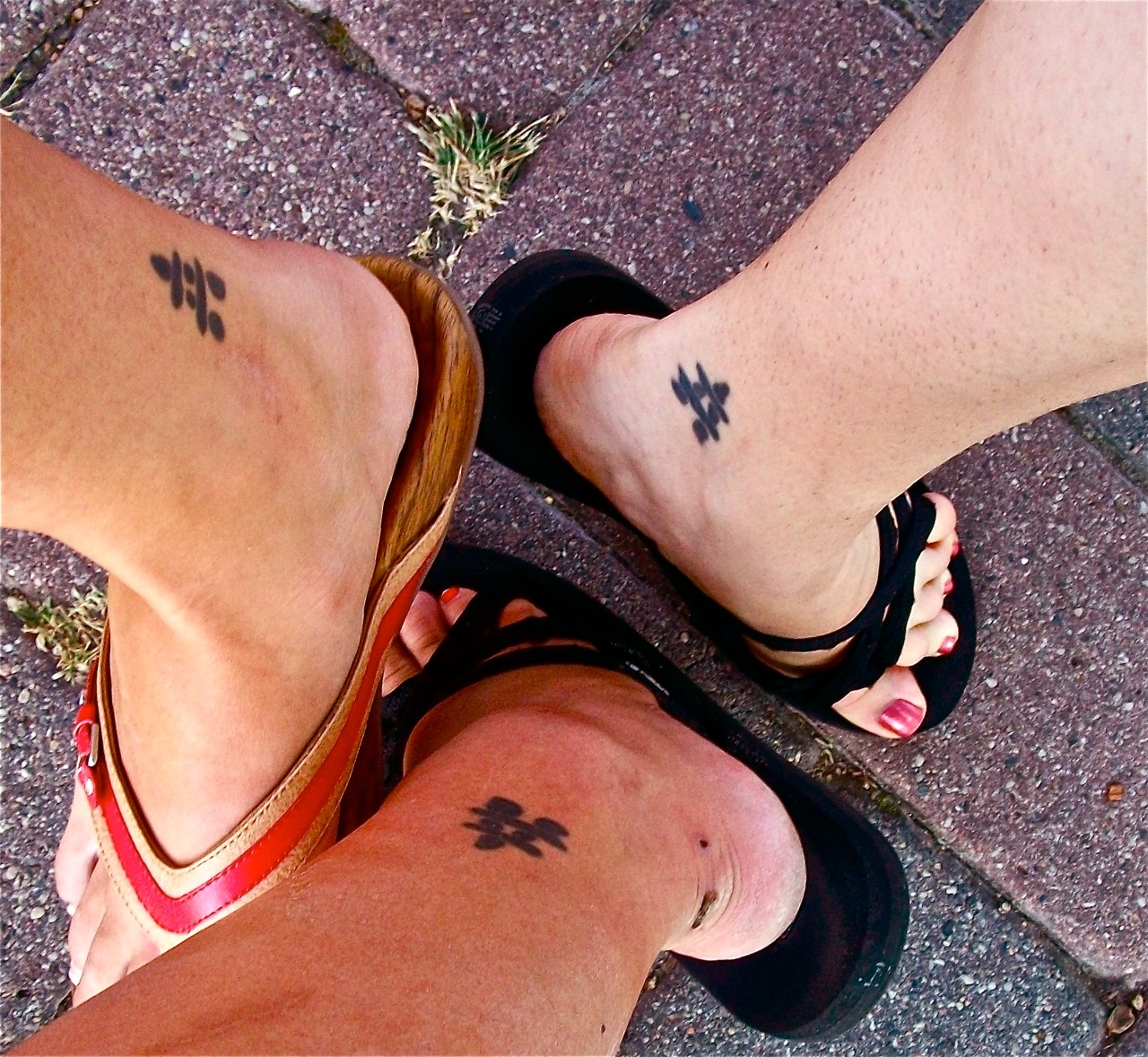
A cairn tattoo is a pretty cool thing. I don’t have one but a friend of a friend does. When Lucie K was 18, she went on a six week long canoe trip in the Nunavut Territory of Canada. She was with six other girls her age and a trip leader. Here is her account of her trip.
We chose to travel on two different but connected river systems in Nunavut: the Kazan and the Kunwak. We were dropped via float plane, travelled over 500 miles and, aside from some musk oxen, and lots of caribou we didn’t see anyone but each other until the end of the trip. The trip ended in a small Inuit community called Baker Lake (on Baker Lake), which is just slightly Northwest of Hudson Bay.
The route we chose (particularly the Kunwak) was absolutely riddled with inuksuks. Before this trip I’d never heard of them, but in that stark, tree-less, tundra landscape they were absolutely stunning to come across. We all fell in love with them. Some were huge (much taller than any of us) which often had us hypothesizing about how the ancient Inuit had gotten the rocks stacked in such formations. Some were a little like Stonehenge to us in their mysteriousness.
After our trip I learned much more about them. I’d gone hiking in the SW many times with my family and knew that the Arctic cairns held a similar purpose as the ones down there, but it was still very fun to research them. I’ve now seen them explained and translated in a number of ways but my favorite is “Man of stone that guides the way.” They were used to mark bends in the rivers and even scare caribou down into river valleys for easier hunting.
Five out of seven of us got the tattoo. In true inuksuk form though they all turned out little differently. (No two inuksuks or cairns can ever be the same!) Nearly all of us got it on our ankles. I don’t think about it very often anymore but I guess that even more than 10 years later, I continue to like the idea that there is a little man of stone (appropriately tattooed very close to my foot) helping guide my way.


October 4, 2012
Cairn A Day 10
This very handsome desert cairn illustrates the wonderful way that sandstone can be used to make a cairn. Because it often splits into pieces with two flat sides, sandstone blocks can be stacked into upright structures, something that you cannot do with rounded boulders and cobbles. This photo came to me from a park ranger at Capitol Reef National Park in south central Utah. Here’s what she told me.
“Unfortunately, I can’t give you too much detail about the cairn. I just remember it was on a not-so-popular trail, maybe even a route, off the west side of the Scenic Drive in Capitol Reef National Park. I really liked it because it was so intricate and well made. Who spent all that time? And, why? I do remember thinking that some park rangers would have knocked it down, but I just took a photo! I can appreciate modern day ‘rock art’!”

October 3, 2012
Cairn A Day 9
This cairn comes from one of my favorite cairned trails, the ascent to the summit of Mauna Loa on the big island of Hawaii. When we hiked the trail last February, I counted over 185 cairns, ranging from just a couple of rocks to ones like this one, massive, tall, and needed. The trail is completely on basalt lava flows and without the cairns, the route up would be very challenging. The cairn also illustrates my observation that basalt, with its rough, hard surface often filled with many holes, is one of the best materials for cairn construction. That surface acts sort of like of velcro such that the rocks cling together and allow one to erect upright cairns, always something nice to see on a trail. Another highlight of this cairn was the chance encounter with the bird flying over the pile. I am not sure of the species but it was very exciting to see.

October 2, 2012
Cairn A Day 8
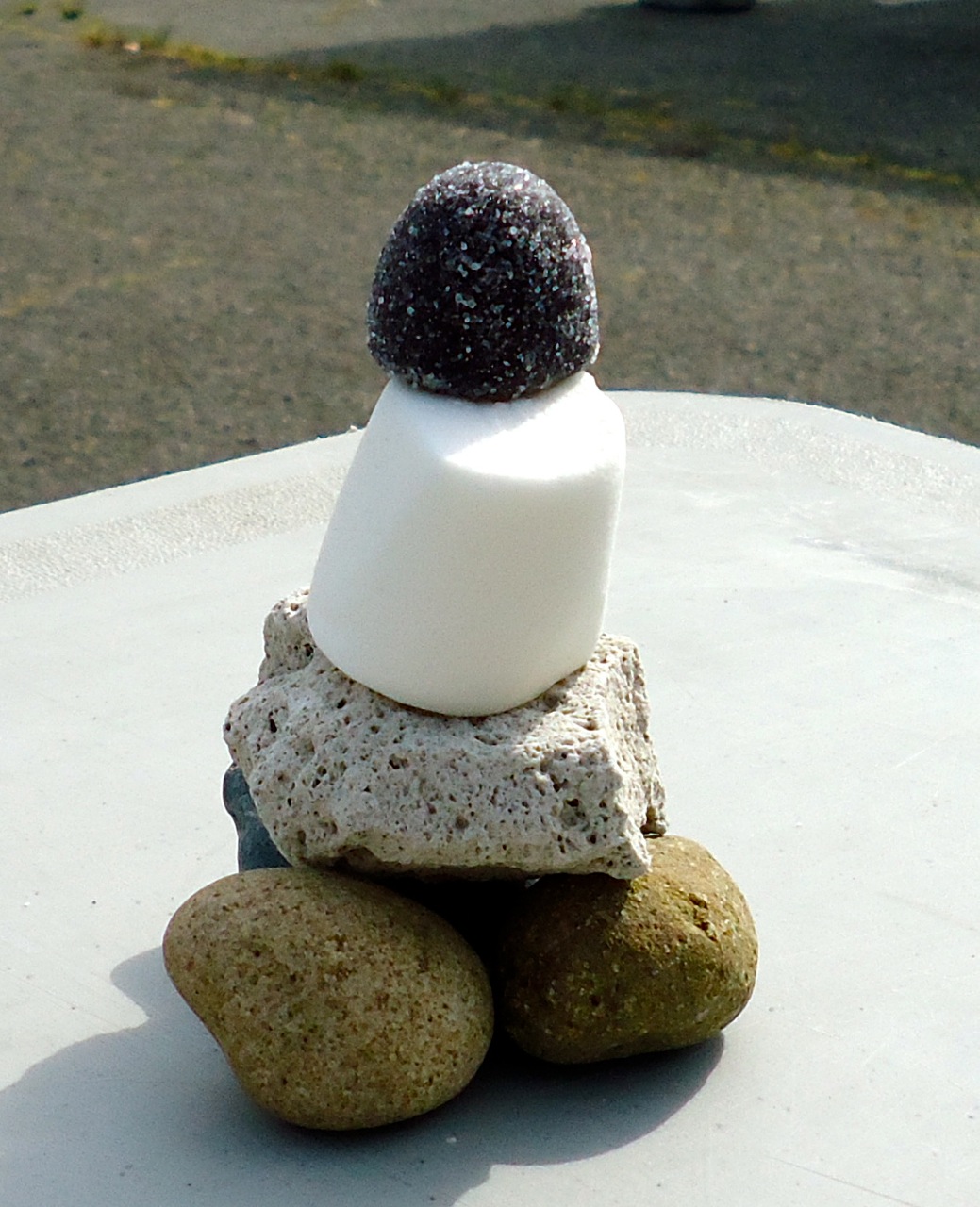
This is a very wee subclass of cairns, those made with unnatural food products. And yet, I think this is quite the ur-cairn, with its classic styling, jaunty tilt to the marshmallow, and carefully placed pumice piece, all capped by a handsome gumdrop. It also illustrates how using a variety of different materials can enhance one’s cairn and make it more noticeable on the trail, not that I recommend using marshmallows in the backcountry, unless, of course, it’s for smores.
October 1, 2012
Cairn A Day 7
In honor of today being is the official publication date for my new book, Cairns: Messengers in Stone, I wanted to focus on the cairn on the book’s cover. It’s a Bates cairn, named in honor of Waldron Bates. According to the website for Acadia National Park, Bates was a Bostonian, a lawyer, and a pathmaker. Starting in the 1880s he and his family began exploring Mount Desert Island in Maine. He also helped create trails around Bar Harbor, including writing a trail handbook. In the 1906 manual he wrote, “Build the cairns as show in the accompanying pictures: two large stones with an opening between in line with the direction of the path, across these one flat stone, and on top of this long stone in line with the direction of the path. Use large stones and set them firmly in place.”
Recently, park rangers at Acadia have reinstituted the Bates cairn at the park. I believe it is the only place in the country with this type of cairn.
John Barnett of 4 Eyes Design made the drawing. He was also the book’s designer. Thanks John.

September 30, 2012
Cairn A Day 6
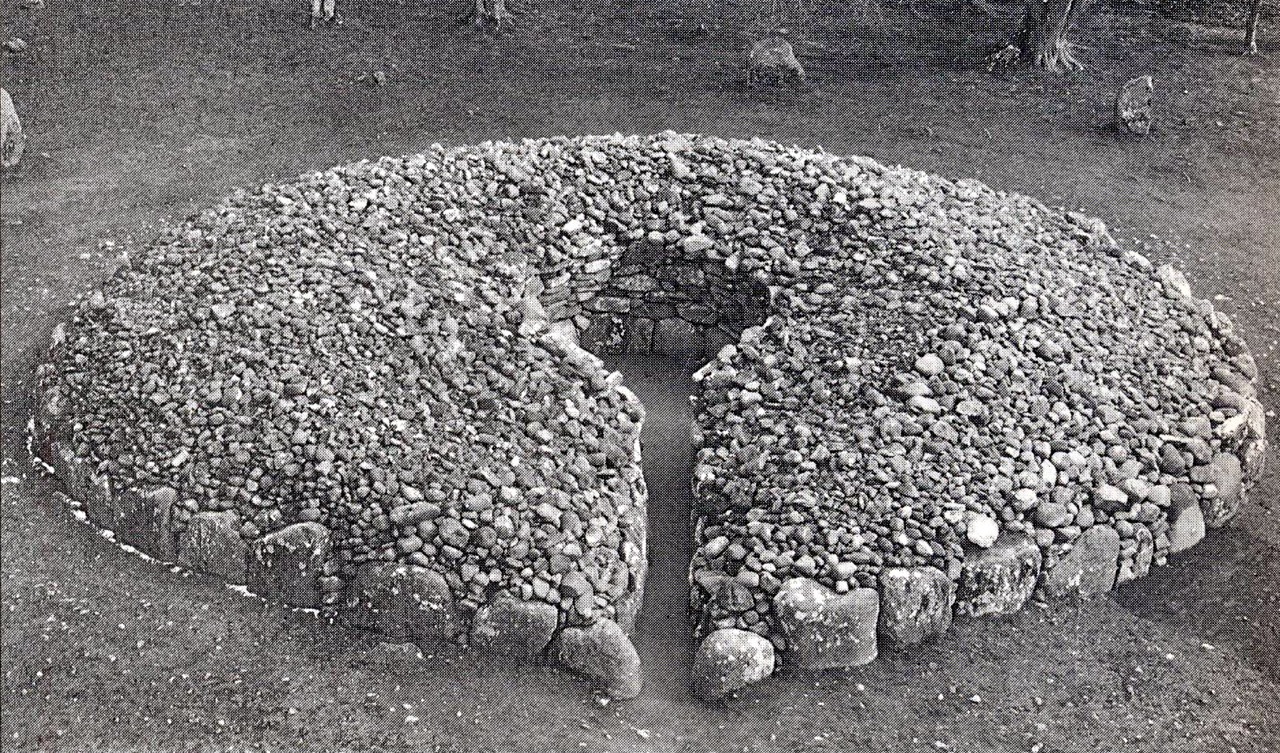
For more than 5,000 years, monumental burial cairns have been one of the most stunning human-made features of the Scottish landscape. The cairns have astounded and perplexed people with some claiming that supernatural beings constructed them, whereas others have attributed the structures to Druids, Romans, or Scandinavian pirates. Archaeologists have described more than 450 of these structures with some more than 100 feet long. They generally consist of an internal chamber, where a body or bodies would have been placed, a corbelled vault roof, and a narrow entrance passage, all topped by the cairn, a pile of stones that covered the entire structure.
The cairn below is one of three that make up the Clava Cairns, or Balnauran of Clava, built around 4,000 years ago near what is now Inverness, Scotland. This type of cairn is known as a passage grave. It is 55 feet wide. At one point it was probably roofed. Recent work has shown that this cairn, along with the two nearby ones, were used as celestial markers, most likely noting the mid-winter solstice. Archaeologists believe that a focus on the winter solstice and the time of increasing daylight affirmed and strengthened the concept of rebirth, not just for the natural world but also for the dead. Together these powerful concepts would have united the community, a central theme that I write about in Cairns: Messengers in Stone.
September 29, 2012
Cairn A Day 5
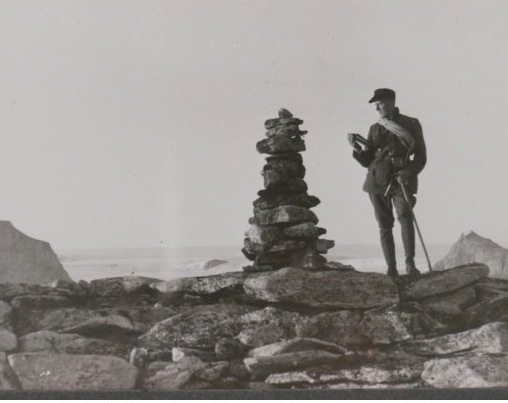
Reaching back and far away, today’s cairn comes from Greenland from an expedition in the summer of 1936. Hugo Pallin was a Swedish explorer on a mountaineering and research expedition to west Greenland. Here is a description of his trip, which comes from an album for sale on Ebay. “He proceeded from Copenhagen on the SS Hans Egede and went along the coast of Western Greenland, visiting Umanak (Uummannaq), Nugssuaq (Nuussuaq) Peninsula (Uummannaq district) and Pröven. After that he went up north on the coast schooner Sigrid to Upernavik Island, and extensively climbed it in the vicinity of its highest peak Sanderson’s Hope. Together with J. Bjarnow, the district medical officer in Upernavik town, Pallin proceeded up north on motorboat to Melville Bay, usually inaccessible in summer, as the main destination. There the party made several ascents of Devil’s Thumb, Cape Seddon, mountains of Holms Island, Nuussuaq Peninsula (Upernavik Archipelago) and a number of small islands.”
This shot is from an unknown peak. The man in the image is probably Pallin. The shot illustrates another aspect of cairns, marking the summit of a peak. Sort of a funny thing to do, as if people didn’t realize they were at the top. Oh well.
September 28, 2012
Cairn A Day 4
Some may claim that this dog isn’t balancing what one would call a cairn, but I am fairly liberal, and opportunistic, in my understanding of what constitutes a cairn. This whimsical sculpture is in downtown Walla Walla. Titled Thoughts Discovered, it is by Walla Walla artist Brad Rude.
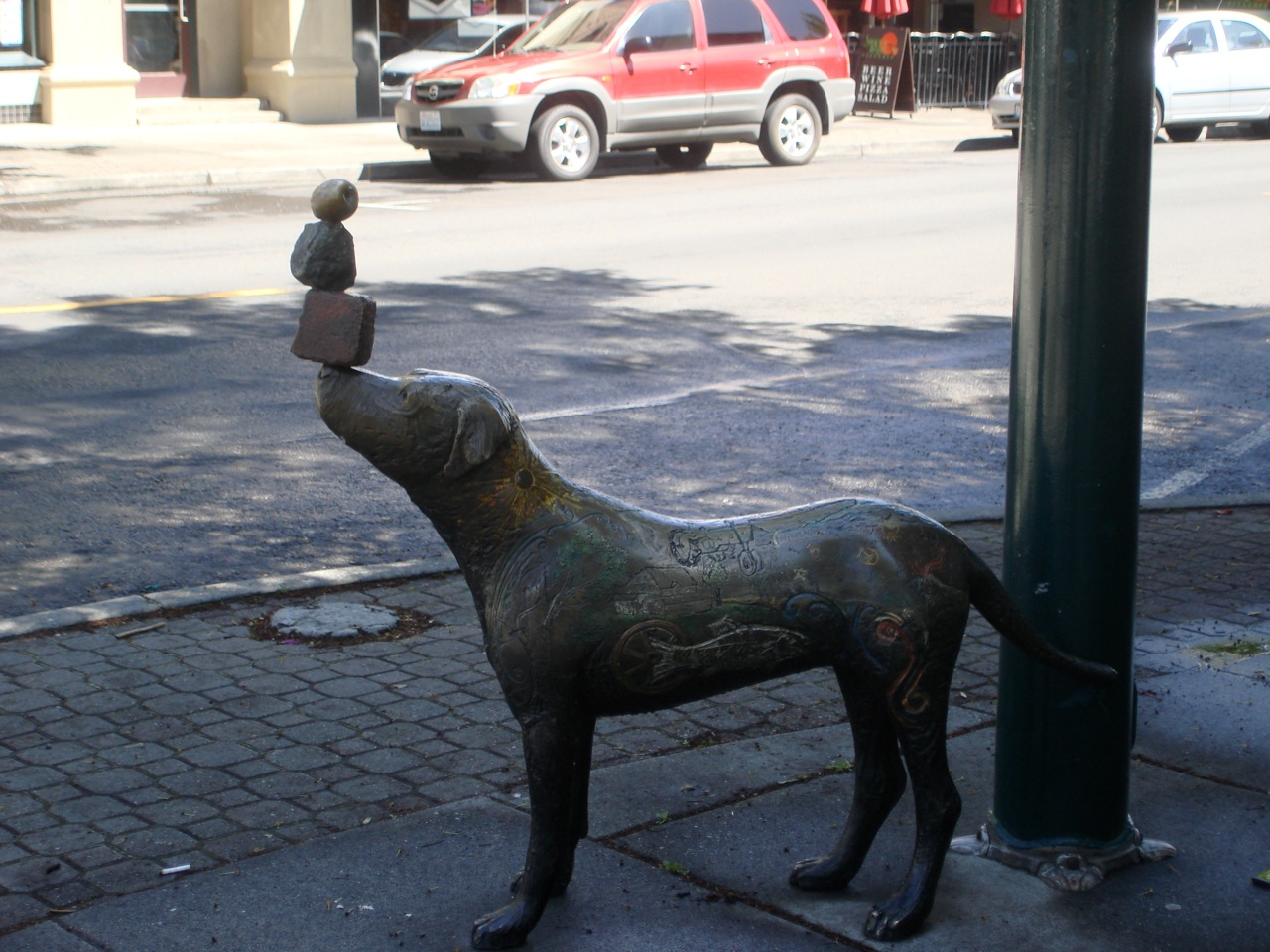
Thoughts Discovered
September 27, 2012
Cairn A Day 3
This cairn and its accompanying pal are on the Cowiche Mountain Loop Trail in Yakima County. The bear, known officially as Big Bear, exemplifies a key aspect of cairns, that animals regularly take advantage of them as a high point to observe the surrounding territory. According to our friends, Big Bear goes on most of the hikes they take, particularly if they can offer the prospect of a chance to see what’s on The Other Side of the Mountain. Or if there are huckleberries or blueberries to find. And a cairn is a good spot for such situations when you need to get up a little higher to see.
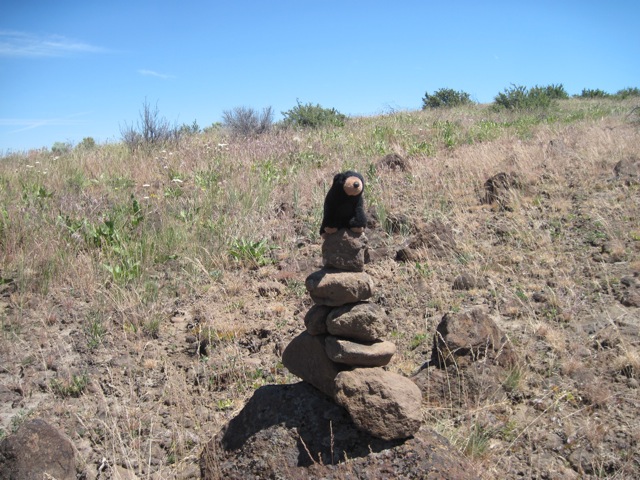
Big Bear on a Cairn
September 26, 2012
Cairn A Day 2
A cairn in the Enchantments, that spectacular backcountry on the east side of the Cascades Mountains and near to the town of Leavenworth, Washington. Notice the classic erosion of the granite, which creates perfect stone for erecting a tall, and what I think is a rather handsome cairn. The haze in the background comes from big fires burning around Wenatchee, about 25 to 30 miles to the east. By the lake is Colchuck Lake.