David B. Williams's Blog, page 19
February 8, 2013
New Book for Canyon Country
A quick announcement that after more than 12 years since its original publication, my first book will soon be available in a new edition. A Naturalist’s Guide to Canyon Country first hit bookshelves in spring 2000. The new updated version will be out next month. I just received the new edition in the mail and I have to say it is quite handsome and an improvement over the previous one.
 The book covers the plants, animals, and geology of southern Utah with an emphasis on the area around Moab. I started writing the book during my time as a ranger at Arches National Park. I did so out laziness, as I had become tired of lugging around a plethora of field guides. Seemed easier to me to carry just one. So naively, I started writing one. Of course it was rejected by several publishers, including the present publisher, Falcon, now owned by Globe Pequot. (After talking with a friend who had published with Falcon, I tweaked my proposal, sent it to a different editor, and they bought it.)
For this new edition, I had several goals. First was to update all of the scientific names. It was surprising how many had changed over the past dozen years. I also updated all of the geologic information. There were a few name changes but the main changes had to do with dating as several time periods were way out of date. I also added more than 30 species, primarily bugs, but also California condors, lichens, and mosses. Another addition was what we came to call Close-Ups. These focus on topics of particular interest to me, such as Upheaval Dome, chert, rock varnish, the enigmatic Colorado Plateau, scat, hidden gardens, and the night shift. They are some of my favorite parts of the book. Hope you enjoy it.


February 1, 2013
The Street-Smart Naturalist Blog
Recently, I was asked by a friend to contribute a regular blog post to the Urban Naturalist reader blog at the Seattle P-I. The post below is my first post for that blog. In addition to the P-I postings, I will also be posting other thoughts and observations on urban natural history to this site.
I didn’t set out to be an urban naturalist. After graduating from college with a degree in geology, I moved to Moab, Utah, paradise for geologists. I spent most of my time out in the red rock canyons hiking, biking, canoeing, and teaching. During my final years in Moab, I worked as an interpretive ranger at Arches National Park. I thought I would stay and be a naturalist in Moab for many years but when my wife decided to go to graduate school, I followed her to Boston.
Initially, Beantown was not a good fit for me. All I knew about the geology of Massachusetts was that a group of renegades had supposedly landed on some piece of stone we now call Plymouth Rock. One day though I was walking across the Harvard campus when I stopped to look at Harvard Hall, a stately Georgian structure built in 1766.
 I distinctly remember walking up to the stairs to look at the stone work, which had begun to erode. Making sure that no one was looking, I stroked the crumbling stone. Sand grains accumulated in my hand. They immediately transported me back to my beloved Utah.
I had looked at these sandstones around Boston for months but it wasn’t until the sand grains of Harvard Hall nested in my hand that I made the connection: what I had known as red rock in Utah, easterners calledbrownstone. Both are sandstone colored by iron, which in an oxygen-rich environment rusts and coats individual sand grains like the skin of an apple.
From that point on, I began to focus intently on the geology of Boston’s building stones. I found buildings made of the same stone as Plymouth Rock, which I learned was a 610-million-year old granite; churches fabricated of a purple hued, cobblestone-rich sedimentary rock known as puddingstone; and rooftops covered in slate, formed by a chain of islands crashing into North America. I had found the geologic stories that could provide the connection I had lost to wildness I had treasured in Utah.
I have continued to seek out such stories around Seattle. I learned that the reason it’s generally easier to bike north/south than east/west is the region’s recent glacial history. When I bike from the my house around Licton Springs to Lake Washington, I have to travel up and down the trough and ridge system carved by a 3,000-foot-thick glacier. When I bike to downtown, I am riding in one of the troughs.
I also discovered the rich diversity of life in the city. It is not unusual for me to see bald eagles in the city; I have even seen and heard them in the towering Douglas firs in our backyard. Speaking of trees, we are unusual as a city in that our dominant tree cover consists of our native Douglas firs, bigleaf maples, and red alders. And, of course, I have found building stones galore, ranging in age from 100,000 to 3,500,000,000 years old.
These stories have revealed to me the rich textures that make up the urban landscape. They have made my chosen home of Seattle a more interesting and more enjoyable place to live. I still love to get out in the wild places and see the grand scenery and the grand stories but I have found that living in Seattle still allows me to connect to wildness. It may take a little more effort to find the stories but they have more deeply rooted me in place.
So my goal with this blog is to explore not just the geologic stories but all aspects of the natural history of the urban landscape. In doing I so, I like to believe that we can learn from these stories of urban wildness not only about the land and its inhabitants but about ourselves and our place in this place we call home. I look forward to sharing this journey with you.
January 23, 2013
Dino Brains and Poetry
Perhaps the most famous dinosaur poem of all is one penned by Chicago Tribune columnist Bert Leston Taylor. Taylor’s poem includes this famous little ditty, which I think is quite brilliant.
The creature had two sets of brains
One in his head (the usual place)
The other in his spinal base
Thus he could reason a priori
As well as a posteriori.
Taylor’s poem is also one of the most misattributed. Nearly every time you see it, you will find it dated as 1912. Even the vaunted New York Times noted this date in a February 1998 column by C. Clairborne Ray. I am guessing that Ray, like others, was referring to a short volume of poetry by Taylor, A Line-o’-Verse or Two, which came out in 1911. But Taylor didn’t write the poem for his book. Instead, he wrote it for his A Line-O’-Type or Two column, published regularly in the Tribune. The famous words are from The Dinosaur, published in the Tribune on February 26, 1903.
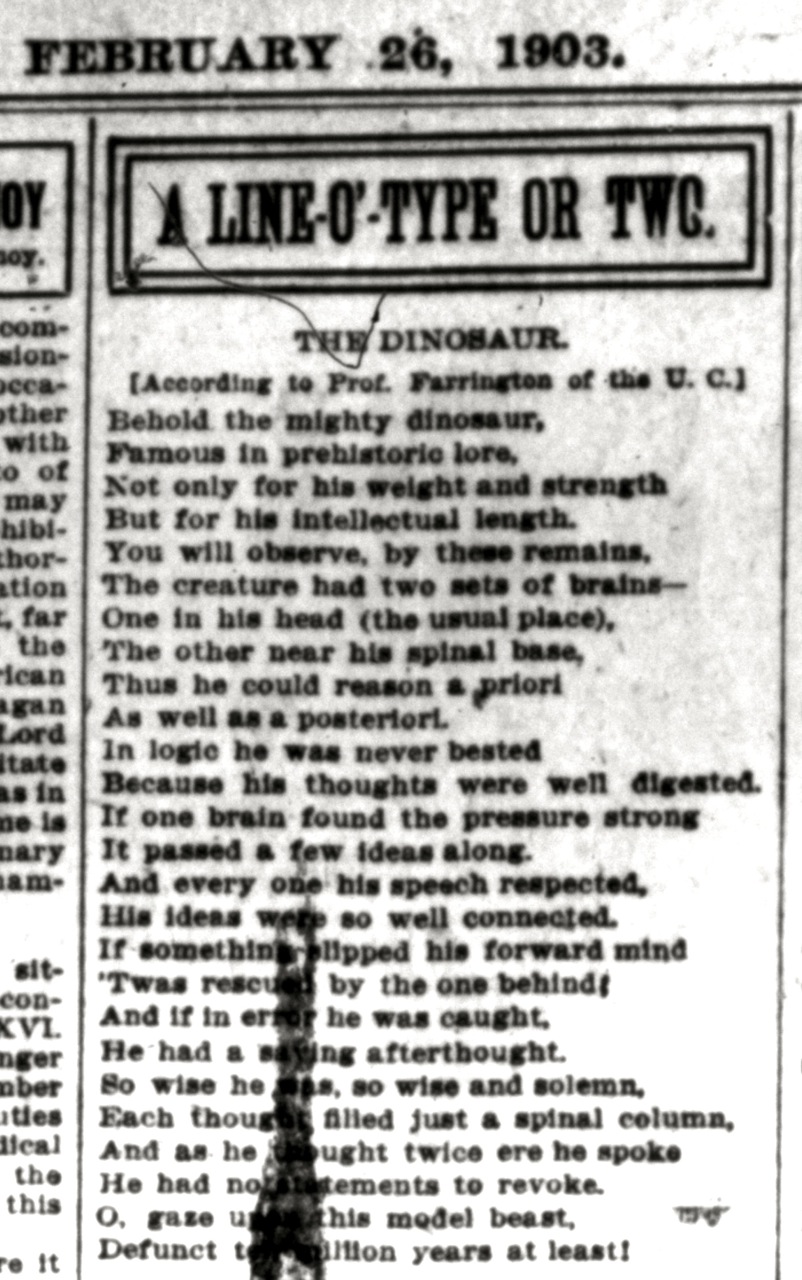 The poem in the paper also includes a line that refutes another myth about Taylor’s words. They do not refer to the most infamous, supposedly two-brained dinosaur, Stegosaurus. Just below the title The Dinosaur, Taylor added “According to Prof. Farrington of the U.C.” Taylor’s reference to Farrington was in response to a photograph and short note that appeared in the Tribune the day before, on February 25.
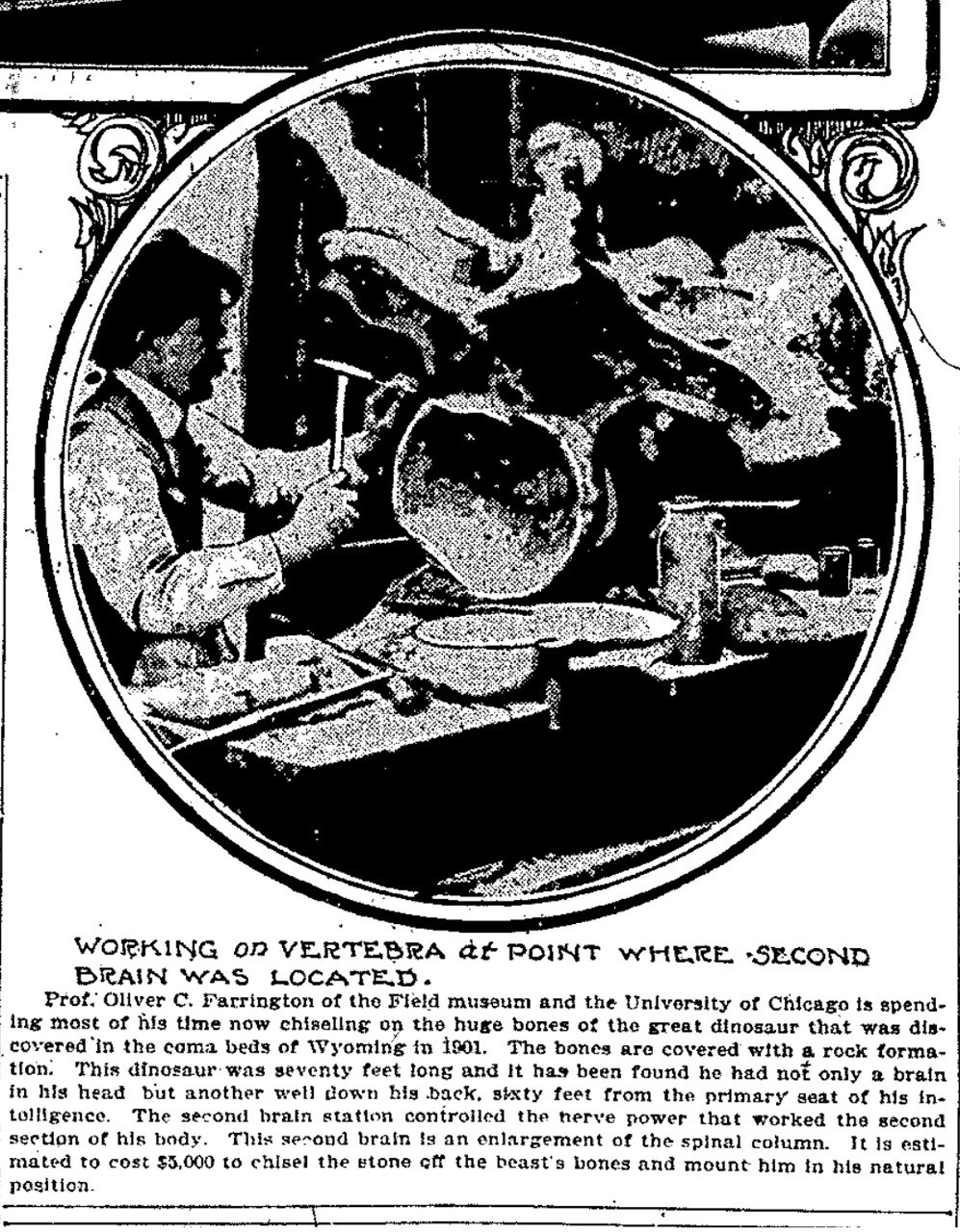
Under a headline that read “Mounting skeleton of 70 foot dinosaur at Field Museum. It was so big that it required two brain to move it about,” was a photograph of about a dozen vertebrae from the museum’s Brachiosaurus. A second photo illustrates Farrington at work on a vertebrae, with an accompanying text describing his work and the dinosaur. “He [the dinosaur, not Farrington] had not only a brain in his head but another well down his back, sixty feet from the primary seat of his intelligence. The second brain station controlled the nerve power that worked the second section of his body.”
 We now know, of course, that no dinosaurs had two brains. The confusion came about because of an enlarged canal in Stegosaurus‘s sacrum. To this day, the function of this body is not clear. I am guessing that a similar space in the vertebrae of the Brachiosaurus led to Farrington’s interpretation of it. We may not know its function but at least it led to a couple of wonderful lines of poetry.
December 18, 2012
Slaves, The Smithsonian, and Brownstone
Just came across a fascinating article in the Washington Post about the building of the Smithsonian Castle. The article is about recently published research by Mark Auslander, an anthropologist at Central Washington University. His research appeared in the journal Southern Spaces. Auslander cites records from the Seneca Quarry in Virginia, the source of the Smithsonian’s building material. Quarry owner John Parke Custis Peter was the great grandson of Martha Curtis Washington, President Washington’s wife. In 1840, Peter owned 23 slaves, several of whom had been owned by Martha Washington. Auslander writes that “it seems likely that a number of the adult men…worked in the Seneca quarry” that provided the sandstone blocks for the Smithsonian. Ironically, as Auslander points out, the stone was known as “freestone.”
Auslander’s article is a fascinating contribution to our understanding of slavery and “enslaved African Americans worked on the construction of many buildings in antebellum Washington, D.C., including the U.S. Capitol and the White House, rarely receiving any monetary compensation.”
And for those with a geologic bent, here’s a little information on the Seneca sandstone. This comes from a post of mine from January 26, 2009, about the building stone of Washington D.C. The quarries are located along the Potomac River, near Seneca, Maryland, 20 miles northwest of Washington. Like the brownstones of Connecticut, the Seneca sandstone formed in massive rift basins that opened 200 million years ago during the breakup of Pangaea. The Smithsonian Castle completed in 1855, uses this brownstone, which has weathered to dark red from its original lilac gray. I recently learned from Through the Sandglass of a great Mark Twain quote about said stone. In a letter published in the March 7, 1868 Territorial Enterprise, he wrote of the “poor, decrepit, bald-headed, played-out, antediluvian Old Red Sandstone formation which they call the Smithsonian Institute.”
December 5, 2012
Cairn A Day 20
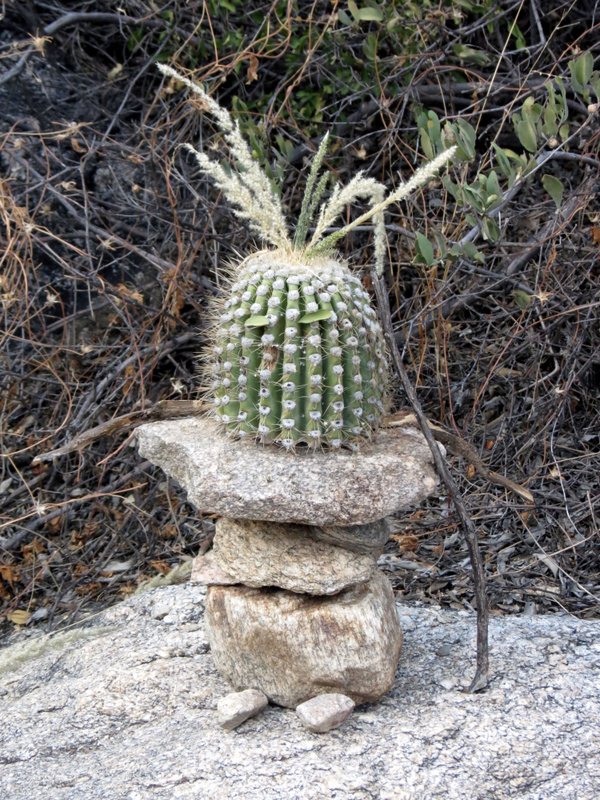
I haven’t added a cairn in a while but this one caught my eye. It’s from a family friend from a hike in Pima Canyon near Tucson, Arizona. It’s either a new form of cactus or a new form of cairn. I am not sure which. All I can add is that I hope it doesn’t come to life but if it does I hope it leaves little babies around, as they would be quite cute.
November 20, 2012
Cairns 1 – Writer 0
Over the weekend I lost a battle with a cairn. Or at least my finger did. I was over in Leavenworth to give a talk to the fine folks of the Wenatchee River Institute and the Barn Beach Reserve. It was a great event with about 70-75 people attending. They were definitely a hiking crowd with many quite familiar with cairns, particularly in their own backyard of the Enchantments. On Saturday we regathered for a cairn building session on the Barn Beach property. A trail passes through the area and the cairns would help direct people from one trail segment to another. 
We began by collecting rocks from several nearby rock piles. It was good rock: blocks of granite with rough surfaces. We then picked a conspicuous location, as discussed in my book, a began to build the pile, always seeking to provide enough batter for stability. It was during this part of the cairn building that my finger was wounded. I distinctly remember thinking that I needed to avoid crushing my right hand when placing the rock I carried. I was successful there but unfortunately I omitted to notice that my left hand, and in particular my pointing finger, was about to be placed between a rock and a hard place. The result is below. Rather ugly but much less painful than it looks.
So now I need to add one more line to my presentation about how to build a cairn. Remember you have two hands and need to watch out for both of them. It’s never to late to learn.
November 12, 2012
Cairn A Day 19
More wine and rocks! Here’s another cairn related winery and winemaker Chris Hanson of Four Cairn told me about how they came up with the name.
“As far as the name and design our winery is young in its life. We were trying to find a name that alluded to the vineyard site we have that is an old creek-bed, sandy, rocky and gravelly. We wanted a name that had to due with rocks but be unique and something that had not been done. So we came to the word Cairn that is known by many and not known by more. The label designer loved the name and idea and came up with the hand drawn rocks that are on the label. The Four comes from the size of our vineyard, four acres. We get a lot of positive comments on our label and questions of what is a cairn. It sparks a conversation on the label, name and wine which is what it was intended to do.”

November 7, 2012
Climate Change – 1: Republicans – 0
Perhaps the Republicans might now be willing to admit that they should believe in climate change. Here’s my simple argument for why they should finally recognize the need to do something about it. Our warming planet helped Obama win the election. Hurricane Sandy, which many have pointed out was bigger and more nasty because of our new climate paradigm, showed Obama’s presidential qualities and the importance of good government.
Yes, his numbers were on the upswing prior to Sandy but Obama’s strong showing during and after the storm certainly aided him and helped make people realize the short sightedness of Romney’s statement about FEMA. So I conclude that the election was the silver lining on climate change. We can only hope that everyone now bands together and tries to address this critical issue.
November 5, 2012
Cairns in the Seattle Times
I was quite honored to be interviewed recently by the book editor of the Seattle Times, Mary Ann Gwinn. Today is the day that the interview appeared in the news. My favorite question was the one about cairns of tragedy. It let me focus on the cairn that honors the death site of Robert Falcon Scott, Edward Wilson, and Henry Bowers, who along with Lawrence Oates and Edgar Evans died on their doomed goal of reaching the South Pole. The other famous cairn of tragedy is the one found on King William Island and which contained the only written evidence ever found from the Franklin Expedition of 1845.
November 2, 2012
Cairn A Day 18
Wine and geology are two things that go together like peanut butter and jelly. So today I am featuring the label from a vineyard in Napa Valley. The Rock Cairn vineyard was named for cairns built by Native people on the property. Unfortunately, I have not had the pleasure to taste the wine, a 2009 Cabernet Sauvignon. The vineyard has just harvested a 2012 Cabernet. Perhaps I’ll have a chance to try that one. If anyone had tasted these wines and has a thought about it, please let me know.