
Cathy Day's Blog, page 19
November 19, 2010
The Gamification of Novel Writing
Question 1: What is your current word count? (on Day 15)
The results varied. At this point, my students should have been at about 25,000 words. (I wasn't quite there myself, alas.) Three students hadn't broken 20,000 yet. One student was already at 58,000 and was sprinting toward 70,000 words. Seven students were at 25,000 or above. Six students hadn't reached the half-way milestone yet.
Are Word Counts like "Points"?
For twenty years, my writing practice had no structure. I wrote when inspired and I would keep writing until I wasn't inspired. If I didn't have a big block of time, I wouldn't write. I waited until I did have a big block of time—which happened…oh…never.
I was 25 years old, two years into an MFA program, and I still acted (without really realizing it) as if writing was something I did "for school." And then one fall, the buzz among all students in my program was that Inman Majors had returned from summer break with a 200-page manuscript, a rough draft of a novel. Of course, we all hated him immediately.
I ran into him at a back-to-school party, and I asked him how he did it. He took a swig of beer and spoke the words I have been quoting ever since: "Well, I'll tell you, Cathy. Every day, I'd write two pages. And then I'd play golf." [Inman has since informed me that he was playing BASKETBALL that summer, not golf. My apologies.] I felt like Moses at the Burning Bush, hearing the voice of God. Really? It was that simple? Well, of course it's that simple.
It only occurs to me now (because I am incredibly slow sometimes) that Inman turned lots of things into games. It's in his blood, so to speak. He liked to make things interesting. He was the guy who always organized the NCAA Bracket Pool (before the internet started doing it for us). He liked to place a bet or two, as I remember.
You can't just sit down and draft a book. You can't just sit down and write 50,000 words. A marathon is run mile by mile. A football game is played one down at a time. Like Anne Lamott says, you have to take it bird by bird. NaNoWriMo forces students to turn an abstract big thing into a series of small concrete things. Words. Pages. Accumulating incrementally over time.
Like gold stars.
Like X's on the calendar.
Like hash marks on the wall.
Like Weight Watchers points
Like frequent flyer miles
Like earning your stripes
Like racking up points in a video game.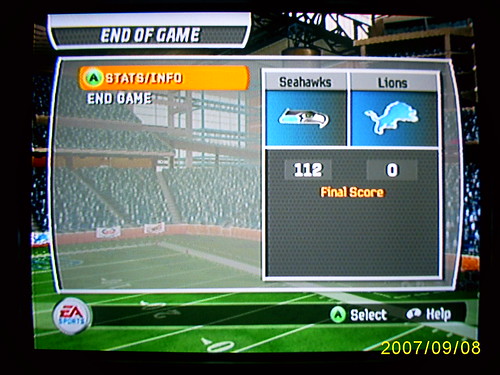
Aha!
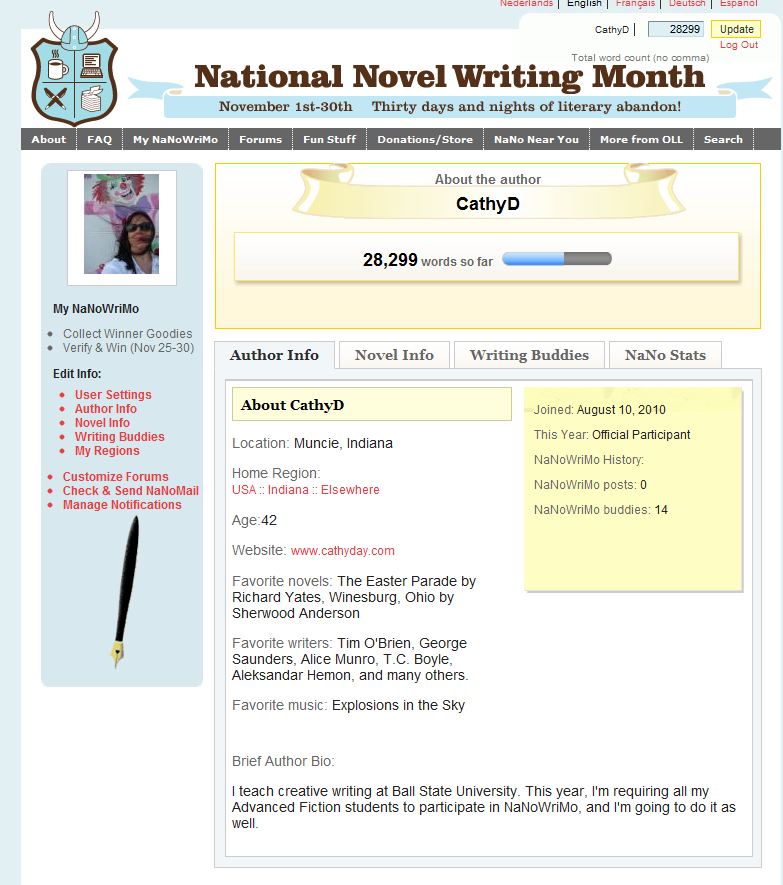
This is why NaNoWriMo is so popular with Generation Y: because it turns writing a novel into a game. A huge, dynamic multi-player game in which you accumulate words and pages instead of points.
Here's an interesting article from The Chronicle on the trend of "Gamifying Homework."
Here's an interesting talk (30 minutes long) by Carnegie Mellon professor Jesse Schell on the Gamification of…well…Everything.
Are you appalled by what I'm suggesting? Are you thinking, "But Cathy, novel writing isn't a game! How dare you suggest such a crazy ass thing!"
But anyone who has written a novel knows that, indeed, it is a game—one you play against yourself, mostly. The only way to win is to get a first draft, and you do it bird by bird, page by page, racking up words until you hit 50,000.
Game over?
No. There are many more levels, but you can't get to those levels until you hit 50,000.
[Here, my video game metaphor breaks down a bit because I know nothing about them. Sal Pane, where are you?]
For a very long time, what separated "real writers" from "wanna-be writers" was that real writers figured out some way to get the writing done. More than likely, this involved creating some kind of internal rewards system or "gamification" to tap into the motivational part of their brains. And then they crafted, yes, and they used their talents and intellects, yes, but first, they had to write a freaking draft.
Now we have have lots and lots of external rewards systems. Like NaNoWriMo. Like 750words, whose creator, Buster Benson, is a big believer in "gamification." And–oh my god–what are creative writing classes and programs but another form of external rewards?
More and more people writing more and more words. The word count keeps climbing.
You either find this up-ticking counter frightening, or you find it thrilling.
I'm the latter.



November 18, 2010
Survey Says!
This is what the survey looked like.
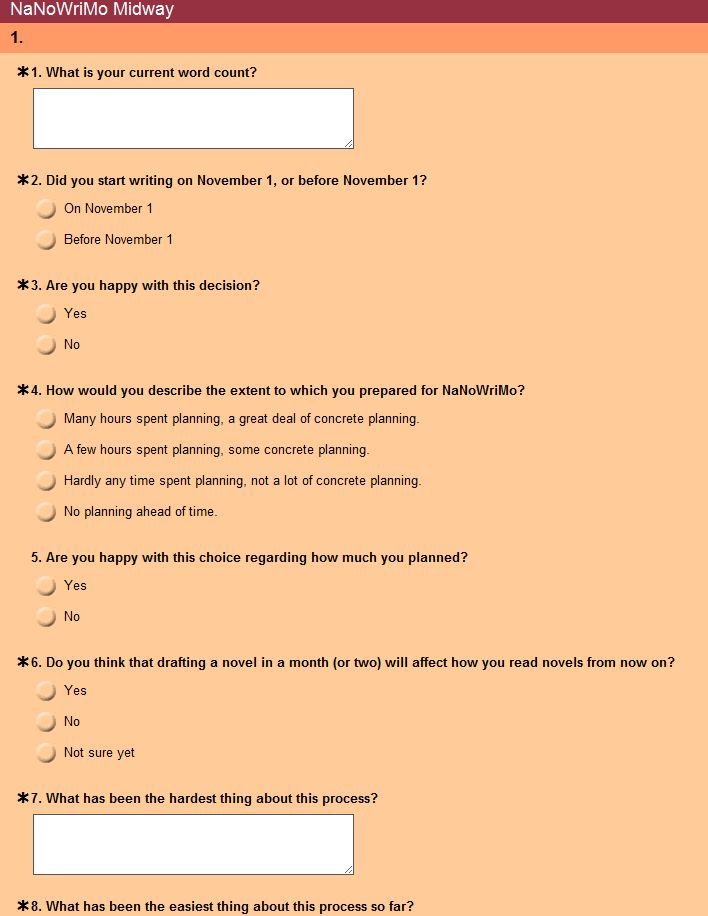
I have 15 students, and 13 of them took the survey, and I have decided to share this enormous amount of scientific data with you.
And because I am also trying to get to 50,000 words while teaching classes, grading papers, living life, and blogging about this teaching experience, I am going to post the results one or two questions at a time, along with a little reflection on those results.

Tomorrow's post: the "gamification" of writing a novel.
November 12, 2010
Writing Together

I walked around the room to find out how everyone was doing. "What's your word count?" Some people started in October and are farther along than others. At this point, one week in, they should be at about 25% of the goal or 12,500 words. Most were. Some weren't, but they recognized this and told me their plan to get back on track. I marked their progress on this handy-dandy poster I got from the Office of Letters and Light.

They settled in. Some like to use the computers already in the room, always the same one, same spot. Some bring their own laptops. Some sit on the floor. One student brings her own pillow for this purpose. They fired up their iPods. Logged into 750words.com. Opened up Word or Q10. And then they started writing. Tap tap tapping. Everyone entered the world of their story.
I have been teaching creative writing for almost 20 years, but I've never witnessed anything like this.
My students.
Writing.
Right in front of me.
Usually, this activity takes place privately, out of sight, and I am merely presented with the fruits of said activity. Over the course of the semester, I've slowly gotten them used to writing in this room, with each other. It wasn't easy. Many of them resisted, and I understand why. I've never liked writing in public places—coffee shops, libraries, etc. But I'm realizing now that there's something profoundly comforting about doing so, like the difference between practicing yoga alone vs. in a studio full of people.

Writing is a profoundly meditative activity, and to do so in the presence of others reminds us that we aren't alone in this endeavor. Anti-NaNo-ists are troubled by the idea of millions of people engaged in the act of writing—alone or in small groups, in real rooms and virtual ones—but I don't understand why they are so troubled.
This morning, I got up at 6 AM so that I could spend an hour inside the world of my book. This is my 43rd day of continuous writing. Sometimes, I rise a little earlier than normal so I can get my words in before the day begins. Sometimes, I close the door to my office for twenty minutes. Sometimes, I write in the classroom with my students. I've come to look forward to this time. Its sanctuary. Its blessing. I'm beginning to realize that writing isn't something I should associate with a physical place. Not a desk. Not a particular computer. Not a room. Rather, it's like a small garden in my head, and finding a way to spend time in that garden—making time for it—is what matters.
Everyone wrote for 70 minutes or so, and then I gently announced that class was almost over. Slowly, we all left our stories and returned to the room, returned to the real world. We looked around at each other. And then we left the room and went on with our days.
November 10, 2010
Publicity as a Motivator

The Ball State Daily News ran a story today about National Novel Writing Month.
Seriously. Front page. Above the fold.
The neighboring headline read "Sex Study places BSU 31st." And right above, there was a huge picture of Conan O'Brien. So: the editors could have led with a story about S-E-X, or a story about a HUGE CELEBRITY, but instead they went with a story about a bunch of students writing fiction.
Which is pretty awesome, I think.
It was a nice article (thanks Keshia Smith!) and it definitely got my students pumped today. They walked into class full of energy and quickly got to work. Making the front page of the student newspaper will do that to you.
This is what my classroom sounded like today. I think it's a glorious sound.
November 9, 2010
Facebook: The Pedagogy Forum
Over the weekend, I responded to a Facebook status update.
"KYLE MINOR notices that MFA programs are producing more good short story writers than good novelists. Many of my friends from many different programs have had difficulty, post-graduation moving from the short form to the long. Five-plus years into this novel, I've come to believe that the novel and the story are very different animals which might require different training."
And so began an interesting exchange, lots of writers discussing their experiences as students and teachers. One of the responders, Michael Nye of The Missouri Review, just posted his thoughts on TMR blog. You need to read this.
Any veteran of fiction workshops can tell you: the short story is a more workable and practical pedagogical tool than the novel. Nye discusses this at length. I related to many of his frustrations, both as a former student and as a teacher and mentor.
However, I remain convinced that writing programs can (and should) accommodate both long and short-form fiction. I don't agree that a writing program is only capable of teaching you how to write a short story, that graduates of fiction workshops must figure out how to write novels entirely on their own.
We can do it. We just have to start thinking outside the box we've been living in for 50 years.
Do you teach fiction writing in a creative writing program? Then read Kyle Minor's FB thread. Read the responses to Nye's blog post. Think about your own pedagogy. Talk about it here or elsewhere. If you've figured out ways to encourage novel writing in your classes, share your insights and ideas.
Because it seems clear to me that inquiring minds want to know.


![[image error]](http://www.tcd.ie/disability/projects/DS3/images/facebook.jpg)