
Cathy Day's Blog, page 18
January 30, 2011
Why I'm Watching Downton Abbey
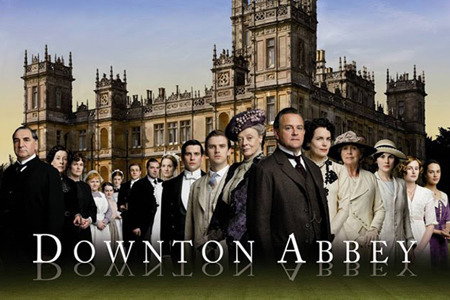 Because I'm working on a Big Thing, a work in progress that's partially set in the Gilded Age and the Edwardian Era.
Because I need to time travel. I've been reading lots of biographies, histories, and fiction of and about the period. Sometimes I feel like Christopher Reeve's character in Somewhere in Time, trying to will myself into the past. When I was writing The Circus in Winter, I practiced this same technique, immersing myself in movies and books and old-timey objects. (You wonder why the background of my blog looks like upholstery? Now you know…) In a period drama like Downton Abbey, the past is recreated with painterly precision, and I can study the brushstrokes.
Because Laura Linney introduces each episode. For episode 2, she reminds us of the limited options available to unmarried girls of modest means and how the typewriter changed lives. For episode 3, Linney discusses fashions in the context of social change, reminding us that "sometimes the engine of change doesn't roar. It just quietly sits down to dinner." The best historical fiction (on the screen or on the page) dramatizes individual lives taking place amid abstract "eras" and "movements."
Because it stars Elizabeth McGovern as Cora, the Countess of Grantham. If, like me, you've spent the last few years reading biographies of Gilded Age women, then watching McGovern is like seeing two women at once: Consuelo Vanderbilt, the real person Cora is based on, and Evelyn Nesbit, the real person turned into a fictional character by E.L. Doctorow and played by McGovern in the movie Ragtime. Cora Crawley is no Evelyn Nesbitt, that's for sure, but Cora, the heiress-auctioned-to-an-Earl, gets the happy ending Consuelo, the heiress-auctioned-to-a-Duke, never got. For further reading, I highly recommend Paula Uruburu's American Eve: Evelyn Nesbit, Stanford White, the Birth of the "It" Girl, (here's a trailer for the book) and Amanda Mackenzie Stuart's Consuelo and Alva Vanderbilt: The Story of a Daughter and a Mother in the Gilded Age.
Because of Maggie Smith. Period.
Because I love downstairs, too. The lives of the servants are just as interesting as the lives of those they serve. I hope the Bates and Anna story ends more happily than the end of Remains of the Day.
Because it's a participatory event. On Sunday nights, I follow the live tweets of @edwardian_era, also known as Evangeline Holland, "Historian, Foodie, Novelist, Vintage Fashionista, and Edwardian enthusiast," who blogs at Edwardian Promenade, a site that's been an indispensible resource to me. Watching the show + following her twitter stream of info nuggets provides an intertextual, "Pop-Up Video" experience. When the Earl teases his mother about consulting the "stud book," @edwardian_era tweets "stud book = Debrett's" and includes a link to the Wikipedia entry, where I learn that it was the British equivalent of The Social Register. Bingo! How lucky is this? This show airs just as I'm writing about the period, and experts on the period are sharing their expertise as they watch the show. Wow.
Because relationships are inherently suspenseful. As Katie Roiphe says in her book, Uncommon Arrangements: Seven Portraits of Married Life in London Literary Circles 1910-1939, "Marriage is perpetually interesting; it is the novel most of us are living in."
Because…I don't know. I don't know why I love period dramas. I asked my Facebook friends about this, and a friend suggested: "Women had much less power yet many women (myself included) can't get enough of costume dramas. Is it that we relate, primarily, to the upper classes and imagine a life in which we had leisure, servants, beautiful clothes and went to balls, as a way to indulge our romantic selves, and then we can pull back, turn off the TV, and regain our authority?"
I don't know. Maybe.
But I think it's because of something like this: Downton and Gosford Park writer Julian Fellowes was asked, "What's our fascination with turn-of-the-20th-century life about?" and he said:
"It's almost our world. When you look at something going on in 1640, you don't see a connection. But when you look at 1900, you see our world but apparently a simpler form of it where somehow everyone knows the rules, whereas we increasingly have a sense that none of us know the rules. And we're in a slight state of social chaos. And it seems beguiling to watch an ordered world where everyone knew what they were doing."
Or as Richard Drew at The Atlantic says: "For me Downton Abbey is as complex and fascinating a study of the early 20th century as Mad Men is of the 1960′s."
And the last (and best) reason why I'm watching Downton Abbey: Because it's helping me "get inside" my character, a young woman of that time and cultural milieu. In other words, I get to watch great public television and call it "research."



January 26, 2011
This is How You Do It #1: Writeshop
You need to know this: I was not talking about MFA programs in my Millions essay. Or at least, not MFA programs exclusively. I was also talking about undergraduate creative writing programs. I think it's possible (and necessary) to accommodate long-form prose at the undergraduate level, too.
How to do it: turn workshop into a writeshop.

For example:
I don't know Joe O'Connell, but he responded to a post by Dinty Moore on the Brevity blog, and I thought what he had to say about his teaching was really interesting.
"I do teach novel writing, but I call it novella writing (which may say something!). The notion is no workshopping whatsoever. Write 40,000 words in a semester after spending some time using the tools (including screenwriting) to "construct" a basic plot plan. Students are urged to come back the next semester and spend that time revising. The problem with writing a novel in a traditional workshop is the workshop part. It's too close of reading and disrupts the writing of an original draft. If it were to work, you'd have to have the draft written first. Instead get that bad draft on paper in a class."
This is basically what I did last semester in my Advanced Fiction Writing class at Ball State University. A few months ago, I described that methodology in a post titled "Note Toward a Supreme Fiction."
It's a very different approach. Basically, you don't use classroom time to discuss polished drafts, but rather as an opportunity to help students generate. The focus is on the writing process, and is more akin to a studio art class than a traditional workshop.
Note that at Ball State, our undergraduate creative writing courses aren't even called workshops. They are called Poetry Writing, Fiction Writing. Creative Nonfiction Writing.
Thanks Joe O'Connell. I'm glad to know I'm not the only one leading a writeshop instead of a workshop.
January 24, 2011
How I Taught Myself to Write a Novel
An outtake from my Millions essay. Hope you enjoy it.
My first book, The Circus in Winter, a novel-in-stories, was written over the course of twelve years—one story at a time—and thus provides a wide-ranging experience as the reader observes me trying on different aesthetic approaches. There was one narrative hurdle, however, that I couldn't seem to surmount: sustaining a plot for more than 25 pages. The book contains many big, maximalist stories that span large spans of time, even multiple generations, but I always compressed them until they fit into the short story form.
When I published the book in 2004, the inevitable questions arose: Why is that story a story and not a novel? What are you working on now? And please say it's a novel, right? I resented this insistence on novel, novel, novel until I asked myself why I felt so much disdain for the form and for its fans. People who love to read—myself included—love being "inside" a story for three days or three weeks, entering John Gardner's vivid and continuous fictional dream. Certainly this kind of loving is what brings most of us to writing fiction in the first place: the desire to create a reading experience that we ourselves value. As much as I enjoy the 30-minute thrill of short stories, I was raised on novels. I spent my youth living inside them, a perfectly normal dissociative state that allowed me to blessedly not be me for short periods of time. I think most writers are familiar with this condition, and it's one of reasons we like losing ourselves in stories—those we read and those we write.
Everyone seemed to want me to grow up and write a novel. I had an idea for one, but to be perfectly frank, I had no idea how to do more than write a short story. Then I happened upon an interview by Karin Lin-Greenberg (who would, one year later, become a student of mine at the University of Pittsburgh!) with fiction writer Dan Chaon. I'd long admired his short stories, but he'd recently published his first novel, You Remind Me of Me. How did he move from story to novel, I wondered.
Chaon said, "This seems simple-minded, but the architecture of a novel is really important. In some ways, with a short story, when you're writing it, you can just feel your way. It's like being in a house in the dark and you can find the walls and you can figure out where you're going…If a short story is like being in a darkened room, then a novel is like being in a darkened field…it was a process of finding the architecture of the novel before I even knew what was going to happen in it. The process of finding a story is more intuitive for me."
These comments resonated strongly with me. Maybe writing a novel necessitates that you know more up front—the big picture, the shape, the arc, maybe even the rough plot—unlike writing short stories, where you are strongly encouraged not to know too much.
E.L. Doctorow famously compared writing a novel to driving a car. "You can only see as far as your headlights, but you can make the whole trip that way." True for some, perhaps, but I'm one of those map loving, visual memory people who drives with at least a hazy picture of the route in her head. In writing and in life, I tend not to do well in the face of uncertainty, so, as I moved from story to book, I looked for an already mapped narrative route.
For me, the answer was to write a nonfiction novel. Instead of wondering fearfully what would happen past page 25, I started with an already lived plot, the architectural bones around which I shaped a novel-length reading experience. I embarked on my next book project in the investigative mode of documentarian—accumulating 350+ pages of very raw material/journaling/"footage" over the course of a year, followed by an intense six-months in the editing booth/at the word processor. (I can't tell you the joy I felt inside when I saw numbers like "52" and "173" appear in the top right corner of my document.) Then, I spent a few more months on final edits, and boom, I'd written a book in two years. This was Comeback Season, a book that didn't do well, really, but from which I learned a great deal.
Twelve years spent trying to write one perfect sentence after another, one perfect story after another, vs. two years spent (first!) writing a really shitty first draft, followed by (second!) revising that shittiness, and (third!) editing, tweaking, cutting, clarifying, controlling, polishing that shitty draft into a shiny new book of which I am extremely proud.
Next time: the first in the series, "This is How You Do It."*
*"It" = better encourage and accommodate big projects within a semester, within a busy life.
January 22, 2011
Who says that nobody cares about creative writing pedagogy?
I'm still trying to process the response to my essay in The Millions, and all I can think to say is: holy shit.
Thanks to analytics and Google Alert and trackbacks, I've been able to follow much of the unfolding conversation. A dialogue has begun. This makes me happy.
I learned a lot this week. It was sort of like going to AWP without having to go to AWP. It was a standing-room only panel in an enormous hotel ballroom, the inspiring kind of panel that recharges your soul-weary batteries.
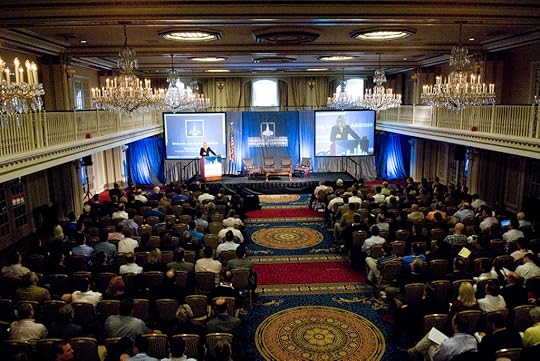
I laughed! I cried! It was better than AWP!
What's clear to me is that many, many people in this world identify as writers, and they're all working to lead literary lives. Many have experienced some form of creative writing instruction, and thus, they have very strong feelings about pedagogy and creative writing curriculum—even though they might not use those terms to describe those feelings.
How do you change the default setting of the traditional workshop so that big things can be brought class and discussed meaningfully? Twice in the essay, I provide bad examples, how not to do it.
Okay. Very funny. So how DO you do it?
The first draft of my essay described the ways in which I've been trying to practice what I preach—in the classroom and in my own writing life—but I cut it. The essay was getting really long. I opted instead to include a link to this blog.
Please, check out my previous posts (Tags/Topics)and consider subscribing. [See right column.]
I will post at least once a week about teaching and writing big things. I will endeavor to make these posts worth your while—and believe me, I know you already have too much to read.
Many creative writing students and teachers responded to my essay by sharing their own experiences and best practices. For the next week or so, I'm going to make frequent posts highlighting those.
I'm calling this series: This Is How You Do It.
Thanks for being here.
January 17, 2011
Pedagogy Disguised as Humorous (But Completely Serious) Essay
[The composition history of my essay, "The Big Thing," up at The Millions on 1.18.11.]
In January 2010, I write an informal mini-lecture to deliver to my graduate fiction workshop.
I adapt said lecture into a real, honest-to-goodness pedagogy article (with end notes and everything). I submit this article to the AWP Writers' Chronicle (30,000 subscribers), a magazine that should be familiar to anyone who resides in or emerged from a creative writing program.
A few months later, I receive word that AWP is considering my article for their pedagogy forum on their member-only, password protected e-Link.
Wow. I had no idea there was such a thing as the AWP Password-Protected Pedagogy Forum. It contains many great "exclusive" articles about teaching. In particular, I admire "Toward a Pedagogy of Process for the Creative Writing Classroom" by Jenny Dunning and "More Than Just Mentorship and Modeling: Creative Writers and Pedagogy" by Gerry LaFemina. Here is the link. I hope you can access it.
Unfortunately, AWP decides not to publish my essay. Not in the print Chronicle. Not in their Password-Protected Pedagogy Forum.
Damn. [feel disappointed]
Okay. [get over feeling disappointed]
Make important realization. An essay about Novel Writing can be submitted to a magazine like Poets & Writers, Writer's Ask, Fiction Writer's Review, etc. But an essay about Teaching Novel Writing cannot, because that's pedagogy. And nobody likes the p-word.
But…every time I post a status update on Facebook about teaching, I get beaucoup notifications. Everyone I know (granted, a particular segment of the population) wants to learn more about teaching creative writing, but nobody seems to know anything about the AWP Password-Protected Pedagogy Forum.
Instead, everyone is still talking about Louis Menand's New Yorker essay/review of Mark McGurl's book, The Program Era.
Anis Shivani publishes a provocative article on MFA programs in the Huffington Post. [dialogue/shitstorm ensues]
What to do with my pedagogy article? A colleague suggests that I submit it to Pedagogy: Critical Approaches to Teaching Literature, Language, Composition, and Culture. This publication would "count" as serious scholarship. But if my creative writing teacher friends can't find the AWP Password-Protected Pedagogy Forum, will they ever find my article in Pedagogy? I mean, College English devoted its January 2009 issue to Creative Writing, and wow, didn't THAT just rock the world. [no dialogue/silence]
On The Rumpus, Anelise Chen publishes "On Blowing My Load: Thoughts from Inside the MFA Ponzi Scheme." [dialogue/shitstorm ensues]
Someone suggests that I send my pedagogy article to Creative Writing: Teaching, Theory, and Practice. Again, wow. I had no idea there was such a thing, and again, I find great essays about teaching creative writing. But no one hangs out at this journal which has been around since 2008. Its online forum contains two topics and a total of seven posts. Meanwhile, over at HTMLGiant, Roxane Gay writes an essay about teaching and receives 73 comments, a response which represents but a small fraction of the number of eyeballs that have been on that piece.
Inspired by other writers (here and here and here and here and here and here) who occasionally blog about or share info about their teaching, I start a blog called "The Big Thing" to talk about my experiences teaching a novel writing course in which all class members (including myself) participate in National Novel Writing Month.
Anis Shivani publishes a provocative article on the Huffington Post. [dialogue/shitstorm ensues]
One night, a writer friend of mine posts a casual Facebook status update in which he muses about the difference between writing short stories vs. novels. Do the two forms require different kinds of training? [dialogue ensues]
Okay. Okay. I decide to revise my pedagogy article into something more provocative so that my ideas can reach a wider audience. I hope that a dialogue will ensue. Not a shit storm. [feel nervous]
I give a talk at a writer's conference about my "Big Thing" ideas. Someone comes up to me afterwards, a writer who is well known as a teacher of creative writing as well. I tell her the story I've been telling you, and she shakes her head knowingly. "No one wants to publish essays about teaching," she says, "but everyone I know is absolutely desperate to read them."
Anis Shivani publishes a provocative article on the Huffington Post. Ibid.
I finish a draft of "The Big Thing: 10 Thoughts on Moving from 'Story' to 'Book'" just in time for a reading at the University of Illinois. Perhaps the audience came expecting fiction or maybe some memoir. Instead, I give them Pedagogy Disguised as Humorous but Completely Serious Essay. Despite this, people seem to like what I am talking about. [feel jazzed]
Slate publishes an excerpt of Chad Harbach's n+1 essay, "MFA vs. NYC." Harbach says, "The MFA system also nudges the writer toward the writing of short stories; of all the ambient commonplaces about MFA programs, perhaps the only accurate one is that the programs are organized around the story form." [dialogue ensues]
What do teachers of creative writing have to say with regard to these matters? Not a lot. Probably because we are absolutely up to our eyeballs with work to do. Classes to teach. Manuscripts to review. Manuscripts to write. When we have a free second, we chatter on Facebook about it or in the comment threads on blogs. We make xtranormal videos. We vent. We feel self-righteous. How dare anyone impugn our discipline!
Why don't we take the time to write something long and well-considered? Why don't we write about our teaching? What do we call a piece that's about teaching, about the classroom, but isn't pedagogy and isn't a how-to craft essay? Will it count for tenure and promotion? And who will publish it? Who will read it, for godssakes?
I think about all this for a long, long time. And then I send the essay to The Millions. And a few days later, they say yes.
I hope you like it and will share it with others. [dialogue ensues]
December 12, 2010
FAQ
So Cathy, what happened? How did your students do?
I'm so sorry it's taken me awhile to update you! The end of NaNo is also the end of the semester, a busy time, as I'm sure you know.
Okay: FINAL RESULTS.
15 students
12 reached 50,000 words. Four of 12 started October 1. Everyone who started October 1 finished. Eight of 12 started November 1 and also finished. Most spent the month/s writing toward the novel they planned to write, but a few students started writing towards another project when one idea petered out.
Three did not reach 50,000 words. One came within 5,000 words. Another came within 12,000 words. Another stopped generating new words at the midway point and started revising.
So did the students who failed to reach 50,000 get a bad grade?
No.
The 12 students who reached 50,000 words got full credit, 100 points. The students who did not reach 50,000 did not get full credit, but still received 90 points, an A-.
When I created the syllabus, I made "NaNoWriMo Completion" worth just 10% of their grade. I wanted their NaNo performance to be about something other than Writing for the Grade.
However, I did not reveal how many points they would receive out of 100 if they "lost" NaNo either.
Honestly, about midway through the month, I expected the students who were falling behind to pin me down on this. "Professor Day? If I don't reach 50,000 words, how many points will I get? If I only get halfway, will you give me 50 points? Zero points?" But, to their credit, they never asked me, so I didn't talk about it. I just kept saying, Keep trying. Keep going.
Did they write from scratch, as NaNo encourages?
Yes and no. It was up to each student. Some students started from absolute scratch, others wrote towards ideas and plots and characters that had been germinating for awhile. One student said,
"I pulled out a stack of short stories I wrote in high school. Each was short, no more than five pages double-spaced and they concerned a high school student living in California with her lawyer mother and her socialite aunt. Since I was already familiar with each character, and since a novel concerning the three had been marinating in my head for years (I even based a half-finished screenplay on my stories once) I deemed this a feasible world to write about."
What kind of novels did they write?
One wrote a novel of psychological and aesthetic realism, akin to What's Eating Gilbert Grape and The Outsiders. One wrote an epistolary novel akin to The Perks of Being a Wallflower (which we read as a class) and Go Ask Alice (her favorite book). The rest wrote some form of genre fiction. There were many speculative, science fiction stories about time travel, the mind and identity, dystopian futures. There was some fantasy. There was mystery and suspense. Two students ended up writing toward nonfiction projects rather than fictional ones: one student worked on a memoir, an account of a trip he'd taken to another country, and the other wrote worked on an immersion memoir, an account of her November preparation for a very important qualification exam.
So, how well did they write? Did they cheat?
On December 1, each student sent me the Word doc file that contained all their NaNo writing. I opened each file, scrolled around a bit to make sure that all the words were legitimately theirs—not cut and pasted text from Wikipedia. All of it was legit. The quality varied widely from somewhat unreadable, very rough (my own 50,000 words could be described as such) to very readable, very decent prose, which is incredible considering how fast they were going. This "readability" quality seemed to depend on how much thinking/planning/writing they'd already done toward the project, but ultimately, readability and writing quality were not the desired outcomes anyway.
So, if you're not grading the quality of their writing, what the heck are you grading?
Here's the breakdown:
Process Blog 20%
Book Report 1 20%
Book Report 2 20%
Participation 20%
NaNoWriMo Completion 10%
Revision of NaNoWriMo piece 10%
What is a Process Blog?
Simply, it's a class blog where students chart their progress transparently. They don't just talk to me. They talk to each other. Over the last few years, I've been introducing emerging media technologies into many of my classes. This has been a significant ongoing project: integrating into my teaching practices the lessons I'm learning as a working writer in the 21st century. Blackboard allows me to create a closed social media environment that builds camaraderie and community, a fertile environment for risk taking among students. You might ask why not use Blogger or WordPress so that you could "follow" our process discussion? Interesting in theory, but I think asking students to post to an open blog rather than a closed one might change what they say, what they write about, what they'd be willing to share.
From my syllabus:
"Imagine that each of you has requested to work with me on an independent study project, a Big Thing. I want you to write a description of your project, a faux independent study proposal, and the Process Blog is a virtual meeting place, a transparent journal, a think space where you'll post, update, and maintain information related to your project. Every week or so, you will be required to check in with the process blog and take stock. 'What did I do this week toward my project?' The process blog is the place you go to talk to me (and everyone else) about your project and your process."
What is a Book Report?
These reports were worth a combined 40% of their grade, and thus, much was expected. Each report involved a four-step process in which students create their own learning activity.
The first step: Identify the technique you want to study, something you struggle with and know you need to focus on. Creating emotionally complex characters. Transitioning between scenes and chapters. Structuring a plot over X number of days/weeks/months/years. Creating suspense which leads to a "surprise ending" that actually works. Grounding dialogue so that it's organically integrated into the scenes.
The next step I call "Taking Note" in which you don't just passively read the book, but also take notes as you read—in the book or on your own. It helps you notice things you don't always notice while "just reading" and helps you identify and mark patterns, rhythms, recurring motifs, echoes, chronology, the passage of time, the introduction of characters and ongoing subplots, themes, conflicts, characters.
Next, they write what I call a craft analysis (3-6 pages) that responds to these prompts: What did I learn about X from reading this book? How can I apply it to my own writing or to my reading of the work of others? Why did the author approach X this way and not another way? How would different narrative decisions produce different effects?
The last step is to produce a visual aid, an artifact that represents your physical interaction with the book. An outline, storyboard, collage. A transcription to get the "feel" for the style or voice. You should do whatever you think will be useful. This is shared with the class—because what you find might help someone else, because what you find might help us read your work better
What books did your students read?
Haven Kimmel, A Girl Named Zippy
Haven Kimmel, Something Rising (Light and Swift)
Stephen Chbosky, The Perks of Being a Wallflower
Jack Kerouac, On the Road
+ one book of their choice
Haven Kimmel is a native Hoosier and a Ball State alum, and so it was really amazing to have her visit campus right before NaNo. A Girl Named Zippy provided a good model of a non-linear narrative, a way to write a novel as a collage rather than as a straight line. I chose the Chbosky book because the subject matter is 'relatable,' it's got a discrete timeline (one school year), and it's got what my colleague Matt Mullins calls "Two Plots," the suspense plot (the scenes that dramatize Charlie's life and build tension) and the emotional plot (the internal character arc, the change Charlie undergoes). I've already talked about using Kerouac here.
Also: each student was allowed to pick a book that most directly matched their particular needs for their NaNo project.
What did your classroom look like day to day, week to week, month to month?
We spent most of September and October discussing the assigned books. If you had walked past my classroom on most days, you would have thought it was a typical English class. But I set aside a few class periods as "Studio Days," time devoted to students working individually or in small groups on their Book Report or NaNo Prep. On some Studio Days, I provided focused prompts and we typed, generating character profiles and short scenes. Some days, we simply "sprinted" just to gauge how fast or how slow we tended to write, depending on the circumstances. Studio Days helped us acclimate to writing in that room with each other.
During November, the class became a writeshop. Students signed the attendance sheet, checked in with me to update their word count, listened to my announcements, and then spent the hour typing furiously. Once, I surprised them and asked to see the words they'd generated that day, which they sent in an email. But for the most part, I removed myself from their writing process. I wanted them to turn off their Internal Editor, that pesky voice in your head that leads to writer's block. I wanted them to write for their own pleasure and edification. I did not want to be a voice in their head until December.
On December 1, they turned what remained of their energy toward producing a good first chapter or excerpt of 10-25 pages. They gave this excerpt, along with a novel synopsis, to their peer group (three people) and spent time "workshopping" each other's novels and talking about what to do next. I read over all these excerpts very quickly—two days with about 150 pages—and provided one or two suggestions about how to polish the excerpt further.
Now what happens?
Tomorrow, December 13, 2010 at 4:30 is their scheduled final exam. They will post these synopses and excerpts to the Process Blog. The process isn't over. They haven't written novels yet, and they understand that. But those polished pages do represent a milestone, and as anyone who has ever written a novel or run a marathon can tell you, milestones are pretty powerful things.
Next post: "No More NaNo." Why I won't be "doing NaNo" again. Not officially, at least.
December 3, 2010
Finding Time for a Big Thing
The last two questions on the midterm Survey Monkey survey I gave to my students:
What has been the hardest part of this process? What has been the easiest part of this process?
Far and away, they said the hardest part was finding the time to write:
"Making time within the day to write. I have so many things going on."
"Sitting down and actually writing… I get distracted by online quizzes and video games easily."
"Actually finding the time day to day in order to write."
"making myself sit down and do it"
"Writing without distractions has proven difficult."
"Exhaustion. Approach-avoid conflict."
"Keeping up with the writing."
"Scheduling time to make up missed days."
"Forcing myself to write."
"Finding the time to write."
You might be surprised by what they said was easiest. (Here's a sampling.)
"Writing it. I just find it enjoyable and I love taking time off from homework to do it. In fact, I stopped calling the writing process homework. I just find it too much fun to consider it in that category."
"When I get going, I usually don't stop unless I have to go do something. Also, writing directly after amputating the words 'distraction' and 'road-block' from my vocabulary. Sitting down and writing 2,000 or so words an hour every class period has helped immensely."
Many students said they would have liked "more guidance on how to find the time to write."
I laughed. Well, duh. Limit or eliminate television, gaming, and Facebook, and you're golden. The request made me cranky. It's not my job to teach you time management skills! But then I realized that, yeah, it sort of is—given the unique nature of the course.
A former student of mine who lives and works in San Francisco just started participating in #Reverb10. It's kind of like 750words + New Year's Resolutions. Each day during December, Reverb10 sends you a writing prompt, which my student is using to reflect on her life generally and her writing in particular. She's sharing these reflections on her blog—>sharing your journey is part of the point—>you send out "reverberations."
Her prompt for December 2 was "Writing. What do you do each day that doesn't contribute to your writing — and can you eliminate it?" She outlined a typical day and took a good hard look at how she spends her time. Next time, as part of our preparation for this course, I will require my students to outline their own days and take a good hard look at how they spend their time.
(Actually, why not do this in all my creative writing classes?)
Even if you don't become a writer in the long term, even if you don't finish the novel you drafted, you learn a lot from participating in NaNo. It reveals with startling (sometimes painful) clarity the reality of how you spend your days. 
How do you find the time to write 50,000 words in a relatively short period of time? Well, how do you incorporate any big thing into your life? Said "big thing" being novel writing, having a baby, caring for a dying parent, taking a second job, studying for the bar exam, taking 1,000,000 pictures, training for a marathon, traveling to every country in the world, eating a healthy, well-prepared meal every single night, etc. You find time, make time, create time. Or you don't.
Recently, The Fiction Writers Review asked the incredibly productive writer Benjamin Percy this question:
"You've got this novel coming out. Stories keep popping up in magazines. You teach at Iowa State University and in the low-res MFA program at Pacific University. You contribute to Esquire and other publications. How do you balance it all and still find new material and time to work on your fiction? How do you stay in the ring, to reference another of your P&W articles?"
Ben said:
"You're forgetting the hardest job of all: I'm father to two young children. I don't sleep: that's the answer. Five hours a night sometimes. My blood type is caffeine. I never take it easy—I'm always working, always writing or editing or grading. Even when I'm supposedly relaxing, I'm not. If I'm at the gym, I'm listening to an audiobook. If I'm watching a movie, I've got my notebook out and I'm jotting down ideas. If I'm out in the yard with my kids, I'm pushing around sentences in my head. People often seem to view writing as an indulgence, but I operate under the belief that you must give up all indulgences if you want to write seriously. I used to think this was a calling—that's too romantic of a term. I'm fairly certain that I'm driven by obsession."
For some, the answer isn't how to do more with less time, but to alter one's life, to make it more outwardly simple in order to live more richly.
In her novel, The Maytrees, Annie Dillard writes:
She took pains to keep outside the world's acceleration. An Athenian marketplace amazed Diogenes with, "How many things there are in the world of which Diogenes hath no need!" Lou had long since cut out fashion and all radio but the Red Sox. In the past few years she had let go her ties to people she did not like, to ironing, to dining out in the town, and to buying things not necessary and that themselves needed care. She ignored whatever did not interest her. With these blows she opened her days like a piñata. A hundred freedoms fell on her. She hitched free years to her lifespan like a kite's tail. Everyone envied her the time she had, not noticing that they had equal time.
A few months ago, the New York Times ran this piece, "But Will It Make You Happy?" which seemed to strike a cultural chord. I know it certainly did with me.
Finding time to write wasn't something I thought about until I was no longer in school. Suddenly, the external structure that had guided my writing life up to that time was gone. NaNoWriMo teaches valuable lessons about personal development and life planning, knowledge that students can keep for life, the ultimate transferable skills.
Next time, I'll talk about why I'm NOT going to formally engage with the National Novel Writing Month headquarters next year.
Yes, this probably surprises you. It surprises me, too.
November 28, 2010
Notes Toward a Supreme Fiction
Question 3: How would you describe the extent to which you prepared for NaNoWriMo?
Many hours, lots of concrete planning 5
A few hours, some concrete planning 6
Hardly any time, hardly any planning 2
No time, no planning 0
Are you happy with the amount of time you spent planning?
Everyone was either glad they'd planned or wished that they had planned more. Except for one person who planned a lot and hadn't gotten very far at that point. S/he skipped the question.
Writer, Know Thyself: Are You a Plotter or a Pantser?
NaNo says there are two types of novelists: plotters (those who plan) and pantsers (those who write by the seat of their pants). I strongly encouraged my students to be plotters, but that's because when it comes to writing a book as opposed to writing a short story, I'm definitely a plotter. But I didn't demand that they plot just because that's what makes sense to me. Like Richard Hugo said in The Triggering Town, "Every moment, I am, without wanting or trying to, telling you to write like me. But I hope you learn to write like you. In a sense, I hope I don't teach you how to write but how to teach yourself how to write."
This topic—how much to prepare—was a big topic of discussion in our class in the months leading up to NaNo. Many of my students were afraid to do too much planning. They didn't want to take all the fun and joy out of actually writing their novels. Some believed that "writing with a plan" was cheating somehow.
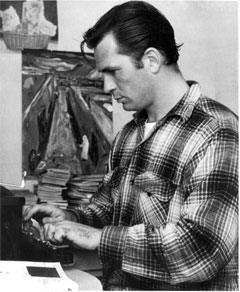
On the Road
as NaNo Novel
To that end, we read On the Road and a wonderful essay on its composition history by Howard Cunnell, "Fast This Time: Jack Kerouac and the Writing of On the Road," which refutes the perception that Kerouac "pantsed" that novel. Contrary to popular belief, it wasn't the product of a semi-magical, drug-induced twenty-one day binge writing session, but rather a fourth draft; three "proto novels" exist. And Kerouac didn't compose the "scroll version" in 1951 off the top of his head. As he typed, he was surrounded by notebooks, journals, correspondence, and previous typescripts.
No matter what you think of On the Road, teaching this novel (or just an excerpt) along with the Cunnell essay are great pedagogical tools to dispel commonly held myths about the writing process.
I would not, however, recommend teaching "The Scroll Version" in addition to or in place of the published version of On the Road. There's not a big enough difference between the scroll and the published book to generate much discussion. In fact, I think I unwittingly reinforced the idea that a novel written in one month can be and should be published almost as is, which is definitely not what I wanted to do.
Storyboarding 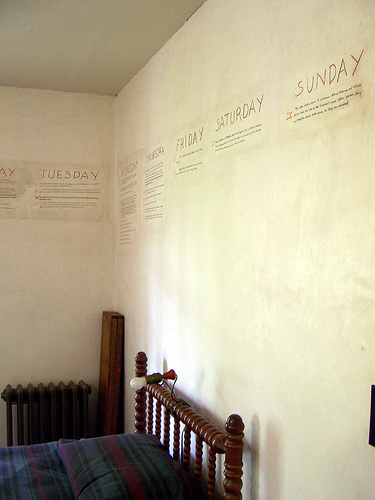
Photo by Rachel Norman
I encouraged my students to storyboard their novels, to concretize their plot in broad strokes. We looked at lots of examples.
Anne Tyler's famous "index card method."
Even Faulkner storyboarded, as you can see in the photo above.
I pointed them to lots of resources: old-fashioned index cards or post-it notes or storyboard sheets, and new-fangled programs for their computer.
For the Plotters
I provided them a formula. Yes, a formula. When attempting something this large, it helps to have a blueprint, a map, some kind of guide so you know what you're writing toward. Syd Field's "Paradigm Worksheet" worked great for this purpose.
I asked my students to consider:
What's the basic story? Roughly, what do you think is going to happen? Beginning, middle, end.
How much time will your novel cover? One week? One month? One year? Five years? Fifty years?
Students came in for conferences. They were required to fill out a paradigm worksheet, inserting their own plot points.
[image error]
However, if they needed to adapt the worksheet for their own purposes, that was fine. If they needed to write a narrative synopsis instead, that was fine. If they decided NOT to fill this out, they needed to talk about why. Did they firmly believe that pantsing was the way to go, or were they "default pantsing" because they hadn't given themselves time to plot?
This month, I saw many of them begin our in-class writeshops with something sitting next to the keyboard. An outline. An index card. A chart.
For the Pantsers
Some of them, however, didn't have anything next to the keyboard.
The editors of Wired magazine suggest that, at the very least, you end each day's writing session with a note to yourself about what to write the next day. "Having the scenes for tomorrow in your head today will give your brain time to work on it even when you aren't thinking about it directly. In fact, you may well find yourself dreaming about your novel, working out ideas in your sleep."
Writer Timothy Hallinan describes his process as a few months of what he calls "noodling around."
Long before I begin to write a book, I begin to write about the book. I just open up and let it flow – no censorship, no self-criticism, no pressure. I write about the problem, the setting, the characters. I write biographies of the characters. I let them write about themselves, in the first person. I do a lot of work on what's at stake – what it is, why it matters, how each of the major characters stands on it. (I may even diagram that.) What's the worst that can happen, and to whom? What's the best possible outcome? I make notes for possible scenes and, just for the hell of it, drop my major characters into those scenes and let them begin to talk to each other. (Quite a bit of this material later gets cut and pasted into the book, and then revised as necessary.) I give myself permission to make mistakes.
This is the kind of writing that isn't always encouraged in creative writing classrooms.
Because how do you grade it? Who does this kind of writing mean anything to–except the writer herself? Is it "real" writing? When you're writing about your book, does that count the same as actually writing your book? At what point does one become the other?
Hallinan says that usually after pantsing around for 100 or 200 pages, he realizes he's writing the opening scene of the book, and that's the moment he knows that's he "really" writing a book, although he still may not know what's going to happen.
Hmmmm….NaNoWriMo asks participants to write 50,000 words or about 175 pages.
In a few days, my students will send me the file that contains all the writing they did during November, and I really don't care whether it was plotted or whether it was pantsed. Whether it's the end result of scrupulous planning or determined noodling. I don't care if that document is a Supreme Fiction or merely Notes toward a Supreme Fiction. It can be abstract. It can change. And as long as it gives pleasure, the effort, it seems to me, was worthwhile.
November 26, 2010
MFA vs. NYC = Team Short Story vs. Team Novel

In his book, The Program Era: Postwar Fiction and the Rise of Creative Writing, Mark McGurl says that it's time we paid attention to the "increasingly intimate relation between literary production and the practices of higher education."
So. This is me. Twenty years as a writer-teacher. Finally paying attention.
Apparently, I'm not the only one wondering whether the creative writing classroom can accommodate Big Things.
Here's Michael Nye at The Missouri Review blog, where even Peter Turchi weighed in with a comment.
Here's another response.
HTMLGiant noticed.
And today I read this fantastic essay on Slate, "MFA vs. NYC: America now has two distinct literary cultures. Which one will last?"
Novelist and n+1 editor Chad Harbach says:
The MFA system also nudges the writer toward the writing of short stories; of all the ambient commonplaces about MFA programs, perhaps the only accurate one is that the programs are organized around the story form. This begins in workshops, both MFA and undergraduate, where the minute, scrupulous attentions of one's instructor and peers are best suited to the consideration of short pieces, which can be marked up, cut down, rewritten and reorganized, and brought back for further review. The short story, like the 10-page college term paper, or the 25-page graduate paper, has become a primary pedagogical genre form. It's not just that MFA students are encouraged to write stories in workshop, though this is true; it's that the entire culture is steeped in the form.
[image error]
I highly recommend that you read this piece, an excerpt from n+1. For one thing, Harbach suggests (rightfully so) that without "MFA program culture" to offset "NYC publishing culture," the short story might cease to exist at all. For another thing, it's a useful paradigm. MFA vs. NYC might seem reductive, but it expertly frames the difficulties of making a literary life in the late 20th but especially the late 21st century.
As I think about my cohort, the "second generation" of writers-teachers who will one day take the leadership reins of AWP and academic writing programs, I wonder (perhaps more than I should) about the future of creative writing instruction. Forty years after the first generation of writer-teachers established our curriculums and classroom practices, what have we learned? Where are we going? Where have we been?
Harbach wonders this, too.
It will be interesting to see what happens when this group of older writers dies (they are unlikely to give up their jobs beforehand); whether the MFA canon will leap forward, or back, or switch tracks entirely, to accommodate the interests, private and aesthetic, of a younger group of writer-teachers. Perhaps (among other possibilities) the MFA culture will take a turn toward the novel.
And now, back to my novel…
November 21, 2010
Changing Habits During NaNo
Survey Question 2: Did you start writing on Nov. 1 or before?
9 students started on Nov. 1
4 students started before Nov. 1 (sometime around Oct. 1)
Are you happy with that decision?
All the students who started on Oct. 1 are happy with that decision. And they are all cruising right along, almost done.
Of the 9 students who started on Nov. 1, five are happy with that decision and four are not. Not surprisingly, the four who are not happy with their decision had the lowest word counts.
In an earlier post, I talked about why I encouraged my students to start NaNoWriMo on October 1 instead of November 1, so I won't rehash that here, except to say that next time I do this project (and I will do this again) I am going to mandate that everyone starts on Oct. 1. It's just more reasonable to ask students to write about 850 words a day than it is to ask them to write 1667 words a day while taking classes, working, etc.
Besides, writing 50,000 over the course of two months rather than one instills a far more practical lesson in young writers: that it's better and easier and healthier to do a little writing every day.
I'm serious people: doing this NaNo thing as a class activity is very, very enlightening. It forces students to confront their writing process–or lack thereof–in ways that would never happen otherwise. My god, it's forced ME to confront my writing process—or lack thereof—in ways that should have happened years and years ago.
I've been teaching craft for years, but I've never really talked with students about time. How much freaking time it takes to write a book. Probably because until recently, I was just like my students, writing without a regimen of any kind.
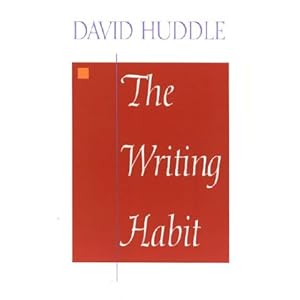
In The Writing Habit, David Huddle says:
"The major difficulty a writer must face has nothing to do with language; it is finding or making the circumstances that make writing possible. The first project for a writer is that of constructing a writing life."
Later on the Survey Monkey survey, I asked my students, "What has been the hardest thing about this process?" The responses were almost unanimous: finding or making the circumstances that make writing possible.
Before NaNo, one of my students said she planned to create that circumstance by finishing all her homework so she could focus solely on her writing. I told her, "I used to think that way, too. But that's a sure way to never write. Because the desk will never be clear. You'll never get all your work done, and besides, even if you do get it all done, you'll be so tired and brain dead, you won't have any energy left to write. Write during your good hours."
Write during your good hours. That's advice from Huddle, too.
"If you're a would-be writer, what you need to find out is not how someone else works but how you are inclined to work. You have to determine your good hours, the writing tools and the writing environment that best suits you, the limitations you can overcome and the best methods for dealing with the limitation you can't overcome. You also have to become aware of your inclination toward laziness, dishonesty, glibness, and other personal foibles. You have to become skillful at outwitting those negative aspects of your character."
Turning my class from a workshop into a writeshop has created the circumstance that makes writing possible for 16 people, myself included. And that's a good thing.
In The Writing Habit, David Huddle describes his "Lake St. Clair Experience," a few productive months he spent writing in solitude, which "demonstrated to me what it felt like to have a real writing life…I have never been able to duplicate that experience, but because I had it that once, it gave me something to aspire to again."
Will my students continue writing a little each day even after NaNoWriMo and the semester are over? I don't know. I hope so. But even if they don't, I'm glad they've had a version of their own Lake St. Clair experience.
Next time: Plotting a novel vs. "pantsing" it


![[image error]](http://www.iowow.com/Images/FAQ.jpg)
![[image error]](http://www.scriptxray.com/wp-content/uploads/2010/03/photo1-300x225.jpg)
![[image error]](http://www.greenturtle.com/images/i%20love%20new%20york%20t%20shirt%20ndf10500m.jpg)