
Cathy Day's Blog, page 17
February 27, 2011
This is How You Do It: John Vanderslice (Part 2)
Part 2 of my talk with John Vanderslice, a fellow writer-teacher who is experimenting with new ways to incorporate Big Things into the creative writing classroom. (You can read Part 1 here.)
So, what did you do the third time you taught the course?
During Fall 2010, I ran the class in a radically new way. Instead of just beginning novels over the course of one semester, the students would begin and finish them. Period.
That's definitely a challenge. I didn't take it that far.
I set a specific word count goal for their projects—55,000—and gave them weekly word count goals as well. Every week one of the first things I did was to check their word counts—fortunately, they all had laptops or could plug a flash drive into a computer.
I found 750words.com to be really helpful in verifying word counts.
In order to keep my students on track, I had to radically rethink the week-to-week activities. The emphasis had to be on production, not workshopping. In fact, I dropped the "all-class workshop" altogether. This course met once a week in the evening, and every single week, no matter what other activities were on the schedule, we spent the second half of class writing. I just said, "Okay, for the next hour and a half you can work on your novels." And they did. In fact, what I actually told them was that we would take a short break (as is typical of three hour night classes), recharge, then come back and start writing. But most of my students proceeded to open up their laptops and begin writing immediately. They wanted to use every second possible to work on their books.
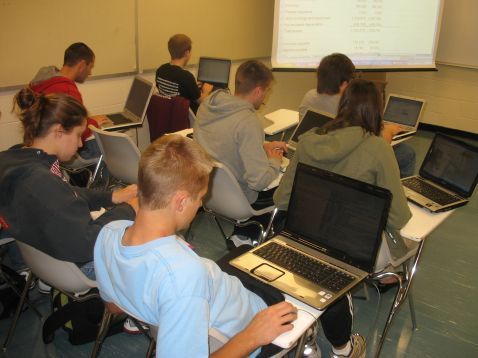
It's kind of awesome to see that, isn't it? What did the first half of each class look like?
The class read two short novels that I thought would be both instructive and illuminating. We discussed those books, or we discussed chapters in our novel-writing textbook. Otherwise, they did peer review. Given that the title of the class was Novel Writing Workshop I felt responsible to build in some mechanism in which the students could get some feedback on their projects. But I wanted a mechanism that was less threatening and less prescriptive than the typical workshop session.
How did you do that? I sometimes find it hard to get students on board with the idea of a descriptive, supportive workshop.
I broke the class into groups of two or three. They emailed their pages to the group in advance of the scheduled Peer Group sessions. They shared ideas, impressions, reactions. No written critiques were required, although they weren't forbidden either. I left that up to the individual groups. My only explicit instructions were that they NOT get hung up on line editing. Commenting on another student's spelling or grammar was forbidden. What they were supposed to focus on, I said, was not criticizing but understanding and providing support, maybe even ideas.
This has always been my biggest hang up. I feel like if I am not personally at the center of a critique session, the students won't learn anything. Which is both true and not true, of course.
Not all the peer review groups were terribly helpful on a response level, but almost all my students were glad the groups existed. They were glad to have some kind of audience for their novels—they didn't want to write in a complete vacuum—and they also thought it was very valuable to be responsible to someone else for the word counts. In other words, if they didn't meet the word count they wouldn't just be letting me down they would be letting down their peers.
You were writing alongside the students, too. Did you submit the novel you were working on for peer review, too? Were you in one of the peer groups? Or were you reading everyone's pages all along? This is what most teachers who are willing to try this want to know: how to provide students some feedback without getting buried.
Yes, I participated in one peer review group. It only seemed natural that if I was going to write a novel along with the students that I would join in the peer review. So I read the work of the two students who were in my peer review group as they sent me their sections, but I did not read any of the other student's novels, not while they were progressing. It would have been simply impossible for me to read all that and respond given my other teaching duties. But that's hardly a reason not to have the students take on an assignment—like writing a novel—that can be very valuable to them. I think that as teachers we sometimes exaggerate our importance, as if the students can't survive or produce without our feedback. That's simply not true, especially if the class is full of third and fourth year majors. In a reflective piece one of my students wrote at the end of the semester, he mentioned that what he liked about the class was the students were kind of teaching themselves. He found that refreshing.
What novel-writing book did your students read?
I used Chris Baty's No Plot? No Problem? The focus of the book is on production more than precision, and it's written for people who do not normally define themselves as novelists.
This is probably the point at which someone reading this is thinking, "But if you're not focused on precision, on revision, if you're not critiquing the work, what are you doing? How is this teaching creative writing?" Seriously, it is such an enormous paradigm shift. How would you answer that?
The two aspects of the course that I had the most teacher-ly anxiety about—forcing 20 year olds to write 55,000 word novels and eliminating workshopping from a workshop class—were the aspects that the students most appreciated. Students complete an anonymous survey, and to a person, they said the most useful aspect of the course was that they finished a book. When I asked how badly they missed traditional workshopping, every student but one answered "Not at all." And that one other student said he only missed workshopping "A little." When I asked them how useful the class would have been if they'd only been made to write the first part of a novel rather than the whole thing, every student indicated the course would have been much less successful for them. So to kind of touch back on one of your earlier questions, I am convinced that to have made them write less so that I could provide everyone with weekly feedback would have been, in the end, a very bad trade off.
I also gave an anonymous survey, and my results were exactly the same.
Talk about justification. Having taught the course this way, I can't imagine teaching it any other way. And under no circumstances will I go back to running it the old way. One student actually took the course "the old way," but had had to drop out. She told me she was extremely worried on the first day of class this fall when I explained how differently I would run the class this time, but she ended up thanking me and asking if I could teach the course again in the spring so that she could write Book 2 in her Fantasy series.

I think I just felt a lot of readers cringing. Thanks for bringing up the Genre Fiction Issue. But you know what? Ever since I stopped forbidding particular aesthetics, I've found that I enjoy my teaching a whole lot more. There's an abiding satisfaction that comes with helping people write the books they want to write. When I was in graduate school, genre fiction was not welcome, and all my peers wrote short stories in a very particular realistic, minimalistic mode that was popular at the time.
I'm actually not a fan of the Fantasy genre, but it's never made sense to me that in a course called "Creative Writing," a teach would tell his or her students which kinds of creativity were allowed and which were not. That's completely anathema to me. And finally you're not doing the students any favors by stifling and censoring them. You're not improving their writing but just frustrating them. So many students come to our classes fired up by, entranced by, the fantasy or supernatural or thriller books they read. That passion is wonderful to see; it's exactly what we don't want to extinguish, although so many English departments seem determined to. And it's only natural to follow your reading passion into your writing. All of us do that; all of us did that when we were young. So let them. People who are meant to write Fantasy should. Those who aren't meant to will eventually figure this out on their own. And in the meantime most of the rules for good writing apply no matter what genre the student is working in, so there's absolutely no reason for a teacher to claim that he "can't" provide feedback to genre writing. That's a coward's response. A cop out.
Now, like you, I can't say my teachers in college or graduate school ever much encouraged genre writing, or writing in longer forms. I never had a course like my novel workshop as a student. I never even heard of such a course being offered anywhere. And I can't recall a single student, even in graduate school, bringing a novel chapter to workshop. It simply wasn't done. The tyranny of the short story, described in your "Millions" piece, was absolutely true to my workshop experience as a student.
Next time: we talk about the inspiration for these ideas, how "good" these novels are, and the nitty gritty stuff, like grading and getting the pages read.


February 26, 2011
So This Happened
Someone has created an elaborate parody of my Millions essay, "The Story Problem."
It's a powerful mediation on creative welding that's changed how I think about…well, everything.
Enjoy.
February 23, 2011
This is How You Do It: John Vanderslice (Part 1)
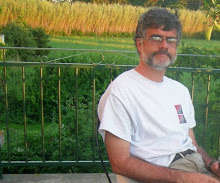 From time to time, I'm going to interview people who have figured out ways to teach "Big Thing" creative writing courses.
John Vanderslice
is one such writer-teacher. He teaches at the University of Central Arkansas, blogs at Creating Van Gogh, and was kind enough to answer a whole lotta questions for me.
From time to time, I'm going to interview people who have figured out ways to teach "Big Thing" creative writing courses.
John Vanderslice
is one such writer-teacher. He teaches at the University of Central Arkansas, blogs at Creating Van Gogh, and was kind enough to answer a whole lotta questions for me.
What made you decide to try this? Had you ever taken a Big Thing class? How did you figure out what to do?
For the most part, I've taken, as a student, and run, as a teacher, creative writing workshops that are organized around composing the "small thing": the essay, the poem, the short story. Smaller forms rule the workshops because they are better suited for the machinery of the workshop class—even if they are less suited for the temperament of the individual writer. I've been guilty of running the same machine. For several years, now, however, I have been open to, and even encouraging of, students workshopping parts of the larger works: chapters of novels, essays or stories that are part of a cycle. I appreciated that the students were "thinking ahead" to the larger forms, for heftier and more expansive ways to explore a story or a theme.
A lot of people responded to my piece by saying, "I/We don't prohibit larger works!" but I think there's a difference between "not prohibiting" and "actively encouraging." How did you move towards "active encouragement"?
First, I tried having an undergraduate fiction writing class work on a group novel. We had some of the most animated, life-or-death workshop discussions in that class that I've ever experienced, because everyone had a stake in the project under discussion. The project taught the class something about the state of mind required, and the obstacles one has to overcome, in order to complete a book length work of fiction.
But I must have known all along that even with a liberal, welcoming attitude toward bigger projects—and the willingness to try a crazy experiment once in a while—the traditional workshop just wasn't encouraging and enabling most students to tackle the larger works that are what most people in the literary marketplace want to read and buy, and, more importantly, what most writers dream of creating.
Thanks for saying that. It's not about responding to market forces, or at least, not directly. It's also about recognizing that writing a novel is what most students want to do, what many of them are already trying to do outside of our classes.
So I then I tried my first Novel Writing workshop. I more or less organized the course as I do any other workshop. Instead of workshopping stories or essay the students were workshopping novel chapters.
I think that's what most teachers do—replace "the story" with "the chapter." What else did you do differently?
I had them write brief explanations of their ideas for their novels. I made them compose a chapter-by-chapter plan for the novel, not just telling me what would happen in those chapters but how the chapters served the greater purpose of the novel. I stressed emphatically that these outlines were not set in stone, that they were just starting points and that over the course of the semester their plans could and probably would change. That was okay, I said, but I still wanted them to at least begin with a plan. And they were less resistant than I feared. Several told me later that they really enjoyed seeing how their novel could unfold from the kernel of an idea they brought with them to the classroom on the first day.
I assigned a book on novel writing, and I set aside classes in which the students would do focused journal writing about their novel, writing that was designed to get them to understand their characters better and to suggest new and interesting developments to them.
I called that "Studio Time."
Also, they were required to pick a novel from a list I presented and give a presentation on that novel. So that was the week-to-week rhythm of the course—read in textbook, write in journals, turn in chapters, workshop for a while, read in textbook, write in journals, etc.
So, pretty much a typical workshop + in-class writing time. What happened? Was it successful?
My students imagined and began some marvelous novels. Truly marvelous. But the big drawback is that workshop and presentations take up so much time and energy. The students only composed three or four chapters of their novels. And I never expected any more than that. I expected that their books would get a firm start and, having pushed off so decidedly, they of course would keep going once the semester was over. Hah! Only a few carried on with their novels after the semester ended and virtually all them stopped long before a first draft was completed. Only one of the fifteen students who took the course the first time I taught it actually ended up finishing her book. Given how promising their novels seemed, this result killed me.
Most people would say that outcome is exactly how things are supposed to be, that the desire to finish a book has to come from within the students. But I also know that young writers can often prove themselves capable of more than they realize—with the proper structure and support. I like how you kept thinking of ways to maximize their chances at succeeding.
Truthfully, after the first time I ran the course I already knew something was amiss. I didn't change it for the second time around because I honestly didn't see how else to run it and—with our teaching-heavy burden (4/4 is typical)—I felt so pressed for time that I did the easy, foolish thing and just decided to run it the same way, the way I had a pattern for, and hope for better results.
That's what most of us do, I think. Nobody has enough time.
Unfortunately, the results were worse. This time around, not a single student went on to finish. I knew I simply could not run the class that way any longer. I realized that the class had become—not a class in which the students would write novels, or even start novels they would go on to write fully—but rather a class in which they played around with, talked about, made notes on the idea of writing a novel. And because they were not going through the process of composing an entire novel, what they were actually learning about novel-writing was minimal. All the novel writing books in the world won't teach you as much as writing a novel will.
So: how did he do it? Stay tuned until next time.
February 20, 2011
This is How You Do It: Stop Using the Word "Story"
You need to know this: I never forget my students. I forget their names, but never their faces, and I usually remember their stories.
When my essay came out in The Millions, I read the comments with fascination and interest. One of the comments was from a former student of mine, "Liz B," who wrote, "You may not remember me…"
Actually, I remember her very well. She took me for Intermediate Fiction the horrible summer I quit smoking. Indeed, she mentions in the comment that I once yelled at her. (I'm really sorry Liz. I was a real basket case that summer.) And she took me for Senior Seminar, a class in which I required students to produce a 50-page manuscript, a Big Thing.
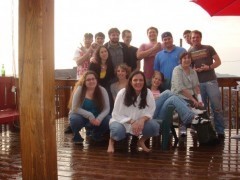
Senior Seminar, Spring 2008, class of "Liz B"
Liz B. writes: "It always drove me crazy having to submit short stories for your classes since all I wanted to do was write a novel."
What interests me about this statement is that, while it's true I focused on short stories in the Intermediate Fiction class, I still have the syllabus for the Senior Seminar, and it clearly states that it's fine for students to submit novel chapters.
Now, I'm not trying to argue with Liz B., but to point out—to you, the reader—that there is an obvious disconnect between what was on my syllabus and what a student understood to be an unspoken convention of the class.
Some of the response to the Millions essay has been along these lines: I don't prohibit students from working on novels or linked stories! I encourage it! Our program encourages it! The "problem" of which you speak does not exist!
Okay. That is probably true. But if the problem doesn't exist, then why the reaction?
I mean, I've been trying to foster "big thing" writing in my classes for years, and my own students are telling me they felt discouraged from doing so.
Why does this happen? And what to do about it?
One thing I'm doing in the classroom now that I didn't do when I had Liz B.: I don't use the word "story." I used to use say things like "Your story is due on Monday at 6 PM." And "Let's talk about Chuck's story."
"Story" was short hand for "chapter" or "linked story" or "series of flash fictions" or whatever they wanted to turn in for workshop. I didn't necessarily mean "short story," per se, but what came out of my mouth was the word "story."
Yes, I know, a chapter is a story, too, but let's be real. What a student writer hears me say "story" it means "short story," which to them means 8-15 pages—unless they hear different from me.
Slowly, I've broken my habit of using the blanket term "story" to refer to any kind of submitted fiction. Now I say, "Your manuscript is due on Monday," and "Let's talk about Chuck's manuscript."
"Short Story" is not a dirty word. But it is not the only word to describe what we're asking students to produce in a fiction workshop.
Good luck to you Liz. I remember you were working on a piece about a family, two brothers, two sisters. Are you still working on that? Or something else? In any case, I'm really happy you're still writing.

February 18, 2011
This is How You Do It: No Typed Critiques
Update since my last post: I wrote a letter to the Chronicle of Higher Education, and they published it, along with a response from Elise Blackwell. Since then, she and I have emailed privately. We shared some ideas and experiences. We even know people in common. The air is clear, and all is well. It's funny how you meet people these days.
Okay, so now that THAT is out of the way, back to my series, "This is How You Do It," which focuses on ways to re-think your classroom practices in order to accommodate long projects.
Fiction writer Matt Bell (How They Were Found, 2010) was kind enough to post an excerpt from my Millions article on his blog, but it was the reposting of that entry as a note on Facebook that generated the most discussion. It was in this forum that fiction writer Josh Weil (The New Valley, 2009) chimed in to share how Brooklyn College accommodates novels in their curriculum.
Josh said: "The credit goes to Brooklyn College for making it a part of the curriculum that's available to MFA students, but, honestly, I think it worked, and worked well—and isn't that hard a thing to do. The key? Not workshopping a novel until the writer is a good way into it. We workshopped 150 pages at a time, 4 hour workshops devoted to one submission. In one case, where the writer had written a completed draft, we workshopped 300 pages (and that was his sole turn "at bat"). This, I think, is a useful way to run a novel-writing-workshop."
When I read this, I wondered a few things:
How many people were in this workshop?
What kind of preparation—besides reading the submissions themselves—was required of students. Annotation? Line edits? Typed critiques?
I'm not sure of the answers, but I know what I would do if this was my Novel Workshop: I wouldn't require students to write discursive critiques.
I know. Heresy. But hear me out.
If the short story is our primary pedagogical model, the critique is just as de rigueur. And I'm a big believer in the value of assigning lots and lots of critiques. Jeremiah Chamberlain wrote one of the best essays I've read about this topic, one of our most sacred pedagogical practices:
"You become a strong writer by writing critiques, not reading them, " I say. Being forced to analyze the effectiveness of other writers' stories and to then provide them with clear, concise, specific suggestions for improvement will do more to develop a writer's craft than almost anything else.
But as much as I believe in critiques, I also believe that they aren't necessarily appropriate for every kind of manuscript, nor for every kind of fiction writing course.
We can't forget this: the time it takes to read and evaluate a big thing. We can't treat 150 pages "up" in workshop the same way we treat 15 pages. And perhaps one of the reasons so few teachers are willing to welcome 150 pages to the table is that we only know how to handle 15 pages.
This is why I think it's okay to suspend common workshop practices (which were designed for the review of small things) when a big thing is up for discussion.
For example:
If someone submits a 15 page story to workshop, I might spend 3 hours annotating the manuscript, doing line edits, and writing a discursive critique. And that manuscript might be one of two manuscripts that are "up" in a given 3-hour long workshop, giving me approximately 6 hours of prep time to lead your typical workshop. Minimum.
 So, let's say that someone submits 300 pages to workshop and takes up both "slots" or "at bats" in a workshop. Then it's reasonable to expect everyone in the class to still spend 6 hours reading that manuscript. Annotations, line edits, and critiques optional. Instead of line edits, the writer receives oral feedback only as the class discusses the manuscript as a whole.
From the point of view of the writer: You leave the workshop without that big stack of marked-up manuscripts, and without typed critiques to mull over (obsess over?) later. You don't get a close, close read (which you may not be ready for yet anyway). Just the workshop's reactions and the ensuing discussion. You listen, take notes. Who knows, maybe at a certain point, you actually contribute to the discussion, too. And perhaps the best part: your instructor and your peers aren't grumpy about how much you've given them to read, because they ended up investing the same amount of time preparing for class that they would have spent if two 15-page stories were "up."
What do you think? Is it smart, or is it sacrilege?
(And thanks Matt Bell for helping me to keep the conversation going.)
February 16, 2011
Debate is Not Hate
 Let me be perfectly clear: I am not against MFA programs.
My essay in the Millions was originally titled "The Big Thing: 10 Thoughts on Moving from "Story" to "Book." Wisely, the editors re-titled my piece "The Story Problem: 10 Thoughts on Academia's Novel Crisis." Their provocative title prompted many people to read and share and discuss the essay—which is good. But perhaps it also raised the hackles of creative writing faculty—which is not good.
(BTW: Here's a short history of the recent spate of MFA Program Critiques that have come out in the last year or so.)
Today I discovered this article by Elise Blackwell published in The Chronicle of Higher Education. The real subject of this essay is the importance of geographic diversity in one's literary upbringing. I support this idea wholeheartedly. As a native Midwesterner who earned her MFA in the South, I'm living proof that a writing apprenticeship doesn't have to take place in an East Coast urban center as some might believe—and I tell my students this, year after year after year.
But for some reason, her wonderful argument was prefaced by pointing to "anti-MFA online hate," and my essay was included as an example of said hate, a "dismissal" and a "strike to the heart" of writing programs.
This distresses and angers me. And I want to respond, because it's important to my students—past, present, and future—that I not be unfairly categorized as some sort of zealot.
And this is why:
There's a file on my computer called "Recommendations." Right now, there are about 100 letters in that file written over the last 15 years. A lot of those letters were written in support of my students' efforts to get jobs, scholarships, internships, to get into law school, into writers' conferences and colonies, into all kinds of graduate programs.
But most importantly, I write a lot of letters on behalf of students trying for a dwindling number of open slots in two very competitive applicant pools: the academic teaching-position pool, and the MFA admissions pool. The letters I write for those students are read by creative writing faculty, and I need those folks in particular to hear me say this: I am not Anis Shivani.
My essay was not an attempt to tar and feather an entire discipline or those devoted to teaching within that discipline. I merely wanted to start a conversation among my fellow teachers of creative writing. I'm not someone on the outside of the ivory tower looking in, throwing stones. I've been inside this system for twenty years.
And in the last few years, I'd started noticing something:
A lot of young writers I knew (online and f2f) were graduating with MFA theses comprised of short stories and were having a tough time finding a publisher for those books. They were frustrated—with their literary apprenticeship, with the realities of the publishing market, but also with themselves.
A lot of young writers I knew were trying to move from the writing of disparate stories and essays to the writing of books, but were struggling to do so. Some were motivated by the aforementioned frustrations, but in most cases, they were making this move because writing a novel or novel-in-stories was their lifelong dream.
A lot of young writers I knew said they felt discouraged from bringing novels and "big things" to workshop. Some of those young writers were my own students. Yes, my own undergraduate and graduate students said they regularly submitted short stories to fulfill my workshop requirements while writing longer works on their own, outside the workshop environment. Note: if I was blaming anyone in my Millions essay, I was mostly blaming myself.
Such a series of circumstances represented to me a puzzle worth solving. Why was this happening? Granted, not everyone agrees that these circumstances even exist, which is fine. But personally, I thought it was something worth investigating. And because I am a writer, I wrote about that investigation. I also started this blog as a way to share this investigation with others.
I'm not sure what—besides the headline of my essay, which was not written by me—would cause anyone to lump my inquiry into any category that includes "hate."
Granted, Blackwell is careful to differentiate between me and Shivani. "The most extreme arguments" she says, "are akin to scenarios like Palin's 'death panels' in which groups of well-credentialed whitebread writers plot the exclusion of the interesting and talented"
Yeah, wow, that's not referring to me.
Instead, mine is the "softer imagination" that "blames a vaguer villain: workshop process among tables of people-pleasers."
Well, my goodness, I'm certainly not the first person to assert that the workshop process has a downside. Mark McGurl in The Program Era calls it a form of retraction or "shame management." Chad Harbach calls it the MFA vs. NYC divide. Even veteran creative writing teacher Madison Smartt Bell, in his introduction to Narrative Design, maintains that "there [are] enormous, crushing pressures to conform" in fiction workshops, but the pressure comes not "from any teacher but from the students themselves. It [is] a largely unconscious exercise in groupthink and in many aspects it really was quite frightening."
None of these arguments represent "hatred" of MFA programs. They represent sound reflection and critical inquiry. The Creative Writing Program system keeps growing. Do we…and by "we," I mean the thousands of people employed to teach creative writing in this country…do we really expect that such a boom will go unremarked upon? And does remarking on it constructively and rationally constitute a condemnation of said system?
I hope not.
For the last few days, I've been working on an AWP panel proposal on the topics I raised in my Millions essay, and I'm really excited about it. Three writer/teachers have committed to participate, most of them MFA program directors, and they are intrigued (not exasperated) by the perfectly healthy conversation that's arisen out of my Millions essay. I hope that the panel is accepted so the conversation can continue.
February 13, 2011
This is How You Do It: Require a Process Blog
I want to get back to my series of posts about how to do it: concrete ideas about how to change the default setting of the creative writing classroom so that Big Things can be brought to the table.
I want to highlight this post from a former student of mine, creative nonfiction writer Amy Whipple. She talks about her experience in my workshop Spring 2010, a semester in which I tried a variety of things to help my students to move from "story" to "book."
Idea: require students to keep a "process blog."

Yep. That's the gang sign for "blog."
As Amy says:
"We kept a class blog where each of us posted our project proposal and charted our progress and our process. This alone was great. And then I got to see how it went over to get fifty pages of a classmate's work in a classroom setting."
You can read the rest of her post here. And if you love television the way Amy loves television, then you should follow her blog, too.
Thank you, Amy. I look forward to reading your big thing.
February 10, 2011
Celebrating (and Celebritizing) Teaching Creative Writing
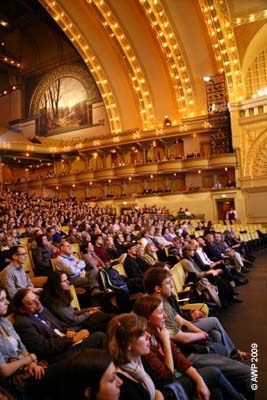
What if they were listening to a writer talk about teaching?
Today, Fiction Writers Review is running "Where Are We Going Next? A Conversation about Creative Writing Pedagogy (Pt. 1)," a co-written article by myself, Anna Leahy, and Stephanie Vanderslice. This lively, wide-ranging conversation took place during the summer of 2010 via email exchanges.
I just want to thank FWR for publishing this article. You might be wondering why it appears there and not in, say the AWP Writers Chronicle or a pedagogy journal. Well, the truth is, we did submit it to the Chronicle, but they passed, as is their right, of course. When we got the very kind rejection, we discussed what to do next. Where else do you publish an article about teaching creative writing? (I've discussed this problem at some length here.) Since most creative writing teachers don't (won't?) read pedagogy journals, we decided to shoot for more mainstream publishing venues. Our first priority was making these ideas "findable" and "share-able."
I'd like to take this opportunity to make two suggestions that weren't included in this conversation:
A keynote address on Teaching Creative Writing at the annual AWP conference. I would pay good money to hear anything Charles Baxter or Peter Turchi or Janet Burroway had to say about teaching. Why can't Good Teachers be "celebritized" at AWP alongside the Good Writers?
More "teaching-creative-writing blogs." This blog has invigorated my teaching in many wonderful ways, and it's brought me many new friends. Yes, it takes time, and I know we all struggle to find the time to write, to teach, and to live our lives. In the midst of a busy life, why make time to write about teaching when it doesn't "count" for tenure and promotion?
Because when you force yourself to articulate what you do and how you do it, your teaching improves.
Because. Teaching. Matters.
February 6, 2011
Linked Stories Workshop
What is a novel-in-stories? A linked collection? A story cycle? I find it hard to make distinctions between these terms. Instead, I think of it this way: On one end of the prose spectrum is the traditional linear novel. On the other end is the collection of disparate stories. Linked stories exist on the narrative spectrum between "novel" and "story collection," and they are unique and valid formal artifacts.
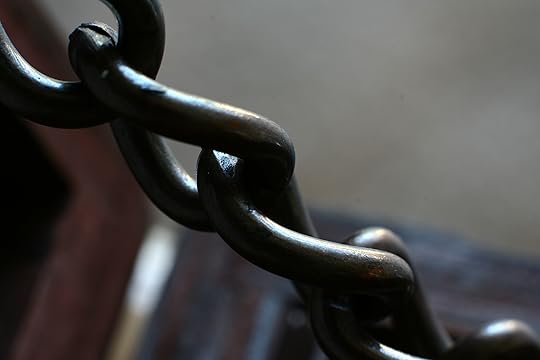
Forrest Ingram's 1971 definition of linked story collection or "story cycle" is this: "a short story cycle [is] a book of short stories so linked to each other by their author that the reader's successive experience on various levels of the pattern of the whole significantly modifies his experience of each of its component parts."
Robert M. Luscher defines the sequence: "A volume of stories, collected and organized by their author, in which the reader successively realizes underlying patterns of coherence by continual modifications of his perceptions of pattern and theme." He continues, "Within the context of the sequence, each short story is thus not a completely closed formal experience… The volume as a whole becomes an open book, inviting the reader to construct a network of associations that binds the stories together and lends them cumulative thematic impact" (148).
Here are ten ways to lead a linked stories class or workshop. My advice is aimed at creative writing teachers, but writers can easily translate for their own purposes.
1. Assign books that represent the spectrum between story collection and linear novel.
a collection of unrelated stories, such as Susan Perabo's Who I Was Supposed to Be or Miranda July's No One Belongs Here More Than You, George Saunders' Pastoralia, Ben Percy's Refresh, Refresh.
a collection of linked stories, somewhat related: by setting, like Annie Proulx's Close Range, or by subject matter, like Brad Watson's Last Days of the Dog-Men.
a novel in stories, a collection of stories more linked, more unified: like Tim O'Brien's The Things They Carried, Stuart Dybek's Coast of Chicago, Susan Minot's Monkeys
a novel that might be highly linked stories: Evan S. Connell's Mrs. Bridge, Dean Bakopolous' Please Don't Come Back from the Moon, Jennifer Egan's Goon Squad, or Susan Vreeland's Girl in Hyacinth Blue
2. Or, if assigning whole books is cost or time prohibitive, select 2-3 stories from one of these books so they can get the gist: 3 stories from Sherwood Anderson's Winesburg, Ohio, George Willard is or is not the main character, or three stories Junot Diaz' Drown or from Donald Ray Pollock's Knockemstiff, or three stories from Anne Sanow, Triple Time—The Date Farm, Safety, Rub Al-Khali
3. With the books and/or the tri-stories, spend time "reshuffling" the stories to discuss how changing story order changes how the book reads. For example: what makes Mrs. Bridge read like a novel is that it is arranged chronologically. If instead Connell had grouped all the vignettes differently (all the Ruth, all the Douglas, all the Grace Barron, all the Alice Jones, the trip to Europe) that book would read a lot less like a novel and a lot more like a collection of linked stories.
4. Assign David Jauss' essay "Stacking Stones: Building a Unified Short Story Collection," first published in AWP Writer's Chronicle in 2005 and reprinted gorgeously in Alone with All That Could Happen: Rethinking Conventional Wisdom about the Craft of Fiction, published by Writer's Digest books.
5. In this frame of mind, ask your students to re-read all the work they've written over the last few years and look for obvious and possible linkages, or what Jauss calls "liaisons": images, setting, character, or subject matter. Important: in order for a collection to be linked organically, you need to make the decision to link fairly early. It's really really hard to do this late in the game.
6. Now: decide how you feel about "story recycling." Advice: require student to pick one story or 5-10 pages they've already composed.
7. Create an assignment whose outcome will be linked stories. Such as: ask students to create the narrative equivalent of a Diptych or Triptych or Mobius Strip or Ring of Stories.
8. Ask for pages, call it "a manuscript," not stand-alone stories.
9. Require students to submit their work in progress in manuscript form—with a title page (must indicate the form!) and "front matter" that will "teach us" how to read the book: ie. table of contents (show students the TOC of Winesburg, Ohio, and how it prepares the reader to read the book), a map, a family tree, a cast of characters. Require them to submit more than one piece to workshop. Remind them how much story order matters.
10. Discuss these manuscripts in two distinct ways: in terms of each story by itself, and in terms of how the stories fit together. You might try using Blackboard and have the "big picture" discussion there, and using class time to have the "smaller picture" discussion. Or vice versa. Or use groups—some which assess individual stories and some of which assess the whole manuscript.
Thanks to everyone who came to our AWP panel "Linking it Up: Working with Story Cycles, Linked Collections, and Novels-in-Stories." Thanks to our fearless leader Anne Sanow for putting it together, and to my co-panelists Dylan Landis and Cliff Garstang who had wise and witty things to say.
February 1, 2011
Anxiety + Community = AWP
"Are you somebody?"
[Note: This post has nothing to do with snow. ]
AWP is like my Facebook feed.
It's where I go to feel connected to and learn from other writer-teachers. So many panel topics! So many great discussions! Sometimes I just show up to listen and learn, taking notes. Sometimes I propose a panel and start a conversation. It's often energizing and enriching. I'm part of a community, a profession, a discipline. If this is what it feels like to have "a calling," to be doing the thing(s) you're supposed to be doing in life, then that is what I feel like when I'm there—at AWP, on Facebook.
But it's also where I experience profound doses of professional anxiety. I observe things, hear things there that fill me with despair. It's an environment full of Yardstick People against which I can't help but measure my own accomplishments. In my head, there's a constant battle going on between pride and humility, and the outcome determines nothing less than the state of my soul. It's an incredibly, incredibly status conscious environment in which some have clout, while some are still in the hunt for it, and therefore flock like birds, like red-carpet fans, to Those Who Are Perceived to Have Clout.
Last year, writer Blake Butler posted this snippet at HTMLGiant: "Overheard at AWP: "Are you somebody?"
This is a t-shirt-worthy observation.
Probably, this anxiety hits everyone, everywhere. Maybe middle-aged football coaches feel like this at the NFL Draft. And doctors at medical conferences. And salespeople at Hewlett Packard's shareholder's meeting. And actors at the SAG awards.
Last week, the writer Amber Sparks posted an essay at The Big Other about this, and it hit quite a nerve. Meg Pokrass created a great xtranormal animation on the topic, too.
Sometimes, I long for the days before Facebook, before websites and blogs and analytics and Amazon.com rankings, long for the days before I was a professional writer-teacher who attended conferences. I felt considerably less anxiety in those days. But I was also far less productive and often lonely.
In the spirit of embracing all that is positive about AWP and pushing back against all that is negative, here's a list of the panels I think deserve your attention. I think these are the most important discussions taking place at AWP.
Thursday's full schedule
Noon.-1:15 p.m
The Future of the Book Review: How to Break In. (Salvatore Pane, Roxane Gay, Irina Reyn, Emily Testa, Paul Morris) Diplomat Ballroom Omni Shoreham Hotel, West Lobby
1:30 p.m.-2:45 p.m.
What Do Writers Do All Day?: Articulating Our Work in the Profession. (James Engelhardt, Stephanie Vanderslice, Kathryn Miles, Christine Stewart-Nunez, J.D. Schraffenberger) Coolidge Room Marriott Wardman Park, Mezzanine Level
3:00 p.m.-4:15 p.m.
The Art and Authenticity of Social Media: Using Online Tools to Grow a Community. (Jane Friedman, Tanya Egan Gibson, Guy Gonzalez, Bethanne Patrick, Christina Katz) Delaware Suite Room Marriott Wardman Park, Lobby Level
4:30 p.m.-5:45 p.m.
I think this is the most important panel at AWP.
Creative Writing and the University: A Conversation with Mark McGurl. (Mary Stewart Atwell, Mark McGurl, Eileen Pollack, Tracy Daugherty, Dean Bakopoulos, Nathaniel Minton) Diplomat Ballroom Omni Shoreham Hotel, West Lobby
9:00 a.m.-10:15 p.m.
The Good Review: Criticism in the Age of Book Blogs and Amazon.com. (Jeremiah Chamberlin, Charles Baxter, Stacey D'Erasmo, Gemma Sieff, Keith Taylor) Delaware Suite Room Marriott Wardman Park, Lobby Level
10:30 a.m.-11:45 a.m.
The Future of Creative Writing in the Academy. (Terry Ann Thaxton, Joe Amato, Philip Gerard, Nigel McLoughlin, Lisa Roney, Kass Fleisher) Harding Room Marriott Wardman Park, Mezzanine Level
Noon.-1:15 p.m
Memoir, Spirituality and the Self in the Narcissistic Culture of Our Time. (Elizabeth Kadetsky, Rodger Kamenetz, Farideh Goldin, Julia Spciher Kasdorf, Executive Room, Omni Shoreham Hotel, West Lobby
3:00 p.m.-4:15 p.m.
These are both very important panels. Very important.
Does the Writing Workshop Still Work? (Dianne Donnelly, Graeme Harper, Anna Leahy, Patrick Bizzaro, Mary Ann Cain, Katharine Haake) Harding Room Marriott Wardman Park, Mezzanine Level
Flinging the Ink Pot: Resisting Messages About Off-Limits Subjects in Memoir. (Jill Christman, Kate Hopper, Paul Lisicky, Joe Mackall, Sue William Silverman) Thurgood Marshall North Room Marriott Wardman Park, Mezzanine Level
4:30 p.m.-5:45 p.m.
Don't Call Me Mother. (Ellen Placey Wadey, Jan Beatty, Miki Howald, Geeta Kothari) Nathan Hale Room, Marriott Wardman Park, Lobby Level
9:00am-10:15am
Small Ships, Deep Ocean: Independent Presses Keep Short Story Collections Afloat. (Clifford Garstang, Mary Akers, Laura van den Berg, Jason Ockert, Jim Ruland) Thurgood Marshall South Room Marriott Wardman Park, Mezzanine Level
10:30 a.m.-11:45 a.m.
Finding and Creating Online Teaching Opportunities—and Sustaining and Succeeding in Them. (Erika Dreifus, Sage Cohen, Andrew Gray, Michael Morse, Chloé Yelena Miller, Scott Warnock) Virginia C Room Marriott Wardman Park, Lobby Level
Noon.-1:15 p.m
Poetry as Multimedia Documentary. (Susan B.A. Somers-Willett, Kwame Dawes, Erika Meitner, Natasha Trethewey, Ted Genoways) Delaware Suite Room Marriott Wardman Park, Lobby Level
1:30 p.m.-2:45 p.m.
As Long As People Write: Training and Supporting New Writing Teachers. (Sarah Harris, Crystal Fodrey, Ben Ristow) Nathan Hale Room Marriott Wardman Park, Lobby Level
3:00 p.m.-4:15 p.m.
I don't know if this is necessarily an important panel, but it's the one I'm on. Hope to see you there.
Linking It Up: Working with Story Cycles, Linked Collections, and Novels-in-Stories. (Anne Sanow, Cathy Day, Clifford Garstang, Dylan Landis) Harding Room Marriott Wardman Park, Mezzanine Level


