
Cathy Day's Blog, page 10
February 27, 2013
For the man who called me for advice about how to get published


The phone on my desk at school. It never rings.
To the man on the phone who called me today at my university office and asked if I had a few minutes to help him figure out how to get published.
First, wow, the phone rang. That hardly ever happens. I wasn’t sure it worked.
Second, no, I don’t have a few minutes. I’m getting ready to go teach a class, and I’m frantically trying to grade a few more quizzes.
Have you heard of the Midwest Writers Workshop? It’s here in Muncie. I’m on the planning committee. It’s really great.
Also, have you tried looking at my blog? I’ve got a lot of info there.
Or this blog?
Or maybe this one?
You are very persistent. You just want a moment of my time. You’re doing what all those books say you should do: reach out and ask for help and advice.
I worry that you’re going to ask to buy me a cup of coffee.
Then you ask me again—very earnestly.
And I take a deep breath and say (not quite this, but close), “No, I’m sorry, but I’m not going to talk to you, and I’ll tell you why. Because I have 50 students this semester, and I had 50 last semester, and the semester before that, and the semester before that. They ask me questions—constantly. They never stop asking questions. And it’s my job to help them. I’m all about helping them. I fall all over myself helping them, actually. Which is why they keep asking me questions, because I just keep answering them.
“I give away too much. Ask anyone who knows me.
“And I’ve decided that I have to draw a line somewhere, and so my rule is that I can’t help everybody. I only help people I know because they took a class with me or they went to school with me. Sometimes, I break this rule and help people I only know on the internet, but I definitely do not break it for perfect strangers who call to chat me up.
“And you should know, Man on the Phone, that this is the fifth or sixth time this month that strangers have asked me to help them, and I know it’s lonely out there as a writer, and I think it’s good that you’re taking the bull by the horns and taking action. That’s great. But no, I’m not going to sit here for 30 minutes and pour my wisdom into you. No, you can’t pick my brain. At least, not like this. Follow me. Friend me. My brain is available to you in all kinds of ways. But right now, you will have to find another way to learn how to get published. Trust me. There are many, many ways to learn this. I wish you good luck.”
When I said this (a much kinder, much shorter version of this) your voice caught in your throat and you said, “Thank you for your time.”
Why did you have to make me feel bad, Man on the Phone? Why?
I want you to know that I finished my quiz grading and went to my class and told those 20 students about your phone call.
And then I said, “You guys have no clue what it’s going to be like five, ten years from now. How much you will miss these classes, each other. How much you’ll miss these deadlines I give you. I stand up here every day and watch you reading your phone while I’m trying to talk to you about how to write well and get published, and it makes me want to scream. I watch you blow off the readings by visiting writers that we provide for you. I listen to you bicker about this professor or that, complain about how my assigned readings are “too depressing.”
Few of you ever come to my office hours. The Man on the Phone desperately wants to come to my office hours, but I’m protecting my time—for you!
“So often, you guys turn me into the enemy, and I’m not your enemy. Hoo boy, do you have it all wrong.
“My advice: find two or three people in your classes who you can trade work with in the years to come, because you’re going to need those people. Bad.”
My students sort of sat there stunned, but they nodded their heads. Like maybe I’d spoken a little truth. Like “Whoa.”
Man on the Phone, I taught for 75 minutes and returned to my office to find 15 messages in my queue, waiting for answers. Because it’s not just my students who want to communicate with me, it’s lots of people.
Two weeks ago, I was up late one night and sent out some despair tweets:
10 years ago, I feel like I could write/teach/serve AND have a life. Now, I feel like it’s teach/serve/answer emails/write
I spend more time fielding the voluminous communication coming at me than ANYTHING else I do, including reading/responding to student work.
Bitter truth: the situation will only get worse insofar as email, etc is concerned. Already unable to handle it all. 10 years from now?
Bitter truth: I don’t even have it that bad. I don’t administrate, edit, direct, coordinate any large groups. But I will. You betcha.
I’ve started opening up my email accounts to show students how many messages I get in a day. “Think about how you will get your msgs read.”
Maybe you don’t care about this, Man on the Phone, but your call has unnerved me. I’m actually sitting here writing this at 5:59 PM on a Wednesday when I have a class in 30 minutes I haven’t quite prepared for. You’re taking up my time, Man on the Phone!
But I write this because I want to say: I’m sorry I couldn’t help you, but I hope that eventually, you find the answers you’re looking for. Someday, when you tell the story of how you got published, I don’t mind being your bad guy.


February 20, 2013
How to Talk to Writers

Stay in touch!
A key principle of literary citizenship is that writers should build their community and expand their circles.
Not “network.” Not “schmooze.”
In her book Living a Literary Life, Carolyn See advises writers to send one “charming note” a day to someone in the publishing field—a writer, editor, publisher, etc. The point isn’t to ask for anything, but rather to just make a connection. These days, thanks to social media, it’s never been so easy to make those kinds of connections.
I require my Literary Citizenship students to friend or follow or email someone five times a week. Friending on Facebook, liking an Author Page, following on Twitter: these are “passive” acts. But at least once a week, they’re supposed to actually say something to somebody. Such as “I enjoy your work,” or “You published one of my favorite books,” etc.
 They’ve been using our private Facebook group to share their weekly lists. They get ideas about people to follow from seeing each other’s posts.
This activity, which I call “Charming Notes”/Network Building, is worth 100 points or 10% of their grade.
Staying in Touch with Writers
We’ve been doing this for five weeks now. Recently I asked my class, “Have you noticed a difference? Is your Facebook or Twitter feed different now?”
Much nodding of heads.
A student said that a year earlier, he’d interviewed the writer Bonnie Rough for Ball State’s literary magazine The Broken Plate. (You can check out the interview here.) “When she came to campus for her reading, she told me to ‘stay in touch.’ But what does that mean?” he asked.
“Well,” I said, “some writers say that but don’t really mean it. Some do mean it. The only way to find out is to stay in touch.”
“But how?” he asked. “Surely she doesn’t want me to send her a letter.”
In the Olden Days
I suddenly remembered my own bewildering early days as a writer, which occurred post-email but pre-social media. In those days, I was a faithful sender of Christmas cards and post cards. Every December I’d write a little newsletter about What I Did This Year, photocopy it, and stick it in with my Christmas cards. This is how I kept in touch with my teachers from undergrad and graduate school, as well as some of the writers I’d met along the way. At conferences. At readings.
I did the same thing with postcards.
Dear [Former Professor], I’m at AWP in [insert name of city] and remembered your class on [whatever]…
Dear [Writer I Met at That Conference], I just read your new book and really loved it. I just published one of my crazy circus stories in the Whatever Review.
Do you remember that?! When you published a story in the Whatever Review, added the line to your vita, shelved your contributor’s copy, maybe “shared” it by buying a round of drinks at your local bar, and that was it. Did anyone read your story? Who knew? Oh, the innocence of those days…and the loneliness.
Anyway, I sent these cards because it felt good to be in touch. People come to my mind many times a day. Before Facebook and Twitter, I’d usually take that opportunity to drop them a line.
The Old-Fashioned Christmas Card List
 When I went on Facebook in 2007, my mother asked me what it was. I said, “It’s like exchanging Christmas newsletters with all your friends, except instead of getting them at the end of the year in the mail, you get them in real time on your computer.”
Once upon a time, being on someone’s Christmas Card List meant something. It signified they considered you a part of their social circle. Incidentally, this is why hardly anyone sends holiday cards these days—because Facebook performs this function for us instead.
Now, I should say that I definitely didn’t grow up in the kind of family that networked. My blue-collar parents weren’t working their way up any ladders. In fact, I grew up in the kind of family and the kind of town where brown-nosing, trying to “get in good with the boss” was a sure ticket to ridicule if not outright ostracism. When my mom sent out Christmas cards, she sent them to her (ha ha) “social network,” which consisted of family, maybe a few co-workers, and her friends from high school. My folks lived in a small town, they hadn’t gone to college at that point, and so I’m sure every Christmas card my mom sent had a 46970 zip code. If it didn’t, I’ll bet it went to someone who used to have a 46970 zip code.
How to Make Friends and Influence People
What I’m trying to say is this: When you teach at an expensive, private college or university, you don’t have to teach your students the value of networking, that “who you know” matters. They get it. Or their parents do.
But my students don’t always get it. Or they get it and—to their credit—they’re uncomfortable with this whole notion of “expanding their circles,” which derives from “social circle,” which sounds a lot like kissing ass.
This, my friends, is why I had to call this all this activity “Literary Citizenship.” Because when my publishers said, “You have to start doing this work,” everything in me rebelled.
How to Stay in Touch
So, to my student who asked, “What does it mean when Bonnie Rough tells me to stay in touch?” I say:
My advice: simply follow her on social media. Everyone once in awhile, when the situation is appropriate, chime in with a comment or just “like” something she says. Stay on her radar in a genuine, meaningful way.
Recently, Rachel Fershleiser (who works at Tumblr) talked about planning an engaging book event, but what got my attention was a comment further into the interview about engaging with authors online:
I always think you should join Twitter or Tumblr and just listen for a while — you should follow people you think are interesting, and you should hear what kind of things they’re talking about, and what they have to say. Sometimes it’ll be about books, or about business, or whatever your topic, and sometimes it’ll be their amazing chili recipe, and you’ll find out which ones are engaging to you overall, and then when you start replying to them, it’s going to be like “check out this recipe from my grandma,” and not about just buying your book.
An analogy: Staying in touch with Bonnie Rough via social media is like being at a big cocktail party and she’s there, too. Would you run up to her and bombard her with questions? No. But by the same token, don’t NOT talk to her. You’ve met her. Go up and say hello.
(Maybe you grew up in the kind of family where your parents entertained? Where you were often being introduced to people you didn’t know and expected to make conversation? Maybe you’re extroverted and love talking to strangers? Well, screw you, because for the rest of us, walking up to a writer—in person or online—and talking to them is actually kind of hard.)
And students, don’t just stay in touch virtually, but IRL, too. Maybe you’ll go to AWP and she’s on a panel or gives a reading or you see her in the hallway. Go up to her and say hello. Trust me, most writers enjoy this.
Understand, though, that the more popular a writer gets, the harder it will be to talk to them.
In Sum
Anyway, why do I want my students to expand their circles and talk to writers, to send them charming notes and engage with them?
Because they have every right to.
Because it will make them feel like real writers.
[This post is cross posted here and on my course blog, Literary Citizenship]

February 14, 2013
The English Major’s Dream Job: Book Review Advice from David Walton

David Walton, book reviewer extroidinaire
You can find this week’s “Big Thing” post over at the Literary Citizenship blog. My friend David Walton shares his advice about book reviews: how to write them, how to sell them, and why we need them.

February 5, 2013
On Writers Without Websites
 My husband and I have started a little website business, of sorts. We’re not looking to build or expand, mind you. We have one client, my yoga teacher/massage therapist. I’ll call her Violet. She runs a studio out of her lovely historic home. I go there a few times a week and do yoga in her dining room and get acupressure massages in a little room off the kitchen. Violet’s been doing this work for over 30 years, and working with her has made a big difference in my life.
The Findability of Violet
I only found Violet because a friend of mine, Nancy, introduced me. I would never have found Violet on my own. There would have been no way to find her.

From the image search “Yoga Muncie”
See, I knew Nancy did yoga, but I didn’t know where. So I Googled “Yoga Muncie.” This made me very depressed.
Go ahead. Try it.
One day I was walking home from the bus station and saw a sign in a storefront window of women doing yoga postures.
A yoga studio?! Three blocks from my house?! Hooray!
But as I got closer, I saw that the sign was advertising “the Christian alternative to yoga.”
Really? Really!?
This made me even more depressed.
But finally, I ran into Nancy and said, “Hey, I had back surgery. I’ve gotta get back into yoga.” And so she took me to one of Violet’s classes. I don’t know how I would have found Violet’s house otherwise, or known when to show up, etc.
See, Violet doesn’t have a website.
She does have a phone number and an email address, but obviously, since she’s teaching yoga classes or giving massages all day long, you have to leave a message.
Another image that comes up when you search for Yoga Muncie
When are her yoga classes? You can’t look it up on her website, so you wait for her to call or email you back. Which she does of course, as promptly as she can.
She’ll add you to her email list, and that’s the only way for you to find out that she can’t do Wednesday’s class this week, but she’ll be back next week, and next month, she’s having a yoga retreat, etc.
What I’m trying to say is that I desperately needed Violet to get a website and start communicating with me more effectively. But this is a hard thing to say to the woman who’s palpating your psoas muscle.
Bartering
But one day, I finally did it. Shortly after creating the website for my Literary Citizenship class, I asked her if she’d be interested in letting my husband and I make her a website in exchange for some massages and yoga classes?
She said yes.
We met with her and got a sense of what she needed her website to do. The different hats she wears. The big picture. We went home, and I told my husband, “You start and I’ll take a look at it.”
A few days later, he showed me the theme he’d picked out.
“Why would you pick that theme?” I asked.
“It’s good for images,” he said.
“Exactly.”
“Isn’t that good?”
“No,” I said. “You don’t go to her page to look at pictures. You want information.”
[Then we had a fight. I’ll spare you the details.]
The next day, I went through the WordPress themes and picked ones in which:
The name of Violet’s business would be big, prominent.
The navigation menu would be the first thing you saw, as if to say, “Are you here for Yoga reasons, Bodywork reasons, Food reasons, or Retreat reasons? Click here.”
Then you’d see Violet. Because after all, she is owner, sole proprietor, and only employee. You’d see her phone number and email address, as well as her impressive bio.
The next thing you’d see would be her calendar.
Then you’d see a Google maps widget so you’d literally know how to find her house.
I built the pages and the architecture in one hour. I’m a client. I knew exactly what someone would come to her website wanting to know.
Why did I expect my husband to know this? I have no idea.
Being a Small-Business Owner
Being a writer or artist means you’re the owner of a small business called Being Yourself.
That’s what finally got me over my technology hump, actually. My aversion to having a web presence. I thought about all the businesses that drive me crazy because they won’t adapt. The ones you can’t Google and find out when they open or where they are or what they’re like. The ones you want to recommend to your friend, but there’s no link to share, no page to like. You can’t use a credit card there. They have a sale, and you never hear about it. Everything about this business is hard, and you stop going because God help us, you need something easy.
 Websites are like airports. Good ones anticipate your needs and why you’re there and route you where you need to be. They’re easy to find, easy to leave. They piss you off as little as possible. They’re aesthetically pleasing.
I told Violet not to be afraid of technology. “You’re just making it easier for more people to find you. Which means you can help more people. And that’s a good thing.”
Getting to the Point: Writers Without Websites
I know a lot of writers who won’t go online, or will only do it in very limited, very guarded ways. I keep a list of them in my head: Writers I Wish More People Knew About.
Maybe they can’t afford a website. Maybe they think social media is evil. Maybe they think they shouldn’t have to do this work, or they think they don’t have time, or maybe they simply don’t want to.
Seriously, if you know a writer nobody knows about because they’re not online, offer to help them. Show them. Barter with them.
Believe it or not, there was a time when the very idea that I needed to own cathyday.com and blog and update and Tweet filled me with rage. God, how I resented what publishers expected of me, what you, gentle reader, expected from me.
Now, I can’t imagine my life otherwise.
[This week's post really crosses over with my Literary Citizenship class, so I'm going to cross post there, too!]

January 27, 2013
The Agony and the Ecstasy of Making Things Up
This week, my novel writing students have to think about whether or not they are “Outline People” or “No Outline People,” or (more likely) something in between. I decided to write about this, too.
What’s my process?
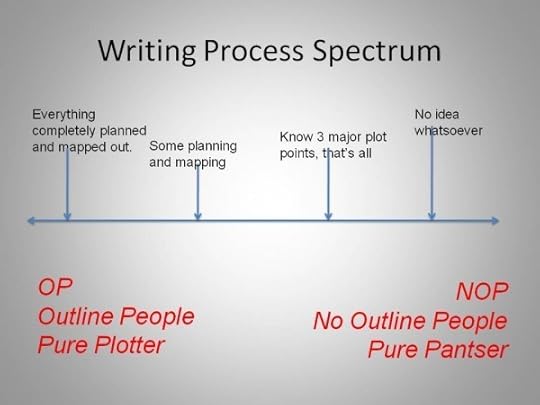
I’m probably on the left side of the spectrum….
Here’s how I know I’m a plotter.
This is how I taught myself to write a novel. By writing a nonfiction novel rather than a fictional one, I didn’t have to “make up” plot. Actually, I had more plot than I knew what to do with.
Plot as a Given
What I’ve discovered is that I need a sense of the overall architecture before I start building, a blueprint, even if I end up modifying it.
Right now, I’m working on a novel tentatively titled, Mrs. Cole Porter. The first thing I did was create a storyboard. Cole and Linda Porter’s “real life” provides the base time plot, or at least a rough outline of it.
I spent a few months reading all the Cole Porter biographies, and these are the best.
The Life that Late He Led by George Eells
Cole Porter: A Biography by Charles Schwartz
Cole Porter by William McBrien
As I read these books, I used created “event cards” and “scene cards.”
Every time the biographers wrote “On such and such a date, Cole and Linda went to the Hotel Ritz…” I made an index card.
Since their lives are extremely well documented, I made a lot of cards, as you can see.
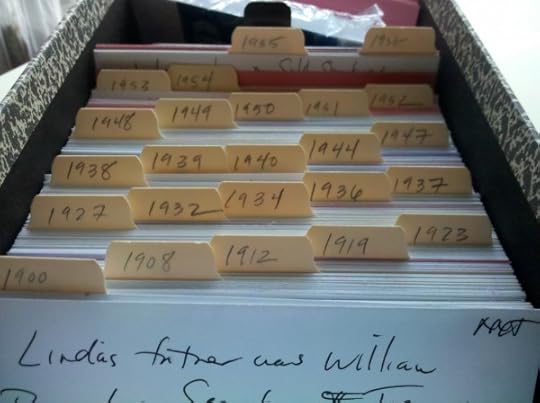
Obviously, I’ve got too many cards.
I remind myself daily that I’m writing a novel, not a historical biography.
My novel can’t cover all of those events, especially not in real time. I have to select specific episodes on that timeline that are ripe for dramatization.
Example: Trip to Egypt
One episode I very much want to dramatize occurs in 1908-1909. Here are the cards from 1908 to 1912.
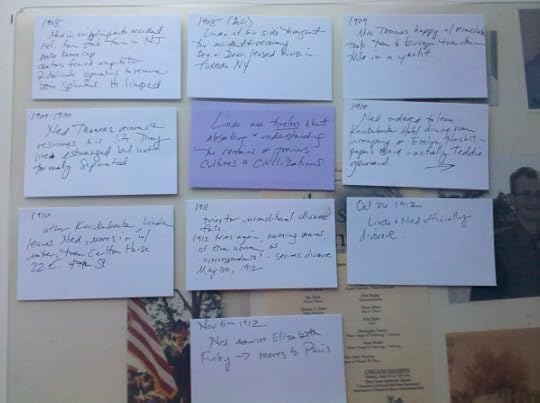
1908-1912
Here’s what’s important in those cards: Linda’s douchebag husband, Ned Thomas, is going to have a car accident in 1908. She will nurse him back to health. His mother will be so grateful for this that in 1909, she pays for an Egyptian cruise down the Nile, which will include their friend and guide, Lord Carnarvon—who, like Ned, loves horses and fast cars.
Aside: All of that is true except that I don’t know for sure if Lord C was there, but in my imagination, he’s definitely there. I very much hope the reader will recognize Lord Carnarvon as the man who discovered King Tut’s tomb and the former owner of one Highclere Castle, also known as Downton Abbey.

I don’t know for sure if Linda ever went to Highclere, but in my novel, she’s going there. Fer sure.
This series of events—the car accident, the trip abroad—is important because
1.) It instills in Linda a love of travel and a love of ancient cultures, especially Egypt.
2.) She’ll equate her fastidious scrapbook practice with the burial practices of the ancient Egyptians, a way to live forever, which is important to the novel’s themes.
3.) As soon as her douchebag husband gets better, he returns to being a douchebag, but this trip to Egypt is going to give Linda the inner strength to finally leave her husband in 1912.
4.) when Linda marries Cole Porter, they will go on an Egyptian cruise just like this.
How many chapters do these ten cards represent? I’m not sure.
How many scenes do I need? To get from “Car Accident” to “Nile Trip” to “Leaves Husband”?
Do I dramatize Ned’s accident and her coming to care for him? Or do I start with them on the Nile and fill the reader?
I have no idea, but it comforts me to know that I’ve got something to head towards.
Give yourself an assignment
The way I’ve been writing the novel thus far is that the “real events” give me ideas for scenes, and I draft them quickly. Every time I sit down to write, I give myself an assignment.
Okay, write the scene when Linda goes to Ned’s side and says she’ll take care of him.
Okay now write the scene where they are going down the Nile and/or she sees the Sphinx. Explain what this does to her.
Okay now write the scene where she picks up the morning paper and sees in the gossip columns that her husband was out with another woman the night before.
Okay now write the scene where she confronts his family and demands the lucrative divorce.
This novel (which is based on a true story) requires me to be a plotter. I don’t want to stray wildly far from the way things happened. But it also requires me to be a pantser.
Playing with Dolls
Writing is like playing with dolls. I take up my Linda doll and move her around the dollhouse (a given). I know what her houses look like, because she had them photographed for Architectural Digest and other magazines, and because her house in Paris and her house in the Berkshires have recently gone up for sale.
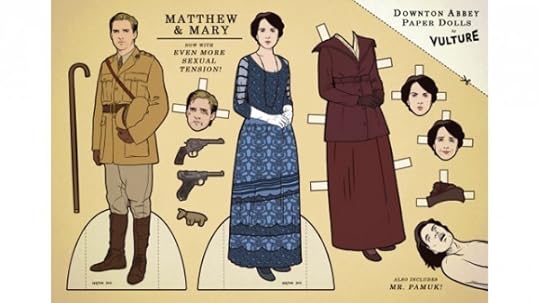
“…I take them up like the male and female
paper dolls and bang them together
at the hips, like chips of flint, as if to
strike sparks from them, I say
Do what you are going to do, and I will tell about it.”
–Sharon Olds, I Go Back to May 1937
But then I start speaking as her (not a given). Sure, some scenes have been already been scripted a bit. I know what choices she’s going to make in her life, but I’m free to invent how and why she makes those choices.
That’s the “pantsing.” That’s the part of the writing process that can’t be outlined or scripted.
That’s the part of the writing process that fills you with something like ecstasy.
Realization
What I’m coming to terms with is that some of the scenes I’ve dramatized (or really, really want to dramatize) will have to be summarized or cut entirely or the novel will be 1000 pages long.
To use another analogy: I’m like the documentary filmmaker who has to cut hundreds of hours of footage down to a story that’s 90 minutes long. She can’t regret the time she spent shooting all that footage, and I can’t regret the time I spent creating more scene cards than I can ever use.

January 22, 2013
What I’m Working On
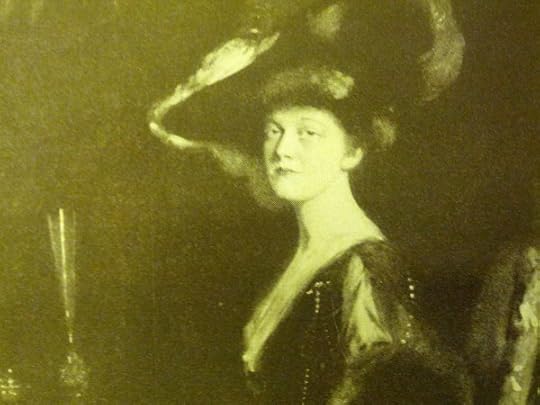
Before she was Mrs. Cole Porter, she was Mrs. Edward Thomas
I’ve been “tagged” in the Next Big Thing Blog Hop (this meme-type thing that’s been making the rounds) by writer/editor Jill Talbot (who was tagged by Barrelhouse editor Tom McAllister, who was tagged by writer Katherine Hill, etc.).
I have never met Jill Talbot IRL, but we like to talk about the hazy line between fiction and nonfiction. She edited the anthology Metawritings and was kind enough to include me.
(I think she’d like that I describe my WIP as “nonfictional fiction.”)
Here are her excellent answers to the 10 Blog Hop questions.
And here are mine.
What is your working title of your book (or story)?
Mrs. Cole Porter
Where did the idea come from for the book?
Cole Porter and I share the same hometown, Peru, Indiana.
What genre does your book fall under?
I like to think of it as nonfictional fiction. A biographical novel.
Which actors would you choose to play your characters in a movie rendition?
Well, Cole and Linda have already been played by Cary Grant and Alexis Smith (Night and Day, 1946) as well as Kevin Kline and Ashley Judd (De-Lovely, 2004).
Whoever plays Linda in an adaptation of my book would have to be able to play her both old and young. I’m going to go with Laura Linney, who’s already played a similar character in The House of Mirth.
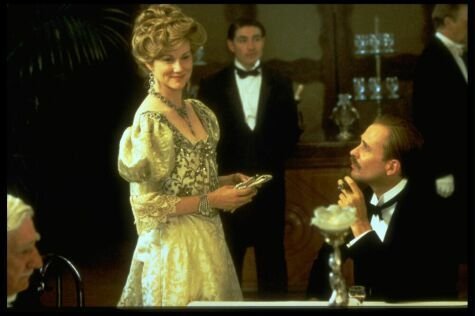
Don’t you think she’d make a great Linda?
What is the one-sentence synopsis of your book?
“During the Gilded Age, poor, beautiful, and naïve Linda Lee marries the playboy son of a robber baron, a high-profile match she survives by learning important skills which she brings to her second marriage—to a talented but unknown gay composer from Indiana named Cole Porter.”
Will your book be self-published or represented by an agency?
If by this question you mean, do I have an agent? then yes, I have an agent, the amazing Sarah Burnes at the Gernert Company.
How long did it take you to write the first draft of your manuscript?
Still working on the first draft.
What other books would you compare this story to within your genre?
It’s got an outer and inner frame, and there’s a bit of archival detective work going on, a bit like A.S. Byatt’s Possession.
Maybe it’s also a bit like Laura Moriarty’s The Chaperone, which I read this summer and loved to death.
This isn’t a novel, but it definitely inspired me: Coco Before Chanel. A possible backup title to my book might be Linda Before Cole. Or Cole Because of Linda Before Cole.
Who or what inspired you to write this book?
There’s a little-discussed anecdote in every Cole Porter biography: he blew up his wife’s mansion in the Berkshires when she passed away. Not only that, he moved his bachelor’s cottage onto the foundation and expanded it to the mansion that’s there today.
His biographers all say Cole did this out of grief. I have other ideas.
What else about your book might pique the reader’s interest?”
In the course of doing research for the novel, I discovered that 86 volumes of her personal scrapbooks were held at Harvard. I’ve made two research trips to the Houghton Library to study them.
And now I’m tagging four more writers. I wanted to keep it local; these are all writers who live within an hour of my house in Muncie, Indiana. You can read about the books they’re working on next week!

January 17, 2013
20 answers to the question: “But what should I blog about?”
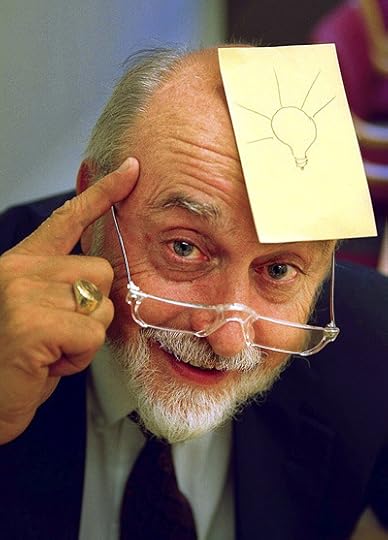 Relax. Don’t try so hard. If you focus on the stuff that matters to you, everything else will fall into place: finding readers, an audience, your tribe.
Pay attention to what you Tweet and share on Facebook. Maybe that’s the material you should be blogging about. Every time you share an article or tweet or retweet a link, you’re microblogging. Why not blog-blog it? Take a few extra minutes and say something about that link and you’ve got a blog post.
I was on Facebook for a few years before I started blogging. I thought, What the hell do I have to blog about? After about a year or so on Facebook, I found that most of my friends were other writer/teachers. People I worked with. People I’d gone to school with. People the people I worked with had gone to school with.
Sometimes these people I knew from Facebook would come up to me in the hall or write to me privately and say, “I like being friends with you. You always share things I find interesting.”
Really? I wasn’t trying to share interesting things. I was just doing what came naturally to me. Talking about shit I liked to talk about.
That’s when it hit me: I should blog about my teaching. Because I love to talk about teaching. I love to figure out how to make a class go better. I love telling other people how I do things and finding out how they do things.
Aside: I’ve worked with many people over the years who could give a rat’s ass about their teaching, people who never want to talk about it ever, or who always want to talk about it—negatively. I don’t get along with these people, and they don’t get along with me. I don’t want to sit around bitching about classrooms or paper grading or my students, and I don’t want to spend time with people who want to do this. I feel kind of sorry for these people, actually, because nobody should spend their life doing something they hate. I really wish they would do something else with their lives. I want them to be happy. (This is not to say that university teaching isn’t a difficult job of gross inequities, a job many people do for not much money, few benefits, etc. I’m talking about people who just don’t like it.)
I’m amazed that it actually took me two years to figure out that I should blog about teaching. Like, duh? I was this person walking around with a big sign on my forehead. Everyone else saw this sign, everyone understood this sign’s essential truthfulness, but I couldn’t see it.
Ask the people in your social network, “Hey friends, what do I talk about a lot?” Or “What do you count on me for?” Listen to what they say.
Ask the people in your Real Life the same questions.
If they say things that make you go, Ouch, pay attention to that, too.
Maybe you don’t know what to blog about because you’re not surrounded by good ideas. If the quality of discourse in your Twitter feed or your Facebook feed brings you down, start hiding people or defriending or unfollowing people. If your “friends” whine and complain and bash, banish them. Life’s too short to spend your time hanging out with people who bring you down and who have no good ideas whatsoever.
Start getting some NEW friends.
Also, take a look at what you’re putting out there. Social media can be a force for so much good in the world. If you’re not putting some good in the world, then start.
Why should anyone read your blog if you don’t read any blogs? Start reading some blogs and start commenting. You love comments. Give some, and you’ll get some.
Start reading some online magazines and bigger blogs and commenting on topics you care about. Make sure that your Disqus profile or Gravatar or whatever those things are that enable people to click and learn more about you, make sure that shit’s working so that your tribe can find you.
Finding your online community is similar to that day in high school or college when everyone signs up for clubs. Start joining some new clubs, people. The things you blog about: that’s like you sitting at a table saying, “I like [blank]. Be in my club.”
You can follow and friend “celebrity” writers if you want. Sure. You can review books that already have 2000 reviews on Amazon. But people, those writers, those books don’t really need your help. There are many, many other writers and books that DO need your help.
Tonight my students asked, “But who are those writers? What are those books?” People, I can’t answer that, because the answer is different for everyone. But I can tell you this: 1.) the searching you do to find them is a very important process, and I can’t do it for you. 2.) you will know when you find these writers, these books because you’ll get really excited, and that’s how you know you’re onto something.
Like Austin Hayden said tonight, read the magazines that you’d like to be published in and friend or follow the people who ARE getting published in those magazines. Better yet, talk about those magazines, those writers on your blog in a genuine, meaningful way, and I promise you, you won’t have to friend anyone. They’ll friend you.

January 14, 2013
Be Interested in What Other People are Doing
So, now I have three blogs.
This blog.
#amnoveling, which I use for my novel-writing class. (Go there now and read my students’ posts about their favorite novels and their writing regimens.)

and now one for Literary Citizenship
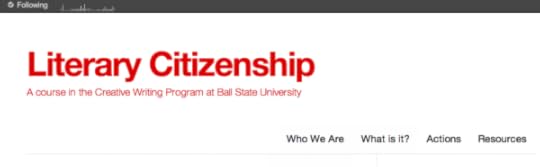
Is this necessary? I think so. I already have multiple email addresses for the different roles I play.
College-employee me.
Teacher me. Yes, these are two different things. My bsu.edu account fills up every day with all matter of university, college, and departmental matters that have nothing to do with teaching. My students’ messages were getting lost in the shuffle. So I created a special gmail address that I only give to them.
Friend and family-member me. These messages get pushed to my phone. A select group of people get this address.
Writer me. These messages are not pushed to my phone. This is a more public email address.
Consumer me. The address I use when I buy things. This is where all the spam goes.
I like this compartmentalization in my daily communication, and I guess I like it in my blogging, too.
The Big Thing, this blog, is still about novel writing and teaching novel writing, as well as posts related to the book I’m working on. And I’m starting to realize that what I write here are essays, something more akin to a newsletter. It’s me talking to other creative writing teachers and writers.
My #amnoveling blog is the hub of a particular course I teach. Me talking to students. Students talking to me. But it’s transparent, so you can follow along. It’s not a MOOC or an online class, but if you’re industrious and motivated, you can certainly follow along.
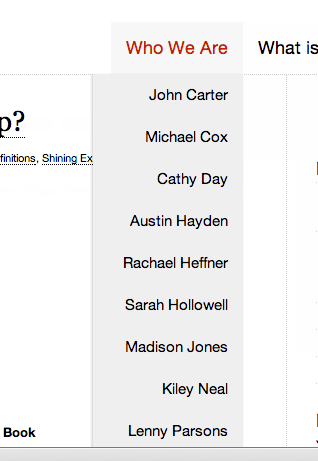 Literary Citizenship is a very different kind of hub for a different kind of class. Me talking to students. An opportunity for my students to get increased traffic to their own blogs, their own hubs. There’s a drop down menu that takes you to their blogs. Follow along and be a fellow literary citizen.
The difference between #amnoveling (in which every student in the class authors the blog) and Literary Citizenship (in which I’m the only author) is that I will only post (or cross post) the best of what my students and I write–not every damn thing we write.
This, I hope, makes your trip to the site worth your while.
So: What’s the secret to getting published on Literary Citizenship? Besides being a student in the class?
Simple. They must write posts that fit the categories, which are all outward focused:
ACTIONS
Online Community
Attend/Organize Literary Events
Interview Writers
Review Books
Other? Create a category
WHAT IS LITERARY CITIZENSHIP?
Definitions
Shining Examples
I’ve limited the blogs categories in this way so that they will blog about something other than themselves, so that the mantra of the course will be upheld:
BE INTERESTED IN WHAT OTHER PEOPLE ARE DOING.
And here’s how you can help me, faithful reader:
Please consider subscribing to the Lit Cit blog (see “Follow us via email” in the top righto of the home page).
Check in regularly, share and retweet our posts. The more traffic the blog receives, the more excited my students will be and the more motivated they’ll be to write posts worthy of being posted to the site.
You can also talk about the topic of literary citizenship on your own blog. If your post fits into one of our categories, I’ll reblog it or cross post it here. (I’m still figuring this out a little…) Here’s a collection of posts about Definitions of literary citizenship, for example.
What is cross posting? Well, I’m going to take the latter half of this post from MY blog and cross post it to Literary Citizenship. Is this plagiarism? No! We’re trying to figure out a genuine, non-skeezy way to get our blogs read by more people.
Thanks for being a part of that.

January 10, 2013
A Story about Creativity
A long time ago, I was asked to be a part of a study about Creativity. I’m not supposed to reveal who sponsored this study, but suffice it to say it was well funded. Let’s call them the Company.
The Company sent me 50 poems, 50 stories, and 50 essays by 8th graders and said, “Using whatever criteria you desire, arrange each pile from Most Creative to Least Creative. In the top right hand corner, write a big ‘1’ on the Most Creative piece and so on down to 50. Then send the stacks back to us.”
A few months later, I was summoned to the Company’s retreat complex, which featured large meeting rooms, a small hotel, and a private, fine-dining room.

It wasn’t this fancy. But close.
As we waited for the meeting to start in a large room that overlooked the pastoral grounds, everyone started talking.
“I want to know how all of you ranked those pieces.”
“Me, too.”
“Of course, our results are going to be all over the place.”
“Definitely.”
“Because creativity is so subjective.”
Lots of nods.
I piped up. “Actually, I think the results will be pretty consistent.”
Lots of puzzled looks.
“And we’re not going to talk about creativity,” I continued. “We’ll probably talk about craft.”
“Craft?”
“Yes, craft. The language of craft.”
A smartly suited woman breezed into the room, and we got started.
There were about 20 of us at a board-room table, and we went around an introduced ourselves. There were child psychologists, a woman from Sesame Street, the editor of a literary magazine for children, a filmmaker, a children’s book editor, and a small group of 8th grade language arts teachers, among others.
That’s when I realized that while everyone in the room specialized in either “Young People” or the Creative Arts, I was the only person in the room who taught creative writing.
Creativity comes from magical star wands. Only some people wield them.
The Company Woman said, “You might be surprised by this, but your rankings were surprisingly consistent.”
“No!”
“How can this be?”
On a large screen, she projected two poems. “We broke your rankings into fifths. Top fifth, second fifth, middle fifth, and so on.” She pointed to the poem on the right. “All of you placed this poem in the top group, while this one…” she pointed to the poem on the left, “…was consistently placed in the second group. Can you talk about why you believed this one to be ‘more creative’ than the other?”
Fingers went to chins. Brows were furrowed. And then they started talking. “Well, the one on the right has more things in it. I visualized and heard sounds.”
I couldn’t stop myself. “Those are called images.”
“Yes, it had more images. And the lines were broken in interesting places.”
Another person said, “I’d get to the end of the line and think one thing, and then I’d go down to the next line and think something different.”
Again, I spoke up. “Yes, that’s called enjambment.”
We moved on to the stories. The Company Woman showed us two stories, one we judged to be one of the Least Creative, and another we said was More Creative.
“The one on the right was too simple. Nothing interesting happened. It started, got going, but never ended. There didn’t seem to be much point to it. But the other one, there was a definite problem being dealt with.”
I talked about how “Only trouble is interesting,” a Janet Burroway maxim. I talked about conflict and plot.
They said, “I felt like I was inside a specific sequence of events in this story.”
I talked about dramatized scenes and vivid, continuous fictional dream.
This continued for two days—them saying “I know this one is better than that one, but I can’t explain why.”
And me explaining why.
I noticed that the Language Arts teachers were scribbling notes furiously. I asked them, “You teach creative writing, right?”
They nodded.
“So what do you do?”
They looked a little sheepish. “We give them a piece of paper and a pencil and say ‘Be creative. Write something. Let your imagination flow.’”
I had to fight to contain myself.

This is where the magic happens.
I said, “Well, that’s a start, but it’s sort of like teaching someone to play piano by sitting them down at the keyboard and saying ‘Be creative. Make some sounds. Let your spirit soar.’”
“But how in the world are we supposed to teach creative writing?” they asked. “It’s impossible.”
I said, “Go to a bookstore. Go on Amazon. There are hundreds, thousands, of creative writing textbooks. Give your students the building blocks, the tools, and then tell them to let their imaginations flow.”
The weekend was sort of tiring, actually. I felt like a sign language interpreter, standing there for hours and hours, signing and explaining and trying to establish a common vocabulary.
Still, the experience was gratifying, and not just because I got paid. I’m grateful to The Company for inviting me to that weekend retreat on creativity.
The experience convinced me that what I did for living had cultural—dare I say it? even practical—value. My profession mattered. I wasn’t participating in some crazy scam. Indeed, creative writing can be taught.
The most creative pieces we saw that weekend were those in which the students seemed to have the most “tools.”
Maybe they had those tools because they were naturally gifted—sure, maybe that.
Or maybe they had the tools because they read a lot—they’d stolen or borrowed them.
Or maybe, it was because their teachers had given them these craft tools—and those little buggers had used them well enough to convince a room full of intelligent adults that they were “creative.”
I tell this story when people ask me: “What’s the difference between craft and creativity?”
I tell this story when people ask me: “But can creative writing really be taught?”
What Made Me Think of This Story
I realized it’s been two years since I published that essay at The Millions about teaching novel writing.
Some people say that novel writing can’t be taught, that you have to “teach yourself” how to write a novel.
I say, sure you do, but wouldn’t it be nice if someone had given you some tools for your novel-writing toolbox first?
I’m teaching my novel-writing class for the fourth time this semester. You can see what we’re up to here. Here’s the schedule.
Every week, we focus on a different tool, slowly working our way into this seemingly impossible and magical and creative process.
Pedagogically, they call this scaffolding. You build an architecture, build student confidence, and then you pull the scaffold away and there they are, doing it on their own. (I might not be using the term in exactly the right way, so forgive me if that’s so.)
I met my novel-writing students last night and told them this: I don’t know if you will finish the novel you write this semester, but if some day—a year, ten years from now—you get an idea and want to write a novel, I hope you’ll remember these steps and use the tools you pick up in this class.
Tonight I meet my Literary Citizenship students for the first time. Their assignment is to blog weekly, and so, dear reader, will I.
Stay tuned.

January 8, 2013
Most Words Drafted–Fall 2012
Here are the two students who won the Total Word Count Challenge: Kayla Weiss (85,007 words) and Kameron McBride (43,880 words).
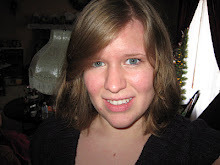 Kayla Weiss
Kayla averaged over 7,000 words a week, or 28 pages a week, for 12 weeks. This is really sort of amazing.
 Kameron McBride
Kameron averaged about 3657 words a week, or 14 pages a week, for 12 weeks. Also pretty amazing.
Scroll down to see how many other students took this challenge and did really well. What’s significant about this is that they were only required to turn in 2,250 words per week as their “Weekly Words,” which I talk about here.
Observations
This is the second time Kayla has taken my class, and she won last time, too.
Kayla started the semester writing one novel, but discovered that she really wanted to work on a different project. For awhile, she alternated between the two projects before finally committing to the second manuscript. This is smart. When you run out of steam with one manuscript, don’t just stop writing. Pull up another manuscript.
Kameron says that what really helped him was using 750words.com. It provided a clean, uncluttered writing space that he’d keep open on his laptop during the day.
What were their novels about?
I don’t want to give too much away, because both novels have good premises.
Kameron’s is sort of a meta-horror novel. Kayla’s is part of a trilogy she’s been working on for a few years.
Kayla and Kameron won a year’s subscription to Poets & Writers.
You can continue following their writing journeys here:
Kameron’s Twitter
Kayla’s Twitter
Runners up
ENG 407-2
Scott Bugher 65,878
Andy House 62, 353
Sarah Hollowell 52, 025
Amy Dobbs 38, 365
Jackson Eflin 32, 971
Samantha Zarhn 27, 393
407-3
Kiley Neal 40,910
Aaron Beal 38, 167
Katelyn Wilhelm 33, 857
Christian Jones 31,915
Hilary Wright 30,694
Aaron Price 27, 555


