
Cathy Day's Blog, page 9
June 21, 2013
Why “Copper” is Addictive and Instructive

 If you like Deadwood, Law & Order, Gangs of New York, and Homicide: Life on the Street, then you need to watch Copper. It begins its second season on BBC America on June 23.
Find out where you can watch Season 1. Here’s a preview.
People, I streamed all ten episodes in two days.
Here’s a preview of Season 2.
Now, one of my most popular posts here at The Big Thing is “Why Downton Abbey is Addictive and Instructive,” in which I analyze the first 15 minutes of the first episode of that wonderful program.
But I’d like to do something a little different here, which is to analyze the last 15 seconds of season one of Copper.
This is one of the darkest, non-cable TV shows I’ve ever seen, and I mean that as a compliment. The action takes place in 1864 in the Five Points neighborhood of New York City (the same period as Gangs of New York). Kevin “Corky” Corcoran is an Irish immigrant, a Civil War hero, and a police detective living in a debauched world. Within the first five minutes of the show, he offers a hard-boiled egg to a homeless waif named Annie–and she promptly offers to blow him.
There are men in Five Points who will sleep with a ten-year old–but not Corky. He’s aghast. He had a daughter once who looked a lot like Annie, and thus, for the rest of the season, Corky tries to save Annie from the men who want to have her, and to thank him for this, she throws herself at him with abandon.
Mind you, Corky sleeps with every other female character on the show. Fiercely. He’s not exactly Mr. Straight Arrow. He’s searching for his missing wife Ellen, but still shacks up with a local madam named Eva.

Sleeps with her.
He also sleeps with Molly, one of Eva’s girls and the love interest of his best friend.

Her, too.
Oh, and he also bags Winifred, the sexy rich lady.

This one, too.
Corky gets around is what I’m saying.
Is it bad to admit that one of the dramatic questions that kept me coming back to every episode was this: Will Corky kiss/touch/sleep-with the 10 year old girl?

But what about this one?
I didn’t want him to do this, mind you, but it’s a testament to the wavy, immoral compass of Copper that I wasn’t sure if it would happen or not.
A whole lot of nastiness goes down in this show–I’m not going to give everything away, but remember, I said dark–and by the last episode, Corky is hooked on morphine and he’s feeling very low.

And a young girl’s head appears just over his shoulder, slightly out of focus. See, Annie is living with him now. He’s just given her a bath, tucked her into bed.
And the writers of the show know that I’m still watching this show wondering if he will sleep with a 10 year old.
The moment is ripe. He’s vulnerable. She’s the predator (and yes, I know it is very creepy to say that about a 10 year old girl).
What happens next? I’m not going to tell you because I don’t want to spoil it for you, but it’s a perfectly executed, old-fashioned reversal. And it works because the writers make you think you’re going to get one dramatic question answered, but they answer another one instead.


June 15, 2013
It’s Okay to Feel Ambivalent on Father’s Day

Me and my dad in 1970.
If the saccharine nature of Father’s Day makes you roll your eyes or get sick to your stomach , please read this. Okay?
The other day, my husband and I went to Walgreen’s to buy Father’s Day cards. One for his dad, one for mine, and then I turned to the “Grandpa” section and remembered that I don’t have any grandpas anymore.
My maternal grandfather died in 2005, and my paternal grandfather died this past January. But my husband still has a grandfather, a wonderful guy who survived Pearl Harbor, so we bought a card for him and mailed it to San Antonio, Texas.
I lost three of my four grandparents in the last year or so. I’m 44 years old, so I got to have them in my life for a very long time, and then boom boom boom, they were gone. What’s hard about losing a grandparent, of course, is that it makes you realize you will lose your parents, and that scares me to death.
I think that’s why so many of us get mushy and sentimental on Father’s Day. We’re mourning in advance. Celebrating our dads, sure, but also keenly aware that we won’t have them forever. And I am at heart a deeply sentimental kind of person.
But here’s the thing, though: some fathers suck, and some people never had a dad to begin with.
I’m fortunate. I have a great father, but I recognize that not everyone does (or did). Maybe you can’t buy Father’s Day cards because they’re all so sickly sweet and untrue. Maybe you’re secretly glad your father is gone so you don’t have to pretend you like him anymore.
A study came out recently that demonstrated that reading fiction makes us comfortable with ambiguity. Like F. Scott Fitzgerald said:
The test of a first-rate intelligence is the ability to hold two opposed ideas in mind at the same time and still retain the ability to function. One should, for example, be able to see things as hopeless and yet be determined to make them otherwise.
If the above quotation is true (and I think it is) that means we must be willing to say that Father’s Day is both a wonderful and an awful occasion That a man can be a great father and a lousy one at the same time. That we can love our dads, but also hate them.
Normally, we celebrate Father’s Day by holding only one idea in our mind–Dad is great, he gives us chocolate cake–but maybe what you need today is to celebrate Ambiguous and Ambivalent Father’s Day? There’s no Hallmark Card for this holiday. What you need is literature.
The story that made me want to be a writer is by Andre Dubus: “A Father’s Story.” It’s a story about man who loves his daughter “more than truth,” and I highly recommend you take an hour or so this Father’s Day and read it. You won’t be sorry. Here are some other stories about fathers that might help you make it through today.
Short Stories
Ethan Canin, “The Year of Getting to Know Us”
Willa Cather, “Paul’s Case”
F. Scott Fitzgerald, “Babylon Revisited”
Dan Chaon, “The Bees”
Dean Bakopoulos, “Please Don’t Come Back from the Moon”
Robert Coover, “The Babysitter”
Junot Diaz, “Fiesta, 1980″
Tony Earley, “My Father’s Heart”
William Faulkner, “Barn Burning”
Zora Neale Hurston, “The Gilded Six-Bits”
Grace Paley, “Conversation with My Father”
John Updike, “Separating”
Harold Brodkey, ”His Son, In His Arms, In Light, Aloft”
Poems
Robert Hayden, “Those Winter Sundays”
Theodore Roethke, “My Papa’s Waltz” (This poem is ambiguity incarnate. Well, all good poems are ambiguity incarnate, aren’t they?)
Philip Larkin, “This Be the Verse”
Sylvia Plath, “Daddy”
Novels
Daniel Wallace, Big Fish
More? I’m sure there are many, many more stories (and poems and novels and films) that should be added to this list. Feel free to add them in the comments section.
Also, here are Fiona Maazel’s “10 Worst Dads in Books.” (Someone in the comments mentions that she missed one: Pap in The Adventures of Huckleberry Finn. Yep.)
May you have a wonderfully ambiguous Father’s Day.
P.S. I have linked to some stories above that should not be available on the internets. If you find a story you love via this post, promise me you will go out and pay for that writer’s book, okay? It’s the right thing to do.

June 12, 2013
Thinking Like Edith Wharton

Edith Wharton photographed in Newport, RI in 1907. http://en.wikipedia.org/wiki/File:Edi...
For the last few years, I’ve had Edith Wharton on the brain.
See, I’m writing a book about the life of Linda Lee Thomas Porter, best known as the wife of Cole Porter. But before she was his wife, she was married for eleven years to the son of a robber baron/industrialist named Ned Thomas.
So: what’s the connection between Linda and Edith Wharton?
Stoneacre “cottage” which burned to the ground in the 1960s.
Linda’s then sister-in-law was married to R. Livingston Beeckman, who would one day be the 52nd Governor of Rhode Island, and around the same time that Linda and Ned bought their Newport mansion, Stoneacre, the Beeckman’s bought theirs, a little place called Land’s End owned by Mr. and Mrs. Edward R. Wharton.
That’s Teddy and Edith Wharton to you and me.
By 1903, Wharton had decided to decamp to The Mount, the mansion she built in Lenox, MA in the Berkshires, a place she built from the ground up. And so she and Teddy sold Land’s End to the Beeckmans.
I have no idea, really, if Linda Thomas and Edith Wharton were friends, but I assume they were at least acquainted with each other. Their lives overlapped at certain points: Newport, RI, New York, NY, and later the two women would both move to Paris.
I’ve spoken to a few people who’ve done extensive research on Wharton, notably Connie Nordhielm Wooldridge, who wrote The Brave Escape of Edith Wharton and who lives nearby in Richmond, Indiana. She’s done extensive research at the Edith Wharton Collection at Yale’s Beinecke Library. I asked her if she ever came across anything on Linda Thomas, and she said no, although “in this crowd, everyone knew everyone,” she said.
And certainly, when I investigated Linda scrapbooks at Harvard, I found many clippings about Wharton. For many years, Linda “followed” Wharton, her career, and her media coverage. She seemed particularly taken with the photographic spreads of Wharton’s gardens that occasionally appeared in magazines.
This, perhaps, is why I write fiction rather than nonfiction. Because I can’t prove that Linda and Edith knew each other, but I want them to know each other. I can’t resist. And in fiction, I can make it happen.
Getting into (Real) Characters
But it’s scary to write a scene with Edith Wharton in it. Harder still to try to imagine what she might reasonably be thinking in a particular moment. I’ve prepared for this challenge by reading a few of her novels (The House of Mirth, The Custom of the Country, and The Age of Innocence), her biography, and some of her short fiction.
I found this quotation in her story “The Fulness of Life,” published in Scribner’s Magazine, 1893. It’s about a woman who dies and meets the man who finally “gets” her in heaven.
“I have sometimes thought that a woman’s nature is like a great house full of rooms: there is the hall, through which everyone passes in going in and out; the drawing-room, where one receives formal visits, the sitting-room, where members of the family come and go as they list; but beyond that, far beyond, are other rooms, the handles of whose doors perhaps are never turned; no one knows the way to them, no one knows whither they lead; and in the innermost room, the holy of holies, the soul sits alone and waits for a footstep that never comes.”
To work up my courage to write in Wharton’s point of view, I’ve been re-reading E.L. Doctorow’s amazing novel, Ragtime, in which he enters the consciousness of a host of historical figures: Harry Houdini, J.P. Morgan, Henry Ford, Evelyn Nesbit, Emma Goldman, and even Sigmund Freud.
I’ve also been re-reading a wonderful and (I think) vastly under-appreciated book of “nonfictional fiction” I read many years ago and which has stayed with me for a long time: Vindication by Frances Sherwood, a novel of the trailblazing feminist Mary Wollstonecraft.
Edith Wharton in Popular Culture
I’ve also been keeping up with Edith Wharton News. There’s been a good bit lately. The year 2012 was the 150th anniversary of her birth. Or maybe we all have Downton Abbey on the brain? Or maybe it’s just because I’m writing the book I’m writing and so therefore am paying attention.
Anyway, first, there was this.

This made me so pissed. So very very pissed.
I’m referring to the Vogue spread in which contemporary male writers stood in for the men of Wharton’s circle (Jeffrey Eugenides as Henry James, Junot Diaz as Walter Berry, Jonathan Safran Foer as Ogden Codman, for example), but no contemporary women writers could match the beauty of the actresses and supermodels chosen to represent Wharton and the women of her circle.
Seriously: Jennifer Egan? Meg Wolitzer? Lorrie Moore? ALICE MUNRO?!
Then there was this: “A Rooting Interest: Edith Wharton and the Problem of Sympathy” by Jonathan Franzen in The New Yorker, in which he famously says:
“Wharton did have one potentially redeeming disadvantage: she wasn’t pretty. The fine quip of one of Wharton’s contemporary reviewers—that she wrote like a masculine Henry James—could also be applied to her social pursuits: she wanted to be with the men and to talk about the things men talked about. An odd thing about beauty, however, is that its absence tends not to arouse our sympathy as much as other forms of privation do. To the contrary, Edith Wharton might well be more congenial to us now if, alongside her other advantages, she’d looked like Grace Kelly or Jacqueline Kennedy.”
For good reason, there were many denunciations of Franzen’s piece published: in The Daily Beast, The Center for Fiction, and The LA Review of Books, to name a few.
And then there was this excellent article entitled “Edith Wharton Invented Kim Kardashian” in Salon. My God, I wish I’d written this essay. Her satirical novel The Custom of the Country deserves a 21st century audience.
Not Midnight in Paris
When I tell people I’m writing about Linda Porter, they automatically associate her with the 20′s and 30′s, with the Midnight in Paris-era. And that will be there, of course. But Linda was a full-grown woman by the time she met Cole, and it’s who she was before she ever met him that really interests me. And that places her not so much in the world of a Fitzgerald novel, but rather in one of an earlier time, by someone like Wharton.
Speaking of which…back to work I go.

June 5, 2013
Writing Machines & Writing Spaces
A little over a year ago, I had back surgery, and this has changed forever the way I write. Because I can no longer sit for long periods of time, I move around a lot. I have a few places where I write.
This is my main desk, command central, you might say. I have a home office. The picture on the left is what my desk looks like normally. The one on the right is what it looks like when I do a purge.

Sometimes, though, I write in our guest room, which is a pretty blue and the desk looks out the window onto our tree-lined street.

On days like today, when it’s nice outside, I write on my front porch with my dog at my feet.

Here’s a YouTube video of my view.
If it’s a cold morning, I write in bed while my husband sleeps. Again, with the dog at my feet. (I’m not going to show you my bed. I have limits.)
Because of my back pain, when I start feeling stiff, I absolutely must get up and move around. I get a glass of water, then move to another station.
 Or I go look at the Idea Wall that my husband made me a few weeks ago. You can buy this stuff called Idea Paint that turns any wall into a dry-erase board. This has been wonderful for my novel storyboard.
I think you get the point. I move around a lot.
I have three laptops with me at home this summer, and because I use Dropbox and Google Drive, I can move between them with no problem at all. Everything’s synched.
The cloud has changed how I think about my writing space and my writing machines. Because I’m no longer tied to one machine or one space, I’m free to move about the cabin and go wherever I want without fretting about my documents. I can pick right up where I left off.
A Room of One’s Own–with WiFi
Where and how do you write? Where and how have you written over the years? And how much does “the Borg” (access to the internet) change how you do these things?
Here’s my personal history.
Pre-1987, I write all things—creative or otherwise—on notebook paper. In high school, I turn in my work handwritten.
1987-1988, freshman year of college, I type my papers on a little electric typewriter because my college doesn’t yet have computer/word processors for students.
 1988-1989, I type my work on an IBM Wheelwriter, which looks like a typewriter, but has a two-line LCD display screen and a disk drive, which allows you to type your work, edit it via the display, and then—when it’s just right—hit print. I am speechless with excitement about this invention. Maybe the revolution will not be televised, but it will be word-processorized! Of course, I can’t afford one of these machines, but someone on my floor has one and lends it out generously, as long as we chip in for replacement ribbon cartridges.
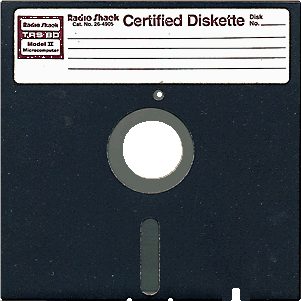
1989-90. It’s somewhere around this time that a computer lab opens in the basement of the college library. The room looks a little like this. Actually, I look a lot like the girl in that photo. For roughly 2000 students, the college provides about 50 computers which look a little like this. When you print your work, it comes out on a printer like this. You save your documents on 8-inch disks, like this. These computers are strictly word processors. No internet. No games. No discussion board. Nothing but typing, maybe some backspacing and deleting. Sometimes, you might put words in italics or bold. But that’s it. There is only one font. I take a lot of creative writing classes my junior year, and so I spend a great deal of time in the computer lab, listening to my Walkman, trying to drown out the tap tap tapping. When I need to take a writing break, I step into the smoking study lounge (amazingly, yes, our library had a smoking study lounge) to grab a cig and think a bit and drink a diet coke.
 1990-1991. My roommate’s dad gives her a personal computer, an IBM, which looks a little like this, and a little dot matrix printer. Basically, it’s the same computer they have at the library, but now I don’t have to schlep over to the library in subzero weather, which means that I can now put off writing papers and stories until absolutely the last minute, because as long as my roommate doesn’t need to use the computer, I can pull an all nighter. This was a significant evolutionary (or de-evolutionary) step in my writing life. Fer sure. .
1991-1994. My roommate’s father sells me this same computer and printer for $500, and I take it with me to the University of Alabama. I write many stories on this machine until it dies, taking with it my 25-page research paper for my Gothic Imagination seminar. I buy a Gateway 2000, which looks like this and is internet ready. There isn’t a whole lot of internet at this point. I can’t even remember how we found anything, how we searched. Anyway, this is what it looked like. Around this time, Alabama assigns everyone an email account, but you can’t check it from home, only at school, and most faculty refuse to use email, and so most communication continues to transpire via paper memos in your English Department mailbox, which I check about as frequently as I now check my email.
 1994-1997. More years at Alabama. Still using the old Gateway 2000, although they are phasing out the whole futuristic “2000” moniker since it will very soon be the year 2000. Anyway, it’s during the summer of 1994, on the Gateway 2000 machine, that I have my first prolonged spurt of writerly productivity: 2 pages a day all summer long. Every morning, I get up and write two or three pages. Sometimes this takes 30 minutes. Sometimes it takes five hours. Then I go running. Working out is my reward for having written, along with cigarettes, computer solitaire, turkey sandwiches, television (I got one channel), trips to the Chukker, and calling friends on the phone. The computer provides no distraction, no reward, except for computer solitaire. To check my email, I must walk to school.
1997-1999. I get my first teaching job at Mankato State University, where, for the first time, I have a computer in my university office. I spend at least one day each weekend in my office, grading papers or writing or sending emails.
 1999. I get a fellowship and move to Gettysburg for the year. Upon arriving in Pennsylvania, I rupture my L5-S1 disc. For the next nine months, I am in constant pain. Can’t sit in a chair. Can’t stand up for more than five minutes. And so I buy a lazy boy chair and an IBM Thinkpad, a portable desktop, and I write most of The Circus in Winter in that chair, kicked back with a laptop on my belly. I have dialup internet. Twice a day, I reward myself for having written by plugging in all the cords and checking my email.
2000. I start teaching at The College of New Jersey. For the first three years, I don’t have internet at home. Looking back, I think of those years as blissful. My office was a short walk to campus, and so I would sometimes check email on the weekends, but often I did not. All I could do with my computer in those days was write stories and play solitaire.
2003. Still in New Jersey. I get rid of the Think Pad and buy a shiny Sony Vaio Laptop, and get internet at home, and so my computer becomes my music player, writing machine, and internet source. The Circus in Winter is done, and so I spend the next year making crafts in my kitchen, listening to music on my laptop, reading crap on the internet. I write nothing.
2005. Move to Pittsburgh, where I don’t know a soul. I spend my considerable down time lurking on Battlestar Galactica and American Idol message boards. I have no one to talk to in real life except by phone and email. I am not on Facebook. I am not on MySpace.
2006. I start working on my second book, Comeback Season. Over the course of a year, I accumulate 350 pages of material. Journaling. Musing. Thinking. In other words, stuff that comes from me. But also, a lot of research, stuff from outside me. Internet articles on football strategy and statistics. Peyton Manning. Female coaches and their spouses vs. male coaches and their spouses. You name it, I researched it, cut and pasted into word documents. Dating profiles cut and pasted. Scenes sketched out. Game stats. Pittsburgh demographics. Reggie Wayne’s brother’s obituary. YouTube clips of sports movie training montages. Project Playlist music mixes. What did Al Pacino say in his locker room speech in Any Given Sunday? What’s the name of that sideline reporter Joe Namath tried to smooch? How many single or divorced men between the ages of 35-42 are enrolled on Match.com right now? Google search, cut, paste, boom. (Man, did I need Evernote!) I use my MySpace blog to try out new material on friends. Emails drafted and sent and received and saved in specially marked folders. However, when it’s time to actually write the book, I decide I must separate Writing from Internet Research/Play, so I bring my office desktop computer (a 2005 Dell) to my home office and I don’t hook it up to the internet.
I write on the Desktop Machine, just like I did in 1993.
I research/play on the Vaio Laptop Machine, which sits next to the Desktop Machine, in case I need to look something up or play some music or send an email.
This system works well, and I complete 6-10 pages every day on the Desktop Machine over the course of 4 months. This book went from idea to finished product in a little over a year, and it would have been impossible to write (or even to conceive of writing) this book ten years earlier.
To broaden the lens a little: What is the relationship between the rise in popularity of creative writing programs and the cultural shift from typing (a labor intensive way to create text) to word processing? Would fewer people imagine themselves as writers if it was physically harder to do? Does Microsoft Word make you “feel” like a writer in different way than typing made you feel like a writer?
Question: if you weren’t able to write on a word processing machine anymore—the apocalypse has come and there are no computers, no electricity, or you’ve become paralyzed—would you still find a way to write?
Question: 30 years ago when writers had bad backs, how did they cope? 30 years ago, how many people gave up on research-heavy books because it would take too long to complete them?
Thanks for reading! Why don’t you write a similar blog post, dear reader, and link back to this post? I’d love to see pictures of your writing space and read a history of your writing machines!

May 22, 2013
Book Reviewing in the Social Media Age: or, What if Mark Richard and I Had Been Facebook Friends?

For a time, I was completely obsessed with this headshot of Mark Richard. I wanted one just like it someday. (Didn’t happen.)
Here’s a question: What if I’d become a writer after–not before–social media? If you’re my age, do you ask yourself this question as often as I do?
Mark Richard was one of a handful of writers who made an enormous impression on me early in my apprenticeship. (I’d use Andre Dubus here, but he’s deceased, much to my sorrow.)
What if, after reading Mark Richard’s story “Strays” in Best American Short Stories 1989, I’d friended or followed him?
“Strays” and “On the Rope” changed my life.
If you’d like to read more of my thoughts on this subject, just go here. It’s a cross post between between The Big Thing and Literary Citizenship.
Basically, I speculate that social media might have made Mark Richard’s name as recognizable as Dennis Johnson, Annie Proulx, and Stuart Dyek, other writers who published collections around the same time.
I have no idea if this is true or not, but it’s interesting to think about.
Who else was a big fan of this book? I know I was. Big time.

May 8, 2013
Bringing New York Publishing to Muncie, Indiana

This is the table where BSU Board of Trustees meets. It’s kind of awesome.
Thanks to a grant from the Discovery Group, I’ve hired 11 Ball State students for internships at this summer’s Midwest Writers Workshop.
I’ve told you before about this conference, but here it is again.
Some backstory
Ever since I arrived at Ball State in 2010, I’ve been trying to come up with a way to expose students to the benefits of this conference. MWW is run by a group of dedicated volunteers. It’s not funded by Ball State University; it just happens to take place on campus. One day, I was talking about this to BSU professor Beth Turcotte (who knows everything about how to find the resources to make amazing things happen) and she recommended I look into the Discovery grant, and boom, I applied. In December, I found out I was a finalist and made a presentation to the members, and in February, I found out I’d been funded. I quickly put out a call for applications, and by April, I’d assembled my team.
We had our first meeting on April 29, 2013 in the fancy-schmancy Boardroom at the BSU Alumni Center.
Here’s what this amazing grant had made possible.
The Discovery 2013 Internship
Four students will work as Agent Assistants
Sarah LaPolla‘s assistant will be Rachael Heffner
Victoria Marini‘s assistant will be Sarah Hollowell
John Cusick‘s assistant will be Sara Rae Rust
Amanda Luedeke‘s assistant will be Becca Jackson
Each agent will hear 30 pitches. In advance of the conference, the assistants will coordinate those schedules, communicating with the literary agents and the attendees. At the conference, they’ll handle last-minute changes to the agents’ schedules, act as a timer during the pitches to keep things moving along, and moderate the Agent Panel. They’re getting a close-up view of the way publishing works, and they’re really excited about this opportunity.
Seven students will work as Social Media Tutors
Mo Smith
John Carter
Madison Jones
Kiley Neal
Rebekah Hobbs
Kameron McBride
Jackson Eflin
Everyone who attends Midwest Writers will have the opportunity to schedule a FREE, 50-minute social media (or technology) consulting session. For years (thanks to the continued presence and wisdom of Jane Friedman), MWW has been telling attendees about WHY they need use social media, but this year, we’ll be able to show them HOW.
In advance of the conference, the tutors will study their clients’ current online presence and make some recommendations about how they can be better literary citizens.
Helping me to direct this project is my grad assistant Linda Taylor, a fellow MWW planning committee member who worked in publishing for 30 years before coming to Ball State for her master’s degree. She was a great resource when I taught Literary Citizenship this past spring.
Stay tuned for more updates about this project!

April 28, 2013
When and how do students write?
I found this great article the other day, “Seven Effing Great Ways to Build Your Writing Routine.” The author encourages us to find our writing “sweet spots” in order to maximize our daily/weekly output.
Consider the following questions:
How long does your typical writing session tend to last?
How frequently do you sit down to write?
On average, how many words do you write per session?
At what time of the day do you do your writing?
Back when I taught novel writing as a “writeshop,” my students wrote in class and we talked a lot about writing process. I’ve moved away from that model over time, but next year, I need to be more explicit and deliberate about talking to students about WHEN and HOW they write. I’ll share this article with them.
Also: I’m thinking about having students log in or “check in” when they’re writing. Like the way I can check in on Facebook or GetGlue when I’m watching a particular TV show or reading a certain book. (What do you think about this, friends?)
Context
This semester, I lowered the Weekly Words requirement from 12 weeks of 2,250 words to 10 weeks of an even 2,000 words.
This is way down from the 12 weeks of 3,300 I required three years ago. Why did I let up? Ball State students take 5 and 6 three-credit classes a semester, not 4 four-credit classes, and most hold down jobs. I felt like I was asking too much–given their circumstances–and the burn-out rate was significantly lower this term. No one dropped.
Of the 15 students enrolled, only two drafted less than 20,000 words. They came up with a partial by the due date, but missed a few weeks here and there.
Ten turned in 20,000 to 25,000 words, or a little over the required amount.
Only two turned in well over the required amount every single week and thus ended up with double the required words. In fact, they were so close that I decided to feature them both here.
The Winners
Adam Gulla came in first place with 40,000 words. He gets a subscription to Poets & Writers.

Adam Gulla
He took me up on my offer to “count” handwritten journaling and drafting. Every week, he turned in 2,000 words in a Word doc, plus he’d scan his journal pages where he wrote up character profiles, developed backstory, and built the world of his science-fiction novel.

One of about 50 such pages Adam sent me over the course of the semester. .
We came up with a formula for what each page equaled.
Smart idea.
Every semester, I encourage my students to do this, to “count” pre-writing AND writing-writing, but Adam is the first student to take me up on that offer.
Veronica Sipe came in second, less than a thousand words behind Adam at 39,290.

Veronica Sipe
She’s working on a historical novel with post-colonial themes (she’s also majoring in Spanish) that takes place in an invented South American country.
As I look back at my weekly emails from Veronica, I see that she always sent me her words well ahead of the deadline, and that she always had more than the required 2000 words.
So, what do Adam and Veronica have in common?
When and How They Wrote
Here’s how they answered the four questions above.
How long does your typical writing session tend to last?
Adam: I tend to have multiple writing sessions a day. My quick, sporadic writing sessions usually last twenty minutes each. My planned writing sessions last two hours.
Veronica: I have two kinds of writing sessions: casual ones that last about an hour and a half, and longer ones that can last as long as five hours, with a couple short breaks. Those are rare, though.
How frequently do you sit down to write?
Adam: I try to write multiple times a day, every day (and despite my best intentions, this is not always accomplished). What usually ends up happening is this: I get up in the morning and crank out a few words before class; I write during my lunch break; I write in short spans after each homework assignment I complete; and finally, I write later in the evening.
Veronica: During the school year I find time for writing maybe once or twice a week. More often in the summer.
On average, how many words do you write per session?
Adam: During my quick writing sessions, I tend to get 200 words on the page. During my planed writing sessions, I come out with around 1200 words (again, despite my best intentions, this is not always the case).
Veronica: If I have direction I can get about 2000-3000 words in a couple hours.
At what time of the day do you do your writing?
Adam: I write at all times of the day, but late nights (9 PM – 2 AM) and early mornings (5 AM – 8AM) are the most productive times for me to write. During these hours, no one disturbs me, and I can devote complete focus to my work.
Veronica: On days when I have nothing else to do, I like to write in the early afternoon. On work/school days, I prefer writing at night. I also like to take a notebook to work and to lecture classes so I can write if I have a break or get bored. Which is probably not very responsible, but oh, well.
Adam: For the longest time, I used to edit while writing (I still find myself doing this on occasion). It was a constant process of adding and taking away until two hours were gone, and the only things I had to show for it were a few paragraphs of roughly 500 words. Sometimes, I could spend as much as ten minutes deciding on the “perfect” word. As you can well imagine, my writing routine used to crawl by slower than a crippled snail. It was frustrating. It took me months to write a short story. And worst of all, the stories suffered from it. I would spend so much time consumed by sentence level concerns and specifics that the elements of plot, character, and story logic were being neglected.
I have since adopted the process of getting everything inside me on the page first and foremost, without being too selective. By doing this, I dump my ideas without hindrance. From here it’s a matter of going back over the rough draft and touching it up, piece by piece. This process has more than doubled my writing proficiency. I find it much easier and much more convenient to have words on the page that I can work with. For me, the most enjoyable and productive part of writing is rewriting. By using this process, it streamlines my writing routine.
Congratulations you guys! And I hope you finish those novels!

April 16, 2013
Top 10 reasons to come see The Circus in Winter on 4/25
Oh man, I’m so excited to hear the “Higher Ground”/Flood sequence again, I can’t even tell you.
1. Sutton Foster will be there. Not performing. Just watching. But still…Sutton freaking Foster, people.
2. My parents will be there. They are cute.
3. My sister will be there. She is cute.
4. The President of Ball State University, Jo Ann Gora will be there. Note that I put my family before President Gora but after Sutton Foster…please don’t read too much into this. I need to keep my job and my family relations intact.
5. Thanks to Goodspeed Musicals in Connecticut and to the hard work of Beth Turcotte, Ben Clark, producer Sean Cercone and others, the book (the story, the script) is better. The plot is different from the version you might already be familiar with. There’s a new character!
6. There’s some new music, new songs by Ben Clark. So yay! new material by Ben! (You’ve probably seen him on teeeee-veeee…)
7. I hear the whole band will be there, too! Yay Joe Young on the mandolin! Yay Nick Rapley on percussion! Will Sean Muzzi be there, too? (He just got a gig playing for the Glenn Miller Orchestra!)
8. It’s a concert reading. And the next morning, they’re taking off for NEW YORK CITY to perform in front of a select group of investor-type folks. So we need to send them off with a bang, like in a pep rally sort of way!
9. WHERE IS IT? It’s taking place at 8 PM, 4/25 at the Cornerstone Center for the Arts, 520 E. Main St., in downtown Muncie, which also happens to be a block from my house, so yay! I can stumble home happily afterwards.
10. It’s free and open to the public, so tell all your friends!

March 25, 2013
The Next Thing: Professionalization in Creative Writing
 Not every Creative Writing major wants to go to grad school, and to be honest, I’m not even sure if most of them want to be published writers. What brings them to our classes, I think, is a desire to be connected to the world of books. This essay by Dean Bakopoulos speaks to that desire.
Creative writing isn’t a pre-professional discipline. We’re not like some academic majors which prepare students for a concrete, discernible “next thing,” such as graduate study, this job, that career path. When my students say, “What I can do with this degree?” I talk about “transferable skills.” I point them in the direction of the career center.
To be honest, I hate it when they ask me that question, because I know there are no easy answers. I wish there WAS a concrete, discernible “next thing,” because I’d feel so much better if what I did for a living helped people afford health insurance.
Here’s an answer from a great writer, teacher, and literary citizen, Dinty Moore. (He posted this on Facebook a few days ago, and I hope he doesn’t mind my sharing it here.)
Dear E****
The short answer is that you will have to be creative in your job search if you major in poetry: you might end up working in editing or publishing or you might end up in a field entirely unrelated. This is hard for parents to understand, but students often end up finding careers well outside of their majors no matter what they choose. I have spent most of my life around writers, poets, painters, dancers, actors, and though many of them wait tables, tend bar, sell real estate, or do data entry, none of them in my experience is actually starving to death. People find ways to survive and still do what they love. Of course, your parents want you to choose accounting and then go immediately into an accounting job and stay there all of your life, so they never have to worry about you. I understand that impulse: I have a daughter as well. That is just something you’ll have to work out, based on your relationship with your parents, how badly you want to be a writer, and other factors.
But here’s the deal: just because it’s hard to answer the question “What can I do with this degree?” doesn’t mean it’s not a fair question. We should try to answer it. And every school, every program DOES try to answer that question–even if it’s to point students in the direction of the career center or internship office.
What we don’t have in the discipline of creative writing, especially at the undergraduate level, is a tradition of offering courses engaged in the direct professionalization of students.
This year, I’m on a committee that reviews curriculum proposals across the sciences and humanities, and I’ve come across a variety of courses in other departments–1 credit, 2 credits, sometimes 3-credit courses–in which the practical necessities of career planning are brought into the classroom.
For example, check out this capstone professionalization course offered in my own department–within the Professional Writing minor.
On the other hand, I think it’s also true that CW students don’t always recognize “professionalization” when they see it, when it’s actually happening to them.
For example, on the first day of my literary citizenship course, a student said she wished that our CW major “did more” to teach students about publishing and related careers.
And I said, “Well, we offer a year-long course in Literary Editing and Publishing, during which you edit a national literary magazine. And we offer a class called Creative Writing in the Community which gives you teaching experience. And every year, we host a literary festival called In Print in which we bring first-book authors to campus to read and to talk to you about the experience of publishing their first books. And in my fiction-writing courses, I talk about how to submit work to lit mags and to agents and editors. And at this university, you have many chances to take ‘immersive learning courses’ (Ball State’s moniker for ‘experiential learning’) in which you develop all kinds of real-world skills. And in this major, we offer coursework in Screenwriting, during which you can submit a script that actually gets made into a movie by TCOM majors and acting majors.
“So, explain to me how we are NOT preparing you for real life?”
The room got kinda quiet.
I see this course, Literary Citizenship, playing another important role in how we professionalize students–by teaching them how to blog and use social media as writers.
In her article, “How to Get an Internship in Publishing: 5 Tips,” Livia Nelson writes:
I do believe, though, that our generation’s saving grace in this economy is that we understand social media and the blogosphere. Even some of the most connected industry vets can barely figure out how to block pop-ups, let alone create a Facebook/Twitter/ LinkedIn/blog presence. But social media integration is essential to businesses now—and since we’ve been playing around with Facebook etc. since they’re beginnings (I first got a Facebook when I was 16), it’s like a first language to us (the technical term for this is “digital native”). So make sure to play up the fact that, for you, working with social media ain’t no thang (I included social media in my list of skills).
And so, because it’s that time of year when students are starting to freak out a little about the next thing–or their lack of a next thing–my grad student Linda Taylor has compiled this awesome resource list of job search websites for publishing internships and jobs. Some of these require signing up in order to access job boards.
Go here to download: job hunting websites
[This is a cross post between The Big Thing and Literary Citizenship.]

March 20, 2013
My students, my friends
 It’s “In Print Week” here at Ball State–the In Print Festival of First Books. Each year, we invite to campus a poet, fiction writer, and nonfiction writer who have published their first books.
This has been a great year for me as a teacher; a number of my former students had books come out. We invited one of them to In Print–Eugene Cross. This is the introduction I wrote and read last night, and I think it speaks to a lot of things I blog about here–literary citizenship, community, and how to make it through the dark times. So: I thought I’d share it with you.
Why did we invite Eugene to In Print?: An Intro in Three Parts
1.
Eugene Cross is the author of the short story collection Fires of Our Choosing, published by Dzanc Books, which was long listed for the Frank O’Connor International Short Story Award. He received an MFA from The University of Pittsburgh. His stories have appeared in some of the best magazines in the country, and he’s earned a place at the table at the Chautauqua Writers’ Festival and both the Bread Loaf and Sewanee writers’ conferences. He teaches at Columbia College Chicago and is currently the Simon Blattner Visiting Assistant Professor of Fiction at Northwestern.
2.
We invited him because Eugene was my student. But only briefly. Just one class. I think it’s more accurate to say that he learned more about writing from his other teachers, and that what I taught him was how to steer his way through “The Abyss,” which is a word I use to describe the time between “finishing school” and “publishing a book,” between “Book 1” and “Book 2.”
Honestly, most young writers don’t make it through the Abyss. Life gets in the way. They lose their resolve. Or they discover they really want something else entirely. It’s a scary, empty, often lonely time, and that’s when I knew Eugene—when we were both wading through different forms of this abyss.
After graduating with his MFA in 2006, Eugene decided he wanted to move home to Erie, keep working on his stories, and teach at a local college—first for peanuts, and then for something that sort of approached a living wage—and he did this for five years. We talked often during this time. How to get a job. How to teach a class. How to write when you’re teaching. How to keep going when you start racking up the rejection letters. How to get an agent. I wrote a lot of letters for Eugene.
And because his momma raised him right, he always sent me a thank you card or little gift. Once, he gave me two tickets to a Steelers preseason game against the Packers—which was awesome.
From the beginning, I urged Eugene to get out of Erie, out of Pennsylvania, but for a long time, he resisted. Then I found out why: he’s got the nicest family. In 2007, I gave a reading in Erie and he and his mother had me over for dinner—which included four courses of authentic Puerto Rican dishes and his entire extended family. I was overwhelmed by their generosity.
Eugene was also a generous reader for me when I was writing my second book. I’d send him chapters and he’d call me up and give me pep talks and say, “It’s good! It’s good! Just keep going.”
I hope you can see the lesson in this: every writer faces the Abyss; thus, you need friends who are writers, and you need to work at keeping those friendships once you’re out of school. Eugene has many friends—2,504, according to Facebook—and I’m lucky to be one of them.
3.
We invited him because I knew you would like his work. He writes about his hometown, and even though it’s 383 miles away, it might as well be Muncie or Michigan City or Peru, my hometown, or yours. In a recent interview, Eugene said, “The end goal is that somewhere down the line, hopefully, somebody is going to read a story I wrote and it’s going to have a similar effect as the stories I read that really changed everything for me. That’s the highest aspiration: to one day write a story that means as much to somebody as the stories I read as an undergrad or the stories I read now—those stories that really stop me in my tracks. That’s the hope.”
Well, judging from the reaction of my students, I can safely say Eugene, you’ve done what you set out to do and I look forward to the stories you’re going to tell next. [end]
And then we hugged. (I need to get a picture of us together…I’ll do that today and put it here.)
If you’d like to see some pictures from In Print, go here.


![[image error]](http://cathyday.com/files/2013/05/stoneacre.jpg)




![[image error]](http://cathyday.com/files/2013/05/ice-at-bottom.jpg)
![[image error]](http://cathyday.com/files/2013/04/1400x720-FliG3u5EaBpQ13WB.jpg)