Jean Collen's Blog, page 8
April 7, 2021
EXTRACTS FROM MY TEENAGE DIARIES – October to December 1961.
OCTOBER 1961
2 October – Start working in Barclays Bank, Simmonds Street. It is not as bad as I had expected. Am put in cables department where I do a little typing. Girl, Marty, teaches me what I have to do. My boss is an elderly silent type, Mr Peddie, and his underling is an elderly jovial type, Mr Ford.
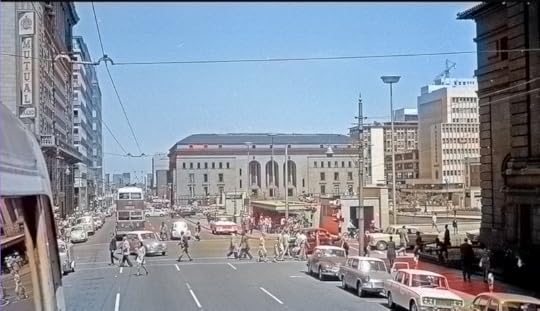 Barclays, Simmond Street was down Market Street on the left. The Central Library was the imposing building facing Market Street.
At night I get mummy to phone Webster about a reference. He answers and mummy explains that she hopes he will be a referee for me. He says he knows all about it – he had a form to fill in a few weeks ago – how long he had known me etc. He hasn’t a clue where he sent the form back to but he did send it. Mummy thanks him very much and he says, “She needn’t worry: I said she didn’t back horses or gamble!” He says he’ll give me a written reference if necessary. It’s funny that he didn’t mention it to me.
Mr Russell also filled in a form and gave them all the low-down about me, and will give me a written reference on Thursday.
3 October – Work and make a half-hearted attempt to practise both morning and evening.
4 October – Work a half day and go to music in afternoon. Mrs S works me hard but she is very sweet and I like her. Go and play table tennis at night.
5 October – Work. We talk about singing and Martie says she loves to sing.
After work I go to the studio. Webster answers the door. I listen to Nellie (who is about 40) singing the Liddle setting of Abide With Me. Her voice isn’t bad but she’ll never be an opera star. Webster goes to put money in the meter and I go in and pay Anne. I tell her that I appreciate Webster filling in that form for the bank and she says that it was a pleasure. I say that they need a written testimonial as well and she says he will also give me one. He’ll type it out at home and post it to me tomorrow. Anne says she knows somebody in Kensington – Heather McDonald-Rouse’s mother. Do I know her? Yes, I know her well. She is delighted!
We do some scales after tea which don’t go very well at first but improve as I go higher. She says my range is developing beautifully, especially my high notes.
We start on the Noel Coward medley and Anne says that I must cover my “ee” vowels and sing forward. She says that of course it’s very pop and common, then she stops and says reflectively, “I shouldn’t call it that when we made so much money on that type of music.” I say that I like it very much and I love listening to their recordings of it. She says, “Oh, sweet!” and turns red.
They sing Dearest Love together and I just keep quiet. They sing so beautifully that I want to cry. I clench my teeth together so that I don’t cry! On Let’s Say Goodbye they find the music (and words) rather nauseating. Anne says Noel Coward probably wrote it after a hectic night out in the Bahamas. She says he is described by Eric Blum in the Actors’ Who’s Who? as an actor, playwright and AMATEUR musician!
Webster discovers that the sink in the kitchenette is blocked and the water is seeping through to the seventh floor. He phones up about it and when nothing is done he gets into a rage and says if they don’t do something soon the water will seep through and the people on the seventh floor have just had their walls redecorated. He says violently, “Bloody fools!” First time I’ve heard him that violent. After this interlude we pass on to Hark, Hark which Anne says we must concentrate on very hard next week.
Depart, leaving them fussing over the blocked sink.
Go to choir at night.
Listen and record Webster’ programme. He starts with a sacred record by himself which is beautiful, then more from The Dream, Pagliacci and then two duets from Lilac Time by themselves.
6 October – Work, but not terribly hard. Martie and I talk for hours and I manage to transpose I’ll Follow My Secret Heart – it goes well.
7 October – Work harder today. Webster’s reference is there. It is very nice.
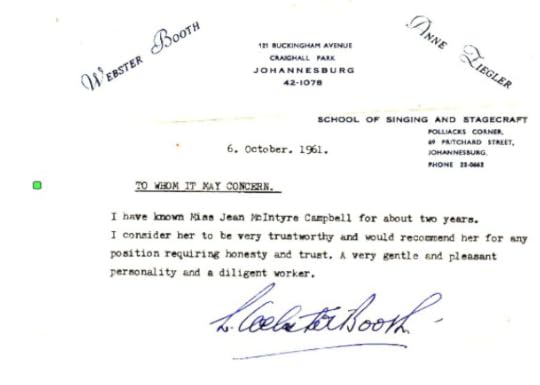
It was sweet of him to write it and it touched me to read it! He is such a famous and busy man and yet he took time to write me a reference. Mr Russell gave me a very long eloquent reference but somehow I shall always treasure Webster’s halting one which he typed himself and signed with a flourish.
9 October– Back to work. Quite a pleasant day.
10 October – Public holiday. In the afternoon Dad and I go to see Hand in Hand at the Monte Carlo. See the Booths’ green Zephyr in the street when we come home.
11 October – Work hard and go to music in the afternoon. Mrs S says I am doing good work. I go to the ordination service at night – very impressive.
12 October – Work hard and have lunch with Mum. Go to Webster and Anne in the afternoon. Webster answers the door and says, “Isn’t the heat dreadful?” I agree wholeheartedly. Nellie is singing quite nicely today and she gives me a big grin when she leaves. Anne comes in and we complain about the rather ghastly hot weather and then the very cold winter. She says that when she first moved into the house in Craighall Park she needed 4 blankets, a hot water bottle and an electric blanket and thinks the winters here are worse than they are in the UK.
We start with scales and they go well. When Webster comes in I thank him for my reference and he says, “Oh, was it all right? I told some fine lies, didn’t I?” We all have a good laugh.
Anne tells him to make some tea because “Jean is dead.” Says Webster, “That makes two of us.” He goes in and upsets the kettle on the table. Anne turns white and rushes in to see what is wrong. She comes back and says, “What frights that man gives me!”
We go on to the Noel Coward medley and she is delighted with the transposition of I’ll Follow My Secret Heart. It all goes quite well. She tells me that she sang the song in panto after she’d fought the dragon, and won the lady in Puss in Boots in East London. She sings Dearest Love by herself and it sounds really gorgeous. She explains that I must push the time forward and then pull it back in songs of this kind. We go through them and she marks the pauses. She says that good songs sing themselves but Noel Coward’s songs need showmanship and selling otherwise they would sound corny.
Webster says that my voice sounds beautiful and in a few years it’ll be really gorgeous. He says that my “e” vowels have improved tremendously, and I say that I’ve been practising hard! He says, “Yes, I can tell that!”
Anne asks when I get time to practise and I tell her of piano practice in the morning and singing in the evening. She says that if you are tired, the voice is the first thing to go because it is so much part of you.
When we finish – miles over time – she tells me that she has to appear in court tomorrow at 9.00 am. Evidently she bought a sewing machine from someone in Forsdsburg and traded in her old one. The man ran off with her old one and she refused to pay the full price so she now has a court order against her. She says she’ll probably be there all day so “Maestro” will have to hold the fort in the studio. I say goodbye and wish her luck in tomorrow’s case.
Webster’s programme is gorgeous as usual. He plays the prelude to Missa Solemnis by Beethoven and a Jewish chant. Then he plays his own recording of Just For Today, with Gerald Moore accompanying.
His opera is Turandot and then two duets from The New Moon, “sung by Anne and myself,” Wanting You, and Lover, Come Back to Me.
13 October (Friday!) Have damnably gruelling day at work and then go to guild where I play in front of about 300 people for hymns at the Youth Rally where they have a Methodist cavalcade play which is very good. Dr Webb comes to the event and receives a wonderful ovation.
14 October – Practise, and at night we go to the Spargos. Ann Stratton is there too, so Joan, Ann and I go to see a group of one-act plays at the boys’ school. Cecil Williams (the communistically-inclined producer) adjudicates and talks for an hour – brilliant and witty. Kudu House wins on the play presented last night. We come home with Peter Spargo. It is about 1 in the morning now!
19 October – Go to Webster and Anne after work. Nellie is singing O Love, From Thy Power badly. When she gets to the high note Anne says that she changed it on “Jean’s copy” so they change it on her copy too.
I go in and we talk about the horrible weather and she asks if I’ve seen any good plays lately. For want of something to say I talk about the plays at the boys’ school and Cecil Williams. She is not at all keen on him. She makes tea and tells me that her brother was ten years older than her, and her sister twelve and a half years older so she was almost like an only child in another generation.
We start on scales and she says I must control my breath more and not move my “bos”. We toddle over to the mirror and she demonstrates her fantastic breathing once more. Webster comes in and says, “If you don’t smile I won’t give you a cup of tea!” I smile!
I say I hate singing in front of my father because he criticises me so much. Anne says it’s fatal to sing in front of someone – she won’t even sing in front of Webster. She says Roselle’s father has a down on her voice and made her give up singing to concentrate on the piano for a year. Webster says, “I think he’s Afrikaans though, isn’t he?” That dismisses him!
We do Rest in the Lord and it doesn’t go too badly. Anne says I must watch diction and not sing in my throat. I must keep my voice forward in the mask and always feel it in the head – easier said than done.
Webster says I must sing everything to “mee” until I get proper resonance. He says that he’ll be playing the aria in the third week of November on his programme, sung by Norma Procter. I ask whether his programme is on tonight and he says, “No. These damned election results have put a stop to it. If only it had been Wednesday for the results and not today.”
20 October Work is fairly quiet today. I don’t practise singing today and feel a little down-hearted.
21 October – Work till 11.30 this morning. I practise in the afternoon and singing improves a bit. We’re going to convert the second bedroom into a music studio so that I can have peace to practise.
22 October – Piano is now in its new position in the second bedroom.
Little Sunday School boys are better today. Molly Reinhardt says in her column that Webster is going to Durban with The Amorous Prawn. I hope Anne stays at home. What would I do if I didn’t see either of them for months on end?
Inge Alexander visits in the afternoon so we have rather an unmusical time.
25 October – Work very hard. Go to music in the afternoon and Mrs S works me hard too. She is, nevertheless, very sweet, but I will have to work very hard for the forthcoming piano exam.
Go to anniversary practice at night.
26 October – Work very hard – it’s like a sweat-shop! I do get my first wages though. I have lunch with mum and buy square-toed shoes.
At night I go to singing. Webster answers the door dressed in a short-sleeved shirt. I say hello and sigh and he says, “Yes, it’s that kind of day, isn’t it?”
Nellie is singing “my” Delilah aria very badly indeed. She complains that sometimes she feels she can’t sing at all – That’s just how I feel sometimes too! When she goes, Anne says, “Well, the next victim can come into the hothouse!”
Webster goes down with Nellie to put money in the meter and I go in and unburden my worries and grievances to Anne. She is the ideally sympathetic audience.
We start on scales and they go very well today. Webster says I must sing the high ones twice as quickly as I’m doing at the moment. He goes off to make tea and comes back looking rather aggrieved telling her that his finger has burst again. Evidently he had a very bad burn and now has a big blister.
She marks my vowels in Rest in the Lord – not as good as I did them last night at the anniversary practice. I sing the song and he says it’s very good apart from the “ee” vowels. We do one particular part with all ee vowels and it goes a little better. We do He Shall Feed His Flock and they are thrilled with the improvement – thank goodness, as that was what I sang as a solo in church. We do O Love From Thy Power to fill in time as the next chap doesn’t arrive. Anne says she doesn’t like to talk about other pupils to me but Nellie drags this aria out too much and will never sing it properly. She’s Afrikaans of course and rather slow. Anne says she herself trained in her teens as a mezzo.
When I ask her whether she’s going to Durban for a month she says, ”God, no! I’m just going for one Thursday because there are five Thursdays in November.”
Webster adds, “Someone has to earn the money, Jean!”
` I say goodbye and depart feeling remarkable invigorated by the lesson. When I went up I was exhausted but when I left I was a new being.
Listen to Webster at night. There was a storm so the reception was grim. He plays the Alto Rhapsody sung by Kathleen Ferrier, Where E’er You Walk (by himself) He also plays the duet from Barber of Seville sung by himself and Dennis Noble. He finishes with Eldorado.
27 October – Work – not quite as busy today but bad enough. Practise in a mediocre fashion at night.
28 October – Work in the morning and thank God to say goodbye to the bank for a day and a half. I meet Mum and we have a shopping spree – 3 dresses and a petticoat. We have lunch then meet Dad and see The Hustlers – a rather revolting picture with Paul Newman as the star.
29 October – It’s pouring this morning. Hope it stops for the anniversary. It does. Sing for about 3 hours in all. It goes very well. Have tea at Betty’s in the afternoon and tea at the manse at night.
31 October – Work hard. I get a lovely surprise in the paper at night – Anne posing as Mrs Siddons from the original Gainsborough painting. It is the most gorgeous photo I have ever seen of her.
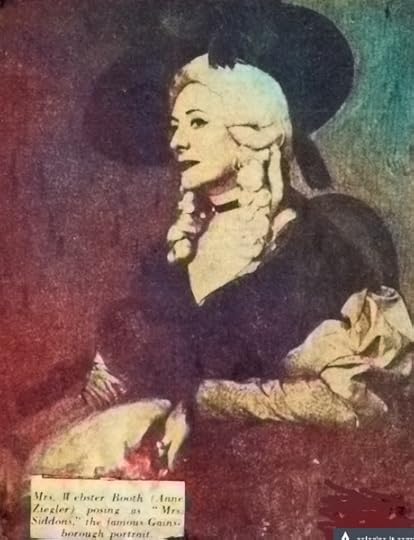
Anne as Mrs Siddons
NOVEMBER 1961
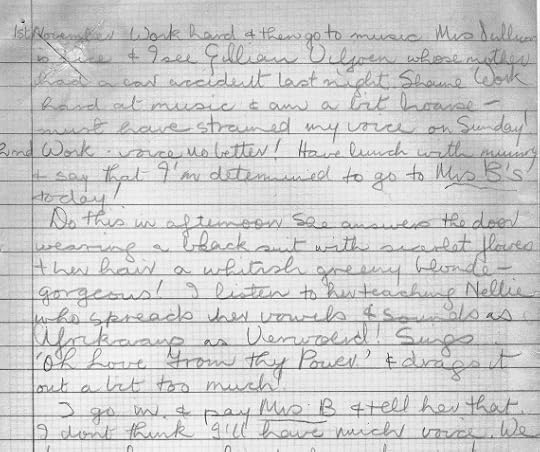
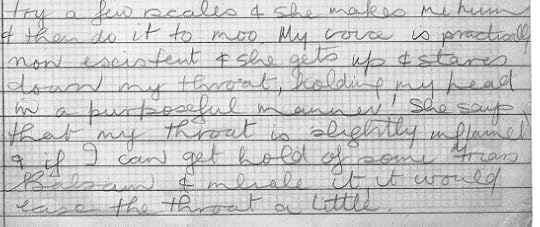
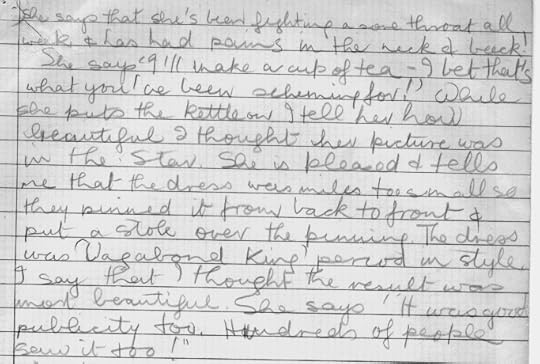
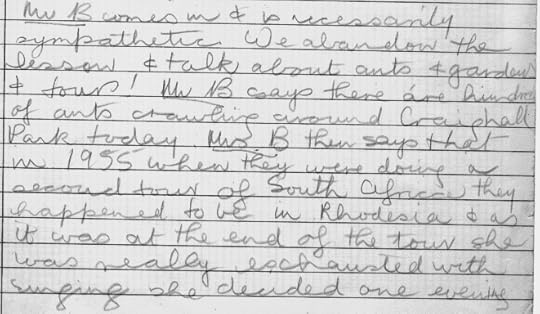
The first few pages of November were illegible so they were scanned and enhanced.
to stay in the hotel suite to write a letter home while Webster went to some farm. When she went to the bathroom the bath was full of ants! They talk of their house – a very old house with a garden of half an acre. They say
that when they moved in the back garden was in a terrible state – the previous owners had left a huge pile of rubbish with little bottles of injector stuff for diabetes. She says she’s so disgusted to find these little bottles in the garden still. The soil is awful and nothing will grow in the garden because there’s too much lime in it.
She runs down Nellie and says that although she has a wonderful voice she spreads her vowels, is Afrikaans, and is a bit too old to learn! She looks up after she says this and gives a guilty little giggle!
They introduce me to Bill Perry (following pupil)and I depart, telling Anne that I’m sorry to have wasted her time. She says she’s sorry for my sake.
I go to choir at night but don’t – and can’t – sing.
Webster’s programme is as gorgeous as usual. He starts by playing Lacrimoso by Mozart conducted by Bruno Walter. Then he plays Speak For Me to My Lady sung by himself – glorious with Malcolm Sargent conducting the Liverpool Philharmonic from Don Giovanni. He plays a record by Lili Pons, “whom Anne and I met when she came over to England together with her husband André Kostelanis, the conductor. We found them both charming and a pleasure to work with.”
He plays one of his favourite songs, Where Haven Lies, conducted by Mark Lubbock. It is one of Anne’s favourites also.
8 November – Work – short day. In the afternoon I see Dell looking more spoilt and petulant than ever. Piano with Mrs S goes well and I manage to sing a little at night
9 November –Work. Go to singing in evening. Anne answers door – hair now silver-blonde!
I hear about the whole of Nellie’s lesson. When she goes, Anne says, “Don’t you think, Jean, that she has improved a bit since last week?” I agree that she has. Anne says that it’s difficult to get Afrikaners to sing “h” properly so they have to get them to sing a guttural “gh” before the “h”.
She makes me a cup of tea and offers me sugar. I say that I’m really getting too fat and she says I’m fine for my height. She’s surprised that I’m 5’8” and says she’s 5’5” but I’m sure she’s taller than that. She says that when you come to her age it’s a battle to keep your figure. Her father, who died at 90, kept his and could move with as much agility as she could herself. She’s sure age is hereditary.
I manage to sing and surprisingly sing better than I have done or ages. She is pleased. Webster comes in in the middle of this (from the dentist) and greets me charmingly. He looks very debonair in a blazer. Anne says, “How did you get on, darling?” and he says (through his teeth) “Ooh, it was a bit grotty.” He goes out again to bring her car round into Pritchard Street and we do Oh, Rest in the Lord. I manage to bring it more forward and she is pleased. I ask if I can do one of the Trinity College exams next year and she says it would be a good idea. I must get the syllabus. She talks about the old examiner, Mr Guy McGrath He played in an orchestra in which they sang during the war and when she saw him she asked him to dinner and then to Webster’s show. He’s 74.
We finish Rest in the Lord and Webster comes in and is pleased with it. He asks how Nellie got on. Anne says, “Oh, she’s very despondent about her voice. She doesn’t think she’ll ever make a singer, but Jean and I have both decided that her singing is better today so, at least, it isn’t my imagination.” She says it so flippantly and cattily but one still can’t help adoring her!
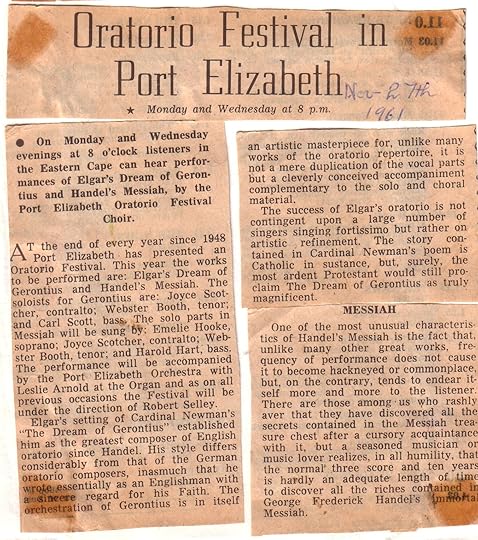
Webster is going to Durban next week and is leaving on Sunday by car. Anne is flying down in two weeks time to collect the car before he goes to Port Elizabeth to sing Messiah and Dream of Gerontius.
I wish Webster a happy time in Durban and tell Anne that I’ll get the syllabus for the exams. She says, “Do that, and if the old boy comes out next year half the battle will be won!”
Webster’s programme is lovely as usual. I’ve lost my list of records but he plays a wonderful record of himself singing an armistice song – There is no Death. At the end of the programme he plays two duets – Swing High, Swing Low and Trot Here and There.
10 – 15 November Don’t have time to record anything.
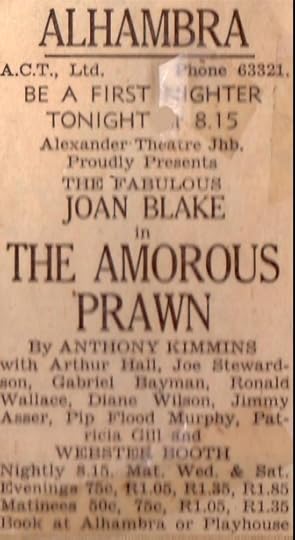 The Amorous Prawn, Alhambra, Durban.
16 November – Work like mad but manage to get up to my lesson with Anne. Nellie is there as usual and her singing has improved a bit. At the end of her lesson, she shows Anne a tray-cloth which her sister had embroidered. Anne says that it is gorgeous and then Nellie says, “Anne, I should like you to have it. You and Webster have done so much for me in my singing. You’ve changed my life.” Anne is absolutely stunned and says, “No!” violently, probably because of the shock of Nellie’s words. Nellie presses her to take it and Anne says in a broken voice, “Bless you, Nellie!” The atmosphere is electric and I feel sure that they are both going to start crying. Somehow, I think that the teacloth will mean far more to Anne than all the orchids she has ever received.
Anne comes in and says, “Come in, sweetie Please excuse me a second. I simply must go and spend a penny. I’ve been in this studio since two o’clock and haven’t been out once!” She makes a dash for it.
I sit in the studio and savour the lovely wonderful atmosphere. Shall I ever forget, as long as I live, the photo of Webster and Anne standing looking fresh and bright-eyed and Anne holding a big bouquet? As long as I have memory, I’ll remember it.
Anne comes back and pores over Trinity College exams and decides on Grade 5. When she comes back from Durban she’ll go into Kelly’s and look at the music.
We start on scales and I get very high and very low and she is pleased. However, I am tired so I tend to drag Rest in the Lord but it isn’t too bad. She makes me a cup of tea for which I am thankful. She asks if I heard the symphony concert on Tuesday. She heard half of it and then fell asleep. She thought the singing of the SABC choir was very good. Suddenly she asks if I wouldn’t like to join it. I say that I’m not nearly good enough, and she says, nonsense. I must write to the choirmaster, Johan van der Merwe (good Scots name, says she!) and say that I’m a pupil of theirs and they think it would be a good idea for me to join.
She says that another pupil of theirs who is 16, Ruth Ormond, joined without any trouble at the audition. So drop a line to him. Whew! I’d like to but… I end up telling her of the awful efforts of our church choir.
Bill Perry arrives and I finish with The Lass with the Delicate Air which isn’t too bad. I say I’ll write to Mr vdM and I hope she’ll have a good time in Durban.
Am now listening to Webster on the radio. He starts off with some Christmas carols by the Norman Lubboff choir and his own record Sanctuary of the Heart with St Stephen’s choir, London, by Albert Ketelby whom he doesn’t think at all common or vulgar as so many others do.
His opera for the week is Gianni Schichi, recently produced successfully in South Africa by “my friend and colleague, Bruce Anderson.” The best is O, My Beloved Father sung by Victoria de los Angeles.
Then he plays a Noel Coward medley with Joyce Grenfell, Graham Payn and Anne. The cast was especially chosen by Noel Coward.
17 November – Go to rink with guild and have a gay time. Meet Menina, Pat, Gwyn and Jean Johnson. Menina has really improved. Robert, Peter and Rita come home and we have tea together.
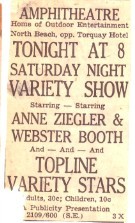 Durban concert at the Amphitheatre.
 22 November – Work hard then go to piano. Before this, I meet Cressola Raftopolous working in John Orrs for the holidays. Mrs S is affable. But how will I live through tomorrow without you-know-who?
Go to table tennis at night. Talk to Peter C who is definitely going to learn singing with the Booths in January.
23 November – Get a letter from Johan vd Merwe to go for an audition. Phone him and he is affable and says I must phone him tomorrow to arrange a time for my audition. My teeth chatter!
Am now going to forget all about it and listen to Webster. He starts off with In Verdure Clad sung by Isobel Baillie from Creation. Next he plays a semi-sacred song by Michael North, Such Lovely Things. He goes on to play the test song from The Master-Singers conducted by Sir M. He says, “I always felt my voice was too light to sing Wagner but Sir M insisted.” Next week he is playing Elijah as promised. Only I know that he will play Rest in the Lord sung by Norma Procter!
24 November – Work hard and practise at night because I’m having an audition at the SABC tomorrow at 10am. Groo! I’m scared!
25 November – Wow! What a day.
Toddle off very nervously in the morning armed with music case for the audition with Johan van der Merwe, the conductor of the SABC choir. Another girl with a music case is anxiously awaiting an audition as well. Mr vd Merwe comes in – a small dark man with glasses, aged about 25. He comes back from his office and is very pleasant and takes me into a gorgeous recording studio with a huge grand piano and microphone. He asks who I learn with and how long I’ve been there and how often I go for lessons.
He accompanies me in Drink to Me Only beautifully. I feel nervous to start but get better as I proceed. He says I have a lovely voice but it needs developing. He makes me sing two verses of Heidenroslein and corrects some faulty pronunciation. Sight-reading is quite difficult but I manage it. He agrees to take me on and tells me that I can come to the rehearsal on Monday night. I nearly die on the spot. I am thrilled to bits. My voice must have something.
Have lunch with Dad and then go to hear Capedium choir sing Creation in Great Hall at Wits. Excellent. I intend to work my fingers to the bone for music!
26 November – Sunday school and Church. Betty agrees that to be chosen for SABC is marvellous. Sing in choir at night.
27 November – Work like ‘ell and don’t get home till 6. Go to SABC for first rehearsal. I feel a bit nervous as there is no sign of Mr vdM in huge studio. Sign on and talk to fellow alto. Mr vdM arrives and gives me some music. I see Gill Viljoen – Mrs S’s pupil – and feel happier. Rehearsal is really marvellous. Johan certainly knows how to train a choir. I see only two intense-looking girls who could be Ruth Ormond. I feel exalted with rehearsal.
29 November – Work hard. In the afternoon it’s my half day but there is no lesson with Sylvia Sullivan because it’s the fifth Wednesday of the month and she doesn’t teach on that day.
Gill is at choir tonight and we go and do ourselves up before we go into the studio. Johan tells us he’s been conducting for six hours and is tired.
There aren’t so many there tonight. Gill tells me she teaches music and singing at Waverley High School for Girls and was dead scared about the audition. We practise and Johan is a wonderful conductor and gets everything out of us. At interval I discover that we wear full-length white dresses for concert performances and next Wednesday is practice with piano, Thursday rehearsal with orchestra and Friday recording for Christmas programme. I’m thrilled!
We talk to Johan afterwards and he says friends can sit in the control room to watch recordings. Tomorrow I’ll see Anne again.
30 November – Not too busy today. Go up to the studio. Anne is wearing a turquoise skirt and blouse. Nellie’s singing is really grim today and Anne pulls a wry face when she leaves.
Anne tells me that she feels revolting. She drove two of the cast of The Amorous Prawn back from Durban and had a dreadful time – Arthur Hall (who took over Simon Swindell’s part) was developing a ‘flu virus and felt awful, and Gabriel Bayman, who is an alcoholic, wanted to keep stopping for drinks! The car’s electrical system was giving way and she thought they’d all have to spend the night in Standerton. However, she managed to get the two horrors back in one piece.
She has managed to get all the music for the Intermediate exam for me. She spoke to old Kelly himself and he thinks that this exam would suit me fine. She has bought My Mother Bids Me Bind My Hair (Haydn). We go through everything to find the most suitable and easiest songs in the albums. She gives me a lukewarm cup of tea and offers me a biscuit which I refuse. I tell her about the choir and she is pleased, saying that Johan is very gifted. After much debate, we decide what we are doing for the exam and I leave the studio at a quarter to six. I ask Anne what Ruth Ormond looks like and she says she’s small with a round face, dark untidy hair and brilliant blue eyes. She’s a hard worker and she is very fond of her. I must look out for her.
We talk at the door for ages about the choir recordings and heaven knows what else. I feel quite elated. When she sings today she doesn’t sound as good as usual and her voice is a little trembly.
At night listen to Webster and he plays “my” Rest in the Lord by Norma Procter – beautiful and glorious. He plays his own recording of If You Had But Known, and things from Don Giovanni and Peter Pan. Lovely programme as always.
DECEMBER 1961
1 December – Work. At night have rather dull evening at guild but I have to go because of playing the hymns. I tell everyone about the SABC choir and act vivaciously!
2 December – Work in the morning. Have a quiet afternoon. Spargos, Strattons and Fred Shaw visit at night and we have fun. I sing solos, and duets with Mr Stratton.
3 December – Sunday school. Diamonds come in the afternoon and have tea in the manse at night.
4 December – Work. At night I go to the SABC and we have a lovely rehearsal. I look around for Ruth Ormond but don’t think she’s here.
5 December – Go for music lesson and meet Gill V. there. Poor Mrs S is very cut up about the death of her mother.
7 December Work. Have lunch with mum in Ansteys. Go to studio after work and Webster answers the door looking fit. Nellie is as bad as ever.
DECEMBER 1961
1 December – Work. At night have rather dull evening at guild but I have to go because of playing the hymns. I tell everyone about the SABC choir and act vivaciously!
2 December – Work in the morning. Have a quiet afternoon. Spargos, Strattons and Fred Shaw visit at night and we have fun. I sing solos, and duets with Mr Stratton.
3 December – Sunday school. Diamonds come in the afternoon and have tea in the manse at night.
4 December – Work. At night I go to the SABC and we have a lovely rehearsal. I look around for Ruth Ormond but don’t think she’s here.
5 December – Go for music lesson and meet Gill V. there. Poor Mrs S is very cut up about the death of her mother.
7 December Work. Have lunch with mum in Ansteys. Go to studio after work and Webster answers the door looking fit. Nellie is as bad as ever.
When I go in I ask Webster how he enjoyed Durban and PE. He says he had a wonderful time but was furious that the SABC didn’t broadcast The Dream or Messiah but they put on an Afrikaans Messiah on Sunday which was grim and very poorly done. Handel must have been turning in his grave, says he. “That damned Anton Hartman,” he adds.
I make tea for myself and pay Anne before starting on exercises and scales. In the middle of the vocalisation exercise the phone rings. It is Mum to tell me to meet Dad outside the studio to get a lift home. It is the first time I am in their little office and see all the playbills with their names 50” high and wide!
We go on with the songs and they cannot decide where the grace note in Polly Oliver should go so they take the book home to check up on it.
We do My Mother.. and Webster sings it with me to get the accompaniment right. His singing is more wonderful than ever. Imagine singing with the best tenor in the world (which is what I know he is!)
I depart with Webster in the lift. He moans at me about the SABC not broadcasting the PE oratorios. He says Anton Hartman put his own wife into the Afrikaans Messiah and the bass was putrid with a limited range. At least Gary Allighan stuck up for him.
He stands with me in Pritchard street for a little while and asks if I’ll be all right. I insist I shall so he says goodbye and walks purposefully off to fetch his car. While I’m waiting for Dad Anne comes down and we talk about how lackadaisical the choir is. She decides it’s going to rain so she dashes to the other side of the road. Dad arrives on the other side too so I wave at her and depart.
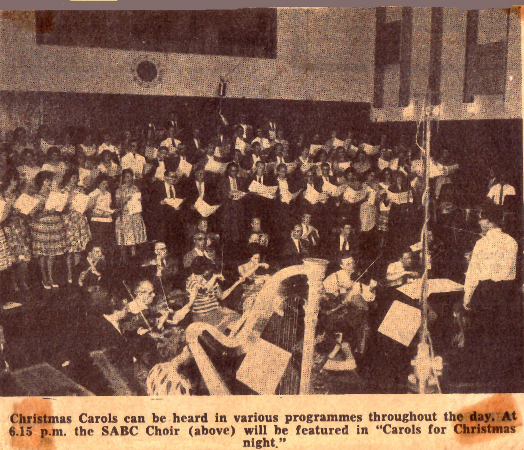
Go to SABC choir and we record the carol concert for Christmas day. There is a huge crowd there, including Annie Kossman, leader of the orchestra. I sit near Gill V and we sing for all our worth. A photographer takes a number of photographs and Johan conducts beautifully and all is glorious.
At our tea break I look around for Ruth O. See a likely-looking girl – small with deep blue eyes. However, when I go out, all I can do is stare at her and she stares at me. She is sitting all by herself in the foyer. I suffer Gill, Mrs Viljoen, and Rita Oosthuisen and then, when I go back into the studio, I decide to take the bull by the horns.
I go over to her and say, “Are you Ruth Ormond?” She says, yes, she is. I tell her that I’m a pupil of Webster and Anne and I believe she is too. She is quite delighted and tells me that Anne told her about me, saying I was tall and dark and she was very, very fond of me indeed. I tell Ruth what Anne said about her. Ruth says, “I’ll bet she said I was shy-looking.” I deny this, although Anne said she was very intense. She tells me that she plays the piano as well but doesn’t play very well and we both agree that singing is wonderful and we love it more than anything but the piano is a means to an end. She’s been learning with the Booths for a year and a half. We agree too that they are both pets and good teachers, and we talk about him singing in PE.
She is a perfectly lovely girl and terrific fun but she seems a little lonely. She has the same enthusiasm as Roselle but she is quieter. I’m so glad I’ve met her and I’m sure we will be friends.
Return to my place and we manage to finish recording. There’s a party on Monday. Says Johan, “Tea or coffee will be served in the canteen.” There is hollow laughter all round. I hope Ruth goes.
8 December – Work. Listen to tape-recording of Webster’s programme – Kathleen F, Isobel B, Laurence Tibbet, Webster and Anne singing Porgy and Bess, and something specially written for them by Harry Parr-Davies, and Webster singing Give and Forgive.
9 December – Work for the morning and leave about 11.30am. The first person I meet in Pritchard Street is Gill V. She says she’s exhausted after teaching all morning. “Let’s go and have a cold drink.” She takes me into a coffee bar in the arcade between Pritchard and Kerk and we have cokes.
She emotes about how terribly we sang on Thursday and how patient, sweet and kind Johan is. It’ll probably turn out beautifully but we’ll know it isn’t as good as all that. I promise to go to the SABC party on Monday night.
Practise at night. My Mother is coming along after Webster has given me a few ideas about it.
10 December – Go to sing in a combined choral festival of carols at City Hall. There are 300 singers but they don’t sound nearly as good as the SABC choir.
Dora Sowden comes in for a while but soon disappears. During the tea break I meet Elna Hansen who was with me in Lace on Her Petticoat in 1958. She is going to teach ballet next year.
11 December – Go to SABC at night. We all go up to SABC canteen and have tables of eats and tea and coffee. Johan comes in and we sing For He’s a Jolly Good Fellow. He makes a little speech and says he is very happy with us as a choir and now we can all start eating.
Gill and I talk about music. Unfortunately, she doesn’t like Webster for some reason or other. I say he is a pet and she says nothing further. We go to the studio opposite Springbok Radio to hear our recording. It is not at all bad.
13 December –Feel a bit under the weather at work today. I ask mum to excuse me from piano. I manage to go to table tennis at night and Peter tells me he phoned Webster Booth and has made an arrangement to go to see them.
14 December –. Webster answers the door and tells me to take a cup of tea and I do this while Nellie sings. She wants to sing The Holy City and Webster sings this for her most beautifully. After Nellie’s lesson he goes to put 3d in the meter “so that I won’t be had up,” he tells me.
Anne tells me that the verse with the grace note in Polly Oliver is left out so we can forget about it. She says Ruth told her that she had met me and I say how sweet I thought her.
Webster comes in and sits on the chair opposite the piano while I sing. He says that I’m getting into a bad habit of standing sideways over the piano instead of behind it!
We do My Mother which I mustn’t drag.
After the lesson I ask if they had a call from Peter. I suggest that I could give up ten minutes of my lesson next week if he’d like to audition him then. Anne says that Nellie isn’t coming next week so I could come earlier and Peter can have the audition at 5.20. I say that Peter is very nervous and will be glad to get the audition over before Christmas. Webster says, “Good Lord! How can anyone be nervous of me?” I tell them that he’s studying to be a minister. Anne says, “Now tell him to make sure to come ’cause I’ve got his name written down.’
When I get home I phone Peter and he is thrilled about the arrangement.
Listen to Webster at night. He starts with The Ballad of Diss by Vaughan Williams. He says he was a great friend of Vaughan Williams (who looked more like a farmer than a musician) and that Anne’s uncle was the rector of Diss for many years.
Next he plays his own recording of The Little Road to Bethlehem which makes me cry. He then plays Tales of Hoffman featuring Lili Pons and Richard Tauber. He plays their own duet, Take the Sun. He says that since the copyright on Gilbert’s words has fallen away he has been asked to give a series on G and S on the radio from the beginning of next year.
17 December Sunday school. Peter worries about suitable music so I ask him to come and practise in the afternoon. He sings I’ll Walk Beside You. His voice is sweet enough but rather unusual. He is nervous about singing to Webster. Who wouldn’t be?
18 December – Work hard and have lunch at Ansteys with mum. Our photo is in the SABC bulletin. Choir looks like specks on the horizon. I can see myself on the right-hand side but poor Ruth (on the opposite side) is cut right out of the picture altogether.
20 December – Work hard and long. Go to music in the afternoon and work reasonably well at piano. See Gill and wish her a happy holiday. At night, because of the pressure of work, I get mum to phone the Booths to see if I can go up at a quarter past five with Peter and have lesson afterwards.
Go to party at Betty Johnson’s at night and have a lovely time. Dance mainly with Peter. Come home in the wee small hours of the morning.
21 December – Work hard. Meet Peter outside the studio building. He looks a wee bit nervous. Go up and Anne is wearing a gorgeous pink dress with white spots. I introduce him and she is charming and asks us to have a seat. She is teaching another nice quiet girl with a good soprano voice. When she goes Anne tells us that she’d like Peter to have his audition when Webster comes so I can start on my lesson and go on after the other girl and Peter have their auditions.
I go in and Anne offers me tea which I accept. I have tea with Anne and say how tired I am with the Christmas rush. We start on scales and she takes me over to the mirror and makes me drop my jaw down more. Webster comes in with Lemon, wearing his white sports jacket and they decide to hear the two aspirants. Peter goes in first and I talk to Lucille Ackerman. Peter is accepted and will start on 6 January. Lucille sings Ah, Sweet Mystery of Life. She has a fantastic voice. She is 19. All her family arrive and intend to sit and talk about the glories of Lucille. However, Anne remembers me and tells them that she’ll have to ask them to go as, “The poor child has been waiting an hour for her lesson.”
I go in and say what a wonderful voice Lucille has. Webster says, “Yes, but if she isn’t careful, she’ll strain it and lose it altogether.”
Anne says, “Jean went to a party last night and didn’t get to bed at all and then she had to work hard today!”
Webster asks, “Are you busy?” and I enlarge on the subject. We go through My Mother a few times, also Bedford May Day Carol and Polly Oliver. He says I can borrow his recording of the latter by Jennifer Vyvyan so that I can get the hang of the acting part of it. I wish them a happy Christmas. Webster wishes me one back and Anne thanks me for my card and comes with me to the door. She wishes me a happy Christmas and kisses me, saying, “God bless you.” When I get out of the studio my eyes fill with tears – she is a darling.
Get Elna on the bus – if I hadn’t had someone to talk to I would have sat howling with emotion! She tells me she met someone at dancing who is staying with Webster and Anne at the moment. She says she adores dancing and couldn’t live without it. We talk in the same strain.
Am now listening and recording Webster’s lovely Christmas programme Next week is the last in the series. How shall I bear it to end?
22 December – Work fairly hard. We go to the Kensington Sanitorium to sing carols with the Guild. After that, we come down to my house and have tea, song, and music.
23 December – Am lucky enough to have the day off. I do some last minute shopping and meet Cressola in John Orrs, also Joy Bodes.
See On the Double with Danny Kaye in the afternoon.
25 December – Go to church with family and everyone kisses everyone else! We go to Diamonds in the afternoon and then come home to listen to SABC choir broadcast. It is really lovely – far better than I expected. Listen to Scrooge at night – very enjoyable Christmas day.
6.15pm Carols for Christmas Night, The SABC Studio Orchestra, Conductor: Johan van der Merwe, with the SABC Choir in a programme of Carols, arranged by Spruhan Kennedy.
Wassail song (trad), O Little Town of Bethlehem (Trad), Whence is that Goodly Fragrance Flowing (Trad), The Cradle (Kennedy), Pat-a-Pan (Trad), I saw three ships come sailing by (Trad), The Son of God (Kennedy), Adeste Fideles (Trad), Pastoral Symphony (Handel)
27 December Work again like mad but get off in time to go to Mrs S for lesson. Gill is there and we discuss broadcast in blasé tones.
Go to table tennis and to Doreen Craig’s for tea afterwards. Peter brings me home.
28 December Work like mad today. Have lunch with mum. In the afternoon I am so busy that I doubt whether I’ll be able to get to my lesson. I phone and Webster answers – loud, loud, “Helloooo!” Anyway, when he hears it’s me he says, “Oh, hello, Jean,” pretty normally. I’m going up at 5.15 but manage to get away in time for my normal lesson. Lemon is there. Nellie starts singing Ye Banks and Braes and Lemon barks along, only to be scolded by Webster.
“Come in, honey,” says Anne. I go in and complain bitterly about work. She is charmingly sympathetic, shoves a biscuit down my throat and orders Webster to make tea.
She talks to me about Peter and says she doesn’t think she’s deaf but when anyone talks quickly with their mouth shut she can’t hear a word they say! She says that he need foster no illusions about his voice. It is very light and at best will only be moderately good. Anne says she loves my hair in a band, “Don’t you, Boo?” We talk about Christmas. She said it was parties all the way. Her maid is on holiday so they have to cook for themselves. Webster comes in with tea and says, “Don’t you two plan to do any work today?”
We start on My Mother and it goes quite well. He tells me to sing through the rests more and watch the “er” vowels and spread them – the only vowel I can spread. He says I must have more facial expression, for heaven’s sake! He stands and stares at me and I feel self-conscious and he knows it!
They sing the May Day carol together. He sings beautifully. Anne still has a tremor in her voice. She says, “The maid got a holiday because I wasn’t in a show this year.”
We work through everything and all goes quite well – considering. Bill Perry doesn’t come but apparently he goes on paying all the same.
I go down with Webster after wishing Anne a happy new year. He tells me he’s so tired he can hardly stand up and his legs are sore. When we’re in the lift I say, ”Tonight is your last programme, Webster.” He says, “Oh yes. I’m sorry it’s ending. I’ve enjoyed the series.” and I say, “So have I. I’ve heard every single programme.” He looks quite impressed, and then remarks, “I haven’t!” He tells me that he got a letter from Douglas Fuchs, the regional director, saying how much he and his wife had enjoyed the programme. He says he’s looking forward to the G and S programme although he doesn’t know if he’s approaching it in the right way, but if he isn’t he can always revise it. We part in Pritchard Street – he going one way, me the other. He’s such a pet.
At night his programme is glorious. He plays something by the Huddersfield Choral Society, I Know That My Redeemer Liveth by Elsie Morison. I’ve recorded everything so I’m not going into great detail. There are two records by Webster and Now is the Hour – it makes me howl.
31 December – Well, this is the end of another year. What have I achieved?
Passed matric although it must be classed as an extra from 1960.
Learnt shorthand, typing and bookkeeping. Started work and it’s probably good to know that I’m capable of doing a hard day’s work!
Learnt the rudiments of singing. I can keep my tongue flat now and I have a far better idea of how to sing than I did a year ago.
Learnt much about music – mainly from Webster’s radio programme I only knew about 2 pieces from the Messiah before. Now I know the entire work!
One can’t count wild adulation for Webster and Anne as an achievement but through the year they have inspired me to do things.
I sang my first solo and was accepted into the SABC choir.
What would I like to achieve in the new year?
Pass my singing and piano exams and, at least, be able to be good enough to teach music for a living.
Sing like a bird!
I’d like to make real friends with Ruth Ormond and others in the choir.
I wish I had fewer inhibitions. Let me be able to smile when I sing.
I’d like to be a nicer person. I’ve made many mistakes, been bitter and hard at times, but the new year holds a wealth of opportunities!


EXTRACT FROM MY TEENAGE DIARIES – AUGUST – SEPTEMBER 1961
AUGUST 1961
2 August – Another interview – at this rate I will never get the job I want – or even the job I don’t want!
3 August – I am thankful to see Webster looking hale and hearty when I go to studio. I ask how he is and he says in self-pitying little voice, “Well, I’m not as bad as I was but it’s still hanging over me, but I’ll soon shake it off.” He tries to make a cup of tea but a fuse blows so he is upset because we can’t have tea after all. Listen to Dell singing Il Bacio – very well, I must admit. Hear Anne telling her that she started to learn languages as part of her musical training with John Tobin and, of course, she went all over the continent with her family.
Anne tells Dell to sing the last part of the song again and Dell says, “I think I’ve done enough for today, Miss Ziegler. Apparently she doesn’t want ME to hear her sing badly. Anne says, “Well, we’ll shut the door!”
When Dell goes I pay Anne and start on scales. She is thrilled with my tongue in the exercises. We go up quite high – On the high note my voice goes back and she imitates me and then says, “That’s unkind, isn’t it?” and I say, “Yes,” with my tongue in my cheek. She says, “Jean, you’ll have to excuse my hands,” and glances fondly at her lily-white, smooth hands, “But I’ve been gardening like mad yesterday. Someone gave me some plants and they simply had to go in.” I make a polite remark and somehow cannot imagine her digging in the garden.
We start on Oh Love and Anne makes Webster come and sing it with me. He can’t read the words so he sings them incorrectly. She looks around at him and he IS quite injured at being pulled up by her. Anyway, Webster and I get on quite well, but we must have looked a jolly funny couple of duettists as he’s about 43 years older than me. She says I must imagine that I am Delilah, trying to woo Samson and cut his hair off, and look on the aria vulgarly as chorus, verse, chorus, as they do in the jolly old musical comedy. “Singing is like selling Cappuccino stockings in John Orrs. You have to put everything you know into it to sell your songs.” Nice vulgar ideas from an ethereal Sweetheart of Song!
I tell her that I was listening to my voice on the tape and it sounds very cold and she replies with the nice, well-worn lecture, “Smile, use your eyes, have no inhibitions. She writes “Smile” on top of the Delilah song and says, “I should add ‘darn you’ as well, shouldn’t I? Yes?”
I depart and she admires my colour scheme. I say goodbye to Webster and he replies. He’s like a spaniel puppy today.
I go up to choir at night and tell Mr S that I want to sing a solo in the choir sometime. He is delighted and says that he’s crying out for soloists. When we come home, Mr S tells Mrs Weakly that I’m going to sing a solo. I don’t know whether she thinks this is a good idea or not!
Webster at night – I listen and record the programme. He starts off with two items from the Beecham recording of Solomon, a choral piece from the Brahms Requiem to Robert Schumann. Then he plays his own recording from Rigoletto, This One or That One, Care Nome sung by “my old friend, Gwen Catley, one of the most popular coloratura sopranos in Britain.” Gwen Catley has a lovely lyrical voice and she is really gorgeous. Then comes the quartet from Rigoletto – Webster, Edith Coates, Arnold Matters and Noel Eadie.
King’s Rhapsody. Webster and Anne were asked by Ivor to make duet arrangements of – Someday My Heart will Awake and The Gates of Paradise, and finally We’ll Gather Lilacs from Perchance to Dream.
4 August – At night the guild goes to Fotheringham’s bakery and we have a bread-making demonstration. I go with Joan, Ann, Dorothy and Mr and Mrs Spargo. Mr S says that instead of gadding about they could be listening to programmes on the radio, “like to your singing teacher, Jean.”
We have an interesting time at the bakery and cakes and drinks afterwards. On the way home Mrs S raves about the Booths. She tells me that she loves his programme. “He’s a lovely, kindly man – is he like that in real life?” “Yes, he’s a honey.”
“Anne Ziegler is sweet too of course. I remember hearing them sing Messiah and they sang it so reverently. They’re a lovely, humble, reverent couple and I love the way he says “Anne and I” on the radio.” They ask where they live and where their studio is and I tell them about singing with Webster yesterday and about his ‘flu. We part on very good terms.
7 August – Go into town to the dentist and meet Muriel Hicks and Michelle Aronstam from Vanderbijlpark. Both are at Teachers’ Training college, as is Janet Lockhart-Ross, and Biddy Lawrence. Jackie Keenan and Irene Stanton are at Natal Varsity. Betsy Draper is doing a Rhodesian matric and Pam Nicolai and Valerie le Cordeur work at Iscor.
8 August. – Go skating in morning and practise in the afternoon. Listen to Ivor Dennis at night and he reaches the very top of my list by playing a record by Webster – by Coleridge-Taylor. He says, “Most of the listeners will probably know that Webster and his charming wife came to settle here some years ago and they are heard often on the radio.” He is a sweet old man and plays very nicely indeed.
10 August – Go for an interview at SABC – very Afrikaans indeed. Talk to Pieter de Waal on the lift. I don’t think I’m going to get a job there!
Go to the studio and Webster answers the door in kindly, unclish fashion. Dell doesn’t do so well today and I am happy – bad me! When I go into the studio Anne is powdering her face and tells me that her eyes feel as though she has been crying for two days. They are happy with my scales and I feel a little more self-confident than I have done lately. Webster says, “Now do the same with Delilah’s aria.”
He makes tea and Anne says brightly, “Let’s have some of the new biscuits. Will you have one, Jean? They’re delicious.” We go on with the Samson and Delilah aria and they say it has improved but I must clip my consonants with the tip of the tongue. Webster is very red in the face today and doesn’t look very well. Anne gives me a few tongue exercises for my consonants and Webster dashes off to put 3d in his parking meter. I tell Anne that I might be starting work soon and what shall I do about lessons? She says that after 5 pm is a busy time but she’ll arrange something – never fear. She sounds reassuring so I hope she can.
11 August – Listen to Webster at night – he doesn’t play any of his own records. First Owen Brannigan singing The Trumpet Shall Sound, something from the Brahms’ Requiem, a chant by a Russian choir, and arias from Othello and songs from Kismet.
17 August – Go for interview at Barclays Bank, Simmond Street. I’m going to start there in October. Have lunch with Mummy and then go to Afrikaans eisteddfod and see about 20 little grade one girls singing – eek!
Go up to studio and Webster answers door and says in funny accent, “Helloo – Sit ye down.” Listen to Dell singing. Anne says something about Dell going to night spots and they suggest she is “hitting the bottle!” Dell goes out. She is wearing a leopard skin coat. I go in and Webster says impudently, “And how is Delilah today?” They are in the throes of the Afrikaans eisteddfod and have had two firsts and a second and hope for a few more prizes tonight. She is dressed to kill in a dress made of coat material.
Scales go quite well and they are pleased with high B. Webster says the Delilah aria is too pedantic and does one of his gruesome imitations. He says I must think of my voice as a ‘cello, and pretends he is playing it. He is funny at times. Anne tells me how much she likes my white hat. She says, “Oh, it’s sweet, isn’t it, Boo?” He studies it for a moment and says that it’s utterly charming. We say goodbye and I grin at Roselle, whose mother is with her. Come down on the lift whistling Only a Rose in complete abandon.
At choir I sing solo 4 times. I am to sing it on Sunday night. Am listening to Webster now. He plays excerpts from La Bohème – him singing Your Tiny Hand is Frozen, then the duet in the last act with Webster and Joan Cross, and a duet with Dennis Noble.
20 August – Practise song for tonight – God help me! Absolutely massive congregation (for our church) about 80 or 90 and I feel grim – cold hands, warm face, and I try to think uplifting and confident thoughts. My doom arrives and I manage through it fairly well if not a bit tremblingly in my own heart.
Everyone in the choir says that it is good and I feel relieved that it is over. Well, that is my first solo over with reasonable success and I don’t think I let my parents or Webster and Anne down too badly. Let’s hope that future solos will be successively one per cent better and that I will actually enjoy singing them. Whew!
21 August – Go to eisteddfod in afternoon at Library theatre. Girls (Form 2) sing solos – My Skat is ‘n Boerseun.
24 August – I practise the piano in the morning and then go to the Booths in the afternoon. Webster answers and looking worried, says, “I didn’t even hear you knocking!” We start on scales and they are both delighted – I get B flat comfortably. They make me smile while I’m singing. Webster does this in wicked fashion by mimicking me and then he makes me sing The Lass with the Delicate Air and makes me smile again. High A in this is beautiful and they think so too.
Everything goes well. After about four lines of Delilah aria Anne stops me and I wonder what on earth I have done wrong. Webster looks quite thrilled and says, “That note was absolutely beautiful.” Anne says she had to stop me to tell me so. I feel very flattered. We do the aria again and work through it thoroughly.
Anne says, “You have a really lovely voice but you mustn’t be so mean with it – you must let everyone hear its beauty.” I say, “It must be the Scots in me,” and we all have a good laugh.
Anne says that she’s been using all her spare time for the garden and her hands are in a terrible state – they look like the hands of a charwoman. I look at them – they’re lily-white – so I can’t resist saying that they look very nice. She says they’re very dry and she always puts oil in her bath for them but it still doesn’t help.
Webster goes down to put money in the parking meter. She says they have a recording of Delilah at home so she’ll lend it to me. It is done by Risé Stevens. I say that this is very kind of her.
She has a violent choking fit – swallows saliva wrong way and dashes up and into the kitchen to get some water. While she is there Roselle arrives with friend and I hear her telling Anne that friend has a lovely voice and she’d like Anne to audition her and give her verdict. Friend is evidently very nervous but she still thinks that Anne will put her into an opera right away!
Webster comes back and I finish the aria with reasonable success. Webster tells me, “You may think you look silly, but you don’t.”
Listen to Webster at night. He starts by playing O Thou That Tellest by a counter-tenor. He then plays Lift Up Your Heads by Jo’burg African Choral society. Very well sung indeed. He goes on to La Bohème – a well-known aria on every page. He goes on to Naughty Marietta and then plays, Ah, Sweet Mystery of Life “sung by Anne and myself.” Afterwards he says, “Well, that was Anne Ziegler and Webster Booth!” He plays out with the Pizzicato Polka.
He’s singing a solo on Monday night at the Yeoville Presbyterian Church.
26 August – At night I notice Webster’s solo appearance mentioned in the church columns and also get quite a shock.
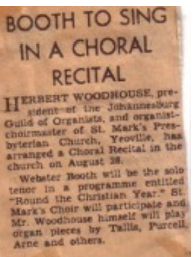
27August – The other day when Dell asked if she could change her lesson to Tuesday, Anne said, “Well, it’s OK for this Tuesday but the next week is his first night.” I thought at the time that she meant they were going to Lucia di Lammermoor in Pretoria but it says in the paper tonight that Webster is playing in the West End comedy success The Amorous Prawn as the title character, with Joan Blake and Simon Swindell! I didn’t even know about it. Dad says we can go to see Webster in the play so that’s something to look forward to.
28 August – Sunday school. Mark is very naughty. In the afternoon go to Spargos and have a lovely time. We go for a drive and see Waverley, the block of flats where Webster and Anne used to live. We look in Rosebank shops. When we arrive back Mrs S pumps me with innumerable questions about Webster and Anne – Are they well off? Are they religious? I say I think they’re quite comfortable, that they are Anglicans but I don’t say whether they are religious. After dinner we go to Church. Ann comes and tells me that my singing last Sunday was gorgeous and it was a very difficult thing to sing. Leona says she liked the singing but not the aria! I wonder if the Spargos want Joan to do singing. Poor them – they’d be a little worried if they could see the huge picture of Webster and Anne advertising beer!
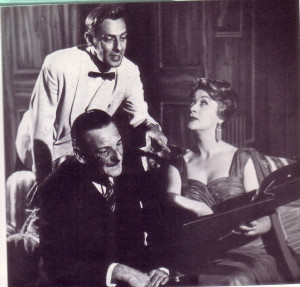
Webster, Joan Blake and Ronald Wallace in The Amorous Prawn
]
29 August – Go into town today for an interview with Sylvia Sullivan with whom I’m going to study piano. She has a very nice studio in Edinburgh Court in Von Brandis Street– quite a few rooms to it. She is middle-aged possibly as old as Anne. She is quite plump but very nice. I’m going to start next Wednesday.
I have to go to dentist afterwards so I go into John Orrs to kill time. The first person I see is Dell carrying a big bunch of flowers, with eye shadow plastered indiscriminately round the relevant regions and wearing her artificial leopard skin coat. She is going up to Webster and Anne. She has changed her time – perhaps because she doesn’t want me to hear her singing. She doesn’t see me but I expect she wouldn’t have been very affable had she seen me. I wonder if the flowers were for Anne.
30 August – Have lunch with mum and then pay another call to the dentist. I’ll be glad when it’s all over for another three months. At night I see another picture of Webster in paper with the rest of the cast – Simon Swindell, Gabriel Bayman, Joan Blake and Victor Melleney. Joan B has a protective arm around Webster’s shoulder. Caption is, “Comedy rehearsal is no joke,” and the whole cast looks grim. Webster looks cute with monocle but what will Anne say about Joan B?

Amorous Prawn rehearsal.
31 August – My 18th Birthday. Go for lesson and Anne is wearing a black jersey – very sexy indeed. A girl is there singing an Afrikaans song terribly and they battle over it with her. She tells them that she is having pupils on Saturday from a quarter to eight till 5 in the afternoon. She says she is not a bit nervous about singing because she has been on the stage since she was three. She is singing this song at a wedding and is worried about it. I expect, by the way she talks, that she will be a really gorgeous-looking girl, but she isn’t. She is tall with glasses and I dislike her on sight!
They are both thrilled with my scales but Anne says I must smile. She takes me over to the mirror so that I can practise there and puts her arm around me in protective fashion. I look in the mirror feeling like a cabbage next to her. I don’t really understand why I should smile when I’m singing scales!
We do Delilah aria and Webster says I mustn’t do it like a little girl because I am a grown woman! I say that I’m afraid to sing too loud in case I go out of tune. He says, “Well, you’re here to learn to sing, so sing out of tune!” We go through the aria again with reasonable success. Anne says I must fill in all the vowel sounds for next week to see that I understand which ones I must use. I say, a little sarcastically, that instead of going out at night I can sit at home doing this!
Roselle’s mother phones to say that Roselle can’t come because she has an inflamed throat and has to stay in bed. Anne says to Webster, “I hope you reminded her that it is a five-week month so we won’t be making up the lesson.” No word of sympathy for poor Roselle and her throat.
When I go, I remark that I hope it will soon be cooler and she says, “Oh, but I love the summer. I think it’s gorgeous.”
I listen to Webster on the radio. He starts with the Sanctus from the Solemn Mass by Beethoven with Elisabeth Schwartzkopf and three other German singers. Webster says that the music is very hard on the voice. He plays Malotte’s setting of the Lord’s Prayer sung by himself. Gerald Moore and Bertram Harrison are his accompanists. It is lovely. At this very moment, I am of the opinion that Webster is far more sincere in what he says than Anne. He has Magic Flute as his opera, one of the two operas in which he sang at Covent Garden (NOT the principal role). He plays the opening scene from Gypsy Baron and this is really lovely. Webster forgot to bring the Samson and Delilah record for me. Perhaps he is too busy with the play.
SEPTEMBER 1961
5 September – Have lunch with mum. Opening night of The Amorous Prawn. Peter phones at night.
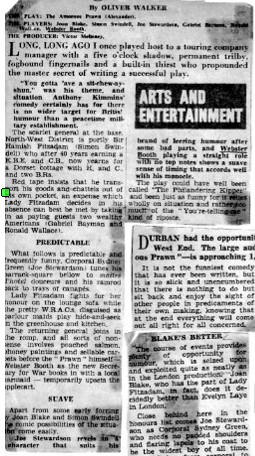
6 September – Go for piano lesson with Sylvia Sullivan in the afternoon. She says that I can do a Senior Trinity College exam and seems quite pleased with my playing. Start on set work and she is stickler about fingering. She is very good but quite impersonal – quite the opposite to Webster and Anne. Her niece, Svea Ward, brings her a cup of coffee but certainly not to me! Now look at Webster and Anne – the great man makes tea himself and then gives us all a cup into the bargain!
Oliver Walker’s crit in the Star is a dream as far as Webster is concerned. He says that he has a wonderful sense of timing.
We go to the Strattons at night and we are showered with Ann’s handiwork made in connection with the Teachers’ Training College.
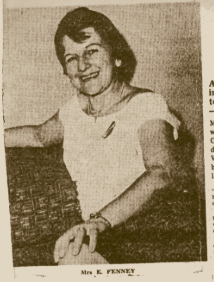
Article about Mabel Fenney – back in South Africa on a visit from Berlin. She is returning to Berlin to complete here course. (Below)
7 September – Go into town in the afternoon and book for The Amorous Prawn matinee next Saturday. Go up to Webster and Anne and Webster answers the door as large as life and in quite a gay mood.
My friend Dell is in having lesson once more, singing Mimi’s aria from La Bohème and breathing badly. Anne gives her usual breathing lecture and makes her practise. Dell says, somewhat sarcastically, “I had better take up swimming to improve my breathing.” Anne says that the area around her own ribs is quite hard which is unusual for a woman and also very large. She used to be quite tiny when she was young – 89,000 years ago – but intercostal breathing developed her. She goes on about how healthy it is to breathe properly and yesterday morning after Webster’s first night when they both felt like hell, breathing did them good.
I go in and pay. Webster asks if I’d like some tea and I say I would love a cup. Anne shouts through – “Boo – will you bring the biscuits, darling?” She asks if I’m going to see him in his play and I say, “Yes. I booked today for next Saturday’s matinee.”
Anne says, “Oh, sweet! It’s really a wonderful play. The first night was one of the best I’ve been to – the audience laughed right through the whole three hours. Being British, I think you’ll really enjoy it.” I say that the crits were wonderful and she agrees emphatically. Webster says I mustn’t expect to see him till about 5 o’clock. He’s actually very modest about the whole thing.
We start on scales and she makes me smile into a little mirror. I get it right but my cheeks tremble for some reason. She, of course, has to notice this.”
She corrects the Delilah vowels – I tell her that she’ll have to excuse it because I was ill at the weekend when I did it. She is all sympathy and finds out that I had a stomach chill. Most of the vowels are right. She tests them as she goes through it and says, “This would sound funny on the tape.”
When we do the aria they are both very happy about it and say that there is an improvement. Webster goes to put 6d in the meter. She says the aria has come on very nicely and next week we must do something about the consonants.
When we have tea and Anne has a biscuit, she says, “I shouldn’t have this really. I’m getting so fat!” I almost choke with derisive laughter! Thankfully, I don’t say the inevitable, “Oh, nonsense, Anne. Look at me!”
I happen to be wearing a copper bracelet for it matches the clip in my hair. Anne says she hopes I’m not suffering from rheumatism. We have a good laugh about it.
I meet Webster at the bottom of the stairs and say goodbye to him.
I go to choir at night and we work through anthem which is lovely – I hope they do it properly on Sunday.
Listen to Webster at night. He presents a really charming programme. He starts with Elijah and says that it’s popular because it’s tuneful music and he thinks that, first and foremost, music should be tuneful. He plays a duet sung by Isobel Baillie and Gladys Ripley, conducted by Sir Malcolm. Next, he plays his own recording If, With All Your Hearts, with Warwick Braithwaite conducting, next Is Not His Word Like a Fire? By Harold Williams. He plays three arias from the Magic Flute, more from Gypsy Baron and ends with Nutcracker suite.
9 September – In the Star there is a gorgeous picture of an almost aristocratic-looking Anne with Mr Leslie Green at first night of Amorous Prawn.
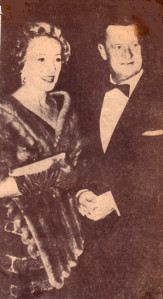
10 September Sunday Times crit by James Ambrose Brown is also excellent and says much the same about Webster – suave, man of the world. Very nice.
Mum and I go with the Diamonds to Hartebeespoort dam and we skirt Craighall Park. I like it very much – it isn’t anything like Houghton but just nice, and in-between and quite modern.
12 September – Go into town and have lunch with Mum. We decide that as I am presumably going to start work soon I should go today and see Anne to arrange a time for my lessons.
She phones and Webster answers and tells him that it is Mrs Campbell, Jean’s mother. He says, “Oh yes, how d’ye do?” Mum asks to speak to Anne and he says, “Who?” and eventually obliges with Anne who says I can come at half past one.
I go up to the studio. Webster answers the door. He opens door, looks at me and says in outraged manner, “What the dickens are you doing here?” I tell him that I have an appointment at half past one and he looks relieved and tells me to have a seat for a few minutes. There is a big bass singing very loudly. Hear Webster cursing the kettle – “My God, this kettle’s got too damn hot!”
Anne comes in to see me, dressed in tight skirt and dark over-blouse. Her hair is almost straight but attractive as always. She goes through her appointment book while big bass continues to sing. We decide on Friday at 5.30 for next week. She asks, “Are you glad you’re starting work?” I say, “Not particularly. I’ve enjoyed doing nothing!”
13 September – Go for piano lesson in afternoon. I feel more at home with Mrs S now.
14 September – Go to Anne in afternoon. She answers the door looking glorious in a very low-cut summer dress. A girl is singing Hello, Young Lovers – not very well. Anne says, “That must be the Irish in you.” The girl says quite vehemently that there is no Irish blood in her. Anne says, “Oh, surely – with a name like Maureen!”
Maureen departs I get a surprise when I see that it is Maureen Schneider who was at college with me.
Anne and I have discussion about times and come to reasonably satisfactory arrangements. Webster presents me with the Samson and Delilah record with a really seductive picture on the cover. Anne says we should listen to it here first so while Webster sets up the record we start on scales. She makes me go to the mirror to see that I drop my jaw right down and then she comes over and puts her arm round me and we do it together. She says that my scales are really lovely.
Webster plays the aria and says I have in my own voice all the power and quality of Risé Stevens if I would project and bring it forward and work. He wants to hear me singing with as much richness as Risé Stevens next week. I have a wonderful voice and I must use it. I feel quite embarrassed but it must be true – he doesn’t say things without meaning them.
Webster makes tea and I sing the aria – well, I think. Webster goes to put 3d in the meter. Anne says she doesn’t think I’m too young to sing Delilah because she had a friend, Nancy Evans and she sang it at 16. She tells me that when she was 17 she joined a women’s choir of 24 voices and received more training in it than anywhere else.
I tell her that I know Maureen and Anne says she seems a sweet girl but hasn’t got a voice anywhere near mine.
We go on with the aria and it goes well. Webster’s suit arrives and Anne signs for it. Webster is in the kitchen with Roselle who is making a frantic attempt to wash the dishes. I depart with record and the signature of Webster Booth scrawled all over it.
I go to choir and then listen to Webster. Today is the 220th anniversary of Messiah so he plays some of it. It was first produced in Dublin where you can get gorgeous shrimps. Handel discovered that one of the singers – a little man from the North wasn’t singing in the right time. He said to him in broken English, “I zot you zed zat you could seeng at sight?” Replied the man, “Ay, so I did, but not at first sight!” His accents are gorgeous and I have a good laugh. He plays the chorus, The Glory of the Lord.
At the opening ladies were requested not to come to the performance wearing hoops. He, himself, has given a recital in the same music hall and he liked it. He plays his own recordings from Messiah and says that this is one of his favourite recordings and one of his best.
He goes on to Madame Butterfly which he says he doesn’t like it very much as it is built around two arias, The Love Duet and One Fine Day.
He goes on to Eldorado by Ralph Trewhela. He says it was originally written for “Anne and myself” for a radio programme but because Anne had so many commitments he was “ably partnered by Doris Brasch”.
15 September – Go to guild at night. I give the epilogue which goes very well and everyone congratulates me about it. We practise for Guild Sunday and they can’t manage one of the hymns so Mrs Russell makes the 4 from the choir sing it alone. Once again I practically sing a solo. I have to do the reading and talk about the work.
Peter walks Doreen, and me home and I get home at about 11.
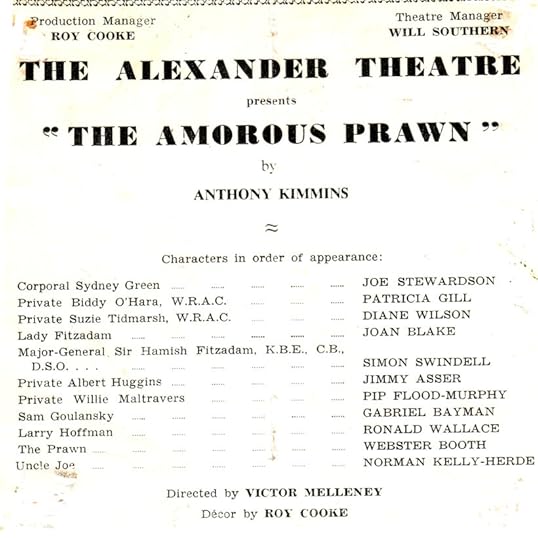
16 September – We go to see Webster’s play and it is really gorgeous. When we arrive the first people I meet are Claire Judelman and Adele Fisher. Claire tells me about European trip and I tell her I’m here to see my singing teacher. First two acts are good and at the beginning of the third act I see a woman slipping in to the theatre and think it is Anne. Webster comes on – handsome, well-dressed, young-looking – perfect for his role. His diction is glorious, his acting well-timed. He makes the play and when he takes his bow I clap until my hands are red and almost blistered.
I see that Anne slips out the minute the lights go up and I am a little disappointed but when we get outside I see her a little way down the road talking to a fat garrulous man. She is wearing the same dress that she wore on Thursday, flat shoes and straight hair. I go up to her and her face lights up and I tell her, “Oh, Anne, I thought your husband was lovely.” She says, “Oh, I’m so glad you liked him. Did you enjoy the play?” I say, “Oh, yes, it was wonderful. Please tell Webster I thought he was lovely.” She asks if I came with my parents and when she sees them she smiles in charming fashion.
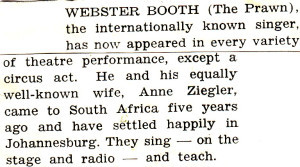
I come home – on air. I believe I enjoyed my little talk with Anne better than anything else that afternoon – except Webster of course. I noticed that she also clapped violently for Webster and laughed loudly at all his jokes. She probably didn’t want to be recognised because she did look a little bit of a sight. The blurb in the programme reads:
17 September – Go and have all my little children for Sunday school. Afterwards I go to Betty’s house with my record (Webster’s actually!) and we listen to Risé Stevens. She has a really thick – or should I say, velvety? – voice. I shall never sing like that. I wish Webster didn’t have such confidence in my voice. I have a nice tea with the Johnsons but feel a bit insulted when Mrs J says that she thinks Webster has a far better voice than Anne and she doesn’t like her. People – especially women of her own age seem to dislike Anne but it’s probably because she’s too attractive for them.
At night we have a guild service and I do the reading which goes off well. Afterwards we have a social and see a film about Liverpool delinquents.
18 September – Letter comes from Aunt Nellie in Scotland and she says her stepson and his wife know my teachers and remember them well. Practise piano and singing.
20 September – Go to piano lesson and all goes well. Mrs S is very affable and we concentrate entirely on the work in hand.
21 September – Go into town and have lunch with Mum and then go to lunch hour concert. Phillip Levy is the piano soloist. I meet Jill Harry. She doesn’t like her job and is leaving at the end of the month.
Meet Gill Mc D in the street and she is very affable for a change. I go up to studio and Anne arrives late with her hair almost straight. She says that all she seems to do is rush around. She was playing for an exam this morning and what with the Springs eisteddfod she has had “a hell of a week”. She gives me a new exercise to do so that I can get up speed.
She says I must be getting a bit sick of Oh Love so I can start a new song soon. We do Oh Love and on the trill my tongue goes up so I must get it down. We look in the mirror and her tongue goes up too! She says she didn’t pay enough attention to her tongue when she was a girl and now – “at my age I’m having to battle with it. When I’m singing publicly I know that if my tongue goes up my voice will go out of pitch and I’d hate to think that when you get to my age you’ll blame me for not insisting that you keep your tongue down!”
Maureen is ill today so Anne comes down on the lift with me to do some shopping. We talk about the play and I say how lovely I thought it was. She says, “Weren’t you shocked?” I say, no. She says she thought he was very well-cast. “Of course some snobs say that it isn’t real theatre, though, is it? But I think it’s a masterpiece.” She quotes, “Easy to write first and second acts but the third act is the telling one.” She treats me as though she is genuinely fond of me and she always brings out the best in me.
Go to choir and come home and listen to Webster. He starts with Dream of Gerontius sung by Heddle Nash and Dennis Noble. He says, “It may be of interest to you to know that I am going to sing in The Dream in PE in November.” He goes on to Tosca. He plays his own recording from it and two other recordings by the Rome opera company.
He goes on to Merrie England and says, “Anne and I have played Bessie and Raleigh innumerable times.” He plays his recording of the English Rose – one of the loveliest recordings I have heard.
Then he says, “I’m going to let you into a secret. When I first took Anne to the recording studios for a test recording, the song which she sang was Bessie’s Waltz song. When she signed her first contract the company gave me the test record and I have it here with me now.” He says after the record is over, “Not bad for a young beginner, is it?”
Next week he is going to play more from The Dream, Der Rosenkavalier and the White Horse Inn.
23 September – Go into town in the morning and meet Ann and Leona preparing to study in Rhodes Park library. I go to Central library and then to John Orrs. When I come out the first people I meet are Webster and Anne and Lemon. Anne is wearing black and white striped dress. She is terribly sweet and Webster gives me big grin. Lemon dashes around madly. What a lovely surprise. Meet Liz Moir as I’m going down Eloff Street.
27 September – Go for lesson with Mrs S. Her studio houses the Trinity College examinations room. Imagine my surprise when I hear a well-known voice talking to someone, “You’ll have to come and have dinner with us then.” I decide not to greet her in case she thinks I’m taking singing with Mrs S instead of with them.
I have my lesson and Mrs S loads me with work which I shall do. On the bus home I think that I should have greeted Anne for I shall have to mention it to her tomorrow so that she understands that I’m doing piano and not singing with Mrs S.
28 September – I have lunch with Mum and then go to a lovely lunch hour concert – Sonette Heyns sings and Edgar Cree conducts. I meet Jill and Lynn afterwards and we talk for a while.
I kill time in the library for a while and then go up to studio. Anne is wearing a pink striped dress. Middle-aged pupil called Nellie is having a lesson. Webster is playing a recording of his Abide With Me (Liddle) and he says, “I’ll play this for you one Thursday night – say a fortnight from today.
Nellie departs and Webster tells me to go in. Before we start on scales Anne tells me about all the prizes they had won at the Springs eisteddfod. I say, “Were you at the Trinity College examination rooms yesterday?” She says she was, and I tell her I was going for a piano lesson with Sylvia Sullivan and I heard her speaking to someone. She said she was speaking to the old examiner from Britain who comes out every year and looks about 90 although he’s only 70!
We start on scales and on one note Webster says, “That was glorious – sing it again!” Over tea I tell Webster rather nervously that I loved his play. He says, “Oh, did you like it? It is fun, isn’t it. Did the others like it?” I say, “Yes, it was lovely.”
Anne says that on that day after the show she went out to see a particular garden. The roof was off on the Hillman and she was wearing flat shoes so she arrived looking a dreadful sight but didn’t expect to see anyone she knew. When she walked in all her friends were there and she felt terribly embarrassed.
We do Roslein and it is agreed that it is an improvement beyond bounds from the last time I sang it. We do Hark, Hark, the Lark and she decides that we should do it. We look at it in one of her books which she has had since school days. He says he hates it for he sang too much of it as a choir boy.
I listen to Webster at night and find complete peace listening to him. He plays a few excerpts from The Dream sung by Heddle Nash and Gladys Ripley. He says he found it very difficult at first but then decided it was the loveliest oratorio of the lot.
Then he goes on to The Rosenkavalier which he sang in 1938 at Covent Garden with Erich Kleiber conducting. He tells the story of Lotte Lehmann’s husband being arrested by the Nazis and she was so upset that she was unable to continue with the performance.
He plays some pieces from The White Horse Inn and says that he spent many happy weeks in the Austrian Alps where the musical is set.
April 6, 2021
EXTRACTS FROM MY TEENAGE DIARIES – June – July 1961.
JUNE 1961
1 June – College again. We have a long day which is rather depressing after the excitement of the week. This is broken by the lunch hour concert conducted by Jeremy Schulman with Annie Kossman on first violin. They play Poet and Peasant overture. Alan Solomon plays a violin solo with orchestra – Symphonie Espagnol. Last – Knightsbridge March by Coates. I meet Pat Eastwood again in the afternoon.
At night Mr Stratton calls for me for choir and this is enjoyable – any chance to sing is nice for me. A young tenor comes to practise songs for a wedding on Saturday – he’s singing This is My Lovely Day. He has a good voice but a face as miserable as death!
Come home from choir and listen to Webster on the radio. First, he plays a quartet from the Verdi Requiem. Webster says, “Verdi seemed to have a grudge against sopranos. In this record the soprano has to hold a note for twenty seconds – a real test of breathing if ever there was one!”
Plays an aria from Judas Maccabeus sung by Isobel Baillie. “Isobel is my ideal singer of oratorio. The way she floats up to the high Bs and B flats is beautiful to hear. It’s a long time since she visited this country, but I know she is well loved by all who saw and heard her.”
He talks about Faust and says, “I met Anne Ziegler during the filming of Faust. Of course, I was Faust and she the heroine, Marguerite. We used to be so tired doing it that it took the make-up man all his time to cover up our tired looks.”
This leads him into Rosemarie and he plays recordings by George Tsotsi, Frederick Harvey and Julie Andrews. The last sings Pretty Things and, says Webster. “Very prettily she sings it too!” He says he knew Julie Andrews as a child prodigy of 12 years old singing coloratura opera arias and making a lot of money for her parents. She lost her beautiful voice but still has a very workable, pleasing voice and acting talent to go with it.
He clears his throat violently, plays the Soldiers’ March and starts reminiscing about Canada and the Rockies and how much he and Anne enjoyed being there when they did a concert performance of Merrie England in Calgary in 1953. He says that a brown bear pulled at Anne’s skirt and that this was a very happy period of their lives. He plays the finale from Faust with himself, Joan Cross and Norman Walker.
Webster says, “Now Anne will join me in singing Indian Love Call. I’ve heard this record before but I shall never cease to wonder at their voices. So long as that record continues to be played they will be remembered for ever. He ends with the overture to Oklahoma! and then it’s “Goodnight until next week!”
2 June – College and thank heaven for the weekend. In the afternoon I buy a Durban paper and there is the advert for their concert in the city hall for over 60s – 25 cents a ticket with limited seating for the general public at 50 cents a ticket!

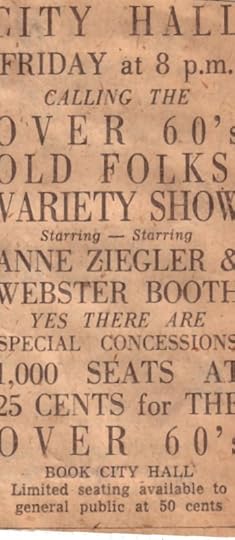
Go to guild at night. We have a bible quiz which is quite good fun but wouldn’t I rather have been at the Durban concert!
3 June – Go into town and have lunch with Mum and Dad and buy a few songs. Come home and sing and sing. Hear Webster and Anne singing Only a Rose on Freddie Carlé’s programme – feel terribly happy about this – too gorgeous for words!
6 June – College and then to studio. Phone rings and Anne comes through and says to him, “Webster, Salisbury wants you.” Webster speaks to someone in Salisbury and I hear him say, “Well Anne could come up too, if necessary.” Anne comes into the kitchen wearing a red hat to cover absolutely straight unset hair, and a black dress and coat with wings for sleeves. She looks a bit corny all round. I go in and pay her and this makes her happy.
Anne and Webster meeting All Blacks team at residence of New Zealand ambassador, Lower Houghton.
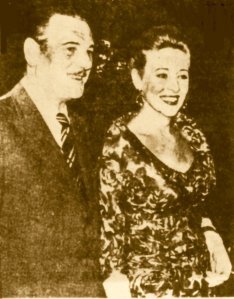
We start on singing and she informs me brightly that I’m going to get a new exercise today to get the tongue flat. “ca, ca, ca” – very exhausting. She says, “Nothing is impossible.” Says Webster, “Once you get this you’ll wonder why you couldn’t do it all along.” We do The Lass and my breathing is dreadful. He says I’m expounding too much energy in diction and does a cruel imitation of this. We start again with breathing and he sings with me and breathes with me as well, and it goes better.
Anne tells me I have some excellent notes but I shall have to resign myself to the fact that I’m going to be a contralto, do I mind? “Most singers are so disappointed when they hear that they’re going to be contraltos because they think sopranos are far more romantic.” She says this in her most stagy, catty voice. Webster says that I shall definitely have to start on some contralto oratorio arias. O, Rest in the Lord would be best. I say that I shall copy it into a manuscript book for next week. He looks surprised that I should be able to do this.
I ask how they enjoyed Durban and Anne says theatrically, “It was lovely! Very rushed of course, but we managed to get a dip in the sea on Saturday morning, but it was freezing. Both concerts went marvellously – the second one was in the open air.”
Anne asks me if I can go at 4.30 next Tuesday. Will it be convenient? Oh, yes. Offers me an Eetsummore biscuit but I decline with thanks. Anne escorts me to door still in red hat, angel-like coat and straight reddish-blonde hair. Today she was in one of her stagy, and therefore less attractive, moods.
8 June – Go to lunch hour concert – Edgar Cree conducting. The soloist is Cecilia Wessels – a large lady in her fifties looking every inch the typical prima donna of fifty years ago. On the loud notes her voice (dramatic soprano) is excellent but her soft notes tend to crack. Apparently, she is very well known and there is a saying about her, “Don’t say ships; say Wessels!”
At night Mr Stratton takes me to choir and we have reasonable time – all would be so much more pleasant if Mrs Weakley shut up a little. Come home and listen to Webster while lying in bed. He plays an aria from Messiah sung by American bass-baritone, Donald Gramm – Why Do the Nations?
Webster talks about Bach and says that he and Bach have something in common – they were both educated at a cathedral school – free! But there the resemblance ends. Plays the Cantata for Ascension Day sung by four dear friends – Eva Turner, Kathleen Ferrier and two others whose names I don’t catch.
Next he plays something from Thais by Massenet, and then Don Pasquale. Rossini was in poor health when writing this and died in an asylum. Next come three songs from My Fair Lady sung by Rex Harrison, Julie Andrews and Stan Holloway. He says, “Anne always says that Rex should have been her brother-in-law but her sister married an Edinburgh accountant instead.” Re Julie Andrews, “We’ve known her since she was ten years of age and at one time she trained with Anne’s former singing teacher – Lilian Stiles-Allen, who might be known to older listeners as an oratorio soprano.” Stan Holloway: “I’ve known Stan since his concert party days. All three were dear friends of ours.” What a lot of name-dropping in one session! But I’ve always admired the three, especially Rex Harrison for what he did for Kay Kendall.
Lastly, he plays Merry Widow by Mantovani – Manty as he is affectionately known. Lovely programme but none of his records there, I notice.
9 June – College. Gail Blue leaves today – she has found a job!
Go to guild at night. George Fleetwood, Claudie, Rose and I go with Kippie to Parkwood guild and after much searching we find the hall and enter late amidst the rendering of a song by an unfortunate young baritone.
A play is presented – The Late Mr Wesley which is very good and the girl turns out to be Wendy Smith from the rink. Afterwards, we greet each other effusively and she tells me that she’s doing a BSc at varsity and she must come to the rink some time. She is terribly sweet and her acting was lovely. Also meet Lynnette Roberts from college and she is most effusive too. In her effusion she knocks a cup of tea on to George and his suit! Rushes for cloth to wipe it and apologises – effusively!
10 June – Go skating this morning. Neill is there and is gay (when not bragging) and so is Menina full of a long holiday in Durban. Dawn V comes and she too is full of herself. My skating is still the same as it was a year or two ago! Talk on and off and am pestered by Dawn to dance. I have actually lost all lust for skating – the only reason I go there now is for a social occasion. I hope that my interest in singing will not peter out as my interest for skating has but I have been brought up on music so maybe it’ll win through!
In the afternoon I go with parents to see Tunes of Glory with Alec Guiness, John Mills and Duncan Macrae (Parents knew him in Britain). It is an excellent picture set in Edinburgh and I enjoy it immensely.
11 June – Eleven kids in Sunday school today including Michael Ferguson and Mark – what a time I have! In the afternoon I practise singing and sing in choir at church at night. Mr R’s sermon is excellent and after service Leaders’ representatives are elected – Daddy is elected on to the committee.
12 June – Mother’s birthday (60!) College. In the afternoon I happen to meet Dawn Snyman outside the CNA. She hasn’t changed a bit after a year and is still a darling. She says that Erica Batchelor has gone for a holiday overseas. Dawn is going to visit Chubby. Says she wrote five letters to her and got a postcard in return! We talk about Kay and the rink and she says she is at Modern Methods business college. We say we’ll probably see each other at the rink. She is a pet. I always liked her.
Practise singing at night for great day tomorrow.
13 June – In the afternoon go to reference library and read Stage Who’s Who and Television and Radio Who’s Who – both very eloquent about Webster and Anne – makes me feel terribly insignificant and then very determined to do well at singing!
Go to the studio and Webster answers the door and says, “Anne isn’t back yet, but just have a seat till she comes – she won’t be long.” I sit down and listen to Webster coughing. Anne doesn’t come in for ages so Webster says that I had better come into the studio and he’ll make a cup of tea while we wait for her. He says, “I have to go to Rhodesia the week after next, dammit, and God knows how much music I have to take with me.” I make the necessary grunts in reply. Then he says, “I don’t know what’s happened to Anne – she only went to John Orrs and that was half an hour ago.” Anne duly returns after I have had a nice feast on the photographs. She is wearing a fur coat. She apologises for being late. She went to John Orrs to buy a pattern and all the patterns she wanted were out of stock and won’t be in for six weeks.
Anne removes her coat and says, “Well, my dear, let’s start.” Webster brings tea and I drink it. He says to her, “I’m so sorry, I put sugar in it, darling.”
She says archly, “Monster! We’ve had three cups of tea today and I’ve had sugar in every one of them!”
We start on the ca-ca exercise and I tell Anne how exhausting I find it as a prologue. She is delighted and they both stare at my tongue and are charmed with it. Anne says that I must have practised thoroughly which is very different from most of her other pupils who don’t pay any attention to what she tells them to do!
I mention that they asked me to copy O, Rest in the Lord and I produce my copy. They are both thrilled with the manuscript copy and Anne says that Webster will be coming to me to copy out music for him.
We do it and it goes very well. We concentrate on it line by line, and Webster gives a demonstration – no imitations of me this week – and they tell me that my voice seems to have improved and is settling down nicely. We end with The Lass and Anne says that a two and a half octave range is quite fantastic and I have the makings of an excellent singer.
When she sees me to the door, she asks, “Are you glad you’re doing singing, Jean?” and I say, “Oh, yes. I love it!” and boy, I really do. Ernest is waiting to go in for his lesson and gives me an earnest look. Say goodbye and come away gaily – a little more cheered than at other times.
15 June – College. We go to lunch hour concert. Edgar Cree conducts the Ballet suite from Faust and a waltz from Eugene Onegin. Adelaide Newman is one of the best pianists I have heard.
At night I go to choir with Mr Stratton. When I arrive home I listen to Webster and he is excellent as usual. He starts off with an excerpt from the Mozart Requiem and then plays part of the Ninth Symphony, but says that although he likes to listen to it, he loathes singing it, although he has sung it under three twin knights – Sargent, Beecham and Wood, and also Felix Weingartner.
Next he plays two pieces from Cavaliera Rusticana, an opera about ordinary people. He says the opera is very bloody, “A lovely cheerful night’s entertainment.” He plays The Dance of the Seven Veils from Salome, which is unpleasant, in my opinion.
“It’s amazing at how many South Africans we meet here who can remember us in Sweet Yesterday at the Adelphi, specially written for us by Kenneth Leslie-Smith. I would like to play you three songs recorded from the show sung by Anne and me.”
The first is a duet, Life Begins Anew followed by Anne singing Sweet Yesterday and the last one is a rousing one by Webster called Morning Glory. What voices they had! He finishes with some more Lehar.
16 June – College – Go to guild at night and we have Victoria guild over so there is quite a crowd. Playing goes very well and we see two films on refugees – one with Yul Brunner. Ann takes the epilogue.
17 June – Go skating – Dawn and friend, Sally, MJ and Neill are there and we have glorious time. Neill does aeroplane spins with Dawn which come on nicely and a double spin with me which is gorgeous. I have regained old form and all is terribly gay.
In the afternoon I practise singing and at night we go to Mr and Mrs Scott – they have a lovely little flat in Reynolds View. We listen to the Gondoliers and they are full of praise for Webster and Anne. See programme of Dancing Years – they are in advert – Sweethearts of Song.
18 June Sunday school and then a beautiful sermon by Mr Cape. Peter tells me that he has to take speech lessons for preaching so he wants the Booth’s telephone number. The Alexanders come in the afternoon with Mrs Radzewitz’s mother.
19 June – College – come home with Margaret Masterton on the bus and ask her how her parents are enjoying their holiday in the UK. She tells me that her father died in Scotland two weeks ago. I feel rotten about it. Poor Margaret and poor Mrs M. She says that she’s dreading her mother’s return and can’t believe that her father is dead.
We talk about singing and her exams and I tell her about Webster and Anne and singing – contralto etc. She says that Yvonne Hudson (Miss Kempton Park) is learning with Anne. We talk about Drummond Bell which takes Margaret’s mind off her sadness. Apparently, her father knew that he was dying and wanted to return to Scotland to die there.
20 June – College and then singing lesson. They are discussing various songs when I go in – keep on talking about Sweet Yesterday. I sit in the kitchenette and think how gorgeous their record of it sounded on Thursday night.
Anne comes in – is quite charming and her hair looks lovely. She asks if I can change times from Tuesday to Thursday at 4 o’clock. I say that it will be fine. She says she hates messing me around but that will be settled. She says she’s going up to Rhodesia the week after next but will talk to me about that later.
I sure will have a musical Thursday – lunch hour concert, Webster and Anne, choir and then Webster at night.
We start on scales – ca-ing away – and Anne is very pleased with my tongue. We go on to Rest in the Lord and I don’t do it too badly. Webster sings a bit of it with me and tells me that I must sing louder. He stands further away and tells me to sing loudly, so I do. He says, “It’s beginning to sound like a voice now!” What did it sound like before, I wonder! Webster says, “It’s terrible, but I can’t find that contralto book I wanted for Jean – It had Father of Heav’n in it and everything.”
He starts rummaging through all the music albums and Anne says, “Let’s try He Shall Feed His Flock while we’re waiting for him.” My copy of it is “out of date” so she alters it – first wrongly –and she says, “Oh, darling, I’m sorry,” and alters it once more and we start again. She says that I have some beautiful notes in the aria and I must try to get the same quality into all the notes and it’ll sound gorgeous.
Webster says that I mustn’t be afraid of having a good sing. She says, “I hope you don’t feel as though you’ll make a fool of yourself in front of us.” “Good God, no!” Webster says vehemently.
It goes quite well today and they are sweet. Anne says very proudly, “Webster is going up to Rhodesia next week to adjudicate.” I say, “That is lovely.” She also tells me that she is going up the week after next and will have to alter my time again – she’s sorry.
When I leave, Ernest is there once again. Peter is not mentioned so undoubtedly he has not yet phoned. If he decides to go to Nora Taylor I couldn’t give a darn! Listen to the radio at night and Ivor Dennis is excellent in his little programme.
21 June – Hear Kathleen Ferrier singing on the Afrikaans programme. She sings folk songs – The Keel Row, Blow the Wind Southerly, The White Lily, Ma Bonny Lad, Willow, Willow. If that’s what a contralto can do, please let me be one.
22 June – Anne’s 51st birthday. Go up to choir at night – Mr S isn’t there because Mrs S is ill, so we go through the hymns in a haphazard fashion. Ann and Leona come down to excuse him. Joan tells me that she went to see The Dancing Years last Saturday night and loved it, She makes me la away at Waltz of My Heart.
Come home from choir and listen to Webster on the radio. He starts with the Verdi Requiem – Libera and Dies Irae. Soprano ends on pianissimo top B. Very nice but very heavy. He plays his own recording of a recit and aria from Samson conducted by Stanford Robinson with the BBC orchestra – very beautiful indeed. He plays parts of Carmen conducted by Thomas Beecham and sung by Victoria de los Angeles.
He plays parts of Annie Get Your Gun. Emile Littler presented it in London and their friend, Wendy Toye produced it. He says they were at the first night of the show and the audience wouldn’t let the cast go so they had to sing all the numbers from the show over again. When they were in Australia it got the same reception. He ends with the overture to Gipsy Princess which he sang many times for the BBC. The recording is played by their old friend Mantovani.
24 June – Have lunch in and have a look in Polliack’s. Net Maar ‘n Roos is displayed in the window. Mummy says I can have the record some time. We see No Love for Johnny with Peter Finch, Mary Peach, Stan Holloway and Billie Whitelaw – excellent.

Mr and Mrs Diamond come at night and I sing for them. They are impressed and I feel happy.
Webster arrives in Salisbury, (then Rhodesia).
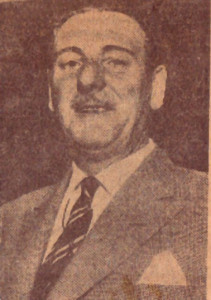
29 June – Go to Anne in the afternoon and have a really gorgeous time. I arrive earlier than her and hear her coming out of the lift and thanking the man profusely for holding the door open for her. She wears a red hat and cape-like coat. She says, “Oh, hello, Jean. Did you think I wasn’t coming?” “Oh no, Anne. I was here early.” “The other two before you have ‘flu so that’s why I’m here so late.”
We go in and she fouters around in the office and I look at the pictures and I try to figure out who some of the people are – I only recognise Leslie Green and the Royal family. Anne asks if I can come on the Monday (a public holiday) because she’s going up to Rhodesia next week on Sunday. Yes, of course I can!
We start on ca exercise which she says is marvellous and dead on. She says that I must do 4 cas at a time on the same note in the same exercise and then my placing will be “bang on”.
We do He Shall Feed His Flock. She says it’s going to be gorgeous but I must watch that I don’t spread my “ees”. She says, “I can say what I like about Boo and I know that we have our little squabbles, but I must admit that he has really beautiful diction. It doesn’t matter what he sings – opera, oratorio or pop musical comedy – his vowels are just the same. He was trained in the right way since he was seven years old as a choir boy and he has never forgotten that basic training. You are just at the right age to be trained in the proper way, Jean, and no matter what you do in the future you’ll always be able to fall back on your first basic training. I think it’s wonderful the way you do everything I tell you to. You’re a good girl and you have a lovely voice.”
She asks, “Do you like singing, Jean?” and I say profoundly, “Oh, yes. I like it very much.” Not very eloquent but very true.
We go on to Rest in the Lord and this goes well until we reach, “And wait…” and then my tongue goes into the wrong position. She takes me over to the mirror to see that I get my tongue down and she looks in the mirror and says, “Don’t mind me keeping my hat on, but my hair’s such a mess that I couldn’t possibly take it off. I’m going to have it done tomorrow though, so it’ll be OK again!”
She says that she thinks I’m losing my breath too quickly because of the “h” and that she gets her “hs” out without moving her ribs with her abdomen. She gives me a demonstration, and honestly, it is quite marvellous. She tells me to feel her ribs and puts my hands on them with hers – they’re gloriously warm compared with my cold ones. She’s a miracle with her breathing.
We do The Lass and when it comes to top A it sounds terrible to me – not so much terrible but because my parents have said it sounds terrible. She says, “Jean, you have a really beautiful note there. No! Don’t make a face. I wouldn’t tell you that if it was rotten. But look happy about it and don’t let people see you’re thinking, “Oh, God, I can never reach this!”
When we finish, Anne says, “You know, Jean, you really and truly have a beautiful voice.” I feel quite overcome at this and look a bit grim. She says, “Well, aren’t you happy about it? You look as if it was something terrible.” I manage to get out a strangled, “Thank you,” and she looks at me and says, “Jean, I really believe that you are shy. Please, whatever you do, don’t feel shy with me. I don’t know about HIM, but please never feel shy with me, dear.”
I tell Anne to have a nice time in Rhodesia and we say goodbye… She is one of the sweetest people I have ever met. She’s so generous and natural – she’s an angel.
Listen to Webster at night. He starts off with something from Elijah. He says that there seems to be everything in the record that he likes – his favourite baritone, Harold Williams, his favourite choral society, Huddersfield, and his favourite conductor, Sir Malcolm. It is a lovely record and Harold Williams is excellent. Webster says HW’s voice is nectar to his ears. Next he plays the quartet from Elijah, Rest Thy Hearts Upon the Lord.
Webster talks about Handel playing the organ for a choral society near Bushy Heath. “Where Anne and I spent much time filming Gounod’s Faust. Evidently the society had a collection of very high tenors and it was for them that Handel wrote Acis and Galatea. Webster plays his own recording of this, Love Sounds the Alarm conducted by Warwick Braithwaite. ‘Well, you can see what I mean about the high notes, can’t you?” he says when the record is finished.
He goes on to Lucia di Lammermoor and says that Mimi C is coming out next August to do this and she’ll have a good two hours of coloratura singing to do. He plays two arias from the opera. He plays three songs from The Song of Norway which, he says, he saw in London. It was produced in America in the open air with an artificial iceberg for the skating ballet. He plays Freddie and His Fiddle and Strange music. He will play more of this next week and some items from The Vagabond King.
JULY 1961
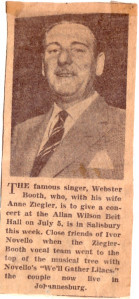 Webster in Salisbury, Rhodesia for Eisteddfod.
6 July – I go to the music library and have lunch with Mum in the Capinero. Afterwards I go to the lunch hour concert and meet Jill Harry, who is much nicer than usual. Edgar Cree conducts orchestra beautifully – Eric Coates suite, My Fair Lady, with soloists from the orchestra.
At night I go to the choir with the Strattons. Ann has gone on holiday with Leona. Mr Stratton and Mrs Weakly are singing a duet on Sunday night. Come home from choir and listen to Webster on the radio. It’s difficult to believe that I haven’t seen him for over two weeks. He starts off with something from Elijah but makes the terrible mistake of saying, “Now something from Mendelssohn’s Messiah!” He plays Woe Unto Them sung by Gladys Ripley and an aria by Harold W. He also plays his own recording of In Native Worth (Creation), which is lovely and two extracts from Nabucco. Evidently Nabucco was the nickname Verdi gave to Nebuchadnezzar because the proper name was so long. “I always associated Nebuchadnezzar with one of the earliest stories I ever heard. A man knocked down a cow in Nebuchadnezzar street and went to fetch a policeman to see what he could do about it. The policeman came along and took out his notebook to write down the details. When he realised the name of the street he said, “Let’s drag the cow round into Smith Street – I can’t spell Nebuchadnezzar!”
He plays an aria by Ezzio Pinza and then the Slaves’ Chorus. After that comes the part of the programme I’ve been waiting for – The Vagabond King, revived by them in 1943 at the Winter Garden Theatre. He plays three duets from the show and I lie in bed and cry the whole way through!
He ends with the overture to Iolanthe and says it’s his favourite G and S opera. And then goodnight and goodbye for another week, but I’m luckier than most – I’ll see them on Monday. I don’t honestly think I could live without seeing them. They’re different from parents and relations. I know that one day I’ll have to say goodbye to them – it’s inevitable – happiness like this doesn’t last forever, but while it does there is no harm in being happy, is there?
7 July – I hear Webster singing in an early recording from 1936 – I Breathe on Windows – a very lively affair by Billy Mayerl.
8 July – Go into town in the morning and buy a few things, including a Rhodesian newspaper. Webster and Anne’s concert in Salisbury is splashed all over it. Go to see Return to Peyton Place with Dad – seaminess isn’t in it!
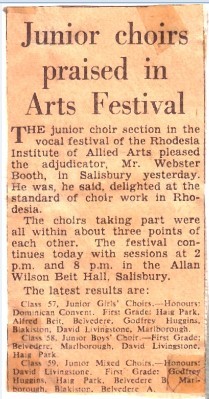
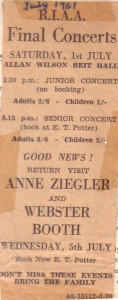
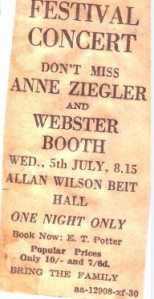
9 July – Go to Sunday school and have the pleasure of teaching my little boys – and one little girl – and also playing the piano for the department. Sing in choir at night.
10 July – Go to lesson in the afternoon and enter a very quiet Polliacks building (family day) They are running late so I sit in the kitchen and listen to them giving a lesson to Dell. She sings Il Bacio very charmingly and Webster sings along with her. Anne can’t stand this so she says quite rudely, “Shut up!” He does for a time and then joins in again. Dell says that she heard Doris Brasch singing this song very nicely the other evening and evidently Anne gives her a very fishy look for Dell says, “Oh, don’t you like her?” and Anne replies, “Yes, but I think that this is far too high for her.”
Anne has her hair died mousy blonde which looks quite attractive and startling. She tells me she had a really nasty time in the last week. “As you know, I went up to Rhodesia and the first thing I did was to contract a ‘flu virus so I spent practically the whole time in bed.” We start on scales and she looks really ill. I feel terrible for making her pound away at the piano. Webster comes in from the verandah dressed very flamboyantly in a brown checked waistcoat and brown shirt. They are pleased with my scales.
We go on to Rest in the Lord and Webster tells me to almost hum the first note to get the hang of it. He sings along with me and this time she doesn’t tell him to shut up. During one of the breaks, Anne tells me that when she was in Rhodesia she had to make a recording but collapsed halfway through it on Tuesday and then had to get up to do the concert on Wednesday and then they had to finish the recording on Thursday and by the time they got home he had the ‘flu as well. Anne shivers the whole time during my lesson and complains of the cold – she can even make the ‘flu romantic!
We do the Messiah aria which goes reasonably but not nearly as well as when I had Anne to herself. She discovers the Noel Coward songs that I have in a book and she plays them through, singing them vaguely and is quite delighted with them. She says I may as well do a few of them because what I’m doing is hell of a serious, so she picks out three and I try them. I feel a bit nervous singing musical comedy in front of them for isn’t that where they made their money and their name? Anyhow, I do and all goes fairly reasonably. If Webster didn’t exert that magnetic personality of his, I should feel far happier.
When I leave I tell Anne that I hope she will feel better soon. She smiles wanly and says she hopes so too. During the lesson, she remarked several times that she was feeling dizzy, so I was waiting for her to faint into my arms.
Webster comes down with me on the lift to unlock the door, and for want of something better to say, I tell him that it was pity they both got ‘flu in Rhodesia. He says, “I honestly think it was more of a heavy cold that I caught.” His manners are charming as always, and he opens the doors in a courteous fashion and comes right out into the street with me. The pictures are out and I can feel the eyes on us, staring at him. I just happen to be in the way! I leave him standing at the door of Polliacks in the “I am a monarch of all I survey” attitude.
13 July Go to studio in the afternoon. They are talking to a man from the Star as they’re going to advertise for more pupils. “A few vacancies exist for selected pupils..” The ad is going to be in the Star all next week. The man leaves and there is another knock at the door. Webster answers and says, “My God, you’re early aren’t you?”
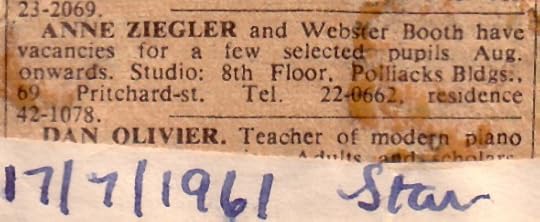
“I know, I’m sorry,” says Roselle. “But I’ve got a reason. Two men were pestering me downstairs.” Webster looks amused and says, “Well, you’re lucky that someone takes notice of you, aren’t you?” Roselle makes a horrified face and says, “Oh, Mr Booth – they’re horrible.”
Anne tells me that she has to go for her glasses from the optician, but Webster will take me through exercises. What a vile player he is. Exercises go reasonably, but Rest in the Lord cracks on “rest” – an “er” vowel – and we do various experiments to get this without a crack. I think it is partly nervousness at being alone in the presence of the maestro. However I manage to waffle through it and then Anne returns and listens and says it is very unsteady – the understatement of the year.
Do some more exercises and Webster says, “Well her voice cracks in the right place.’ Anne says, “Nonsense – she’s not a bass!” I do more exercises and eventually it is a bit better.
Webster tells me to get Samson and Delilah and look at an aria there. Anne, being in a flippant mood today, rubs it in about me being a contralto with a mezzo top!! I ask her how her ‘flu is now and she says, “Oh, fine, thank you. I got rid of it by working in the garden.” Come home feeling worse than death.
At night Webster plays Schubert’s Ave Maria sung by Marian Anderson – a contralto who doesn’t crack and I don’t suppose she would crack even if she had someone as terrible as Webster to accompany her! He plays Love in her eyes sits playing from Acis and Galatea. He says afterwards, “Well, all you young tenors, get your tongues down and your jaws working!” Bragger.
He plays two recordings from Lohengrin – the prelude and an aria and then some music from Kiss me Kate with Alfred Drake and Pat Morrison, and says that it came to London about 1950 but “Anne and I heard the record before it came to London and we liked Wunderbar, which has since become our most popular duet.” He plays two cuts from the record and says, “Now Anne will join me in singing Wunderbar in Afrikaans, believe it or not.” I can safely say that this left me cold. Their accents, voices, everything about it is terrible. Webster ends with the Nutcracker suite and says that next week he’ll play something from Gangway.
17 July – Poor Linda Michael from college was killed in a motor crash with her brother. Can hardly believe it – poor Linda.
19 July – Back at college and all is miserable because of poor Linda’s tragic death.
2O July – College goes nicely with Jill and Lyn. Go to studio and a gorgeous blonde Anne answers the door. She tells me that Dell is sick – her sixth cold this season.
We start on “ca” and Anne is pleased with new tone. Webster comes in, rather red in the face, and looks surprised to see me there so early. They are pleased with cas and we start on Oh, Love, From Thy Power from Samson and Delilah. Anne sings the whole thing jolly well, considering that it is miles too low for her. She says that Cora Leibowitz sang it at the eisteddfod for the mezzo solo.
This song ends on low A flat and they spend time getting my jaw in the right position for it. After seeing much of Webster’s bad teeth, I manage it. Anne says I must put some “guts” into it and gives rather a good imitation of my choir boy lyrical singing of the dramatic aria. Then she laughs and pats me and tells me that she doesn’t mean to be unkind – I know that, don’t I? I start again and become a little more dynamic and put “Vulgarly I know, darling, guts into it.”
Says something to Webster – and looks fondly at him, saying, “An old North country expression, isn’t it?” She asks me to copy the piece out and, as she says, it’s a stinker to play and to copy. Swears charmingly, “These bloody keys; where the hell is it?”
Webster sees me to the door and asks concernedly if I can manage. They are in good moods today. Meet Roselle on ground floor rushing madly, “Am I late?” she yells, and then, with a “My goodness!” she jumps into the lift and is gone.
There is an article in the paper about them in the morning – they were guests of honour at the Rand Women’s club and spoke archly about their world tour in 1948.
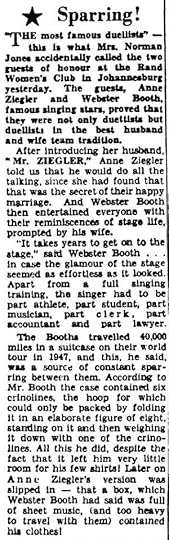
Go to choir and am now listening to Webster. He starts with the Bach Mass in B Minor – Hosanna in Excelsis sung by the Society of Friends of New York. He says he thinks the performance is too staccato. He plays the Ab Dextrum sung beautifully by Kathleen Ferrier. Webster says she was “the loveliest of singers and our dear friend”. He plays his own recording of Sullivan’s Lost Chord made in the Kingsway Hall which seats 2000 people, a full symphony orchestra and a choir of 500. Accompanied by Herbert Dawson on the organ.
He plays three pieces from Il Trovatore and says that he isn’t very fond of the opera – it’s a bit corny. He saw the opera at the Carl Rosa when they were going through a bad period and the chorus was very small so they had to relay it.
25 July – College. At night (after large singing practice) Peter Spargo takes me to Sunday school fellowship at Ann S’s home. A wee bit dull but we have a lovely tea! Come home at 11.
27 July – College – all gay. Go to studio in afternoon and I listen to Dell having a lesson. Anne is in a really lovely mood. She comes into the kitchen and asks, “Would you like a cuppa?” I agree and she fills the kettle. “The old man’s sick, so that’s why he isn’t here.” I say, “Oh, shame. What’s wrong?” She tells me that he has ‘flu really badly and she was frightened in case it was going to mean congestion of the lungs. “On Monday he came home from doing his recording and felt so ill he went to bed.” On Tuesday she called the doctor and he said Webster had to stay in bed. By Wednesday he was delirious.
Then Anne says, “Don’t think I’m telling you lies if I tell someone on the phone that he’s gone away for a few days. There is a certain woman who would be over at our house immediately if she knew he was alone in bed!”
We do some scales and then have tea. She says she has a terrible headache from all the running around. She had a lot of penicillin injections in Rhodesia so she warded off the ‘flu but Webster got it badly. She has a misplaced vertebrae and she’s not even supposed to lift a case, but she likes gardening. “Life’s too short to take precautions and worry about everything.”
We do Oh, Love and she is delighted with the transcription and said she’d come to me any day for copy work. The song goes fairly well and we go through it several times. She is a darling today and I sing well – better than when I’m trembling in front of Webster. I say that I hope Webster will be all right soon and she says she’ll be glad to have him back in circulation again.
I listen to him at night. I haven’t got my list of records here but I remember most of them – a glorious record of Be Thou Faithful Unto Death. He says he always sings this at weddings. Please let him sing it at mine! He also plays his recording of Celeste Aida – from Aida, in his opinion, Verdi’s best opera – conducted by Sir Malcolm. Plays a selection from South Pacific – not a musical I care for. Next week his musical will be King’s Rhapsody.
He talks about adjudicating in Salisbury and the good choirs they have there. “But, alas, choral work seems to be a lost art in the Union,” says Webster. I hope he’ll be better soon.
28 July – Last day of college. Say goodbye to Jill and everyone and feel quite OK about it. I have lunch with mummy then we come home – meet Liz Moir and she asks what I’m doing I say in my “Lizzie” voice that I’m unemployed at present. She wishes me luck and we bid each other goodbye – I still think she’s a pet.
29 July – Go for a job interview this morning. We buy a Philips 4 track tape recording and it is really gorgeous.
We see Tea for Two with Doris Day and it is lovely.
At night I hear my own singing voice on tape for the first time and I am quite pleased. It’s not as bad as I imagined it might be. We have fun with the tape recorder!
30 July –Tape, tape glorious tape! In the afternoon I record Webster and Anne’s Hear My Song, Violetta and it is perfect in every respect but not sentimental enough to make me cry. I go to church and night – Denis Newton preaches beautifully and the choir sounds a little better than usual.
31 July – Spend the day practising singing and piano and amusing myself on the tape – great fun.
__ATA.cmd.push(function() { __ATA.initDynamicSlot({ id: 'atatags-26942-606cb8175820f', location: 120, formFactor: '001', label: { text: 'Advertisements', }, creative: { reportAd: { text: 'Report this ad', }, privacySettings: { text: 'Privacy', } } }); });April 5, 2021
EXTRACTS FROM MY TEENAGE DIARIES – FEBRUARY – MARCH 1961
2 February – Work hard at the library – the hours are unbearable so I may be going to business college instead.
3 February – Am definitely going to business college! Have lunch in town with Mum and Dad and then wander around and look in the Belfast – I meet Inge Alexander there and we talk for a while. Practise my piece at night.
4 February – I go for my lesson today. First, I miss the tram and then the lift in Polliacks Corner leaves without me and I have to wait for ages for it to return to the ground floor. I imagine I shall be frightfully late, but when I arrive at the studio Webster answers the door with their little Maltese poodle (Lemon) in his arms and he asks me to have a seat. I pet Lemon, and Webster warns me that he goes for ankles. I sit in the kitchen and play with Lemon and listen to them teaching a girl to sing. They all sing together and this make me giggle with Lemon.
Girls seem elusive and nondescript –this one goes and Anne calls me in and we discuss Lemon. She says that he’s the loveliest pet she’s ever had – she’s crackers over him.
Webster goes out for a while and Anne says to Lemon, “Now come and sit down at my feet and be obedient.” For a moment I forget that Lemon is there and then I realise who she was talking to! I tell her my mistake and we have a good laugh.
Anne says that my diction in the poem is now perfect, but everything must be a hundred percent, “So use yer face and yer eyes!” I endeavour to do this to the best of my ability – impossible! Anne says, “A smile lifts the voice and gives it light and shade.” Webster comes back and she calls to him, “Oh, Boo, this is much better!” and he replies, “Yes, I could hear she was smiling.”
We start on the movement again. 1) Move from waist down. 2) Move knees (flexibility) and, 3) Know every move. She asks, “Did you see Lock Up Your Daughters, Jean?”
Feel grim at this and have to lie, “No, I would have loved to of course but we just didn’t seem to find the time.” What a whopper! How could I have told her, “My father didn’t approve of this risque play and wouldn’t let me see it!” She talks and demonstrates different movements such as the “Cor blimey cockney movement” (as she calls it), the burlesque movement and others. She says, “Come with me towards the mirror, Jean, dear!” Talks about the way Indians and Africans walk. “You must enter a room, stage, anywhere without apologising for living. Even if old Dr Verwoerd comes in, still feel that you are just as good as him!” Yay for Anne’s attitude. Wish I could do all this.
Says I must work out every move beforehand because for two minutes everybody’s attention will be focused on me and the adjudicator will be waiting for me to make a mistake. Says that dozens of people have said to them, “But you and Webster are so natural on stage.” She takes me by the hand and we stand in some corny position in front of it (like foxtrotting at the rink) and she says that they might appear natural but every move is planned and they even know exactly where they will put their feet.
They are going on holiday soon and will be back about the 5 March and she will phone me on the Monday after they get back to make an arrangement for lessons. However, I’m still going to her on Monday afternoon. Shall have to work hard tomorrow.
Anne says she gets rheumatism in her neck – that must be grim. She is wearing exactly the same shoes I bought the other day – I shall never be able to wear them to the studio now. Webster says goodbye to me and Anne comes with me to the door, and Lemon is in the offing. Webster says, “The whole family is here today.” They give me practically a whole hour today. They are honeys. Webster looks rather grim in a light white sports jacket.
Meet Mummy and buy a briefcase for college – Harvard Commercial College in President Street under the direction of Mr Pelkowitz, then we have lunch with Dad and see Make Mine Mink with Terry Thomas and Hattie Jacques which is good!
6 February – I start my commercial course at Harvard Commercial College in President Street, near the library today. I find Jill Harry from school there, so there is a known Jeppe face amongst the other girls who are all mainly from the northern suburbs, putting in time until they find suitable husbands. When we come out of college in the afternoon I moon around for an hour, walking round and round the block between John Orrs and Polliacks. I get tired of doing this so I go up to the Booths – terribly early but desperate.
Webster answers the door and takes me into the waiting room cum kitchenette while he dries the dishes. He asks me about college and the brief job in the library and is hang of a sweet. He tells me that he has been walking around town for hours this afternoon in sweltering heat. I ask whether I can help him dry the dishes, but he says resignedly, “No, I’m used to it.” He offers me a cup of tea but I refuse – I’m too tired to live, far less drink tea. While sitting there I think how sweet they are and how horrible everyone else is to be so nasty about them.
I go in at Anne’s bidding – I feel at times as though she’s the Queen granting an audience to a very lowly subject, and she says, “How are you?” I say, “Tired,” which makes a change from “Fine”.
She gets me to do Shall I Compare Thee? and tells me that it is absolutely perfect and she wouldn’t interfere with it in any way. Praise indeed. She spends ages going through the book to find some new ones for me to do while she is away on holiday. Eventually, after a long search – in which time I realise that the photo on the table is of Leslie Green – she chooses three poems – one Scots one – To a Field Mouse, and she makes me read them, sits next to me and listens, then criticises, reads them over herself and says my Scots accent is so cute.
Gets Webster to put the poems on tape – they sound ghastly and she had said, while tape was still running, “Oh, darling, I’ll read this poem too!” We practically kill ourselves when it is played back. Anne says I pitch my voice too high when I start. She says it’s like some of their early speeches where they sounded quite burlesque because of the high pitch of their voices. Webster calls through asking for something. She looks at me in such a puzzled fashion and asks what he said. I say, “Something about ink.” and she calls, “Oh, Boo, we haven’t any.” Poor old Boo!
Anne makes arrangements for my next lesson. I am in credit and she owes me a lesson – 10 March, a whole month away – boo-hoo (no pun intended) and she makes me write down the times. Webster hands me a pen. He checks my phone number and asks what suburb the number stands for – I say Kensington, and he looks enlightened and says, “Oh, of course, Kensington!”
I wish them a lovely holiday and they are pleased. I hope they do have a lovely holiday. They deserve it.
8 February – Listen to Leslie Green and Marjorie Gordon on the radio and do my homework. Play piano and sing (seriously in both cases) at night. Have worked out three poems starting on Friday thus giving me a week each for two short ones and two weeks for long one. All during this time must keep up Shall I Compare Thee.
9 February – Webster and Anne leave on holiday. Very miserable and rainy but I dare say they would leave anyway.
I spend lunchtime on the college veranda with Jill H, Audrey and Lynnette and we consider whether it would be a good idea to spend our lunchtime in the bar across street – decide against it!
Learn Fair Daffodils We Weep to See on tram in about ten minutes – good, eh?
10 February – Meet Doreen Craig on the bus and we discuss the guild outing to the old age home. I am to play a selection of songs there. Perhaps I can wangle We’ll Gather Lilacs (Webster and Anne’s song!)
At guild at night we go to Rosettenville church guild and have mock Olympics which is quite fun. Doreen and I go and return with Mr Russell, the minister. We talk – or gabble would be a better name for our conversation!
18 February – I go to the rink and I’m delighted to see Kay Tilley there after a long absence. Kay is still at college in her second year. She says she thinks Anne is not as good as Webster – the first approving opinion of him I have heard for a long time.
20 February – College once more. Jill tells me that Colleen O’Donaghue has got into varsity. We sit on library steps at lunch. Listen to Leslie Green in the afternoon. He’s sweet.
22 February – I am absent from college today because I still feel ill. It’s worth it thought because I hear Sweethearts sung in Afrikaans (very well) by Webster and Anne. I feel really proud of them. They have wonderful voices no matter what people say.
I was thinking yesterday that the present generation of performers don’t really have much talent – Elvis Presley, Tommy Steele, Cliff Richard etc. earn much more money than Mr MacMillan (British PM) yet they’re positively amateurish compared with the Booths. Even now, in middle age, they are wonderful. Britain doesn’t know what they’re missing not to have them living there any more. It is sad that they should have had to come to South Africa to make a living – and even here they are constantly criticised by ignorant people.
23 February – I practise for our concert at the Old Folks Home. Doreen phones to talk about this and I feel as though I’m preparing for a first night at the London Palladium.
24 February – College goes well as always. At home I read the autobiography of Noel Coward which doesn’t cheer me up any owing to talk of bad performances of his which took place in London theatres, and don’t really apply to playing at an old folks’ home!
Go up to guild at night feeling vaguely theatrical. I am first, with Doreen a close second. We speak to Peter Casteling and he agrees to lead the singing and is very affable. Doreen organises lifts for us – Peter, me, and Doreen go with Mr Russell. At OPH we hear great hilarity – old people are already singing to the accompaniment of an old lady who plays extremely well. Peter C leads the singing. When singing Roamin’ in the Gloamin’ he says, “Now lets give it big licks for the benefit of our Scottish pianist!” Dave shows slides; Kippy gives a talk, and I play hymns. Then, while we are having tea, the old lady plays again – a bit loudly, but still very well indeed. Peter asks me to play again. I do so because of vague recollections that an artist must never play hard to get, and also because I want to shove all the songs the Booths sing down their ears! Play We’ll Gather Lilacs, Operette, and Only a Rose (Webster and Anne’s signature tune).
Joan and Doreen tell me with great surprise, “You played so well tonight.” Obviously a good piano and a lively imagination contributed to that. Peter says, when he introduces me for a second time, “I don’t think I’ve introduced you properly to our Scottish pianist, born at the bottom of the banks of Loch Lomond – Miss Jean Campbell!” All very nice in a terribly small way I know, but how I’d love to revel in things like that often. I wouldn’t be a pianist of course, but an actress – professional at that! But these are dreams that will probably never come true. In the meantime, I shall have to make do with giving speeches at guild, playing at old folks’ homes, spouting poetry at eisteddfods (if I don’t go dry-mouthed) and doing speech with Anne. Webster and Anne are the luckiest people I know. They have had world-fame and respect, and now they are still great celebrities over here despite the criticism of some people.
25 February – Brian and Mr and Mrs Stratton come at night. Mr S goes back home to fetch music and comes back with it to sing for us while I play. He has a lovely baritone voice. When Ann is in my room she sees picture of Anne and says, “What a lovely picture of Anne Ziegler!” She has never mentioned Anne before – except with derision!
MARCH 1961
3 March – I get Gill McDade home on the tram. We talk theatre. I am put off when she tells me that Lock Up Your Daughters was wonderful except for Anne who gave her the shivers because she yelled far too much. I tell her that I expect the play was terrible and that Anne is sweet and a real darling. I should like to know how they achieved such fame and popularity when everybody I know seems to have terrible vindictive downs against them.
4 March – Go to the ice rink today and Susan comes. I skate for a time and then get the shock of my life when I see Gwyn Jones arriving, complete with Springbok colours blazer – whew! I go in and tell Sue Johnson about his arrival and we both talk to him for ages. He was allowed into the rink again on Tuesday. I’m glad to see him back. Says he had a gorgeous time in Scotland and at the Olympics and didn’t need any oxygen. He shows us various routines – very good, considering how long he’s been away from skating. We talk about the Goon Show and Peter Sellers. I mimic his Scottish accent in recent film – terrific fun. Gwyn carries on madly on ice.
5 March Booths are back from their holiday today!
7 March – George Formby dies.
8 March – Sir Thomas Beecham dies. Wendy phones at night about Cliff Richard and so does Peter (hymns – 4!).
9 March – Cliff Richard arrives today – mobbing outside Carlton in evidence from the morning.
10 March – After college I come home in terrible rain and then – the time I have looked forward to for a month arrives – I go for my lesson with the Booths. When I arrive I bang on the door and nobody answers. I begin to think vile thoughts, thinking they have forgotten me again, and decide to wait until five past five and then leave. A number of prospective models arrive for Madge Wallace’s modelling school next door and they eye me and I eye them with mutual disdain. Madge Wallace comes out and asks whether I’m waiting for her.
I say, “No, actually I’m waiting for the Booths, but as it’s five I doubt whether they’ll come now.”
She says, “Yes, they will, but they’re always late. Why not take a seat in my studio until they arrive and watch the models.” I do this – models are still extremely disdainful, but the seat is very welcome. Eventually I see Anne at the door of her studio and forget all social graces and go out to Anne who was looking a bit worried. Maybe she thought I had changed studios and was going to take up modelling instead!
Anyway, she is a honey as always – quite brown after holiday and wearing sunglasses. She says their holiday was gorgeous. I go into the studio and sit on studio couch and look at these infernal pictures. I say infernal because they all reflect their fame which I shall never achieve! I hear someone clearing their throat at the door – Webster Booth!
Never in all my living experience can I describe what a shock I receive when I see him – he has grown a beard! I ask you – a beard! A horrible bristly beard, very grey which clashes with the colour of his hair, and moustache. I hope I didn’t let my feeling of horror show. I ask him how he enjoyed his holiday and he talks through his teeth with ecstasy, “It was wonderful,” he says.
]
1961 Advertising Skol beer – Webster with beard!
Anne and I start on Shall I? and she says it is good but I must have no inhibitions, shyness, or embarrassment of any kind. (Q. Am I showing all those negatives?) We do the other Shakespearean sonnet, Being Your Slave and suddenly she decides that I do that far better than the other. She says, “I’m almost tempted… What do you think Boo, don’t you think Jean could do this better for the eisteddfod?”
He says, “Is it a sonnet?”
“Yes, it’s got fourteen lines.”
“But Anne, are you sure it hasn’t got fourteen lines by accident?”
She asks me what I think – I don’t really mind. She says, “It’s much less hackneyed, but I must smile when I do it. She makes me walk into the room smiling and makes me look at myself in the mirror – I always look vile in their mirrors! She says, “Walk on your toes, head up, shoulders down, and a slight movement of hips wouldn’t go amiss!”
Begins to wax eloquent and continues, “There’s nothing so attractive as seeing a beautiful girl walking on to a stage with a lovely smile. Even if the adjudicator doesn’t smile back, don’t worry – he won’t be in the Profession. A person in the Profession would always smile back at you. In Springs when I was adjudicating I smiled at every contestant just to cheer them up!”
At the end of my lesson she says to me, “You have a lovely face, so smile!” Gives me a big grin which I reciprocate in practised manner and feel quite touched at her good acting. During the whole session Webster chipped in once to say I must clip off “world-without-end-hour”. She says that my diction is good but I can afford to be less pedantic now. Both come with me to the door. A rather nice chap is waiting for his lesson – gives me a grin – sweet! Say bye-bye about a dozen times. (Must remember to say cheerio) and then get lift and come down.
See their car with its GB plate – after five years one would think they might remove it. It’s a green Zephyr – that is, it isn’t a Jag, Rolls or a Mercedes like Daphne Darras’s father’s car, but still, its theirs!
11 March – Go to rink. Sue comes and while she, I and Carol Ann (little American) are sitting in cloakroom Mrs Nicholls (Denise’s mother) comes in and tells us that Lennie and Glenda have won British junior pairs championships. She is nearly crying with excitement and I must say that a lump comes to my throat too. Sue and I are utterly thrilled and say so. Good show!
We go out and talk to Gwyn about it, and I must say, that he takes it all in good heart and says how terrific it is. Go on ice and talk to Neill about it too and we are all thrilled. Menina Klein comes and we talk – I tell her about Webster and Anne and she nearly does her nut over them, telling me how lucky I am and how famous they are.
Gwyn is as mad as usual and carries on on the ice wonderfully. Sue has (at least her dad has) a new car and she wants a name for it. Gwyn says in disgustingly – or should I say – deliciously rude manner – why not a chemical formula: ShoneT! My goodness! Says he saw Cliff last night – he thought him good but too screamy. Sue skates gorgeously as usual and so does Gwyn. We fool about and make spectacles of ourselves – everyone watches us – wonderful fun! Neill buys me a cold drink and is sweet but a terrible bragger. Still, he is cute. Afterwards I walk down the road with him and catch a bus on the other side of the road. Lovely morning and am thrilled about Lennie and Glenda.
14 March – College – fine. Come into town again and wait outside the Carlton for Wendy to go to see Cliff Richard. Girls and boys are waiting for Cliff to come out of the hotel – all in vain. Wendy comes and we have supper in the Capinero and talk to Carol Balfour afterwards.
Go to Coliseum and feel the atmosphere! Show is very good and so are supporting turns, especially young comedian, Norman Vaughan – amusing and can play the guitar, tap and sing. Cliff and Shadows are lovely and we all clap to the beat. I really enjoyed it, although, on reflection, I prefer Tommy Steele but Cliff is good fun.
17 March – College. We are all thankful for the weekend ahead. I come home with Ann and Colleen O’Donaghue. Talk is centred around college and all the projects Ann has to do for Teacher’s Training College. I come back to town in rather a strange frame of mind and feel rather a failure theatrically speaking. Go up on the lift and think they probably won’t be there yet, so I knock. I am shocked when I realise that somebody is singing and I’ve interrupted them.
Webster answers door – still with beard – and is affable. Takes me into the kitchen and asks me if I want a cup of black tea. I decide to accept so he tells me to help myself. I do so and he disappears. I drink tea and then wash and dry spoon, cup and saucer.
Girl – her name is Roselle – sings Someday My Heart will Awake really gloriously and touches high A with great ease – the sort of singing that touches the heart. Anne says, “Very cheap, very common, but lovely.” After lesson, Roselle tells Webster and Anne she loves singing far more than the piano and could give her whole life to it. She is very eloquent about the whole thing – something I could never be. I am very surprised when I see that Roselle is only a girl of about fourteen – very plain and a bit stodgy, but my goodness, her voice will be her fortune.
I go in next – an anti-climax for all – and say that Roselle’s voice is too gorgeous for words. They are both enthusiastic about it too and enlarge on her. She could only sing to the A above middle C when she first came but can now reach high A. Has a great future if she’ll work. She loves singing and is very musical. Webster says, “The day she came, I knew she was going to be good. She has a voice like an adult.” (He places the accent on the ULT)
Webster gives me a long lecture. “When I was young, the famous character actor, Bransby Williams gave me a tip. He said, “When you walk onto the stage, feel proud of yourself as if you’re just as good – if not better – than anybody else. It’s something I have never forgotten.” He gives a demonstration of Bransby Williams walking onto the stage.
Anne says, “He wouldn’t have been so arrogant, Boo.”
“He wasn’t arrogant, but he was self-assured.”
I tell them that I don’t feel nervous on the stage in a play, only when I’m doing something by myself. They say that is understandable, but one must be able to be a soloist as well as an actor. Anne says that she has to accompany some of the singers and she feels nervous. How unusual! On leaving, Webster says I shall have to get onto some plays – very good idea. I’m sick of spouting poetry…
18 March – Copy music, play piano and listen to radio in morning. Go to lunch with Mum and Dad in and then we go to see Midnight Lace with Doris Day and Rex Harrison. It is a really good thriller – Doris Day excels herself in this dramatic role. Rex Harrison is excellent too with beautiful diction.
When we come home I see Jeppe girls coming from the swimming gala. I talk to Dawn Vivian and she tells me that Jeppe came seventh out of nine! Parktown came first – watch out for bragging at college on Monday! Girls are far more demure than usual – Miss Reid and Miss Allen are following them in their car to keep order!
21 March – College. Mr Pelkowitz says it’s OK for tomorrow’s prize-giving at school so shall have a holiday. Wendy phones this evening and we discuss the prize-giving. I am meeting her tomorrow at 9.45. It will be funny going back to school again.
Play the piano and then listen to the radio. I am barely seated at the radio when the phone rings again. I wonder if it is Wendy phoning again and wonder what on earth she wants.
Voice, which isn’t Wendy’s says, “Hello, is that Jean speaking?” I reply “Yes,” and wonder if it is Mrs Watt or Mrs Corrigan. Then mysterious voice says, “Oh, Jean, this is Anne Ziegler speaking.” I nearly die on the spot. My heart jumps into my throat and I say in surprised voice, “Oh, good evening.”
“I just phoned about your lesson, Jean. Do you think you could possibly make it Thursday instead of Friday?”
“Yes, Mrs Booth – that would be fine – what time?”
“Four o’clock – would that suit you?”
“Yes, that’ll be perfect.” I reply in slightly dazed tone.
“Well, goodbye, Jean. We’ll see you then. Don’t forget – Thursday 4 o’clock.”
“Goodbye,” I reply in cheerful yet distraught fashion.
I go through to the lounge feeling a great shock, but it’s rather a nice feeling really. Can I forget, “This is Anne Ziegler,” – To have a name so famous and to use it so carelessly. I don’t know what or why it is, but when I speak to them I forget their fame and their singing, but this incident gives me a gentle reminder of who they are – not Webster and Anne as they have become to me, but Anne Ziegler and Webster Booth, the famous singers.
22 March – We have prize-giving today. It is very strange returning to school and seeing the girls again. Winnie, Gay and Hazel J are nurses. Sit next to Claire J and Audrey D. Miss Reid’s report on last year’s events is cold and impartial – take a deep breath at mention of Miss Scott (who taught us English so brilliantly for a term). We get our prizes (matric certificate!) and talk. Gill Clarke is there – gushing and facetious as usual – utterly charming all the same.
Go into town and Mum buys a tangerine jacket for me in the Belfast – lovely.
While dad is twiddling with the radio he comes across a well-known voice on the English programme – Webster presenting a new programme – Webster Booth presents opera, oratorio and operetta. It is lovely to hear his voice on the radio unexpectedly and to know that I know him. He reminisces about his youth – born in Birmingham then advised to go for audition at Lincoln Cathedral school which would give him a free education. He was accepted and became a boy chorister, trained by Piggy (nicknamed because he snorted while he was conducting). Life at Lincoln gave him a rigorous musical training for four years until he was thirteen when his voice broke. He was told, “Don’t sing for two years and then you’ll be a tenor.” He followed the advice, but he hoped to be a bass rather than a tenor. He says in typical Webster manner, “I have made 350 solo recordings and many duets with Anne Ziegler.”
He fills this talk in with record he has made – religious aria, aria from Carmen and several others – oh, yes – How Lovely are Thy Dwellings. He plays some Gilbert and Sullivan overtures too. It is a gorgeous programme – not only because it’s him but because he’s so interesting and presents himself so well, and because his singing is beautiful and cannot be surpassed. Please let me have the courage to tell him that his programme was wonderful when I see him tomorrow. No one who has good taste can deny that!
23 March – Go to college again and work hard and feel dead by the end of it all. I kill time for an hour in Anstey’s and then meander slowly up to the studio, feeling quite strange in the lift as I usually do.
Anne arrives after me and is charming as usual. She admires my tangerine jersey acquired yesterday. We go in and I sit down for a minute and look at the photos. She sits down and I do poem – swallow “per chance” for some reason – perhaps because Webster opens the door at that very moment. Webster stampedes – that’s the word for it – in, and it takes him a few seconds to realise that I’m there! He says, “Oh, hello Jean. I didn’t realise you were there!” I ask you!
He says that six weeks ago he wrote to hire a wig and it didn’t arrive, and now he has had a letter to say would he please return it. He is furious and goes into the office to phone up about it.
Anne tells me that they haven’t had any tickets for the eisteddfod. How can people make arrangements for Easter with this infernal eisteddfod looming? Their maid is going into hospital for a tonsillitis operation so she won’t have any help in the house. She has to come into town for eisteddfod about nine times, so doesn’t know what to do.
She says that if I’m nervous I should take deep breaths as this is very calming. Swears, using hell in one of its forms – can’t remember what exactly she says! She says it’s time I started on plays now. She pores over innumerable scripts and brings out Spring Quartet – they were in it in Cape Town when they first arrived in the country in 1956. She explains the plot to me and I do the part of a Scottish girl in Austria while she reads all the other parts. It is gorgeous acting with her. She says that Scottish comes very naturally to me so she’d like me to try something else. She finds And So to Bed when the phone rings and Webster looks up the part – Mistress Pepys – and hands it to me after much searching. They played Mistress Knight and King Charles II in the touring production in the UK in 1953/54. She comes back from the phone and tells me that I should take the script home and study Mistress Pepys which should be done with a slight French accent.
She’ll phone me if she gets any news of the eisteddfod. I say goodbye and shout goodbye to Webster who is in the office. He is affable in a dazed fashion and shouts, “Oh, goodbye, Jean.”
Armed with the script which they had used at the height of their fame – I walk down Eloff Street feeling spontaneous and happy. I glance through the script on the bus and laugh at some remarks Anne had written in the back of it.
Betty phones at night – Peter, 1 o’clock on Saturday – coming here. And now, as Pepys would say, “Goodnight, sweet dreams and so to bed!”
25 March – Go with rest of teachers to visit Mr and Mrs Jones who have stand at Hartebeespoort Dam. We have a really gorgeous time. I go with Fred Shaw, Joan Spargo, Wendy Price-Williams and Dorothy Shaw – the Jones have a houseboat situated in a wilderness of shrubs adjoining the dam – really beautiful. Ann, Peter, Leona are already there when we arrive. Mr Jones is a local preacher who preached once at our church.
Go home eventually with Fred. Peter comes too and we sing on the way home. Peter has a good voice – should have it trained with Webster! We discuss them. Wendy says how wonderful it was when they sang Wunderbar at church concert, and she loved it when Anne said to Webster, “Just wait till I get you home!”
We all sing this and other songs and Wendy tells me I have a wonderful voice – I should join the choir – says this so sincerely it fairly bucks me up. I adore singing. I put my heart and soul into it – I love it!
29 March – Webster with his gorgeous programme again – it has been renamed On Wings of Song and it is introduced with the Booths’ recording of the song. Webster sounds familiar and yet a complete stranger.
He tells of applying for the post of tenor soloist at a certain cathedral, but turned it down for the salary of £200 a year was too low. He started his singing training with Dr Richard Wassall and started to sing tenor solos in the choir.
While working in an accountant’s office, he gets offers from oratorio agents and began singing all over the country – including in Wales and Scotland – and so became reasonably well-known in oratorio circles.
He is proud that he sang with Harold Williams, whom he considers to be the baritone of his generation. He plays some of his own recordings, all conducted by “my old friend, Sir Malcolm Sargent”. He also plays the overture to Merrie England, in which he took the tenor lead with Dr Wassall.
He makes all this so interesting and his records are beautiful – plays arias from Messiah and Elijah and other songs. What a man, what a voice and how nice he really is. To think I’ll see him tomorrow and he will once more become that rather vague person, dominated by Anne.
30 March Go for lesson. Arrive early and hear snuffles of Lemon at the door. Man who has come up on the lift with me comes into the studio too. I go in and Webster holds Lemon in his arms and asks customary question, “Are you wearing stockings?” I say, “Yes, but please put Lemon down.” I play with him – what a sweetie. Anne comes into kitchen looking too beautiful for words in red and white sheath dress and she tells me she is dead tired because of all the work she had to do at home without the maid who has gone into hospital for her tonsil operation. Between the worry of the eisteddfod and the heat, she’s dead beat. She takes me into the studio and Webster introduces me to the man called André van der Merwe. He says, “We’re sorry we haven’t been able to spend more time with you while you were here,” and A vd M departs – saddened, me thinks.
Anne gives me tickets for the eisteddfod and says she doesn’t know if she’ll manage to be there to hear me. Webster disappears to make tea. She says that she’ll have to accompany a singer in the Duncan Hall, so she isn’t quite sure… I say, “Anne, please don’t come. I shan’t feel so badly if you’re not there.” She laughs and says that she’s sure I shan’t do anything badly. Now I come to think of it, I don’t suppose she has any intention of coming to hear me recite the silly poem at the eisteddfod!
Webster returns and Anne searches for her And So to Bed script. I realise that this is the moment, so I say, “I thought your programme was terrific last night, Webster.” He turns around and says, “Oh, thank you, but I wasn’t too happy with it last night. I could hardly hear it either with the crowd around the radio. I was better pleased with the first one, but next week is a nice one.” I assure him that I enjoyed both of them and he is obviously pleased, but tries to appear nonchalant.
Anne takes me over and shows me pictures of And So to Bed. Mistress Pepys with Charles and Pepys (played by Leslie Henson) with Anne looking as gorgeous as anything. I make appropriate remarks and then we start. Webster promises to do Charles, but we don’t get that far. I really enjoy doing the play with Anne. She’s terribly vulgar in explaining character – be bitchy and wish the other woman to hell. She seems pleased with my acting and French accent. She says that I pick up my cues well and I obviously have been taught to do this. Webster turns around and says that I do it very well and could do the part anywhere – rather a compliment coming from him when he usually tries to criticise me.
In the middle of this there is a knock at the door and a stodgy little girl of about nine enters the room. Anne’s expression changes to ice and she says in a horribly cold voice, “Oh, it’s you Sally. You had better sit in the kitchen for a while.”
Anne tells me that this kid hasn’t turned up for her lesson for six weeks and yesterday her mother phoned up for a lesson for her today. Anne was flaming mad, but said, “OK, 3.30.” She didn’t turn up then and has turned up now and they are expecting someone else after me. Webster comes in and Anne says flatly that Sally can’t have a lesson today. We continue with our play without further disturbance and all is convivial.
During tea a discussion arises about different teas. Anne says that in Britain they used to drink Indian tea and she loathes Ceylon tea. She has discovered an imported blend in Thrupps, and compared to it, this tea tastes like DDT. Webster says, “What nonsense,” and I am inclined to agree with him but more politely. When I leave they both wish me luck. I say goodbye to Webster and Lemon. and Anne comes with me to the door and wishes me luck yet again and see I win a prize! I shan’t! What pets they are. Anne tells me how she loved Daddy’s Scots accent.
Jean Collen 5 April 2021
__ATA.cmd.push(function() { __ATA.initDynamicSlot({ id: 'atatags-26942-606b7f6145fcd', location: 120, formFactor: '001', label: { text: 'Advertisements', }, creative: { reportAd: { text: 'Report this ad', }, privacySettings: { text: 'Privacy', onClick: function() { window.__tcfapi && window.__tcfapi( 'showUi' ); }, } } }); });EXTRACTS FROM MY TEENAGE DIARIES – January 1961
Anne asks me whether I would like to enter the eisteddfod. I say I’d like to enter if I didn’t make a fool of myself. She says, “Oh, we wouldn’t let you do that.”During my lesson with Anne, Webster goes and makes us coffee, is very sweet and calls me Jean a lot.
We work through She Walks in Beauty while Webster prepares coffee and she tells me dozens of things to do to improve it. She says, “You may think I’m pulling you to pieces completely, but you need someone else to notice your mistakes. Over the years Boo (that’s Webster) and I have pulled each other to pieces all the time.”
Anne tells me that when she was very hard up in London she became a model and the photographer told her to use her eyes. She says this is a good tip, and I must use mine. I mustn’t become a poseur, but I must use my eyes
moderately as she did in the Craven A advert of 1935.

7 January – Matric results are in the paper and I manage to look up my own name. I pass! Breathe a sigh of happiest relief – now I shall really be able to concentrate on my breathing!
8 January – On the Springbok Radio programme, Tea with Mr Green, Leslie Green talks of his daughter, Penny’s recent wedding and says that just before she and her new husband were leaving the reception to change their outfits to leave on their honeymoon, the band was playing We’ll Gather Lilacs. Webster and Anne were at the wedding so they told the orchestra to carry on while they sang it for the bridal couple – very nicely too! That was a lovely thing to do.
I’d love to be so spontaneous and not to be frightened of what people might say or think of me, but act as the spirit prompts me. Honestly, I think that was so sweet! At night there is a gorgeous picture of Anne with Valerie Miller, complete with their Maltese pets in their dressing room at Lock Up Your Daughters! Anne uses her eyes like anything! I hope she remembers the sonnet for tomorrow.
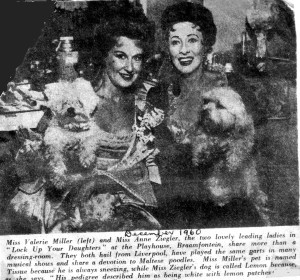
9 January – Go for lesson today. Anne answers the door wearing a tight white skirt and over-blouse. She looks nice but a bit tired. Webster is in the studio too and is busy making coffee. He offers me some and I accept and sit on the divan drinking it a wee bit nervously, glancing at the array of adorable photographs enclosed behind the glass on the wall above it. Anne brings out her Shakespeare and we talk of Eisteddfod and the sonnet, Shall I Compare Thee to a Summer’s Day? Webster tells me where to get the entry form and they have a little squabble about whether I have to buy a syllabus to go with it. He ends the argument by saying, “It only costs a shilling anyway!”We go over She Walks in Beauty amidst tremendous noise and she says, “Use your face more.” Only wish I could.
Then we do Shall I Compare Thee.. Anne says I do it well but then says that my dimm’d sounds nasal and Liverpoolish and gives me an example of it! She says, “I love a Liverpool accent – it reminds me of home but…”It goes on to tape once more and we all listen with rapt attention and I have mistakes pointed out to me. Webster says, “Be emphatic with clipping your words off at the end.” She says, “But not too emphatic,” and another small argument develops. She reads it – very nicely too – and says that of course, Shakespeare was thinking of home when he wrote the sonnet – if he did write it!.
Home – England naturally – she and Miss Scott should get together. Anne takes me over to the mirror to show me an exercise to practise with tip of my tongue to make it more flexible. Afterwards she asks Boo to do the exercise. He says he can’t, so she says, “Oh, darling, really! After all those years.”He says, “My tongue isn’t a snake like yours!”
Anne’s favourite expression, “You be the boss,” with regards to lungs, tongue, speech, face, anything. She shows me how she keeps her tongue on the floor of her mouth when singing and starts off at low A and goes right up – must have been past high C. Really stupendous. Anne complains of the heat and is generally homesick. Tells me that she always has nerves before a show – she’s frightened in case she forgets her lines – but sees that I’m dry-mouthed when nervous. She says that Thomas Beecham always had his score photographed in his mind and concentrated on that when he was conducting. She says, “It’s the only way.”
Both of them come to the door this time to bid me goodbye and I think this is sweet.
12 January – Biting remark from Taubie Kushlick concerning flops, “I don’t believe audiences stay away from plays to see GI Blues. Two’s Company and King Kong are sell-outs. Perhaps there has been so much theatre lately that there has not been enough talent to go round.” With regards to Lock Up Your Daughters, methinks that there was oodles of talent but bad material.
14 January – Dad comes home from work with some magazines. In Let’s Go is a photograph of Webster and Anne advertising LM Radio. I would take a bet that they never listen to it! Quite a nice picture though.
 Listening to LM Radio.
At night we visit the Scotts. We talk about Webster and Anne and they are not complimentary about them. – I feel quite infuriated! They add that of course their names were household words during the war.
16 January – Go into town in the afternoon to buy a few things and meet Margaret Masterton when waiting for tram. We talk of matric and as she is a singer, of Anne, whom she says sings well at times. I tell her about my preparations for the eisteddfod and she says she can’t enter this year because of the upcoming singing exam for which she has to work. She says she will have lots to do this year between Teachers’ Training College, singing, Physical Training – she is going to become a games mistress – and dramatics. Her parents are going overseas in April. Depart after enjoyable conversation with Margaret. She’s fun!
17 January – Go for lesson today and Webster answers the door and is sweet. I am wearing a heavy coat, so he says, “I see you thought it was cold today as well.”
How could Mrs Scott say he is past his best? He’s a darling. I sit in kitchenette until they tidy up the studio and then she comes in looking delightful in white skirt and blouse. We go into studio and Anne looks at entry form for eisteddfod and Webster says that it’s a swindle to have to buy a syllabus for every time an entry form is required. One of their pupils, Elizabeth, is entering four competitions and it will be unfair if she has to buy 4 syllabuses. Says he will go into Kelly’s and complain about it this afternoon. I do Shall I Compare Thee with Anne and she says I do it well, but more light and shade are required and I tend to move up and down on my feet too often. I say that I do this in case I forget something. She says that she always takes a step backwards if she forgets something.
“It’s a natural reaction to remove oneself!” Webster makes tea and we go on with the poetry. She says I must be sincere when I speak, and think and feel from my heart. “Webster and I have made such a success of musical comedy because we have always been sincere in our parts.” Says the usual – use face and eyes – will never be able to! Anne starts to work on Shall I Compare Thee, and coming to part, And often where I don’t pronounce the d as I ought to, and she is trying to explain to me how to do it, Webster intervenes and says that my and should be accentuated. She disagrees. We all stand and look in the mirror and make motions of tongue with and. Webster says, “In all my records you’ll hear how I accentuate my and slightly.” She had said earlier, “Webster is an example of perfect diction in singing,” but by this time she is a bit cheesed off with him, and says, “I couldn’t even hear your often there. Darling, I don’t want you to think that I think you’re interfering but I think it would be better if you let me deal with this.”
Poor Webster disappears silently. He then turns on the tape recorder and she says, “For God’s sake – turn that thing down!” Whew! Archness can fairly fly! She says it’s my Scots accent combined with a north country accent that has to be eradicated – I hear this every week. She reverts to a Lancashire accent and says, “A could eas’ly revert to mi old Lancashire way of talkin’ and drop mi jaw dawn, but ah ‘ave to improve mi diction.” I nearly die laughing, although she has probably never had a broad Liverpool accent like that in the first place.
Then, at another stage of the proceedings, she says in appropriate accents, “Gor blimey, now yer talking Cockney!”She tells me how to “make an entrance” at the eisteddfod – I haven’t much clue about this and just can’t smile sincerely for I don’t feel sincere! She says that I should stand with one foot in front of the other so that there is a secure pivot. “I do that always on the stage – as I have done for the past ten thousand years!”
She makes me hold her hand and walk up to the mirror with her, SMILE, and use my TEETH, and appear self-assured. “Be the boss. God gave you teeth to eat with and to smile with – use them!”Says that when she was little her father said to her, “Look people straight in the eye.” I must do that on stage and half the battle’s won. I must look naughty, saucy, wicked – heaven knows what else – Anne is a darling.
After my lesson, Anne says they are going to try to take a holiday in February, but they will easily be able to fit me in for a lesson before they go. They are so sweet and charming that I hate it when people like Mr Murdoch and Mrs Scott say horrible things about them. I’ll always stick up for them no matter what people say about them. Anne says she is left-handed like me. She wears a big signet ring with A on it – cute.
24 January – Go for my lesson today and meet Shorty from the Church on the tram – he pays my fare! Anne answers the door looking divine as usual and with her hair done once more – gingery this time. She takes me in and there is no sign of Webster. She arranges the ashtrays and says that when Webster is in the studio by himself he makes such a mess – you know what men are. She sits down and asks me to say poem and then Webster comes in nattering about a glass being missing. Anne says, “Oh, darling, Jean is here.” His face lights up and he says, “Oh, hello, Jean.” Cute – the lighting up part – I mean. We go on with eisteddfod poem and Anne says that Shakespeare is most difficult and if you can manage Shakespeare you can do anything. Says that in singing, Handel is most difficult – if you can sing Handel, you can sing anything. We go through the poem, line by line, and Webster makes us coffee. While we are drinking coffee, Webster says, “I came across a letter at home yesterday written by a Jean McLennan Campbell” – (I put in McIntyre – sotto voce) – “asking for singing lessons.” I remember that letter written in a very impulsive moment in October to which I never had a reply. I feel extremely embarrassed and admit, “Yes, it was me.” I try to pass this off lightly, saying, “I’ve lost the notion for singing, because I’ve come to the conclusion that I haven’t got much of a voice.”
They are equally embarrassed and try to pass off not replying to my letter by saying how rushed they’d been with producing The Country Girl and Anne appearing in Lock Up Your Daughters. When I had no reply to my letter, I consoled myself by assuming that it got lost in the post. Anne then says, “Anyway, I’d like to hear some scales.” She sits down at the piano and I go through some arpeggios not too badly – at least I keep in tune – and she determines my range up to high G. She says, “It’s all there anyway. You should practise the scales, even if you don’t take singing, to improve the lazy tongue.”She makes me read the poem on tape and while over by the recorder I notice an address on the back of an airmail letter to them from Mrs Fenney, the music teacher who taught at Jeppe for a term. Mrs F could fairly sing too.
When we come to the end of the lesson I tell Anne that I am starting work in the library tomorrow so I don’t know about my lesson next week, so she tells me to phone her at home – 42-1078. They are going on holiday for three weeks from the ninth so I’ll only have two lessons next month – better than nothing. Webster and Anne come with me to the door and say they’ll hear from me tomorrow. They’re darlings. Funny that I write more about them in my diary than anything else although it only takes ¾ of an hour in actual time than of anything else.
25 January – Start work at the Central Library today and boy, talk about working – between issuing, discharging, filing, and running to the vast book-room under the library building – I am exhausted. Am shown the ropes by Merle someone and have lunch with her and her friends. Thank heaven the first day is over. Do not learn my hours and am not sure if I’m going to like working there! The shifts – particularly the split shifts – sound uncongenial. Come home on the tram with Mr Moodie. He pays my fare and gives me a long spiel about Webster and Anne. He tells me that Webster is really past singing now – they live near Heather, you know. I have met Heather, haven’t I? Yes, yes, yes. He says that Webster and Anne still sing light things well and that they are sweet. He once heard Webster singing with Peter Dawson, the Australian bass-baritone.
After tea I phone the Booths. Webster answers – speaking even more beautifully than normally – and tells me that Anne is out. I tell him that I don’t know my hours yet, but can I phone them tomorrow? He says, “Yes, certainly – any time between 10 and 3 at home.” Thank him, and he asks, “How did you get on at work, Jean?” I say, “Well, I had to work really hard, and boy, am I tired!” He says, “I don’t expect you knew where to turn.” I say, “Well, I’m glad the first day’s over, anyway!”He says to me, “Well, don’t worry about anything, Jean, and get on with the job.” I say cheerio and promise to phone tomorrow. He’s a pet and he doesn’t drink excessively – I know!
26 January Work, work, glorious work once more. I am given my hours which makes me happy. Now I know whether I’m “coming or going!” During my lunch hour the public phone held up by an old “gentleman” who stays in there for at least half an hour, so I go into the office and ask if I can phone from there.Anne answers, and I say, “Can I please speak to Mrs Booth,” (knowing all the time that it is her on the phone!). I tell her my hours, and none of my afternoons or mornings off suit because of their holiday. She tells me to hang on while she looks up her appointment book. She comes back with it and I hear her fiddling around with the book, saying, “It’s in such a muddle”. She asks if I can come on Saturday week at 11 and then on Monday at 4. I agree to this and she says, “You won’t forget to come, will you?” I say, “No,” (and mentally add, “And you?”) She is charming as always but her voice doesn’t sound as nice as Webster’s on the phone, who honestly has a most beautiful voice and wonderful diction.
29 January – to church in the morning and feel hacked off with Betty who says she can’t stand the Booth’s act. I say that they are charming in private but she still doesn’t seem too happy about it. I wonder why everyone I know thinks it is fine to criticise them! Play and play, sing and sing in the afternoon. I’ll appreciate my free days now!
31 January Picture of Anne in the paper at night. In brackets (well-known singer, Anne Ziegler). It isn’t actually a very nice picture – she looks rather cold but as it’s her, I let that pass. She’s really a honey! Choosing wallpaper.
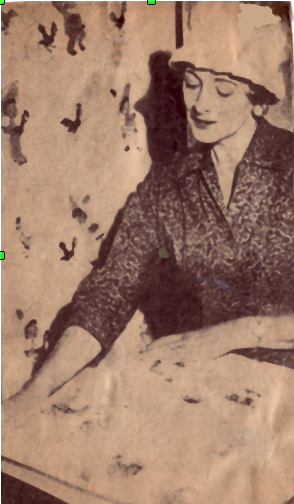
EXTRACTS FROM MY TEENAGE DIARIES. 1960 (in connection with Anne Ziegler and Webster Booth)
DIARY 1960
7 January – Today Gillian McDade (last year’s head girl at Jeppe) phones me and I congratulate her on her first class matric pass. She promises to sell me her Ridout English textbook and asks me to usher with her at the Reps theatre (later the Alexander) for The Glass Slipper and I accept with thanks.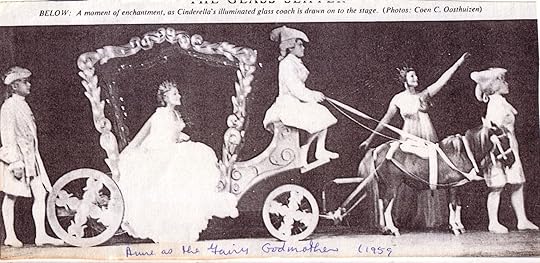
I meet her on the tram and she tells me about her holiday with Margaret Robson. We get to the Reps Theatre (now the Alexander) and see Miss Jacobson with her nephew. We usher the audience to their seats. The house is full so we sit on the carpeted steps of the side aisle to watch the play which is really marvellous. Anne Ziegler as the Fairy Godmother is my favourite, and boy, has she got a voice!
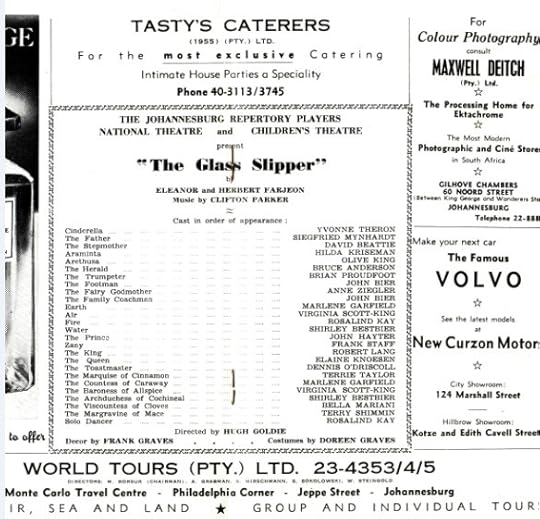
24 April 1960 – Have a quiet morning and finish knitting my new pullover which is a fair success. In the afternoon I go with dad and the dog, Shandy to his work for him to check up on something and then we go for a run to Alberton and Germiston.
Listen to Anne Ziegler and Webster Booth in the last programme of the series Do You Remember? on Springbok Radio. They say they have a tiny cottage in Craighall Park, and are sorry to end their programme because they have been happy to share their reminiscences with everyone. As George Moore says afterwards, we seem to be saying goodbye to everybody today. All the things that we know and love are taken away and replaced by something new, but we will always feel nostalgia for what has gone.
26 May 1960 (Ascension Day) – Have a quiet day but have calls from Mr Moody and Mrs McDonald-Rouse asking us to go to a Caledonian concert on Saturday night. It’s going to be a very busy weekend for Friday night is our church Variety concert with Anne Ziegler and Webster Booth.
27 May 1960 – Go to confirmation class but only Ann Stratton, Rosemary Nixon and I arrive so we don’t have it. I have my autograph book handy and learn that Anne Ziegler and Webster Booth have to leave straight after the first half of the show, so Ann promises that she will come with me backstage. The harmonica band and the accordion band are excellent. Dawn Berrange, the girl ventriloquist is really talented and witty.
Then came Anne Ziegler and Webster Booth, and I promise you, they are fabulous. She wears a gorgeous tangerine sheath dress with sequins, very low cut with a wide panel at the back. Her hands are very long and slim and she wears a large diamond ring. He wears tails and seems to be growing a moustache. Their turn was honestly wonderful and they sang terrific songs, including Ivor Novello’s My Dearest Dear, I Can Give You the Starlight, Fold your Wings – all the songs I try to sing but the notes are too high for me. They fool about a bit together and she is very piquant and fun. They may be losing their voices, as everyone tells me, but certainly not their charm. And, come to think of it, they sing extremely well into the bargain!
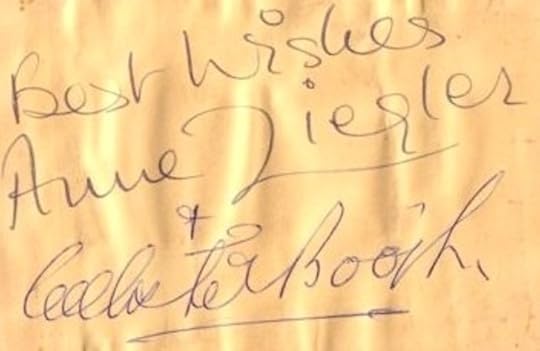
As soon as their performance is over Ann and I rush out and wait by the vestry to catch them as they leave, but eventually Ann leaves me alone to go and serve tea to everyone. Anne comes out first and I ask for her autograph. She says, “Why certainly,” and proceeds to sign my book. She is very nice and not at all standoffish. He comes along after her and says that we had better go into the vestry so that he can sign my book. By this stage, I was in such a flap that I am going to let him go into the vestry before me, but he stood behind like a gentleman and ushered me into the vestry where he signed my book. After this, they were ushered out through the church. They are fabulous!
It was a great concert and I enjoyed every minute of it. It was such a lovely day: Cookie Matthews back at the ice rink, Anne Ziegler and Webster Booth…
5 October. Picture of Anne Ziegler and Webster Booth together with David Davies advertising their Afrikaans LP in paper at night.
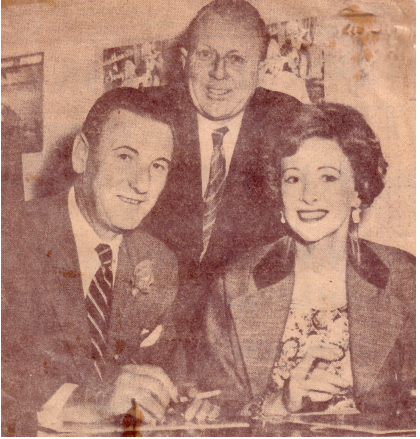
l0 October See Anne Ziegler and Webster Booth’s long player in one of the shops. Looks quite nice but how does one sing We’ll Gather Lilacs in Afrikaans? I write to them at night to ask about a place in their singing school. Here’s hopin’!
l7 October. Swot in afternoon and read the paper at night. There is a photo of Rosalind Fuller in it, looking charming. Also there is a rather strange article about Webster Booth. Evidently he went to a talent show incognito as Charlie Eastwood. He sang, and then the audience was told who he was! Incidentally “Eastwood” is his wife”s maiden name. Her stage name is Anne Ziegler. Very strange this!
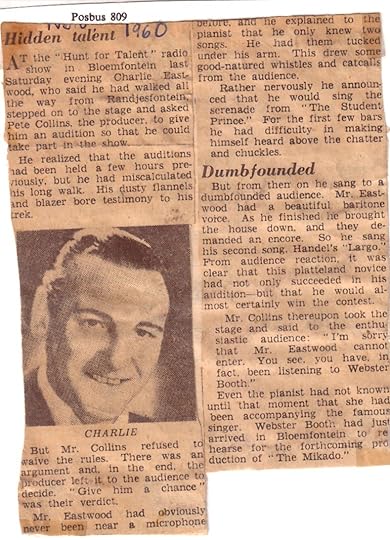
The rest of 1960 appears in an extract from my book, Sweethearts of Song: A Personal Memoir of Anne Ziegler and Webster Booth (second edition).

Jean Collen 5 April 2021.
EXTRACTS FROM MY TEENAGE DIARIES: JULY 1963
1 July – Go to music library and see Leo Quayle there. Coming home I see Graham Burns waiting for a bus.
2 July – Go to singing. Anne is wearing her mink coat. We have tea and biscuits and she tells me she hates Britain at the moment – with the shock of the John Profumo/Christine Keeler affair. She says they used to belong to the Conservative Party in Hampstead but fell out with them over something or other. I sing Open Thy Blue Eyes, the Landon Ronald song Cycle, and Love’s sickness. She is pleased. She tells me I can use the studio at any time and don’t owe them anything for this month. I see Dennis and his mum and have more tea with them.
I meet Betty on the way home and Ruth phones in the evening.
3 July – Go to studio and work hard in the peaceful atmosphere. I have lunch in Ansteys with Mum then go to Mrs S for lesson. I’m going to listen to our broadcast now.
4 July – Go to the studio and the lunch hour concert. Webster comes in a bit late (after Anne phones to let me know). We have Heather and Yvonne Marais and then he puts his hands on my shoulder and says, “Put on your coat, love, and put some money in my meter!” I do so. He is a honey. We have Graham and Reeka and then come home in the Anglia. He tells me about the near accident he had coming down the Great Orme in his Talbot in Llandudno, and the Springs Operatic Society. He says, “Imagine that I’ll not be seeing you until next Friday!” I say, “How can I bear it?” half in fun, but whole in earnest!
5 July – I work in the studio in the morning and lunch with Mum. In the afternoon Anne comes in and I have an hour lesson and I enjoy it enormously. We have tea and biscuits and she says I must eat them up when I’m in the studio by myself. She says Webster told her all about my account of Jossie B’s singing lesson and she enjoyed it. She lends me Doris Bolton’s Joan Sutherland biography to read over the weekend and says that of course I can come in on Monday although it’s a public holiday. She’s a sweety.
8 July – Family day. Go to studio to return the Joan S autobiography.
9 July – Go to singing in afternoon. Anne is there teaching Jimmy Elkin, the son of the optician! She tells me that I’ll be in on Monday to play for Webster for he really can’t manage without me. We do Love’s Sickness and when we are having tea Anne shows me the Ravel song cycle she sang at the Wigmore Hall as Irené Eastwood – Scheherezade. We do the unaccompanied folk song and she imitates my serious face during my singing of it. We both end up in the giggles. Webster phones and she gives me a whole hour. We finish with Love, From thy Power and then Winnie arrives. I wash the dishes before I leave.
10 July – Go into the studio and read the script for Mrs Puffin. Lunch in Ansteys with Mum then go to Mrs S for lesson. Listen to Webster’s super new programme Ballads Old and New. He plays the Evening Song by Blumenthal – beautiful.
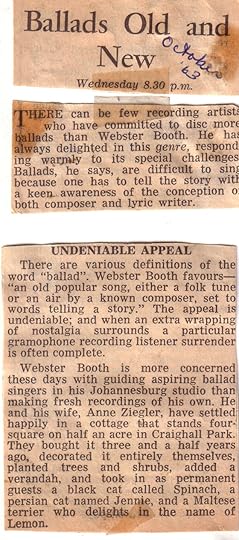 Ballads Old and New – July – not October!
12 July Go to studio and Webster arrives at 3.00 but Lucille doesn’t come!! He tells me of the difficulty they are having to find an accompanist for their concert in Ficksburg. He says he would ask me to play for them but they prefer a male accompanist as a female takes the audience’s attention away from Anne. Mayor of Brakpan’s son comes and sings pleasantly. I have a lesson and we go over all the Messiah arias. Gertie and “Clara Butt” come later. Come home in the car from the garage and we have a discussion about Gert P and Jossie B!
13 July – Webster’s programme is excellent. He plays one of his own records. Go to Mrs S and work with Margaret and company. We see Sammy Going South.
15 July – Go to the studio to play. Webster makes me tea the moment I arrive. Myrtle is our first pupil. We talk about his programme on Saturday and have a number of pupils. He talks about making the Afrikaans record on the way home.
.
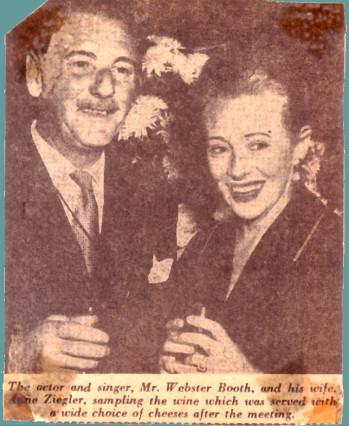
16 July – Go to Mrs S and work with Margaret. Lunch with Mummy and go to studio where Anne makes me tea. Tells me her lights fused completely last night and they didn’t eat until 10.00! I sing well and she is pleased. Jimmy doesn’t come so she gives me an hour because she says, it’s pleasant to work with me. There is a lovely picture of them in the paper at night. I listen to the recording of the SABC choir and think it is very good indeed.
18 July -Anne phones to say Webster will be a bit late. Yvonne, her Mum and little sister arrive early. Yvonne wants him to hear her sister sing. He tells them that she can’t start having lessons yet as she is far too young – wait until she is in her teens. We have Heather, Yvonne and Colleen. He tells me that Anne has caught a cold from Leslie Green – she went to a film with him last night.
On the way home we go up to Wallie Petersen’s theatrical agency where he is offered a directorship of a film company. He introduces me as, “This is Miss Campbell – she plays for me.” We are pleased about the offer. He says he’ll phone tomorrow if he wants me to go in and work for him at the studio.
19 July -Anne is too sick to come to studio and father has ‘flu too so Webster and I “do” again. Lucille comes first and tells us about a funeral. She sings well for an hour and I play well. I have my lesson – oratorio as before. Selwyn arrives in a weepy mood. Gertie comes next and he says to me, “Jean, darling, make me a cup of tea.” Gertie and Brian Morris come afterwards. Webster brings me home and I tell him to give Anne my love and I hope she will feel better.
20 July – Go into studio and Webster is there in a good mood and making coffee. Anne is evidently worse this morning. We have the morning pupils and the last two don’t come so we go home in the Hillman with the roof down. As we pass the Kensington Sanitorium he says that it’s such a lovely day that it would be wonderful just to carry on carrying on driving all the way to the coast! Unfortunately, we can’t do that!
21 July – I wash my clothes and hair in the morning. I phone Ruth in the afternoon and she is full of her recent holiday to Victoria Falls. We decide to go out together sometime next week. She’ll phone me on Tuesday. I phone to see how Anne is keeping. Webster answers and is pleased to hear from me. He tells me she is improving and crawling around the house. When we part, he says, “Goodbye, darling.”
22 July – Lunch in Ansteys with Mum. Go to studio and Webster tells me that Anne is a lot worse today. Myrtle comes for her lesson and he tells us about the loss of vision he experienced last night. When he went to lie down the room spun around him. He makes a tape of the pupils today for his cousin in England, Jean Webster. Janet and Lucille come. Webster is always far too nice to the latter for my liking! Reeka is the last pupil and then we come home and discuss the possible reasons for his bad turn.
23 July – Work. Lunch in the Capeniro with Mum in rather remote frame of mind after the obsequious way he behaved with Lucille yesterday. I must be jealous! When I get to the studio Anne is there looking terribly ill. We spend a long time discussing Webster’s habits – I don’t say anything to her about Lucille. She says he used to be such a good husband but these days he’s always in a bad mood and drinks and smokes too much. She wants him to see the doctor but he refuses to do so. We do some Elijah and have tea. She says he hates teaching in the studio (apart from a few pets), and he is too indulgent with the dog so that he is too spoilt for words. I wish her well and depart feeling somewhat restored but sorry for Anne.
24 July – Go to the studio. After lunch I go to Mrs S and work with Elaine and Edith and have my piano lesson. Ruth phones. She’s coming to fetch me tomorrow at the studio for lunch. She tells me about all her activities, including Yoga lessons which she is enjoying. Listen to Webster’s Ballads Old and New and it is terrific as usual. Why is he always so good?
25 July – Leslie Green phones the studio wanting to speak to Anne and Webster. He talks to me for quite a while – he is just as pleasant to me as he is to his listeners on the radio. Ruth comes up and we have lunch in the Chesa – she tells me all about her holiday while I spend time imitating my current bones of contention – “Ag, Uncle Boooo!”
26 July – Lucille arrives early so we go out for an hour and return together. He calls out a casual greeting to me, then when he sees Lucille he makes a great fuss of her. I am upset and spend a dismal hour playing for her during her lesson. He tells me that Anne is just as ill as ever and has been physically sick today too. In the car we discuss Leslie Green, Brian M and Show Boat. He promises to phone me tomorrow if he needs me.
27 July – Anne is still sick so I go into the studio to play for him. Webster makes me coffee and this time it is he who tells me he’s had a disagreement with Anne over Leslie Green and the doctor! Anne insisted on them going to dinner in Leslie Green’s draughty house despite the fact that she is not at all well. Ruth has a lesson and she is full of the joys of spring over the results of her aptitude test. Coming home in the car he talks about Gary A. I listen to Webster on the radio at night.
29 July – Go to town with Mum and lunch in Ansteys. Go to studio a little early and have tea with Webster. He is tired but he’s in a lovely mood. Ruth phones. She has passed her driving licence and asks me to dinner. Webster says he will drop me off at her house which means a shorter trip home for him. We pass Zoo Lake on the way and he says the bowling club there is one of the loveliest settings in the world. I have a pleasant dinner with the Ormonds and they drive us in their huge Rover to the SABC where we have a meeting and then refreshments a la Anton H. Mr O drives me home – lovely day.
30 July Go to singing in the afternoon. Anne tells me she is going to see the doctor on Thursday about her laryngitis. She would have preferred to go on Wednesday but Webster is going to play bowls then come hell or high water! We have tea together and discuss Ruth and the effects of the lottery on her life – all favourable. We work at Father of Heav’n and concentrate on breathing. I see Lucille’s invitation to her twenty-first birthday – they can’t go. Good!
Jean Collen 5 April, 2021.
April 3, 2021
STUDYING WITH ANNE AND WEBSTER. Extract from “Sweethearts of Song (Volume 2) Chapter 7”.
On 17 October 1960 an article appeared in the StoepTalk column of The Star about an unknown singer called Charlie Eastwood who turned up late at a talent show in Bloemfontein. He begged the compère of the show to give him a chance to sing. The compère said firmly that he was too late to enter the competition, but the audience cajoled him into letting Charlie have his chance on stage. They were not disappointed by the beautiful singing. Charlie was obviously the clear winner of the contest. Charlie turned out to be Webster Booth, who was in Bloemfontein for a production of The Mikado. It was at that time that I wrote to them to enquire whether I could have lessons with them when I finished school at the end of the year. I was too shy and unsure of myself to ask about singing lessons so suggested that I could study “stagecraft” instead.
Extract from my 1960 diary:
4 December. Come home with Wendy Scott-Hayward, feeling rather sad about leaving school. When I arrive, Mum phones and tells me she phoned Anne Ziegler! Says that Anne was charming and I have to go to see her on Thursday evening. I am thrilled. Mum says Anne Ziegler was very friendly and conversation went more or less like this:
M. I understand, you run a school of Singing and Stagecraft. My daughter is interested in doing drama.
A. Oh yes, speech training. How old is she?
M. 17.
A. Oh lovely. What’s her name?
M. Jean Campbell.
A. Oh, what a lovely Scots name!
They go on to make an appointment. I have to go at 5.30 to the studio on Thursday. I’m so nervous!
8 December.
I meet Mum in the Capinero restaurant and we have something to eat which I can hardly digest owing to extreme excitement, and then we proceed to Polliacks building and go up to the eighth floor on a horrifying lift. When we arrive outside the studio we can hear a girl singing so we wait till the singing stops before we knock. Anne comes to the door herself and is very bright with gingery-blonde hair, big blue-green eyes with lots of eye make-up on, wearing a striped dress. She is taller than I imagined her to be and she says, “Oh, please take a seat in there,” pointing to a kitchenette with a washbasin. “I”ll be with you in a minute.” We sit in the kitchenette and listen to her teaching the girl to sing. Anne has a strong, purposeful voice with a touch of English accent. She’s from Liverpool originally but it doesn’t sound as though she has any traces of a Liverpool accent.
 Studio in Pritchard Street, eighth flooir of building on the right.
After fifteen minutes the girl leaves and Anne takes us into her large studio which has a grand piano at one end, a big mirror at the other and a divan (converted into a studio couch) against the wall. On the wall behind the studio couch are photographs of her and Webster in different shows, featured with various celebrities, and an excellent cartoon of him.
She apologises for keeping us and says that her husband is in Port Elizabeth at the moment, so she has to cope alone. She says, “He’s singing Messiah tonight and it will be broadcast on the English programme”.
She asks what I want to do and I tell her “Drama,” and she asks, “Will I have to get rid of a dreadful South African accent?” I say that I am from Scotland and she says, “Yes, I think you have more of a Scottish accent than a South African one. You have a really good Scottish background.”
We discuss suitable times for lessons and she says, “Next week I”ll be rehearsing like mad for my play at the Playhouse and I don’t want to mess you around, so can you start the week before Christmas?”
I say yes, any time, then she looks up her appointment book and asks if Thursday 22nd would suit. “Yes, certainly.” She says that she finds it difficult to get S Africans to sound “h” as in hark and that vowel sounds are difficult. She tells me that singing is merely an advanced form of talking – merely!
]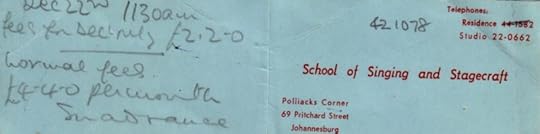 Anne Ziegler studio fees
We get up to depart and she says to me suddenly, “You’ve got a lovely face.” I nearly faint on the spot. Mum says archly, “She doesn’t think so.” Anne stares at me and says, “0h, but she has, and a lovely smile too. Make the most of it!” Oh, brother! She apologises again for keeping us waiting and wishes us goodbye. She’s a honey!
I’ve never met or spoken to anyone as famous as that before and I thought I should be frightfully nervous and that she would be snooty and standoffish, but truly, I felt at home with her. My heart didn’t jump wildly in my mouth as it has done for lesser people. I’m sure I shall get on very well with her. She tells me to bring a Shakespeare and poetry, so here’s hoping. Perhaps this is the start of something new. All I can say is, that Anne Ziegler is a regular honey.
22 December. Go into town in the morning and get Gill Mc D on the tram and it feels like old times – drama groups etc. We talk of the theatre. She tells me that Percy Tucker says that people with clean minds book for Jack and the Beanstalk whereas the dirty-minded book for Lock Up Your Daughters!
Go up to Polliacks eighth floor (trying to tell this impartially) – knock at the door about a dozen, times but there is no answer: Begin to feel furious and ready to scream with wrath when suddenly Webster appears, armed with briefcase and wearing a white light-weight sports jacket.
He looks at me quizzically and I say that I am meant to be having a lesson. He is still completely mystified but quite charming. He takes me in and apologises for being late – traffic was so bad. He then goes into the little office and looks up his appointment book and comes out looking rather frustrated and tells me that my lesson is down with his wife and she didn’t come in this morning.
I look at him rather coldly and he tells me that she’s in a play, you know. Yes, I do. “Well, last night it went very badly and she is in a real fandangle about it and has to go to an extra rehearsal in the afternoon and is most upset. She did mean to come into the studio in the morning but because of the rehearsal in the afternoon she didn’t.”
He will phone her. I hear him talking to the maid, “Hilda, is the madam in?”
Evidently the madam is not in so after great confusion over finding telephone numbers, he phones Heather MacDonald-Rouse and says, “Oh, Heather, is Anne there?”
Apparently Anne is there for they have a conversation and he does not seem exactly pleased with her. He comes out and says, “Anne just doesn’t know what to say, she’s so ashamed!” He asks if I could come next week and says, “I’ll make a big cross next to your name for next time.” Naturally, I have to agree and he asks if I came from far.
I say, “Not particularly far,” rather dryly. He apologises once again – more apologetically than ever – and says that he would take me himself but he is frightened that Anne would not approve of what he might give me. He is, on the whole, quite charming and genuinely upset about his wife’s behaviour, but I am very disappointed. I can’t help it – I just never thought that she would forget about the lesson!
However, I have met Webster so that’s something. He is very nice, with rather a red face, and his speaking voice is beautiful – just as it is when he speaks over the radio.
I eventually began my lessons with them the following week. At the time, Webster was fifty-eight, Anne fifty, while I had recently turned seventeen.
Webster was tall and dark, still with a good head of hair which was going slightly grey at the temples. He sported a small moustache and had a disproportionately large nose.
“Hatchet faced, like all my relations,” he once growled, referring to his “conk”, as he always termed his nose.
He was quiet and reserved, not really the temperament one might have expected of an entertainer. Many times I saw him literally pull himself together to put a good face on it when he had to meet new people or do something he was not keen on doing.
At fifty, Anne seemed youthful in comparison to Webster. She was tall and regal with a good figure, classical bone structure, aquamarine eyes, and a rose and white English complexion.
When she was in a good humour, she made everyone feel wonderful, but her moods occasionally blew from hot to cold. When one thinks of the tremendous upheaval they had both suffered in coming to South Africa, one could hardly blame her for occasionally feeling less than cheerful.
Anne had more energy and aptitude for teaching singing than Webster. She had worked hard to cultivate her voice, while he had a God-given voice, even as a child chorister at Lincoln Cathedral. He could not understand why lesser mortals who were not blessed with his perfectly placed instrument, needed to sweat blood to achieve a modicum of success. Anne always said that things had come far too easily to Webster. They had a number of good singing students, but there were others with lesser talent, who were there because they were curious about their celebrity.
While I was studying with them they continued their theatrical and radio work. Anne was playing Mrs Squeezum in the musical play, Lock up your daughters at the end of 1960, with the incongruous song, When Does the Ravishing Begin? to sing – a sea change from We’ll Gather Lilacs or Only a Rose. The show was not a success. Johannesburg was not yet ready for a bawdy Restoration musical.
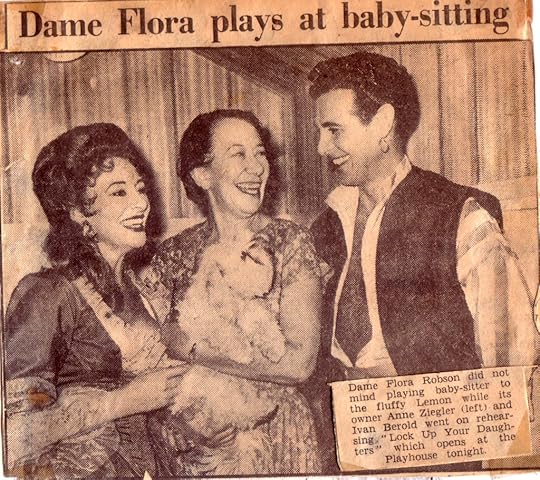
The Johannesburg Eisteddfod was held around Easter each year. On Easter Monday of 1961 my father and I went in to the Duncan Hall where I bought a season ticket to the Eisteddfod, hoping to benefit from hearing the singing of other students. We stayed for an hour or two to listen to some of the competitions. As we were leaving, we discovered Anne and Webster, sitting further back in the auditorium.
Anne was there to play for one of their students and looked very pretty in a bright floral dress. Her face lit up when she saw me and she said, “Why hello, Jean, how are you?”
Webster turned round to greet me and I introduced them to my father, who said, “It’s a privilege to meet you,” when he shook hands with them.
At the time I thought my father was a bit over the top in his response to them, but he had heard their singing in the UK when they were at the pinnacle of their careers and knew their true worth.
During 1961 Webster presented a programme of oratorio, opera and operetta on the English Service called On Wings of Song and I listened to this without fail every week. During the programme he told the story of his own career and interspersed the tale with appropriate music, including many of his own recordings.
Eventually they heard my singing voice and were happy to change my lessons from drama to singing. Despite my diffident nature, my singing lessons were going well and I worked very hard to please them.
At the time I was singing various Schubert songs in German. Webster said at one lesson, “Honestly, Jean, you’ve got a wonderful memory – of German too. If I had a memory like yours I could really do wonders!”
I smiled at his remark and he added, “But Jean, I wish you’d smile like that when you sing: you’ve got such a lovely smile.”
In the middle of the year Webster went up to the (then) Salisbury in the (then) Rhodesia to adjudicate at the eisteddfod there. Anne joined him at the end of the eisteddfod to give a concert, but they both caught ‘flu. Anne spent most of her time in Salisbury in bed, but she still managed to sing at the planned concert.
Webster appeared as the eponymous prawn in The Amorous Prawn with Joan Blake and Simon Swindell in the latter part of 1961. The distinguished critic at The Star, Oliver Walker, said of Webster, “Playing a straight role with no top notes to sing, Webster Booth shows a suave sense of timing that accords well with his monocle”.
The play opened in Johannesburg and later transferred to Durban. It was very popular. We enjoyed the show although we had to wait until the Third Act for Webster’s appearance.
I was in the middle of my lesson one afternoon when Lucille Ackerman and her family arrived for her audition with Anne and Webster. She was nineteen years old, a year older than me, with a remarkably mature and pleasing soprano. I felt vocally inadequate when I heard her voice. She had spent the previous year at home recuperating after an illness, on the family farm near Piet Retief. Hendrik Susann, the well-known Afrikaans bandleader and violinist lived on a neighbouring farm, and had already featured her as a singer in some of his band’s broadcasts on the SABC.
I had been learning with Anne and Webster for nearly a year when they suggested that I should audition for the newly resurrected SABC choir. Three hundred people auditioned, but only a hundred were accepted. So with some trepidation, not fancying my chances, I went to Broadcasting House in Commissioner Street one Saturday morning to audition for Johan van der Merwe, the choir master. He was an affable dapper young man, only seven or eight years older than me. He took me into one of the smaller studios, where I sang for him and did some rather tentative sight singing tests. I was delighted when he told me he would be pleased to have me in the choir as an alto.
Anne and Webster told me to look out for another of their young students, a girl called Ruth Ormond, who was already singing soprano in the choir. I would recognise her by her piercing blue eyes and honey coloured hair. Anne said she was a hard worker and very intense about her singing. When I met Ruth at the interval of my first rehearsal, she said that Anne and Webster had told her that I was tall, dark and serious looking, and they were very fond of me.
From then on we sat together during the choir break and regaled one another with tales about our lessons with Anne and Webster. We were both originally from Glasgow; we loved singing; and we adored Anne and Webster, the way the majority of our friends adored the latest pop singers like Tommy Steele, Cliff Richard and Elvis Presley. But we were in the lucky position to interact with our idols when we went to the studio for our lessons.
She was a year and a half younger than me, still at Parktown Girls’ High, a short plump girl with deep-set blue eyes. She was outwardly confident, brave and full of fun, with two older sisters, while I, an only child of elderly parents, was shy and diffident, taking a while to warm to strangers. Although we had contrasting personalities, we immediately became the greatest friends.
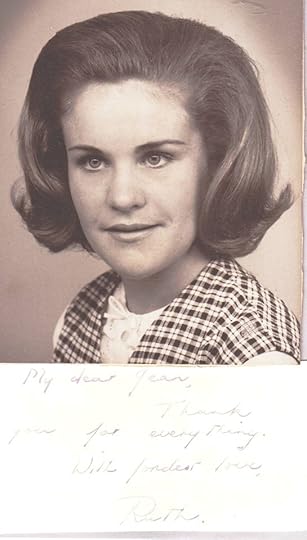 Ruth Ormond.
In 1962, her family fortunes changed for the better when her mother won ₤40 000 on the Rhodesian Sweep. It doesn’t sound like a fortune today, but in 1962 it seemed like untold riches. Her parents celebrated the win with a trip back to Scotland, the purchase of an imposing black Rover car, and the installation of a kidney-shaped swimming pool in the back garden of their Parkwood home.
I went to her house in Torquay Road to swim in the new pool and she visited me in Juno Street, Kensington where we spent our time singing solos and duets to my piano accompaniment, reading aloud extracts from plays, and sometimes recording our efforts on the Philips reel-to-reel tape recorder my parents had bought me to help with my singing studies. Although we lived a fair distance apart, we made up for the distance by speaking on the telephone for hours on end, in the days when a call, no matter how long, cost no more than a tickey (threepence) a time.
At the beginning of 1962, when the copyright on W S Gilbert’s words ended, Webster presented a Gilbert and Sullivan programme on the English Service. He reminisced about his days in the D’Oyly Carte Company, and played the operettas in chronological order. Up to that time it had not been possible to play any recordings with Gilbert’s words on the radio, so although I recognised some of the music, I found it interesting to be taken through the operettas each week and get to know and like them.
Anne and Webster were producing The Vagabond King at Springs and held auditions for the show on April 26. Earlier in the year Webster took the small part of the doctor in The Andersonville Trial where he had to sit on the stage for over two hours watching proceedings, with only a few lines to say. On the day I went to the matinée he caught sight of me in the audience and amused himself by giving me secret glances from the stage. My piano teacher, Sylvia Sullivan, saw the show and remarked to me, “Such an insignificant part for such a great man.”
After The Andersonville Trial finished – “I’m out of jail at last,” said Webster – he presented another radio series on the English Service called Drawing Room. The idea was to create the atmosphere of a polite middle-class Victorian or Edwardian drawing room concert, where singers and instrumentalists performed their party pieces like In a Monastery Garden, The Maiden’s Prayer, O Dry Those Tears and the like. Sounds of polite conversation and laughter between the items, with restrained applause for the musical offerings were required, so a studio audience was invited to provide these “noises off”.
For the first recording, Webster invited pupils and friends to form part of the Drawing Room in one of the recording studios at Broadcasting House. Ruth and I were there with our parents and we noticed Lucille, accompanied by a large family contingent.
Anne and Webster looked particularly glamorous for the occasion. Anne was wearing a beautiful evening gown, her fair hair in a chignon, while Webster was in full evening dress, to act as compère for the evening and to sing some drawing room ballads into the bargain. The accompanist for the series was Anna Bender, the official accompanist for the SABC. Anne and Webster received their guests graciously. Anne told Ruth and me to save her a seat in the front row, where she sat between us and played her full part in chatting to us between the items on the programme to evoke the atmosphere of a drawing room at the beginning of the twentieth century.
Over forty years later I still remember Miss Rita Roberts (soprano) singing Christina’s Lament to the tune of Dvorak’s Humoresque, Mr Walter Mony (violin), Miss Anna Bender (accompanist) and finally Webster himself, aged sixty, but still in fine voice singing The Kashmiri Song, The Sweetest flower that blows, Parted, O Dry Those Tears and finally Had you but known with violin obbligato by the excellent Mr Mony, a French Canadian, who became a professor and head of the music department at the University of the Witwatersrand.
Ruth and I were entranced to have spent such a happy evening. As we were leaving I told Anne breathlessly that Webster’s singing was wonderful and she replied, “Yes, we’re both very proud of him, aren’t we, darling?” which made me feel rather naïve and childish although I was all of eighteen.
The Drawing Room series was recorded over a number of weeks and we attended another recording when Anne, in a sleeveless black evening dress, sang If No One Ever Marries Me, The Little Damozel and the Handel aria, He’ll Say That For My Love. Later in the programme she and Webster sang duets together: Drink to Me Only with Thine Eyes and The Second Minuet.
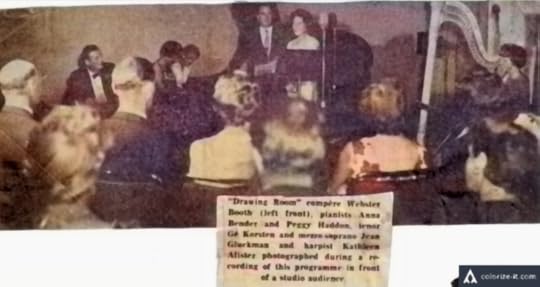 The Drawing Room. SABC (1962)
One evening Ruth and I were at choir practice and she decided that during our interval, we should go to the Drawing Room studio to say hello to Webster during the break in his recording session. He appeared delighted to see us and kissed us both. He asked what we were doing there, and then said, “Oh, of course, you’re working aren’t you? It’s a pity you can’t stay for the next recording to hear the wonderful trumpeter.”
Ruth was so excited at meeting Webster that she walked into the men’s cloakroom instead of the women’s, only to have him politely point her in the right direction. We were both blood red with embarrassment by the time we got back to our seats at our now rather tame choir practice.
1962 was an exciting year for the SABC choir. Igor Stravinsky, aged eighty-two, came out to the country with his wife and his amanuensis, Robert Craft. The choir was singing Stravinsky’s Symphony of Psalms. Professional singers were invited to take part to boost the choir, and my piano teacher, Sylvia Sullivan, and her friend, Jossie Boshoff, the wife of the SABC conductor Anton Hartman, joined the choir for the occasion. Webster had also been asked to sing, but he was insulted that they expected him to do this without a fee and refused. He had also been invited to sing in the choir at the Coronation of Elizabeth II in 1953, but had turned down this invitation too, for the same reason.
At the time of Stravinsky’s visit Webster was having a bad time with toothache. He thought a few whiskies and soda would sort it out, but the pain persisted so he had to have the offending tooth removed. By this time an abscess had developed and this caused him a lot of discomfort. He was given a penicillin injection, but he felt too weak to come into the studio so Anne had to cope with all the students on her own.
The Stravinsky concert was memorable. Robert Craft conducted the first half of the concert, including the Symphony of Psalms. In the second half Stravinsky conducted Fireworks and Petrouchka without a baton, but with a score in front of him. At one point he lost his place in the score and had to search for it again, but the orchestra continued regardless. There was a huge ovation for him at the end of the concert. As we were leaving the hall we noticed Percy Tucker, the director of Show Service, the ticket agency, with the famous British actress Flora Robson and a party. Anne had listened to the concert at home, and while she thought the choir did very well, she admitted that she preferred music with more melody.
During that year I met another of their students, an Afrikaans girl called Roselle Deavall, who lived quite close to me. I had heard her singing during her lesson before mine. At fourteen she had a remarkably mature voice. She was at Queen’s High School and visited me several times. Unlike Ruth and me she was very confident of her vocal ability. I still have a recording of her singing The Mountains of Mourne, complete with Irish accent. She stopped lessons with Anne and Webster until she finished school. After school she went back to them but did not remain with them for very long. In 1965 Webster told me that she had left because she did not think they could teach her anything more. When I returned from England in 1968 I heard that she was singing with the Performing Arts Company of the Free State (PACOFS).
Towards the end of June Webster was booked to go to Bulawayo to adjudicate at the music festival there. The day after Anne’s fifty-second birthday, 23 June, he caught a bad dose of ‘flu and had a temperature of 102 degrees and had difficulty in breathing.
Ruth went to their house on Sunday evening to return some records they had lent her. She had been singing in the choir at St Francis’ Church, Parkview, and was still in her choir robes. She persuaded Anne to let her see Webster, who was still in bed with the ‘flu. She was shocked at his unkempt and pale appearance. He was very ill indeed, with numerous pills and potions on his bedside table, looking quite different from his usual well-groomed self.
Despite his illness he insisted on leaving for Bulawayo the next day as planned. Four days later he collapsed with further breathing difficulties and a temperature of 103 degrees. He had to be flown back to Johannesburg prematurely and was seen by a specialist, who ordered various blood tests to be done. The blood tests revealed that there was too much sediment in his blood. The medics thought he might have contracted a rare tropical disease so he was admitted to an isolation ward in the Fever Hospital in Braamfontein. Anne was not allowed to visit for fear of contracting a disease. All she could do was wave at him through a glass partition.
Much later, after he had undergone many medical tests and suffered some indignities in the process, it was discovered that he had contracted a virus which had led to myocarditis, which caused severe damage to the membranes of his heart. He was in a very bad way and we all feared that he might die.
He seemed to improve and was discharged from hospital for a week or so, but the virus flared up all over again, and so he was once again readmitted to the Fever Hospital. Thankfully he eventually recovered from the debilitating illness, although he was very weak and was away from the studio for several months.
Because of his illness he was unable to record the Gilbert and Sullivan programmes for some time. It fell to Paddy O’Byrne, the worthy winner of The Voice of South Africa competition, to read Webster’s scripts. Paddy O’Byrne was a fine broadcaster and had a wide musical knowledge. He continued as a broadcaster with the SABC, and later with Radio Today, until he and his family returned to their native Ireland towards the end of the century.
The broadcaster, Leslie Green, a great friend of Anne and Webster’s had gone to the UK for a holiday and sent recordings of his travels to the SABC to be broadcast on his Tea with Mr Green programmes while he was away. His wife had died in a car accident some years earlier when she was fetching their daughter Penny for the holidays from her boarding school. Penny survived the crash.
I had my singing lesson at 4.30pm after the programme was broadcast so Anne suggested that I should come in early and have tea with her and we could listen to the programmes together. He visited Anne’s great friend, Babs Wilson-Hill (Marie Thompson) and did an interview with her. He said that she had one of the most beautiful gardens in England.
Not long after his illness Anne and Webster (as themselves) shot a short scene in an Afrikaans film called Lord Oom Piet. In the film they sang Ah leave me not to pine from The Pirates of Penzance at a garden party, hosted by the new Afrikaans “lord” of the title, Jamie Uys. During their singing the lord, attired incongruously in a kilt, was attacked by a swarm of bees – or was it mosquitoes? The duet could not be completed as the lord squealed, rudely interrupting the singing, eventually flinging himself into a stream of water to relieve the stings -or the itch. Ruth and I saw the film when it was released at the end of 1962, and we despaired that Anne and Webster, two international stars, had chosen to make such an appearance in the film.
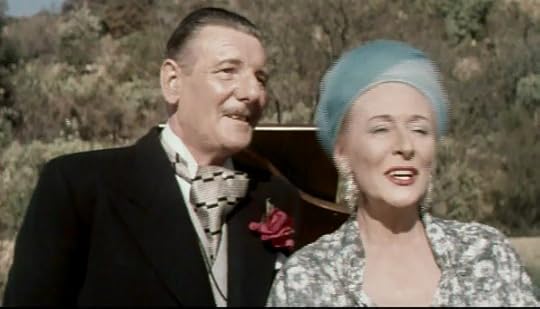 Singing in “Lord Oom Piet” (1962)
At the end of 1962 Webster sang in Elijah and Messiah at the Port Elizabeth Oratorio Festival. Two older women in the SABC choir were constantly making disparaging remarks about the quality of his singing to Ruth and me, no doubt enjoying our discomfiture and hurt at their comments. Despite the fact that the music critic for the Eastern Province Herald wrote that he had sung “with superb artistry” in Elijah, I was distressed when none of his arias were played in the national SABC broadcast of excerpts from the Festival. The two women triumphantly cited this as proof that he was long past his vocal best.
 Sylvia Sullivan and grand daughter.
Bottom: Jean Campbell (later Collen) 1965
 Jean Campbell later Collen (1965)
Sylvia Sullivan Choristers. Jean is wearing a hairband. The photo includes the late Margaret Masterton, Gillian Viljoen, the late Belinda Bozzoli, Bridget Anderson, Mary Dreyer, Mary and Gretchen Hofmeyr, Sheila Prior and others.
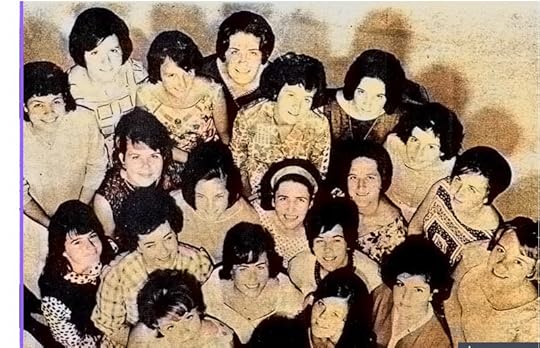 The Sylvia Sullivan Choristers (1964). __ATA.cmd.push(function() { __ATA.initDynamicSlot({ id: 'atatags-26942-6068ad11105ca', location: 120, formFactor: '001', label: { text: 'Advertisements', }, creative: { reportAd: { text: 'Report this ad', }, privacySettings: { text: 'Privacy', onClick: function() { window.__tcfapi && window.__tcfapi( 'showUi' ); }, } } }); });
April 1, 2021
A SCATTERED GARLAND: GLEANINGS FROM THE LIVES OF WEBSTER BOOTH and ANNE ZIEGLER, and other books.
 Early Days – 1920s to 1939
A Scattered Garland: Gleanings from the Lives of Webster Booth and Anne Ziegler was originally published in one volume but because of the additional material I have discovered the work now extends to four volumes: Volume 1: Early days (1920s – 1939) Volume 2:Years at the top in the UK (1940 – 1956) Volume 3 South Africa (1956 – 1977) Volume 4: Back in the UK (1978 – 2003) and additional information.
The work includes articles, criticisms, cuttings, and extracts from the online archives of The Times, The Scotsman and The Stage, and other newspapers. In Volume 2 I have included material from New Zealand and Australian newspapers, and in Volume 3 there is material from South African newspapers. Occasionally I have supplemented this material with my own notes. All my own writing is italicised. This book contains information about the early days of their careers.
 At the Top of the Tree.
This is the second volume of A Scattered Garland: Gleanings from the Lives of Webster Booth and Anne Ziegler, and includes articles, criticisms, cuttings, and extracts from the online archives of The Times, The Scotsman and The Stage. In this volume, I have included extracts from New Zealand and Australian newspapers from 1948 when the Booths did a concert tour there. Occasionally I have supplemented articles with my own observations. All my own writing is italicised. The book was originally published in one volume but because I discovered so much additional information I am publishing the work in 4 volumes.
 South Africa: 1956 – 1977.
When I was 17 years old I began my singing studies with Anne Ziegler and Webster Booth in their studio on the eighth floor of Polliack’s Building in Pritchard Street, central Johannesburg, where they taught Singing and Stagecraft. A few years later I became Webster’s studio accompanist when Anne (who was accompanist as well as teacher) had other commitments. I studied with them for five years and did my Associate and Licentiate singing diplomas under their guidance. Despite several years when Anne and I were estranged, we remained friends until Webster’s death in 1984 and Anne’s in 2003. I published the story of my relationship with Anne and Webster on Lulu (https://www.lulu.com/duettists) in April 2006 in a book entitled Sweethearts of Song: A Personal Memoir of Anne Ziegler and Webster Booth. Because Volume 3 concerns my direct relationship with the Booths I have mentioned events briefly if I consider them to be relevant.
 Back in the UK. 1978 – 2003.
Volume 4 covers the last period of the lives of Webster Booth and Anne Ziegler. They returned to the UK in 1978 and were welcomed by fans who remembered them from the forties and fifties when they had been at the top of the tree. I have also written extensively about the life of Paddy Prior, Webster’s second wife. She was a very talented performer in her own right. Her divorce from Webster was soon forgotten and he and Anne had great success while her own career remained static.
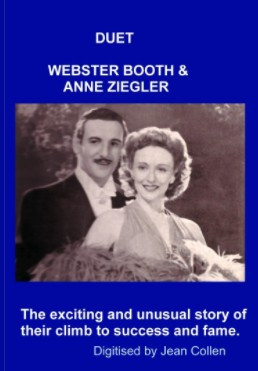 Duet by Webster Booth and Anne Ziegler. Digitised by Jean Collen.
“Duet”, the autobiography of famous British duettists, Webster Booth and Anne Ziegler was first published by Stanley Paul in 1951. I have digitised the book and have published it here (without index, but with the original illustrations). I am very grateful to John Marwood for meticulously proofreading the book for me. Webster and Anne have told the exciting story of their lives and careers – a must-read for everyone who remembers them or who have just discovered them recently.
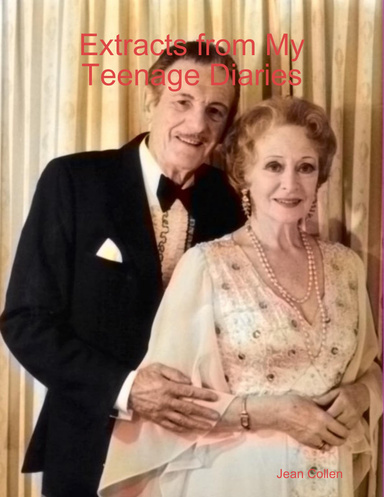 Extracts from my Teenage Diaries.
I kept diaries from 1960 onwards and have published them until August 1963 when I turned 20 at the end of that month.
All these books are available at: lulu.com/spotlight/duettists
Jean Collen 1 April 2021.
ABOUT WEBSTER BOOTH and ANNE ZIEGLER.

The links to all posts may be found in the black space above the blog, as follows:
RECORDINGS AND PODCASTS – LINKS
RELATED ARTISTES AND FRIENDS – LINKS
WEBSTER BOOTH, ANNE ZIEGLER IN SOUTH AFRICA – LINKS
WEBSTER BOOTH-ANNE ZIEGLER – LINKS
CONTACTBLOG
Anne Ziegler, the widow and singing partner of Webster Booth, died in Llandudno, North Wales, on 13 October 2003, at the age of ninety-three. Her death brought an end to an era of British entertainment before and after the Second World War. Her death brought an end to an era for me also.
I was seventeen when I first met Anne Ziegler and Webster Booth at the end of 1960. They were in the same age group as my parents, their top-flight stage career in Britain behind them. Anne and Webster made a great and lasting impression on me, first as teachers and mentors, and then as life-long friends.
During the five years I studied singing with them, I kept detailed diaries, and although several of these diaries were destroyed, I immediately wrote a full account of the “lost years” in an attempt to replace these memories while they were still fresh in my mind. I have a complete collection of all their letters to me, covering a forty year period.
I was too young to have seen them at the height of their fame, but even before I met them, I knew at once that they were a shining couple, their gifts and personalities setting them apart from humdrum lesser mortals. More than sixty years later I hold the same opinion of them.
One of the most memorable periods of my life was when Anne and Webster asked me to act as Webster’s studio accompanist when Anne (who usually accompanied their singing pupils) was away. I was all of 19 years old at the time. In 1990 I went to the United Kingdom for a holiday after my father’s death and spent a very happy few days with Anne at her home in Penrhyn Bay, North Wales. She was kind enough to leave me a bequest in her will which I received in 2003 shortly after her death.
When I was writing my book about my association with Anne and Webster, the late Mrs Freda Davies of Port Elizabeth passed on her correspondence with them to me. For some years Mrs Davies lived on the top floor of their home in Knysna with her father, Mr Fred Cropper, and they became close friends.
Although I have a great collection of photographs it was almost impossible to find out who the photographers were, or from whom copyright clearance should be obtained. Most of the photographers in the early photographs were dead; the press agencies and photographic studios no longer existed. The late Sally Rayner, the executrix of Anne’s estate, gave me permission to use suitable photographs in my book and elsewhere on the internet.
The book, Sweethearts of Song: a Personal Memoir of Anne Ziegler and Webster Booth was published in 2006 and was recently revised and updated. Other books succeeded it, including a 4 volume work of A Scattered Garland: Gleanings from the lives of Webster Booth and Anne Ziegler, which covers their careers through the early days, top of the tree, time in South Africa and back home again. All these books are available at https://www.lulu.com/spotlight/duettists/
Jean Collen
1 April 2021
__ATA.cmd.push(function() { __ATA.initDynamicSlot({ id: 'atatags-26942-606579cf0be8f', location: 120, formFactor: '001', label: { text: 'Advertisements', }, creative: { reportAd: { text: 'Report this ad', }, privacySettings: { text: 'Privacy', onClick: function() { window.__tcfapi && window.__tcfapi( 'showUi' ); }, } } }); });