Jean Collen's Blog, page 30
May 20, 2012
Book Reviews

I have just read the fascinating story of three lively young South African girls who went to Europe in the 1960s to spend a year travelling from place to place without spending too much money on their travels. They made use of youth hostels and managed to go from one place to another by hitching rides. Admittedly they had strict rules about hitching so they never came to any harm. Somehow I don’t think it would be possible to do the same trip today as everything is so much more expensive and the South African Rand has diminished in value. The book is well-written and extensively illustrated. I recommend this book to anyone who would like to learn more about the girls’ fascinating European adventure all those years ago. The book is available in print and Kindle editions.
 Relish – My Life on a Plate by Prue Leith
My rating: 4 of 5 stars
I have just finished reading Prue Leith’s lively autobiography and I enjoyed it very much. I am not particularly interested in cookery, but I have fond memories of seeing Prue Leith’s mother, the brilliant South African actress, Margaret Inglis in “Separate Tables” when my family and I were on holiday in Durban in 1957.
Prue Leith is four years older than me and grew up in South Africa so we shared similar childhood experiences. I found the account of her early years in South Africa, and later years in France and the UK fascinating. With most autobiographies and biographies, the years of struggle are usually far more interesting than the years of success, as the successful years often amount to no more than a brag-list of achievements and awards.
Although Prue Leith discussed her many achievements, her story held my interest to the end of the book, as her personality and humanity shine through in her writing. Despite success, fame and riches, Prue suffered her fair share of setbacks and she does not skim over the setbacks as others embarking on writing the story of their lives might have done.
Not only did Prue succeed as a cook and caterer, but she has published a number of novels in the later part of her life. I have only read one of them but intend to read the others in due course.
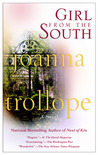 Girl from the South by Joanna Trollope
My rating: 3 of 5 stars
I did not enjoy this book quite as much as I enjoyed many other Joanna Trollope novels I have read. Perhaps it was because it was partly set in Charleston in South Carolina, and all the other novels have typically English settings with restrained English characters. I thought the author handled the American characters very well and created the atmosphere of the South very well, but, perhaps because I am set in my ways and thought I knew what to expect from Joanna Trollope, I would have preferred another Aga-Saga!
View all my reviews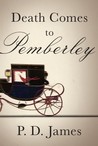 Death Comes to Pemberley by P.D. James
My rating: 4 of 5 stars
I thought that P.D. James captured the style and mood of Jane Austen’s writing in this book. She assumes that one has a thorough knowledge and understanding of “Pride and Prejudice” as she makes many references to Jane Austen’s book and even introduces characters from “Emma” towards the end of the book. The plot of “Death Comes to Pemberley” was slow-moving as one might have expected in a Jane Austen novel which concerned the minutae of the every-day life of the gentry; nearly three quarter’s of this book is taken up with the happenings of several days, seen from the points of view of the characters concerned in the murder. This necessitated a great deal of repetition of the events.
Jane Austen would probably never have concerned herself with something as distasteful as a murder, while P.D. James had to limit herself to a rather unremarkable murder mystery, quite different from the complicated modern mysteries she has written previously. After the mystery was solved I found the epilogue redundant to the plot. Why did Darcy and Elizabeth have to spend considerable time explaining to each other exactly why they acted as they did in “Pride and Prejudice”?
I enjoyed the book and admired P.D James ability to write in the style of Jane Austen, but I hope she continues to write classic murder mysteries and doesn’t repeat the Jane Austen experiment.
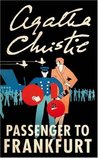 Passenger to Frankfurt by Agatha Christie
My rating: 2 of 5 stars
This book by Agatha Christie was different from the murder mysteries. It was written in 1970 and reminded me of Buchan’s “Thirty-nine Steps”, in that it was an adventure story where the aims of the people involved were unclear to me, and therefore fairly meaningless. The best part of the book was the quotation by Jan Smuts preceding the story: “Leadership, besides being a great creative force, can be diabolical…” I thought that this quotation could be applied to quite a few diabolical leaders, past and present.
I waded through this book, hoping that I would eventually be gripped by this tortuous tale, but I’m afraid I gave it up when I was half way through. I am too old to waste time reading books which are uncongenial and meaningless to me. I am glad that Agatha Christie did not continue writing novels like this but returned to writing tales of the detective exploits of Hercule Poirot and Miss Marple in the few remaining years of her life.
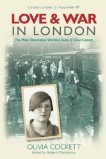 Love and War in London: A Woman’s Diary 1939-42 by Olivia Cockett
My rating: 4 of 5 stars
This book focuses on the wartime diary of Olivia Cockett, which she wrote for Mass Observation. It is edited by Robert Malcolmson. Olivia was 26 when war broke out and is a singular young woman in that she had been working in a clerical position since she was 17 and having an affair since that age with a married man in his thirties, whom she met at work.
Olivia is a very intelligent young woman who read widely. She was not afraid to tackle authors such as James Joyce, T.S. Eliot and Bertrand Russell and preferred serious music to the light music she heard on the radio. Her liberal outlook on life is the opposite to the conventional outlook of her Man. Because they were unable to marry – even their attempt for him to obtain a divorce goes wrong – she has had two illegal abortions before the war.
She describes routine and unusual events of her life during the war concisely and without emotion or self-pity. Once I became used to her style of writing I found the book a fascinating insight into the life of an ordinary, yet, in many ways extraordinary, young Londoner during the war. I would recommend it to anyone who is interested in civilian life at that time.
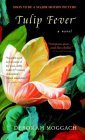 Tulip Fever by Deborah Moggach
My rating: 3 of 5 stars
I have read nearly all Deborah Moggach’s novels and enjoyed them very much, but I put off reading “Tulip Fever” as it seemed very different from her modern novels. Apparently the book was inspired by various Dutch paintings which are shown in the book and is set in 17th century Amsterdam.
The plot is rather far-fetched, bordering on fantasy, quite unlike her other well-crafted modern novels. One has to suspend belief at the twists and turns of the plot and none of the characters are well-rounded. Perhaps she meant them to be as one-dimensional as the subjects featured in the paintings. Although there were references to streets in Amsterdam, Dutch phrases, Dutch names and characters whose main diet was herring, I did not get a rich sense of time or place in this novel.
I’m glad I read the book, but I do not think it is Deborah Moggach’s best novel and it might disappoint her admirers.

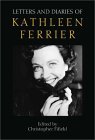 Letters and Diaries of Kathleen Ferrier by Christopher Fifield
My rating: 4 of 5 stars
From 1949 to 1951 Anne Ziegler and Webster Booth lived at Frognal Cottage, Hampstead, opposite 2 Frognal Mansions, where Kathleen Ferrier lived. The Booths became friends with Kathleen when they met her walking on Hampstead Heath as they were out walking their Cairn terrier, Smoky. Webster had been booked to sing a Messiah with her in 1951, but they were both very disappointed when she had to cancel this performance because of her illness. I was singing much the same repertoire as Kathleen when I began studying with the Booths in 1961 and they often lent me her recordings from their own record collection. Thus, although Kathleen had died tragically young when I was a child, I always felt a close affinity with this wonderful woman with the unique contralto voice of the twentieth century.
I was rather disappointed to find that Kathleen Ferrier’s diaries were little more than concert dates, occasionally with brief remarks about how a particular engagement went. On reflection, she was working hard so would have had little time to write substantial diary entries at the end of a busy day.
The letters more than compensated for the brevity of the diaries. She wrote many business letters to keep her very busy career in order. While many singers might have longed for more engagements, Kathleen Ferrier was overwhelmed with offers, to the extent that she often had to turn engagements down and beg for a few days respite from her agent, Emmie Tillet. She could certainly never have undertaken such a demanding career had she been married with children. Her letters show that her extensive American tours in the late 1940s involved exhausting travel arrangements. She had to pay for her own advertising, travel, accompanist and accommodation on these tours, so she hardly made a fortune at £50 a concert.
Her affectionate, informal letters to her sister, Winifred, her father and other friends were always bright, self-deprecating and humorous. Her letters of thanks to acquaintances were always appreciative and polite. Even when she turned down songs which had been sent to her, or engagements she could not undertake, she did so in a kindly way.
Once again, it was sad to see her grave illness taking hold so that she eventually lacked health and strength to write her own letters and relied on her help-meet, Bernie to write on her behalf.
There is a good bibliography,an extensive index of works in Kathleen’s repertoire, another of places, venues and festivals, as well as a general index.
My rating: 4 of 5 stars
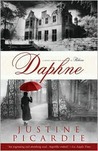
This was an interesting and unusual novel covering several strands: the narrator’s research into Daphne du Maurier’s work; Daphne du Maurier researching the Brontes in order to write a biography of Branwell Bronte; and Symington, the disgraced Bronte expert. I found it interesting how the author interwove fictional fact with the narrator’s own story, showing similarities between all the characters of her novel. It has encouraged me to reread my collection of du Maurier novels, and to look at Branwell Bronte in a new light. I would recommend this book as a well-written, gripping and unusual novel.
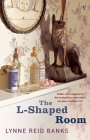 The L-Shaped Room by Lynne Reid Banks
My rating: 5 of 5 stars
This is one of my favourite books, which I read a few years after it was first published in 1960. It will be difficult for young readers to credit that fifty years ago it was considered a disgrace for a woman to have a baby out of wedlock and that her parents might disown her for doing so. The heroine of “The L-Shaped Room” even intends to keep her baby, which would have been unthinkable for most girls in 1960, when they were sent to homes for unmarried mothers and had their babies taken away from them at birth to be put up for adoption.
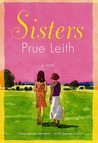 Sisters by Prue Leith
My rating: 4 of 5 stars
I bought this book a year or two ago and had initially given up reading it after a few pages. I decided to try it again recently and was pleasantly surprised to find that I enjoyed it very much. Perhaps some of my enjoyment stemmed from growing up in South Africa at much the same time as Prue Leith did herself and remembering her illustrious mother, the late Margaret Inglis, who was one of South Africa’s greatest actresses of her generation.
Prue Leith had many cookery books published in the earlier part of her life. In the comparatively new genre of novel-writing she is very competent and the book held my interest. Perhaps she might have considered giving the sisters in questions more distinctive names – Carrie and Poppy can easily be mixed up. Carrie is not entirely likeable for most of the book, but (as in the advice given in most writing courses)she changes for the better as the book progresses.
My only criticism is that Prue Leith spent too much time discussing the food the characters were eating – or cooking! I suppose this is understandable as she made a great name for herself as a cook and restaurant owner.
“Sisters” is not great literature but it is a very enjoyable novel. Now that I have read it I look forward to reading more novels by Prue Leith.
 The Middle Ground by Margaret Drabble
My rating: 2 of 5 stars
I am finding the book quite absorbing, although, since it was written in 1980, the feminist and political views expressed by the characters seem rather dated, in the light of hindsight. I expect they were considered quite unusual at the time. Later: I am afraid that as the book progressed I began to lose interest in the main character’s increasingly peculiar life, friends and acquaintances. I finished the book with difficulty and was very disappointed in it as Margaret Drabble has written some excellent novels and is usually one of my favourite authors. I fear this book is not in the same class as others she has written – or perhaps I lacked the intellect to enjoy it.








May 19, 2012
ANNE ZIEGLER-Light Operatic Duettist With Husband Webster Booth. | eBay
This item is on auction on EBay. The note certainly demonstrates that at the height of their fame they were polite enough to respond to fans with a personally written note. I wonder how many of today’s stars do the same?







Dietrich Fischer-Dieskau’s Incomparable Voice – NYTimes.com
I was saddened to learn of the death of Dietrich Fischer-Dieskau yesterday. Not only did he have a great voice, but he was blessed with profound musical intelligence and insight into the lieder he performed so well. May he rest in peace.
Dietrich Fischer-Dieskau’s Incomparable Voice – NYTimes.com.







May 13, 2012
15% DISCOUNT ON MY BOOKS AVAILABLE UNTIL TOMORROW!
Save money on purchasing any one of my books until 18 May. Use the code below when purchasing at Jean Collen’s Book Store








15% DISCOUNT ON MY BOOKS AVAILABLE UNTIL 18 MAY 2012
Save money on purchasing any one of my books until 18 May. Use the code below when purchasing at Jean Collen’s Book Store
April 10, 2012








Eyewitness News: Questions surround N.Cape farm murders
Eyewitness News: Questions surround N.Cape farm murders.
It is very sad that brutal farm murders like the latest one in Griekwastad, Northern Cape continue unabated in South Africa yet they are hardly ever reported in great detail. I really dislike it when a farm murder is reported and a "talk show host" tries to justify the atrocity by asking how the farmer in question might have treated his farm workers. Whether farmers and their families are murdered or farm workers are abused, both are equally horrendous crimes and should be condemned by everyone.







March 28, 2012
Pronunciation and phrases – PET HATES!
I was having a discussion about annoying expressions and mispronounced words with some of my Facebook friends yesterday. What set me off was hearing a newsreader on Talk Radio 702 refer to an envoy as an ONvoy. For some reason this appears to be the received pronunciation for the word on this radio station as I heard a senior and highly experienced newsreader using it later that evening.
As a classical musician I am disturbed at the way some announcers mispronounce the names of composers, soloists and works when they advertise a symphony concert. Someone who gives the impression of being highly cultured and literary made an idiot of herself pronouncing the name of the composer, Antonín Dvořák. Admittedly it might be a difficult name if she didn't know how to pronounce it, but she should have done her homework before she read the ad on the air.
Various broadcasters, who should know better, freely make use of the following pronunciations: EELectricity, CAMbridge, CaTAGory, EuROWPean, IrreVOCable, instead of electricity, Camebridge, category, EuroPEAN and irrevocable. In the bad old days in South Africa, pre-1994, the English Service of the South African Broadcasting Corporation employed a language adviser, so if ever there was any doubt about how a word should be pronounced, she was there to help, and if she heard someone mispronounce a word, she was there to criticise and correct! Perhaps South African radio stations should consider employing such a person today before their supremely self-confident broadcasters mangle the English language any further.
Surely broadcasters should set an example to others with regards to correct pronunciation. English is not the first language of the majority of people living in South Africa, so they should not be misled by hearing bad pronunciation on the radio.
Irritating expressions:
At this moment in time – instead of now, or even at the moment
For free – Why not use free or for nothing?
At grass roots level
On the ground
Basically
Paradigm shift
I speak under correction
Have you any pet hates? Please let me know and I'll add them here.







March 15, 2012
COMMON WRITING FAULTS
As I have mentioned elsewhere, writers should never submit their work for editing or proofreading, until they have gone through their first draft carefully and made as many corrections as possible to it themselves. The first draft is the beginning of the writing process and needs to be honed carefully before anyone else sets eyes on it.
It is not my job to correct errors of fact, only errors of grammar, spelling, consistency, sentence construction and style.
I have found the following general errors in many pieces of writing, and I dare say there are many other errors which could be included in the list :
1. Inconsistent use of tenses, such as writing one sentence in the present, the next sentence in the past.
2. Writers who do not correct their work often write a sentence then add something to the end of it as another thought occurs to them. This makes life difficult for the editor, for it means that sentences have to be rearranged and rewritten in order to make sense of them.
3. Padding. Expressions like "to be honest," "frankly and honestly", "for me", and "in my honest opinion". It is unnecessary to use any of these phrases at all. You are obviously expressing your own opinions (and I hope they are frank and honest) so phrases like these are superfluous padding and hold up the action of your story. Use of words such as "just" and "also" are often superfluous.
4. Inconsistent use of personal pronouns: we, I, it, they, you, and one which often change within a sentence.
5. Avoid frequent use of words like nice and get.
6. Frequent dashes do not make for good reading. Punctuate each sentence properly and make sure each sentence contains a verb.
7. Difference between "its" and "it's" . "It's" is short for "it is". "Its" without an apostrophe is possessive.
8. Be consistent. Either use litres or gallons; kilometres or miles; numerals or numbers in writing. Don't change these terms from chapter to chapter.
9. Unnecessary capitalisation of words like brother, father, visa, war.
10. Spelling should follow British or American rules – not both in the same article.
I'm sure I will find many more faults as time goes by, so this article is a work in progress. I will be glad of your suggestions.







February 10, 2012
CURRENT AFFAIRS
11 February 2011
It is over three months since I have posted anything here. I made the following comment about Samuel Coleridge Taylor's Hiawatha's Wedding Feast today:
While I was never lucky enough to see any performance of "Hiawatha's Wedding Feast", my late singing teacher and life-long friend, tenor Webster Booth, took part in many performances of the work under the baton of Sir Malcolm Sargent. His first performance was in July 1937 when he and the rest of the cast were clad in American Indian costumes and I have an imposing photo of Webster in his full regalia. He later sang in the fiftieth anniversary performance of the work. Malcolm Sargent chose him as soloist in the work to celebrate his sixtieth birthday. Webster's recording of "Onaway, awake, beloved" (1947) is one of his finest recordings.
26 October 2011
Knysna-Plett Herald | Criminals target safe haven.
It is very sad to think that criminals have repeatedly targeted the soft target of a safe haven for abused women and children in Knysna.
We are experiencing a heatwave in Johannesburg, with temperatures up to 33 and 34 degrees for the first time on record. Tonight the animals are quivering with fear because of the fireworks exploding around us to celebrate Diwali, and tomorrow and Friday we have the ANCYL march to the Chamber of Mines to call for nationalisation of mines in South Africa, and to push for their "expropriation of land without compensation" policy.
I wish it would rain very heavily to douse the fireworks and quell the ANCYL's enthusiasm for the march. It seems strange to arrange such a march at a time when many members are in the middle of Matric and University examinations.
4 October 2011
Today the Dalai Lama cancelled his planned trip to South Africa to attend the eightieth birthday party of Archbishop Emeritus Desmond Tutu because he had not yet received a visa to enter the country. The Archbishop himself was furious and accused the present ANC government of being worse than the Nationalist government of the apartheid era in South Africa. This news generated a great deal of polarised comment on news sites and on Facebook. I made the following comments:
Perhaps people have forgotten or were not taught at school that at one time the Archbishop was the lone voice speaking out against apartheid to the world while the ANC was involved in its arms struggle. The refusal to give a visa to the Dalai Lama is one of the present government's lowest points. Dance to the tune of the Chinese government who have no idea about "human rights". Disgraceful!!
Another commentator asked why people should make a fuss about the views of "an old angry man", referring to the Archbishop. I said:
Without that old angry man you might not be enjoying your freedom right now. Maybe China will take complete control in SA and then we'll see what it is to be oppressed like those they shot dead for their protests in Telemann Square.
3 October 2011
Family of three shot dead on their Walkerville small-holding. News 24 reported this chilling incident earlier today. It was suspected that the mother had been raped, and both father and his thirteen-year old son were shot dead – execution style. There were many furious comments in response to the article. I made the following comment:
Another sad and shocking story of a family being annihilated in the most horrific way. How can any normal human being live with the knowledge that they have killed a child in cold blood, as well as violating his mother and killing her and his father? Will they ever find these killers? I doubt it. The death penalty is too good for them. This kind of thing doesn't happen in other parts of the world. If it did, there would be a massive outcry about it. Here it's just another story which might – or might not – appear as a small item in the middle of the newspaper.
23 September 2011
Radio 702 was commemorating Heritage Day at Freedom Park near Pretoria this morning. No soldier who died in the South African Defence Force fighting in Angola has his name on the Freedom Wall. Apparently they were all fighting to support Apartheid. The Voortrekker Monument, situated not far away, commemorates Afrikaners who died in that war. John Robbie was asking for some kind of reconciliation so that the names of all South Africans who died in past wars could be included on the Freedom Wall.
I made the following comment on this matter:
Apart from anything else, most of these young men were CONSCRIPTED into the Defence Force whether they believed in the cause they were fighting for or not. They were not all Afrikaans – they were all white South African matriculants regardless of their language. I will never forget seeing a bunch of these raw recruits, straight out of school, at the old Show Grounds when I was writing a UNISA exam. These 17 and 18 year old boys were being shouted at by a very fierce Afrikaans corporal. This morning they were talking about Afrikaners who were commemorated at the Voortrekker monument. What about all the others who died in that war and who never believed in Apartheid? Those who became conscientious objectors were put in jail for indefinite periods and were subjected to very rough treatment. I do not wish to visit the Voortrekker Monument or the Freedom Wall. Both are equally divisive.
22 September 2011
Today I heard the sad news that my old friend, Ron Ince (aged 86) had died in Auckland, New Zealand. Although I never met him, he was very kind to me and sent me some wonderful tapes of rare recordings by Anne Ziegler and Webster Booth, as well as many other recordings of singers he knew I'd be interested in. Apparently he had a large collection of records and tapes which he had collected over the years. He and his late wife Julia had attended one of Anne and Webster's concerts in Auckland in 1948 when they had been on a tour to New Zealand and Australia. He also sent me some tapes of Julia's singing and told me something about her and her father, who had been a professional violinist.
Ron had been a broadcaster in New Zealand in years gone by, and always did tapes to me in the form of a broadcast. I loved hearing his gentle voice when he introduced the records – hisdelightful personality shone through. I sent him various tapes in return and we corresponded regularly until the last year or two when our correspondence was reduced to notes and cards at Christmas. I last heard from him at Christmas time when he told me about the heart attacks he had suffered earlier last year. He had introduced me to his friend Alasdair Fenton in Scotland and I wrote to him and exchanged tapes with him until his sudden death a few years ago – he was quite a few years younger than Ron and was an expert on Jack Hylton. I will never forget either of them as they both enriched my life. Ron is sadly missed and I will always remember him fondly.
19 September 2011
Apparently SA President, Jacob Zuma took two of his wives on a visit to the States! I made the following comment in The Times Live:
What a shame! After the 1994 elections South Africa and the ruling party had a chance to redress the ills of the past. In 2011 there are more people unemployed than ever. We have a weak President, which leaves the way open for the likes of an extremist like Malema to take charge of the country. We are faced with a draconian "Freedom of Information" bill. Now Zuma takes two of his wives to the US. Next time, he'll probably take the lot and make the taxpayer cough up for them. The fragmented opposition parties need to unite and present a viable alternative to the ANC, and those who vote for the ANC should realise that the fat-cat, arrogant politicians do not put South Africa first, only their own interests. Heaven help us all!!
13 September 2011
I wonder what your opinion on this change to the copyright law on records is. I understand that the law will not be retrospective, which is a good thing for smaller companies who have issued CD compilations when the original recordings went out of copyright. Many of Anne Ziegler and Webster Booth's recordings were issued on CD in this way in the 1990s.
I posted the following comment on Facebook regarding this change:
"I don't "like" this change in the copyright law. It will give people like Cliff Richard and the surviving Beatles, who are already "in the money" even more money to add to their coffers. Those artistes who are now dead and gone and were struggling financially saw their recordings go out of copyright after 50 years and feature in CD compilations without benefiting from the sales of these CDs in any way at all."
There's not much anyone can do about this change in the law now, but it would be interesting to know your views on the matter.
7 September
There was an article in the New York Times this morning regarding when US troops would be withdrawn from Iraq.
I posted the following comment:
When the US and European powers enter foreign conflicts hoping to bring about Western-style democracy to places where democracy has never existed before, they must either leave these countries in a state of flux, or maintain a military presence, with soldiers being needlessly killed by dissidents on a regular basis. This is a sad situation with no winners, regardless of whether troops remain or withdraw.
5 September 2011
It was reported that Thabo Mbeki wept when he resigned from parliament after being recalled by the ANC.
My comment:
Thabo Mbeki might have made mistakes but he was dignified and articulate. I was sad when he was recalled and South Africa's poor have not benefited by the present leadership. Corruption is the order of the day and Zuma is an "all things to all people" leader. This vacuum in good leadership has allowed Julius Malema to come to the fore.
29 August 2011
http://www.timeslive.co.za/scitech/2011/08/29/rhino-hunting-ban-considered
Rhino hunting ban considered – Times LIVE.
In the light of the shocking slaughter and poaching of South African rhinos for their horns, I think a hunting ban and dehorning of all rhinos should be implemented as soon as possible. "Trophy hunters" are legally allowed to come to South Africa and shoot our wild life. In this day and age, such people are a disgrace to humanity.
26 August 2011
Rightwinger Clive Derby-Lewis, convicted of the murder of SA Communist Party general secretary Chris Hani, has been denied parole.
via Derby-Lewis parole denied.
My Comment
I hold no brief for Derby-Lewis, but the man is old and sick and has spent many years in jail. The Hani family will never agree to him getting parole, unlike the parents of the American girl who forgave the killers of their innocent daughter and even befriended them. Thousands of innocent people have been killed in South Africa since the murder of Chris Hani, whether for political or criminal motives. I think it is time to release this man and move on.
24 August 2011
South African National anthem – the talking point on the media today
http://youtu.be/ArRzytMd-yA
The singer who sang the SA national anthem at the ceremony to announce the rugby squad going to the forthcoming Rugby World Cup in New Zealand forgot the words, although he managed to carry on after the initial error. South Africans criticised and berated this poor gentleman on Radio 702 and other radio stations this morning. He even came on to the John Robbie show to apologise for his memory lapse. Apparently he knew the words perfectly at the rehearsal, but froze during the performance. In a discussion about this on Facebook, someone suggested that it would be better to have four singers, each singing the part in the national anthem which is written in their native tongue.
I made the following comments:
I had the same idea as Humphrey when I was listening to the heated discussion on Talk Radio 702 this morning with everyone deriding this poor chap because he had forgotten the words. If four people sang the part of the anthem written in their own language nobody could be offended by bad pronunciation. It might even create a feeling of South Africans being united instead of divided.
I am a retired singer and singing teacher and learnt to sing in German, Italian, French, Afrikaans and Zulu (where vowel sounds are similar to pure Italian vowel sounds). I have a working knowledge of some of these languages and always understood what I was singing even if I could not conduct an intricate conversation in them, but Humphrey is correct in saying that one spends a long time learning and memorising roles and songs, and it takes a lot longer to memorise words in foreign languages than in one's home language. He had three weeks in which to prepare the anthem and performed it perfectly at the rehearsal. Apart from Ard's memory lapse, he has a very pleasing voice. People seem to think that professional singers should never make mistakes and should churn out everything flawlessly like robots. He was overcome by the occasion, which was different from engagements he was used to.
I have since heard his updated recording of the national anthem. Strangely enough, his pronunciation and singing of the Zulu and Sotho words of the anthem sound very much better than the Afrikaans and English sections. This is because he uses Americanised vowels to sing in Afrikaans and English, so neither of these parts of the anthem sound right. He also ends the anthem on an uncertain note. I think that it would be better to employ a straight singer accompanied by an orchestra to sing the anthem. Somehow a crooner with guitar accompaniment is not appropriate. After this debacle, I sincerely hope that the version sung before the games at the Rugby World Cup in New Zealand will be appropriately performed or even pre-recorded. South Africa has many good straight singers who could do justice to the dignity of the anthem. How about tenor, Sipho Fubise who studied at the Royal Northern College of Music in Manchester, won many prestigious awards and scholarships during his time there and took the lead in several operatic productions?
23 August 2011
I read on the British Monarchy page of Facebook that the Duchess of Cornwall has adopted a Jack Russell puppy named Beth from the Battersea Dogs' Home. She already owns two Jack Russells named Tosca and Rosie.
I made the following comment on Facebook:
Good for the Duchess of Cornwall for adopting this sweet puppy and giving her a loving home. Obviously she could have afforded to buy the fanciest breed of dog in the world from a breeder. I take my hat off to the Duchess for following the adoption route. I am sure Beth will have a long and happy life with Tosca and Rosie!
22 August 2011
On the 1 January 2011, I posted this comment on Facebook concerning the terrible noise of fireworks which had frightened our dog:
I wish there could be a COMPLETE BAN on fireworks in South Africa. Those loud bangs are no less than cruelty to animals and birds, and now they're letting them off again tonight. Someone sms-ed 702 this morning, saying, "Pet owners should just get over it." Tell that to those who have lost dogs because they fled in panic at the shocking racket last night!
Stefan Collini reviews 'English Journey' by J.B. Priestley · LRB 19 November 2009.
20 August 2011
The ANC is planning to discipline leader of its Youth League, Julius Malema
ANC charges Malema with misconduct: News24: South Africa: News.
My comment on this issue on Facebook reads as follows:
The ANC should have disciplined Malema sooner. He has managed to push his own agenda because there is no decisive leadership in the ANC. I see two possibilities – either he will be given a slap on the wrist because he says things in public which the party leaders are saying in private, or else they will discipline him severely and he'll form his own party which will have a lot of support from disaffected youth.
16 August 2011
Gautrain Johannesburg service resumes – Times LIVE.
My comment:
I feel very sorry for Errol Braithwaite as the Gautrain is a world class project which is being undermined by wild cat strikers and cable thieves. Perhaps the SA Government should take a note of what steps the British Government intends taking against those convicted after the English riots of last week.
14 August 2011
ANC Youth League president Julius Malema has been paid R1.2m, through a Johannesburg architect building his home, by businessman Steve Bosch, a report says.
via Tender boss paid Malema R1.2m – report.
My comment:
Another very depressing report of dubious practices, so complicated I can hardly get to grips with them. JM is in the pound seats while the poor he claims to represent, and the many who support him, regardless, will see South Africa sink even further into the quicksand because of fat cat corruption. I agree with debrakayestylist: "Moeletsi Mbeki FOR President".
12 August 2011
Desmond Tutu says white people must accept that they benefitted from apartheid, and has also called on Cabinet ministers to get rid of their expensive cars in the spirit of ubuntu.
via Desmond Tutu criticises SA whites.
My comment:
All the Archbishop's comments might be true, but they are not going any way to unite South Africans, judging by the reaction of commentators on this page. Everyone – except those political fat cats – is far more divided and pessimistic about the future of South Africa today than when South Africans voted together in 1994 and looked forward to a new beginning as part of the "rainbow" nation.
This is a sample of the paper I compile each day from my tweets on Twitter.