
Jean Collen's Blog, page 28
June 24, 2012
ANNIVERSARIES OF A DEATH AND A BIRTH

SWEETHEARTS OF SONG: A PERSONAL MEMOIR OF ANNE ZIEGLER & WEBSTER BOOTH
21 June 2012 was the twenty-eighth anniversary of the death of Webster Booth in Llandudno Hospital, North Wales. The following day was the hundred and second anniversary of the birth of Anne Ziegler, born Irene Frances Eastwood in Liverpool in 1910, who died nearly nine years ago. I knew Webster for twenty-four years, so he has been dead for four years longer than I knew him. I remained friends with Anne for forty-three years until her death in October 2003. They certainly made a very strong impression on me as a young seventeen year-old just out of school. In the usual course of events I would never have met them except as one of the crowd waiting at the stage door to catch a glimpse of them as they left the theatre or a concert hall after yet another triumphant performance. In fact, I had met them briefly six months earlier in June 1960 when they had sung in the Methodist Church Hall in Roberts Avenue, Kensington, Johannesburg where they had been the star attraction at a variety concert, held to raise funds for the church. This time there were no eager crowds waiting to catch a glimpse of this glamorous couple as they left at the interval after they had sung. I was the only one waiting with my autograph book to ask for their autographs, which they graciously signed in the vestry of the church.


August 1955
Webster Booth was one of Britain’s finest tenors of his generation and only five years before I met him he was still singing at the Royal Albert Hall under the baton of Sir Malcolm Sargent, who had nurtured his more serious singing career since he had selected him to sing the tenor solos in the Good Friday performance of Messiah at the Royal Albert Hall in 1936.

An unfortunate incident related to the Inland Revenue in the UK had led to the Booths being obliged to leave England and settle in Johannesburg in 1956. Despite their hard work over the years and the fame they had achieved, their circumstances were much reduced by the time they arrived in South Africa. At that time there were not many professional theatrical companies and even if they commanded top South African fees, these must have been far less than they had received for their work in Britain. They did a fair amount of performing and broadcasting in South Africa, but found it necessary to start a school of singing and stagecraft on the eighth floor of Polliack’s Corner in Pritchard Street, Johannesburg to supplement their dwindling income.

Anne gave me this card when I attended my audition with her.
At first they asked far higher fees for lessons than reputable local singing teachers, but few could afford to pay such high fees, so they eventually reduced their fees to an amount closer to the fees local teachers charged. Because of this my parents could afford to send me to the Booths for singing lessons after I left school. Webster was away in Port Elizabeth singing at the Port Elizabeth Oratorio Festival under the baton of Robert Selley at the time of my audition, so I met Anne by herself on my first visit to their airy studio, which contained a beautiful Chappell grand piano, a set of shelves against the wall which contained all their sheet music, and a full length mirror so that students could watch themselves as they sang. There was a glass pane behind the studio couch, filled with photographs of Anne and Webster in various roles and in the company of famous and illustrious people who had been their friends and colleagues in Britain.

The corner of Eloff and Pritchard Streets, Johannesburg. Anne and Webster’s studio was on the eighth floor of the building on the left.
ANNE ZIEGLER SINGS NOEL COWARD SONGS

Little did I know that this first meeting with Anne would result in an association with the couple, first as a student, a few years later as Webster’s studio accompanist, and in a friendship which lasted until Webster’s death in 1984 and Anne’s in 2003. We had our ups and downs over the years, but I will never regret knowing them and having the course of my life changed because of my friendship with them. As long as I am alive they will never be forgotten. 
Jeannie C June 2012.








June 23, 2012
Webster Booth and Anne Ziegler: Current news items
How Ivor Novello’s songs may become old friends to new listeners – Telegraph.

Ivor Novello
A concert featuring the music of Ivor Novello will be held at this year’s series of Promenade Concerts. Perhaps the concert will revive interest in his music and the recordings of his music by Anne Ziegler and Webster Booth.

Collage featuring Anne and Webster.
Ivor Novello Memorial, Cardiff. Photographs and collage by Charles S. P. Jenkins. I am grateful to him for allowing me to use these photographs in this post.

Ivor Novello memorial, Cardiff.

Ivor Novello Memorial, Cardiff

Ivor Novello Memorial, Cardiff
All things connected with Webster Booth and Anne Ziegler on Pinterest.
This item was on auction on EBay. The note certainly demonstrates that at the height of their fame they were polite enough to respond to fans with a personally written note. I wonder how many of today’s stars do the same?
This very charming signed photograph of Anne Ziegler was on auction on EBay.

.

Luton Hoo reverts to Merrie England with Douglas Fairbanks Jnr – Nostalgia – Bedford Today.
Webster Booth and Anne Ziegler starred in this sumptuous production of Merrie England at Luton Hoo to celebrate the Coronation of Queen Elizabeth the Second in 1953. They are pictured in this small photograph.
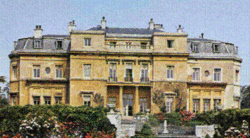
Luton Hoo, now a luxury hotel.

BBC – Desert Island Discs – Castaway : Webster Booth.
Webster Booth appeared on “Desert Island Discs” in April 1953. You can see the records he chose on this link. Sadly there is no recording of the programme in the BBC archives.
D-Day remembered during airfield event | This is Cornwall.
This article mentions that Anne Ziegler and Webster Booth entertained there during the war. A photo of Anne and Webster in a still from the wartime movie, ‘Demobbed”.
[image error]
Anne and Webster in a still from the film “Demobbed” (1944)
.


D-Day remembered during airfield event | This is Cornwall
D-Day remembered during airfield event | This is Cornwall.
This article mentions that Anne Ziegler and Webster Booth entertained there during the war. A photo of Anne and Webster in a still from the wartime movie, ‘Demobbed”. .
.







June 21, 2012
Webster Booth (21 January 1902 – 21 June 1984)
[image error]
Today is the twenty-eighth anniversary of the death of famous British tenor Webster Booth. He died in Llandudno hospital on 21 June 1984 and is sadly missed, but always remembered.
If you like Webster Booth you might consider “liking” his page on Facebook at:
Webster Booth (tenor) 1902-1984
or joining the Booth-Ziegler Yahoo Group at: Booth-Ziegler Yahoo Group







June 19, 2012
My Pinterest Boards
Have a look at my boards on Pinterest. You might like to create Pinterest boards too. You can save all your favourite photos from the Web there. I have included categories of special interest to me.







June 18, 2012
Book Taster: I CAN’T FORGET YOU, a novel by Jean Collen

PROLOGUE – MAY 1974
ELSPETH MCPHAIL
“The guest in Musical Memories tonight is the distinguished tenor, Derek Bailey, who celebrates his seventieth birthday today. Join Michael Broadstairs in conversation with Derek Bailey at 8.30 this evening.”
The television set was the focal point of the tiny sitting room of the modest terrace house in South Lambeth. It stood at an angle in the corner of the room with the armchairs and couch of the old-fashioned maroon lounge suite facing towards it. The only other item in the room was a large veneer cocktail cabinet, which had been George Pratt’s proudest and most utilised possession when he was alive. He had died five years earlier, and the two remaining occupants of the little house had little use for it except as a handy receptacle for the odds and ends they brought into the room to keep themselves comfortable and well fed while they watched television.
Although it was springtime, the atmosphere was redolent with the mingled odours of fish and vinegar, more in keeping with a cold winter’s night than a pleasant spring evening. The elderly occupants were settled deep in their armchairs eating from TV trays.
Mrs Pratt, George’s widow, uttered an exclamation at the announcement. She turned eagerly to her younger sister, expecting her to react to the words in some way, but judging by the remote expression on Elspeth McPhail’s face, she doubted whether Elspeth had even heard the announcement. Her sister was eating her fish and chips slowly, staring at the television screen without registering any visible emotion.
“Did you hear that, El?” asked Mrs Pratt. “I thought he had died years ago. To think we’ll be seeing your old flame after all these years.”
Mary Pratt was surprised that Elspeth McPhail only smiled faintly in response. Mary thought it would be interesting to see Elspeth’s old boss again after nearly forty years, yet she doubted whether she would have the patience to listen to him blathering away about the technicalities of singing for the full half-hour. But it might cheer Elspeth up to see him and they could always switch over to the variety show if Derek Bailey’s interview proved too dull for them.
“You were a bonny girl and could have had any man you pleased, but after Derek Bailey married that singer Helen Dean, the sparkle seemed to go out of you.”
“I don’t want to talk about Derek Bailey,” Miss McPhail retorted irritably. “Let’s just enjoy the telly while we eat our tea.”
Somewhat disappointed at Elspeth’s calm demeanour in the light of the significant announcement on the TV, Mary Pratt fell silent and settled down again to watch her favourite soapie. After a bleak day doing her share of cleaning and cooking in the small house, she was only too pleased to immerse herself in Coronation Street where everybody led such eventful lives compared to their own dull lives, and even the most casual conversations proved to be of the deepest significance to the development of the plot. Periodically she glanced at Elspeth, but still her sister gave no outward hint of her feelings as she continued to stare impassively at the flickering television screen.
Mary could not help remembering that she herself had been responsible for curtailing Elspeth’s relationship with Derek Bailey. She had never told her sister that several years after his shot-gun marriage to Helen Dean, Derek Bailey had arrived at this very house in a distraught state, begging Mary to tell him how he could find Elspeth. She had sent him away, claiming that her sister was on the point of marrying someone else and refused to give Derek Bailey her address. At the time she thought she was acting in Elspeth’s best interests and that she would eventually marry Archie Taggart and forget all about Derek, but here she was, after a life time spent in domestic service, still unmarried with only distant memories of the halcyon days she had spent with Derek Bailey to sustain her.
Elspeth resented retirement. After forty years as housekeeper to a variety of employers, she found enforced inactivity dull. Her interests, once so varied, had been whittled down to occasional trips to the local library and mindless nights of fish and chips eaten on a tray in front of the telly. It was only when she was alone in her small bedroom that she was free to remember the exciting days when she had been ecstatically happy with Derek and had lived her life to the full.
Tonight, despite her outward calm in front of Mary, her long-term lethargy had indeed been dispelled. At the mention of her old employer’s name, her fingertips had tingled as long-forgotten emotions and memories, too deep-seated and intimate ever to share with her garrulous sister, resurfaced.
Derek Bailey had been Elspeth’s first employer shortly after she arrived from Scotland as a raw and ignorant young girl. He was making his name as a singer when she became his housekeeper, and after she left his employ, his glowing reference had ensured that she became housekeeper to a succession of other famous and sometimes titled people. But although the conditions of her employment and salary improved with every move she made, none of her subsequent employers ever made the profound impression on her life as Derek Bailey himself had done.
She had never stopped thinking of Derek for the rest of her life, nor had she found another man to match him, although she had received a few offers of marriage in her time. In the years of Derek Bailey’s success, she had listened to his broadcasts, collected his records and kept scrapbooks of cuttings about his performances and his colourful personal life. When she managed to save some extra money she had even attended some of his concerts and had felt proud that his performances were received with such enthusiasm. But over the last ten years, there had been fewer broadcasts, concerts, or newspaper cuttings to give her staid life the occasional frisson of excitement.
She had heard so little about him lately that she often wondered whether he was still alive and in good health. Her sister asked her why she took the Daily Telegraph. It seemed like a highfalutin newspaper for plain people like them. Elspeth justified buying the paper, citing that it was well-written with excellent political and arts coverage. She even whiled away her spare time trying her hand at the daily crossword. But she refused to admit to her sister that the real reason she took the paper was because of its extensive obituary page. If anything happened to Derek, she trusted the Daily Telegraph to let her know at once and to write a fitting tribute to him.
She would watch Musical Memories tonight. If she chose to do so, she could share with the world a number of non-musical memories concerning Derek Bailey, but so far she had never confided them to anyone, not even to her own sister. Nobody was ever likely to hear of the bond which had once existed between Elspeth McPhail, now a sixty-two year old working-class spinster, and Derek Bailey, celebrated tenor.
The intrigues of the folk in Coronation Street were lost to her that night as she thought of the intrigue of forty years before which had coloured her life for all time.
LINDA BAILEY
Linda Bailey regarded herself in her dressing-table mirror with well-founded satisfaction. She had been to her hairdresser that afternoon for a rinse and set. The light auburn colour of her hair suited her pale complexion and complemented her deep green eyes. She was wearing her low-cut, figure-hugging aquamarine evening dress and the ruby necklace and earrings Derek had given her as a present for a distant wedding anniversary. She anticipated the comments of the women at the party to be held in Derek’s honour after the interview.
“The old girl must be sixty if she’s a day, but doesn’t she still look marvellous? She could easily pass for thirty-five – in the right light!”
Linda looked forward to being the centre of attraction again, fêted by eminent theatrical and musical people because she was Derek’s wife. Derek had retired from the Kings Opera company some years earlier to become a celebrated teacher of singing at one of the music colleges, but his dry academic colleagues bored her in comparison to the flamboyant theatrical and musical colleagues she had known while he was still performing. It horrified her to realise that almost two generations knew Derek only from an occasional lecture-recital, the old seventy-eights and the few long-playing records he had made towards the end of his singing career.
On rare occasions when the BBC risked its recording equipment to play one of his records, there was usually a cautionary preface, “Now for one of our historical recordings by veteran tenor, Derek Bailey. Please excuse the scratchy surface…”
Linda tried to console herself with the fact that the veteran had worn very well and was still handsome and charming enough to turn a number of greying heads and, more worryingly for Linda, a few blonde, brunette and auburn heads also. She always made a determined effort to laugh off his flirtations with the legion of young women who were invariably flattered by the light-hearted attentions of a famous man.
She told friends airily that he had a predilection for young girls, aged eighteen to twenty-five, as though it was all a great joke, but it had amazed her that recently he had the gumption to expand one of these flirtations into a serious and long-lasting affair. It seemed she had managed to persuade Derek to end that ludicrous fiasco. He was going to see the little bitch for the last time tomorrow to let her know their affair was at an end, once and for all. At least, that is what Derek told her he would do but she was not sure whether she could believe him. But then, he had little reason to be entirely confident of her lasting fidelity and honesty either.
She turned to him. He was sitting in a fat armchair, sipping a small whisky. These days he preferred to spend the evenings at home reading an entertaining novel, rather than face the drive through busy London streets, but the invitation to appear on Musical Memories had been too intriguing to turn down.
He rose reluctantly with only the merest suggestion of creakiness, and glanced briefly at himself in his wife’s mirror. His evening suit was nearly twenty-five years old, but skilful alterations allowed it to hang as stylishly on him as it had ever done.
“Nobody will believe you’re a day over sixty, darling,” smiled Linda, reading his thoughts. “Not a bad looking pair for our ages, are we? We’ve been through some torrid times lately, but we are going to be happy now, aren’t we? Our marriage hasn’t been a complete disaster?”
Derek Bailey met his wife’s scrutinising gaze and made an effort to keep the doubt from reflecting in his sad dark eyes.
“You’re beginning to sound like a publicity handout, darling,” he said lightly. “Now then, are you ready? We’d better be off sharp otherwise there’ll be no memories, musical or otherwise tonight.”
As he put the ignition key into the Jaguar, he suddenly remembered that he had promised he would try to phone Jane before the broadcast. He had no trouble visualising her, seated on that little stool beside the telephone of the flat in Earls Court Square, eating her heart out because he had not rung her as he had promised. If he lived to be a hundred, he would never understand why Jane cared about him as she did. No matter how famous he had once been, he was only a tired old man who was finding it increasingly draining on his emotions to maintain their clandestine relationship. He was dreading tomorrow when he had promised Linda he would see Jane for the last time. Jane had asked little of him over the five years of their intense affair, but he knew she still cared for him deeply. Yet, since his return from Australia, he had sensed a subtle change in her, almost as if she were expecting their relationship to flounder but didn’t know how to rescue it.
He tried to shut thoughts of her out of his mind as he glanced at Linda. He had swept his entire life aside in his determination to marry her, caring nothing about the bad publicity he had received when he and Helen divorced shortly before the war, at a time when divorce was more difficult to obtain and caused more scandal than it would do today.
He could not even claim that Linda had been the love of his life. After Elspeth, no other woman had managed to stir the same depth of feeling in him. Certainly Linda had been a beautiful and charming young girl, but even before the divorce from Helen was final, his initial enchantment with her had already faded. He would have preferred to have held on to his hard won freedom and devote himself to his work without being tied down in another marriage, but he had felt obliged to marry Linda because of the scandal she and her family had endured during the divorce proceedings. But now the passage of time had dimmed the public’s memory of their shocking liaison, and their long marriage was generally considered to be a happy, fairy-tale confection.
Jane had never expected him to go through another publicity-laden divorce for her sake. He had made it clear from the beginning of their affair that he could never divorce Linda. He owed it to her to stay with her in their old age.
They had arrived at TV Centre. Derek braced himself for their entrance, and with a genial expression on his face he and Linda entered the foyer, arm in arm, the epitome of public happiness and graciousness. Michael Broadstairs was waiting for them. Usually he sent his assistant down to collect his guests, but Derek was one of his oldest friends from their early days in London.
“Marvellous to see you both,” he was saying, “You look younger every day, Linda, my dear.”
Linda basked in the warmth of Michael’s compliment and drew her soft wrap closer to her, flashing her charming smile at Michael, enveloping him in the glow of her outwardly warm personality. At that moment she felt confident in the lasting devotion of her husband. She had recovered from the shock of Derek’s five-year affair with a plain unassuming girl forty years his junior whom she would not have noticed at a dinner party, far less in a crowd.
JANE WALTERS
Jane Walters was not really listening to what her mother was saying on the telephone. She kept glancing at her watch anxiously, wondering how she could stem the constant flow of Mrs Walters’ inconsequential chatter.
“.So Dad’s off to Kettering tomorrow to see whether Brownings will put the new clothing agency in his hands.”
Jane listened distractedly.
“It will mean the world to us if he gets this, Jane. You have no idea what a struggle it is trying to keep up appearances on Dad’s present commission. I sometimes wonder how we’ll manage to live when he retires. He hasn’t put enough away for us to be really comfortable in our old age.”
“Mum,” cried Jane desperately. “I have to go now. I’m expecting such an important call. I’ll phone you tomorrow, I promise.”
“Why is this call so important to you, Jane?” her mother asked idly, making Jane feel even more frantic as her mother launched into another trivial homily. “Has your agent another engagement for you? It amazes me how people can even afford to attend concerts at today’s prices. Dad and I can only manage to one if you are kind enough to give us complimentary tickets and, to be really honest, some of that modern music bores us stiff and Dad is inclined to nod off and snore – so embarrassing – but beggars like us can’t …”
“Yes, Mum, I know. Look after yourself and give Dad my love. Goodbye.”
Even as she replaced the telephone, she could hear her mother’s voice rambling on unabated. She would be hurt and accuse Jane of cutting her off. She knew she should have granted her mother her customary half-hour of chatter about inflation, the parlous state of the country and the St Albans social scene, but she was desperate to have the phone free in case Derek should have a spare moment by himself to phone before the television interview.
Dejectedly she slumped into her favourite easy chair in front of the television. She had turned the sound down in the vain hope that Derek might yet telephone, although she was beginning to doubt whether he would now, only half an hour before the live TV show was due to commence. Perhaps he’d been trying to call her while her mother hogged the line or perhaps Linda was all over him and he couldn’t find a moment to himself.
She could hear his voice offering the usual excuse for breaking this or that promise.
“It’s so difficult at times, darling. Linda is always with me when I’m at home.”
Jane often asked herself what on earth he and Linda found to do all the time they were together if he had really not slept with her for the last five years. She remembered an occasion when she and Derek were together in the flat after one of his prolonged holidays with Linda, nearly three years ago. She had been weeping foolishly because she saw so little of him, knowing even as she wept, that he hated tears and if she wept too often she might eventually drive him away. It was his wife’s prerogative to weep and nag. Jane, the mistress, was supposed to be cheerful, loving and light-hearted, unperturbed by broken promises, always understanding him when his wife failed to do so.
“You don’t think I actually sleep with her?” he had asked, outraged. “I haven’t been to bed with her for years. She’d wonder what the hell I was doing if I tried anything on like that! We don’t even share a bedroom.”
“But you say she loves you, that you can’t leave her…” Jane had trailed off hopelessly.
He had not answered. He didn’t want to get involved in a discussion about whether or not he could leave Linda. Instead, he drew Jane into his arms and made love to her for the second time that day with all the energy of a younger man and the deference and gentleness of an older one, willing her to forget her desolation at his departures and the futile existence she led without him as she lived in anticipation for the few stolen moments they could spend together.
While everyone insisted nowadays that marriage was not important, that girls could do as they pleased, Jane was beginning to feel she was missing out on one of life’s major experiences. All her friends were married with young children now, and although they thought she remained single because of her successful musical career as an accompanist, they persisted in arranging meetings with ghastly men who had nothing to recommend them except their bachelor status. Derek, on the other hand, was perfect in every way, but attached and therefore ultimately unattainable. Derek had driven the need for secrecy at her from all sides.
“Don’t trust anyone but yourself, darling,” he would say. “You only have to tell one person and before you know where you are everyone will hear about it, and if word gets back to Linda she would kill us both.”
She wished she could be honest with her friends, even if they thought it peculiar, even disgusting, for her to be involved with a married man older than her own father. She had not dared to tell Derek that she had confided in her closest friend, Louisa. Jane looked forward to visiting Louisa, knowing she could trust her not to gossip about the affair, or condemn her as a two-timing slag. Jane knew that it was Derek who had everything on his side: a pretty, discreet young woman, who adored him, was available at the shortest notice, and made no demands on him to leave his wife. She had entered the relationship knowing that he would never break up his marriage. In the heady days of their blossoming love, it had been enough just to be with him when he had the time to spare. She worshipped the ground he walked on, but as she grew older she wanted something more lasting than an affair, which, in the end, would have no meaning in the grand scheme of things. With a start she saw Derek appear on the television screen and jumped up from her chair to turn the volume up once again. She could not bear to miss a moment of the programme.
“I have pleasure in introducing the celebrated tenor, Derek Bailey in our series Musical Memories, Michael Broadstairs was saying.
“Hello, Michael,” Derek replied, “How very kind of you to invite me on to your programme tonight. It has been such ages since last we met…”
She heard his first few words in that beautifully modulated voice she knew so intimately. She reflected on the five years she had spent with him, and marvelled, with just a tinge of bitterness, at how much futile joy she had crammed into her life in that time.
-oOo-
The three women of the past and present who had shared various parts of Derek Bailey’s life and moulded in different ways, felt quickening heartbeats at the sound of his voice which had altered little with the passing years. His recording of Questa e Quella from Rigoletto in English was playing in the background:
“Though with one girl I was happy this morning,
Yet tomorrow, yet tomorrow, another I’ll find.”
Did you enjoy this taster? Read more about the book at:
JEAN COLLEN’S STORE FRONT ON LULU

JEAN COLLEN’S STORE FRONT ON LULU
 Click to join booth-ziegler






June 17, 2012
Extract from “Just the Echo of a Sigh” by Jean Collen.

“Just the Echo of a Sigh” by Jean Collen
Read more at: JUST THE ECHO OF A SIGH by JEAN COLLEN
CHAPTER SIX
MARINA DUNBAR – 12 MARCH 1936
I had no engagements lined up for that particular Thursday so I decided to treat myself to the luxury of eating breakfast in my canopied brass bed instead of rising early to attend a rehearsal or prepare for a broadcast. My little cook-housekeeper, Annie, brought my breakfast in to me on the big silver tray my mother had given me when I left home. Annie had even managed to find a pink rose which she had placed in a small crystal glass to adorn the tray prettily. Annie was my own age and was most accomplished at running my Maida Vale flat to perfection. Being completely undomesticated myself I could never have managed without her. I could not bear to think of my first six months in London two years earlier when I had shared a tiny flat on the top floor of a dilapidated building in Earls Court with two fellow chorus girls, and had been forced to take my turn to do disgusting chores and even try my hand at cooking for the first time in my life. Never again, please!
Annie had folded the latest edition of The Stage and placed it neatly on my breakfast tray. I looked forward to mulling through the paper while I savoured my boiled eggs, toast and steaming hot coffee. It was always interesting to catch up with the latest fortunes or misfortunes of my stage colleagues, and, with a bit of luck, perhaps Malcolm Craig or I might feature prominently in its pages.
I was thankful that work had fallen so easily into my lap since I arrived in London. I had a pretty soprano voice, although it was no better than the voices of hundreds of other girls who converged on the capital to try their luck on the professional stage. Even before I met Malcolm and he started pulling some strings for me with his agent and the BBC, I was usually successful at auditions, not because I had the best voice in the crowd, but because of my good looks. Even a hard-bitten director found it hard to resist my blue-green eyes, my blonde hair and my perfect figure. I didn’t worry my head about the fact that I was taking work from plainer girls with better voices than mine for I knew that looks and personality were just as important as talent when one is appearing on the stage. Thank goodness I had now reached the point where I was offered plenty of work through my agent and was no longer obliged to join the ravenous herd at all those soul-destroying public auditions.
I felt very sorry for those people who had to resort to desperate adverts in The Stage to draw the attention of uncaring managements to their talents. “Gladys James, soubrette and dancer, available for pantomime…” The advert belied the fact that poor Gladys, Billie, Marie, or whoever, had spent their last few pounds putting the ad into the paper. If there was no immediate and positive response to it they would no longer be able to afford to pay their rent or scrape up enough money to catch the tube or bus to auditions. Eventually they would have no alternative but to trail back to some dreary town in the provinces and forget their dreams of a stage career.
The only blight on my horizon on that particular Thursday morning was that Malcolm was still married to soubrette, comedienne and dancer, Sally Bryant. By a nasty trick of fate he had married her a year before I met him. Please don’t think I approve of girls stealing other people’s husbands, but in our case Malcolm and I were meant to be together. It was just as simple as that – or so I thought in those days. Because Malcolm was married we rarely went out together in London as our faces were instantly recognisable to everyone who took the Radio Times or Radio Pictorial.
Malcolm had assured me over and over again, that he had made a mistake when he married Sally and that now he felt nothing more than affection for her, but I could not help but feel deeply jealous of her all the same. I was always afraid that perhaps he really cared far more about her than he had led me to believe. I hoped she would not make a terrible fuss, or worse still, name me as co-respondent, once she found out about me, for I had no intention of allowing adverse publicity to damage my burgeoning theatrical career. Some of my growing band of fans might disapprove of their ethereal heroine, who had been dubbed Radio’s Nightingale by a very discerning critic, breaking up the marriage of a popular tenor. Of course, in this day and age, nobody would even turn a hair about yet another theatrical divorce. It would simply be a titillating story in the gossip columns to give the nine-to-five brigade something to talk about at work, but in the thirties people were far more conventional and inclined to frown on marriages breaking up because a third party was involved. In those days wronged wives were even known to sue the co-respondent for alienating the affection of their husbands and they often won their cases.
Malcolm was a successful, almost famous tenor and never short of work, but although Sally had been on the stage since her teens, she still had to place one of those desperate ads in The Stage from time to time in an attempt to generate more work for herself. When I made the mistake of suggesting to Malcolm that perhaps Sally’s work was not up to standard if she had to resort to such a desperate move, Malcolm had defended her hotly, telling me that she was an original talent and one day everyone would recognise her true worth. Perhaps Malcolm really believed this, but in all the time she had been a pro she had never progressed beyond the round of provincial pantomimes and musical comedies, seaside concert-parties, after-dinner entertainments, and occasional broadcasts on radio and the fledgling TV service. I still remember how I had blushed with annoyance at the way he had reacted to my rather bitchy remarks about his wife, even though he was supposed to be mustering up the courage to tell her about me and get a divorce from her as quickly as possible.
My heart sank when I read the snippets in the Concert Artistes Association columns of The Stage when I discovered that Malcolm and Sally had been the after-dinner entertainers at a Masonic Ladies’ Night the previous week. I was surprised at the depth of my fury which quite spoilt my appetite for my leisurely breakfast. It was all wrong. It was me who should have been his wife. It should have been me doing joint engagements with him. I had a proper voice which would blend far better with his than Sally’s silly little untrained mezzo. Surely he realised that he was letting himself down by associating with her professionally? He told me that when they were first married they loved getting joint engagements because they had wanted to spend all their time together, but surely that didn’t apply any more now that I was on the scene?
I felt even more despondent when I came across yet another snippet. Malcolm and Sally had been guests at the wedding of a couple they had known when they were all pals together in Concert Party in Margate in 1933. He hadn’t told me they were going to the wedding together, or that he had sung Mendelssohn’s Be Thou Faithful unto Death at the wedding ceremony as a gift to the couple. A very inappropriate choice of solo under the present circumstances, I thought. On the day they were enjoying themselves at the wedding, I had been at home all by myself, unable to settle to anything, hoping that Malcolm might ring me up or even snatch an opportunity to come round to the flat for a while.
Although I had been engaged to several young men before I arrived in London and had tried out a few gauche kisses and awkward cuddles with the fiancé of the moment, I had never thought seriously of going to bed with any man until I met Malcolm and I didn’t like the idea that I was sharing him in that way with his wife. I was not really naive enough to imagine that he and Sally no longer slept together just because I was somewhere in the offing. In fact he told me that one of the main reasons he had married her was because she was “good in bed”. I could imagine exactly how he and Sally had rounded off their day after they arrived home from the reception, primed with drinks and the warm camaraderie they had enjoyed with their theatre friends.
The harsh ringing of the white telephone next to my bed interrupted my unhappy reverie. It was Malcolm.
“Sally has an after-dinner engagement out of town so she won’t be home tonight,” I heard him saying rather breathlessly, as though he didn’t have much time to spare on the telephone before Sally returned to the room.
There was a slight pause.
“Tell me you’re not booked up for the evening?”
“So you’re not doing yet another joint engagement with her this time?” I asked sharply. “I’ve just been reading all about your latest great success at the Masonic dinner in my copy of The Stage.”
I sensed his discomfiture. Had he really thought I wouldn’t hear about it?
“We were booked for that engagement months ago. I couldn’t get out of it,” he replied rather coldly.
“Maybe not, but you could have got out of going to the wedding with her on Saturday though,” I replied equally coldly. “Are you ever going to break it off with Sally? I’m fed up staying in this flat all by myself while you’re out enjoying yourself with your wife. Surely I’ve waited for you long enough. “
“We’ll talk when I see you tonight. You know this state of affairs won’t go on for much longer. You don’t really have to go out tonight, darling, do you?”
“No. You know very well – I only leave this flat when I have work to do or if I go shopping with Suzette or Madeleine. I spend most of my time waiting for you,” I said, my irritation melting somewhat. “Come round as soon as you can.”
“I’ll be there the moment Sally leaves for St Albans. I’m longing to see you.”
I let my copy of The Stage slip to the floor and hurried into the kitchen, still in my gown, to tell Annie to lay out a special cold supper for two and to change the sheets on my bed while I was bathing.
I was too excited to settle to anything now, although I really needed to polish up several new songs for a broadcast on Radio Luxembourg the following week. After my bath I stood naked in my bedroom, wondering what I would wear for the evening. I tried on my new silk hostess gown and looked at myself with some satisfaction in the full-length mirror of my wardrobe. The nipples of my small breasts were erect, clearly visible under the pliant blue-green silk. I was nearly faint at the thought of the bliss I would experience later in his arms.








June 16, 2012
BBC – Desert Island Discs – Castaway : Webster Booth
BBC – Desert Island Discs – Castaway : Webster Booth.
Webster Booth appeared on “Desert Island Discs” in April 1953. You can see the records he chose on this link. Sadly there is no recording of the programme in the BBC archives.







June 9, 2012
Luton Hoo reverts to Merrie England with Douglas Fairbanks Jnr – Nostalgia – Bedford Today
Luton Hoo reverts to Merrie England with Douglas Fairbanks Jnr – Nostalgia – Bedford Today.
Webster Booth and Anne Ziegler starred in this sumptuous production of “Merrie England” at Luton Hoo to celebrate the Coronation of Queen Elizabeth the Second in 1953. They are pictured in this small photograph.









![[image error]](http://jeancollen.files.wordpress.com/2012/06/2012-06-12_211741.jpg)
