Jean Collen's Blog, page 5
April 22, 2022
MY PODCASTS ON ANNE AND WEBSTER.
I decided to make some of my own podcasts after I was a guest on Clare Marshall’s programme, Morning Star, on Radio Today.
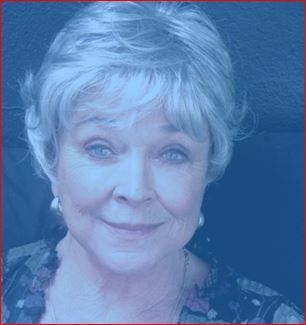 Clare Marshall.
I really enjoyed talking to Clare Marshall about The Golden Age of Webster Booth-Anne Ziegler and Friends as the group was called in 2013. The programme was heard at 8.30am on Sunday morning, 28 April 2013, on her beautiful programme “Morning Star”.
Clare Marshall with guest Jean Campbell Collen on Anne Ziegler-Webster Booth, British duettists.
https://www.podomatic.com/podcasts/podcast68887/episodes/2013-05-01T01_53_43-07_00
At the time I made this broadcast Radio Today was situated in the beautiful grounds of a plant nursery. At that time the station catered for older listeners but since then the it has changed in character, is no longer situated here and Clare Marshall no longer presents her lovely Morning Star programme.
 Radio Today, situated in a beautiful plant nursery in Jan Smuts Avenue in 2013.
After I made this initial broadcast with Clare Marshall I decided to make some podcasts of my own. I did this for several years and these are still available on Podomatic and on the Internet Archive.
There are a number of my podcasts on Podomatic from the days when I had no trouble uploading them there. All these podcasts contain recordings by Webster and Anne and related artists. If anyone is interested in hearing them, the link is:
https://www.podomatic.com/podcasts/booth-ziegler
Additional podcasts are available at: https://archive.org.bookmarks/JeannieC
including ON WINGS OF SONG – WEBSTER BOOTH AS SOLOIST –The podcasts may also be heard at: https://websterbooth.blogspot.com/
A PERSONAL MEMOIR OF ANNE ZIEGLER AND WEBSTER BOOTH:
https://ziegler-booth-radio.blogspot.com/
Jean Collen 22 April 2022.
__ATA.cmd.push(function() { __ATA.initDynamicSlot({ id: 'atatags-26942-6262ed445b1bb', location: 120, formFactor: '001', label: { text: 'Advertisements', }, creative: { reportAd: { text: 'Report this ad', }, privacySettings: { text: 'Privacy', } } }); });

April 2, 2022
WEBSTER BOOTH AND ANNE ZIEGLER’S ASSOCIATION WITH BLACKPOOL.
WEBSTER’S FIRST RELUCTANT APPEARANCE IN BLACKPOOL
Long before Anne and Webster began performing in prestigious variety shows in Blackpool in the early 1940s, Webster had to fulfill a contract in Blackpool for Muriel George and Ernest Butcher’s summer show at the Central Pier.
Webster had made his West End debut at Drury Lane as the Duke of Buckingham in Rudolf Friml’s The Three Musketeers earlier in 1930 and was making a success in the role, but could only remain there for three months because he had signed a contract to appear in a summer show for Muriel George and Ernest Butcher at the Central Pier, Blackpool from June to September 1930. Even the great Sir Alfred Butt could not obtain his release from this contract. His part was taken over by Yorkshire tenor, Robert Naylor.
Webster was very disappointed but had no choice but to move from Drury Lane to Blackpool. He continued singing Queen of My Heart, with which he had scored such a great success in The Three Musketeers, in the Blackpool summer show.
A Blackpool newspaper report reads as follows:
12 June 1930 to September 1930 – Muriel George and
Ernest Butcher returned to the Central Pier, Blackpool,
last Thursday with a new company with the exception of
their faithful and talented accompanist, Ethel Brigstock…
Webster Booth delights with his fine rendering of A
Wand’ring Minstrel and Queen of My Heart.
MARRIAGE AND DUET PARTNERSHIP
When Anne and Webster were free to marry on 5 November 1938 they hoped to work together as often as possible. They still had a number of solo engagements to undertake and Webster continued with his more serious work in oratorio as long as their duet partnership continued. When they were asked to appear on the Halls as a variety act in 1940 they were not too sure whether this transition would work as they had very light voices and feared that two shows a night for six days a week would be hard on their voices but the money offered was very tempting so they decided to go ahead with it.
They made their variety debut in Manchester in March of 1940 and were an instant success. Only a few months later they appeared in a Gala Variety Performance at the London Palladium which replaced the usual Royal Command performance during war time.
Their first appearance in Blackpool was in Lawrence Wright’s On with the Show from June to October of 1940. They rented a big Georgian house at Singleton, seven miles from Blackpool which had 27 acres of ground!
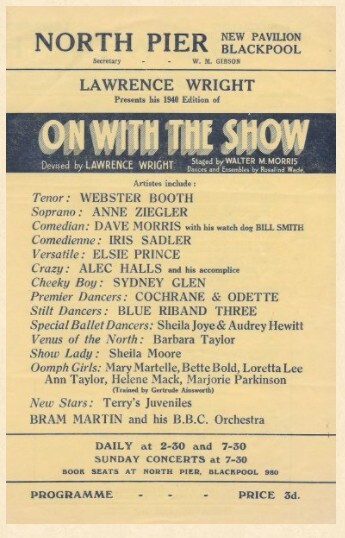 On with the Show 1940
I was lucky enough to receive the following charming article from Peggy Cruden in 2010, telling of the time she worked as a housekeeper for Anne and Webster when they were in this show. She was 93 when she wrote the article.
I REMEMBER ANNE ZIEGLER AND WEBSTER BOOTH by Peggy Cruden (nee Wakefield) (2010)
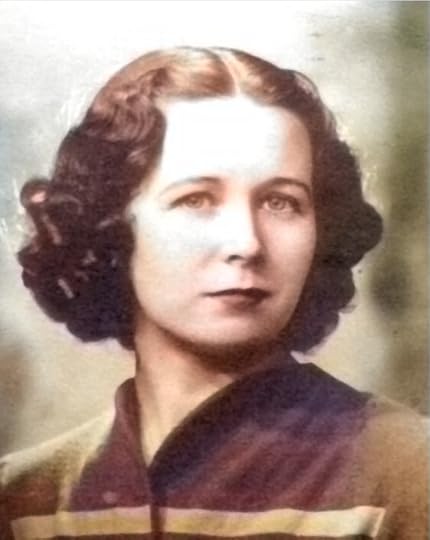 Peggy as a young woman.
I first met Anne Ziegler and Webster Booth in June 1940. I had of course heard of them before because they were so well known. I was 22 years old at the time and lived in Blackpool with my mother, Elizabeth Wakefield. We had come to live in Blackpool following
evacuation from Birmingham during the Great War because of the fear of bombing by German Zeppelins.
My mother had known Webster’s parents in Birmingham. Quite by chance one day, my mother was talking to the local butcher, Charlie Farrar who told her that Anne and Webster were living in North Park Drive, Blackpool whilst performing in On with the Show at the North Pier Theatre. He knew this because he delivered orders to them. My mother arranged, through Mr Farrar, to meet up again with Webster to renew old acquaintances and we went to visit them at the house. I was struck by what a glamorous couple they were yet at the same time very homely and friendly.
During the visit Anne and Webster mentioned that their housekeeper, whom I understand usually travelled with them, was unable to work for them for the foreseeable future because her father had been taken ill. My mother offered to help with the housekeeping chores and Anne and Webster happily agreed. However, my mother, who was in her sixties by this time found that the housekeeping was a little too much
for her. I was not working at the time as I was waiting to be called up for war service so I offered to help out instead. Anne and Webster were perfectly happy with this arrangement so I became their housekeeper for the rest of the season until it ended in October 1940.
I had a wonderful time working for them. They were always so kind and friendly towards me and were such good company. I went to the house six days each week during the morning and did general dusting and cleaning. I recall that I never had to make the bed for them as they seemed to do that for themselves. I made a rice pudding for them on one occasion. Webster said it was the best he had ever tasted
although, being such a gentleman, I expect he was just being polite!
An embarrassing thing happened one day whilst I was working upstairs in the house. I heard the bathroom door open and when I turned around there stood Webster wearing, it seemed, nothing but a shirt! I turned away but Webster didn’t appear to be concerned at all.
Anne was very generous to me. She gave me a wonderful black dress with thin silk pleats which she no longer needed and a beautiful peach coloured nightdress. I had to shorten the black dress as Anne was a little taller than I was. I also used to admire her range of make up and other cosmetics such as Elizabeth Arden cream and she would let me have some of her make up if she no longer needed it. Anne would
ask for my suggestions as to where to buy good quality clothes in Blackpool and also for my recommendations for a good hairdresser. I suggested my own hairdresser who began visiting Anne at the house on a regular basis.
I recall that Anne was a very delicate lady who was anxious to maintain her strength and energy for her performances. The butcher used to deliver marrow bones and I recall that Anne would regularly eat the marrow from the bone. She would also have regular visits from the doctor, a very handsome man as I recall. One rather bizarre recollection
I have is that during one of his visits, the doctor sat me down on the bed and syringed my ears for me. I cannot remember why but I suppose I must have asked for it to be done!
I do remember Anne telling me one day that her agent had asked her if she would like to perform a show with Richard Tauber. I was most impressed because of Richard Tauber’s reputation but for some reason Anne was less than thrilled at the prospect and as far as I know turned down the invitation.
During the summer Webster’s son, Keith, visited the house for a few
days. One day the air raid siren sounded and although Blackpool was
never really a target for German bombers, Keith and I took refuge in the coal house until the all clear was sounded. Another memory of Keith was that, according to Anne and Webster, he told them that he had been walking behind me in the street one day and had ommented
that I had a very trim figure! They were probably just teasing me but it was very flattering anyway!
Anne and Webster invited mother and me to their show at the North Pier Theatre. Mother was worried because she didn’t have a decent hat to wear so she rushed out to buy a new one. On the night, Anne commented upon how much she liked my mother’s hat which pleased my mother.
They called for us in their car, Webster driving, and parked in Queen Street, about 100 yards from North Pier. We all walked across
the short stretch of Promenade and along the pier to the Theatre. Everyone who passed by recognised who they were. It made mother and me feel very important! When we reached the Theatre, Anne went backstage to the dressing room while Webster showed mother and me to our seats. During a wonderful performance, Anne and Webster even
acknowledged us from the stage with a friendly nod! After the performance, we were driven home again by Anne and Webster.
As the end of the season approached, Anne and Webster asked me if I would go back to London and continue working for them. This was such a tempting offer which in other circumstances I would have happily accepted. However, I had by this time received notice that I was to work in munitions, making parts for Wellington Bombers at the Vickers aircraft factory in Blackpool.
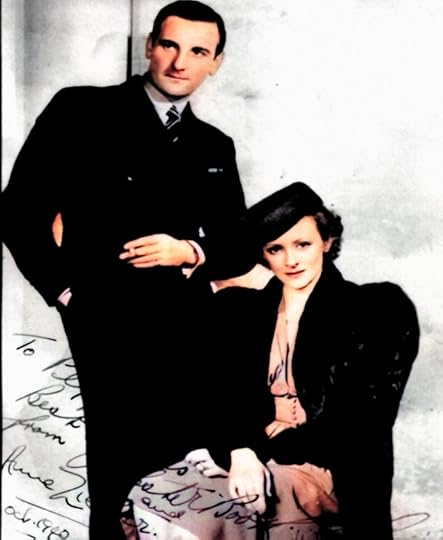 One of the photos Peggy chose and which Anne and Webster autographed for her.
As they were leaving, Anne showed me a case which she kept under the bed. The case was full of photographs of the couple and Anne invited me to take whichever photographs I wanted. I chose two and Anne and Webster autographed them for me. I still have the photographs to this day!
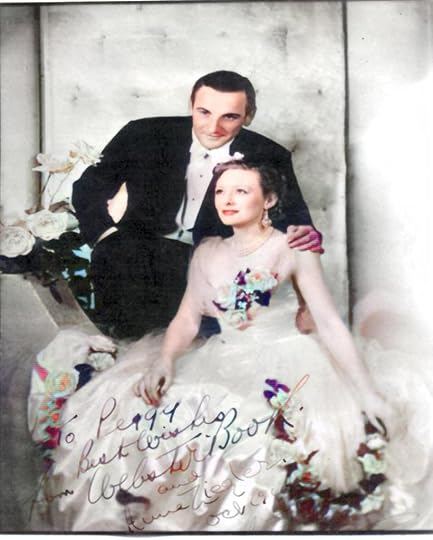 Peggy’s autographed photo.
I still live in Blackpool not far from North Pier and although I
celebrated my 90th birthday in 2007, my time with Anne and Webster still evokes fond memories. I was so fortunate that, during the dark early days of World War Two, my life was brightened by two such
shining stars.
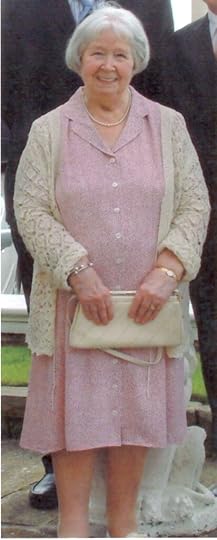 Peggy at the time she wrote the article.
The following year they appeared at the New Opera House for George Black in Hullabaloo. George Black liked their act so much that he invited them to appear in Gangway at the London Palladium early in 1942.
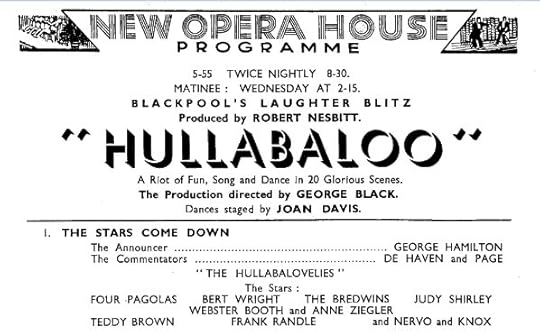
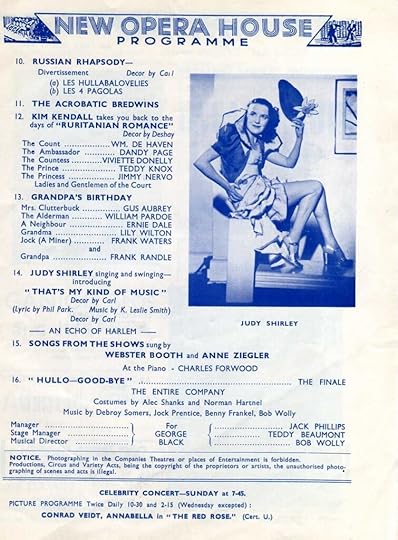
They appeared before the finalé in Songs from the Shows accompanied by Charles Forwood, who would remain their regular accompanist until the 1950s.
On 5 October 1941 they were back at the Opera House for a fund-raising concert for the RAF Benevolent Fund along with other illustrious performers including Vivien Leigh, Lawrence Olivier, Anna Neagle, Frances Day, Flanagan and Allen, Frank Randle, Nervo and Knox and Teddy Brown.
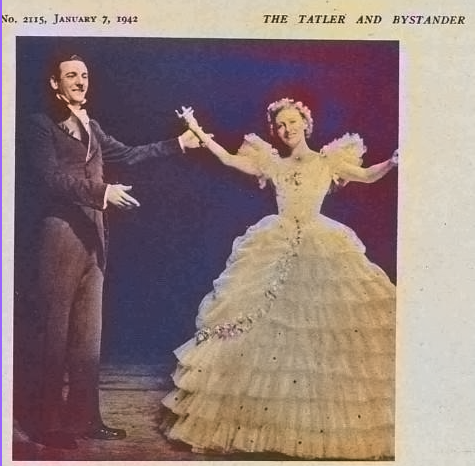
Appearing in Gangway at the London Palladium in January, 1942. Harry Parr Davies wrote some of the music for the show.
In May 1942 they appeared at the New Opera House, Blackpool for another George Black show called Black Vanities. Unfortunately Anne was taken ill during the run of the show and Webster appeared on his own in it for a while.
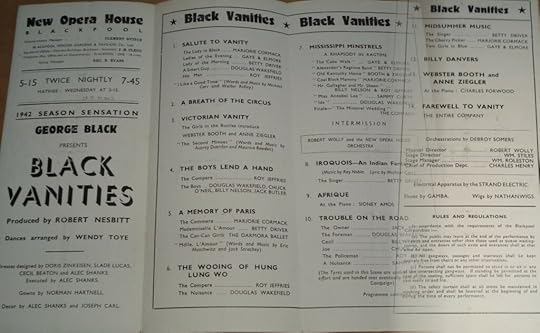 Black Vanities (1942)
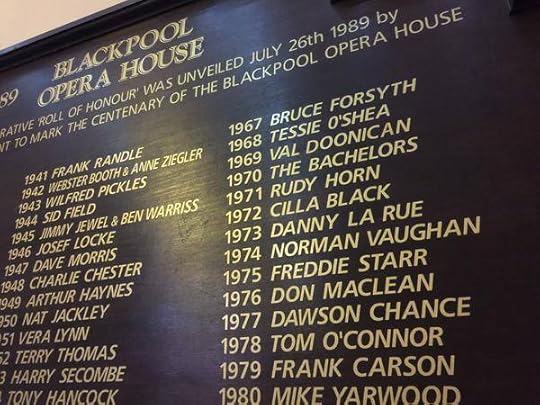
When the Roll of Honour for the New Opera House was erected in 1989, Anne and Webster’s names were given for 1942. Anne was able to attend this event in 1989.
THE MESSIAH
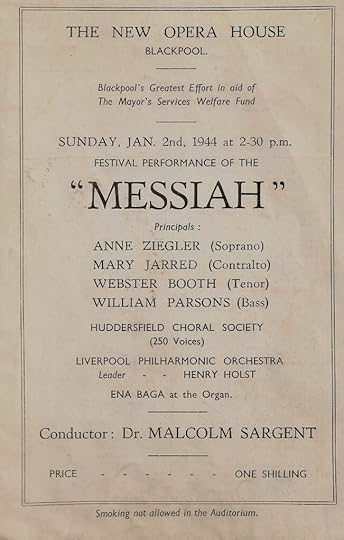
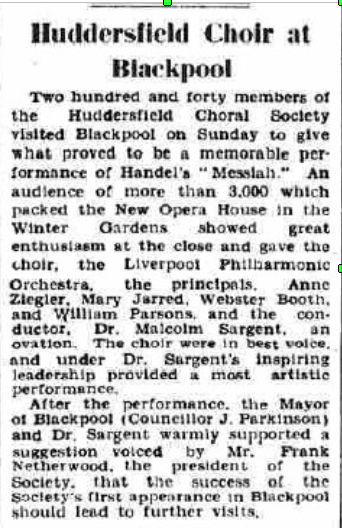
Webster had continued singing in oratorios and at serious concerts while he was singing in Variety with Anne. Anne had always longed to do more serious singing and was thrilled when Webster managed to obtain a date for her to sing the soprano solos in Messiah on 2 January 1944 with distinguished soloists and the Huddersfield Choral Society, conducted by the (then) Dr Malcolm Sargent.
OTHER BLACKPOOL CONCERTS
There were no further summer season appearances in Blackpool but Anne and Webster sang in a number of concerts there over the years, either for Harold Fielding or in Variety, usually at the New Opera House. The one below was a Harold Fielding concert in 1946.
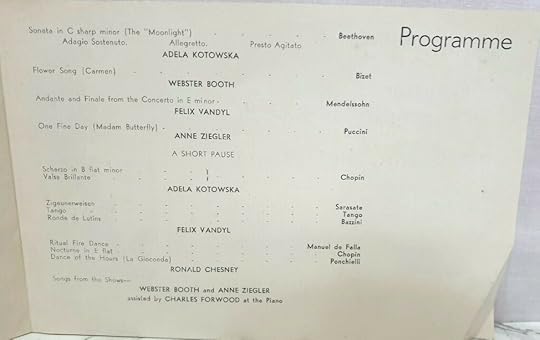
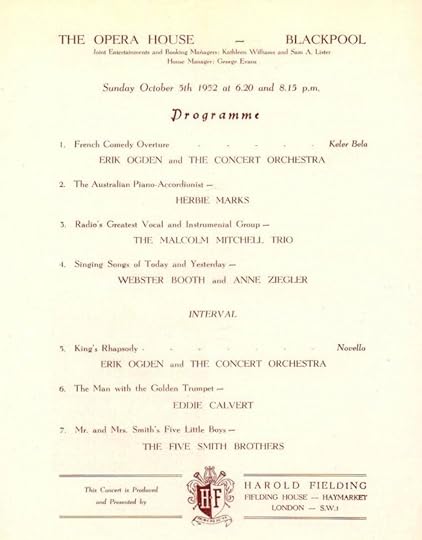
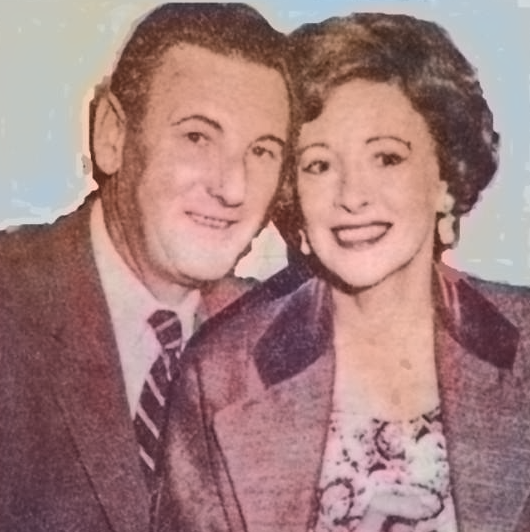 Launch of the Afrikaans LP recording.
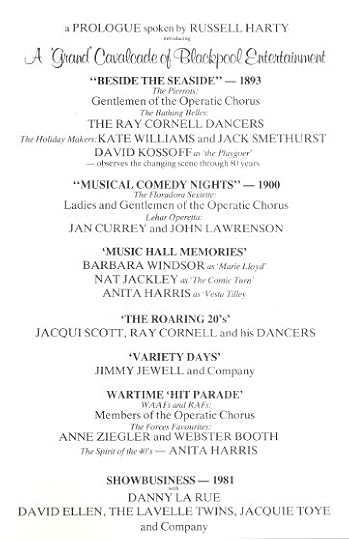
ROYAL GALA PERFORMANCE – 1981
Several years after Anne and Webster returned to the UK from South Africa they sang at a Royal Gala Performance in Blackpool. Prince Charles attended the performance and when they were presented to him after the show he asked whether they were married as he obviously had no idea who they were!
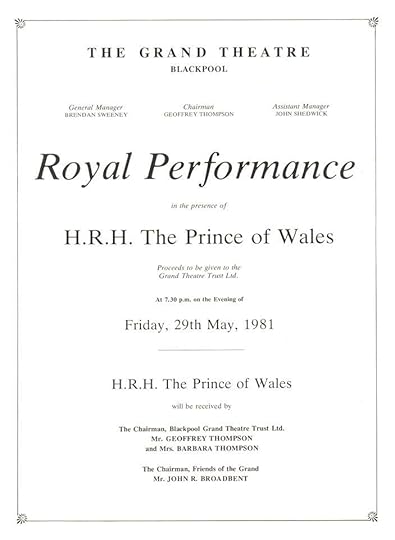
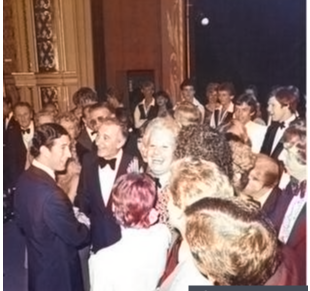 Prince Charles is chatting with some of the artistes. Webster can be seen in the background directly behind the Prince. He died three years later.
A HUNDRED NOT OUT: CENTENARY OF THE BLACKPOOL OPERA HOUSE
22 September 1989 – BBC2. 7.30-8.00 pm, A Hundred Not
Out: Centenary of the Blackpool Opera House. Programme
Number RNWF933Y, Recorded on 26 July 1989. John Mundy
narrates a programme about the Blackpool Opera House,
celebrating its 100 year anniversary. Lord Delfont unveils roll of
honour to commemorate the centenary. Among others, Anne
Ziegler recalls the glamour of the shows. Featuring Queen
Elizabeth II, Prince Philip, Mike Craig, Ken Dodd, Cilla Black,
Frank Carson, Mike Yarwood, Marti Webb, Charlie Chester,
Formby, Tommy, Bobby Ball, Stanley Holloway, Jimmy Jewell,
Bernard Delfont, Bill Waddington, Brian Crompton, Anne
Ziegler, Betty Driver, Harold Fielding, Ben Warris, Josef Locke,
Ken Robinson, (theatre-goer), Alfred Black, (theatre producer),
Lisa Waddington, George Black (theatre producer), Dickie
Hurran, Elizabeth Buzzard, Jack Taylor (theatre producer),
Peter Rigby Camera), Bernie Lowe (Camera), Mel Cross
(Camera), John Mundy (Narrator), Terry Wheeler (Producer)
Jean Collen. 3 April 2022.
March 27, 2022
DUETS OF WEBSTER BOOTH AND ANNE ZIEGLER.
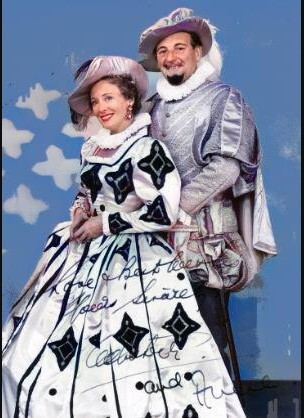 Anne and Webster in “Merrie England” East London, South Africa (1958).
A member of the Webster Booth-Anne Ziegler Appreciation Group on Facebook, Robert Knight, wrote the following:
‘Listening to Webster and Anne duetting I’m always amazed at the combination of energy and sentiment they impart with their interweaving voices.
I would love to know how the arrangements came about. Were all the songs written with duet parts that they adhered to, or did they use arrangers from the recording studios, or did they arrange the parts themselves? Did either of them take the lead in creating the arrangements? Finally do any other duettists of the period they lived through compare to their particular style, and in particular their energy and blending of voices.
I wonder if you have a few words on this or can point to anything published about Webster and Anne singing together.’
I thought that was one of the most interesting questions I have received in all the years this group has been running and it could not be answered in a few words on the group page.
I think Anne and Webster sang duets together so well was because they formed a permanent partnership both as a married couple and as duettists. Anne once told me that every single move they made was planned and rehearsed before they ever appeared on stage. Each duet was a theatrical performance as well as a musical one. It should also be remembered that they were both extremely good-looking with charming personalities and often interspersed arch comments to one another between the singing, emphasising their “sweethearts of song” image and their happy marriage.
I remember watching a couple singing duets at an Ivor Novello concert during the Proms several years ago. They were both excellent singers but there was no rapport or give and take between them as they sang. They hardly looked at each other during the entire performance. In fact, I have noticed some singers turning a duet into a competition as to who could sing louder than the other without much thought about blending the two voices together.
I suppose the only long-standing duettists to whom they can be compared are Jeanette MacDonald and Nelson Eddie. Jeanette MacDonald was very vivacious and attractive. Nelson Eddie always seemed rather wooden although he had a good voice. They were not married and appeared in films with other partners throughout their careers.
As Anne freely admitted, she was merely a “two-bit soprano” while Webster had a great voice and was certainly viewed as one of the finest oratorio singers of his day. He was often criticised because he sang duets with Anne rather than concentrating on more serious work. It should be noted that their pay for variety appearances was a great deal higher than what he was paid for performing an oratorio at the Royal Albert Hall!
He could easily have drowned Anne out had he chosen to do so, but he was careful that when they sang in harmony he toned his voice down so that their voices blended, and only let himself go when he was singing a solo part in the duet.
They stuck to the original arrangements of the musical comedy duets but Webster often arranged the music for songs which had not been written as duets, such as “Dearest of All” by Vernon Lathom Sharp, and the two Ivor Novello songs from King’s Rhapsody: “Fling Wide the Gates of Paradise” and “Someday My Heart will Awake“.
The London Times published my comment shortly after Anne’s death in 2003.
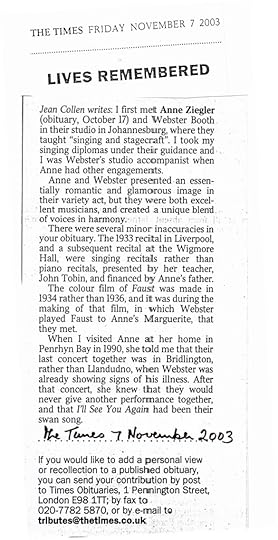
I’m afraid I don’t know of anyone who has written about Anne and Webster’s duet singing except me!
Jean Collen. 27 March 2022.
March 7, 2022
Extract from “LOVE SET TO MUSIC” by FIONA COMPTON.

Malcolm Craig – April 1957 Opening a Singing Studio.
There was nothing more to be done. We had sung at concerts, taken roles in musicals, appeared in film adverts, and made some radio broadcasts. If wealth could have been measured by the number of times our photos appeared in the society pages of the local newspapers, we would have been the richest people in Jo’burg! The truth was that we really couldn’t live on what we were earning. The money we had managed to bring to South Africa together with what we had left in a bank before we returned to England after our tour was fast disappearing. We had to cast our net wider in order to continue living with a certain degree of comfort. Reluctantly, we realised we had no alternative but to start teaching singing, certainly the last thing I had ever wanted to do.
I had been blessed with a good voice and had never needed to work very hard in order to improve it. To tell the truth, I had absolutely no idea how to teach other people to sing. On the other hand, Marina had worked diligently to improve her small voice and rid herself of a range of vocal faults. She was always telling me that things had come far too easily to me, while things had been difficult for her. Despite all her hard work, her voice remained average in comparison to mine. That might sound very big-headed, but it was no more than the truth.
For a very reasonable rental, we found a charming, airy studio on the eighth floor of a building in central Johannesburg. From the balcony leading off the studio we had a fine view of the hustle and bustle of the city. Across the road from the studio we had competition from three little boys who appeared every morning to play Kwela music on a penny whistle, guitar, and a bass made of a tea chest with strings attached to it. We moved our Chappell Grand piano, a fine Wilton carpet and a full length mirror into the studio. With the aid of a fitted cover and matching cushions Marina managed to turn a rather pedestrian divan into a fashionable studio couch. There were roomy shelves at one end of the room so we brought all our music in and filled the empty shelves with our large collection of songs and scores. Marina had a glass panel erected above the studio couch and we placed numerous photos of ourselves in various shows and with some of our famous colleagues from our days in the UK behind it. We had a phone connected in the tiny room leading off the studio which we grandly called “the office”, bought a smart leather-covered appointment book, put several classified advertisements in the local newspapers advertising our services, and waited for a rush of prospective pupils to phone for an audition and put in an appearance.
We even held a studio-warming cocktail party one evening in anticipation of the arrival of our prospective students. All the well-known musical and theatrical folk we had met attended the get together, along with friends we had made since our arrival in Johannesburg. Some genuinely wished us well in our new venture, while others attended out of mere curiosity to see how we had arranged our studio, and perhaps hoping that our latest venture would fall flat very soon.
“It’s very charming,” said one of the local singers who ran a large and successful teaching practice in the city, styling herself as Madame Ricardo. I sensed a “but” was to follow, and I was right. “But where are all your music diplomas and degrees? You should put up all your qualification certificates on the wall. Even though you are famous compared with the rest of us poor locals, parents usually like to see that you have letters after your name before they hand out their money to you every month. I have one wall of my studio simply plastered with all my music diplomas – you must come up and see it one day.”
Marina and I smiled at Madame Ricardo and murmured non-commitally. Truth to tell, neither of us had a diploma or a degree to our names! Despite the lack of these paper qualifications we had enjoyed careers these locals could only dream about. Had Madame Ricardo, with her wall plastered with all her musical qualifications, ever sung in the Albert Hall or at Drury Lane? Having letters after her name did not automatically mean that she was a capable performer.
“And of course, you must join the South African Society of Music Teachers,” Madame Ricardo continued. “I’ll be very happy to nominate you for membership. All you have to do is fill out a form listing all your qualifications and your teaching experience.”
We moved on to greet our other guests without giving her the satisfaction of admitting to our lack of professional qualifications. Presumably the Society of Music Teachers would turn us down flat as we had neither qualifications nor any teaching experience! Not for the first time, I wondered if I was living in the middle of a terrible nightmare from which I might never wake up!
We had a number of curious inquiries from our classified advert, but few followed up their initial enquiry when we told them the fee we were asking. We had assumed that we would charge the same sort of fee we had heard quoted before we left London. One of my colleagues had retired from the concert platform and was running a successful and busy teaching studio from his home in Highgate. Before we left the UK he had told us what he charged for lessons. We had reckoned on charging the same in Johannesburg, but we had not bothered to ask the local teachers with all those impressive letters after their name, what the average local fee was. Before we even had a chance to gain experience in teaching, we had effectively priced ourselves out of the local market.
FIONA COMPTON.
__ATA.cmd.push(function() { __ATA.initDynamicSlot({ id: 'atatags-26942-62262544702e2', location: 120, formFactor: '001', label: { text: 'Advertisements', }, creative: { reportAd: { text: 'Report this ad', }, privacySettings: { text: 'Privacy', onClick: function() { window.__tcfapi && window.__tcfapi( 'showUi' ); }, } } }); });January 20, 2022
WEBSTER BOOTH – 120TH ANNIVERSARY OF HIS BIRTH ON 21 January 1902.
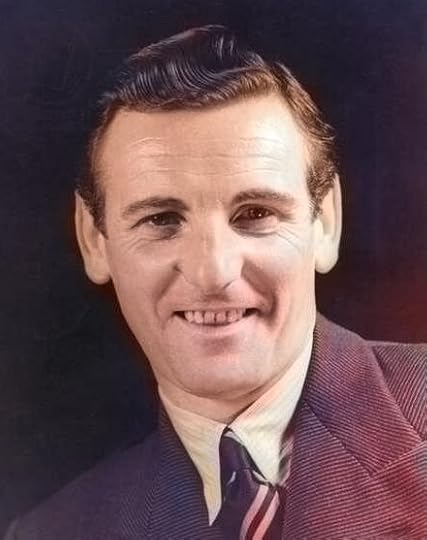
The famous tenor, Leslie Webster Booth was born in Handsworth, Birmingham on 21 January 1902. The 21 January 2022 is the 120th anniversary of his birth. He died at the age of 82 in Llandudno, North Wales on 21 June 1984.
I first met Webster Booth on the eighth floor of Polliack’s Corner, Pritchard Street, Johannesburg, outside the singing and stagecraft studio belonging to him and his wife Anne Ziegler in late December of 1960. I was 17 years of age and had just left school. He celebrated his 59th birthday on 21 January 1961.
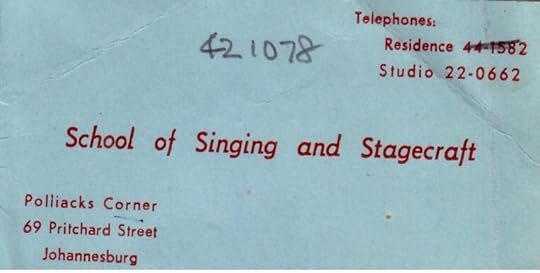
In 1963 they asked me to play for Webster when Anne went on holiday with Leslie Green – one of the highlights of my life. We remained friends until Webster’s death in June of 1984 and Anne’s death on 13 October 2003. They were a major influence in my life and will never be forgotten.
Today I discovered a programme of the pantomime, “St George and the Dragon” presented in December 1927 at the Brixton Theatre by the “pantomime king”, Fred Melville. Webster played King Arthur of England, while Tom Howell, the leader of the Opieros, was Sir Mordred de Killingsley.
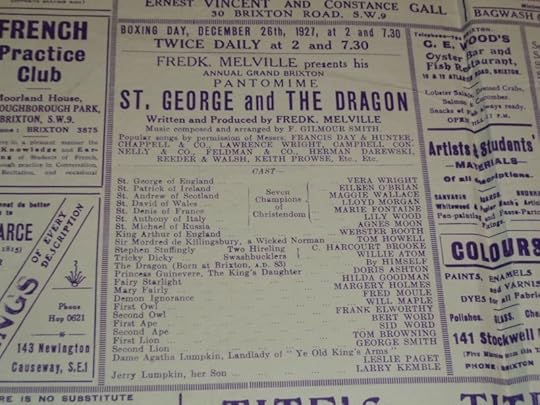 St George and the Dragon. 1927.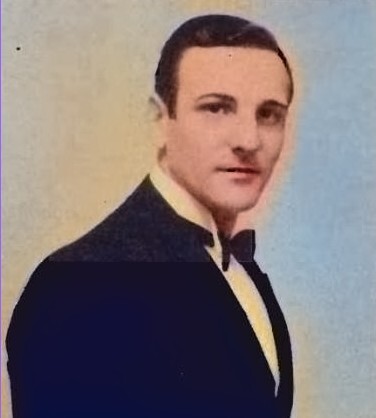
https://drive.google.com/file/d/1uaqW-WSoBzJav71Ud3E-uRGBkbcRkaR9/view?usp=sharing Here is a recording made in 1936 with the South African soprano, Garda Hall.
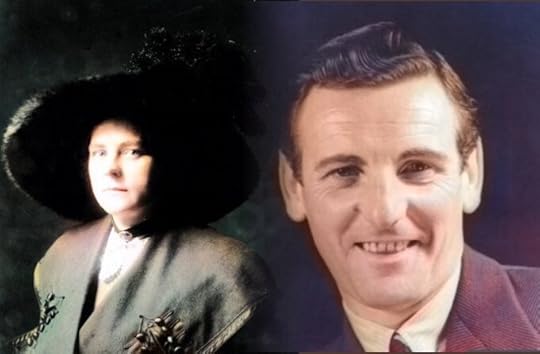 Garda Hall, Webster Booth.
https://drive.google.com/file/d/10Bgn_fwe1OUttQBis0UpQU4GdpLZB5pl/view?usp=sharing
Lovely Maid in the moonlight (with Joan Cross), In a coupé (with Dennis Noble)
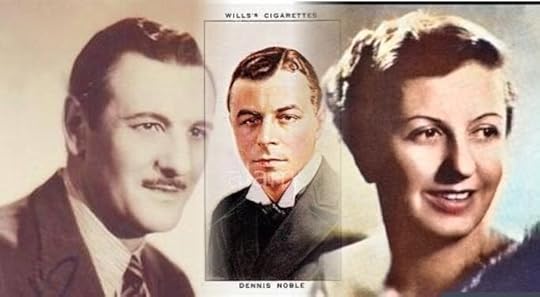 Webster Booth, Dennis Noble, Joan Cross.
https://drive.google.com/file/d/1HYry2070p5541YLH1EeGEvUFyOQfh2xR/view?usp=sharing
Duets with Anne Ziegler: Here in the quiet hills (Gerald Carne), Still as the night (Carl Bohm), Love Me Tonight (Vagabond King – Rudolf Friml)
 Anne Ziegler and Webster Booth at the wedding anniversary party for Maurice and Jean Buckley in 1981.
I commemorate this milestone anniversary with a melody of songs featuring two operatic recordings, two oratorio recordings, two ballads and two songs from musical comedy. Webster Booth was a versatile singer and all these songs show his excellence in various spheres of vocal art.
Your tiny hand birthday medley: Flower Song (Carmen), Why does the God of Israel Sleep? (Samson), Your Tiny Hand is Frozen (La Boheme), Sound an Alarm (Judas Maccabeus), Sylvia (Oley Speaks), Porgy and Bess (Gershwin), Trees (Oscar Rasbach), Morning Glory (Sweet Yesterday, Kenneth Leslie-Smith) https://drive.google.com/file/d/1I9XuuvuMvMbmN9snch1oBX9okyestqy0/view?usp=sharing
 Remembering Webster on the 120th anniversary of his birth.
Jean Collen, 21 January 2022.
__ATA.cmd.push(function() { __ATA.initDynamicSlot({ id: 'atatags-26942-61ea65ae77c96', location: 120, formFactor: '001', label: { text: 'Advertisements', }, creative: { reportAd: { text: 'Report this ad', }, privacySettings: { text: 'Privacy', } } }); });October 12, 2021
IVOR NOVELLO MEDLEY FEATURING WEBSTER BOOTH AND ANNE ZIEGLER.
The link to the Ivor Novell medley featuring Anne and Webster is: https://drive.google.com/file/d/1QXOwSLxwZ__2US_z6R-pG0gNnoagnYIg/view?usp=sharing
The other evening I listened to a podcast in the Great Lives series of programmes on BBC Radio 4 about Ivor Novello. https://www.bbc.co.uk/programmes/b037tnxp 4 Extra Debut. Entertainer Russell Grant nominates Welsh composer Ivor Novello. With Matthew Parris and biographer Richard Stirling. From 2013.
I found the discussion quite interesting until they spoke of another Ivor Novello programme which shared a photograph of Anne Ziegler and Webster Booth “in their dotage” which suggested that Ivor Novello’s compositions was “naff music” for “naff listeners”. I was rather upset to hear these comments about my dear old friends, which suggested that they were nothing but second-rate performers. I think this was the photograph to which the two Ivor Novello “experts” referred to when they had returned to the UK after 22 years in South Africa. Webster was nearly eighty, Anne nine years younger.
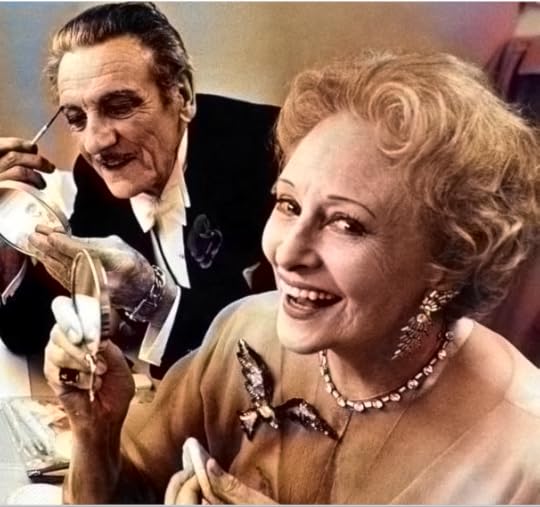 Annr and Webster (1979)
I decided to compile some of their Ivor Novello recordings.
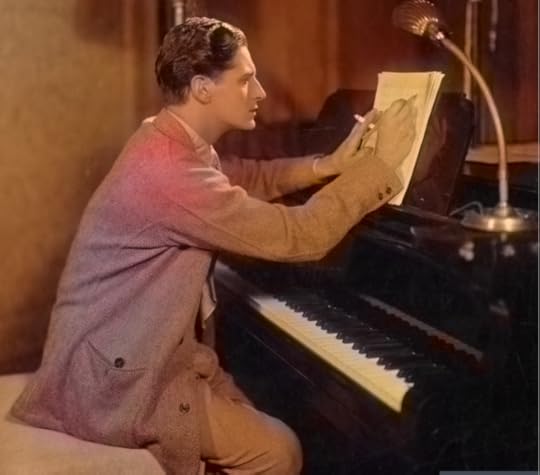 Ivor Novello.
4 October 2021 Ivor Novello medley: https://drive.google.com/file/d/1QXOwSLxwZ__2US_z6R-pG0gNnoagnYIg/view?usp=sharing
Someday my heart will awake ANNE ZIEGLER (sop), WEBSTER BOOTH (ten)(o MARK LUBBOCK) London. 12 July 1950. Released November 1950. Deleted February 1953. Webster arranged the two songs from King’s Rhapsody as duets.
Careless Rapture medley (WB and Angela Parselles)
Fling wide the gates of paradise (cuts off before the end). ANNE ZIEGLER (sop), WEBSTER BOOTH (ten)(o MARK LUBBOCK) London. 12 July 1950. Released November 1950. Deleted February 1953.
C3521 Ivor Novello Vocal Gems, Part 1: ORCH Keep the Home Fires Burning. OLIVE GILBERT Bless You. PETER GRAVES Every Little… ORCH They Didn’t Know the Way to…
Part 2: OLIVE GILBERT Thoughts of You. HELEN HILL Glamorous Night. WEBSTER BOOTH Shine Through My Dreams, OLIVE GILBERT Rose of England. ORCHESTRA (HARRY ACRES. London. 15 October 1946. C3522 Ivor Novello Vocal Gems
Part 3: HELEN HILL Waltz of My Heart . WEBSTER BOOTH My Life Belongs to You. HELEN HILL, WEBSTER BOOTH France will rise again.
Part 4: ORCH April’s Lady. HELEN HILL I Can Give You the Starlight. WEBSTER BOOTH Love is My Reason. OLIVE GILBERT We’ll Gather Lilacs. ORCHESTRA (HARRY ACRES). London.15 October 1946.
My Dearest Dear/Merry Widow Waltz (Anne and Webster) Broadcast circa 1980
We’ll Gather Lilacs (Anne and Webster, with Albert Sandler on violin). Recorded 1945.
13 October 2021 Anne Ziegler medley: He’ll say that for my love (Handel), The Little Damozel (Ivor Novello), Pink Lady (Palm court orchestra), Pink Lady (Anne) https://drive.google.com/file/d/1T50dfR8KfTi0VmRElcPLuQeSBpPbk7qf/view?usp=sharing
Anne Ziegler died on 13 October 2003, 18 years ago. She is sadly missed but will always be remembered with love.

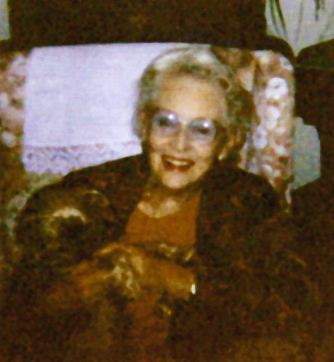 Anne with Bonnie, her beloved little Yorkie. October 1990, Penrhyn Bay. Photo: Jean Collen.
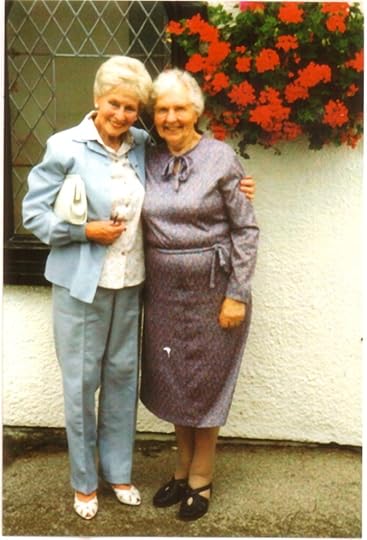 Anne and her friend, the late Joan Tapper (circa 2001)
 An extract from Anne’s last letter to me in June 2003. We spoke on the telephone in August, shortly before she had a bad fall and was admitted to hospital.
Jean Collen 12 October, 2021.
September 22, 2021
MEDLEYS – 2021 ONWARDS.
There are many more recordings to listen to if you search this site. In future I will add medleys here rather than post them directly to The Webster Booth-Anne Ziegler Appreciation Group in Facebook. I get the feeling that the medleys are an acquired taste so I don’t want to bore people who belong to the group. The ones I post here will connect to my Google drive. I will be interested to hear if you listen to the recordings and what you think about them. If I add more medleys I will post a monthly reminder on Facebook to this site.

April 2021 Marigold medley: Scherzo Caprice (Leon Goossens) The White Dove WB, Air de Ballet, As I sit here, WB A May morning, Say that you are mine, WB, Little lady of Spain, Just for today WB, My party frock, Trees WB, Marigold (Fred Hartley playing Billy Mayerl). https://drive.google.com/file/d/12EeC4ZSBsd2g8j6YqZkdR2yhkTJ55-lR/view?usp=sharing
2. September 2021. Serenade d’Arlequin Medley: Nocturne (Borodin), Morning (WB), Albinoni Adagio, May the Good Lord Bless and Keep You (WB), Tosti Cavatine, Evening Song (WB), He Bought my Soul at Calvary (WB), Lovely Lady, There’s a Land (WB), Brighton Hike. https://drive.google.com/file/d/1BEAEXmV7UOCQtw4WkU-JKvOlqI3CMLeT/view?usp=sharing
9.9.2021 Sweethearts. 3 versions copied. https://drive.google.com/file/d/1mu09BcgzsAEOm6YCN6FZ-QiVRDmaoMi4/view?usp=sharing
20.9.2021 Oratorio medley: Allegro (Sandler), Acis and Galatea (Handel) (WB), Care Selve (Handel), In Native Worth (The Creation) (Haydn) WB, Apres un reve (Faure), Be thou faithful unto death (St Paul) (Mendelssohn) WB, Arioso (Handel), Total Eclipse (Samson) Handel) WB, Concerto in d minor 3rd movement (Marcello) https://drive.google.com/file/d/1JJ5uKF8jwYsxCgOATS2d02uDl8pcHu7f/view?usp=sharing
WB: Webster Booth. Most of the medleys feature Webster Booth as a soloist.
Jean Collen 23 September 2021.
September 15, 2021
SWEETHEARTS (Victor Herbert)
https://drive.google.com/file/d/1mu09BcgzsAEOm6YCN6FZ-QiVRDmaoMi4/view?usp=sharing
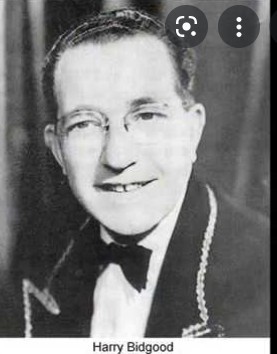
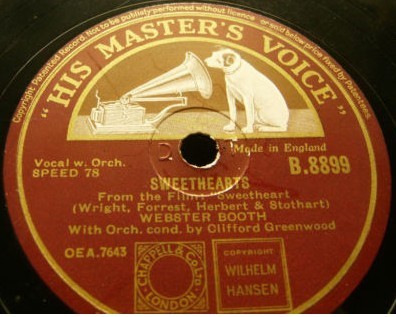
I have joined the three versions of “Sweethearts” sung by Webster Booth on three different recordings. The first version is sung by Webster and an unknown soprano (as vocal refrain) with Carlo Santana’s accordion band. Carlo Santana was a pseudonym for Harry Bidgood who made many recordings under his own name and used a number of pseudonyms into the bargain. The identical recording was also on the Primo Scala recording (another Harry Bidgood pseudonym).
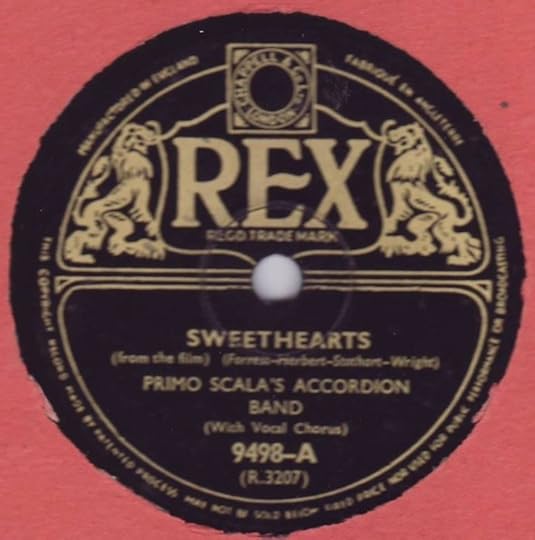
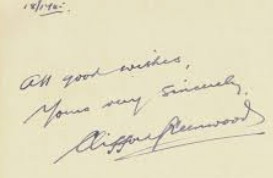
The second version is one Webster made for HMV in 1939 and was conducted by Clifford Greenwood. I couldn’t find a photo of Clifford Greenwood but here is an autograph instead.
A recording made by Hugo Rignold in his more serious days as a conductor of classical music.
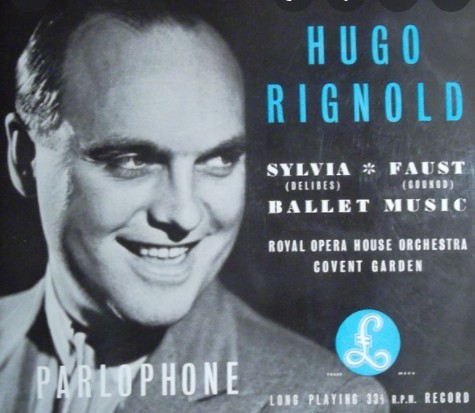
The third version is with Hugo Rignold’s band. I am grateful to Mike Taylor for finding the last recording and sharing it with the group. I assume that the violin introduction was played by Hugo himself. I was rather surprised that Webster was not mentioned by name on this recording but is acknowledged only as “With Vocal Chorus”. Perhaps this had something to do with the fact that this record was produced by Columbia and he was under contract to HMV at the time.
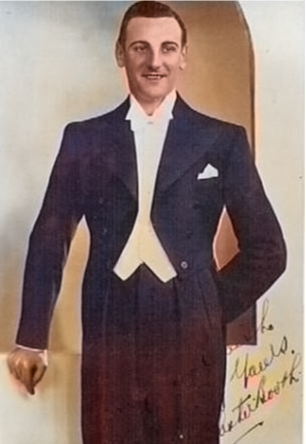
Webster had known Hugo Rignold as a violinist and member of Fred Hartley’s sextet (or quintet) when Webster appeared regularly on the radio with Fred Hartley’s group in the 1930s. Hugo Rignold’s father had been a conductor and most of young Hugo’s early life had been spent in Canada. Apparently Hugo delighted in telling funny stories and amused everyone in his wake. Webster and Anne shared a dining table with him when they travelled to South Africa aboard the Pretoria Castle in July of 1956. By then, Hugo was a conductor of symphony orchestras but still kept everyone in stitches!
Webster’s relationship with Hugo Rignold ended abruptly. Rignold visited South Africa to work with the Cape Town symphony orchestra in the early seventies. At that time he was accompanied by his daughter who was managing his career. Webster and Anne were living in Knysna at that time and they wrote to him, suggesting that they could meet while he was working in the country. He left at the end of 1973 and but he did not reply to their letter. They felt rather hurt about it and wondered if his daughter had not passed the letter on to him.
Jean Collen
15 September 2021.
September 9, 2021
BOOK REVIEWS by JEAN COLLEN.
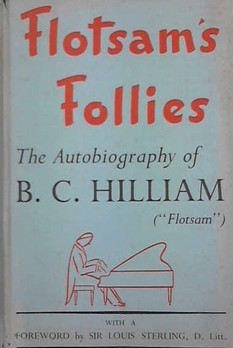
“Flotsam’s Follies” by B.C. Hilliam
My rating: 4 of 5 stars
This book was published in 1948 and B.C. Hilliam (Flotsam) has an idiosyncratic way of writing, often interspersing the prose of his autobiography with numerous verses, many of which were used in various performances with his long-time partner, Malcolm McEachern (Jetsam), and for “Flotsam’s Follies” which followed after McEachern’s untimely death in 1945.
The book is filled with fascinating information about his own colourful life and tales of his theatrical contemporaries, including mention of Garda Hall, Bettie Bucknelle and Paddy Prior, all of particular interest to me. He and McEachern were devoted members of the Savage Club and made many informal appearances there. Hilliam included many of his amusing pencil sketches in his book. I thoroughly enjoyed the book and although it is long out of print, it can still be bought second hand online.
Greasepaint and Cordite: How ENSA Entertained the Troops During World War II by Andy Merriman

My rating: 3 of 5 stars
I found this book interesting, well-written and well-researched.
My criticism is that it would have been better if the book had been written twenty or thirty years earlier when more ordinary ENSA entertainers were alive and could have shared their memories of working for the organisation. Instead, a great deal of information had been found in books by – or about – famous performers like Vera Lynn and Joyce Grenfell. I had already read many of the books in the author’s bibliography, so I did not discover much new information in this book as the experiences of forgotten performers were rather thin on the ground.
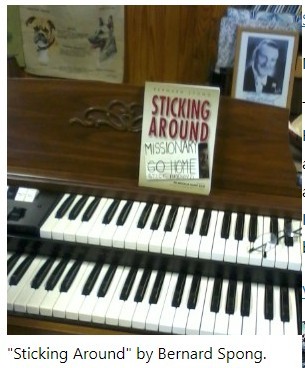
Sticking around by Bernard Spong
My rating: 5 of 5 stars
This is a wonderful and enlightening book by the Reverend Bernard Spong. His interesting, and sometimes painful experiences as a minister and an anti-apartheid activist in South Africa, are very different from my own and were an eye-opener to me. I can thoroughly recommend this captivating book and I am very grateful that Bernard was kind enough to send me a copy of his book. I shall treasure it.
Letters and Diaries of Kathleen Ferrier by Christopher Fifield
My rating: 4 of 5 stars
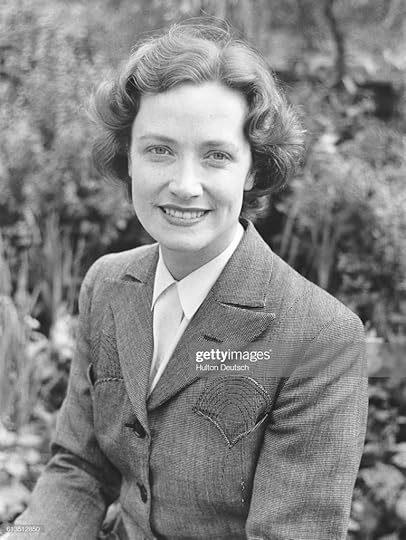 (Original Caption) British contralto opera singer Kathleen Ferrier at the Edinburgh Festival in 1947. (Photo by © Hulton-Deutsch Collection/CORBIS/Corbis via Getty Images)
From 1949 to 1951 Anne Ziegler and Webster Booth lived at Frognal Cottage, Hampstead, opposite 2 Frognal Mansions, where Kathleen Ferrier lived. The Booths became friends with Kathleen when they met her walking on Hampstead Heath as they were out walking their Cairn terrier, Smoky. Webster had been booked to sing a Messiah with her in 1951, but they were both very disappointed when she had to cancel this performance because of her illness. I was singing much the same repertoire as Kathleen when I began studying with the Booths in 1961 and they often lent me her recordings from their own record collection. Thus, although Kathleen had died tragically young when I was a child, I always felt a close affinity with this wonderful woman with the unique contralto voice of the twentieth century.
I was rather disappointed to find that Kathleen Ferrier’s diaries were little more than concert dates, occasionally with brief remarks about how a particular engagement went. On reflection, she was working hard so would have had little time to write substantial diary entries at the end of a busy day.
The letters more than compensated for the brevity of the diaries. She wrote many business letters to keep her very busy career in order. While many singers might have longed for more engagements, Kathleen Ferrier was overwhelmed with offers, to the extent that she often had to turn engagements down and beg for a few days respite from her agent, Emmie Tillet. She could certainly never have undertaken such a demanding career had she been married with children. Her letters show that her extensive American tours in the late 1940s involved exhausting travel arrangements. She had to pay for her own advertising, travel, accompanist and accommodation on these tours, so she hardly made a fortune at £50 a concert.
Her affectionate, informal letters to her sister, Winifred, her father and other friends were always bright, self-deprecating and humorous. Her letters of thanks to acquaintances were always appreciative and polite. Even when she turned down songs which had been sent to her, or engagements she could not undertake, she did so in a kindly way.
Once again, it was sad to see her grave illness taking hold so that she eventually lacked health and strength to write her own letters and relied on her help-meet, Bernie to write on her behalf.
There is a good bibliography,an extensive index of works in Kathleen’s repertoire, another of places, venues and festivals, as well as a general index.
September 8, 2021
THE RECORD CONTRACT by FIONA COMPTON.
Gingerly Heather Craig nibbled on the thin slice of dry toast and drained her cup of weak black tea. The morning sickness was getting worse and she didn’t know if she could hide her pregnant state from Malcolm for much longer. She was relieved that she had an appointment with her gynaecologist that morning, and not a moment too soon.
Mrs Hubbard bustled into the dining room with the first post. Malcolm’s agent had forwarded the week’s fan mail, so she put the pile of letters at Malcolm’s place. The pile was not quite as high as it had been four or five years earlier, but it was still sizeable. In contrast, Heather received a few accounts and the weekly letter from her mother. Heather noticed that the month’s copy of Gramophone had arrived, probably containing the anticipated review of Malcolm’s first long-playing record.
Heather decided to read the review before Malcolm came down for breakfast. He was due at the recording studios later that morning for his regular recording session. She had difficulty in locating the review as it was much shorter than she had anticipated. As she read the brief review her nausea returned, this time brought on by shock and dismay. One sentence stood out above all the others.
“Only Malcolm Craig’s most ardent fans will enjoy this innocuous collection of highly forgettable songs.”
Heather heard Malcolm’s footsteps on the staircase and hurriedly hid the periodical under her chair. This spiteful piece was the last thing he needed to see before his recording session and the Watford concert that evening.
“You’re up early, darling,” he remarked as he planted a kiss on the top of her blonde head. “Have another cup of tea and keep me company while I eat.”
Malcolm poured some strong tea into her cup, but she knew she would not be able to take a sip of it.
Malcolm glanced perfunctorily through his post.
“No sign of the Gramophone ?” he asked casually.
“Perhaps it’ll come by the second post.” Heather tried to sound light and cheerful, willing her warring stomach to settle down. She bent down and somehow managed to hide the offending periodical under her red dressing gown, before fleeing from the table. Just in time she managed to reach the privacy of the bathroom before nausea overwhelmed her completely. Malcolm would have to wait until tomorrow before he faced some unpleasant reading.
-0-
It was March 1951 and Malcolm Craig’s recording contract was due for renewal. The ritual was always the same. Each year, for the last twenty years, Frank Downey, the managing director of the famous BRG recording studio in Wigmore Street, would arrive before the session and invite Malcolm into his office to sign the new contract when he had finished his work. The business concluded, Downey would offer him a tot of his excellent single malt whisky.
“How are you, Malcolm?” Frank Downey greeted Malcolm Craig effusively. “Would you mind calling into my office after your recording session? I have some business to discuss with you.”
Malcolm Craig recorded the eight selected songs in less than three hours. He was an excellent sight-reader, so all he needed was a brief run through with the eminent accompanist, George Manning, before he was ready to lay the cake on the table.
He listened to the takes with his producer and George Manning, then, satisfied with the morning’s work, made his way up to Frank Downey’s sumptuous office to find the gentleman already hovering at the door ready to greet him.
Downey ushered Malcolm to the plush leather chair facing his large oak desk. Usually the contract was lying on the desk waiting for him, a gold Schaeffer pen near at hand, ready for him to sign on the dotted line. But today the desk was bare and Malcolm speculated about the empty desk and why Downey appeared so fidgety and uncomfortable.
“Is the contract late?” Malcolm asked, trying not to show concern.
“That’s what I wanted to discuss with you, Malcolm,” Frank began. “What with the advent of the LP and changes in people’s taste since the war, your records are just not selling the way they used to.”
Downey watched Malcolm’s rugged face slowly lose its colour. He really had not reckoned on the man passing out on him.
Despite his pallor, Malcolm spoke in measured tones.
“Frank, I’ve known you too long to listen to a lot of soft soap. Are you telling me you’re not renewing my contract?”
“I’m so sorry, Malcolm. I fought against it of course, but I was outvoted.”
As though to console Malcolm, he added brightly, “You’re not the only one to suffer – we’re not renewing the contracts of many of our gifted pre-war artistes. They’re all still in good voice, but there’s no demand for them these days. I’m really sorry.”
Malcolm’s legs were trembling. Despite being nearly fifty, and one of Britain’s’ greatest and most versatile tenors, he was close to tears. He was still in the prime of his vocal life, and here he was being discharged like an indolent office boy. He was due to sing at a concert in Watford that evening. After this blow he would need all his professional expertise to carry the engagement off successfully.
He rose to his feet, willing himself to leave with dignity before he broke down.
“There’s nothing more to be said then,” he said baldly. “No doubt you’ll send any money owing to my agent.”
“Please don’t leave like this, Malcolm! Have a whisky with me for old time’s sake,” pleaded Downey.
What was there left to discuss now that he had no contract binding him to the company? The whisky would choke him. He turned on his heel and walked out of the office, and left the building without a word of farewell to anyone. He gained the privacy of his Wolseley, lit a forbidden Capstan and drew on it deeply. Concert and radio dates had been falling off a bit lately, but he and Heather relied on the steady income from his recordings to keep them in comfort. What was he to tell her?
He made his way to his comfortable home in Hampstead, aware that he would probably never drive the same route again. He wondered whether his voice, the splendid gift he had taken for granted since childhood, could be failing him. But that couldn’t be right. He had just heard the recordings he had made that very day. His voice sounded better than ever. As he edged the big car slowly up the driveway, he glimpsed Heather, in tiny pink shorts and a bright seersucker top, sunbathing on a deck chair near the rose bower.
He had met Heather in a concert party in Margate, a few years after he had signed his first record contract, a gorgeous blonde of twenty, with sea green eyes and a complexion like a ripe peach. Her stunning looks and charm excused the fact that her voice, though pretty and sweet, was merely run of the mill. She had managed to make a stage career for herself because of her looks and charming personality.
They had fallen in love, and spent every free moment together, mingling with the holidaymakers licking cornets, while their children were having special treats seated on the staid donkeys on the beach. The light-hearted atmosphere on the seafront contrasted with their seaside lodgings where they were surrounded by elderly corseted widows in the dining room and the lounge.
They were married at the end of the season and Heather was only too happy to stop attending audition calls to take on her new role as Malcolm’s dutiful and loving wife. In those heady days he was in great demand for West End musicals, oratorios, Masonic Concerts, recording and broadcasting for the BBC, Radio Luxembourg and Radio Normandy.
Malcolm’s successful singing career gave them all the luxuries of life, but their mutual desire for children remained unfulfilled. Heather had twice fallen pregnant, but had miscarried both times. They eventually accepted that they would be childless and transferred their thwarted parental instincts to their two Scotties, Whisky and Soda.
Malcolm emerged from his reverie and watched Heather as she lounged, half-asleep in the sun without a care in the world. The two dogs had been cavorting around the garden, always with half an eye on their beloved mistress, but now they bounded in his direction to greet him with an effusion he found difficult to reciprocate that day.
-0-
Heather had kept her appointment with her gynaecologist. Dr Urquhart, an elderly Scot, did a thorough unhurried examination to which Heather submitted with stoicism. She had been through such inspections before to no avail. At the age of forty she had not held out very great optimism that she could have a child at such an advanced stage of life.
“I can safely say your pregnancy is going smoothly, Mrs Craig,” he said with a rare smile. “You’ll have to take things easy for you are not young as far as child-bearing is concerned and you have had two problem pregnancies before, but if you look after yourself I see no reason why you shouldn’t carry this infant to full term.”
-0-
“Darling!”
Heather had seen Malcolm’s car at last and hurried to him, eager to kiss him and tell him her glad news right away, but her elation evaporated at the sight of his haggard face.
“Did you sign your new contract?” she asked uncertainly, knowing before he spoke that all was far from well.
“There is no new contract,” Malcolm murmured under his breath. “I’m finished at BRG. I’m sorry, darling.”
Heather took his hand in hers, hurt to see her usually cheerful uncomplicated husband so downcast.
“It doesn’t make sense. You’ve never sounded better. Did Frank give you an explanation? There must be a mistake.”
“They’re getting rid of a lot of us pre-war singers because public tastes have changed. The British public prefers crooners these days. I fear my days as a singer are numbered.”
“Nonsense! As soon as other companies hear you’re free they’ll jump at you,” said Heather hopefully.
“I don’t think so,” replied Malcolm dejectedly. “I’m getting an old man.”
“Rubbish!” she said. “You’re not even fifty. You have years ahead of you as a singer.”
“I’m too upset to talk about it. I still have to get through that concert in Watford tonight, though I don’t know if I’ll have the strength to do so.”
Her heart went out to him in his misery. She decided to postpone her news until after the concert. The copy of the Gramophone was under her side of the mattress. It would be a while before she would produce it. He didn’t need another knock for a while.
Malcolm bathed and changed, then sat on his favourite chair in the drawing room, absentmindedly stroking one of the Scotties, idly regarding the Spanish cabinet, the Chappell grand piano, the Wilton carpets, and the fine antiques, all the beautiful possessions he and Heather had acquired from the money he had earned over the years. How could they afford to go on living like this now his career was on the wane?
He was surprised to see Heather emerge in her low-cut red evening gown – always his favourite – with the diamond necklace he had given her for her last birthday gleaming at her throat.
“‘You take my breath away Heather,” he remarked with a gentle smile. “I didn’t know you were going out this evening.”
“I’m going out with you to your concert,” she replied. “It’s a long time since I heard you singing in public. You‘re still the greatest tenor in Britain whether you have that contract or not.”
He knew she was being kind but he was comforted by her presence on the trip to Watford. The concert was sold out, and a group of ardent fans was waiting for him at the stage door of The Playhouse.
Thousands admired his voice, but this small coterie of fans bought all his records, collected his press cuttings, and travelled to all his concerts up and down the UK if they had money to spare. Over the years, he had developed a personal relationship with them and he and Heather sent them Christmas cards, and sometimes complimentary tickets for one or other of his appearances.
Singing had certainly given him an insight into vagaries of human nature he would never have experienced had he been voiceless and working in the family butchery alongside his two older brothers.
Heather watched him brace his shoulders to face his fans with good grace. Although it was the last thing she felt like doing, she smiled as she wafted quickly through the crowd, knowing it was Malcolm they really wanted to talk to.
“Hello, Geraldine. Don’t tell me you’ve come all the way from Manchester just for tonight. David and Veronica – lovely to see you again.”
Malcolm was always genuinely pleased to greet his loyal fans. Tonight especially it cheered him to see their friendly faces glowing with pleasure at his kind words.
“We couldn’t believe that review in the Gramophone, ” said Veronica. “I’ve already written to the editor to say that it was a disgraceful criticism. The reviewer ought to offer you an apology.”
“The review? You mean the review of my LP record?”
For the second time that day, Malcolm’s face lost all its colour.
“Was it very bad?” he asked in a small voice.
“Quite uncalled for,” said David, as the others nodded their agreement. “But don’t you worry, Malcolm. We think you’re still the greatest tenor in the world – never mind just in Britain. We’ll all be buying your LP.”
Malcolm tried to smile.
“I hope you enjoy the concert. I’ll probably see you all afterwards. God bless you for being here tonight.”
He went to the Green Room to warm up with George Manning, who had played for him at BRG earlier that day, and had booked him for tonight’s concert.
“I’m so sorry about the contract, Malcolm,” George said. “Frank was distressed when you left so suddenly.”
“Not half as distressed as me!” replied Malcolm dryly.
He caught a glimpse of his beloved Heather sitting in the prompt corner and raised his hand to her. Even without the record contract and news of the bad notice in the Gramophone, he was still the luckiest man alive to have such a beautiful and loving wife. As he walked onto the stage, the audience rose to cheer him before he had even sung a note. He was engulfed in the warmth of their sincere affection.
He raised his hand and immediately they sat down, waiting in silence for the recital to begin. George began playing the opening bars of Schubert’s To Music . Malcolm’s earlier ordeal had put him on his mettle. He sang better than he had ever done before. They were stamping for him at the end and he sang several encores, finishing with I leave my heart in an English Garden from Dear Miss Phoebe by Harry Parr-Davies. The show had opened at the Phoenix Theatre the year before and was still running.
Although his mood had lifted, he dreaded the mayoral reception, but it was in his honour so it would be bad manners to disappoint the guests and go straight home as he longed to do.
When he and Heather entered the reception, the guests applauded, although most of them were not music lovers, but the well-heeled influential great and good of Watford. To Malcolm’s surprise, he saw George, already settled with his whisky and soda, chatting easily to Frank and Lucille Downey. He thought he had seen the last of Frank for a long time and he certainly didn’t want any more of him now, but Frank was bounding towards him relentlessly.
“I’ve never heard you sing better,” he told Malcolm effusively.
“So why is my contract not being renewed?” enquired Malcolm.
“We may still be able to offer you a bit of work on an ad hoc basis here and there, with all the music we’ll be putting on to the LP format. That’s what I had wanted to tell you before you rushed off this morning. After all, aren’t you one of the most versatile tenors in Britain today?”
Frank Downey was relieved to see that Malcolm was slightly mollified by his remark, although he said nothing.
Heather and Malcolm left the party early. He longed to shut out the world of fans, admirers, detractors, and record producers, without giving a thought to singing. He wanted to relax with Heather in his arms.
When they were in bed, Heather said, “I have some news, but it might not be as welcome as I thought it would be when I saw Dr Urquhart.”
“You’re not ill?”
Malcolm realised that the cancelled record contract was nothing in the scheme of things compared with his darling Heather being in poor health. Now that he looked at her properly, she did look rather pale and drawn.
“I’m pregnant, darling. I have been for a few months but I thought I was starting the menopause early so I didn’t say anything until I saw Dr Urquhart today. He seems to think I’m over the danger period, but I’ll have to take things very easy for the rest of my pregnancy.”
Malcolm took Heather gently in his arms and kissed her, all thoughts of the lost record contract and the bad review forgotten.
“I’ll make sure you take things easy, darling,” he said. “The contract pales into insignificance when I think of holding our baby in my arms at last.”
It had been a funny old day with highs and lows as wide as his extraordinary singing range. He was glad it had ended on a high, he thought, as he lay close to Heather.
Towards the end of 1951, he signed a lucrative record contract with Mellotone Records. A week later Heather gave birth to their adorable little boy.
Fiona Compton. Updated 8 September 2021.