Michael C. Taylor's Blog, page 15
July 28, 2019
Where’s George?
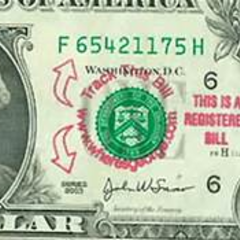
I was on vacation on Cape Cod this summer, staying with my parents in the house where I grew up. Most days or nights we walk, bike or drive to the homemade ice cream shop down the hill. My chocolate sundae tasted especially sweet a few weeks ago because I received a $1 bill in change with intriguing red, stamped, markings. “Track This Bill” said the stamp, like a mystery message from Louis Carroll, followed by a URL for the website www.wheresgeorge.com.
But oh joy! Unlike Alice puzzling over the White Rabbit’s invitation, I knew just what to do.
The “point” of that website – if there is something as prosaic as a point here – is to upload and track individual paper bills as they move around the country.
My ice cream store-acquired bill with serial number G55…..H (2006) had been first entered into the WheresGeorge website just 35 days earlier, in upstate New York. For each bill ‘found’ and uploaded by another person the site reports the distance traveled and “average speed.” After uploading the info, I learned the bill in my hand had travelled 306 miles and 8.6 miles per day.
In addition to uploading a specific bill’s serial number, the site prompts you to enter a few lines of description about where you found your bill and what condition it is in.
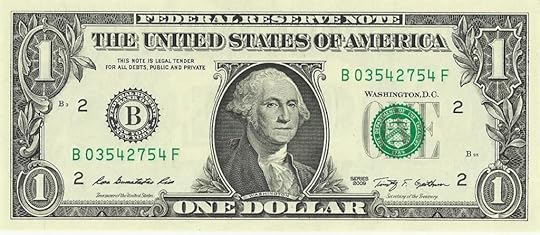
The “George” in the title is of course President Washington, the handsome dude whose visage adorns the $1 bill, but you can just as easily upload serial numbers for Jeffersons, Lincolns, Hamiltons and Jacksons, all of which I have done over the years. I have never uploaded Grants or Franklins to WheresGeorge, as I don’t traffic in these as often.
The WheresGeorge site launched in December 1998.
I created a profile there nearly twenty years ago, and entered my first few $1 bills in December 1999. I recall reading a newspaper story that year about WheresGeorge. Even then it appealed to my money nerdiness.
But also, I remember in 1999 the site represented a cutting-edge use of the internet, a kind of cloud-based social media site built around numismatics. Remember, this was five years before MySpace, six years before Facebook.
I distinctly remember feeling the WheresGeorge site was pretty darn exciting, allowing everyone to upload disparate data points to create an accessible but personalized profile. It’s an activity that Facebook made universal and therefore banal. It still had the power to excite back then.
Funny enough, the site hasn’t much updated its format since 1999. It looks just how you’d expect a 1999-era website to look. Which is to say, pretty clunky. But, I learned, it still does the job in 2019. And if you’re the type of money weirdo who likes to track data, as I am, there is a lot going on here.
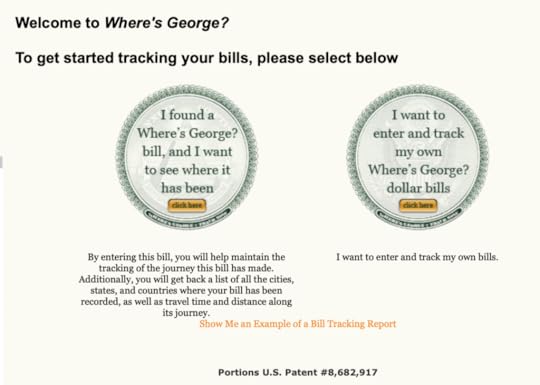
According to my personalized stats, I have entered 56 bills for a total value of $201. Three of these have had ‘hits,’ meaning another user has found my bills in the wild and uploaded the serial number to the site. I have, in turn, found 12 bills previously marked by other WheresGeorge users. My ice cream shop bill was the first one I’ve seen since 2016, and as a result it’s the first time I’d logged onto the site in 3 years.
“That’s really cool!” my 9 year-old exclaimed enthusiastically when I showed her my profile with earlier notes on dollar bills that I’d uploaded over the past 20 years. Her enthusiasm made me so happy because – obviously – no need for a paternity test, right? That kid’s clearly mine.
I reached out to Brian Brummer, in La Vernia, TX, known as “Big B” on WheresGeorge. He’s the highest-ranked Texan on the site, and the 20thmost active user overall. Big B’s dedication to the site is, well, astonishing.
Big B’s stats, as of this writing:
305,150 bills entered.
51,802 bills that have ‘hits.’
While Big B’s bills flit around the country, he himself is the most travelled person I’ve ever corresponded with. He’s been to 117 countries. Since retiring in 2002, not only has he uploaded bills from all 50 states, he’s managed to upload bills from all 254 counties in Texas, as well as having others report ‘hits’ from his bills from all 254 counties in Texas.
I wasn’t wrong in thinking that WheresGeorge serves as a key social media site for its active users. The socializing has moved from on-line to in-person. Big B has attended 117 in-person gatherings of fellow WheresGeorge enthusiasts. And counting. The next Texas get-together will be in Austin in October, followed by one in La Vernia in 2020.
Joe Causey of Cullman, Alabama is ranked as the third most active user and known by the WheresGeorge handle MrNiceGuy. He replied to my query through the site and said he used to stamp nearly 20,000 bills per month, and would distribute them through his friend’s 10-plex movie theater, through change at the box office and concessions. The site, and affiliated forums, is by far his most active social media outlet.
I asked Big B what participants shared in common. He replied, “Most Georgers do have an interest in statistics and many have an interest in Geography. Many folks claim we are all weird and having met more than 680 of them I will not argue this point too much. Like any hobby people carry it to extremes and others just enjoy it as something to fill the passing time.”
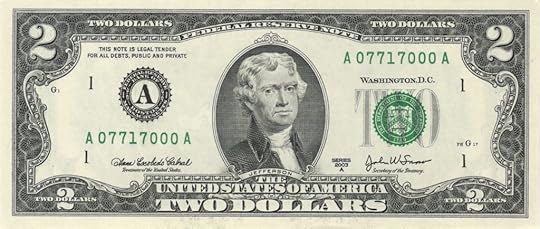 I always try to pay with $2 bills…
That sounds…right. I can relate somewhat. I am the guy who orders $1,000 worth of $2 bills from my bank just so that I always have a bunch to buy my daily coffee with, or for my weekly poker game buy-in. So, yeah, I’m a little quirky about my money hobbies. But I recognize Big B and MrNiceGuy have taken the game to a whole other level.
About my ice cream sundae dollar: I spent it, releasing it like a prized fish back into circulation. If you find it – my $1 bill with a red stamp on it – please upload its info to WheresGeorge.com so that I can track its travels from Cape Cod in the summer of 2019 to across the country, and beyond.
Please see related post:
Post read (73) times.
The post Where’s George? appeared first on Bankers Anonymous.


July 8, 2019
Annuities Rant Part III – Moderating my Complaints
I spilled considerable ink this Spring bashing all manner of insurance products peddled as investment products. I base my un-sell of insurance products on their complexity, illiquidity, mediocre returns, and high costs. Now I will pull some of my punches and give a more moderated view of some annuity products.
The summary of my more moderate views: Some people are happy with their variable annuities and have had good returns, without paying excessive fees. If you already own an annuity product, I don’t think you should necessarily sell it right now, or right away. Finally, fixed rate annuities are at least simple. I like simple.
Don’t get me wrong. I don’t actually endorse these things.
Annuities generally put me in a dark place.
Other than their complexity, illiquidity, mediocre returns, and high costs, I like annuities just fine.
It’s like that awful joke: “Other than that, Mrs. Lincoln, how did you like the play?”
 Other than that Mrs. Lincoln, how did you like the play?
I’ve received numerous responses from insurance salespeople this Spring about how weak my arguments are regarding annuity products. I read their responses and think of Upton Sinclair’s wisdom: “It is difficult to get a man to understand something, when his salary depends on his not understanding it.” Occasionally, when feeling cheeky, I respond to those emails, with Sinclair’s words.
But a thoughtful column-reader recently responded to my variable annuity-bashing by sharing his carefully kept spreadsheet of his variable annuity with Vanguard, which he bought in 2004. Quite frankly, he’s has been happy with it ever since.
His annuity owns a mixture of seven different equity-based Vanguard mutual funds. Whereas most variable annuity funds I’ve seen charge 1.5 to 2.5% management fees, his funds average 0.55% management fee, which I find utterly reasonable. In addition, the “mortality and expense risk charge” accompanying variable annuity funds – which typically runs from 0.4% to 1.75% across the industry – is a mere 0.17% at Vanguard. Again, quite reasonable.
Not coincidentally, he’s happy to report, his returns since 2004 have been quite competitive.
With a starting value of $110 thousand in early 2004, his funds grew to $340 thousand by mid-May 2019. That’s a 7.7% annual return over a little more than 15 years.
That compares pretty well with an 8.7% return including reinvestment of dividends of the Wilshire 5000 Index of the broad US stock market, or an 8.3% return for the S&P500 index of large US companies. Given mutual fund management costs, I’d say his 7.7% annual compound return on his variable annuity is as good as one could reasonably expect.

His stated reason for purchasing a variable annuity product, rather than a straight brokerage product, is to simplify passing on wealth to his heirs. His belief is that the variable annuity will pass smoothly to his intended beneficiaries without the risk of going through a probate court. I am no estate-planning expert, but if this gives him peace of mind, then that’s great.
One of the distinguishing characteristics about this variable annuity investor is that he was not sold the product by a commissioned salesperson. That partly explains his low costs.
My second moderating comment about various annuity products is that I would not presume to tell anyone to sell theirs, if they already own one. That’s a question that I get asked whenever I talk about how terrible they are.
So I’ll say it clearly: If you have an annuity already, don’t sell it right away. Often in personal finance matters, inaction is the best course. This is because action is costly, and other alternatives could be worse. Maybe what’s done is done. Maybe your annuity works for you. Maybe you have plenty of money already. I’m mostly talking about what you should not buy in the future.
Without knowing anything about your specific situation, a plausible solution to your problem of “I’m currently paying into a terrible annuity product, what do I do?” is to cease paying in to that product, starting paying for a better product, and then over time evaluate whether and how the existing annuity you bought can play a reasonable role in your long term financial plan.
And then finally, what about a fixed rate annuity?

I recently received a quote from my preferred insurance provider for a fixed rate annuity. I wanted to know, assuming I turned over $100,000, what kind of monthly lifetime income could I lock in? The answer is $391.64 per month, for life. I’m 47 years old. Were I older, the monthly payment would be higher, since I’d be more likely to die quicker.
The expected return on my fixed rate annuity was 3%. I don’t find that sufficient. I would never advise anyone with a net worth less than, say, $5 million, to buy one of these.
On the other hand, it’s very straightforward. We can all have different preferences for risk. Some annuities, especially fixed rate annuities, provide certainty. Fixed rate annuities like this are terrible for growing wealth, but have the advantage of simplicity. I like simple. And no fees. You turn over your $100 thousand. You lock in $391.64 for life. They are easily explained and understood. They never let you down.
Except under conditions of medium to high inflation. Other than that though, they’re safe.
A version of this post ran in the San Antonio Express News and Houston Chronicle.
Please see related posts:
Annuities Rant Part I – Complexity
Annuities Rant Part II – High Fees, Low Returns
Variable Annuities – Shit Sandwich
Post read (62) times.
The post Annuities Rant Part III – Moderating my Complaints appeared first on Bankers Anonymous.