Elizabeth Rusch's Blog, page 14
February 4, 2014
Road Maps to the Common Core
Sometimes I get the feeling that any change in educational policy doesn’t matter to the providers of educational materials as long as change is mandated. Publishers of texts and testing products make money no matter what. The objective of No Child Left Behind was basic literacy for all, period. So the emphasis was on decoding skills. It set the bar very low and generated lots of new materials to teach phonics, etc. Now we have the Common Core State Standards which redefine an educated person as someone who can read a text and figure out the main idea, how it was put together by the author, and how knowledge and ideas are integrated. Moreover, students are supposed to incorporate these standards into their own writing. The pushback from the educational community is that now the bar is set too high; especially in light of the new standardized tests that show kids failing as expected. Veteran educations shake their heads in bewilderment. They know better than most that there is no single panacea for delivering high quality education. Just ‘cause you state it as policy, doesn’t mean it will happen.
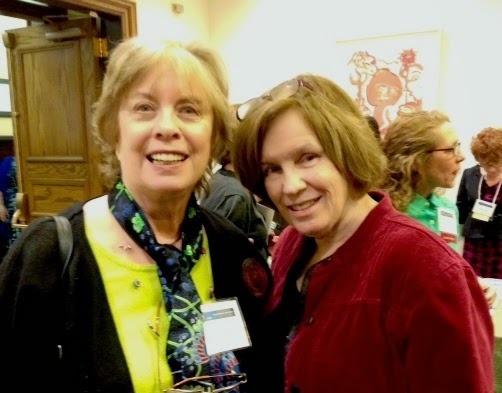 Vicki Cobb and Lucy CalkinsOne such veteran educator is Lucy Calkins of Columbia’s Teachers College who is the founder and director of The Columbia Reading and WritingProject. She is an outspoken champion of the CCSS. She sees it as an opportunity to introduce students to a wealth of nonfiction literature about the real world and she spoke about it at a TC event last week, which I attended. After decades of imposing rules and packaged lesson plans on teachers, of bashing teachers as the primary problem with education, of sucking the joy of learning out of the classroom, and of attempting to standardize teaching as if children were widgets in a factory, some of us see the CCSS as an opportunity to bring creativity, collaboration, and autonomy back to the teaching profession.
Let’s hope it’s not too late. Enter the realityof a teacher’s day. The stress is enormous and now they have to do a great deal of paperwork to justify exactly how they are meeting the CCSS. Their jobs are now dependent on how well their students perform on the standardized test. Many gifted teachers are speaking up or throwing in the towel. Lucy Calkins sees the CCSS as an opening for many approaches to instruction and a diverse curriculum—the opposite of standardization. Since businesses now say they want creative, self-starting, innovative workers, we have to allow teachers to go back to being creative innovators themselves. We also have to experiment with different approaches and ideas with the understanding that some will prove better and others and that not everything that is done will be a home run. In other words, educators, themselves, need room to learn and grow.
The Columbia Reading and Writing Program states, " ‘the Standards define what all students are expected to know and be able to do, not how teachers should teach’ (CCSS, p 6). What's needed is an all-hands-on-deck effort to study how best to create pathways to achieve the Common Core. There will be no one 'right answer' to the question of how a school or a district needs to shift its priorities and methods so as to bring its students closer to the expectations of the Common Core, as schools and classrooms will come from different places and will have different resources to draw upon.”
Teachers need interesting, well-written materials for the curriculum subjects they teach. They can also teach reading and writing skills through “mentor” books that are about content. In addition to books, teachers also need strategies for using books that don’t come with lesson plans. They need support from curriculum people and from each other. If the skills of the Common Core are our destination, (and there is no question that we’d have a very well educated nation if everyone met them) we need ways to implement them and try them out. In other words, we need time to develop road maps through uncharted territory and stop asking, like an annoying passenger, “are we there yet?”

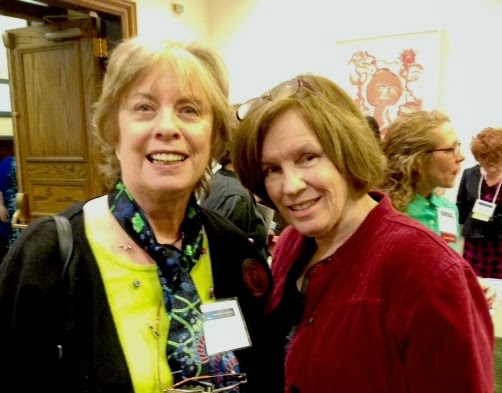 Vicki Cobb and Lucy CalkinsOne such veteran educator is Lucy Calkins of Columbia’s Teachers College who is the founder and director of The Columbia Reading and WritingProject. She is an outspoken champion of the CCSS. She sees it as an opportunity to introduce students to a wealth of nonfiction literature about the real world and she spoke about it at a TC event last week, which I attended. After decades of imposing rules and packaged lesson plans on teachers, of bashing teachers as the primary problem with education, of sucking the joy of learning out of the classroom, and of attempting to standardize teaching as if children were widgets in a factory, some of us see the CCSS as an opportunity to bring creativity, collaboration, and autonomy back to the teaching profession.
 Let’s hope it’s not too late. Enter the realityof a teacher’s day. The stress is enormous and now they have to do a great deal of paperwork to justify exactly how they are meeting the CCSS. Their jobs are now dependent on how well their students perform on the standardized test. Many gifted teachers are speaking up or throwing in the towel. Lucy Calkins sees the CCSS as an opening for many approaches to instruction and a diverse curriculum—the opposite of standardization. Since businesses now say they want creative, self-starting, innovative workers, we have to allow teachers to go back to being creative innovators themselves. We also have to experiment with different approaches and ideas with the understanding that some will prove better and others and that not everything that is done will be a home run. In other words, educators, themselves, need room to learn and grow.
The Columbia Reading and Writing Program states, " ‘the Standards define what all students are expected to know and be able to do, not how teachers should teach’ (CCSS, p 6). What's needed is an all-hands-on-deck effort to study how best to create pathways to achieve the Common Core. There will be no one 'right answer' to the question of how a school or a district needs to shift its priorities and methods so as to bring its students closer to the expectations of the Common Core, as schools and classrooms will come from different places and will have different resources to draw upon.”
Teachers need interesting, well-written materials for the curriculum subjects they teach. They can also teach reading and writing skills through “mentor” books that are about content. In addition to books, teachers also need strategies for using books that don’t come with lesson plans. They need support from curriculum people and from each other. If the skills of the Common Core are our destination, (and there is no question that we’d have a very well educated nation if everyone met them) we need ways to implement them and try them out. In other words, we need time to develop road maps through uncharted territory and stop asking, like an annoying passenger, “are we there yet?”


February 3, 2014
STRANGER THAN FICTION
OK history buffs (or non-history buffs) - which of the following wild assertions just so happen to be true and which ones are false? Since I have to write about this stuff all the time, I actually know the answers and don’t have to look them up. See how many you already know….TRUE OR FALSE: 1) Ben Franklin invented the fan chair, which was a rocking chair with a fan on top to blow away flies.
2) Ben invented a musical instrument that caused dogs to run away and hide and also made people think there were ghosts in their room.
3) Pocahontas was bald.
4) She taught her boyfriend, John Smith, how to smoke tobacco.
5) Before being captured and enslaved, John Smith won a Turkish fortress by making a bunch of explosives and catapulting them into the Turks’ camp while they slept.
6) George Washington always wore a white wig in public, even as a child.
7) George Washington chopped down a cherry tree, and when his dad asked him about it, he said “I cannot tell a lie, pa. I did it with my little ax.”
8) George Washington had scars on his face from a duel.
9) During the California Gold Rush, a single piece of paper cost $150 but you could get 12 shirts washed and ironed at the Chinese Laundry for $3.
10) During this gold rush, cooks regularly checked chicken gizzards for small gold nuggets.
11) Frenzied gold seekers from 37 different countries rushed lickety-split straight toward California to seek their fortunes.
12) Cowboys traveling on The Old Chisholm Trail used to cross the muddy rivers by running on their cows backs.
13) The trail was finally closed by barbed wire.
14) Charles Darwin and Abraham Lincoln were born on the very same day just a few hours apart, and they didn’t always get along with their dads.
15) When Charles Darwin journeyed around the world by ship, he caught a giant octopus and sent it back to England for scientists to study.
16) Charles Darwin used to ride on horseback with a wild Gaucho cavalry, ride on the backs of gigantic tortoises, and ride in a box on the back of an elephant in true Indian fashion. 17) In Salem Massachusetts, some people made medicine by combining boiled snippets of children’s hair, spirits of mummies, and the brains of young men who had died a violent death.
18) During the Salem Witch Trials, nineteen people were burned for the crime of witchcraft.
19) During this time, people of all ages were accused of turning into a ball of light the size of a bushel basket, choking a woman with nails and eggs, stupefying a boy for 12 years, making a wagon plump down into a hole on flat ground, and killing victims with their evil “eye beams.” (A ghost said so.)
AND THE ANSWERS ARE:
1) False, but he did have such a chair inside his house.
2) True. It was called the glass armonica, and before it went out of style for hurting dogs' ears and sounding spooky during seances, it was so popular that Mozart and Beethoven wrote music for it.
3) True. Pre-pubescent Powhatan Indian girls shaved the tops of their heads, and Pocahontas was between 10 and 12 years old.
4) False. Of course she was way too young to be John Smith's girlfriend, and besides, he thought smoking tobacco was disgusting.
5) True, all true. He was also great at making fireworks.
6) False. George hated wigs even though they were in style. If he absolutely had to, he would powder his hair instead.
7) False. Parson Mason Locke Weems made up that fake story to get kids to tell the truth like their hero. Oh, the irony.
8) False. The scars were from smallpox.
9) All true.
10) True again. One time a chicken gizzard panned out at $12.80
11) False. They came from more than 70 countries and set off one of the greatest mass migrations in history.
12) Yup, that's true. Those guys had talent.
13) True. Barbed wire smarts if you're a traveling cow.
14) True. Their dads didn't seem to think they'd amount to much.
15) False, false, false. He did uncover plenty of humongous fossilized bones from extinct giant animals though.
16) True. Darwin perched these various backs in Argentina, the Galapagos, and the Isle of Mauritius.
17)True. Guilty as charged.
18) False. They were hanged, not burned. A 19th guy was pressed to death by stones.
19) True. People really did tell all of these bald-faced lies in court. AND THERE ARE NO WITCHES!!!
Didn't I tell you truth is stranger than fiction? So how did you do? Feel free to try this on your students, friends, and enemies, and if they get all the answers right I will send them a lollipop. (False.)


January 31, 2014
BOOK BAIT: 10 Ways to Hook Kids On Nonfiction!
 Authors, illustrators, and publishers put a great deal of effort into the quest to interest readers in their books. Ideally, every nonfiction book should have a terrific title, intriguing information, sensational sentences, and interesting images (and by all means alliteration...only kidding about that last one!?)
 Because of the great response to my last post about nonfiction activities, I was inspired to focus this time on how to entice students to read a variety of informational texts. Recommendations from their peers is one of the primary ways that kids decide to read a book, so with that in mind, ask students to:
1. Choose a nonfiction book to recommend, place it on your desk, then tour the room for new reading options.
2. Share one sentence that gives an idea of what the book is about.
3. Compile a class book of reviews then explore classmates’ suggestions.
4. Prepare and present book talks to the class in the form of posters, presentations, or videos.
5. After discovering a good book, create a display of more works by the same author.
6. Choose one page in a book and list the facts the words tell, then the information shown by the pictures.
7. Redraw an illustration or other image and add labels and other info.
8. Find a favorite cover and explain how it summarizes the book.
9. Design a new cover for a book to persuade more kids to read it.
10. Compare two or more books on a topic using a Venn diagram.
Click for my Pinterest board with nonfiction teaching ideas.
Enjoy!
Loreen
My web site

January 29, 2014
A Change of Scene
My home is in beautiful Missoula, Montana, but my husband Greg (a food writer) and I decided to try something new. We became snowbirds, leaving home in late October and planning on returning in early April. At first we condo-hopped in Hawaii, but now are settled in Oceanside, CA, across the street from Del Mar beach.
Some writers need to work in their own familiar space or settle at a table in a familiar cafe near home to write. But Greg and I feel fortunate that we can write anywhere, as long as we have a few reference books and our trusty MacBooks. My nephew recently did some consulting for Microsoft and presented Greg with a sticker for his computer that declares "This is my office." I want one too!
 I find working in a new location has its own rewards. The phone rarely rings, as no one knows this number. Our cell phones stay mostly silent, since we don't use them that often. That means fewer distractions. We don't have the usual social engagements either, or other appointments, so we have more time to write. The new location also means new experiences, like a variety of farmers' markets in surrounding communities with gorgeous greens and succulent citrus fruits, foods we can't get locally grown in Montana during the winter. We both feel healthier, not only from the food but also the sunlight and relative warmth.
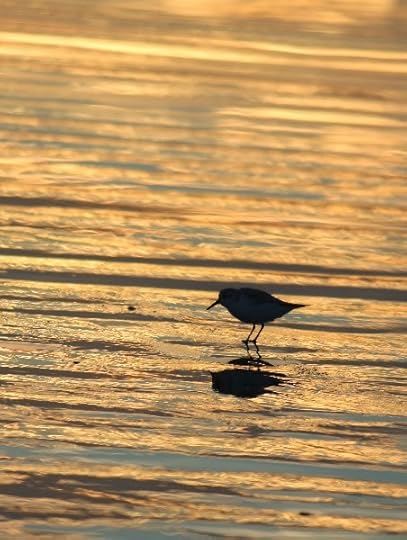 There's also the stimulation of the writing instinct in a new place. Greg is inspired to devote his blog (www.thebakingwizard.com) to "unplugged" recipes, ones that don't require a food processor or mixer, since we don't have those things here. I find myself obsessed with photographing birds and brilliant sunsets over the Pacific, with the damp sand creating magical reflections of the glowing colors. Maybe I'll write a book about sunsets! Or about gulls, or maybe I'll revive my out-of-print book on pelicans.
When I take my afternoon break walking along the damp, firm surface of this beach, I feel I could walk forever. It's a form of meditation for me, allowing my mind to clear and to settle down. Then I can focus on prioritizing the many tasks large and small that go along with being a writer, or just "be." I can't do this at home in wintertime Montana, where it can be too icy or too cold to walk and where the sky during the short days is almost always an uninviting gray. But as I enjoy looking out over the silvery sparkles of reflected sunlight on the waves, I look forward to Montana in the Spring, when fresh green sprouts push forth from the earth and the familiar birds, "snowbirds" like us, return to enjoy new life and creativity in that special place.

Some writers need to work in their own familiar space or settle at a table in a familiar cafe near home to write. But Greg and I feel fortunate that we can write anywhere, as long as we have a few reference books and our trusty MacBooks. My nephew recently did some consulting for Microsoft and presented Greg with a sticker for his computer that declares "This is my office." I want one too!
 I find working in a new location has its own rewards. The phone rarely rings, as no one knows this number. Our cell phones stay mostly silent, since we don't use them that often. That means fewer distractions. We don't have the usual social engagements either, or other appointments, so we have more time to write. The new location also means new experiences, like a variety of farmers' markets in surrounding communities with gorgeous greens and succulent citrus fruits, foods we can't get locally grown in Montana during the winter. We both feel healthier, not only from the food but also the sunlight and relative warmth.
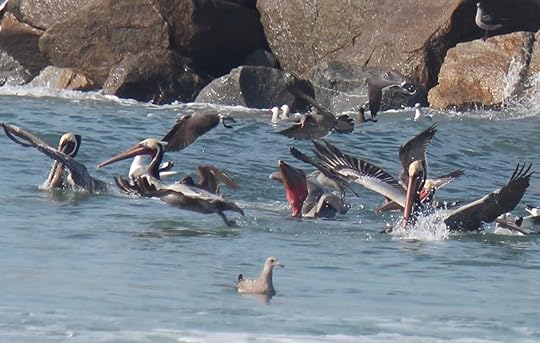
 There's also the stimulation of the writing instinct in a new place. Greg is inspired to devote his blog (www.thebakingwizard.com) to "unplugged" recipes, ones that don't require a food processor or mixer, since we don't have those things here. I find myself obsessed with photographing birds and brilliant sunsets over the Pacific, with the damp sand creating magical reflections of the glowing colors. Maybe I'll write a book about sunsets! Or about gulls, or maybe I'll revive my out-of-print book on pelicans.
When I take my afternoon break walking along the damp, firm surface of this beach, I feel I could walk forever. It's a form of meditation for me, allowing my mind to clear and to settle down. Then I can focus on prioritizing the many tasks large and small that go along with being a writer, or just "be." I can't do this at home in wintertime Montana, where it can be too icy or too cold to walk and where the sky during the short days is almost always an uninviting gray. But as I enjoy looking out over the silvery sparkles of reflected sunlight on the waves, I look forward to Montana in the Spring, when fresh green sprouts push forth from the earth and the familiar birds, "snowbirds" like us, return to enjoy new life and creativity in that special place.

January 28, 2014
Finding Mumbet
 My latest book, Mumbet’sDeclaration of Independence, comes out on February 1. I’m always happy on pub dates, but this one feels especially good (thanks, PW) not least because of the book’s spectacular illustrations by Alix Delinois. He lives in New York, has done since he was seven. But he was born in Haiti, and Caribbean light and color shine all through the book and perfectly reflect the tone I tried to express in the text. I’m going to interview him for my February blog, so I won’t gush on now.
  I love writing about little-known people and I’m pleased that editors are publishing books about them. Every season sees more new heroes and heroines lining the lists. As for Elizabeth “Mumbet” Freeman, I discovered her while researching Write on, Mercy! The Secret Life of Mercy Otis Warren. Not for the first time, research for one book led to the next one. Both Mercy (white and well-educated) and Mumbet (an illiterate slave) lived in Massachusetts during the American Revolution – Mercy in Plymouth, Mumbet in the Berkshires. Both used revolutionary fervor to advance their causes: Mercy, to write and publish her political views; Mumbet, to sue for her freedom. (This is a portrait painted on ivory, of Mumbet in old age. It's in the Massachusetts Historical Society in Boston.)
 I try to bond with my subjects, and that often happens when I travel to their home territory. This was true with Mumbet. ‘Twas a frigid day of January that I was given a “Mumbet tour” in Sheffield and Stockbridge, Massachusetts by historian Barbara Dowling, then working for the Trustees of Reservations, the conversation group that owns Ashley House, where Mumbet spent her slave years. The house was closed for winter – it being colder indoors than out! – but Barbara opened it for me to poke around, searching for traces of Mumbet’s life there.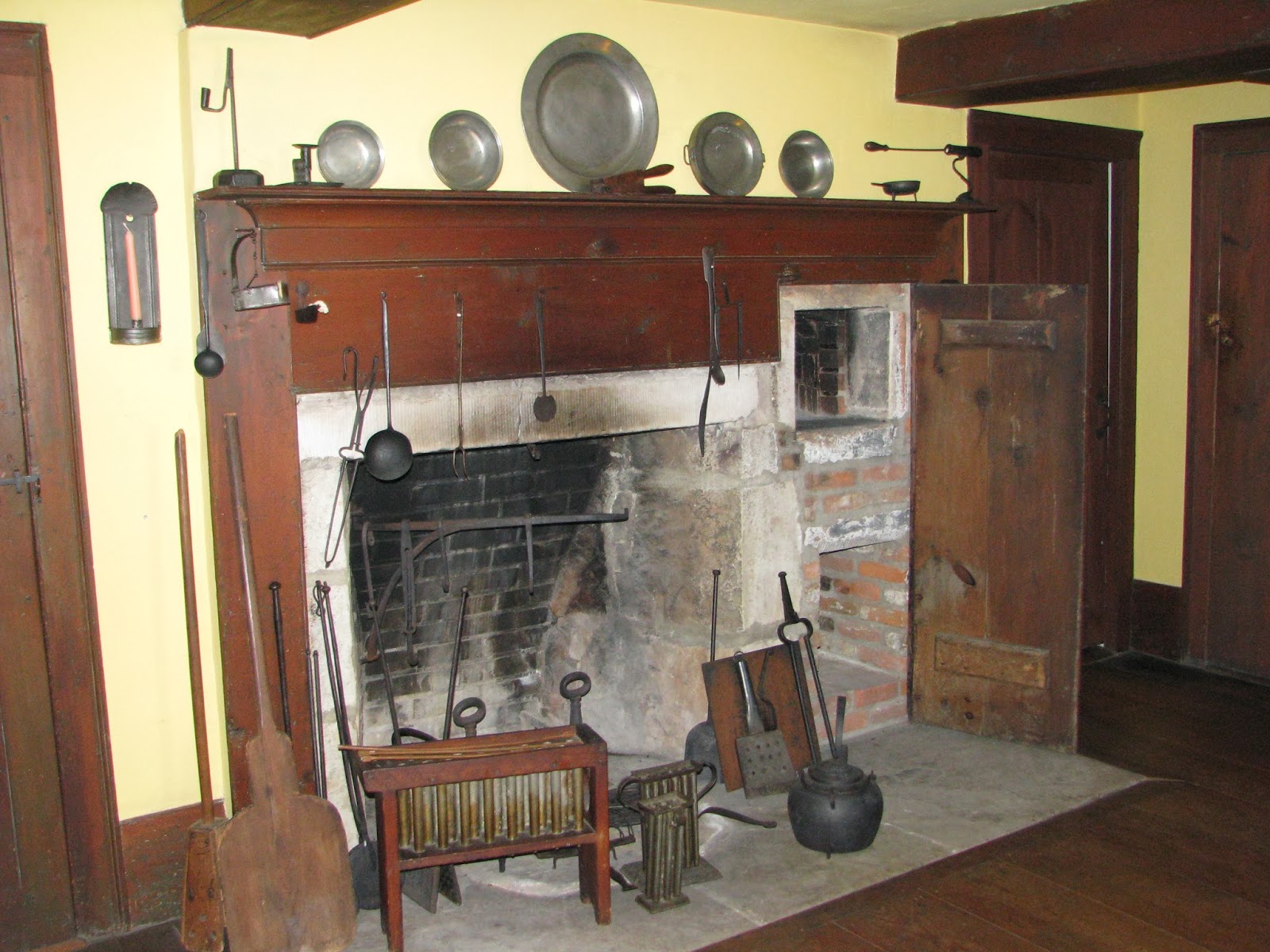
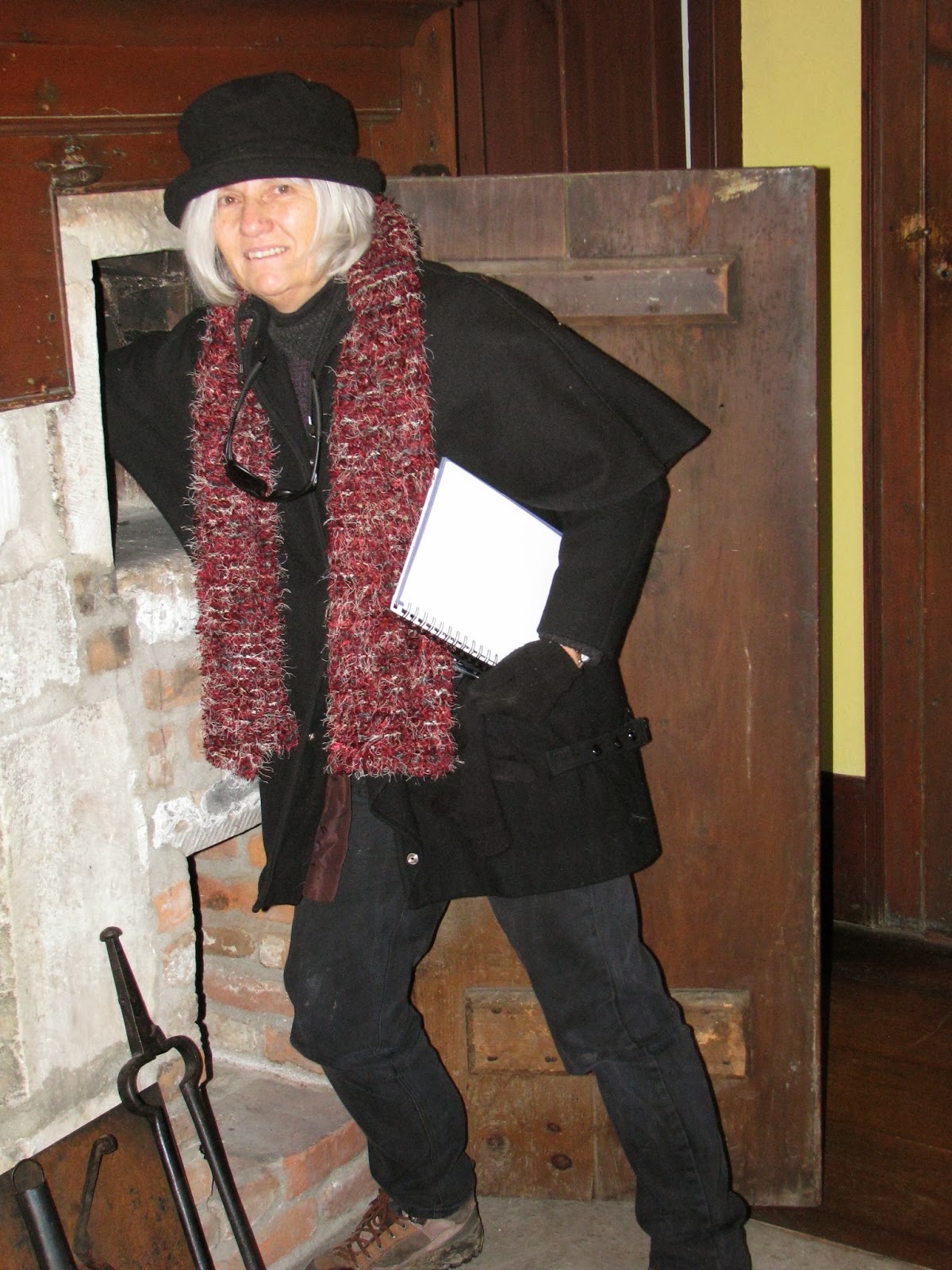 It's a comfortable, not grand, house, with a big hearth where Mumbet worked. I peeked up the chimney, stuck my arm into the baking oven, gazed into the small room off the kitchen when she probably slept. I climbed the narrow stairs that she climbed carrying refreshments to white men who discussed their fight for political freedom from the British.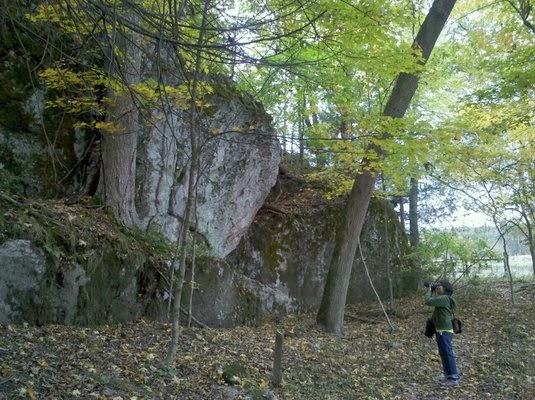
 Outdoors, nearby Bartholomew’s Cobble, far-off Berkshire mountains, and the Housatonic River presented themselves as symbols of Mumbet’s strength and courage, and found their way into my book.
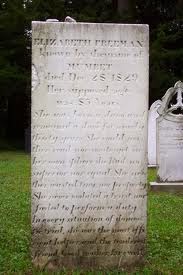 A few miles away sits the imposing Sedgwick estate, home of her lawyer, where Mumbet worked for two decades as housekeeper and second mother to the seven Sedgwick children. She saved enough from her wages to buy a small farm in the hills outside Stockbridge, and retired there to live with her daughter, grandchildren, and great-grandchildren. The house is gone, but I envisioned her, looking out over the Housatonic Valley that held a life's worth of memories. Her grave includes this epitaph written by Catharine Sedgwick, one of Mumbet’s charges:
She was born a slave and remained a slave for nearly thirty years. She could neither read nor write yet in her own sphere she had no superior or equal. She neither wasted time nor property. She never violated a trust nor failed to perform a duty. In every situation of domestic trial, she was the most efficient help, and the tenderest friend. Good mother, farewell.
I ended Mumbet’s Declaration of Independence just after she sued her owner and [Spoiler Alert!] won her freedom. But she lived long after that, and her life led to me other African Americans of that era, and another book about worthy and under-reported lives. I included Mumbet’s later adventures there, but you’ll have to wait until 2015 to read those.
In the meantime, tune in next month to meet Alix Delinois, who also traveled to the Berkshires to bring Mumbet into view.


Let the Games Begin! (But Where are the Good Books?)
Anyone else sorely disappointed in the selection of books on the Winter Olympics? I sure am. I’ve been trying to put together something interesting for my K-3 crowd: a little bit of general history, some stand out biographies, and (if it’s not asking too much)a concise explanation of the actual winter events.
The pickings are certainly slim. As I search and search again, the most frequently viewed item is a fiction book about a certain penguin in a Hawaiian shirt named Tacky playing his own version of the Winter Games.
Where are the I.N.K. books on this subject? Isn’t this the kind of subject where non fiction should shine?
What’s going on here?
Only one book stands out to me, and I’ve been forced to rely on more than I would like.
 Olympics by B. G. Hennessy.
 Published in 1996.
Other than that, The Magic Tree House series does tackle the Ancient Games in one volume. It even has a non fiction companion "fact tracker" listing facts about Ancient Greece and the Olympics. It’s certainly possible an intrepid second grader could read it without falling asleep.
Next week lets wave our flags and pretend to bobsled on our sofas. And lets think about, and perhaps even start writing, some medal worthy books.

January 24, 2014
How Did You Get the Idea of This Book and Other Burning Questions Revealed
This week, Debbie Glade at Smart Books for Smart Kids reviewed my new book Women of Steel and Stone. The review can be found here.
Following the review, she asked if I would mind answering a few questions for the readers of her website. The questions got me thinking about why I wrote the book, the process, STEM, and girls in engineering fields. I thought INK readers would like to read a part of that interview. The full interview can be read on the Smart Books for Smart Kids website. I'll post the link as soon as it is live on the site. I also added a few extra questions and answers for the readers here. All the questions and answers can be read on my new website Anna M. Lewis.
How did you get the idea to write this book?
My editor and I were going back and forth with proposal ideas in two different series - Activities for Kids and Women of Action. My degree is in Product/Industrial Design and I took several design history classes in college, so design was an area that interested me. Then, I found one website that listed the top 100 architects. There were only 2 women on the list – 2 women out of 100 architects. That didn’t sound right to me. I started researching women architects and found some amazing women whose stories hadn’t been told. From there, I also discovered several women engineers and landscape architects, and the book grew from there.
How did you come up with the women you featured in the book, and was it difficult to find the detailed information you needed about some of them? Each book in the Women of Action series has about 16 to 26 profiles, so I knew I had to have about that many women. My daughter's favorite number is 22, so I felt that I had to appease her and the karma gods and write about 22 women. That number worked perfectly. In forming the list, I basically had 7 women per category; which meant, 2 of the first in the field, 2 of the most current, and 3 in the middle. As it turned out, all the women I chose had interesting stories to tell. Every chapter had to have a compelling story to pull the reader in; otherwise the book would just be a rehash of wiki pages and facts. Some of the background stories had to be dug out, and I was digging for days. When I found an interesting story about a woman, it was almost like finding gold. Sometimes, after fact checking, a great story turned out to be not true. A popular book on Julia Morgan tells how she was dusting the family stairs and said that when she was older that she wouldn't design houses with spindly staircase rods that little girls would have to dust, and then she ran outside to play with her brothers. Many other sources also cited that story. It took some digging but I found a transcript of an interview with several family members and co-workers. I read through the entire entire interview and at one point the interviewer asked the family if that was true. They said, "No, Julia never said that." Great story but I couldn't use it… but I found other great pieces to use in that transcript. Julia was hard to research. After she was misquoted early in her career, she never gave another interview. She even instructed her staff to destroy all her papers after she retired.
In the beginning, I asked the leaders and archivists of several engineering and architecture groups to review my list. I wanted to make sure that I didn't leave anyone out. Their suggestions were perfect.
Did it strike you when researching and writing the biographies that the accomplishments of these women from long ago would be equally as impressive in today's world as they were back then? Three things stood out to me while writing the book. First, it has been over 125 years since Louise Bethune became the first female member of the American Institute of Architects (AIA), and women are still struggling to get noticed in that field. Second, all the women in my book had very supportive parents. Third, all the women chose architecture, engineering, and landscape architecture because they were drawn to those fields. To answer your question, yes. But also, it also surprised me that after 125 years, things haven’t changed much. Women are still having a difficult time in those fields. The recent petition that sought to highlight Denise Scott Brown’s accomplishments with the inclusion of her name on her husband's 1981 Pritzker Prize put this issue into the spotlight. While media took great note, the Pritzker Committee turned down the request.
In building our future, we need all our students involved in creating wonderful things.
Considering the limitations women in the 1800s and early 1900s had wearing such binding, layered clothing with long dresses and corsets, do you think just the change in the way we dress has made it more possible for women to work in male dominated fields? I don’t think the change in clothing was a large factor. Julia Morgan used to hike up her long skirt and climb up scaffolding, sometimes three stories high. Actually, the invention of the bicycle was a huge factor in the changes of a woman’s role in society. She was able to go to so many more places – without a chaperone, and her clothing loosened to allow her to ride. Society accepted this change with a few protests.
Honestly, the women in my book and their strong-willed desire to do something that they wanted to do broke down the barriers and showed that women could work in the same fields as men. What's your next writing project? I’ve been going back and forth with my editor. I’ve been trying to decide if I want to write another Women of Action book or an Activities for Kids book. I’m also working with two other publishers on some fun ideas.
What do you most like to do when you are not working? When I’m working, it doesn’t really feel like work. I love to read, which in a way is working. Actually, I have a pile of books that I can’t wait to get my hands on.
Besides writing, I’ve been doing some illustration work, which is like playing to me. I’ve been having fun learning how to use the Wacom tablet to create digital images.
Questions I added:
Did you have a special process while writing the book?
While doing the research, I had a box of grey folders and I made a folder for every woman. I also made a folder for my intro and chapter intros. I made copies of every quote for easy access when I compiled the Notes section. I also bought quite a few of my research books, a little while after I started racking up some library fines. (It's amazing how those due dates can slip by you when you are deep in work.) The actual books came in handy during the year-long editing process, when I had to check sources multiple times.
Towards the end, I made a spiffy excel spread sheet to keep track of all of my 22 women, images, permissions, word count, etc.
Did you have a personal connection to this book? Yes, my father passed away suddenly the day after I got the go ahead to work on the proposal. My father ran a medium-sized engineering practice in Cincinnati for over 50 years. His firm oversaw the HVAC (Heating, Ventilation, and Air Conditioning) on many major construction projects. The last few years of his life he taught engineering at the University of Cincinnati. I think that he would have approved of this book.

Following the review, she asked if I would mind answering a few questions for the readers of her website. The questions got me thinking about why I wrote the book, the process, STEM, and girls in engineering fields. I thought INK readers would like to read a part of that interview. The full interview can be read on the Smart Books for Smart Kids website. I'll post the link as soon as it is live on the site. I also added a few extra questions and answers for the readers here. All the questions and answers can be read on my new website Anna M. Lewis.

How did you get the idea to write this book?
My editor and I were going back and forth with proposal ideas in two different series - Activities for Kids and Women of Action. My degree is in Product/Industrial Design and I took several design history classes in college, so design was an area that interested me. Then, I found one website that listed the top 100 architects. There were only 2 women on the list – 2 women out of 100 architects. That didn’t sound right to me. I started researching women architects and found some amazing women whose stories hadn’t been told. From there, I also discovered several women engineers and landscape architects, and the book grew from there.
How did you come up with the women you featured in the book, and was it difficult to find the detailed information you needed about some of them? Each book in the Women of Action series has about 16 to 26 profiles, so I knew I had to have about that many women. My daughter's favorite number is 22, so I felt that I had to appease her and the karma gods and write about 22 women. That number worked perfectly. In forming the list, I basically had 7 women per category; which meant, 2 of the first in the field, 2 of the most current, and 3 in the middle. As it turned out, all the women I chose had interesting stories to tell. Every chapter had to have a compelling story to pull the reader in; otherwise the book would just be a rehash of wiki pages and facts. Some of the background stories had to be dug out, and I was digging for days. When I found an interesting story about a woman, it was almost like finding gold. Sometimes, after fact checking, a great story turned out to be not true. A popular book on Julia Morgan tells how she was dusting the family stairs and said that when she was older that she wouldn't design houses with spindly staircase rods that little girls would have to dust, and then she ran outside to play with her brothers. Many other sources also cited that story. It took some digging but I found a transcript of an interview with several family members and co-workers. I read through the entire entire interview and at one point the interviewer asked the family if that was true. They said, "No, Julia never said that." Great story but I couldn't use it… but I found other great pieces to use in that transcript. Julia was hard to research. After she was misquoted early in her career, she never gave another interview. She even instructed her staff to destroy all her papers after she retired.
In the beginning, I asked the leaders and archivists of several engineering and architecture groups to review my list. I wanted to make sure that I didn't leave anyone out. Their suggestions were perfect.
Did it strike you when researching and writing the biographies that the accomplishments of these women from long ago would be equally as impressive in today's world as they were back then? Three things stood out to me while writing the book. First, it has been over 125 years since Louise Bethune became the first female member of the American Institute of Architects (AIA), and women are still struggling to get noticed in that field. Second, all the women in my book had very supportive parents. Third, all the women chose architecture, engineering, and landscape architecture because they were drawn to those fields. To answer your question, yes. But also, it also surprised me that after 125 years, things haven’t changed much. Women are still having a difficult time in those fields. The recent petition that sought to highlight Denise Scott Brown’s accomplishments with the inclusion of her name on her husband's 1981 Pritzker Prize put this issue into the spotlight. While media took great note, the Pritzker Committee turned down the request.
In building our future, we need all our students involved in creating wonderful things.
Considering the limitations women in the 1800s and early 1900s had wearing such binding, layered clothing with long dresses and corsets, do you think just the change in the way we dress has made it more possible for women to work in male dominated fields? I don’t think the change in clothing was a large factor. Julia Morgan used to hike up her long skirt and climb up scaffolding, sometimes three stories high. Actually, the invention of the bicycle was a huge factor in the changes of a woman’s role in society. She was able to go to so many more places – without a chaperone, and her clothing loosened to allow her to ride. Society accepted this change with a few protests.
Honestly, the women in my book and their strong-willed desire to do something that they wanted to do broke down the barriers and showed that women could work in the same fields as men. What's your next writing project? I’ve been going back and forth with my editor. I’ve been trying to decide if I want to write another Women of Action book or an Activities for Kids book. I’m also working with two other publishers on some fun ideas.
What do you most like to do when you are not working? When I’m working, it doesn’t really feel like work. I love to read, which in a way is working. Actually, I have a pile of books that I can’t wait to get my hands on.
Besides writing, I’ve been doing some illustration work, which is like playing to me. I’ve been having fun learning how to use the Wacom tablet to create digital images.
Questions I added:
Did you have a special process while writing the book?
While doing the research, I had a box of grey folders and I made a folder for every woman. I also made a folder for my intro and chapter intros. I made copies of every quote for easy access when I compiled the Notes section. I also bought quite a few of my research books, a little while after I started racking up some library fines. (It's amazing how those due dates can slip by you when you are deep in work.) The actual books came in handy during the year-long editing process, when I had to check sources multiple times.
Towards the end, I made a spiffy excel spread sheet to keep track of all of my 22 women, images, permissions, word count, etc.
Did you have a personal connection to this book? Yes, my father passed away suddenly the day after I got the go ahead to work on the proposal. My father ran a medium-sized engineering practice in Cincinnati for over 50 years. His firm oversaw the HVAC (Heating, Ventilation, and Air Conditioning) on many major construction projects. The last few years of his life he taught engineering at the University of Cincinnati. I think that he would have approved of this book.
January 23, 2014
Happy TENTH Anniversary to the Mars rover Opportunity!
On July 7, 2003, tucked into a Delta 2 rocket, the rover Opportunity blasted into space headed to Mars.
 On January 24, 2004 PST (Jan. 25 Universal Time), the rover was dropped onto the surface of Mars wrapped in airbags, where it bounced 26 times before coming to rest in a crater. This little rover, about the size of golf cart, was designed for the three-month mission to find signs of past water on Mars.
 Tomorrow marks the 10-year anniversary of Opportunity’s mission on Mars. TEN YEARS!!! HURRAH! WHOOT WHOOT! I MEAN, CAN YOU BELIEVE IT PEOPLE??? TEN YEARS!!! It was a three-month mission and this little robot, which was not designed to survive even one Martian winter, is STILL EXPLORING MARS TEN YEARS LATER! It is a miracle. This is perhaps the most successful space mission EVER!
I don’t get to write like this, in all caps and with multiple exclamation points, in my books for children, but this is how I feel about this mission and this rover. I am astounded. I am in awe. I cannot believe that a dream and the work of a bunch of scientists and engineers have given us a ten- year tour of another planet.
Opportunity was designed to only travel on flat terrain but has explored crater after crater after crater and is currently climbing the tallest hill of its mission. This is where Opportunity has traveled so far: Opportunity is currently exploring the rim of Endeavour Crater, near an outcrop that may contain clay laid down in a watery past. Signs of past water have been found before, but evidence suggests that unlike the battery-acid-like water present on other parts of the planet, the water here may have been neutral enough to have once sustained life. LIFE!
I hope you can find a little time to celebrate the incredible success of this mission, especially with your children and students. You can:
Watch a live broadcast from the Jet Propulsion Laboratory today Thursday, Jan. 23, 11 a.m. PST (2 p.m. EST) which will include appearances of two of the heroes from my book The Mighty Mars Rovers , Steve Squyres and John Callas. (Webcast live at http://ustream.tv/NASAJPL and on NASA TV streaming at http://www.nasa.gov/nasatv.)
See Space.com’s slide show of the top ten discoveries from Spirit and Opportunity’s mission.
Enjoy these stunning photos from a decade of exploration.
Check out a slideshow about why the rover lasted so long, at NASA’s 10-year anniversary page.
Print out free posters, calendars and stickers.
Read the story of girl who was in eighth grade when Opportunity landed on Mars and is now an engineer on the mission.
Teachers, there is so much this mission offers to inspire your students. As the mission continues to unfold, Opportunity gives you an incredible opportunity to connect reading, writing, science, history, news, books, videos, and primary source material easily available on the internet. A teachers’ guide to my book The Mighty Mars Rovers offers discussion questions, hands-on activities, and resources. You can also find good ideas in two Common Core guides, one short and one long.
When I started writing The Mighty Mars Rovers , my husband bought me a little scale model rover to keep on my desk as inspiration. But my model kept falling off my desk and breaking.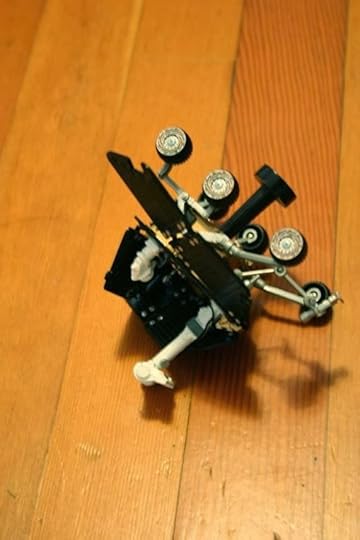 Perhaps my desk is a more hazardous place than Mars.
Or perhaps we humans are capable of much more than we can even imagine.
Long live Opportunity!
Elizabeth Rusch
Images courtesy of NASA/JPL, except for the last one, which I took myself.
 On January 24, 2004 PST (Jan. 25 Universal Time), the rover was dropped onto the surface of Mars wrapped in airbags, where it bounced 26 times before coming to rest in a crater. This little rover, about the size of golf cart, was designed for the three-month mission to find signs of past water on Mars.
  Tomorrow marks the 10-year anniversary of Opportunity’s mission on Mars. TEN YEARS!!! HURRAH! WHOOT WHOOT! I MEAN, CAN YOU BELIEVE IT PEOPLE??? TEN YEARS!!! It was a three-month mission and this little robot, which was not designed to survive even one Martian winter, is STILL EXPLORING MARS TEN YEARS LATER! It is a miracle. This is perhaps the most successful space mission EVER!
I don’t get to write like this, in all caps and with multiple exclamation points, in my books for children, but this is how I feel about this mission and this rover. I am astounded. I am in awe. I cannot believe that a dream and the work of a bunch of scientists and engineers have given us a ten- year tour of another planet.
Opportunity was designed to only travel on flat terrain but has explored crater after crater after crater and is currently climbing the tallest hill of its mission. This is where Opportunity has traveled so far:
 Opportunity is currently exploring the rim of Endeavour Crater, near an outcrop that may contain clay laid down in a watery past. Signs of past water have been found before, but evidence suggests that unlike the battery-acid-like water present on other parts of the planet, the water here may have been neutral enough to have once sustained life. LIFE!
I hope you can find a little time to celebrate the incredible success of this mission, especially with your children and students. You can:
Watch a live broadcast from the Jet Propulsion Laboratory today Thursday, Jan. 23, 11 a.m. PST (2 p.m. EST) which will include appearances of two of the heroes from my book The Mighty Mars Rovers , Steve Squyres and John Callas. (Webcast live at http://ustream.tv/NASAJPL and on NASA TV streaming at http://www.nasa.gov/nasatv.)
See Space.com’s slide show of the top ten discoveries from Spirit and Opportunity’s mission.
Enjoy these stunning photos from a decade of exploration.
Check out a slideshow about why the rover lasted so long, at NASA’s 10-year anniversary page.
Print out free posters, calendars and stickers.
Read the story of girl who was in eighth grade when Opportunity landed on Mars and is now an engineer on the mission.
Teachers, there is so much this mission offers to inspire your students. As the mission continues to unfold, Opportunity gives you an incredible opportunity to connect reading, writing, science, history, news, books, videos, and primary source material easily available on the internet. A teachers’ guide to my book The Mighty Mars Rovers offers discussion questions, hands-on activities, and resources. You can also find good ideas in two Common Core guides, one short and one long.
When I started writing The Mighty Mars Rovers , my husband bought me a little scale model rover to keep on my desk as inspiration. But my model kept falling off my desk and breaking.
 Perhaps my desk is a more hazardous place than Mars.
 Or perhaps we humans are capable of much more than we can even imagine.
Long live Opportunity!
Elizabeth Rusch
Images courtesy of NASA/JPL, except for the last one, which I took myself.
January 22, 2014
The Port Chicago 50
I’m excited to report that my new book, The Port Chicago 50, is now out and getting some good attention, including three starred reviews so far. I just happen to have one of them right here: http://www.publishersweekly.com/978-1-59643-796-8
.jpg) This is a little-known but very dramatic World War II civil rights story, set at a naval base near San Francisco. The main characters are young African American sailors who take a stand against segregation—and end up getting charged with mutiny and told they’re all going to be shot.
This is a little-known but very dramatic World War II civil rights story, set at a naval base near San Francisco. The main characters are young African American sailors who take a stand against segregation—and end up getting charged with mutiny and told they’re all going to be shot. This book is a great example of how I, and I think most of the I.N.K. writers, truly never know where the next idea is going to come from. A few years back, at Thanksgiving, I was talking about my research for a book about the making of the atomic bomb, and my brother-in-law, a great lover of conspiracy theories (as am I), asked if I knew when the first bomb was tested. I said, “Yeah, in New Mexico, July 16, 1945.” He said, “That’s what they want you to think!”
Then he told me this fantastic tale, firmly believed by many on the Internet, that the first atomic test was actually in the summer of 1944, at a naval base called Port Chicago. I was intrigued and did some digging. There really was a massive blast at Port Chicago in 1944, one that killed more than 300 American sailors and marines. But the real story is that it was an ammunition ship, packed with thousands of tons of bombs, that exploded. To this day, no one is sure why.
 After a bit more research, I learned that the sailors loading bombs and ammunition onto ships at Port Chicago were all African American. The Navy didn’t allow black sailors to serve at sea, except as messmen, so they were put to work on land at places like Port Chicago—only they were never trained to handle explosives. The men were pressured to work quickly and knew something terrible was going to happen. And of course they resented facing segregation while serving in a war that was being fought, as President Roosevelt kept saying, to preserve freedom around the world.
Then came the explosion of July 17, 1944, by far the deadliest home front disaster of World War II. With much more research, and some travel and lots of help, I was able to track down in-depth, unpublished interviews with many of the sailors who survived the blast. So in my book I’m able to follow the story from their point of view as they face what they know will be a life-changing decision: go back to work under the same conditions, or defy orders and face the consequences?
I won’t give away too much more, except to say that the number in the book’s title refers to the fifty men who wind up court-martialed for mutiny. I can’t promise a happy ending, though there’s no question that the stand these men took helped end segregation in the military, and was an early spark of the civil right movement of the 1950s and 60s. It's a story I am very proud to have the chance to tell.