Mary Kingswood's Blog, page 25
June 29, 2021
Review: The Unforgiving Eye by Beth Andrews (2021)
 As with the first in this series, the subtitle of this book is a complete sham. It describes itself as ‘a sumptuous unputdownable Regency romance’, and the only part of that to be unequivocally true is ‘Regency’. It is certainly not sumptuous (whatever that means in the context of a book – a TV show may be sumptuous, or a meal or furnishings, but a book?). It may, possibly, be unputdownable (opinions may vary). What it most assuredly is NOT, however, is a romance. The first in series could, at a stretch, be described so, but not this one. It’s a cosy murder mystery set in the Regency era.
Having got that gripe out of the way, here’s the premise: our low-key couple from the first book, John and Lydia Savidge, are on their way home from their honeymoon when they are diverted to a house where there just happens to have been a murder. Can they solve it in three days? Well, what do you think? Our intrepid duo set about their task with vigour. Who had a motive for killing Sir Benedict Stanbury? Who even knew he would be at the place where he was murdered, and at midnight, too? Did he really intend to change his will? If the murderer wasn’t the stable hand, the lover of Sir B’s niece, could it be the solicitor? Or the niece herself? Or the timid governess? Everyone has secrets, yet no one seems to be a likely murderer.
I’m going to be honest here and say that I spotted the murderer at a very early stage, and everything that happened afterwards served to confirm it. Not the most difficult puzzle to solve. It was fun watching John and Lydia investigate, but it got a bit wearing at the end when they seemingly couldn’t see what was right in front of their noses. A whole chapter was devoted to them telling each other that no, they couldn’t crack it, it was just impossible to work out and they would have to admit defeat… They were practically out of the door before the vital hint appeared to nudge them in the right direction.
Despite all that, this was an enjoyable read, whimsical and charming, with as eccentric a bunch of characters as anyone could wish for. It’s technically clean (no onscreen sex), but everyone seems to be having affairs so there is a lot of discussion of the subject. Unlike the first book, the author has got the names right this time, and I only spotted one place where some dialogue was wrongly attributed to Lydia instead of the niece. This wasn’t quite as much fun as the first book, but it felt like a more assured work, the murder unravelling was given centre stage, without the distraction of a faux romance, and I might well read future books in the series. If only the publisher could refrain from hyperbole in the subtitle! Four stars.


Review: Aunt Sophie’s Diamonds by Joan Smith (1979) [Trad]
 Well, this is a complete riot. It’s old-school, more of a Regency romp than a romance, although the romance side isn’t as neglected as it often is in books of this era (Georgette Heyer has a lot to answer for). This is light-hearted fun with a hero who’s sensible and only a teeny bit arrogant, and a heroine who seems demure and spiritless but absolutely isn’t, together with an array of charmingly wacky side characters.
Here’s the premise: Sophie Tewksbury is finally about to turn up her toes, and her relations gather at her deathbed to speculate about who will get the famous Beresford Diamonds and the rest of her fortune. But the will contains a surprise – the diamonds are to be buried with her, some lesser pieces are to be distributed, and the family are to gather again in a year’s time to hear the rest of her dispositions, which depend on what has happened in the interim. No one knows what that means, but in the meantime, the diamonds are buried in the graveyard, awaiting anyone brave enough to turn up with a spade and tools to break into the steel lining of the coffin.
Our heroine, Claudia, is a bit part player in this drama, for although she’s a niece of Sophie’s, she’s never met her and has no expectations. She’s surprised to inherit an emerald ring. Her cousin Luane, however, is miffed that she wasn’t given the diamond necklace, as she was promised, and determines to dig it up. She enlists Claudia to help her, and also a cousin, Gabriel, whom Luane hopes to marry one day. Another cousin, Jonathon, has inherited the ramshackle house but no money, so he’s also keen to find the diamonds. Claudia’s mother, Marcia, summons her beau, a former ironmonger, who she thinks will have the knowledge to break open the coffin. Ranged against these schemes is a more distant cousin, Sir Hillary Thoreau, a wealthy neighbour and nonesuch (a male incomparable), who watches over them all with amused detachment.
And so the stage is set for a great many graveside encounters at midnight, as one party or another tries to retrieve the diamonds, not to mention a certain amount of courting from the ever-optimistic Jonathon of either Luane or Claudia, as circumstances change. One or other of the cousins, he’s sure, will inherit the rest of the fortune, and he wants to be married to whoever it is, so he can afford to restore the house to its former glory. But it isn’t until the ironmonger beau turns up and looks set to marry Claudia’s mother that he settles on one of them. The ironmonger, now a moneylender, is fabulously rich and he’s bound to leave all that wealth to Claudia, isn’t he? There follows possibly the funniest proposal scene I’ve ever read. The book is worth the read for that alone.
Meanwhile, the urbane and unflappable Sir Hillary is also paying court to Claudia, and thank goodness for a hero who makes his intentions clear from the start, and doesn’t make an out-of-the-blue declaration in the final chapter. Claudia, of course, is oblivious to it all, and even when she does begin to have an inkling, she daren’t allow herself to believe it. She’s lived her whole life in the sort of dull situation where nothing really good ever happens to her, and here’s this dashing, rich, charming and worldly man with his wonderful houses and luxurious life – he can’t really want her, can he? And so there are some minor misunderstandings, but not such as to cause any real difficulties, and the romance ends in fine style.
There are some historical wobbles – my eyebrows rose at the mention of a welding torch (an expression not used before about 1900), but the book dates from the pre-internet era when research involved a trudge to the library, so it’s forgivable. The author seems to be entertainingly unfamiliar with chess. No, each player does not have some white pieces and some black, and I was entirely unconvinced that Claudia would be able to play such an intellectual game without paying much attention to it. You might play backgammon that way, perhaps, but chess involves a lot of deep thought from both players. On the other hand, hurrah for unmarried characters who find themselves potentially having to overnight at an inn, who sensibly ask at the parsonage for beds for the night (I wish more stranded Regency characters would do that instead of being caught out and having to marry in haste). My grumbles are very minor issues, and overall this is a fine read, well-written and with characters who are both charmingly eccentric and perfectly believable. I enjoyed every minute of it. Five stars.
Review: Aunt Sophie’s Diamonds by Joan Smith (1979)
Well, this is a complete riot. It’s old-school, more of a Regency romp than a romance, although the romance side isn’t as neglected as it often is in books of this era (Georgette Heyer has a lot to answer for). This is light-hearted fun with a hero who’s sensible and only a teeny bit arrogant, and a heroine who seems demure and spiritless but absolutely isn’t, together with an array of charmingly wacky side characters.
Here’s the premise: Sophie Tewksbury is finally about to turn up her toes, and her relations gather at her deathbed to speculate about who will get the famous Beresford Diamonds and the rest of her fortune. But the will contains a surprise – the diamonds are to be buried with her, some lesser pieces are to be distributed, and the family are to gather again in a year’s time to hear the rest of her dispositions, which depend on what has happened in the interim. No one knows what that means, but in the meantime, the diamonds are buried in the graveyard, awaiting anyone brave enough to turn up with a spade and tools to break into the steel lining of the coffin.
Our heroine, Claudia, is a bit part player in this drama, for although she’s a niece of Sophie’s, she’s never met her and has no expectations. She’s surprised to inherit an emerald ring. Her cousin Luane, however, is miffed that she wasn’t given the diamond necklace, as she was promised, and determines to dig it up. She enlists Claudia to help her, and also a cousin, Gabriel, whom Luane hopes to marry one day. Another cousin, Jonathon, has inherited the ramshackle house but no money, so he’s also keen to find the diamonds. Claudia’s mother, Marcia, summons her beau, a former ironmonger, who she thinks will have the knowledge to break open the coffin. Ranged against these schemes is a more distant cousin, Sir Hillary Thoreau, a wealthy neighbour and nonesuch (a male incomparable), who watches over them all with amused detachment.
And so the stage is set for a great many graveside encounters at midnight, as one party or another tries to retrieve the diamonds, not to mention a certain amount of courting from the ever-optimistic Jonathon of either Luane or Claudia, as circumstances change. One or other of the cousins, he’s sure, will inherit the rest of the fortune, and he wants to be married to whoever it is, so he can afford to restore the house to its former glory. But it isn’t until the ironmonger beau turns up and looks set to marry Claudia’s mother that he settles on one of them. The ironmonger, now a moneylender, is fabulously rich and he’s bound to leave all that wealth to Claudia, isn’t he? There follows possibly the funniest proposal scene I’ve ever read. The book is worth the read for that alone.
Meanwhile, the urbane and unflappable Sir Hillary is also paying court to Claudia, and thank goodness for a hero who makes his intentions clear from the start, and doesn’t make an out-of-the-blue declaration in the final chapter. Claudia, of course, is oblivious to it all, and even when she does begin to have an inkling, she daren’t allow herself to believe it. She’s lived her whole life in the sort of dull situation where nothing really good ever happens to her, and here’s this dashing, rich, charming and worldly man with his wonderful houses and luxurious life – he can’t really want her, can he? And so there are some minor misunderstandings, but not such as to cause any real difficulties, and the romance ends in fine style.
There are some historical wobbles – my eyebrows rose at the mention of a welding torch (an expression not used before about 1900), but the book dates from the pre-internet era when research involved a trudge to the library, so it’s forgivable. The author seems to be entertainingly unfamiliar with chess. No, each player does not have some white pieces and some black, and I was entirely unconvinced that Claudia would be able to play such an intellectual game without paying much attention to it. You might play backgammon that way, perhaps, but chess involves a lot of deep thought from both players. On the other hand, hurrah for unmarried characters who find themselves potentially having to overnight at an inn, who sensibly ask at the parsonage for beds for the night (I wish more stranded Regency characters would do that instead of being caught out and having to marry in haste). My grumbles are very minor issues, and overall this is a fine read, well-written and with characters who are both charmingly eccentric and perfectly believable. I enjoyed every minute of it. Five stars.
June 21, 2021
Review: Lucy and the Duke of Secrets by Sofi Laporte (2021) [Trad]
 I tripped over this while bouncing around Amazon, looking for a modern Regency that isn’t predictable and/or boring. And oh boy, is this ever NOT predictable or boring! What it is, though, is funny – and not just witty or chuckle-worthy, but laugh till you cry funny. I’d like twenty more just like this, please.
Here’s the premise: penniless Lucy Bell is on her way to visit a schoolfriend, who happens to be the sister to a duke. A duke, moreover, whom Lucy hates with a passion because he got her thrown out of her school where she was entirely happy, and was then left to fend for herself. Which didn’t work out too well, because Lucy is a one-woman tornado, who sows chaos and confusion and catastrophe all around her. Even a simple journey falls apart, for she finds herself stranded some miles from Ashmore Hall, where her friend lives, with night falling and no money for an inn.
But happily, there’s a man loading up a wagon with plants who seems to be going the right way. Surely he’ll give her a lift? At first, he refuses in the most abrupt way, but eventually he relents, and Lucy chatters away to him happily, while he grumps away beside her. She discovers that he’s a gardener at Ashmore Hall, and his name is Henry. He’s handsome, too, which can’t hurt, and she finds she rather likes him, despite the grumping (the blurb describes him as charming, but he really isn’t; tolerant of her mishaps, perhaps, but grumbling constantly). For various wacky reasons (see previous remarks about Lucy the one-woman tornado), they end up spending the night together in a farmer’s barn, and telling stories and (eventually) kissing.
The next morning, she arrives at Ashmore Hall, and after only the minor mishap of being mistaken for a servant and spending the morning cleaning fireplaces and dusting, she is reunited with her friend, Lady Arabella. Henry, meanwhile, disappears about his gardener’s tasks, she supposes. Lucy has arrived just as a house party is getting under way, to finagle the betrothals of the duke to a cold fish aristocrat, and Arabella to a beautiful but soulless lord. Reluctantly, Lucy is drawn into the house party, where she is shocked to discover that Henry, the grumpily charming and very kissable gardener, is actually the icily cold and rigidly polite Duke of Ashmore, who fails even to acknowledge their previous acquaintance. The reader is slightly less shocked by this discovery, since it is given away in the book’s blurb, so I’m not revealing spoilers here.
From then onwards, Lucy unleashes her disruptive force all over the duke’s household, but particularly at the duke himself. I won’t spoil the surprise by revealing everything she does, but it’s gloriously funny, and culminates in a humdinger of a row between the two of them, at midnight, and in full view of half the household. It’s absolutely wonderful, and when the dowager duchess describes it as a lover’s quarrel, she’s absolutely right, because it crackles with that kind of tension. Lucy’s problem is that she’s in love with Henry the gardener, with whom she feels she could actually aspire to marriage, but still hates the duke, who is obnoxious towards her at every verse end. And Henry’s problem is that old chestnut, a hero who doesn’t realise he’s in love at all. Silly man.
And then everything turns soggy. A certain amount of misunderstanding or keeping of secrets I can accept, but there comes a point in any book where the protagonists, if they are sensible, sit down and talk things through. They don’t continue to not tell each other vital pieces of information, and they don’t, under any circumstances, do noble, self-sacrificing things for the other’s good. Nor do they withhold exciting news when they have it, or leave the object of their affection stewing in misery. So although it comes right in the end, I wasn’t happy about it at all.
Sofi Laporte seems to be a new author, and I for one will certainly be reading more of her work. If this is a debut, it’s a brilliantly accomplished one. I’d have given it five stars, despite the implausibility of some of it, but that soggy ending and a high level of editing errors keeps it to four.
Review: Lucy and the Duke of Secrets by Sofi Laporte
I tripped over this while bouncing around Amazon, looking for a modern Regency that isn’t predictable and/or boring. And oh boy, is this ever NOT predictable or boring! What it is, though, is funny – and not just witty or chuckle-worthy, but laugh till you cry funny. I’d like twenty more just like this, please.Here’s the premise: penniless Lucy Bell is on her way to visit a schoolfriend, who happens to be the sister to a duke. A duke, moreover, whom Lucy hates with a passion because he got her thrown out of her school where she was entirely happy, and was then left to fend for herself. Which didn’t work out too well, because Lucy is a one-woman tornado, who sows chaos and confusion and catastrophe all around her. Even a simple journey falls apart, for she finds herself stranded some miles from Ashmore Hall, where her friend lives, with night falling and no money for an inn.
But happily, there’s a man loading up a wagon with plants who seems to be going the right way. Surely he’ll give her a lift? At first, he refuses in the most abrupt way, but eventually he relents, and Lucy chatters away to him happily, while he grumps away beside her. She discovers that he’s a gardener at Ashmore Hall, and his name is Henry. He’s handsome, too, which can’t hurt, and she finds she rather likes him, despite the grumping (the blurb describes him as charming, but he really isn’t; tolerant of her mishaps, perhaps, but grumbling constantly). For various wacky reasons (see previous remarks about Lucy the one-woman tornado), they end up spending the night together in a farmer’s barn, and telling stories and (eventually) kissing.
The next morning, she arrives at Ashmore Hall, and after only the minor mishap of being mistaken for a servant and spending the morning cleaning fireplaces and dusting, she is reunited with her friend, Lady Arabella. Henry, meanwhile, disappears about his gardener’s tasks, she supposes. Lucy has arrived just as a house party is getting under way, to finagle the betrothals of the duke to a cold fish aristocrat, and Arabella to a beautiful but soulless lord. Reluctantly, Lucy is drawn into the house party, where she is shocked to discover that Henry, the grumpily charming and very kissable gardener, is actually the icily cold and rigidly polite Duke of Ashmore, who fails even to acknowledge their previous acquaintance. The reader is slightly less shocked by this discovery, since it is given away in the book’s blurb, so I’m not revealing spoilers here.
From then onwards, Lucy unleashes her disruptive force all over the duke’s household, but particularly at the duke himself. I won’t spoil the surprise by revealing everything she does, but it’s gloriously funny, and culminates in a humdinger of a row between the two of them, at midnight, and in full view of half the household. It’s absolutely wonderful, and when the dowager duchess describes it as a lover’s quarrel, she’s absolutely right, because it crackles with that kind of tension. Lucy’s problem is that she’s in love with Henry the gardener, with whom she feels she could actually aspire to marriage, but still hates the duke, who is obnoxious towards her at every verse end. And Henry’s problem is that old chestnut, a hero who doesn’t realise he’s in love at all. Silly man.
And then everything turns soggy. A certain amount of misunderstanding or keeping of secrets I can accept, but there comes a point in any book where the protagonists, if they are sensible, sit down and talk things through. They don’t continue to not tell each other vital pieces of information, and they don’t, under any circumstances, do noble, self-sacrificing things for the other’s good. Nor do they withhold exciting news when they have it, or leave the object of their affection stewing in misery. So although it comes right in the end, I wasn’t happy about it at all.
Sofi Laporte seems to be a new author, and I for one will certainly be reading more of her work. If this is a debut, it’s a brilliantly accomplished one. I’d have given it five stars, despite the implausibility of some of it, but that soggy ending and a high level of editing errors keeps it to four.
Review: The Substitute Bridegroom by Charlotte Louise Dolan
 This was a hard one to rate. There was a lot about it I disliked quite intensely, and there were moments that had me rolling my eyes pretty hard. But on the other hand, I read it avidly despite the eye-rolling and that has to count for something.
Here’s the premise: Elizabeth Goldsborough is the Incomparable beauty of the season, a resounding success, capped with an engagement to the most handsome and eligible gentleman of the day, Simon Bellgrave. But an accident leaves her with a disfiguring scar on one cheek, her betrothed has trouble even looking at the injury and so she releases him from their engagement. And he, the cad, takes off without the slightest protest. Elizabeth’s brother isn’t having her spending her days as an old maid, so he informs the man responsible for her accident, Captain Darius St John, that he’d better marry her to make reparation. And he, the cad, refuses. Until his snake of a sister tells him he mustn’t do it, whereupon he promptly offers for Elizabeth, and she accepts him.
And at this point, I’m probably at peak eye-rolling, because what kind of hero only does the honourable thing because his sister tells him not to? And what kind of daft heroine accepts a man like that? I can see that she might if she already knows and likes him, or if he at least presents himself in a gentlemanly manner, and puts a good face on the inevitable, but Darius is so rude and surly and totally bad-mannered that it’s hard to imagine any rational woman wanting him. And it’s not as if she would be entirely destitute if she doesn’t marry him, either. She has a brother to look after her, she has her own fortune, for heaven’s sake, she’s independent. She can wait it out for a man to come along who doesn’t care about her scar. The author makes a valiant effort to convince the reader that Elizabeth is completely unmarriageable now, because only a perfectly flawless face can possibly succeed in attracting a man, and the ton will ostracise her and bla bla bla… no, not convincing for a moment (as later events prove).
So she’s stupid, and he’s boorish and self-centred and rag-mannered and… yes, I disliked him pretty thoroughly at this point. He’s completely focused on his army career, and thinks all women are fickle, duplicitous witches, and with his own family as evidence, I can see where he’s got that idea from. Anyway, they marry and after a quick romp with her, he disappears back to the war, because heaven forfend that he should change anything in his life just because he has a wife (and possibly a child, given the romping interlude). And here’s where we’re back into eye-rolling territory, because at this point, for no reason whatsoever that I can ascertain, she decides she’s in love with him. Good grief.
There’s a strange scenario where she writes to him regularly, nice, chatty letters about what’s going on back home, which he reads out for the entertainment of his men, but it never once occurs to him to write back to her. She’s hanging about waiting for the letters to arrive every day and always being disappointed, so when he appears unexpectedly (because no, he couldn’t possibly have written to tell his wife he’s coming home, could he?), he finds himself cold-shouldered by all the locals who’ve gathered protectively around his neglected wife. And naturally he blames her for it. Because of course he does.
And so it goes on. Whenever there’s the least possibility of him behaving badly and misunderstanding everything and blaming his poor wife for everything he perceives is wrong (because women are wicked, duplicitous witches, so of course he does), he storms out in a huff, and it takes the whole book for him to dimly perceive, through the fog of his own prejudice and (frankly) stupidity that she’s actually quite nice really, despite being a woman. Honestly, his batman is streets brighter than Darius is.
The ending gets pretty silly, with his sisters having a starring role. I think it was meant to be funny, but I didn’t find it particularly amusing. But at least Darius realises what a treasure he has in Elizabeth, and they get their happy ending eventually, even though, as it turns out, scars fade with time and become fashion accessories, so Elizabeth’s prospects weren’t as ruined as we were all led to believe. Especially when she might become a duchess. There was one major historical error – a duke can’t ever resign his title or his entailed estates, whether or not there’s an heir. It was also mentioned at one point that if Elizabeth were a duchess and Darius died, she would lose her title, but that’s wrong, and since there’s a dowager duchess in this very book, I can’t imagine why the idea was even mentioned.
I’ve been pretty critical of this on a number of levels, but the fact remains that I galloped through it almost without taking a breath, and despite all the eye-rolling, I never once considered abandoning the book. So I concluded that it worked for me at some deeper level, despite the problems. It’s probably somewhere between a three and a four star read, but the writing was generally good, so I’m going with four.
June 12, 2021
Review: Bassington by Jenny Hambly (2021)
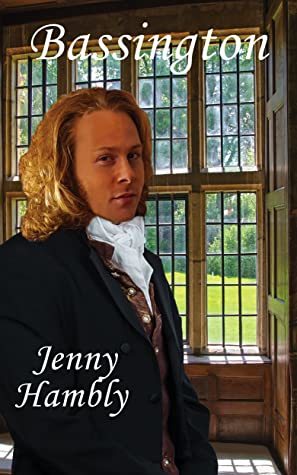 I’ve loved everything Jenny Hambly has written and this is no exception, but I have to admit this one fell a little bit flat and meandered into the weeds at the end. Even so, with two likable protagonists, a fascinating array of side characters and a genuine dilemma for the heroine, this is still a cracking read.
Here’s the premise: Captain Charles Bassington survives the carnage of Waterloo, only to fall ill with an inflammation of the lungs. While he recuperates in rural France, with communications difficult, his neighbour and friend Lady Selena is so mad with worry for him that she sends his friend Lord Carteret to find him and bring him home.
At this point, Selena’s heart is painfully obvious to everyone. She’s been in love with Charles for years, and her worry for him is too great for her to dissemble. But there’s a wrinkle. Charles has been writing to her from France (a bit naughty when they’re not betrothed), and he’s suggested that Lord Carteret would make her a good husband. She’s had an unsuccessful season in London, partly through shyness and partly because she just doesn’t want anyone but Charles, but now she has to face up to reality. She’s twenty years old, Charles is not going to marry her and it’s time she left her childish dreams behind and started looking seriously for a husband.
Almost at once, two suitors pop up. One is the same Lord Carteret recommended by Charles. The other is an older man (all of 37! Mr Knightley territory), Lord Ormsley. Both of them are eligible, gentlemanly and attentive. And here is the dilemma of all sensible Regency women – should she settle for one or other of the two, or should she hold out for the man she really wants, with the risk that she might never marry? It was a serious problem at the time, and waiting for love to happen along wasn’t a good idea outside the pages of a novel.
While Selena is weighing up her suitors and Charles is recovering from his illness, there’s a bit of a mystery thrown into the mix, with the discovery of a body and a necklace in the local lough (lake). The necklace belonged to a local girl who disappeared a few years ago after suffering an unrequited love affair, so it seems an open and shut case, but is it?
In the background are a whole array of minor characters. I loved that both our main characters enjoyed warm, loving families. Not without the odd irritation, of course, but generally they’re normal folks, and not the evil, overbearing relations so often encountered in a Regency romance. In fact, Selena’s stepmother epitomises the deftness with which the characters are drawn. Lord Sheringham has only recently remarried, just nine months after the death of his wife (Selena’s mother). We first encounter the new Lady Sheringham in London with Selena as she tries her best to find her a husband, and there’s a certain tension between the two. It looks as if Lady S is going to fall neatly into the trope of wicked (or at least deeply unpleasant) stepmother, especially as she has a daughter of her own to marry off.
But back home in the north, she is gradually revealed as being rather an insecure person, unused to being part of a loyal and affectionate family and unsure of how far to unbend in her dealings with the tenants. She slowly relaxes her stance towards Selena and is revealed as a much more nuanced and frankly interesting character. I very much enjoyed this miniature character development going on alongside the main story.
Some grumbles (because what would a review be without a few grumbles?). Firstly, the characters. There are a huge array on display here, and I never got them straight in my mind. Selena’s family confused me. How old was Gregory, her brother? Or Eddy, another brother? He was never seen, owing to some illness from India (malaria, possibly?). I never even knew what the family name was. If any of these details were mentioned, I missed them. There were a bunch of local families that I never quite sorted out, including Cedric, who turned out to be quite important to Selena’s history. He was mentioned once or twice in passing, but I never got the impression that it was a big deal, and Selena always seemed so composed that it was hard to believe she’d had a traumatic experience. She was supposed to be shy in company, but that didn’t come across to me particularly well. And Lady Sheringham’s horrible parents appeared out of the blue, with no warning of anything untoward in her history. Maybe I read too quickly to spot the clues, or maybe they were just too subtle for my brain.
The mystery of the body in the lough was resolved in the most unexciting way imaginable. I liked the idea of it, and it felt very plausible, but it seemed like too much of a coincidence, the way it happened. It would have been more satisfying, I think, if the discovery of the body had triggered the resolution instead of it just happening (trying not to reveal anything here). But I was glad it wasn’t as black an event as it seemed at first.
Now, none of this would matter a bit, but I confess to being a bit disappointed at the way the romance ended. Here we have a dashing captain, a leader of men who knows very well how to be decisive, and we have a sensible, intelligent and spirited heroine who knows her own mind. She also has the shining example of two friends who seized control of their own destinies by setting out to snare their chosen husbands. Even if she decided not to use their precise methods, I would have liked to see Selena seize control of her destiny, too. Or that Charles would decide to be brave and snatch her from under the noses of her two suitors. But no. He has to be talked into it by half his relations and hers, and negotiate with his father first, which is very correct but (for me) infuriating. What I want is for one or other or (preferably) both the protagonists to be swept away by passion in the end, overcoming all obstacles, real or imagined. I was also hoping that Charles would turn out to be rich in his own right. His brother-in-law was managing his prize money for him, but although it was mentioned in passing, nothing further was said about that, and Charles had to beg his father for financial support.
As always, though, the book is beautifully written. Here’s a lovely quote: ‘There could be no comparison between Lord Carteret’s cool, grey gaze and Charles’ warm, laughing blue eyes, just as there was no comparison between a still, wintry morning and a glorious summer’s day.’ For almost the whole book, I was utterly enthralled, and couldn’t put it down. Only that somewhat unfocused ending keeps it to four stars for me.
Review: Aurora by Joan Smith (1980)
 This is a whole heap of fun, with a mystery that kept me engrossed. It’s an old-fashioned Regency, which means the romance is rather perfunctory with the mystery taking centre stage, but it works pretty well. It helps that the hero is an absolute charmer.
Here’s the premise: the baron, Lord Raiker, has died, leaving his eldest son to inherit. Now he too has died without an heir, leaving two brothers to inherit. But Kenelm, the elder, vanished years ago, and the old baron’s young second wife sets about having her son Charles declared the new baron. But then a man appears claiming to be Kenelm. The race is on to prove or disprove his claim. Aurora, the unmarried sister of the widow of the eldest son, would very much like him to be Kenelm, because if he is an imposter, he might very well be a murderer, too. And it would never do to fall in love with such a man. But he is so very charming…
Now, it has to be said that the answer to the is-he-or-isn’t-he question is obvious almost from the start, but the twists and turns of the plot are very twisty and turny indeed, so there is constantly doubt being thrown up, not to mention a body exhumed and all sorts of plausible obstacles arising. Even though I was almost certain how it would go, there was always a little niggle of doubt in there. Meanwhile, the man claiming to be Kenelm appears to be enjoying himself hugely, as he gradually draws strait-laced Aurora into his schemes. And did I mention how charming he is? When he persuades her to creep around the manor house attics in the middle of the night, it’s not at all clear whether he really cares about finding whatever piece of evidence is the excuse, or whether he just wants the fun of it. It’s no wonder she falls hard for him.
What did puzzle me somewhat is what he saw in her. He makes his interest obvious almost from the start, but he is also flirting with pretty much anything in a skirt, so she’s not at all sure whether he really likes her, or is just reflexively flirting with her, or whether he’s just using her to help him gain the barony. Aurora never really shows much personality, so what was the great attraction? That was more of a mystery to me than whether the hero was really Lord Raiker or not.
Nevertheless, this is a light-hearted read, very entertaining if you’re not looking for a passionate romance. The flamboyant and rakish hero (did I mention how charming he is? I may have mentioned it once or twice) and his swashbuckling style more than compensate for the rather colourless heroine. Four stars.
June 8, 2021
Review: Unequal Affections by Lara S Ormiston (2013)
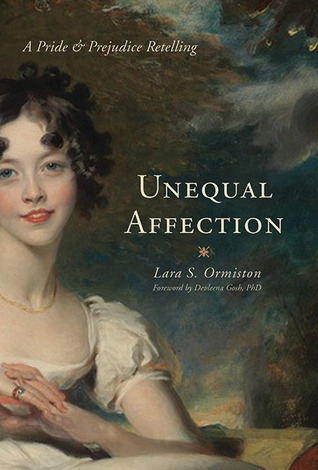 This is only the second P&P variation I’ve ever read [*], and possibly the most expensive ebook I’ve ever bought, but it’s hard to imagine there will ever be anything to top it. The author took two characters we feel we already know well and peeled back layer after layer to reveal every last fascinating nuance of their characters. It’s a virtuoso performance. Perfection.
Here’s the premise: apart from a brief prologue with Bingley, the story opens precisely in chapter 34. Darcy has just made his first, insulting proposal to Elizabeth at Hunsford Parsonage and is waiting complacently for her acceptance. We know how that went in the book! But instead of impetuously rejecting him out of hand, Elizabeth stops to think. He loves her! And loves her so well that he is prepared to make for himself the sacrifice that he deterred Bingley from, and marry into a family beneath his own, in wealth, social status, education and manners. He will put up with her hideous relations for her sake. She realises that she will never again have such a good offer, she can rescue all her family (including herself) from poverty and provide herself with a man who feels an overwhelming passion for her. So she asks for time to consider the offer.
Obviously (because the story would be no different from the book otherwise) she accepts him. They spend a little time in London, where he realises that she has relations of whom she need not be ashamed (the Gardiners), and she realises that amongst his social equals, he can be perfectly agreeable. It’s only when the main characters move back to Longbourn and Darcy bumps up against the disaster that is Elizabeth’s family that things begin to fray around the edges.
This tips the story straight into a maelstrom of discordant emotions. Where Austen is relatively dispassionate, Ormiston brings the muddled feelings of the protagonists to centre stage. Darcy is overwhelmed with love for Elizabeth, but still the proud, supercilious man he is in the early part of the book. He knows intellectually that he has to make sacrifices for Elizabeth, but he thinks it will be a short-lived difficulty, and that as soon as he can whisk her off to Pemberley and away from her awful relations, everything will be wonderful. And Elizabeth is torn between gratitude – he loves her! – and the cold fear that she’s only marrying him for material advantage, and what sort of foundation is that for marriage anyway?
So yes, this is all about the angst, the swirl of awkwardness that is bound to surround two such different people, from very different worlds, marrying for very different reasons. But Ormiston gets wonderfully under the skin of both of them. Elizabeth’s perky self-confidence is gradually stripped away as she begins to realise the enormity of what she’s taken on, and the challenge of keeping Darcy happy, not just through the honeymoon period but for a lifetime. And yet she feels the full force of the power she has over him, of knowing that she has only to smile or lift one eyebrow to bring him to her side.
As for Darcy, we see a side of him that, frankly, never emerges in the book. We see his weaknesses and yes, his vulnerability, on full display. He is tender, gentle and determinedly passionate, and honestly, I’d have married him in a minute, I can tell you. The book softens Darcy and erodes his pride, but it never reduces him to this desperate shell of himself. And yet Ormiston never once made me feel that this was anything other than the Darcy of the books. We just see him exposed in all his complex layers. It’s an awesome performance.
The way they tiptoe around each other is brilliantly drawn. They really know very little of each other’s characters and beliefs (and that was absolutely how it was in the Regency – society combined to keep men and women apart until they decided to marry, so this delicate little dance is spot on). There are two steps forward and one back, meetings when everything goes smoothly and other times when one or the other is cast into despair, wondering what on earth they’ve got themselves into. There are kisses, quite a lot of kisses, actually, but every one is different and the circumstances that lead to them and the consequences of each one are fascinating. But Darcy is utterly steadfast in his love for Elizabeth, and that love (combined with Elizabeth’s outspokenness and willingness to meet him halfway) eventually rips away every last shred of pride. He begins to understand what he has to do to be worthy of her, and she begins to appreciate just what a wonderful man she’s found.
The title of the book tells the story – these two start out with unequal affections, Darcy so overwhelmed with love that he would do anything, absolutely anything, to win Elizabeth. He just doesn’t quite realise what it will take. And he’s utterly confident that he can make her love him in the end. How he comes to realise that, perhaps, that might never be possible and face up to the prospect, and how Elizabeth’s own feelings come to change forms the bulk of the book. The plot actually follows the book rather well, although with some obvious differences, since Darcy and Elizabeth are now engaged. But there are certain scenes and even phrases that come straight from the book, and the divergences are all perfectly logical.
There are plenty of Pride and Prejudice variations that are only tenuously rooted in the book. This is not one of them. This feels like the real Darcy and Elizabeth, but seen from a completely different angle. Much of what they experience here they would have gone through anyway after the wedding – that awkward getting-to-know-you phase of marriage. Here it all happens beforehand in brilliantly realised detail. Austen purists could safely read this and feel they were only adding to their understanding of the couple. And it’s not just the main characters that are perfectly drawn – I heard all of them speaking in the voices of the actors in the 1995 version, that’s how real it felt. It’s a crying shame that Ormiston seems not to have written anything else, but one perfect book is a fine legacy. Five stars.
[*] The other was Thaw by Anniina Sjöblom, which was also wonderful, in a different way.
Review: A Good Match for the Major by Josie Bonham (2020)
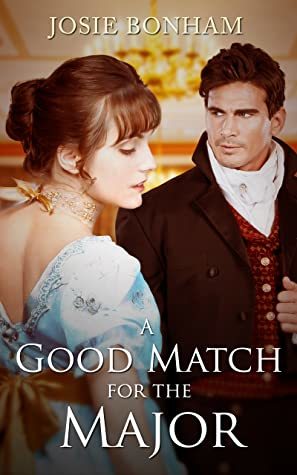 This is a new-to-me author with an excellent realisation of the Regency, a nice mix of characters and a story that, while not venturing into terribly original territory, is a very pleasant and slightly steamy read.
Here’s the premise: Lady Eliza Wyndham is the daughter of a marquess, whose first, brief marriage was miserable. He was a fortune hunter whose seemingly amiable nature vanished as soon as they left the church. Now she’s back home with her younger brother Max, the current marquess, and quite happy to stay unmarried for the rest of her days, helping out around the parish, acting as patron to the village school and supporting her brother. Major Nathaniel Overton (Nat) has moved to the estate next door where he is heir to his elderly uncle. The two meet in spectacular fashion, when Nat sets his horse to jump a hedge and finds himself directly in front of Eliza’s gig. The gig is overturned and Eliza ends up in a muddy ditch. Immediately the two are sparring with surprising hostility.
Needless to say, there are reasons for their aggression. Nat watched his parents killed in a carriage accident, and shock makes him abrupt with her. This forcefulness reminds Eliza of her husband, so they are very much on the back foot from the start. Naturally, despite their initial dislike of each other, they are then thrown together at every turn, both by accident and by gently conniving friends and relatives, who see the suitability of the match between neighbours.
The trouble they have is that they are unquestionably drawn to each other. This is largely physical, with both of them getting hot and bothered by… well, almost everything. There are a great many brushes of hands or thighs (Eliza seems to have quite a thing about Nat’s manly thighs), and meaningful gazes. I was a little surprised that Eliza is so readily aroused considering that her marriage was a disaster sexually (no details are given, only hints, so it’s hard to know exactly what happened, but it’s clear that she didn’t enjoy that aspect of marriage).
Nat’s progress along the road from dislike to attraction to thoughts of marriage is relatively smooth, disrupted only by mixed signals from Eliza. And boy, are those signals mixed! Eliza is the ultimate ditherer, veering sharply between desire and a determination to avoid men for the rest of her life. So one minute she’s encouraging him to kiss her, and the next she’s freezing him out. No wonder the poor man didn’t know how he stood — she didn’t know herself. I have to say, I strongly disapproved of all that kissing and cuddling, when she had no intention of taking things further. I understood what was driving her, but it was horribly unkind to the poor man.
Into all this dithering and angsting comes the dastardly villain, whose efforts to marry Eliza for her fortune (surprisingly large, despite the efforts of her fortune-hunter husband) become increasingly aggressive. Nat and all Eliza’s male relatives have to join forces to protect her. The plot veers somewhat into melodrama at this point, with a misunderstanding or two thrown in for good measure to slow our progress towards the inevitable happy ending.
A few minor grumbles. The book felt overlong, but that was largely because we got every last detail of every banal conversation (or so it seemed), so the dialogue could have done with tightening up. A few extra commas would have made some sentences easier to read, too. I only spotted a couple of historical errors. Dance cards really weren’t a thing this early (more of a Victorian tradition in England). The only bothersome error to me is that Lady Eliza Wyndham is sometimes called Lady Wyndham. I winced at that every time (but most people probably wouldn’t even notice).
I think this is the first publication by Josie Bonham. If so, it’s a very competent effort which I enjoyed very much, marred for me only by Eliza’s excessive mixed signals. The deeper theme, however, of how she could learn to trust a man again, was well drawn, and I completely got her reluctance to commit, despite all the helpful relations pushing her towards Nat. I just wish she could have been open with him, explained what the problem was and asked him to give her some time to grow used to him before she made an irrevocable decision. I could have used a little more humour, too. But this is a solid Regency with a slow-build romance, some drama and a heart-warming ending. There’s just one sex scene, and a whole heap of lusting. Four stars.