Mary Kingswood's Blog, page 26
June 7, 2021
Review: Choice Deceptions by Emma Jensen (1996)
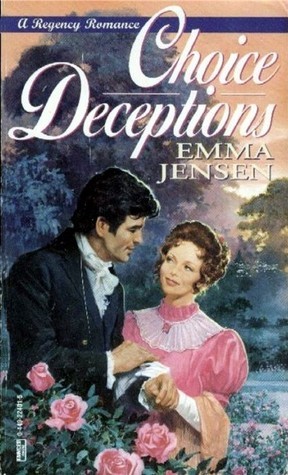 This was a solid read, neither wildly original nor particularly deep, but enjoyable, although spoilt for me by a somewhat soggy ending. I liked the heroine very much, but the hero was a little too typical of the era for my taste – forceful and domineering, with a mushy centre that he refuses to put on display (except with the children, of course). I would have liked him to have melted into a puddle of despairing love at the heroine’s feet, but I daresay that’s my modern sensibilities showing through.
Here’s the premise: in Somerset, Aurelie Carollan needs to get through another three months before she comes into her inheritance and is free of her scheming guardian, whose efforts to sell her in marriage (literally!) before her majority are becoming ever more flagrant. Desperate to escape, she advertises for a post as a governess. Meanwhile in London, Jason, Viscount Tarrant, is increasingly irked by his family’s attempts to get him to fall in with an arranged marriage. The girl is beautiful and amiable, but Jason won’t be forced, so when he sees a well-written advertisement for a governess, he decides that she will be just the ticket – to play his betrothed and head off the arranged match at the pass.
So far, so very predictable, and frankly the plot runs on rails from this point. The deliberately dowdy heroine (to deter the unwanted suitors) is miraculously transformed by some nice gowns, a decent hairdo and leaving off the spectacles, into a beauty. She effortlessly wins over the curmudgeonly relations and is a success in London (even charming – quite inadvertently — one of the patronesses of Almacks). Under her influence, the grouchy hero starts to soften as he falls in love.
There’s nothing actually wrong with predictability in a plot, but where this one goes off the rails into stupid territory is via the Great Misunderstanding. Yes, that old chestnut. I don’t mind a little familiarity here and there, but that’s a step too far. Aurelie huffs off into the sunset, leaving Jason in the lurch and he, idiot that he is, doesn’t go after her. Because of pride or something (hard to tell, because I was pretty irate by this time). And so there’s a long interlude where they’re both pretty miserable, the reader is pretty miserable too because the HEA is right there on the horizon, but we’re still mired in the Slough of Despond and frankly I just wanted to bang their heads together.
So why have I given this four stars instead of simply throwing it against the wall? Because apart from the Great Misunderstanding and the Slough of Despond this was actually a perfectly good read. It also gets bonus points for using actual Latin and Gaelic, and for wrapping the story round a very cute Irish folk story, which lifts the whole thing well above the predictable. A well-written and enjoyable story, very rooted in its era but none the worse for that.


May 31, 2021
Review: Lady Elizabeth’s Comet by Sheila Simonson (1986)
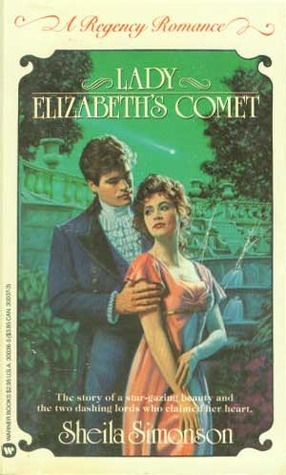 There are books I enjoy, books I REALLY enjoy, and books where everything else grinds to a halt so that I can read on, breathless, until the end is reached. This book is definitely in the third category. I cannot recall a book where the characters are so deep, so subtly nuanced, so downright intriguing before. A fascinating read.
Here’s the premise: Lady Elizabeth Conway, the eldest of eight daughters of an earl, awaits with trepidation the arrival of the new Lord Clanross, a distant cousin who was never expected to inherit, was shipped off to join the army in his youth and has been employed as an estate manager since he was invalided out. Definitely not earl material. His arrival is inauspicious. He looks pale and ill, and is boring as ditch-water, when he’s not being rude. But when his war injuries flare up in life-threatening manner, Elizabeth begins to see a different side to him.
Elizabeth is a fascinating character. Her great obsession is her telescope, through which she hopes to detect a new comet. As she’s viewed as irredeemably eccentric and a blue-stocking to boot, she’s still unmarried at the age of twenty-eight, and her scientific bent makes her largely oblivious to what’s going on around her, particularly the welfare of her two younger sisters, fourteen-year-old twins Jean and Margaret, who have bested a succession of governesses and are well on the way to running wild. Lord Clanross, on the other hand, is very much interested in the sisters and presses Elizabeth to get on and organise a governess. The two spar frequently over this and… well, pretty much everything.
Into this somewhat hostile environment comes Lord Bevis, heir to an earldom, a handsome, witty and charming man who has been pursuing Elizabeth for years, followed in time by Willoughby Conway-Gore, Clanross’s current heir, a somewhat snivelling man who has run through his own fortune and is put out that Clanross has survived to cut him out of the inheritance. He brings with him his beautiful peahen of a sister, with the object of marrying her off advantageously to Clanross or Bevis – either will do. And in the background is Elizabeth’s conventional companion, the new and very unconventional governess and an assortment of relations.
The beauty of this book, however, is that it is entirely written in the first person from Elizabeth’s point of view. This means that we see absolutely everything through her eyes, infused with all her own prejudices and foibles. There are times when the twins aren’t even mentioned, for instance, because Elizabeth has basically forgotten their existence. The dull companion barely registers but the governess, with her scientific bent (she’s a botanist) registers far more. And of course we see the two important men in her life just as Elizabeth herself sees them, and watch how her opinions gradually blur and shift as she begins to view them differently.
Clanross is the interloper, an unworthy commoner with the soul of an accountant, elevated beyond his desserts by a quirk of the laws of primogeniture. He’s rude, plain and downright awkward, and makes Elizabeth bristle with righteous indignation (and outright prejudice) every time she encounters him. Bevis, on the other hand, is the golden aristocrat, the smooth talker, flirtatious, mannered and so, so charming, with the familiarity that comes from long friendship. It’s no wonder that she begins to think perhaps it’s time to say yes to him, and settle down to married life. But the difficult question of her telescope won’t go away. Bevis is horrified by the thought of her pursuing so eccentric a study after they’re married. Clanross, on the other hand, respects and admires her scientific work.
And so, inch by inch, Elizabeth comes to understand Clanross better and begins to appreciate his true worth. And all this is done with scintillating dialogue which is genuinely clever and witty, and very, very funny, as well as Elizabeth’s inner thoughts, and her guilty realisation that she really has neglected her sisters, and hasn’t done justice to Clanross himself. It’s all brilliantly done. I can’t remember when I last read a book that I enjoyed so much, and on a number of different levels. Even the minor characters are perfectly realised and fully rounded human beings, in all their quirky mixture of good and bad and outright weird. And the romance? Perfectly judged and eminently satisfying. An excellent five stars.
May 28, 2021
Review: Leticia by Devi King (2021)
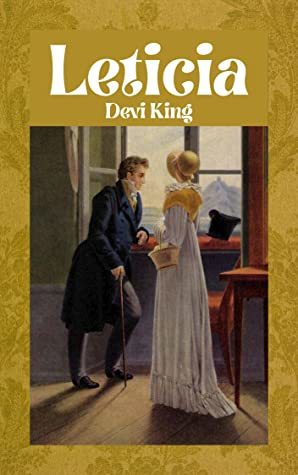 This is an oddball find, something I hit on accidentally when I was bouncing around Amazon looking for something a little bit different. And this is definitely different.
Here’s the premise: Alistair, the Marquis of Yarrowton and Miss Letitia Gough-Dane have been destined for each other for years, since she was a baby, in fact, introduced to the Eton schoolboy as his prospective bride. He has fond memories of the wild child Letty growing up, so when he meets her again for the first time in years and finds he still likes her, he offers and she accepts. At which point she turns into an ice maiden – very correct, very civil but distinctly chilly. Mystified, he determines to find out the reason for her behaviour – has she taken him in dislike? Is she being pushed into marriage? But he gets nowhere, until a chance curricle accident leaves them stranded at a country inn overnight.
At this point, the story veers sharply into Georgette Heyer territory, with the appearance of a charmingly pretty ingenue, an irate lover and a bottle of brandy. It’s all very funny, but resolves rather neatly, the characters are both believable and likable (the marquis is a bit of a charmer) and really my only complaint is that it’s far too short (I read it in not much above an hour). But it’s beautifully written, with an elegant use of language and a very convincing grasp of the Regency. I would very much like to see a full length work by this author.
So what’s so different about it? Only that the author published four other books at the same time as this one. This is a more or less traditional Regency, with no more than a bit of mild kissing and some lusting, with a fade to black on the only sex scene. There’s even a classically traditional cover, very tasteful. The other books are billed as erotic tales of the Ottoman Empire, a genre that could hardly be more different. I commend the author’s versatility, but it’s an uneasy mixture. I don’t know what the erotica is like, but if she chooses to focus on the Regencies, she definitely has a future there. Four stars.
Review: A Gift of Daisies by Mary Balogh (1989)
 This was a difficult book for me to judge. Were it by an author unknown to me, I’d probably have gone with 2*, but with Balogh I’m prepared to see it as an aberration, a brave stab at something that ultimately failed. It ranks, however, as by far the most boring Balogh book I’ve ever read.
Here’s the premise: Lady Rachel Palmer is a social butterfly, the beautiful and vivacious star of the London season, charming even the most unlikely confirmed bachelors to her side. David Gower is the precise opposite, a serious, pious clergyman who may be the younger son of an earl, but isn’t going to let that stand in the way of him devoting his life to his parishioners and good works, living a life of relative poverty. Two people less likely to hit it off could hardly be imagined, yet they have the misfortune to fall in love with each other at first sight. It’s impossible, of course. Except that Rachel doesn’t accept that it’s impossible…
And that, in a nutshell, is the entire book. They spend endless chapters agonising over a dilemma that wouldn’t even exist if either of them had two brain cells to rub together. Here’s the thing: there actually is no obstacle whatsoever to them marrying. He’s of suitable rank, she has a dowry sufficient to support them in reasonable comfort even if he gives away every penny of his income, there’s no reason why she can’t satisfy whatever social cravings she suffers from by visiting her relations, or beetling up to London now and then. A little compromising would have done the job nicely. But no, he has to be noble and self-sacrificing because he’s convinced that she can’t hack it as a clergyman’s wife, and it takes him the entire book to realise that actually, she can make that decision for herself, thank you very much.
She, meanwhile, is proving that she’s too flighty for words by dithering about between David, an old friend and a marquess before finally going off the rails completely and walking out in the middle of a ball with a thunderstorm going on. I get that the author wanted to show her finally breaking free of the stifling constraints of society (aka politeness), but that’s just stupid. And what happens afterwards is even more stupid and melodramatic, and seemed to my mind completely out of alignment with the introspective nature of most of the book.
That, I think, was what made it so unspeakably boring, for me. The two principals go round and round the same things (in their heads) with occasional forays into Serious Conversations, liberally larded with religious stuff. Yes, folks, this a deeply Christian book. I’m not qualified to judge that element of the story, and it wasn’t what made it boring (in my opinion, Regency authors should introduce far more religion into the genre, given that it was an integral part of normal life for virtually the entire population). But if you DO introduce it, and portray one of the characters, at least, as a man of deeply felt faith, then you should really not have him inflicting passionate kissing and much pawing on the heroine. Mixed signals there.
No, what really drove me nuts was the constant and repetitive angsting, and the hero disrespecting the heroine by repeatedly stating that she doesn’t know her own mind and he can’t marry her for her own good. Ugh. And I really don’t get why Christian service can only be demonstrated in abject poverty. It’s all very well to give away virtually all your money, but what happens when your eight or ten children all need to be fed and shod and educated in a manner befitting the grandchildren of noblemen, and you’ve given away every last penny of your wealth? You’ll be going to your more sensible relations for handouts, that’s what. I would have loved to see some mite of commonsense penetrate the skulls of these two dipwits, but no, they were determined to be self-sacrificing.
I had to laugh, though, at the heroine going about the parish distributing cakes to the poor, or reading to them, which is very nice and all, but I’m sure they would rather have had a leg of mutton! I was amused, too, at the lord of the manor grumbling about David doing his good works about the parish and distributing largesse everywhere. “That’s my job,” the lord says. Which is absolutely true. The church was there for spiritual welfare, and the aristocracy were supposed to take care of the more material needs of the poor.
I think this was a brave attempt to write a properly Christian book, and although it failed on pretty much every level for me, it’s still a beautifully written failure. There were a few historical errors, but the only one that really grated was that the clergyman was addressed as Reverend Gower, or even Vicar Gower, which was not common practice then. He would have been plain Mr Gower. And his income comes not from his patron paying him a salary, but from the tithes of the parishioners. A clergyman couldn’t just decide to retire, either. He held the living for life, although he could put a curate in if he wanted to retire from active work in the parish.
To be honest, I don’t recommend this except to Balogh completists. It’s an interesting attempt at portraying two people with deep philosophical differences, who prove ultimately to be more complex than originally suspected. I like what she tried to do in theory, I just didn’t enjoy the result very much. Three stars.
May 26, 2021
Review: Hidden in the Heart by Beth Andrews (2021)
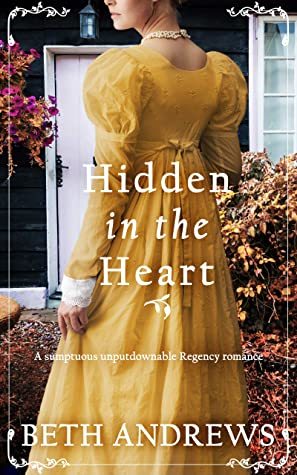 Well, that was unexpected. The title says it’s a sumptuous unputdownable Regency romance, all of which I would question, and none of which should be in the title, for heaven’s sake, the cover suggests it’s a fairly generic type of story, and actually it’s a funny, not to say frivolous, piece of whimsy which I enjoyed hugely, with a couple of reservations.
Here’s the premise: Lydia is the younger of two daughters in the impoverished Bramwell family. When Louisa, the air-headed beauty of the family, goes off to London to make her debut and snag a husband, preferably rich and titled, Lydia is sent to Aunt Camilla, who lives in the Sussex village of Diddlington, to rusticate for the duration. But her stay turns out to be anything but the peaceful and rather boring time she envisages, when a charred and battered corpse is found in the woods. Luckily, intrepid Lydia enlists the aid of innkeeper’s son John Savidge to track down the murderer, which leads to all sorts of unexpected complications…
So let me deal with the title first. The word ‘sumptuous’ implies to me something very rich and upper class and extravagant, and the characters in this story are all well below that sort of level of society. Most of them are not even gentry (Mr Bramwell is a solicitor, so what his daughter is doing being presented at court is a mystery). Unputdownable is fairly subjective, and as for Regency romance – well, it’s set in the Regency and there is a romance or two, but if anyone is looking for passion or even much emotion, better look elsewhere.
But once preconceived ideas are set aside (and the hype in the title is ignored) this is a really cute and funny story. Lydia is both intrepid and very practical, her new friend John Savidge is similar, Aunt Camilla and her French admirer are deliciously overwrought and melodramatic, and there are some fun side characters in the domineering Mrs Wardle-Penfield and the socially ambitious innkeeper, Mr Savidge. The murder plot rumbles along nicely, with some diversions and then an escalation, all of which our two main characters handle with aplomb.
The mystery is, frankly, blindingly obvious from a very early stage, even to me, and I’m usually the one astonished by the last-chapter revelations. But this one was too simple for words. The romance… well, it really wasn’t. Our couple kiss, more or less accidentally, and almost immediately start thinking about marriage, but in the most prosaic way possible. They are a nice couple, but the romance was very much a side issue in the story.
And that leads me directly to the reservations, the first of which is that this book is misbilled. It’s a Regency murder mystery, at the cozy end of the scale, and it’s misleading to pretend otherwise. A lot of Regencies have a mystery in them, but the romance is still centre stage, but not so here, and book 2 of the series features Lydia and John again, solving another murder. Anyone picking this up expecting a standard romance is going to be disappointed.
The second reservation is the names. The Bramwells randomly become Barnwells, and the Savidge family are also Savage and even Savings! And this happens multiple times throughout the book, once even using Savage and Savidge in the same paragraph. Maybe a lot of readers won’t notice, but I did and it drove me insane. Other than that, the editing was excellent, the writing was beautifully done, both very much in keeping with the era and also very funny – as in laugh out loud funny. There are some minor historical glitches (a baronet is not a peer, since he has no seat in the House of Lords), but nothing that bothered me as much as the names.
Overall, I loved this and it has a charm which is sadly lacking in most modern Regencies. The characters felt believably real, while also being entertainingly quirky, the hero and heroine were delightfully down-to-earth, and the murder mystery was interesting, if not the most difficult to solve. This would have been a clear five star read for me but for those pesky name errors, but I still recommend it wholeheartedly.
Review: More Than A Mistress by Mary Balogh (2006)
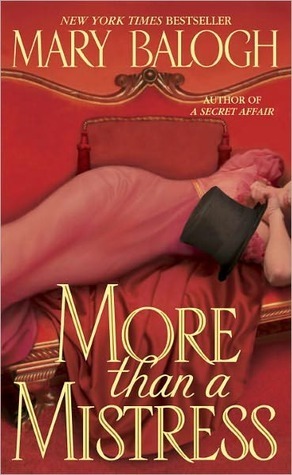 I honestly don’t know what to make of this. It’s Mary Balogh, so it’s beautifully written, that goes without saying. In fact, I would describe it as compelling. Yet I had problems with it right from the off, and not just minor grumbles, but great big NO-NO-NO problems. So it was a weird read for me. I’m still conflicted.
Here’s the premise: Jocelyn Dudley, the Duke of Tresham is engaged in a duel. The opponents are lined up, pistols poised, when out of nowhere a servant races towards them, shrieking at them to stop. Tresham, astonished, does so. His less honourable opponent carries right on and shoots him in the leg. Delayed by the consequences, Jane Inglesby, the servant, loses her menial job unless she can prove that she really was helping the Duke of Tresham. So she boldly marches up to his house and asks him to write in confirmation. Instead, he takes her on to nurse him while he’s recovering from being shot. Which suits her because she’s in hiding and she might as well hide in the comfort of the duke’s town house. For three weeks, they bicker and banter and squabble (and begin to fall in love) and at the end of it, he offers to set her up as his mistress. And she agrees.
Now, there are a million problems with this. First and foremost, what on earth is she doing intervening in a duel anyway? She might stop to gawk, but trying to stop it? WHY? She doesn’t know any of them, has no stake in the outcome and her life depends on her keeping a low profile. It makes not a scrap of sense. Usually I can go with the flow of the opening premise, but this one is just too out there.
Secondly, even when Jocelyn begins to realise that she’s not the orphanage girl she pretends to be, he never questions her about all the secrecy or tries to find out who she really is, or why she hates to be seen by any of his friends.
Thirdly, why why why when she’s hiding from any number of grim possible outcomes, up to and including death, does she agree to sing for fifty guests? And no, the payment of fifty pounds doesn’t convince me.
Fourthly, given that she’s led a perfectly respectable and sheltered life before this, why on earth does she agree to become the duke’s mistress, and no, because she’s got the hots for him isn’t an answer.
And fifthly (and finally, let’s hope), why is she doing nothing at all to rescue herself from her predicament? She isn’t friendless, as we discover later in the book, far too late, really. There were people she could have called upon to help her, even before she left home, when she was being pressurised to marry against her will. And even when things got really sticky and she panicked and ran away, she had a ton of time to think up better options, and (again) people who would have helped her, if only they’d known of her predicament. And once she was ensconced in the duke’s house, she must surely have realised that he would have helped her, if only she’d asked, and he was powerful enough to protect her. As he proved, later in the book (which is the funniest part of it, actually, since he has only to crook his little finger and everyone is your-grace-ing and running around to do his bidding and the whole situation is resolved in three minutes flat and Jane is so irritated that, after all that she’s been through, it’s just so easy for him, being a man and a duke and rich and all that; and I totally got why she was so annoyed).
And that scene kind of summarises one of the big problems I had with the book. Jane is intelligent and feisty and resourceful (and pretty stupid at times, too, but let’s gloss over that for the moment), but she was also pretty helpless. She could do nothing to defend herself, she needed other, more powerful, friends. Whereas Jocelyn has all the power, in spades, but he rarely uses it for any sensible purpose. Instead, he’s the typical Regency alpha-male hero – arrogant, rude, selfish, temperamental, reckless and all kinds of other unpleasantnesses. And he’s also manly and courageous and honourable and loyal and superbly good at everything he does. Because of course he is. Oh yes, and he has a sensitive side, too, so he’s a brilliant (self-taught) pianist and a brilliant (self-taught) painter. Because of course he is. I cannot tell you how much I disliked him.
With a hero like that, there is really only one way for him to redeem himself, to my mind – he has to crawl. He has to be so deep in love with the heroine that he falls at her feet and abandons all dignity to humble himself before her and beg her to marry him. Nothing else will do. But Jocelyn didn’t. Instead he decides (decides!) that she’s going to marry him and even when she steadily and determinedly refuses him, he is still absolutely sure that she’ll agree in the end. Not a single momentary doubt enters his arrogant aristocratic head. Ugh.
So what’s the good stuff? Well, it’s Mary Balogh, so it’s brilliantly written. The dialogue between our two main characters is scintillating, and the heroine usually has the last word, which is refreshing (and probably why he fell in love with her). Every scene between them shone. The hero does have shreds of redeemability in his character, he has a group of entertaining and totally loyal friends (and hooray for likable characters!) and his sister is delightfully silly. The villains are pretty silly, too, but that’s par for the course with Regencies. Mainly, though, I have to confess that despite the deficiencies of the plot, I couldn’t put the book down. So after some agonising, I’m going to set this one down as a four star, and point out (as always) that although I sound pretty negative about this, it’s only my excessively quirky opinion and I actually enjoyed the book quite a lot.
May 18, 2021
Review: Saving Meg by Jayne Davis (2021)
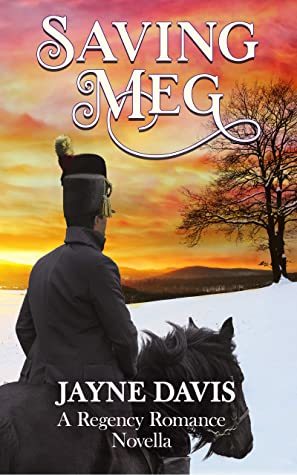 Short but very sweet – a lovely little novella about a soldier returning from the Napoleonic wars to claim the woman he’s loved for years, battling through snow to her side, only to find that she’s on the brink of marrying her cousin. Needless to say, there’s a lot more to it, as Meg is being forced into marriage by threats against her mother. Jon arrives just in time, but what can he do to help? He can save Meg by marrying her himself, that’s what.
So begins a heroic ride through the snow to obtain a marriage licence in time to prevent the marriage, or at least to prevent the repercussions if Meg refuses point blank to go through with it at the altar. I won’t spoil the story by revealing how the villain’s dastardly plot is foiled, but suffice to say that my pedantic soul was thrilled by the clever use of the provisions of the Marriage Act, and by an ingenious intervention from the vicar.
So three rousing cheers for impeccable deployment of Regency law and plot logic, the romance was heart-warming, and there’s a delightfully original epilogue. My only complaint is that it’s too short! I could have stood to read a lot more about these characters. Five stars.
May 17, 2021
Review: Mayhem and Miranda by Carola Dunn (1997)
Here’s the premise: Miranda Carmichael is companion to eccentric Lady Wiston. Now eccentric characters abound in Regencies of a certain kind, but Lady Wiston is *seriously* eccentric – her philanthropic efforts involve viewing prisons and lunatic asylums, and rescuing all sorts of working class people in need of a helping hand. Some of them are recruited to staff her house, some just come for tea and one is teaching her yoga. Miranda takes all that in her stride. But when Lady Wiston’s down-at-heel nephew, Peter Daviot, arrives to write a book of his adventures in British Canada, Miranda finds herself rather torn. He’s very charming and amusing and so forth, but she can’t help disapproving of him, too.
And then another nephew, Lord Snell, puts in an appearance and the plot really builds a head of steam. I won’t say too much about that, because it would spoil things to give away too much, but suffice to say there is plenty of the advertised mayhem of the title, resolved by some very resourceful doings by all the main characters and some of the more colourful secondary characters, too.
I liked both sides of our romantic couple here. It’s clear almost from the start that these two are made for each other, but they don’t hurtle into things, thank goodness, building a solid and very believable friendship first, until the dastardly villain drives them apart (and again, the obstacle was very believable and entirely consistent with Regency mores). Although they could, perhaps, have simply sat down and talked things over, it would have been very much outside the bounds of propriety to do so, so I had no problem with that. And frankly, jealous Peter, misunderstanding everything, was gloriously funny, as were Lady Wiston and her motley collection of wacky misfits.
In the end, it’s Lady Wiston who steps to help our hapless pair of lovers, just as she does for all her rescued ne’er-do-wells, and a more creative and delicious enabling of the romantic denouement would be hard to find. Funny and exciting and charming all at once – I can’t give this less than five stars.
May 10, 2021
Review: Scandal’s Reward by Jean R Ewing (1994)
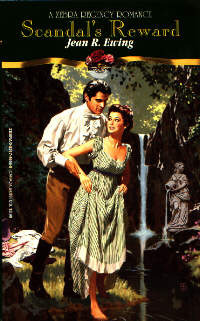 There was so much in this book that I ought to have disliked quite intensely – an improbably daredevil and sophisticated hero with a terrible reputation, a feisty heroine who refuses to admit she’s in love with him and berates him at every opportunity, a series of increasingly implausible events and (my personal automatic fail) a plot that would fall apart in two seconds if the main characters would just talk to each other. And you know what? I absolutely loved it. Who’d a thunk it?
Here’s the premise: bad boy Charles de Dagonet has been disinherited and disowned by his marquis grandfather after a pregnant maid was found drowned in a pond, and he was deemed to blame. He joined the army to make a living, but now that the war’s over, he’s returned home to try to clear his name and reclaim his inheritance. Catherine Hunter is the local vicar’s daughter, taking up a post as companion to Dagonet’s widowed aunt. The two meet accidentally on the moors, and instantly fall out. But their next meeting is even less pleasant – Dagonet sneaks into his aunt’s house, steals jewellery from her, and her son and daughter, and a kiss from Catherine, all at gunpoint.
To be honest, this scene is very funny. Dagonet has been forbidden the house, and the son (George, who stands to inherit everything that was supposed to be Dagonet’s) has posted heavies to make sure he can’t get in. So he duffs up the heavies (four of them!) and climbs in through a window, instead. When Catherine reaches for the bell pull to summon help, he throws a knife to slice through it. And having taken what he wants, trading pithy remarks and erudite quotations with Catherine the whole time, he then leaps out through the window again and disappears into the night. The whole thing is ludicrously implausible, and Dagonet impossibly clever and suave. It’s all so terribly Zorro that I wanted to yell, “Who was that masked man!” All that was missing was the swirling cape, I suppose. And yet – I loved it.
From there onwards, more and more unlikely events pile up, and Dagonet gets opportunities on every page to demonstrate his superb abilities at… well, absolutely everything. Horses, shooting, swordplay, music, apt quotations from a huge array of writers, lovemaking (naturally) and even playing hazard, a dice game that’s a matter of pure chance (unless the dice are loaded). Some gambling games are based on skill (like piquet) or bravado (poker) but anything with dice is only about probabilities. And all the time, he and Catherine are falling in love, and fighting it tooth and nail, because he’s a disgraced reprobate who can’t have anything to do with a virtuous vicar’s daughter, and yet they are thrown together at every turn.
The marquis grandfather is deployed as a plot device to bring matters to a head so that our protagonists finally recognise that they love each other and there’s a suitably romantic ending with a tasteful and not at all graphic sex scene. Completely over the top and outrageously silly, but very funny, with some lovely romantic moments along the way. I loved every moment of it. Five stars.
May 8, 2021
Review: Northanger Abbey (TV movie; 1987)
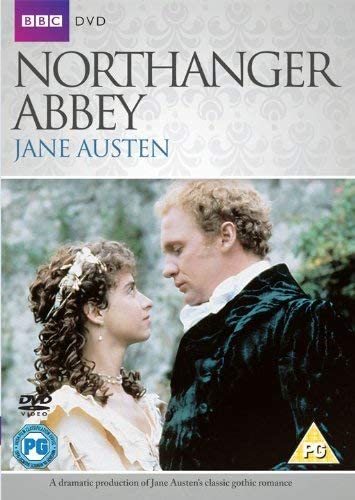 I can’t believe I missed this adaptation, since I have pretty much every other one in existence, but there it is. I’m only just discovering it now. Northanger Abbey is one of the least adapted of Jane Austen’s complete novels, and it’s easy to see why. The heroine, Catherine Morland, is a seventeen year old ingenue whose dull country life has been enlivened by much avid reading of Gothic novels. As a result, she sees melodrama everywhere and is pretty silly as a result. She’s not really a heroine that modern readers can root for (unlike spirited Elizabeth Bennet, or steadfast and sensible Anne Elliott, for example). She doesn’t even have Emma’s get-up-and-go. She’s more of a Fanny Price, only without the intelligence and moral compass. And of course the Gothic novel, which this is a pastiche of, is somewhat out of fashion these days.
On the other hand, it has one of the most charming heroes. Henry Tilney has the great virtue of being faithfully in love with the heroine throughout the book, and is uniformly kind to her. In the 2007 version, the script gives Henry a delicious sense of humour, which makes him perfectly easy to see as a romantic hero. In this version, his lines, while slightly quirky, are much heavier and it sometimes felt as if he were actually poking fun at innocent Catherine. I’m not sure how much of this is lifted from the book, but if I’d been her, I might have been a bit miffed at him and not fallen for him quite so much.
In a 90 minute adaptation, a lot of nuance has to be left by the wayside, and so it is here. The Thorpes, in particular, get very short shrift, and their machinations to detach Catherine from the Tilneys and keep her to themselves are dealt with in cavalier fashion. Isabella is portrayed as the worst and most obvious kind of avaricious minx, with no room for the subtlety of the situation at all. She’s engaged to Catherine’s brother, and the next thing we see is her making up outrageously to Captain Tilney. Five minutes later the engagement is off. So it’s all a bit rushed.
In compensation, the Northanger Abbey scenes are well drawn, especially the confrontation between Catherine and Henry in his mother’s room. I liked Robert Hardy at General Tilney (has Robert Hardy ever underperformed? I can’t remember a time, and he does bumbling fool, as in Emma Thompson’s Sense and Sensibility, just as well as menacing patriarch, as here). I also liked that Eleanor Tilney, an easy role to airbrush out, is here given room to breath. The actress conveys very well the dutiful daughter, rather afraid of her father but also determined to go her own way. The Allens and the Morlands both do well with the limited scope of their roles.
Some niggles. Henry is here not a clergyman, but a gentleman of independent means with his own estate. I understand that modern audiences would not appreciate that a clergyman has a solid position in society and may well be comfortably off, even if not exactly wealthy, since the church was not a vocation in Regency times, more of a sensible career for younger sons. The movie also skates over the insult to Catherine of sending her home, quite alone, on the common stage, an unthinkable thing to do at the time. I suspect that the scriptwriters perhaps were not quite familiar with these nuances. They also made Catherine something of an heiress, giving her the same four hundred a year that her brother would have had if he had married Isabella Thorpe. I’m not familiar enough with the book to know whether that’s canonical or a fabrication, but it seems an excessive amount for a daughter in such a large family.
I have to say I enjoyed this a lot. There was nothing that struck me as completely wrong, the acting, costumes, script and settings (actual Bath!) were lovely, and my only grumble was that Henry was so quirky that I wasn’t entirely sure if he was being complimentary or insulting to Catherine. And she had the sort of blank expression that I’m sure was supposed to be innocent bewilderment, but would in certain parts of the UK be described as gormless. But a good adaptation, overall.