Mary Kingswood's Blog, page 23
October 6, 2021
Review: The Obedient Bride by Mary Balogh (1989)
Mary Balogh is a brilliant writer and one of her greatest talents is to create a unique situation for her characters and then let that work itself out in the most logical and not always the easiest way. This is a marriage of convenience story, but it looks with uncompromising honesty at what a great many Regency marriages must have been like. It’s about expectations of marriage, and yes, it’s about how sex plays into that, so it’s not a traditional read, nor is it a comfortable tale, so anyone looking for light-hearted fluff should move on. It is, however, both powerful and fascinating.
 Here’s the premise: Lord Astor has recently come into his title and estates, and knows he has an obligation to marry to secure the succession. He also owes an obligation to the widow and daughters of his predecessor, who have been left unprovided for. He can fulfil both requirements at once by marrying one of the daughters. He’s never met them, for the relationship is a distant one, but he’s unbothered by which one it should be. After all, what does it matter? His wife won’t be a big part of his life, will she? Apart from producing a few children, she’ll have her own life and he’ll keep his mistress and his masculine friends and pursuits. So he leaves it up to their mother to decide which one is most appropriate. Since the eldest daughter and beauty of the family, Frances, is likely to marry a neighbour, she puts forward her second daughter, Arabella, to marry the viscount. And after a brief period of misunderstanding, and thinking he’s going to get the beauty, he swallows his disappointment and proposes to Arabella, the small, plump one.
The ladies had a misunderstanding, too, for they thought the viscount was an older man. Arabella, thinking herself plain and uninteresting, is quite happy to marry such a man and have a placid marriage, leaving her sister free to marry the man she’s in love with. But the older man was Lord Astor’s father, now dead, and the son is something of a paragon – handsome, fashionable, with perfect manners, and everything that Arabella would never dare to dream of and doesn’t feel worthy of. She’s reduced to stumbling inarticulacy in his presence. She tells him, however, that she’ll be a dutiful and obedient wife and he’s satisfied. That’s what he wants, after all, someone he can basically ignore while he lives his own life, just as he did before.
So the marriage takes place, and yes, it’s consummated, and no, Balogh doesn’t shy away from the details. It’s not outrageously graphic, but it’s clear that Lord Astor has very fixed ideas about sex. What he enjoys with his mistress is purely for pleasure, and he wouldn’t expect anything as uninhibited as that with his respectable and chaste wife. Instead, she gets sex for procreation, perfunctory and by the sound of it deeply unpleasant. She meekly puts up with it, because she’s an obedient wife and it’s her duty.
The interesting element of this is that Lord Astor is doing his duty, too. He’s not an unkind man, in fact he’s rather gentlemanly and considerate. He willingly takes Arabella to town with her beautiful sister for company, he escorts them everywhere, rigs them out in fashionable clothes and supervises Arabella’s transformation to stylish woman-about-town. And he genuinely thinks he’s being considerate by keeping the procreation efforts to brief sessions in the dark, without any embarrassing foreplay. But all the time, he keeps his mistress and is rather surprised to find himself losing interest in her, and actually enjoying his wife’s company instead. He even finds himself distracted during sessions with his mistress by thoughts of his wife.
And so the stage is set for the transformation that will upset the applecart. Arabella gradually gains confidence in company – not with her husband, but with other, safer, men, who are less distractingly handsome and charming. She becomes a success. And Lord Astor gradually realises that a wife can’t simply be ignored. She’s a real person with real feelings, and he begins to care about those feelings, just a little. The way they both change, little by little over many chapters, is one of the joys of the book, beautifully evoked by Balogh. We see it happen because we’re privy to both characters’ thoughts all the way through. And when the crisis comes and Arabella finds out about the mistress, we know their thoughts on that, too, and follow every step of their journey to understanding each other.
Some reviewers have compared this book to some of Georgette Heyer’s works, in particular A Civil Contract or The Convenient Marriage, and although there are similarities, the book that I’m most reminded of is another Balogh one, Dancing With Clara. In that, the marriage is just as cold-blooded an arrangement, between a dissolute rake and gambler who’s wasted his fortune, and a wealthy heiress who is wheelchair bound. It suits them both – he gets her money, and she gets a virile young man as her husband. But that story had a realistic resolution which was (for me, anyway) deeply unsatisfying. The Obedient Bride has a much more positive ending, perhaps less realistic, but much more in keeping with the expectations of romance readers. This isn’t an easy read, but it is a deeply rewarding one, and I commend it to anyone looking for a clear-eyed deconstruction of a marriage of convenience. Five stars.


October 3, 2021
Review: Arabella and the Reluctant Duke by Sofi Laporte (2021) [Trad]
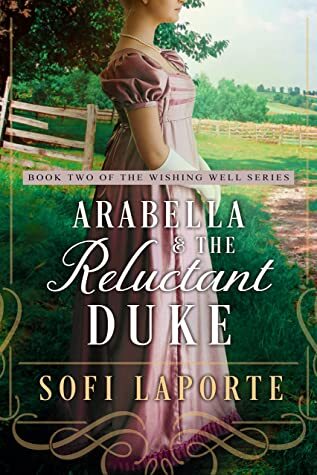 Here’s the premise: Lady Arabella Astley, the sister of the Duke of Ashmore, has run away from her home, all the way to Cornwall in answer to an advertisement for a governess, calling herself Miss Weston. It’s not immediately clear why she felt the need to do this, since there’s no lead in and the first chapter opens with Arabella being interviewed, after a fashion, by the fourteen year old daughter of the house. But it doesn’t really matter, since the three children are delightfully eccentric (and very funny), and then Arabella meets their father… Philip Merivale is a blacksmith and inventor, prone to working shirtless, and devilishly handsome. The family lives in ramshackle style in a cottage, and Arabella finds herself forced to help with the household chores – even cooking! When she’s never even been in a kitchen before! It’s all very educational for a duke’s sister, and Arabella shows her independence and determination in spades when it’s her day to cook. Philip immediately works out that she’s of noble blood, but his secret takes longer to reveal itself.
Given the title, it’s not much of a spoiler to say that Philip is the very unwilling heir to a dukedom. He is the Earl of Threthewick (which is a horrible name, by the way, and impossible to pronounce). I’m not sure why he’s an earl, since a duke’s heir apparent has the rank of a marquess, but let that pass. His son should have a title too (he has the rank of an earl), but let that pass, too. Anyway, Philip has fallen out with his grandfather, the duke, for understandable reasons, and likes to pretend that he’s just a humble blacksmith and the dukedom is nothing to do with him. Which just makes him daft, frankly. He’s going to be the duke one day, whether he likes it or not, and his son after him, and the fact that his son has to point that out to him shows which of the two is the most sensible.
But then, Arabella’s not exactly the most sensible person ever, either. Running away to Cornwall without even so much as a change of clothes and not thinking that her very loving brother might be frantic with worry is also pretty daft. I can admire her pluck, and her brother is definitely over-protective, but still, a little more planning wouldn’t have gone amiss. And then, when she discovers exactly who Philip is, and realises that he’s been berating her for keeping the secret of her noble origins from him, when he’s been doing exactly the same, she doesn’t storm back to the cottage and yell at him, as any normal person would do. She doesn’t tackle him about it at all, she just carries on as if nothing very much had happened. Which doesn’t make much sense to me. I was looking forward to the explosion and it just didn’t happen.
But the romance… ah, the romance! I can forgive all sorts of questionable plot deviousness for a romance like this. Arabella’s journey from oh-my-goodness-a-man-without-a-shirt to despairing love is beautifully drawn, and there were some wonderful moments along the way. Philip’s journey is a little more uneven, and I wanted to slap him upside the head sometimes for not acknowledging what he was feeling, but then a ducal heir who can convince himself that he’s nothing but a humble blacksmith is not a man of great self-knowledge or introspection. At least he got there in the end, if a little bit late and overly melodramatic.
I mentioned above that this is not a particularly convincing version of the Regency. Every author creates his or her own evocation of the era, of course, and since none of us lived through it, they’re all equally valid. But this one feels a little bit off, to me. Arabella teaches Philip how to behave amongst his peers and at formal dinners, and while this is all very funny, it’s more Victorian than Regency. The serving of each separate dish as a course (soup, fish, meat, etc) by footmen, the array of cutlery (oyster forks! When oysters were so abundant and cheap that they were exclusively a dish of the poor until late in the Victorian era; the upper classes only cooked with them), the raised pinkie when drinking tea – please, no! There are also a lot of Americanisms in the writing, so if this bothers you, Laporte is best avoided. But this is one of those cases where I was enjoying the story so much that I merely smiled at these little bumps in the smooth path of my reading.
If you’re not too bothered about these minor details, this is a fun read, with two lovely characters falling very believably in love, a fine array of entertaining minor characters and a nice glimpse at the married life of the couple from the previous book. Four stars.
Review: The Gilded Shroud by Elizabeth Bailey (1992)
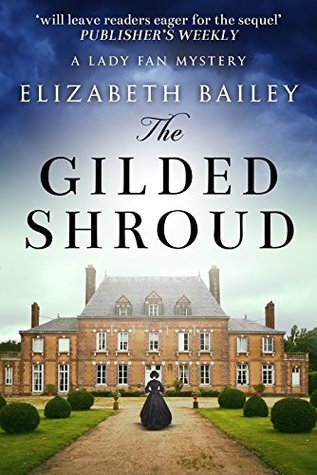 This is a difficult one for me to rate. I like an amateur sleuth murder mystery, and I like a Regency (or in this case, Georgian) story, so it ought to have been right up my alley, but somehow the combination didn’t quite work for me. Still, the mystery is neatly worked out, there’s a nice array of eccentric characters and red herrings, and the romance builds slowly to a satisfactory conclusion, so it will suit a lot of readers.
Here’s the premise: Emily, the Marchioness of Polbrook, is found strangled in her bed after husband Randal, the Marquis, fled the house in the middle of the night. They were far from a happily married couple, so things look bad for him. It falls to younger brother, Lord Francis Fanshawe, to prove his brother’s innocence. Luckily for Francis, his mother’s companion has just taken on a new companion, Mrs Ottilia Draycott, who is not only an outsider, able to observe events dispassionately, but also has an unusual interest in mysteries, not to mention a surprisingly modern awareness of psychology and investigative methods. And so the sleuthing begins.
Now, frankly, it takes a deal of suspension of disbelief to accept that the whole household would defer to this stranger, and put her in charge of the investigation. This is, after all, the eighteenth century, when women just weren’t believed to have brains at all, or the capability for rational thought, and if they weren’t squeamish about gruesome strangulations, would be expected to pretend to be. They were thought to be too delicate in mind and body for the rigours of the unpleasantnesses of life, and would have been bundled out of the way at the first sign of blood. No way would a female have been buzzing about the house interviewing suspects and creeping about at night. There are books which pull this off without compromising the historical elements (such as Anna Dean), but this isn’t one of them.
Having said all that, as a murder mystery it actually works very well. There are plenty of suspects and red herrings, the mystery is slowly unravelled and the murderer is both logical and not too obvious. There is a romance of sorts, but it’s not the main focus of the story, and since this is the first of a series featuring the intrepid Ottilia, it’s to be supposed that the others will be straightforward murder mysteries.
This wasn’t a total success for me, since I like a lot more romance and a bit less gruesomeness in my reading, but it’s well written and cleverly plotted, and I read it avidly to find out whodunnit, so I’ve rated it on that basis. As a murder mystery, I’d give it five stars, but as a Regency (ok, Georgian!) it’s closer to three for me, so I’ll take the average. Four stars. Recommended for cosy fans who like a bit of history with their murder.
September 26, 2021
Review: Romance of the Ruin by Judith Everett (2021) [Trad]
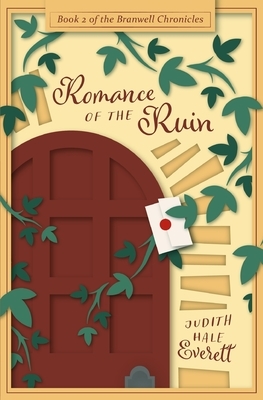 Judith Everett is one of the most original authors I’ve come across in the Regency genre. This one lacks some of the freshness of the first book in the series, Two in the Bush, which is inevitable in a second book, but it’s still a terrific read, beautifully written and awash with interesting characters – and a romantically abandoned house.
Here’s the premise: Miss Lenora Breckenridge is now living with her mother Genevieve and new stepfather, Sir Joshua Stiles (the heroine and hero of the first book) in Sir Joshua’s country estate, Wrenthorpe. Her mother is thrilled to have escaped poverty at last and have a well-ordered house with an army of efficient servants. Lenora is less than thrilled, because what could be duller and less romantic than a house with no ghosts or secret passages or the slightest hint of disorder? She’s learnt her lesson about allowing her love of Gothic novels to infuse her real life, but, frankly, real life leaves her bored to flinders.
Only the gloomy Home Wood inspires her, and there she spends many a happy hour, allowing her imagination full rein. But one day, while enacting an encounter with a suitably romantic prince, she comes across the decidedly unromantic, and thoroughly drunk, James Ingles. Now, I’m going to be perfectly honest, drunken characters just don’t inspire much affection in me, especially when they’re as outwardly unappealing as this one. There was a long spell where Lenora, with her mother’s help, nurse him back to health and sobriety, and even though it’s obvious that this is going to be our hero (after a thorough wash and brush up, and a good shave), I took a long time to warm up to him.
But James has one incomparable attraction to Lenora – he’s the caretaker of a romantically abandoned mansion, Heldon Hall, stripped of all its valuables by its previous owner in a fit of vengeful pique, and still empty, now that he’s dead, while the heir is found. James lives a hand-to-mouth existence in the lodge, but he eventually agrees to show her round the manor house, which she thinks is wonderful, despite the dilapidations. And so, although she likes James well enough, it’s the house that Lenora actually falls in love with, and imagines herself as mistress of. Which means, of course, that she will just have to marry the new Lord Heldon, whoever he is.
And so to London, where Lenora tries impatiently to find out something – anything – about Lord Heldon. I confess to a degree of impatience myself at this point, as the story seemed to be treading water for a while, but once Lord Heldon makes his appearance things move along more swiftly. I don’t entirely approve of the secrecy surrounding his identity, but since the secret is revealed fairly swiftly, and his reasons are sound, I can let that pass.
The story is beautifully written, but there are a couple of things that I think would have made it even better. One is to have more interaction between the two principals. There were long spells without any meetings at all, and those sections of the book were of lesser interest to me. It’s not that there was anything wrong with the peripheral stuff, but I really wanted our hero and heroine onstage together.
The other point is a technical one. Given the precise circumstances of James’s background, it might have given the story more depth not to have the hero’s point of view at all (apart from the opening chapter, perhaps), but to see everything from Lenora’s perspective. It would have added a layer of mystery which is entirely absent when we know pretty much everything that’s going on in the hero’s thoughts. But neither of these is particularly critical, they’re just things that I personally would have preferred.
This doesn’t (for me) quite rise to the heights of the first book in the series, but that was a very high bar, and it’s partly because this book features several of the same characters, so the novelty is somewhat lost. Many readers will doubtless be pleased to see familiar faces again, so for them, this will be a plus. In some ways it’s rather a shame that the stars of the first book, Genevieve and Sir Joshua, have so much screen time in this book, since I found them more interesting characters than Lenora and her hero. This story was somewhat uneven in tone, too, with long spells that felt quite slow. Again, a personal opinion only, not a criticism. However, the author evokes the Regency beautifully, and the language feels authentic without being stilted. I noticed a very few Americanisms (a sprinkling of gottens, which didn’t detract from my enjoyment at all). Four stars.
Review: An Infamous Proposal by Joan Smith (1996) [Trad]
 This was an absolute riot. Not a perfect read, on account of a bunch of wildly anachronistic word choices, but the characters were hugely entertaining, the plot was delightfully wacky and the slow adjustment of ideas by the protagonists was well done.
Here’s the premise: Emma is just twenty-two, but having married at seventeen and being now widowed and emerging from mourning, she feels she’s not really of an age to be thoroughly independent. Her papa thinks so too, and is threatening to impose dragonish Aunt Hildegarde on her as a much stricter chaperon than laid-back, novel-reading Miss Foxworth. This is an emergency – what she needs, and at once, is another husband, or at least a quick betrothal to a compliant man, to deter the dreaded aunt. And who could be more perfect than her husband’s old friend and neighbour, Nick, Lord Hansard, who has always flirted with her and has been so attentive while she was in mourning? He’s perfectly biddable, so he can be brought up to scratch, can’t he? But when he doesn’t take the hint and propose, Emma rushes into a proposal herself, only to be shocked and mortified when he refuses her.
Nick is a kindly soul, however, and although he rather disapproves of Emma, thinking she’s far too flighty, he does agree with her that she needs a husband. Therefore he decides to help her on her way to a second marriage by introducing her to suitable gentlemen. Just how suitable (or otherwise!) they turn out to be forms the bulk of the plot, and all the while, Nick is gradually realising that Emma is not as air-headed as she appears, and Emma is realising that Nick is even more perfect for her than she’d thought.
This is one of those books where the romance builds gradually. There’s no great revelation, just two people growing increasingly convinced that the possible suitors aren’t suitable at all, when compared with the more obvious match right under their noses. Since we get the point of view of both Nick and Emma, we see in fascinating details how they each begin with a rather disparaging opinion of the other, and slowly come to appreciate each other. And all the while, the suitors are providing the comedy. Cousin James, in particular, is a hoot, swearing that he’ll be a reliable and faithful husband… but not quite yet, please.
The whole book is a delight, beautifully written and neither too implausible nor too silly (although it wouldn’t be so funny if it wasn’t a little bit silly). I loved every minute of it (yes, even the outrageously anachronistic words – sicced, anyone? In a Regency?). Five stars.
Review: Pursuing Miss Hall by Karen Thornell (2021) [Trad]
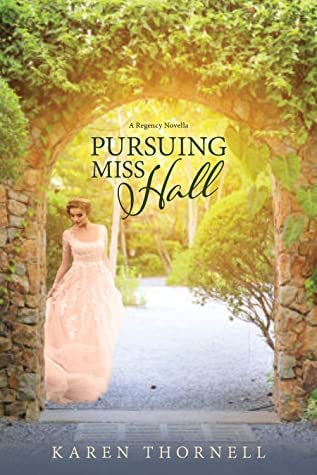 This is the author’s debut, a short but fun read. There’s nothing earth-shatteringly original about it, but the hero and heroine are nice, likable people, the dilemma is one that must have been common in the Regency era and the writing is excellent, with a dash of humour. I enjoyed it.
Here’s the premise: Margaret (Meg) Hall, a baronet’s daughter, missed her season in London because she was very ill. Now recovered, her mother wants to push forward with the desirable match that would lift the whole family up a notch, socially. She throws a house party with three eligible suitors. Meg will be expected to marry one of them – preferably the highest ranking, a viscount. Meg dutifully prepares for her fate. Meanwhile, her lifelong friend and neighbour, Nathaniel (Nathan) Blake realises that he can’t wait any longer to declare his love for Meg. It’s now or never!
Now, the pragmatist in me wants to know why he doesn’t just go straight to Meg’s father and ask permission to throw his hat in the ring. But of course that would make the book about three chapters long, so naturally that doesn’t happen. Nathan’s mother, who is totally on his side, suggests that his first task should be to win over Lady Hall, and so that’s what he does, rather than openly courting Meg. Since Lady Hall is very much against Meg marrying into the lowly Blake family, she takes every opportunity to steer him away from Meg, so he finds himself taking care of the other young ladies of the house party and watching impotently as the three official suitors circle round Meg.
The three suitors are all pretty unappealing. The viscount is boring, the second one seems more interested in another young lady, and the third seems to be distinguished only by having protruding teeth. It would have been more interesting, perhaps, if they had been more rounded personalities, but since Lady Hall has already settled on the viscount as the best option, he’s the one we see most of, and the other two are mere ciphers.
Meg’s problem is one that must have presented itself to a great many Regency young ladies – marry to oblige one’s family, or wait for love to come along. Meg is a dutiful daughter who fully understands what she is expected to do, and she obediently tries to find something to spark her interest in the viscount. Meanwhile, she is realising that she might have real feelings for Nathan. If only he were one of her suitors…
And this is where the book falls apart for me. Nathan does, in the end, simply take the bull by the horns and talk to Sir Robert Hall about Meg, but so does the viscount, so when Meg talks to her father and hears about the viscount’s proposal, she decides on the spot that she’ll have him, and refuses even to hear who the other suitor is. Even when her father tries to steer her that way she doesn’t want to know, and for me that’s a total plot fail. There is no woman on earth who would not want to know who the second man was. This is the author spinning out an already short book to build the suspense. I really don’t like that. It feels manipulative.
But of course it all comes right in the end, and there are some nicely dramatic and romantic moments along the way. The author’s feel for the Regency is excellent, although I’m not convinced that it was commonplace for fathers to deal with proposals, accepting or rejecting them on behalf of their daughters. Asking permission to pay your addresses is one thing, but the idea that a father could simply decide on a suitor and perhaps not even tell the girl about proposals he’s received on her behalf is somewhat weird to me. It’s not like that in Jane Austen, and she’s my ultimate authority on the subject. There are a few Americanisms, but mostly in grammar — ‘look out the window’, for instance, instead of ‘look out of the window’. Trivial things that knocked me out of immersion but wouldn’t worry most readers.
This is a very promising debut, not overly dramatic, but a light-hearted and enjoyable read. Only that plot logic fail keeps it to four stars for me.
September 4, 2021
Review: His Last Chance by Philippa Carey (2021) [Trad]
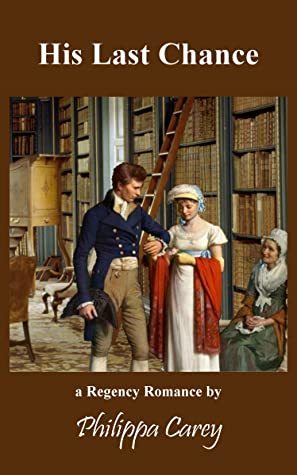 This is such an odd little book. It’s written in a simplistic style reminiscent of a beginner author (although in fact she’s published a number of books), nothing very much happens and there’s no great mystery to be unravelled or obstacles to overcome. And yet it has a charm all its own. If you’re looking for a straightforward gentle romance, with nothing too taxing in it, this may be the read for you.
Here’s the premise: Lord Peter Wilson is the third son of a marquess who’s been left at a loose end for too long. With neither the expectations of the heir nor a career to occupy him, he’s filled his time by rampaging about in London with his equally wild friends. But his father’s had enough. One more quarterly allowance, and that’s it. Peter can support himself in future, either by finding an heiress to marry, by taking up a career or by rescuing the neglected Devonshire estate. If he can make it profitable by the end of the next quarter, his father will make it over to him. That seems like a better option to Peter, and really, how hard can it be to sort out the tenant farmers and get things running smoothly again?
Well, quite hard, as it turns out, since the steward has been robbing the estate blind, and ran off, probably to take ship for America, as soon as Peter arrived. The servants have been underpaid, the tenants have all been overcharged, and the whole place is in a state of dilapidation. Oh yes, and there’s a smuggling operation that uses the cellars to store contraband. So Peter turns to the baron next door for help, to discover that Lord Harford has a charming elder daughter, Anne, who happens to be blind. The baron, his lady wife and the younger daughter are about to set off for the London season, but the blind daughter is staying behind, with crusty Great-aunt Hermione as chaperon…
There was never any doubt about where this was going, and the author takes us there by the most direct route possible. There are no difficulties, no great misunderstandings and no angst here, just a slowly developing liking that turns into admiration and then love, on both sides. And Anne’s blindness isn’t an obstacle in the slightest. In fact, I very much liked that Peter’s early interest in Anne is derived from her blindness. The younger daughter simpers and flirts with him, something he’s seen so much in London and is thoroughly bored by, but Anne is unaffectedly open with him, because she doesn’t see him as a handsome and eligible young man, just as a friendly neighbour. Not being cued by the facial expressions of those around her, she isn’t even aware that she ought to restrain her pleasure when he takes notice of her. He finds her refreshingly natural and she’s thrilled to have a male friend who treats her in a gentlemanly fashion.
And that brings me to one of my standard grumbles with books about reformed ne’er-do-wells. Peter is supposed to be so wild that his own father was prepared to cast him off, yet in Devonshire he behaves impeccably at all times. He’s considerate towards Anne, respectful towards Great-aunt Hermione, understanding towards his servants and tenants, censorious towards the smugglers and courteous to everyone. Except one of the villains, who gets a gratuitous kick or two after he’s been taken down. Naughty Peter. And of course he’s smart enough to sort out the estate’s problems, or at least to get help from people better qualified than he is.
It’s hard not to like both Peter and Anne. There isn’t a lot of depth to them, or any of the characters, really, and everyone is either a jolly good sort or a black-hearted villain. The plot isn’t complicated, either, and everything Peter planned went more or less smoothly. I really would have liked some unexpected twists along the way. In particular, I rather hoped that in the end the estate would turn out not to be profitable after all, and the marquess would descend breathing fire and brimstone, so that Peter would have to argue his case point by point. But in the end, the marquess simply rolled over like a great big pussy cat. It was disappointing.
That was perhaps my biggest gripe about the book, that it was too bland and predictable, with very little bite. There was just one moment where Peter showed an unexpected spark of fire, when he’s asking Anne’s father for permission to pay his addresses.
[The baron] “You don’t mind she is blind?”
Why, for the love of god, do people keep saying this, thought Peter. If he minded, he wouldn’t be asking, would he? He wanted to marry her because he was in love with her.
I would have liked a lot more like this.
I mentioned at the start that the writing style is rather simplistic, and frankly it got a bit dull reading about every trivial interaction between the characters. It also got repetitive. Some repetition was understandable, to show both Peter’s and Anne’s separate reactions to the same event, but with a little more effort that could have been shown without going over the same scene twice. And some was just unnecessary, as Peter explains his actions to various different people. There’s a lot that could have been tightened up. On the plus side, grammar and punctuation was good, and so was historical accuracy. There was only one place where Lord Peter was incorrectly called Lord Wilson, everyone had lunch far more often than was usual in the Regency, and the waltz was the modern version (but the true Regency version wouldn’t have worked for this situation, so I forgive it).
Overall, despite the problems I’ve mentioned, I did enjoy the story, and I was rooting for Peter and Anne right from the start. What keeps it to three stars for me was firstly, the plodding and repetitious writing style that made it a bit dull, and then the horribly abrupt ending, which stops dead directly after the proposal. Poor Anne doesn’t even get a chance to answer. Anyone who’s a fan of long, mushy epilogues should definitely steer clear of this one. But if that doesn’t bother you, this is a charming and uncomplicated short read.
Review: Expectations by Frances Murray (2012) [Trad]
 A strange little book, which picks up a couple of years after Pride and Prejudice finished, and ties up all the loose ends with elaborately double-tied bows. It’s beautifully written, badly punctuated and varies in tone from sublime to merely dull, but it has two incomparable assets: the humour is glorious and it makes a hero of Mr Bennet. These may not be unconnnected.
Here’s the premise: Phoebe Parker is the spinster eldest daughter of a niece of Lady Catherine de Burgh, who married a naval officer against the wishes of her family and was subsequently cut off. When her husband dies, she struggles to manage, but eventually, her other two daughters are safely married, and a neighbour and friend has found positions in the navy for the twin boys. But the outfitting of two young men at once is beyond Mrs Parker’s means, so as a last resort, she writes to Lady Catherine for help. Lady C comes up trumps, and provides all their clothing and equipment, plus a small allowance, but she wants something in return: she asks for Phoebe to become her companion for a year, since her daughter, the sickly Anne, has died. Phoebe, a practical and intelligent soul, is happy to oblige because she feels she will derive endless amusement from the forthright Lady C. But of course, Mrs Jenkinson, the former governess and companion to Anne de Burgh, is not at all pleased by this usurpation of her role.
The Rosings parts of the book are not terribly exciting, with some rather dull business about setting up a school. However, there are fun interactions amongst the characters. Phoebe makes a friend of Charlotte Lucas, Mrs Jenkinson plots, Colonel Fitzwilliam falls in love and Mr Collins is a buffoon, as always. Lady Catherine is very much herself, but it’s a more nuanced and interesting Lady Catherine than the caricature in the book.
But then things take a more serious turn. There’s an outbreak of scarlet fever around Rosings, which carries off poor Charlotte Collins, whose epitaph must surely read: ‘she had a miserable life, and then she died’. It seems unfair, when authors have absolute power of life and death over their characters, to kill off one who deserved better and leave the idiotic Mr Collins alive and well (there were plot reasons for it, but not very plausible ones, even though it led to one of his silliest ever conversations).
The other significant death is that of Mrs Bennet, one whom I’ll not mourn quite so deeply. Or at all, in fact, much like Mr Bennet himself, who sees himself released from the cage of matrimony and swears he’ll never marry again. Well, we know how that’s going to end, don’t we? He sets off to visit Pemberley and various old friends, which he’s never felt able to do before, not wanting to inflict his silly wife on too many people. And along the way, he meets up with Phoebe, who shares his sense of humour.
I haven’t read too many P&P variations, but from reading a lot of blurbs, it seems to me that a great many of them start with the death of Mr Bennet, Mr Collins inheriting Longbourn and the Bennet ladies out on their ear. I must say, I totally enjoyed the idea of Mr Bennet the happy widower, pottering about the country from daughter to friend to other daughter, and generally living the life of Riley. His freedom dissipated much of his bitterness and just made him very funny. Every scene he was in simply fizzed with energy and his sardonic wit, and several times he got the better of Lady C simply by being way, way cleverer than she is. He was utterly awesome, and I’d have married him in two seconds flat. Lovely man, and it was wonderful to see him as a hero.
Phoebe… well, she came across as something of a shadow of Mr Bennet. She was clever, too, and witty and sensible, and she deserved her hero, but she was just a shade colourless by comparison. For those who want to see old favourites, there’s a fair bit of Darcy and Elizabeth, a little of Jane, Bingley, Kitty and Mary, although I have to confess I totally enjoyed Mary’s development (she decided what she wanted and took charge of making it happen with admirable determination), and the delightful Mr Lacey. By the end of the book, almost everyone is married (even Mr Collins finds a second wife) and producing babies left, right and centre (I liked the word-play in the title, encompassing both Mr Collins’ expectations, and the baby-producing sort).
I have a few minor quibbles. The Bingleys have apparently settled in Derbyshire, but surely the book places them in the next county to the Darcys? And there’s something funky with the ages. Phoebe’s twin brothers Peter and Horatio are to become midshipmen at 19, when 12ish is usual, Mary is seemingly still only 17, and Mr Collins is only 24! A clergyman couldn’t be ordained before the age of 24, and this book is set several years after his ordination. It was also odd that he made so much of Phoebe being older than him, when Charlotte had been even older.
But none of this interfered with the sheer joy of seeing Mr Bennet let loose to scatter his wit in all directions, so despite the dull patches and the commas scattered as randomly as salt from a shaker, I loved this enough to give it five stars.
Review: The Bar Sinister by Sheila Simonson (1986) [Trad]
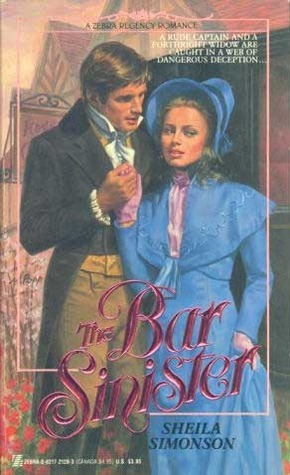 This is the first book in the series, but it was written after the second book (Lady Elizabeth’s Comet) as a sort of prequel, and to be honest, I’m glad I read Lady Elizabeth’s Comet first. If I’d come across this one first, I might never have read any further.
Here’s the premise: Captain Richard Falk needs a safe home for his two motherless children while he fights Napoleon. Widowed Emily Foster wants to take in children as company for her own son. She’s not impressed by Captain Falk, who’s brusque to the point of surliness, but she loves the children, and so they strike their bargain. Over the next two years, she finds herself enchanted by the absent soldier, who writes long, intricate stories for the children in his letters, but when he briefly returns for a visit, she’s again hard-pressed to find any civility in his manner. But then trouble arrives, in the well-meaning shape of Richard’s sister, Lady Sarah Ffouke, to see the children. Because it turns out that Richard is the son of the Duchess of Newsham (although not of the duke), and was brought up as Lord Richard Ffouke for the first twelve years of his life.
And here at once we have the biggest stumbling block in the book, for me. Buckle up, folks, this is going to be ranty. All the way through, Richard is described as a bastard, as illegitimate, as base-born… even the title, Bar Sinister, refers to his illegitimacy. Lady Sarah is always called his half-sister. Yet Richard is completely legitimate – in law, at any rate. In the Regency era, any child born within wedlock is presumed to be legitimate, unless the father repudiates the child, either before birth or shortly after. There’s a very narrow window within which to do this, and if it isn’t done, or if the father acknowledges the child in any way, then it’s perfectly legitimate.
In this case, the supposed father (the duke) didn’t repudiate Richard, and accepted him into his household for twelve years. Even though everyone knew that the duchess had had an affair and Richard was her lover’s child, he was legally a legitimate son of the duke and stood in line to inherit, if his two older brothers died or failed to produce heirs. And no, a sworn statement by the duchess of his true parentage wouldn’t have been enough to convince the House of Lords to set Richard aside, if he should ever claim the dukedom. It would take far stronger evidence than that, and for good reason. If every father could suddenly decide to disinherit a son who displeased him for whatever reason, the peerage would be in chaos. Apart from that very brief window, there is no getting rid of children, ever, where there are inherited titles and entailed estates at stake. Just can’t be done. Frankly, the duke was bonkers to accept Richard in the first place, knowing the likely consequences, but to turn round later and try to get rid of the inconvenient cuckoo in the nest is ridiculous.
A large part of the book concerns the efforts of the duke and later, his sons, to dispose of Richard, although whether they were more concerned with hushing up the old family scandal of his birth or taking him right out of the line of inheritance isn’t entirely clear. Some of their actions seemed designed to kill him, but most were just to persuade him to go away, on the principle of out of sight, out of mind. None of which makes a ha’p’orth of difference to the inheritance of the title. All of it is unbelievable, and I find it impossible to believe in a duke who is so dishonourable as to give his word and then break it, and so downright coarse in his behaviour towards his brother.
My other quibble is a relatively minor one. The author uses a number of words with old-fashioned spellings – sopha, gothick, publick and so on. These may be historically accurate (I wouldn’t know), but they grated rather, and my personal pet peeve was writ as the past tense of write. So Emily writ Richard, Richard writ the children, Tom Conway writ Richard and on and on, until I was grinding my teeth in frustration. Does it matter? Not much, but it was so, so annoying.
But having got all that off my chest, you will be astonished to hear that I actually enjoyed the book rather a lot. Nowhere near as much as Lady Elizabeth’s Comet, but well enough. I didn’t much like the morose and uncivil Richard, and couldn’t quite see what Emily saw in him, but Emily herself, dreaming away in her Hampshire backwater, was a delight, the children were lovely, the military-minded Aunt Fan was gloriously eccentric, and Emily’s papa, Sir Henry Mayne, Bt, was a big softy under that gruff exterior. I even loved McGrath and Mrs McGrath. And I absolutely adored Dona Inez and Dona Barbara and their adventures, although we only got little hints of them, but it was all deliciously funny. I laughed out loud a great deal, and I always approve of a book that makes me laugh.
Two characters of special note were the aforementioned Tom Conway and Lord Bevis, who are main characters in Lady Elizabeth’s Comet, but reduced to walk-on parts in this book. Bevis gets no opportunity to shine here, and is in fact rather an antagonist, but Tom Conway is lovely. He and Emily have some delightfully flirty exchanges which are perhaps the best part of the book, and if I’d been Emily I’d have abandoned surly Richard like a shot to have a go at the charming Tom. But sadly that wasn’t how it went.
I won’t bang on about the shenanigans with the ducal family, because the whole thing was pretty silly and unbelievable (see rant above). The duke and his brother were, not surprisingly, impossible to like. The duchess, Lady Sarah and her long-suffering husband Wilson were nicely drawn and very nuanced, even if I’m not sure I’d want to make friends with any of them. The romance is kind of weird, because the main couple spend very little time together. Emily falls in love with Richard-the-letter-writer and basically decides she’s going to marry him. And that’s it.
This isn’t the smoothest book ever written. There’s a lot of jumping about to places and people I didn’t much care about, where Emily and the children are somewhat forgotten, so the book feels rather lumpy. The plot, as I’ve already pointed out multiple times, has credibility issues. But the writing is elegant and witty, and the characters are (Richard excepted) lovely. If I could give it 3.5 stars I would, but since I can’t I’ll round up to four stars in deference to the sheer brilliance of Lady Elizabeth’s Comet. Which, sadly, is a much more interesting book than this one.
August 25, 2021
Review: Two In The Bush by Judith Everett (2020) [Trad]
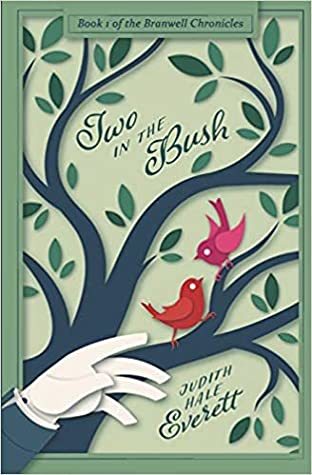 This is apparently a debut novel, although a long time in the brewing, but it’s an astonishing performance. There are few authors who can write in a style that sounds authentically Regency, with the properly structured sentences and correct vocabulary, but here’s one who can. And best of all, that gorgeous prose also manages to create wonderfully real human beings (I can’t even bring myself to call them characters!) who live and breathe and yearn and dream within these pages.
Here’s the premise: Genevieve Breckinridge made a mistake when she married, discovering too late that her handsome husband was a feckless good-for-nothing, who gambled and caroused his way through his fortune and hers. Fortunately for her and her two children, Tom and Lenora, Mr Breckinridge managed to get himself killed before he could dispose of the last unentailed cottage on his estate. This cottage is now home to the three of them and their last loyal servants, while the manor house is rented out and son Tom strives to manage the estate back into profitability. With Lenora about to come out, Genevieve’s good friend Lady Cammersby invites them to London for the season, where Lenora’s friend Elvira Chuddsley will also be enjoying the season. Genevieve hopes that introducing the two girls to real live men will drag them away from the world of Gothic melodrama they find in novels.
But her friend has another motive for her invitation. Her brother Sir Joshua Stiles is a widower who’d love to remarry but is finding it difficult to fend off avaricious women only interested in his considerable fortune. Lady Cammersby sees an opportunity to bring happiness to two people who dearly deserve it, so she dispatches Sir Joshua into the country to deliver the letter of invitation personally. This sets off a catalogue of mishaps that put him into the worst possible mood to appreciate Genevieve’s good qualities, while her propensity to get into scrapes at every turn is just the sort of behaviour to put him off her permanently.
And so the principals find themselves in London in the thick of the season, and Genevieve finds herself falling for this rather serious but very gentlemanly man, who also has a well-hidden sense of the absurd. But there’s a hitch – Lenora also admires him, and it seems that Sir Joshua admires her too. This is the basic plot in a nutshell, and while the reader can see where things are going, it’s also easy to understand why Genevieve can’t. She’s constantly in trouble of one sort or another, for one thing, which causes Sir Joshua to tick her off in disapproving style, so she’s quite convinced he doesn’t even like her, and only tolerates her as the mother of Lenora, with whom his relationship is perfectly smooth.
There is a villain, of course, because what self-respecting Regency romance doesn’t have a villain? He’s rather a chilling one, too, all the more so because the unpleasantness is cloaked in perfect manners. I didn’t quite understand why Genevieve didn’t just give him the cut direct, but her actions made sense to her so I went along with it.
The most delightful sub-plot belongs to the two young friends, Lenora and Elvira, who bring all their experience of Gothic novels to bear on the people they meet, trying to fit them into the essential stereotypes. Their hero is not the charming, wealthy and titled man who falls deeply in love with Elvira, since he obtained his success in life with no effort, but his stammering and impoverished friend, who struggles to overcome his disadvantages. They fall out over which of them is actually the heroine in their story, and struggle to identify the evil duke, so necessary for the true Gothic novel. All of this is very funny, although they do eventually come to appreciate that real life is not a Gothic novel, and thank goodness for that!
There were a few Americanisms, like passed, theater, gotten, chaise lounge and (my personal favourite) sunup, which transported me instantly to a ranch somewhere in Texas, with Sir Joshua garbed in a stetson and chaps. Quite a turn it gave me, I can tell you. There were very few of these little glitches, and the only reason they jumped out at me quite so forcefully is that the rest of the prose is so effortlessly Regency.
I hope the author writes a great many more books, because I absolutely loved this. The first few chapters bogged down a little bit in heavy prose combined with an over-lengthy description of Sir Joshua’s travel difficulties, but once that was done and Genevieve came onstage, with her gloriously mellow and slightly scatterbrained personality, everything was wonderful. Highly recommended. Five stars.