Mary Kingswood's Blog, page 27
April 28, 2021
Review: At Last Comes Love by Mary Balogh (2009)
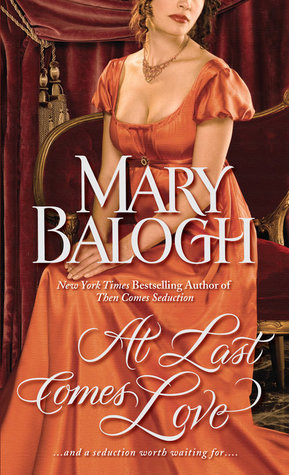 This is a book of two halves. The first half is a corker, crackling with tension on every page, and quite riveting. Then the protagonists get married and it devolves into a schmaltzy snoozefest, with our hero and heroine playing happy families, frolicking naked in the lake and having long, thoughtful discussions about whether they ought to fall in love or not. The ending is both highly predictable and kind of a con trick, frankly. And everyone sheds tears of joy and lives happily ever after.
The premise is one of those Balogh specials that sounds impossibly implausible, but of course she carries it off with aplomb. Duncan, the Earl of Sheringford, has been in disgraced exile for five years, after jilting his betrothed at the altar and running away with her married sister. When he finally comes home, his grandfather, a marquess, swears to cut him off without a penny unless he marries before the old fellow’s eightieth birthday – just fifteen days away. Duncan will inherit everything eventually since he’s the heir, but he really needs funds and a home right now, so he sets about finding a wife. And the first person he bumps into (literally!) is Margaret Huxtable, running away from both the man who abandoned her years ago and her hoped-for future husband, newly betrothed to someone else. They’re both desperate to marry quickly, so…
Yes, of course it’s preposterous. One of the most preposterous aspects is that the heir to a marquessate would be ostracised by society, no matter what he does. Another is that he can’t simply get a job that would keep himself and his dependents from starving until he inherits. Yet another is that the man who is absolutely desperate to marry should immediately trip over the one woman in London who is absolutely desperate for a husband. Well, that part I can let go. Every author is allowed one screaming coincidence per book, provided it sets the action off and isn’t just a convenient get-out-of-jail-free card. Anyway, they meet, they talk, they know perfectly well it’s preposterous, but they kind of roll with it.
Now, this part of the book is glorious. Her family are uniformly against it, she’s sort of against it herself, the hero’s jilted betrothed turns up to deter Margaret, out of the goodness of her heart and nothing at all to do with the fact that she’s now married to the next in line for the marquessate, oh no, she couldn’t possibly be driven by naked ambition and hatred. So there are some wonderful exchanges here that are actually vintage Balogh. Margaret decides in the end that she won’t agree to anything yet, but if Duncan were to woo her properly, then she’ll decide at the last minute whether or not to accept him. If she says no, then he’s lost everything until he inherits, but if she says yes…
And that would have been fine, with great tension right down to the wire. But no, he tells her some stuff and she caves, and they get married immediately. And then the story goes to hell in a handcart. Now, Margaret’s introduction to life as a married woman and mistress of a large-ish estate and being separated from her close-knit family makes a worthy story in itself, but it’s not the story that started this book, and it’s not the story I wanted to read. After the fireworks of the first half, this part was plain dull. There was so little tension, in fact, that the heroine had to create some by acting completely out of character. There was a point where, after being sensible and smart for the whole book, she suddenly throws a tantrum, and that was just silly. When a hero has been painfully honest and open right from the start, not to mention kind and lovable and understanding, the least you can do is give him the benefit of the doubt when he makes a misstep, just once.
The villains were not terribly villainous, and frankly I had some sympathy with the cousin, who actually had the law of the day totally on his side. He was not just being obstreperous, he actually was in the right. But that was not the happy ending everyone wanted, so it didn’t happen.
Of course, this is Mary Balogh, and it’s so beautifully written that it’s easy to forgive all the preposterous stuff and just enjoy it. The hero and heroine are very, very believable and likable and easy to sympathise with. The second half was so flat that it wouldn’t be worth more than three stars, but the first half was twelve stars at least, so I’ve settled on four as a compromise. NOTE: as with all Mary Balogh’s books, there is some sex.


April 25, 2021
Review: Friends and Lovers by Joan Smith (1978)
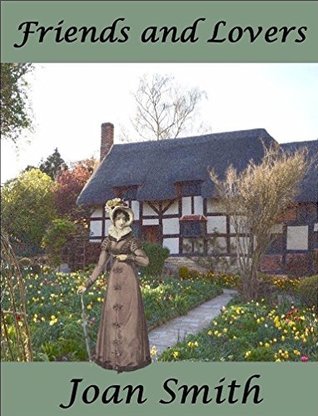 This book infuriated me. I think it was meant to be whimsical and amusing, but I just found it weird. I slogged through the first half purely to see how on earth the author was going to bring about a romantic ending for two characters who rarely met and seemed to hate each other with a passion. Somewhere around the midpoint it livened up a bit and became genuinely funny, only to fall flat again at the end. It managed three stars only because I laughed so much at the roof incident. There were few other redeeming features.
Here’s the premise: Wendy Harris… no, let’s pause there, because I hate this name so much. I suppose the author gets away with it since it’s short for Gwendolyn, but the name Wendy was officially invented in 1904 for Peter Pan. Ugh. Anyway, Wendy Harris lives in genteel poverty with her widowed mother in a grace and favour cottage owned by Wendy’s brother-in-law, Lord Menrod (another horrible name; I actually wondered whether the author had originally given him a sensible name, then found out at the last minute there was a real lord by that name and had to change it. But I digress). His lordship insists on them keeping everything in their cottage exactly as it is, with no changes, no matter how inconvenient, since it’s historical. They are all awaiting the arrival from India of Wendy’s orphaned niece and nephew, whom she hopes to raise herself, but Lord Menrod decides he’s going to raise them. Wendy thinks he’s unfit, on account of the string of mistresses, the constant travelling around and the fact that he’s arrogant and tyrannical. Lord Menrod gets interim custody, so Wendy engages an attorney to fight the case.
Now, written out like this, you’d imagine that Wendy… no, I can’t keep writing that. Let’s call her Miss Harris. Anyway, you’d imagine that Miss Harris would be a sympathetic character, a put-upon spinster only wanting the best for her nephew and niece. But no, she’s a pretty horrible person, actually, who’s determined not to give Lord Menrod any credit for proper feeling, or admit that actually the children will be better off with him, on account of the whole rich lord thing. She’s also incredibly rude about Mr Everett, a rich lumber merchant with a vast mansion stuffed with expensive but tasteless Stuff, who is simply an easy-going guy who wants to marry her.
Lord Menrod is also a pretty unpleasant character in the early part of the book, being just as tyrannical as described. It’s only when the children arrive and he is forced to spend more time at the Harris’s cottage that he begins to mellow a bit. In fact, he becomes the most sensible character in the book, still determined to have the children, but prepared to adjust his lifestyle accordingly. And he never tries to cut the Harris ladies out of their lives. In fact, he is all sweet reason, if a little grumpy when Miss Harris continues to be obnoxious.
He also discovers for himself all the deficiencies of the Cottage That Must Not Be Changed, with unusable fire irons, a dangerously dark stair, a smoking chimney and a decaying thatch roof. By the time he’s burned himself, been smoked out of the house and fallen through the roof (a glorious scene!), he’s become rather a fun character, especially when he lounges around the cottage all day to avoid a persistent lady admirer.
The ending is sadly typical of this era, that is, there are one or two oblique hints of a change of heart on his part, a reference to hate and love being two sides to the same coin, after which he sweeps her into his manly arms and kisses her, whereupon she says: oh, all right then. The end. Very, very annoying. I confess, though, that the biggest problem I had throughout the book (apart from obnoxious Miss Harris, who never does redeem herself – run away, Lord M!) is that I never worked out Lord M’s age. He’s described in such terms early on that I imagined he must be an elderly man, or at least middle aged, but it only gradually dawned on me that he’s possibly only meant to be thirty-something. It’s quite an adjustment to make.
So this really didn’t work at all for me. Nevertheless, if you don’t mind the old-fashioned and rather dry approach to romance that was standard at the time, and are brighter than I was in working out Lord M’s age, it’s a well-written tale with some fun characters (I particularly liked Mr Everett and the mother, and the children were amusing too; oh, and Lady Whotsit who was pursuing Lord M; and the attorney was funny; in fact, in retrospect it seems far more fun than it was when I was reading it). But for me it’s only three stars.
April 21, 2021
Review: Mrs Drew Plays Her Hand: Carla Kelly
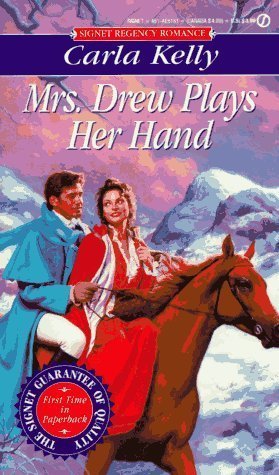 This is the kind of emotionally manipulative book that just drives me crazy. Everything is designed to put the characters (and therefore the reader) through the wringer, dragged out interminably and amped up to the max. It’s exhausting, and I just wanted it to end and put me out of my misery.
To start with, we have a freshly widowed wife mourning her (apparently perfect) vicar husband. She spends her time (when she’s not struggling to survive on half a loaf and two rashers of bacon) walking soulfully through the landscape. There are two sickly-cute children, also mourning. There are no dogs (I think the author missed a trick there), but there is a trusty old retainer and a helpful bailiff for local colour. Oh, and a relative who’s pressurising the widow into sex because in a book like this the villain has to be grotesquely villainous. Into this pantomime setting comes our hero, a grouchy marquess who’s off women for the duration because he had the wife from hell who slept with half of London and had to be divorced. And now she’s remarried and socially acceptable, somehow, and he’s still ostracised because he shamed his family by putting his divorce publicly through the House of Lords (that was the only way to get a divorce in those days, but let that pass).
And for a while everything is lovely and they all frolic about playing happy families, until the pantomime villain pops up again with an order authorising him to take the two cute children away because the widow is bonkers, or something. And so the grouchy marquess and the widow rush off through the midwinter snow to get married in Gretna and get frostbite and rush back again so the children won’t be taken away, and it’s only going to be a marriage of convenience even though they’re head over heels in love with each other and having sex to boot, and none of this made any sense to me. And then the marquess goes away and stays away and the widow and the cute children mooch about birthing triplet lambs (I’m not making this up) and at that point I just lost the will to live.
Here’s the thing: if the characters had an ounce of common sense, they’d have just packed up and gone into hiding to escape the villain’s machinations until the courts reopened, at which point the marquess would have said, “Marquess! I win,” and that would have been the end of it. Because that was pretty much how things went in those days. Or they could have, you know, actually talked to each other and discovered the whole being in love thing and got married sensibly. That would have worked, too. But no, they had to be miserable for months on end, entirely pointlessly, and don’t even get me started on the flu outbreak. Because yes, of course there was a flu outbreak, so the widow was forced to do all the farm work on the estate single-handed. Or something.
Now, I have to be honest, and say that a lot of people consider this the love story to end all love stories, and I can kind of see where they’re coming from. It is quite intense (and we know that because we’re privy to all the main characters’ inner thoughts). It’s also well written. The characters are very likable, except for the one villain. There are some historical errors and Americanisms (we don’t have cookies, folks), but I was so incensed I barely noticed.
I’ve given this three stars because it’s not a bad book in any objective sense, quite the reverse, it’s just written in a style that rubs me the wrong way. Or maybe I’m just grouchier than the marquess today, who knows. I quite enjoyed the author’s Reforming Lord Ragdale, so I’m not writing her off at all. But this one was a dud for me.
April 20, 2021
Review: Sanditon (TV; 2019)
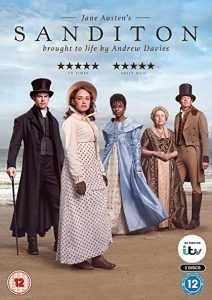 For some reason, I never wrote a review of this when I first watched it (probably I was too annoyed at the ending), but now that I’ve watched it twice, I’m no better pleased with it. It takes the fragment that Jane Austen wrote and spins it into a yarn that encompasses all the essentials of modern TV drama – sex, money, ambition, greed, selfishness, high action, pretty costumes and some very good looking actors. Oh, and a smattering of racism and the obligatory denunciation of slavery. There is precisely one decent character in the whole production (I don’t count heroine Charlotte; she’s a dope). The word that springs to mind is sordid.
The basic plot is straight from Jane Austen – Tom Parker is obsessed with promoting his seaside home of Sanditon as England’s best resort. He’s supported financially by Lady Denham, who is obsessed with money. She has several relatives, Sir Edward Denham, Miss Denham and poor relation Clara Brereton, who are also obsessed with money – specifically Lady Denham’s, which they all want a share of. Heiress Miss Lambe is another target for the money-obsessed. There are also several members of the Parker family, namely brother Sydney, the indolent man-about-town and rather uninspiring hero, and hypochondriacs Arthur and Diana. Charlotte Heywood is the country innocent dropped into racy Sanditon, who immediately gets the hots for sophisticated Sydney.
So far, this is straight from the early chapters that Jane Austen wrote. But the TV show introduces another layer of society, one that never featured at all in any of Austen’s completed works, except as brief walk-on parts. Because Sanditon is still under construction, we get the builders, and an alternative suitor for Charlotte in nice Mr Stringer, the foreman with ambitions to be an architect. And the script-writers couldn’t resist another money-related situation – the workers haven’t been paid for weeks and are getting stroppy about it. Tom Parker keeps promising more men and money, but he just can’t afford it. This strikes me as odd, because labourer’s wages were peanuts in those days. A labourer would have made perhaps ten shillings (half of a pound) a week. If there were fifty men, which seems unlikely, that’s a cost of twenty five pounds a week, something that Parker could have found by selling a vase or two from his house. It was the stone frontages and marble fireplaces that cost the earth in housebuilding in those days. Besides, labourers couldn’t afford to work for nothing – they had families to feed, and without money each week they starved. They’d have been off the first week there was no pay.
But I digress. I’ve mentioned already that there is only one decent character in the production, and I’ll come to him in a minute. The rest are all either fools (Tom Parker, Arthur and Diana) or nasty (Lady Denham, Sir Edward, Miss Denham, Clara Brereton) or silly (Charlotte, Miss Lambe). I’m going to put Sydney in the nasty category, because he’s unforgivably rude to Charlotte in the early episodes, he flip-flops about between grudgingly admiring her and yelling at her, and then betrays her horribly at the end. But what about that nice Mr Stringer, yearning soulfully after Charlotte? He’s pretty silly, because when he’s offered the chance of an architecture apprenticeship (did they do that in those days? I guess they did), he turns it down for stupidly sentimental reasons.
So, to the one decent character. Sydney brings some friends to Sanditon to support his brother’s endeavour. One of them is an amusing drunk, and hallelujah for some humour. The other is Lord Babbington, rich, titled, single and smitten instantly with the disdainful Miss Denham. He spends the whole series chasing her with single-minded and unreserved devotion, and is an utter delight. It may be that he only strikes me that way because everyone else is so relentlessly awful, but whatever. I liked him, and I cheered when he finally got his girl.
But the rest of it? No. The costumes are OK (I particularly liked Lady Denham’s old-fashioned styles), but as with all modern productions now, the hero is trendily unshaven, and Charlotte goes around with her hair down most of the time. I get that she’s supposed to be unsophisticated, but it’s plain wrong. A girl put her hair up when she came out into society, and it never came down again outside the bedchamber. There’s a carriage chase scene which is hysterically funny (as in so bad it’s funny). There’s a fair amount of gratuitous nudity but that’s expected these days. The music at the balls was just weird, but I suppose they were making some point or other. I don’t quite see the purpose in pretending to do Jane Austen, and then throwing out half the historical details (unless you do it in style, a la Bridgerton).
And the ending is an abomination. I watched it in the UK before it reached the US, and I actually warned my American friends not to watch the final episode with anything breakable in their hands, because it would inevitably be thrown at the TV. To repeat – the ending is an ABOMINATION. Worse than Lost, which is saying something. So not one for traditionalists, and be prepared to imagine your own ending.
April 5, 2021
Review: Sanditon by Jane Austen and Another Lady
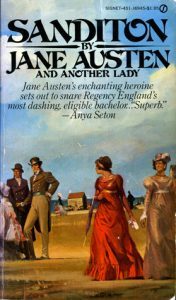 Well, that was fun! I’ve been hoping to read this book for ages, since it’s touted as the definitive version of Sanditon, Jane Austen’s unfinished work, but I was waiting patiently for it to come out in ebook form. But a clear-out of the loft produced a box full of old Georgette Heyer paperbacks, and amongst them this Signet book from 1975, the pages yellowed and brittle with age. I haven’t read a dead tree book in years, but this was one I couldn’t resist.
There was another reason for reading it, too, since I’m working through a rerun of the 2019 TV version, and it was an interesting comparison. Or rather, there is absolutely NO comparison. One is light-hearted, witty, elegant and charming. The other is… well, I’m tempted to say pointless. But enough of the TV version. This review is about the book.
Here’s the premise: Charlotte Heywood is taken up by Mr Tom Parker and his wife after the Parkers’ carriage suffers an accident outside the Heywood house. She is to stay with them at the small seaside town of Sanditon, which Mr Parker is busily trying to turn into a fashionable resort like Brighton, complete with sea bathing (from bathing machines!) and splendid views and lots and lots of bracing fresh air. Lady Denham is the other prime mover in this venture, and the first few chapters introduce an array of other characters: Mr Parker’s brother and sisters, hypochondriacs all; Sir Edward and Miss Denham, the impoverished aristocrats; Clara Brereton, the poor relation; wealthy mulatto Miss Lambe and her entourage; and finally, briefly glimpsed, the presumed hero of the book, Sydney Parker, yet another brother. That was as far as Jane Austen got, so everything else comes from the imagination of Another Lady.
Most of these characters are reasonably well defined from the start, but one is a complete enigma – Sydney Parker. Jane Austen tells us virtually nothing about him, so he’s a blank slate. Another Lady does a terrific job of making him a likable and very heroic hero, while also making him darkly enigmatic at times. He’s one of the most original characters I’ve come across, and I totally understand why Charlotte finds him so compelling. I find him compelling, too! This is one of those rare cases where all the other characters agree that Sydney is a charismatic, charming and intelligent man, and he actually behaves that way. I get so tired of Regency authors telling us that a character is clever when they continue to do blindingly stupid things, so it’s very pleasant to be able to say that Sydney really is clever. His cleverness trips him up sometimes, but he’s clever enough to get himself out of the mess.
The blurb describes Charlotte as ‘Jane Austen’s most captivating heroine’. That’s a bit misleading, because we don’t really know much about Jane Austen’s Charlotte at all, so this is really Another Lady’s Charlotte, and yes, she is rather captivating, a very practical girl who makes an interesting counterpoint to the flighty and up-in-the-boughs Parkers, with their constant schemes. She is also a very well brought up young lady, who gently reproves Sydney whenever he seems to wander into misguided territory. In fact, to begin with, she seems to disapprove of him rather thoroughly, as a frivolous chap with a mischievous or even a bad streak. But of course she comes round nicely.
The plot, such as it is, meanders about rather charmingly, with a visit to neighbouring resort Brinshore and some whimsical efforts to collect seaweed. Towards the end, it veers into melodramatic territory, seeming like one of the more extreme Georgette Heyers before resolving itself neatly and without fuss. A lovely read, and although it has too much focus on the romance to ever pretend to be an authentic Jane Austen, and the language never rises to her sublime heights (in particular, Another Lady never comes close to capturing Sir Edward’s pompous and long-winded verbiage), I enjoyed it enormously. Five stars. Thoroughly recommended.
March 29, 2021
Review: The Fourth Marchioness by Jayne Davis
 Another absorbing read from Jayne Davis, with a basic plot that might have been a bit dull in other hands (that well-worn scenario, the choose-a-bride house party) spiced up with an intriguing spying plot.
Here’s the premise: James, the Marquess of Harlford, is coming to terms with his unexpected ennoblement after his older brother’s death. He’d rather be pursuing his scientific research, but his mother is determined to marry him off to prevent eccentric Uncle David from inheriting. She arranges a house party with some suitable candidates. Among the chosen guests are two who’ve wangled an invitation for reasons of their own. Gossipy Lady Jesson and her companion Alice Bryant have an ulterior motive – to find out if Lord Harlford’s secret letters to France mean he’s a traitor to his country. Alice doesn’t like what she has to do, but when James starts to pay attention to her, her position becomes very awkward indeed.
It’s easy to like both hero and heroine here. James is the sort of person we’ve all met, someone who’s so engrossed in his own affairs that he fails to see what’s right under his nose. Not from lack of perspicuity, either, but simply because his thoughts are so occupied that he just doesn’t notice what’s going on. Alice is smart and sensible, and able to rescue the hapless James from the machinations of his mama’s multitude of ambitious guests. He, in his turn, rescues her from machinations of a different sort. Being thrown together in this way leads them both into a rather tentative courtship.
But there’s more than Mama and a rash of title-hunting young ladies to contend with, because if James isn’t a traitor, who is? And they will stop at nothing to get the information they need about James’s experiments. And so this part of the plot hurtles into melodrama and danger and an exciting rescue plan, and although there was nothing terribly unexpected in any of this, it was still a dramatic page turner.
Along the way, there are some nicely eccentric side characters, like Uncle David and the Dowager Marchioness, and if the house party setting throws up few surprises (why are wannabe marchionesses so unsubtle?), it’s still a fun read, beautifully written and with impeccable historical research. Five stars.
Review: Allerdale by Jenny Hambly
 Every Jenny Hambly book is a lovely read in the traditional style, very much modelled on Georgette Heyer. This is a more conventional outing than the previous series, which transported the reader to the less well-trodden venues of Buttermere and Cheltenham, for here we are in London for the season, complete with outings to the theatre, Richmond Park and the drawing rooms and ballrooms of Mayfair. Very much one for the traditionalists.
Here’s the premise: Eleanor Edgcott is the orphaned daughter of a diplomat. He’s left her very well off, so even though she’s living with a cousin, she’d really like to set up her own establishment and be independent. If that’s not possible, she’ll find some other project to absorb her energies, and there’s always her cousin and his wife to sort out, and a beautiful young girl to rescue from the clutches of a determined rake. The last thing she needs is a husband to cramp her style and curb her independent spirit.
Miles, the Earl of Allerdale, is attempting to polish up his reputation after his wild and impulsive ways led him to near disaster. He’s been learning to manage his estates in the north, and finding it unexpectedly fulfilling, but now he’s back in town and he’s rashly promised his mother he’ll find himself a wife. He’s not very keen, and anyway, no one catches his eye. The respectable ones are dull as ditchwater, and the interesting ones are too headstrong to make good wife material.
Anyone who read Georgianna will remember Lord Allerdale as the villain of that book. Rather a charming and attractive one, as it happens, so the task of transforming him into a hero isn’t terribly challenging. It’s not necessary to have read that book, since the events therein are explained in some detail, but a lot of the characters from that whole series pop up here, which may be confusing for anyone who sees that this is book 1 of a series and expects it to be a fresh start. I get that they would all be in town for the season and they all know each other, but still, I felt that there were rather too many of them, frankly. I’m hopeless at remembering the details of previous books, so I just let it all wash over me, but it was confusing.
Eleanor is a lovely heroine, and anyone who’s read Georgette Heyer’s Grand Sophy will recognise her at once. She’s not quite as interfering as Sophy, and I liked her the better for that, but she’s a splendidly spirited and independent lady, quick-witted and (mostly) sensible. Her interactions with Miles are sparky and fun from the start.
But that raises an interesting point. Although we know almost from page 1 that these two are destined to end up together, and assorted friends and relations are pushing them towards each other, they don’t actually meet until almost a third of the way through the book. It makes the romance seem rather rushed, especially as there’s a very abrupt transition from getting-to-know-you outings to the proposal. I actually enjoyed the proposal scene very much – Eleanor was at her most creative – but it did seem to explode out of nowhere.
I must mention one of the sub-plots, which is another one fans of Georgette Heyer will recognise, this time from Cotillion. A beautiful orphan is being browbeaten by her vulgar aunt into becoming the mistress of a notable rake. Meanwhile, an impoverished Russian gent has fallen wildly in love with her, and it falls to Eleanor to rescue the orphan and pair her up with the Russian gent.
The name of Georgette Heyer crops up a lot in the context of Jenny Hambly’s books. Partly that’s because Hambly’s writing is every bit as deft as Heyer’s, and aficianados will love the familiar expressions and phraseology. As far as plots go, it’s not that Hambly is unoriginal, it’s more that Heyer covered pretty much the full range of plots in certain settings, like Bath and the London season, so anyone treading the same ground is inevitably going to evoke echoes of Heyer. And honestly, that’s no bad thing. I enjoyed playing spot-the-similarity.
If you’ve read Hambly before, this is another accomplished and highly enjoyable read. It was four stars for me because the romance jumped a little too fast to the question of marriage – I like a slower build-up, but that’s purely a personal preference. And if you’re new to the author, I recommend you start at the beginning, with Rosalind.
March 22, 2021
Review: The Difficult Life of a Regency Spinster: Isobel by Susan Speers
 Susan Speers is one of my favourite authors, not because she’s the World’s Best Writer (she has her faults, like most writers do), but because she always takes me by surprise. I just never know from one book to the next what I’m going to find. More than that, even within the book itself, I never know where it’s going. With most Regencies, once the characters are on stage and the circumstances are laid out, it’s generally easy to predict what will happen. Not the details, but the general flow. Not with a Speers book, and there’s an edginess to that that’s almost entirely lacking elsewhere in the genre. Mary Balogh had it in some of her early works, but it’s rare. One reviewer described this book as thrilling, and I can see why. I find it unsettling, but it’s still fascinating, as all Speers’ books are. I’ve varied in how much I’ve enjoyed each one, but I would never dream of missing one, and now that Amazon has stopped telling followers about new releases, she’s the only author where I regularly check to see if there’s a new one out.
Here’s the premise: Isobel is an orphan living with her stepmother and two stepsisters. Her guardian is away in India and has been happy to let Isobel’s stepmother run the estate and look after Isobel, but in the nature of stepmothers, this one is bent on squeezing out Isobel in favour of her own daughters, and taking possession of Isobel’s mother’s collection of jewellery, intended for Isobel. Unable to stop her, Isobel resorts to stealing her own jewellery, and when that is discovered, borrowing and replacing it, just to appease her own sense of injustice.
Into this difficult setting comes the mysterious Earl of Drayton to buy a silver presentation box, part of Isobel’s fortune, being sold over her head. He has his own objectives, but his path runs alongside Isobel’s for a while, so when she runs away from home to avoid an unwanted marriage or the threat of an asylum, he scoops her up to protect her.
Or so he says. I have to say that the earl came across as rather a dark character to me. He very creepily turns up wherever Isobel happens to be. Is he watching her? I was suspicious of him almost to the end, and when he started kissing Isobel in the moonlight, I feared the worst for her. He dumps her on a friend of his, and I was suspicious of her, too! What are these two up to? The friendly Eudora with her mysteriously missing companion and her willingness to take in a random stranger just because Drayton asks her to had me silently screaming: run away, Isobel! Quick, quick!
After this brief interlude of cosseting in London, the book veers off into road movie territory, with a series of stops with various people where Isobel has to pretend to be Eudora’s companion (replacing the mysteriously missing one), Eudora takes malicious delight in bossing her about and the earl continues to leap out of dark corners and indulge in moonlight kisses. It’s this latter habit that inevitably gets them into trouble and leads to a fake engagement. Or is it fake? Hard to tell what the earl is feeling or thinking, frankly, and Isobel, to whose thoughts we are privy, is such a jumble of contradictions that there’s no making her out, either. Eudora was not much easier to understand.
Along the way, there are a number of adventures that don’t seem to be much connected but are quite entertaining anyway, a rather clever denouement that I enjoyed and a satisfactory resolution to the romance. These two were not the most passionate of couples (apart from when struck by moonlight!) but they felt like a good fit, to me. The sex is mentioned but it’s not graphic in the slightest. As far as historical accuracy goes, nothing jumped out at me, although I was thrown by the earl’s estate being called Blackpool (which is a very famous town in Lancashire), but I don’t think it was meant to be anywhere near the town. Another house mentioned was called Blessings, an oddly unBritish name. With all the travelling around, I never had any idea where they were, most of the time. I’d have liked some idea of locations just to get my bearings (it’s very dislocating, as a Brit, not to know where the characters are and which way they’re travelling). As usual with Speers, a final edit wouldn’t have gone amiss. There were a number of typos, and the punctuation was terrible.
This is not my favourite Speers, but I still enjoyed it a lot and galloped through it in a couple of days. It unsettled me not to know whether any of the main characters were heroes or villains or some combination until the very end. Combined with the jumping about from place to place, that keeps it to four stars for me, but it was still a very worthwhile and interesting read. Now on to J… Jane? Juliana? Jennifer?
Review: Mr Gardiner and the Governess by Sally Britton
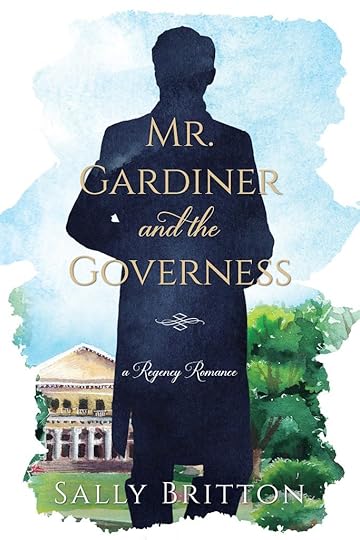 Sally Britton is one of the most talented of the new style of Regency authors emerging from the US who write sex-free stories with a strong historical foundation, and bring a welcome freshness to the genre. Britton’s been honing her craft for a few years now — this is book number twenty or so and it’s well-nigh perfect. Sympathetic characters, a wonderfully evoked setting and a swoon-worthy romance – what’s not to like?
Here’s the premise: Alice Sharpe has been passed from one household to another as the poor relation, but now she’s outstayed her welcome and is forced to take up employment as governess in a duke’s household. She’s desperate to make a go of it, but she gets off on the wrong foot immediately with a man she meets in the gardens, and assumes is just one of the duke’s gardeners. But Rupert Gardiner is an entomologist, a man fascinated by insects, and he’s engaged on a project dear to the heart of the duke – to make an illustrated record of the flora of the ducal grounds. While he’s doing that, he can also study his precious beetles. But the new governess is a distraction, and he’s not sure what to make of her.
The plot… well, there isn’t really a plot. Rupert and Alice tiptoe around each other, trying to reach a working arrangement and get to know each other better without neglecting the duties they’re paid to do, or attracting the ire of their employers. And gradually, oh so slowly, they find themselves drawn together and teetering on the edge of falling in love. They share some lovely moments together, and their first kisses are delicious. There are very few bumps in the road, they are too sensible for there to be any misunderstandings and the duke’s household is composed of universally nice, kind people, so there’s not much to go wrong, really, apart from a few minor hiccups. A special nod to Rupert’s valet, who has a very minor role, but manages to steal pretty much every scene he’s in. The children are great fun, too.
If this sounds dull, it really isn’t because there’s a magical ingredient that lifts the story far above the ordinary, and that is the garden itself. The flowers and trees, the lawns and pools, the statues (I’d love to see the statue garden) and of course all Rupert’s little beasties are evocatively described. I loved it. I also liked the idea of the duke’s house, Clairvoir Castle, which was only built ten years earlier, but was designed to look ancient – a neat conceit. And I squeaked in delight to discover that the castle’s name is pronounced CLEE-VER – that is just so British, like Beauchamp and Cholmondeley and Worcestershire and a thousand and one other names that are pronounced oddly. Kudos to the author for that little touch.
Another aspect I liked is the duke himself. The Regency romance genre is stuffed with dukes who swan idly about, and are invariably young, rakish, manly and very, very hot. This duke is involved in government business, politics and diplomacy, just as he should be, and the ducal family members are gracious and regal. There’s a very strong air that they’re way, way above Alice and Rupert on the social ladder, as you’d expect. This is beautifully done. I loved the scene where Alice is being interviewed by the two duchesses, with the distinction of rank and the opulence and elegance of the room brilliantly evoked.
This is a quiet, low-action story, and if you’re looking for elopements or highwaymen, duels at dawn or a kidnapping, you should probably pass on this one. But if you want a beautifully written and gentle story with a lovely romance and an exquisitely drawn setting, I highly recommend it. Five stars.
March 9, 2021
Review: Scandalizing The Duke by Leslie Knowles
 Well, that was fun! A lively heroine, a duke with Daddy Issues, and a nice but not over-detailed look at the season with a slowly developing romance, this one doesn’t push the boundaries at all but it’s an enjoyable read.
Here’s the premise: Charlotte Longborough is embarking on her first season, alongside sister Elizabeth, who’s still single after her previous season. They are being brought out by their aunt, who turns out to be surprisingly well connected, for Charlotte soon finds herself awash with lords of one sort or another. In fact, there were so many titled gentlemen swilling around that I lost track of all but a handful early on. The principal one, and the top of Charlotte’s hopeful list of eligible men, is Lucien, the Duke of Wolverton, but their first meeting doesn’t go well. While out walking her very large dog, Charlotte is dragged into the path of the duke’s horse, and ends up almost trampled into the mud. A couple more incidents of the same type convince Charlotte that she’s blown any chance she might ever have had with him, and makes Lucien see her as nothing but trouble. Naturally, with such an inauspicious beginning, the two immediately have the hots for each other (because of course they do).
I found Charlotte a difficult character to get to grips with. She’s very likable, with her penchant for rescuing stray animals and her straightforward manners, but I never got a good sense of where she was coming from. Like any good Regency matchmaker, the interested reader needs to know the precise social standing of the heroine, but with Charlotte the only information I had was that her dowry was modest, and there was some slightly disreputable family history regarding an aunt. I have no idea of the rank of her father, who might be anything from lower gentry up to viscount level (but not beyond, or she’d be Lady Charlotte). Where do they live? Are they connected to any of the great families? Why does she have a duke on her list at all if she’s slightly dubious with only a modest dowry? I don’t even know whether her father is still alive. Maybe I missed the answers to these questions, I don’t know, but it made Charlotte feel rather unrooted.
One thing that bothered me is that Charlotte never sees Lucien as a potential husband. Considering he was top of her list, and therefore she sees herself as (presumably) duchess material, and he treats her in a friendly manner, and considering she’s very drawn to him, it surprised me that she never shows any signs of her attraction. At their first dance, she cheekily asks him to introduce her to some of the other names on his list. Was that a subtle form of flirtation? Or just not particularly caring what he thought of her? I couldn’t make her out at all. And later, after they’ve been sharing passionate kisses, even though she responds to him, I never had the sense of her falling head over heels in love with him, or starting to dream about him. She just seems to dismiss the possibility.
Lucien, on the other hand, felt like a much more solid character. It’s easy to see precisely how he got to where he was and behaved in the way he did, and his past (and his father) provided a solid foundation for his character. I think he may have been intended to be a bit unlikable at first – his own aunt calls him priggish and it’s hard to disagree. Nevertheless, I always found him a sympathetic and very interesting character. My only grumble is that, considering his defining characteristic is his determination to behave with the utmost propriety at all times, he gave way to improper impulses at pretty much every opportunity. From lustful thoughts, he progressed to passionate kisses in rather short order, even when Charlotte is staying at his house. There’s no graphic sex, but the kisses are described in some detail.
The villain is a particularly nasty character, and I was relieved that Charlotte persuaded the duke to get involved in the situation and that the matter was resolved satisfactorily. The resolution was a pretty breath-taking page-turner, but more than that I won’t say. Of the side characters, younger sister Sarah is a very useful plot device, sister Elizabeth seemed to fade into the background and I’d have liked to see more of Lucien’s half brother, who interested me a lot. However, this is the first book of the series, so he might get his own story later.
The romance… well, it was obvious these two were made for each other, but quite why it took them so long to realise it is a mystery. Their encounters in deserted libraries and the like were lovely, if a little too sexy for propriety, but then that was the book’s basic premise, the unravelling of Lucien’s priggishness. But the ending left me a little flat. After all that lusting and build-up of sexual tension, I felt there needed to be an actual sex scene to clear the air, or else an over-blown super-flowery emotional scene, and instead the book just stopped. Which was a bit of a disappointment.
Leslie Knowles is a new author to me, and I thoroughly enjoyed this. The first part of the book was slightly choppy, and there were a fair few minor typos, but nothing to spoil my enjoyment, and I just galloped through it. Four stars.