Mary Kingswood's Blog, page 51
October 11, 2016
Review: ‘In Want Of A Wife’ by Odelia Floris
 This book took me completely by surprise. Having loaded up my Kindle ready for a long-haul flight, I started with the big-name books and discarded them one-by-one — too many typos, too implausible, too historically inaccurate. By the time I got to this one, I had no expectations. And then it completely blew me away. Within five minutes of meeting Miss Rosa Lane — shy, stammering, socially inept Rosa — I desperately wanted her to have her happy ever after.
The plot is a time-honoured one: two sisters go to London for the season to find husbands for themselves. The older sister, Arielle, is excited at the prospect and declares she’s going to fall in love with the handsomest man she can find. Poor Rosa is terrified, of course. How will she ever manage at balls and large social gatherings, amongst so many strangers? She’s bound to be inept and say and do the wrong things. And both sisters are correct. Arielle instantly falls for the dashing and handsome Captain Steele, while Rosa can barely speak a word, even to the gentlemanly and unthreatening Mr d’Arcy, a widower in his thirties who is, as Jane Austen and the title of the book have it, ‘in want of a wife’, and who is unexpectedly friendly towards Rosa. But there’s another man whose attention she attracts, Steele’s friend, the strangely sardonic Captain Spencer.
And so the story unfolds with the choice Rosa has to make — the odd Captain, for whom she begins to have feelings, although he shows no sign of affection towards her, or the safe option, the wealthy widower with a comfortable situation, a marriage of convenience and perhaps a lifetime with respectability but no love. It’s a dilemma that so many Regency ladies must have faced — take the dull but safe offer now, or hold out for something better. Tricky. But when d’Arcy makes the offer, Rosa is too grateful and, frankly, too timid to turn him down and so, rather nervously, she marries him.
The rest of the book is an excellent description of how so many marriages of convenience must have gone — the polite formalities, the stilted conversations over dinner (Mr d’Arcy talks of very little beyond the weather!), the sheer loneliness of a life lived with someone who is virtually a stranger, played out in front of the servants. There are some very funny moments though, when the two are trying to conduct a conversation from opposite ends of a very long dining table, and misunderstanding each other, and having to repeat everything and shout. I wondered if they were going to resort to passing notes by way of the butler! The ending is pretty near perfect, and I actually cried when these two lovely people finally got all the obstacles out of the way and were set fair for happiness.
Is the book perfect? No, of course not. There were a few clunky moments, there were one or two places where I questioned the historical accuracy, the villains were a little too extreme and there were some parts of the story that could have been fleshed out a little more to give it some needed depth — I would have liked to see more of d’Arcy’s daughter, for instance, and one or two scenes showing Rosa with her after the marriage would have been welcome. One other (trivial) comment. It takes a certain amount of confidence to write a Regency romance with a hero called d’Arcy. There’s just too much baggage associated with the name. Captain Steele, too, reminded me of Lucy Steele in Sense and Sensibility.
I only have one serious grumble and that is the lack of chaperonage. I’ll forgive the two sisters travelling on the stagecoach because I assume there was an (unmentioned) matron accompanying them. But in London the aunt is simply never around, apart from formal functions like balls. During the day, she seems to be conveniently out visiting all the time, leaving the two sisters alone as prey for anyone who happens to turn up, or to walk about the streets and parks on their own. She must be the world’s worst chaperon! I’d expect her to take the girls with her when she goes visiting or shopping, to ensure they are introduced to all of her acquaintance, and once any gentlemen start to pay them attention she should be checking their backgrounds and ensuring that they’re respectable, and steering her nieces away from any bad apples. Instead she seems to take no interest at all until things reach crisis point.
But none of this detracted from the book for me in the slightest. From the very first page, its charm swept me along, and I was rooting for the hero and heroine all the way. A delightful read. Five stars.


September 9, 2016
Regency romance review: ‘To Kiss A Rake’ by Barbara Monajem
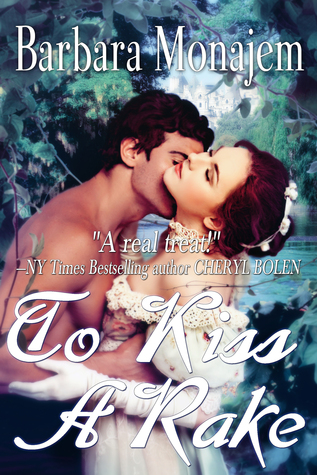 Sometimes when I’m looking for a book to read, I feel the need to do some research for my own Regency romances. So it is with this one. I picked it from the top of Amazon’s popularity lists, and since it’s more than a year old, it must be a good example of a well-targeted book that’s selling well because it gives readers exactly what they want.
First appearances are so-so. The title is exactly like a million other Regencies (To Kiss/Marry/Desire/Love a Rake/Duke/Scoundrel/Lord). Nothing terribly original there. And the cover is also like a million others — a modern couple in vaguely old-fashioned clothes, the man half-naked, the woman in full make-up, in a clinch. So far, so meh.
But the opening chapters are good. Our feisty heroine, Melinda, is helping out a friend who’s cried off from an elopement. She agrees to leave a ball to inform the man that it’s all off, the friend being too cowardly. But instead she meets our sturdy hero, Miles, who is helping his friend manage the elopement. Owing to a misunderstanding followed by a bump on the head, Melinda is abducted instead of the friend and finds herself stranded at an inn far from home with a strange man. He tries to get her home, but (naturally) they’re spotted and recognised. Now, it takes some industrial strength suspension of disbelief to accept all the missteps that have to happen to get to this point. In particular, it’s necessary for Melinda to be believably misidentified as the eloping girl, and I confess to rolling my eyes once or twice. Still, I can forgive a little contrivance to get the ball rolling.
It’s after this point that things begin to go off the rails somewhat. The plot requires a lot of characters to behave in, frankly, incredible ways. I found it impossible to believe in the evil grandmother, and the author has painted a harsh picture of Regency society, entirely filled, it seems, with shallow, immoral and selfish people without an ounce of humanity. I know times were very different then, but people were still people, with just the same range of weaknesses and strengths as modern people, not almost uniformly horrible, as here. Nor did I find Miles’s loss of reputation very believable. Then there’s the ongoing elopement plot, which centred on possibly the stupidest girl in Christendom. This sort of thing is fairly common for the genre, though, it has to be said.
Of the main characters, I liked Miles very much. Melinda, not so much. The romance side of things is good, although there’s a bit too much insta-lurve, and the whole virgin-to-sex-fiend-after-one-kiss trope has been done endlessly, and should die a fiery death. But the build-up was good and the sex scenes were good, so there’s that. But I wanted to bang their heads together to knock some sense into them. I know they both had the obligatory tortured backgrounds and all those emotional scars, yada yada yada, but they were also intelligent and rational people who whined and angsted and got annoyed with each other far too much. They made far too many decisions based on assumptions about what the other would feel, which were inevitably wrong. Ultimately, this book failed one of my acid tests for plot credibility, in that there would have been no plot at all worth the name if the characters had just sat down and talked to each other.
There isn’t anything wrong with this book. It’s well-written and easy to read, although the constant head-hopping from Miles to Melinda and back made me dizzy. There were a few word choices that surprised me (bum, for instance) but I assume the author’s done her research on that. The Regency setting isn’t very pronounced, and apart from the odd reference to Almack’s and the like, the book could have been set anytime up to the late Victorian era without major changes (it’s actually set in 1804). I didn’t notice any glaring errors, which was pleasant.
For anyone who’s looking for a typical modern Regency romance, with plenty of sex and agonising, and isn’t bothered by a certain amount of starkly black and white characterisation, I can recommend this. It wasn’t much to my personal taste, and I did quite a bit of skimming to get to the end, so it’s just three stars.
August 8, 2016
Regency review: ‘The Spanish Bride’ by Georgette Heyer
 Another one I’m going to pass on. Written in 1940, although this is classified as a Regency romance, and it probably is, it’s also based on real historical characters, and, like An Infamous Army, it’s very focused on the historical setting.
Regency review: ‘Friday’s Child’ by Georgette Heyer
 It’s an odd thing, but whereas The Corinthian was every bit as frivolous as this, and ten times as implausible, it was still very enjoyable to read. This one, however, often felt tediously silly. The reason, at a guess, is in the characters. In The Corinthian, both the main characters are sharply intelligent, although muted by innocence (in the case of the heroine) and a degree of cynicism (in the hero). I can forgive characters a great deal if their actions make some kind of sense.
But Friday’s Child is based on stupidity. Both hero and heroine behave in ridiculous ways, without an ounce of common sense, and that’s really annoying. Viscount Sheringham needs to get married to release his inheritance money, and, rejected by the woman he’s been pursuing all season, he is so annoyed he swears to marry the first woman he sees. This turns out to be Hero Wantage, the ultra-naive girl-next-door. And so they marry, and she gets into scrape after scrape through ignorance (or sheer stupidity) and he carries on behaving exactly as if he were still a batchelor. Cue all sorts of tangles.
There’s a certain charm to the characters, and the collection of male friends who rally round the naive bride and make her an honorary member of their set is very amusing. But, as with The Corinthian, the bride is terribly young, only seventeen, and I disapproved violently of her behaviour in Bath, where she pretends to be single.
This was entertaining, in a frothy and fairly silly way, although I’m not a big fan of all the Regency cant, and the sheer weight of silliness keeps this one at four stars.
August 3, 2016
Victorian romance review: ‘Violet’ by May Burnett
 This is (I think) the tenth book in the Amberley Chronicles series, set in 1844, although they seem to be largely stand-alone works, only loosely connected. Typically, I’ve only read the first of the series, The Impostor Debutante, before this, but I didn’t have any trouble reading this one, or feel that I’d missed anything important. There were a number of characters mentioned that perhaps readers of the whole series would have recognised, but it worked fine for me.
The premise is that still-unmarried Violet Ellsworthy is bequeathed a cottage by a previously unsuspected relative with a somewhat dodgy past. She goes to have a look at her inheritance and sort through her relative’s papers (finding some steamy stuff amongst them), and along the way bumps into Simon, Lord Rillingford, who has been accused of raping and abandoning the daughter of local gentry. Violet and Simon are immediately attracted, but first they have to find out who fathered the girl’s baby.
The characters here are both sensible, likable people, who behave in perfectly rational ways, and are obviously well-suited romantically. The writing is excellent, capturing the essence of the era without being unreadably verbose or complex. There’s some mention of sex (the deceased relative had a very lively time of it) and the rape is discussed, but nothing graphic. There’s a real historical feel to the background, so the author has obviously done her research. I wondered a little at the attitude of the local quality, who seemed almost uniformly to believe the pregnant girl, and disbelieve the local lord of the manor, because of some unfortunate dalliance in his past. Personally, it doesn’t usually go well to call the highest-ranking man of the neighbourhood a liar, even behind his back, but it’s a small point.
If I have a quibble at all, it’s that both the romance and the mystery of the raped girl are resolved rather too easily. I’d expected some extra layers of complexity or at least an unexpected twist at the end, but everything came out just as I’d anticipated, which was a bit disappointing. And after that, there’s a certain amount of jumping about the countryside to visit this relative or that, nervously informing them of the impending marriage, only to have everybody happy as sandboys about it. So any possible tension dissipated very quickly. However, this part of the book might be of greater interest to those who’ve followed the series from the start and know these characters well.
Overall, a very enjoyable read, recommended for those who like a clean, authentic Victorian read, only let down for my personal taste by the somewhat flat ending. Four stars.
July 26, 2016
Regency review: ‘The Reluctant Widow’ by Georgette Heyer
 This was published in 1946, a fairly classic Heyer, with a most intriguing plot. Elinor Rochdale, a young woman of good birth but straitened circumstances, sets out to accept a position as a governess. When she inadvertently steps into the wrong carriage at the coach stop, she finds herself conveyed to the estate of one Ned Carlyon. Carlyon believes Elinor to be the young woman he hired to marry his dying cousin, Eustace Cheviot, in order to avoid inheriting Cheviot’s estate himself. Somehow, Elinor is talked into marrying Eustace on his deathbed and thus becomes a widow almost as soon as the ring is on her finger. And from there onwards, the plot descends rather rapidly into a whirl of housebreakers, secret passages, uninvited guests, murder, missing government papers, and a dog named Bouncer.
As a traditional Regency romp, this is rather good. The misunderstandings, adventures and tangled web of mysteries keep things bowling along at a merry pace, and Carlyon’s younger brother, Nicky, and Bouncer the dog steal the show. The romance is the usual unsatisfactory Heyer variant, two people who are obviously destined for each other but show virtually no inclination in that direction until the last chapter. I suppose the heroine could be said to display a softening attitude towards the hero, as her indignant expostulations gradually become more perfunctory, but the hero never seemed to change in tone at all. Only a comment by his sister suggests that there is something going on, so that the ending comes as less of a shock.
This was a very wordy book, and the lady’s protestations at the high-handedness of Carlyon became quite tedious after a while. However, that was the style of the era, and in other respects the book is a good, solid read. Both the main characters were believable and sensible, which makes a change. I’m wavering between three and four stars, but I’ll be generous and go for four stars.
June 25, 2016
Regency review: ‘The Corinthian’ by Georgette Heyer
 After the history-fest of An Infamous Army, written in 1937, which I couldn’t even attempt, this one couldn’t be more different. It’s the most frivolous, silly, light-hearted confection imaginable, but then it was written in 1940, so perhaps frivolity was what was most needed.
The plot begins with Sir Richard Wyndham, the Corinthian (dandy) of the title, accepting that at the age of twenty nine, he must make a loveless marriage to please his family. Neither the icily practical lady, nor her debt-riddled family, appeal much, but he feels he must do his duty. But on the evening before making the offer which will tie him, he gets very drunk and on his way home he spots someone climbing out of an upstairs window. This is seventeen-year-old Penelope (Pen) Creed, an heiress escaping the prospect of an unwanted marriage to a cousin, by dressing as a boy and running away. Richard agrees to help her escape, and thereby sets in train a glorious set of ever-more-unlikely events, involving stolen diamonds, an elopement, a Bow Street Runner, even a murder, and a whole array of wonderfully eccentric characters.
The story is delightfully silly, but the real charm is in the two main characters. Pen is a complete innocent, always coming up with outlandish schemes which go horribly wrong, and then require even more outlandish schemes to set things right. Richard is the world-weary cynic, trying very hard to protect her from the worst consequences of her actions. The writing is as light as a feather, with humour in almost every line.
This book was a delight from start to finish. The romance isn’t totally convincing, not least because Pen is so young and innocent, it’s hard to believe that she really knows her own mind. But that’s a very minor quibble. A very enjoyable five stars.
June 9, 2016
Regency review: ‘An Infamous Army’ by Georgette Heyer
 I set out to read all of Georgette Heyer’s Regency romances in publication order, and here I am at the second book, written in 1937, and already I’m refusing to jump. The opening is a whole confusion of characters, so, naturally, I turned to the Goodreads reviews for advice. And find that this book is more of a historical treatise on the Battle of Waterloo than fiction. It is, apparently, still required reading for the officer training school at Sandhurst.
Well, it may be picky of me, but I read for entertainment, not to be hit over the head with the author’s depth of research. I’ll take a raincheck on this one, and maybe come back to it later, when I feel stronger. Pass.
Nice cover, though.
May 29, 2016
Regency review: ‘Two Corinthians’ by Carola Dunn
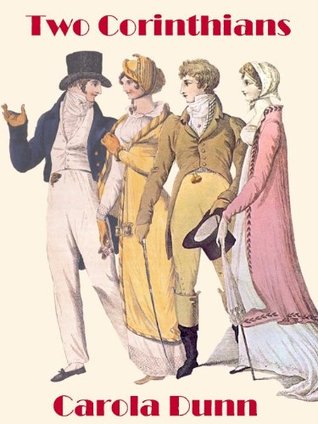 I love a good Regency romance, but I find it difficult to find any that aren’t dreadfully silly, and historically inaccurate to boot. I don’t expect every last detail to be perfect, but some things are terribly easy to check, like correct forms of address for the aristocracy, and it’s a great irritant when the author hasn’t even bothered. However, I have no such complaints here. There is a great deal of detail of clothing, and the language is riddled with contemporary cant, but it all felt very authentic. And while there is an outbreak of silliness at the end, it was forgivable.
The two Corinthians (men about town) of the title are George Winterbourne and Bertram Pomeroy. Bertram having lost the love of his life to George’s brother, is urged by his ailing father to marry soon. The suggestion is the elder Miss Sutton, Claire, eccentric and spinsterish at twenty eight, but suitable. George, meanwhile, becomes entangled with Claire and her lively younger sister, Lizzie, by chance, and enters into a pact with Lizzie: he will pretend to woo her to stop her dragonish mother from berating her.
So George is pretending to court Lizzie and Bertram is reluctantly courting Claire, and… well, we can see where this is going, can’t we? But even if the resolution is predictable, that’s not a fault in a book like this. It’s more about the journey than the destination, and here the journey is entertaining and unfolds gently and rather sweetly, with good behaviour on all sides.
There’s not much action, so those looking for highwaymen or pirates or spies should move swiftly on. Nor are there any outbreaks of uncontrollable lust. If you like Jane Austen and Georgette Heyer, then this book is just the ticket. A pleasant, gentle read. Four stars.
A footnote: I didn’t realise it, but this book is actually a sequel to Miss Hartwell’s Dilemma. It made things a little confusing early on as the author skated rapidly over the backstory, but I soon got the hang of it. However, it’s probably a more enjoyable read if approached in the correct order.
May 26, 2016
Regency review: ‘Regency Buck’ by Georgette Heyer
 This is the first stage in my attempt to read (or reread) all of Georgette Heyer’s Regency romances in the correct order. This was first published in 1935, and it shows. The writing style is high-flown Jane Austen, the backdrops are authentically drawn from the era, complete with famous characters, and the plot is squeezed in amongst all that historical accuracy. The characters have to play second fiddle, and the book suffers for it.
Judith Taverner and her brother Perry are orphans, seemingly abandoned by the guardian appointed by their father, the Earl of Worth. Undaunted, they set off for London to track down the Earl and establish themselves. And on the way there, they bump into (literally!) a most unpleasant character, haughty and supercilious, who treats them like dirt. And guess who their guardian turns out to be?
This was rather good fun, if you can overcome a natural distaste for a heroine who stubbornly does everything she’s told not to do, and a hero who arrogantly manipulates his wards without ever bothering to explain his reasoning. But the side characters were entertaining, the dialogue sparkled with wit and the mystery element of the plot was nicely done, even if there was never the slightest doubt in my mind about what was going on, and why, and by whom.
For fans of historical detail, there’s a veritable deluge of it here. If you want an exact description of the Prince Regent’s outlandish Brighton Pavilion, or a list of the coaching inns between London and Brighton, or the various shops and lending libraries for the well-heeled, or the types of snuff in use, look no further. And several famous people, including the Prince Regent himself and various of his brothers, play small but significant roles in the story. To my mind, so much regurgitated research got between me and the story, and by the end I was skipping the seemingly endless descriptions of furnishings and decoration.
The author has obviously been inspired by Jane Austen, specifically Pride and Prejudice, and I noticed many turns of phrase lifted almost wholesale from there, not to mention certain elements of the plot (the hasty journey to London to track down a missing character, for instance, very redolent of Mr Bennet haring off after Lydia, although in this case with no justification whatsoever). It made the prose a little heavy at times, but still readable.
On the whole, I quite enjoyed the story, and the characters didn’t bother me as much as they did some readers (there are some very disparaging reviews). However, it failed in two respects. The first is the time-honoured one: there would have been no plot at all if the main characters had just talked to each other. The argument for secrecy was never well-made, and the worst thing the hero did to the heroine (to my mind) was to allow her to think her brother was dead. That was cruel and unforgivable, and far worse than the snatched kiss or his consistent rudeness (because – aristocracy; arrogance goes with the territory).
The second failure was the romance. I don’t ask much of a book like this, because the journey is more important than the destination, but there should at least be a conviction in the reader that these two are meant for each other. And honestly, I never felt that here. They argued constantly, and not just sniping but quite forceful battles, and even their romantic rapprochement degenerated into an argument in double-quick time. I’m always happy to see two intelligent, spirited, self-confident souls get together, but this pair veered too far into the arrogant, self-willed and plain bloody-minded. I can’t imagine how they will manage as a married couple.
So despite this being an enjoyable read, well-written and set very much in the era, it still merits only three stars.