Mary Kingswood's Blog, page 2
September 9, 2025
Review: Petteril’s Baby by Mary Lancaster (2025)
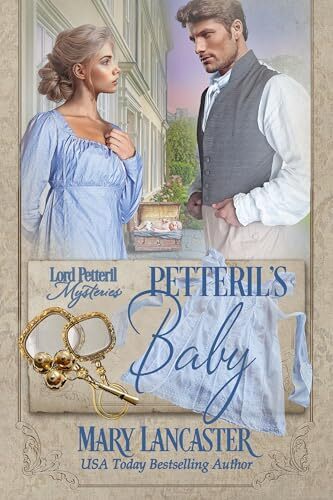 Another good mystery for the Petterils to solve in this, the eighth book in this series. There are still problems for the couple, a predictable twist and one niggling issue for me that spoilt my enjoyment somewhat.
Here’s the premise: a small baby is dumped on the Petterils’ doorstep. Whose is it, and why was it left there? The natural assumption is that it’s a by-blow of Piers’, but he denies it. His relations, disapproving of April, suggest maybe it’s hers until Piers points out the discrepancy in age and timing. So the search is on to find the mother… or the father, possibly. The mystery proceeds with some neat twists and turns, leading to a satisfactory resolution. I liked this part of the book very much.
The other element involves April getting broody (not unexpectedly) but seemingly she believes she can’t have children, and she’s discussed this with Piers before they married. Now this really bothered me. I’ve read the whole series to date, and I don’t recall any such discussion. Well, my memory’s not the best, so maybe I’ve just forgotten, but I spent quite a bit of time trawling through previous books looking for any reference to this, only to come up empty-handed. Now this shouldn’t matter, but when something is presented as having occurred earlier, and it’s something so important (Piers is a viscount, after all, so an heir might be important to him), I’d expect it to be memorable… or at least findable. I’m afraid that every time the subject arose, I was so cross that it became very distracting. I’d love to know whether I just missed the earlier discussion or whether it actually wasn’t there.
But that aside, this is another good read, which would have been five stars but for that annoying niggle. So four stars it is.


August 8, 2025
Review: The Paris Footman by Roseanne E Lortz (2024)
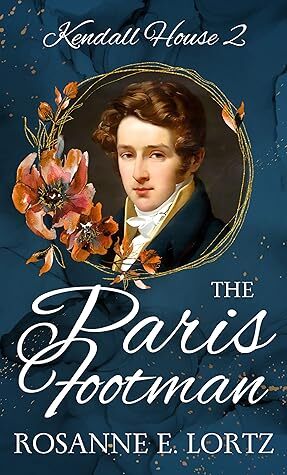 I found this book hard to read because although it’s book 2 of the series, it parallels and interweaves with the plot of book 1 extensively. That book focused on Lord Kendall and Mrs Audeley, whereas this book is primarily about Gyles Audeley and Lady Louisa Lymington, but the first half is the same meeting of Lord Kendall’s family with the Audeleys and their trip to London, with many of the same scenes, just viewed from a different perspective. I found this quite unsettling to read, spending far too much time trying to work out which were the new bits. But then the second half of the book has problems of its own.
Here’s the premise: Lady Louisa Lymington is a wealthy heiress who will come into her inheritance when she’s twenty-one, in just a few months’ time. Her uncle and guardian, however, has a cunning plan to relieve his own pecuniary difficulties by marrying her to his unsavoury pal, who will then slip him a share of the proceeds. Louisa isn’t going to tamely submit to that, so she runs away to Yorkshire, to be governess to the Earl of Kendall’s wards. When Lord Kendall whisks the eldest off to London to be brought out into society, Louisa and the younger girls are also sent for, and thus she returns to the precise place where she least wants to be, in case she is recognised and forced to return to her uncle.
But on the journey south, Lord Kendall has acquired company in the form of Mrs Audeley and her son Gyles. Louisa finds herself powerfully drawn to Gyles, even though she’s forced to avoid him (and everyone!) as much as possible. And when she is inevitably discovered by her uncle and forced to bolt again, it’s Gyles who insists on accompanying her, disguised as a footman, all the way to Paris.
Now, this is the point where I fell out with the book. I like a resourceful heroine as much as the next reader, but I honestly can’t believe in one who sets out to travel to Paris – alone! And set up house there – alone! And finances herself with a small fortune in jewels. No. Just no. Even speaking fluent French and carrying a pistol (and knowing how to use it), I just found it all too implausible for words. And she’s not even particularly grateful to poor, long-suffering Gyles, who stays by her side through thick and thin.
Gyles himself is a lovely hero, and perhaps if there’d been a bit more spark between them, this book could have been redeemed. Sadly, it’s only at the very end that the romance fires up properly, and although it’s nicely done, and there’s a bit of melodrama at the end to liven things up, it was all too late for me.
I don’t know, maybe I’m just in the wrong sort of mood for this sort of frivolity, but whereas book 1 was a charming and delightful read, this felt like a bit of a plodding affair. Still, it’s well written, and if you want to know something about the Empress Josephine and her house and garden at Malmaison, this is the book for you. Three stars.
Review: A Gentleman’s Reckoning by Jennie Goutet (2025)
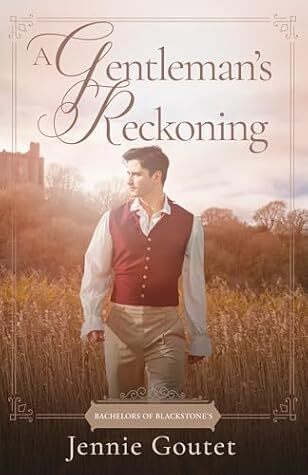 Well. I’ve enjoyed some of Jennie Goutet’s previous works, but this one I found really lax in a number of ways. The idea was good, but the execution felt lazy, as if she hadn’t really thought too deeply about it, and was just pushing the plot along.
Here’s the premise: Lady Eugenia (Geny) Stanich is the daughter of the Earl of Goodwin. It’s a lonely life, for her mother is dead, her father is a distant figure and her young brother is away at school much of the time. She doesn’t much enjoy society life and has few friends among the ton. Her closest friend is a wealthy merchant’s daughter. Her great love is the orphanage her mother started, where she spends a great deal of her time.
John Aubyn is a bit of a rake and a ne’er-do-well, living a dissolute life until he overhears the Earl of Goodwin (Geny’s father, remember) admitting to wanting to dump some investments because he has insider knowledge that things are going pear-shaped. John feels obliged to relay this information to one of the other investors but is disbelieved and blackballed (thrown out) of the clubs and good society. He sets out to get his revenge by proving that the earl is misusing the funds of the orphanage, and gets himself employed as steward there, under an assumed name.
Now, this is a great setup. He’s masquerading as something he’s not and when he’s unmasked, as inevitably he will be, she will see him as a person unworthy of trust. And by that time, they will be well on the way to being in love. Of course they will. So the early part of the book is them developing ‘feelings’ for each other.
I have to be honest, and confess that this part rang false with me. Geny, after all, is an earl’s daughter, and John, for all his gentlemanlike appearance and manners (and I assume an educated accent, although that’s never mentioned), is a lowly employee, and one below the rank of presumed gentleman. It’s hard to believe that she would ever entertain the possibility of a match between them, even for five minutes. But not only does she do so, she encourages him at every opportunity, seeks out his company and even has no hesitation getting into a closed carriage with him without a chaperon, something that would destroy her reputation at a stroke if it became known (and no, him not being technically a ‘gentleman’ wouldn’t save her, it makes it worse, if anything).
The biggest problem with all of this is the practical one – money. How on earth does she imagine they would survive if she married him? She makes a big deal about the fact that she doesn’t need her father’s permission since she’s of age, but she knows perfectly well that he wouldn’t approve and therefore there would be no dowry forthcoming. What’s the salary for a steward at an orphanage? A hundred a year, maybe, if we’re being generous. That wouldn’t even cover the cost of her stockings and gloves. It’s madness. Yet on she goes, allowing herself to be drawn in because she can’t help herself, apparently, and nor can he. Regency restraint? Forget about it.
Of course, there’s a big explosion when everything comes out into the open, and this part of the book and the wrap-up of the romance is nicely done, and if you like sickly-sweet epilogues, you’ll be very happy.
There are some errors and oddities that tripped me up. Geny’s brother, the heir to the earldom, is given the courtesy title of Viscount Fernsby, but is inexplicably addressed throughout as Lord Caldwell. He also seems to think he’s a peer of the realm, which he won’t be until he inherits the earldom. Geny’s orphanage is also called an asylum, more usually a place for those considered to be insane. There are a few grammatical errors, too.
Fans of Jennie will certainly enjoy this book. I did too, up to a point, but the hero and heroine were a little bit too goody-two-shoes for my taste, and John is the typical Regency rake whose dissolute ways are only briefly seen, after which he is a perfect model of rectitude. My biggest problem is the way Geny fell (quite improbably, in my view) for the hired help, without giving a moment’s thought to the practicalities of marrying a man with a negligible income. This should have been a major hurdle, which he could have overcome at the proposal stage by revealing the estate he owns, but it seems the author never even considered this point. Disappointing. So only three stars from me.
July 13, 2025
Review: Vienna Woods by Mary Lancaster (2016)
 A little bit of a let down, being a bit too similar to the previous book, and also a bit politically convoluted for my taste (I felt I ought to be taking notes, which knocks the shine off a bit), but a swoon-worthy hero, some lovely kisses and a fun read.
Here’s the premise: Esther Lisle comes back to consciousness in the Vienna woods with a huge bump on her head and the body of her betrothed, Prince Otto, lying nearby. A stranger is bending over her, although she can’t make out whether he’s friend or foe. It’s a great opening, literally ‘in media res’, with all sorts of questions arising. The unnamed stranger, who tells her he’s from the police, suggests that she keep quiet about Otto’s death, go on with her life and simple pretend Otto’s fine. Just not there.
It’s the middle of the Congress of Vienna, wall to wall crowned heads of Europe, diplomats and anyone who’s anyone, a constant succession of society events, each grander than the previous ones, and naturally endless machinations behind the scenes. So there’s plenty going on, and frankly I got lost in the multitude of names and affiliations pretty early on. I let it all wash over me, so it didn’t make much difference in the end.
The big disappointment is that the characters and romance follow the pattern set in the previous book. Esther is another spirited, intelligent and independent-minded female. Garin is another mysterious spy-type character, able to blend into the background when he needs to or step forward when he needs to take charge, and needless to say a handy fellow to have on your side in a fight. And the romance is again driven by immediate attraction mingled with suspicion and downright lack of trust, although with an added dose of class differences to keep them apart for a bit longer.
But the author can really write romance, and the scenes between them fairly sizzle with attraction, without ever stepping over the line into anything graphic. Historically, everything feels very authentic to me. A good read which would have been much better with a little more space between it and the previous book. Four stars.
Review: Vienna Waltz by Mary Lancaster (2016)
 An extraordinary book in three different ways. Firstly, it’s set in the middle of the famous Congress of Vienna in 1814, when most of the crowned heads of Europe gathered to celebrate the downfall of Napoleon, to squabble gently and outdo each other’s glittering social occasions. Secondly, it features one of the most fascinating heroes I’ve ever encountered. And thirdly, if, as seems likely, this is Mary Lancaster’s first published book in this genre, then it’s a veritable tour de force. I wish my own first steps had been half so accomplished.
Here’s the premise: Lizzie Gaunt is the eldest of several siblings, orphaned and abruptly turfed out of the family home by the new heir, a distant cousin. In desperation, they throw themselves on the mercy of their aunt, whose husband is part of the British diplomatic effort in Vienna. Lizzie herself is past the age of looking for a husband, but her beautiful younger sister should make a good match, if only they had a little money to launch her into society. There’s just one hope – the last remnant of the family wealth, an expensive necklace, is being used by her aunt to bolster the family’s position in Vienna. Eventually, it will have to be given back to the new heir – but not if Lizzie can get her hands on it first. And when she sees a man daring to steal a necklace at the theatre, she knows she’s found the thief who will help her.
So far, so preposterous, but never mind. There’s no law that says a Regency romance has to be plausible, which is just as well, because most of them would be illegal if there were. So the mysterious thief sets about finding out more about his task and finding himself inexorably drawn to the lively Gaunt family (shades of Frederica here). And for their part, they soon see ‘Johnnie’, as he calls himself, as a comfortable friend.
But Johnnie is also Vanya, a Russian aristocrat with a murky history, involving women, booze, duels, the Tsar and (possibly) spying. It’s a testament to the skill of the author that she successfully conveys just what a dangerous man Vanya is in a multitude of ways. He seems to be coiled like a spring, ready to unleash his power at any moment. And yet, he’s as sweet as pie to the Gaunt family, acting like an affectionate older brother, and he’s soon feeling true affection for Lizzie, which she, in her self-effacing way, is completely unaware of, thinking herself to be no sort of draw to a man.
I won’t go into the details of the plot which get delightfully complicated. All I can tell you is that I thoroughly enjoyed the whole thing. I liked the whole political shenanigans going on in the background, and the inclusion, sometimes in starring roles, of real historical figures. And the romance comes slowly to the boil, the very best kind (in my view). An excellent story, beautifully written and highly recommended. Five stars.
Review: The Persuasion of Miss Jane Austen by Shannon Winslow (2014)
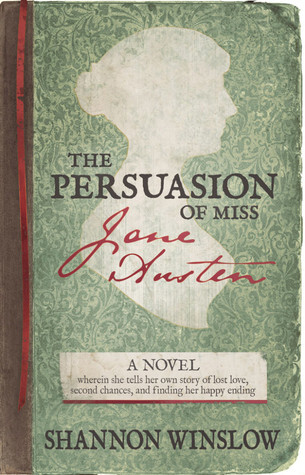 That was different! A what-if? scenario that lots of Jane Austen fans must have wondered about — what if Dear Jane had not been a spinster all her life before dying at the tragically young age of forty-one? What if she had in fact enjoyed the same happy ending that she so generously gave all her heroines? It sounds implausible, but astonishingly, it really works.
The thesis is that Persuasion, perhaps Jane’s most romantic novel with its regrets and a miraculous second chance for happiness, mirrors Jane’s own life. While celebrating the marriage of her brother Henry to Eliza, Jane meets Captain Devereaux, a Frenchman who has escaped the troubles in France to join the British navy against the French. There is a whirlwind romance, quickly followed by a proposal and acceptance. But Captain Devereaux has not yet made his fortune, and Jane is persuaded to give him up. They part in anger, thus far mirroring the events of Persuasion closely, highlighted by a number of quotes.
Later, they meet again, but (again, in a reflection of Persuasion), there is no happy reunion. Instead, Captain Devereaux becomes entangled with another young woman, and becomes engaged to her, even while recognising the reigniting of his feelings for Jane. So far, so identical. But after this, Jane produces a happy ending for Anne Elliott and Captain Wentworth, while her own life (according to this book) takes a different direction. Captain Devereaux is swept up into the renewal of hostilities with France and vanishes from view, leaving Jane bereft.
I’m not going to spoil the surprise by detailing how things go from then onwards. It seemed perhaps a touch implausible, but then to fit the known facts of Jane’s life as far as possible (which the author has clearly gone to great pains to do) things had to be somewhat convoluted. As I said above, it works for me, but then (like most romance readers) I love a happy ending.
What I think is most astonishing is how well the writing mirrors Jane’s own language. Few modern authors can reach this level of authenticity, and if it largely lacks Jane’s biting wit, well, who could possibly match it? I will never criticise an author on that account. Jane was a towering talent, and no one truly comes close, but this is as close as anyone gets.
In fact, the author writes ‘British’ so well that the odd Americanism is all the more jarring for being so rare. I noticed ‘on High Street’ (for some reason, Brits say ‘on the High Street’), and Jane’s sister-in-law, the former Mary Lloyd, is called Mary Lloyd Austen, in the American fashion of incorporating the maiden name. There were some minor typos, too (demure for demur, discrete for discreet), but nothing drastic.
I’ve had this on my Kindle for a long time (three years!) and now I’m wondering just why I waited so long to read it. A very enjoyable read, beautifully written without taking liberties with history and a cracking romance as well. Five stars and highly recommended.
June 1, 2025
Review: The Seventh Suitor by Laura Matthews (1979)
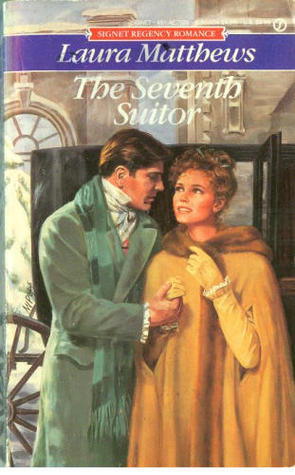 An odd little book, a bit lacking in the romance department and with far too many not particularly interesting characters milling about at the side of the stage, but very readable.
Here’s the premise: Kate Montgomery is settling back into domestic country life after several far more exciting years travelling with her widowed aunt. Her younger sister is about to make her debut in London, but Kate’s past the age of looking for a husband. But one day she receives an astonishing five proposals, one after the other. I’m going to take issue with this right from the start. Usually I can grant a book its opening premise, but not here. The idea is that this is an amusing prank organised by her dippy brother amongst her friends, but frankly, a proposal of marriage in the Regency wasn’t something to be taken lightly. If Kate had said yes to one of them, he would have been honour bound to marry her. Saying it was just a joke won’t cut it. So that’s a pretty silly start.
From then onwards, the story branches out into a multitude of side stories, some of which work better than others, but frankly the book would have been much stronger if it had dispensed with most of those and shed more of a spotlight on the two principals, Kate and her haughty aristocratic neighbour, the Earl of Winterton. He’s a starchy sort of man, although arrogant seems like a better word for it, but with Kate, he’s downright rude. But that’s alright, because she’s rude right back at him.
There’s an interesting reason for the antagonism. Some years ago, Winterton’s brother Carl wanted to marry Kate but she turned him down. He went off to fight in the war, but when he died he left her a substantial legacy (twenty thousand pounds, a tidy sum). Winterton disapproved of Kate accepting it. So did a number of other people, since it really wasn’t done to leave a fortune to a woman who wasn’t a relation of any sort, but Winterton took his disapproval to extremes. So now they snipe at each other constantly, and even though the reader knows that these two are going to get together, it’s hard to see how. It’s well past the 50% point before he notices how pretty she is.
The author rather cleverly chips away at his haughtiness by putting him in humiliating situations, and as they’re repeatedly thrown together they do begin to develop some respect for each other. When they all transfer to town for the season, he actually starts rather tentatively to court Kate, before one of the pesky side plots drags her away. And then it’s just a downhill run to the declarations of love.
I said the book is lacking, romantically, and frankly it’s so limply unemotional that it never actually builds up a head of steam. I make due allowances for its age (1979!) but even for a traditional read it’s pretty tepid stuff. I also disliked the amount of banal dialogue the author saw fit to inflict on the reader. We really don’t need all the greetings and how-are-yous and how was your journey and a recap of all the recent plot developments. It’s tedious.
This sounds pretty critical, but actually it rolled along pretty well, and I was absorbed in it from start to finish. It’s a little too bland for five stars, but it’s a good four stars for me.
Review: Gwendolyn Grows Up by G L Robinson (2025)
 An odd little book, which I found hard to believe was published only this year. It has the feel of something much more traditional, but is very much one of a kind. To be honest, I’m not at all sure what to make of it.
Here’s the premise: Gwendolyn Stanhope has been left destitute by the death of her parents and the unwillingness of her only relations to accept responsibility for her. She’s forced to seek employment, first as a governess, even though she readily admits she knows very little and can’t teach, and when her ineptitude is exposed, she becomes a companion to an elderly lady in London, Lady Wendover. Here she starts to learn about Life through Lady W’s insatiable interest in the gossip columns and the newspapers generally, she learns to read to expand her knowledge and not just for amusement and she falls in love with Lady W’s son, Graham, the Earl of Kendal, a starchy sort of character with an unquenchable affection for his mother.
Graham is sort of, almost-but-not-quite betrothed to the very stuffy Dinah Framingham, who instantly sees that Gwendolyn is her rival and sets out to put paid to the upstart hussy. From this stem all the convoluted plot twists of the story, where Gwendolyn is obliged to abandon the civilised world of Lady W and her son, and make shift in a much less comfortable world. But her indomitable spirit and positive attitude to life carry her through and improve the lives of everyone she interacts with.
There’s a fairytale feel to the story that I wasn’t totally comfortable with. Most of it is simply told, and I confess, I do like to feel a character’s emotions a little more intimately than this. It’s part of the reason why this feels like a much more old-fashioned book. Fortunately, Graham’s dogged search for Gwendolyn after she disappears from Lady W’s house gives the reader a clear insight into his increasingly desperate emotions, and I enjoyed (if that’s the right word) this part of the book enormously. By enjoyed, I mean I was increasingly stressed out myself with G’s continued disappearance.
The reunion was everything an invested reader would hope for. By the time Graham catches up with Gwendolyn, she’s working for a houseful of mannishly-dressed females who drink, smoke and sit around endlessly discussing the weaknesses of males and how females are far superior. This leads to the best moment in the book. When Graham turns up and proposes to Gwendolyn on the spot, the mannish women (in unison) cry: “Don’t do it! It’s slavery!” (She does, of course, because lurve…)
This was so entertaining, and so refreshingly different, that it would normally be a five star read. So why only four stars? Because Graham, the Earl of Kendal, is consistently called Lord Wendover instead of Lord Kendal, and his mother is Lady Wendover. He even has calling cards in the name Graham Wendover (peers never use their family name, ever). I’d let this pass in a pre-internet book, but in this day and age, when this information is readily available, there’s absolutely no excuse for getting it wrong. The other oddity is the number of female servants who somehow manage to marry and yet carry on working. That just wasn’t a thing in the Regency. Male servants of sufficient seniority might marry and continue in service but never female ones.
An unusual and light-hearted read with quite a lot of actual history in it, and some charming characters. The principal trio of Gwendolyn, Graham and Lady Wendover are all lovely. Recommended for something a bit different. Four stars.
Review: London Rose by Rosanne Lortz (2023)
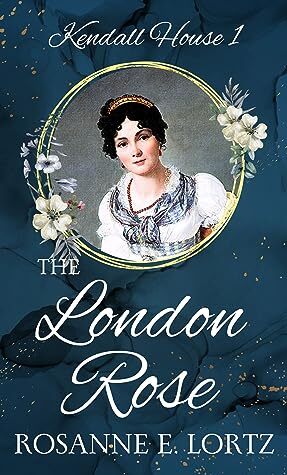 The one word which summarises this book is charm. It’s a delightful, gentle read, which the author describes as an homage to Georgette Heyer and it really does work pretty well, so for anyone yearning to find a new Heyer, while there’ll never be anyone quite like her, this book is a very acceptable substitute.
Here’s the premise: Mrs Audeley is a widow living a quiet, lower gentry life in Derbyshire with her son Gyles, who is obsessed with roses. She’d rather like to visit London again some time for a little recreation, but Gyles isn’t interested. But one day, a girl appears and tells Mrs Audeley that she’s running away from her tyrannical guardian. Mrs Audeley is quite happy to go along with this idea, pushing her out into the garden to be looked after by Gyles, for who knows what may come of that? But when the tyrannical guardian appears, he’s not a monstrous, wicked sort of man, but the rather handsome and well-mannered Earl of Kendall. And in no time he has persuaded Mrs Audeley and Gyles to accompany his niece Penelope and himself to London to help bring her out. Which fits Mrs Audeley’s plans very well.
And so to London they go, where various things happen, both good and bad, but that isn’t really the point of the book. It’s the gently managing manner of Lord Kendall and the pragmatic and easy-going ways of Mrs Audeley and their wonderful conversations that make the book. I love these two, and the fact that they’re both the shady side of forty makes their romance all the more wonderful.
A perfect Regency read, and I can’t tell you how thrilled I was that Mrs Audeley was (very correctly) called that almost throughout the entire book, and Lord Kendall had to ask what her Christian name is when he proposes. Five stars, but I’d have given it more if I could.
May 5, 2025
Review: A Duel For Christmas by Rosanne E Lortz (2018)
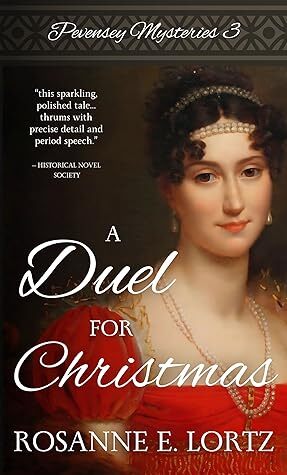 The third in the Pevensey series, and another corker. The author is exceptionally skilled at drawing characters with deep family secrets, and at classic murder mysteries; this book (indeed, the whole series) is a stunning combination of both.
Here’s the premise: the Aldine family has gathered in London at Christmas for an unexpected celebration – the heir to the viscountcy, Will, just twenty-one, is betrothed to the lovely and besotted sister of the Duke of Tilbury, Lady Helena Angiers. Will’s older sister, Maud, is as surprised as anyone that flighty Will is prepared to settle down at such an early age, and Helena’s brother, the duke, is clearly not pleased about it. But Maud has her own problems. She’s a widow, only recently escaped from the depths of Devon, but past events threaten her future, and finding an unwelcome attraction springing up between herself and the duke only complicates matters. And then there’s a sudden death and things get *really* complicated.
The whole book plays out over the twelve days of Christmas, and the return of the eccentric Bow Street Runner, Jacob Pevensey, livens up the second half. Pevensey comes more to life with each book, and now that he’s apparently joined forces with the Cecil brother and sister, one can only hope for a long series to watch further developments.
This book is somewhat unusual in featuring a heroine several years older than the hero. It’s loosely based on real events in the middle ages, and frankly it seems to work pretty well. Maud’s reservations about Geoffrey’s youth are perfectly understandable, but given that he had inherited his title at an early age and was used to being in charge, his maturity was plausible. Although perhaps his propensity for duels might argue against it!
The murder was wrapped up rather neatly, the romance likewise and my only grumble was that the unworthy cousin got to inherit in the end. I was so badly hoping that there had been a secret wedding and a potential heir to cut him out of the inheritance! But the author stuck closely to the historical precedents and I can’t fault her for that. There are a smattering of Americanisms (bussing, passed, gotten and the like) but nothing that particularly bothered me. On the whole, the author’s portrayal of the Regency is very convincing, and I look forward to the fourth book in the series with great anticipation. Five stars.