Mary Kingswood's Blog, page 5
January 31, 2025
Review: The Ghost of Castle Ravenswych by Charlotte Louise Dolan (2013)
 A strange little book, off-the-scale implausible and overwrought. If this had been an older book, from the 80s or 90s, I could have understood it, but for a book that’s not much more than 10 years old, there’s no excuse.
Here’s the premise: When Rowena’s great-uncle dies, and his heir, the new Lord Cheyne, is still away fighting Napoleon, Rowena’s guardian turns up to take care of her, which involves trying to persuade her to marry him, and when she steadfastly refuses, turning to less honourable methods. Frankly, a guardian trying to marry his underage ward for her inheritance is a huge no-no and just as dishonourable, but let that pass. Rowena is fed up with fending him off, and with a whole year to go before she’s of age, she turns to desperate measures – she fakes her own drowning in the local lake. There’s an inquest (without a body?) and Rowena is declared dead by misadventure (still without a body). Happily nobody tries to bury a non-existent body. The guardian takes off, thwarted, and all Rowena has to do is to play dead for the remaining year before she comes of age, and the loyal retainers are happy to assist with this ploy.
Into this scenario comes our hero, Marcus, to take possession of his inheritance, and now Rowena has more of a challenge to keep out of his way in case he discovers her existence. Which of course he soon comes to suspect, finding traces of her perfume, for instance. He becomes convinced there’s a ghost at the castle.
If this were all, this would be quite an unexceptional story, but Marcus is very conveniently prone to bouts of fever after his soldiering, and Rowena is prone to having a look at him while he’s semi-conscious. And not just looking, either. This formerly virtuous maiden (allegedly) finds herself compelled to climb into bed with him and indulge in a certain amount of kissing and cuddling, which even a semi-conscious man is bound to remember as a remarkably pleasant fever-dream.
From this point on, there’s a whole heap of lusting and being unable to keep away from each other, or keep their hands off each other, combined with wildly over the top angsting, and frankly, my eyes were spinning in their sockets. I’m sure this was intended as some kind of Gothic melodrama, but I much prefer my characters and plot a bit more realistic, not to say down-to-earth.
Eventually, hearing the story of Rowena’s ‘death’, Marcus becomes determined to wreak revenge on the unspeakable guardian, and thereupon discovers that Rowena isn’t a ghost at all. At which point they retreat directly to bed, to continue all those feverish dreams. Sigh. Of course they do.
A short book, and if you have a taste for the Gothic maybe it will suit you better than me, but for me it was only a three star read.


Review: A Winter’s Romance (Anthology) (2024)
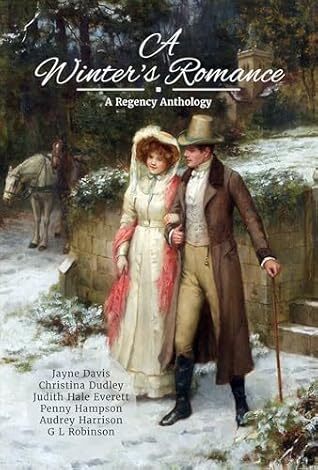 Charming – that’s the only word to describe this collection of short Regency romances by some of the best authors of the genre. I loved all of them, but if you held a gun to my head and forced me to choose a favourite, it would have to be A Worthy Alteration by Judith Hale Everett, if only because the delightful hero, Lord Windon, reminds me so much of one of my favourite Georgette Heyer heroes, Freddy Standen from Cotillion. But honestly, every story is a gem that made me smile in delight. Five stars.
Here’s a brief resume of the plots:
Advice to Young Ladies, by Jayne Davis: Kate Ardley and her younger sister Cecy are invited to a house party to meet marriageable heir Ben Paynton. Kate neither needs nor wants a suitable match and is quite happy to stand aside for her pretty but shy sister. Ben’s tired of being chased by marriage-minded mamas and daughters, but the plain-speaking Miss Ardley is more interesting. What can go wrong? Just the eponymous book of advice to young ladies, that’s all. A teeny tiny misunderstanding, speedily resolved in a lovely way.
A Christmas Wish, by Penny Hampson: Jane Mortimer is a long-suffering teacher at a girl’s school in Bath. Colonel Nicholas Anstruther is a retired army officer, not exactly in tip-top condition, who has been given guardianship of a young girl by a fellow soldier who died. When he meets a pretty and intriguing young woman who’s not bothered by his missing eye, he’s delighted when he finds that she’s actually his new ward’s teacher.
A Worthy Alteration, by Judith Hale Everett: Peter, Viscount Windon, is attempting to reach a house party in pursuit of the latest in a long line of desirably pretty females. Stopping at an inn to ask for directions, he’s distracted by a delectably beautiful female in distress and gallantly offers to help her. She turns out to be Prudence Stowe, a cousin to Honoria Tyndall, the original delectable female, and once home, she morphs into a drably dressed governess. Lord Windon is intrigued enough to find excuses to seek her out.
The Viscount’s Christmas Runaway, by Audrey Harrison: Louisa (do we ever hear her family name? Not sure) is living on the streets of London, eking out a miserable existence with two other reluctant gutter rats, Rosie and Billy. But one day, astonishingly, a well-dressed stranger appears who takes all three under his wing. He and his wife take them into their home, and not only feed and clothe them, but also attempt to educate them, as far as that’s possible. Gradually Louisa learns to trust again and reveal her story, while finding herself drawn to the son of her benefactors.
Epiphany Day, by Christina Dudley: Eliza Blinker is a school teacher forced to spend Christmas as companion to an old friend. While there, a participant in the local hunt is injured and brought to the house to recover, and Eliza helps to nurse him. Because his eyes are injured, he’s blindfolded and unable to see her, but he can hear her voice and realises she’s not quite the middle-aged spinster she claims to be, as protection against his roguish reputation.
‘Twas the Night Before Christmas, by GL Robinson: Hero James crashes his phaeton on ice on Christmas Eve and is forced to seek shelter at the cottage of Elisabeth Wilberforce and her father. Their life is the very antithesis of his own pampered existence, but as he sheds his aristocratic pomposity, he learns to enjoy the simple life, and appreciate the down-to-earth open-heartedness of Elisabeth.
January 10, 2025
Review: Petteril’s Christmas by Mary Lancaster (2024)
 For the first time, a Petteril book turned out to be slightly less than a perfect read for me. Probably just me in the wrong frame of mind, although it crossed my mind that maybe the series has hit the Mulder and Scully problem – the romantic tension of the early books has evaporated now that the principals are married, and there just isn’t that much drama between them. Added to which, the mystery really wasn’t any great shakes this time. All the tension, such as it was, revolves around April’s history, which isn’t uninteresting, but I didn’t find it as riveting as some of the earlier books.
There were some intriguing new characters, like Great Aunt Prudence and her eccentric entourage, some I would have liked to have seen but didn’t (like Gussie, ill for the whole book), and a fair few that seemed to be repeat characters but I didn’t remember them. But that’s a problem I have with any long-running series, so I’m not going to blame the author for it.
I suspect the biggest problem I had with this book is that it didn’t surprise me at all. April running off looking for trouble and not bothering to tell Piers about it is old news now, and although it may be a necessary stage in the development of their relationship, I just wanted to slap her upside the head sometimes. He’s your husband, dear, so trust him, and let him help you.
All that said, this was still an enjoyable read, and a welcome return of the two ill-assorted lovers. Four stars and I hope the next book is a bit more on my wavelength.
Review: Summer Escapade by Charlotte Louise Dolan (2014)
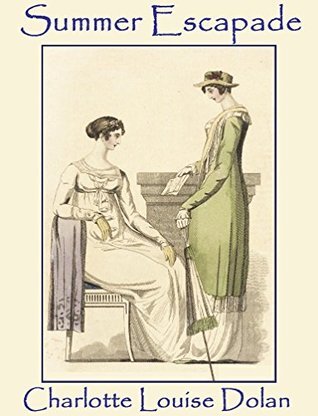 A very short read with a preposterous plot, and too little time to develop characters, or add sub-plot or, frankly, create a rich, immersive reading experience.
Here’s the premise: Marigold Kinderley is fourteen, and an orphan. Her uncle Terence is so terrified that she will succumb to illness like her mother that he insists on her taking no risks, and even keeps her on a special diet. She is finally allowed to attend a school for a term where she makes just one friend – Lady Sybil Dunmire. When Sybil is invited to bring another friend, Clara, home for the summer, she decides it would be fun to smuggle Marigold home in Clara’s place. What could possibly go wrong?
When Terence comes looking for Marigold, Sybil manages to send him off on a wild goose chase to Gretna after the school’s dancing master. And while he’s doing that, Marigold is learning to enjoy life, romping with Sybil and her six male cousins, being mothered by Sybil’s widowed mother, Alicia, and eating anything and everything. Terence is astonished to discover (when he eventually discovers the truth) that Marigold has not merely survived the experience unscathed but has thrived on it.
But where is the romance, you might be asking. Well, Terence and Alicia are the happy couple, and because this is merely a novella, and the childrens’ high-jinks take up so much space, it’s a very perfunctory affair. They meet, they’re attracted to each other, there’s a brief misunderstanding, it’s all sorted out. And that’s it.
There was the potential to deepen the characters sufficiently to make this a much better book, but frankly the whole premise is so over-the-top that I think it’s best left as it is. It’s perfectly readable, and even enjoyable (as long as realism isn’t on your wish list), but it’s the bare bones of the story, rather than the usual richly detailed affair. Three stars.
Review: An Angel For The Earl by Barbara Metzger (1994)
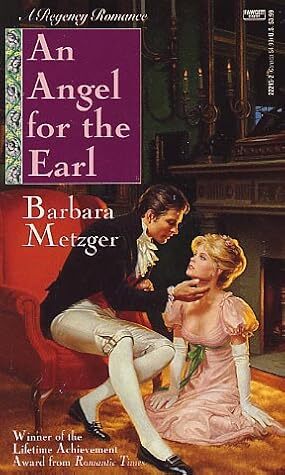 A weird book – a sort of (but not quite) ghost is sent to rescue a wastrel earl from his wicked ways. The element of fantasy is certainly different, even if the theme of the rake’s redemption is an old one. But very readable, so long as you can suspend all critical faculties and just let it flow past.
Here’s the premise: Lucinda Faire is about to be pushed into one of those horrible old-enough-to-be-her-grandfather marriages so beloved of Regency authors. Her father keeps her a virtual prisoner at home, so when she manages to meet a halfway plausible and attractive young man, she instantly agrees to elope with him. He, of course, turns out to be a fortune-hunting rogue, and he’s not even planning to marry her. She deals with him and sets off for home, but an accident sees her unconscious and on the point of death. Her parents, lovely people, are quite happy to let her die. But at the pearly gates, they don’t quite know whether to send her to heaven (she’s young and very innocent) or hell (she eloped, silly girl). So she is given a test – redeem one sinner and she’ll get to heaven, and they even tell her the specific sinner they have in mind – Lord Stanford, or Kerry, a licentious, gambling, drunken thorough waste of space.
Right, I know, plausibility is not this book’s strong suit. But as I say, if you just go with the flow, it’s all very entertaining. Lucinda comes upon his lordship on the point of blowing his brains out, having lost absolutely everything. Needless to say, her appearance gives him the shock of his life, and this is one of the clever conceits of the book – Lucinda’s appearance matches his current state of virtue. So initially, she looks like one of the brothel women he’s so fond of, with a revealing dress, bare feet and her hair tumbled about her shoulders. Every time she manages to persuade him to do something ‘good’, she acquires slightly more modest clothing.
The book then proceeds on entirely predictable lines. The earl gradually is induced to become a virtuous man, Lucinda becomes increasingly modestly dressed and the two contrive to fall in love. The ending requires a complete shutdown of every critical faculty, and my historical accuracy meter blew a fuse at the idea of marrying an unconscious woman (there has to be some smidgen of consent involved, surely?), but a resounding happy ending for all that. Too implausible for five stars, but a very entertaining four stars.
November 29, 2024
Review: By His Grace And Favor by Christina Dudley (2024)
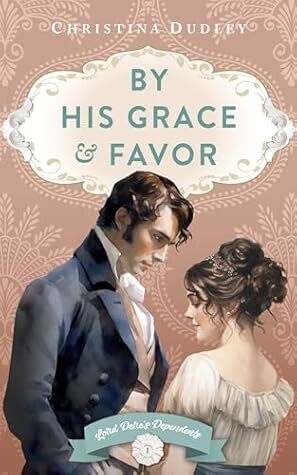 Another amusing and charming tale from Christina Dudley, the first in a new series following the impoverished Barstow family, their elderly and kindly benefactor and the various characters whose paths cross with them.
Here’s the premise: the Barstow family has, through the death of the father and son, fallen on hard times. Eldest daughter Adela, in desperation, contacts a distant relation, Lord Dere, who offers them a cottage on his estate, but as they prepare to move, second daughter Jane elopes with a roguish man who they fear might not even marry her. As they squeeze themselves into Iffley Cottage, three adults and four children, not to mention a dog and a newly acquired kitten, they agree that nothing must be mentioned of Jane’s predicament, only that she is married, lest Lord Dere think better of his offer to such a disreputable family. But it turns out it’s not Lord Dere who must be appeased at all costs, but his niece by marriage, the widowed Mrs Markham Dere, who has insinuated herself and her son, now heir to the barony, into the baron’s seat, Perryfield, and there rules all before her, including the rather timid baron.
Into this awkward situation comes Mr Gerard Weatherill, the newly recruited tutor for Master Peter Dere, even more impoverished than the Barstows, and with secrets of his own to keep hidden, lest he lose his position. And it doesn’t help that the tutor and the practical eldest daughter have the hots for each other right from the start. Nothing can come of a match between two people who haven’t a bean between them, and besides, Adela has a cunning plan to ensure that they aren’t turfed out when all those messy secrets emerge, as they inevitably will. She’s going to marry the elderly but kindly baron, and keep Mrs Markham Dere in her place for ever.
Of course, this works about as well as you might expect, at least until Adela hears what has actually happened to Jane and her new (but feckless) husband, and grows so desperate that she throws caution to the wind.
There’s so much to love about this book, but especially the characters. The Barstows are a wonderful collection, from baby Sebastian (or Bash) to bouncy young son Gordy to 15-year-old Frances who actually manages to inveigle her way into Mrs Markham Dere’s good books in support of Adela’s hopes. I assume that most of the family will get their own book in time. But there’s also Mrs Markham Dere herself, a gloriously not quite over the top character, and the absolutely lovely baron, who surely deserves his happy ever after at least as much of some of the others.
So why only four stars? A couple of things niggled at me. One is the number of times Adela contrived to trip or fall over or otherwise end up entangled with one or other of the two men, the one she’d fallen in love with and the one she’d grimly decided to marry for her family’s sake. A certain amount of that is fine, and mostly it was very funny, but after a while it did get a bit old, and I’d have liked some variation.
The other issue I had was Adela, who has basically entrapped the baron into a betrothal, and then hangs onto him for grim death, even though their marriage would make a lot of people very unhappy. I really, really wanted her to come to her senses, confess all to the baron and throw herself on his mercy, but she never did, right to the (not very bitter) end, when the happy ending is magicked into being with a wave of a well-manicured hand. It was all a bit deus ex machina, and although I didn’t like that Adela wasn’t told what was happening until the very last minute, I kind of felt she deserved all that anxiety, frankly.
As always, a beautifully written and highly literate book. Five stars and I can’t wait for the next in the series.
Review: The Counterfeit Gentleman by Charlotte Louise Dolan (1994)
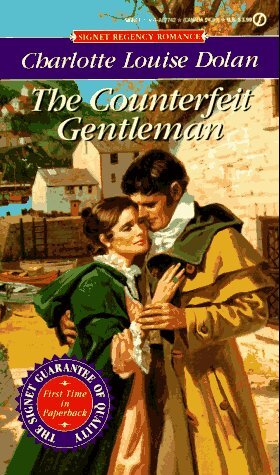 Another very strange read from this author. She really does like melodrama, and sometimes that works and sometimes… hmm, less so. A fine hero, but I’d have liked a bit less of the clingy dependency from the heroine.
Here’s the premise: heiress Bethia Pepperell has been kidnapped, drugged and hauled from London all the way to Cornwall and is about to be dumped into the sea to drown (did I mention the melodrama?), presumably under orders from one of the three cousins who stand to inherit after her death. Miraculously, as she pleads for her life, she’s overheard by ex-smuggler Digory Rendel, unseen in the fog, who contrives to rescue her and leave her would-be murderers thinking she’s drowned. The next day, when they come looking for the body, they meet Digory and his smuggling pals. Unfortunately, their attempts to capture them and find out who sent them end up with both men dead.
Digory’s prepared to help protect Bethia but she knows the only sure way to fix the problem, and that is for the two of them to marry. Since they have the hots for each other, and she’s not at all shy about showing him how she feels, even to the extent of inviting him into her bed and otherwise trying to seduce him, he reluctantly agrees to it, even though he realises that he’s not at all of her station in life. I really felt that Bethia is stepping outside the bounds of propriety and even common sense at this point. Yes, she’s overwhelmed by Digory’s masculinity (or something), but really, girl, get a grip! By hurling herself at him with abandon, she really gives him no choice but to agree to the marriage. Which is pretty silly, frankly.
So they go back to London, where her aunt, whose powers of self-deception know no bounds, happily tells herself that the story she’s been telling that Bethia was laid up with illness is actually true and now she’s better so everything’s fine… isn’t it? And all this worrying about murderous cousins is just nonsense. But Digory summons some very disreputable (but high ranking) friends who will swear to his blameless past and help him marry Bethia, which they do and then show themselves in society so that everyone will think everything’s fine. And then, right at the end, everything goes to hell in a handcart in spectacular fashion. No, it seems an ex-smuggler can’t pass himself off as a gentleman after all.
I’m going to be honest, and say that I really disapproved of both hero and heroine in this one. Bethia was so hot for Digory that she was prepared to do absolutely anything to stay with him, and frankly, I think they should have run off to the continent or America or some such right from the start. It would have saved a lot of bother. As for Digory, with the whole we’ll get married but we won’t really be married schtick – oh, per-lease. Either marry the girl or don’t, but just get over yourself.
My other main quibble is with ‘society’, which is prepared to randomly accept some unknown man because one or two people vouch for him, and then turn against him the instant some other random (and known to be evil) bloke says he’s no good. People, even at the highest levels of society, still have some sense of judgement and don’t accept or reject people purely on the basis of hearsay.
Some historical quibbles. No, you can’t annul a marriage for non-consummation (not in England, anyway). And no, a title once awarded can’t be retracted, even when it turns out it went to the wrong person (in general, anyway; the king could, of course, do whatever he liked about those pesky titles). Money and property, yes, that can be redistributed after the event, but titles, no. What would likely happen if a title has been wrongfully claimed and the true heir turns up is (probably) that he would be given another, equivalent title.
I’m going to be honest – I did enjoy the read, on the whole, but the flaws in the characters of the principals keep it to three stars.
Review: The Counterfeir Gentleman by Charlotte Louise Dolan (1994)
Another very strange read from this author. She really does like melodrama, and sometimes that works and sometimes… hmm, less so. A fine hero, but I’d have liked a bit less of the clingy dependency from the heroine.
Here’s the premise: heiress Bethia Pepperell has been kidnapped, drugged and hauled from London all the way to Cornwall and is about to be dumped into the sea to drown (did I mention the melodrama?), presumably under orders from one of the three cousins who stand to inherit after her death. Miraculously, as she pleads for her life, she’s overheard by ex-smuggler Digory Rendel, unseen in the fog, who contrives to rescue her and leave her would-be murderers thinking she’s drowned. The next day, when they come looking for the body, they meet Digory and his smuggling pals. Unfortunately, their attempts to capture them and find out who sent them end up with both men dead.
Digory’s prepared to help protect Bethia but she knows the only sure way to fix the problem, and that is for the two of them to marry. Since they have the hots for each other, and she’s not at all shy about showing him how she feels, even to the extent of inviting him into her bed and otherwise trying to seduce him, he reluctantly agrees to it, even though he realises that he’s not at all of her station in life. I really felt that Bethia is stepping outside the bounds of propriety and even common sense at this point. Yes, she’s overwhelmed by Digory’s masculinity (or something), but really, girl, get a grip! By hurling herself at him with abandon, she really gives him no choice but to agree to the marriage. Which is pretty silly, frankly.
So they go back to London, where her aunt, whose powers of self-deception know no bounds, happily tells herself that the story she’s been telling that Bethia was laid up with illness is actually true and now she’s better so everything’s fine… isn’t it? And all this worrying about murderous cousins is just nonsense. But Digory summons some very disreputable (but high ranking) friends who will swear to his blameless past and help him marry Bethia, which they do and then show themselves in society so that everyone will think everything’s fine. And then, right at the end, everything goes to hell in a handcart in spectacular fashion. No, it seems an ex-smuggler can’t pass himself off as a gentleman after all.
I’m going to be honest, and say that I really disapproved of both hero and heroine in this one. Bethia was so hot for Digory that she was prepared to do absolutely anything to stay with him, and frankly, I think they should have run off to the continent or America or some such right from the start. It would have saved a lot of bother. As for Digory, with the whole we’ll get married but we won’t really be married schtick – oh, per-lease. Either marry the girl or don’t, but just get over yourself.
My other main quibble is with ‘society’, which is prepared to randomly accept some unknown man because one or two people vouch for him, and then turn against him the instant some other random (and known to be evil) bloke says he’s no good. People, even at the highest levels of society, still have some sense of judgement and don’t accept or reject people purely on the basis of hearsay.
Some historical quibbles. No, you can’t annul a marriage for non-consummation (not in England, anyway). And no, a title once awarded can’t be retracted, even when it turns out it went to the wrong person (in general, anyway; the king could, of course, do whatever he liked about those pesky titles). Money and property, yes, that can be redistributed after the event, but titles, no. What would likely happen if a title has been wrongfully claimed and the true heir turns up is (probably) that he would be given another, equivalent title.
I’m going to be honest – I did enjoy the read, on the whole, but the flaws in the characters of the principals keep it to three stars.
Review: The Unofficial Suitor by Charlotte Louise Dolan (1992)
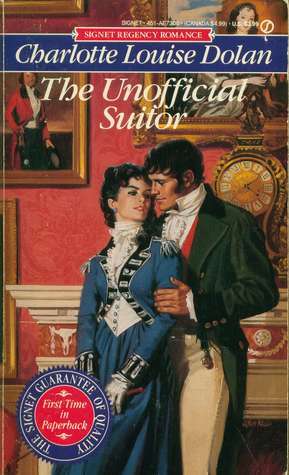 A strange book, which leaves me a bit uncertain what to make of it. There’s some truly dark stuff in the background here, and sometimes it feels as if the author threw in everything but the kitchen sink, but there’s also a wonderful romance (I love a man who knows precisely what he wants) and some amusing moments, too.
Here’s the premise: Lady Cassiopeia Anderby is living a hand-to-mouth existence since her brother, the Earl of Blackstone, has gambled away the family fortune and has been draining the estate of funds for years. But a flying visit shows him that he still has one asset left to sell, namely, Cassie herself. She’s a rare beauty, so she’ll fetch a good price on the marriage mart, won’t she? By threatening Cassie’s younger sister, he persuades her to come to London for the season.
Travelling by stage coach, Cassie, her sister and step-mother Ellen find themselves in company with three very unsavoury-looking characters and when an unexpected snow storm strands them at a country inn (cliches? In a Regency romance? Surely not!), she avoids them as much as possible. They all have to eat, however, so she makes a deal with them – if they bring in wood and see to the fires, she’ll prepare food. The three ladies survive the ordeal unscathed, to Cassie’s surprise, and the next morning the snow has miraculously vanished, so they go on their merry way.
What Cassie doesn’t know (but the reader does) is that the three (Richard Hawke, John Tuke and Perry, now a viscount) are survivors of the American wars and much other drama, returning reluctantly to London to help Perry deal with his recent ennoblement and assorted relatives, and somewhat more reputable than they look. Richard is so enamoured of Cassie’s spirited practicality that he decides on the spot that he’s going to marry her. His friends deride his choice, since he’s now rich enough to buy himself a better wife than the servant that Cassie appears to be. Needless to say, London brings surprises for both sides – she discovers that Richard and Perry are moving in society like respectable gentlemen, and they discover that the servant girl is an earl’s daughter.
The romance is therefore laid out from the start. The obstacle is Cassie’s brother, who gives her a list of three potential suitors that he will accept, and Richard’s name isn’t on it. But there’s another obstacle, too, which is that Cassie finds Richard terrifying. There’s a hint in the book that this is because she’s an innocent, and its her own feelings that terrify her, but I’m not sure I buy that, and frankly, I found her weeping and wailing at the very prospect of innocuous events like driving in the park with him irritating in the extreme. Get a grip, girl! After all, he may be an imposing sort of man, but he’s never been anything but unfailingly kind to her.
Richard being a man who’s (literally) pulled himself up from the gutter, he isn’t going to let a trifling matter like other suitors stand in his way. The stratagems he employs to get rid of them, one by one, are highly enjoyable, even if not strictly honourable. All right, not honourable at all, and his friend Perry does remonstrate with him at one point, but they justify it quite elegantly to themselves. I wasn’t convinced, but at least the author addresses the point.
The romance resolves itself just as you might expect, and there are several other pairings thrown in almost at random towards the end. Memo to authors: not every minor character needs to get their happy ever after, but if you’re going to do it, please try to make it more convincing than this. But for Richard and Cassie, all comes right very satisfactorily, and the evil brother gets his comeuppance, too. Only one major historical error – no, you can’t simply renounce your title and walk away. You don’t have to take your seat in the House of Lords, but the title is settled irrevocably on the heir specified in the original letters patent when the title was created.
An enjoyable read, and I’m used to the plethora of Americanisms now, so that wasn’t more than a few eye-rolling moments. So why only three stars? I really found this an unsettling book. The hero has a very dark past, and although he may be unfailingly honourable in his dealings with the heroine, elsewhere his moral compass is not all it should be. He’s not an out and out evil villain, like Cassie’s brother, but he doesn’t scruple to do whatever it takes to get his own way. If he had given Cassie the option of whether to marry him or not, I could (perhaps) have forgiven him, but he doesn’t. He’s determined to marry her, whether she wants it or not (and she doesn’t; she’s hounded into it), and even though he promises not to touch her until she’s ready, I wouldn’t put any money on him holding to that if she really kept on saying no. So even though I zipped through the book at a rapid pace, and never for one moment considered abandoning it, I disapproved of the hero so much I’m going with three stars.
Review: The Black Widow by Charlotte Louise Dolan (1992)
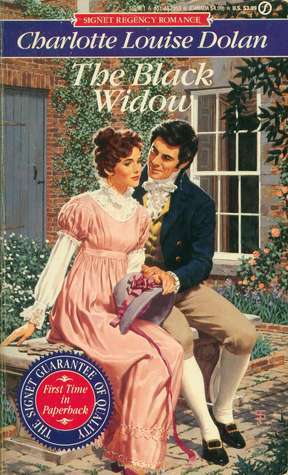 A fascinating and highly original premise, an appealing hero and heroine, some interesting side characters and with a mystery thrown in, to boot – what’s not to like? I tore through this in a couple of days.
Here’s the premise: Demetrius, Lord Thorverton, is happiest raising horses on his Devon stud farm, but an impassioned plea for help from his mother sends him hot-footing it to London to rescue his younger brother from another scrape. It seems he’s fallen under the spell of the alluring lady known as the Black Widow. She’s not actually a widow, but four times she’s been either betrothed to or courted by men who died unexpectedly, so she’s shunned by society as one who puts a curse on any man who goes near her. Demetrius quickly discovers that his brother, along with half the young men of London, are demonstrating their bravery and daring fate by dancing with the Black Widow.
One glance tells Demetrius that Miss Meribe Prestwich— No, wait, let’s talk about those names. Demetrius is acceptably classical, but his younger brother is Collier. Um, a viscount’s brother is named after a coal miner? And whatever sort of name is Maribe? Good grief. I don’t even know how that would be pronounced.
Anyway, as I was saying, one glance tells Demetrius that Miss Meribe Prestwich is no femme fatale, for she’s obviously distressed by her situation. He doesn’t believe in curses, so he undertakes to protect her from the nuisance of foolish young men tempting fate and annoying her by squiring her about himself. Pure altruism, of course, and the fact that she’s young and pretty has nothing at all to do with it. She reluctantly agrees, and things are humming along nicely when someone attacks Demetrius, and calls him by name, to boot. So not a curse, but not random accidents, either. This is about murder.
From then on, the race is on to find out who is behind all these deaths, with the added bonus of trying to prevent Demetrius from becoming the next victim. Frankly, the villain isn’t exactly hard to work out and the dramatic climax is brought about solely because, having worked out not only who the villain must be and deduced that there must have been an accomplice, everybody’s brains apparently switch off and forget some of these important facts. And there’s the usual does-he-love-me-or-is-is-it-gentlemanly-honour business before the hero remembers to tell the heroine that yes, he does love her, actually. And all’s well that ends well.
Not a perfect book by any means, and it’s riddled with Americanisms (gotten, fall, visit with, stoop, and all the usual suspects), and there’s that brain fade at the end, so I can’t give it more than four stars, but it was still a cracking good read.