Mary Kingswood's Blog, page 24
August 25, 2021
Review: A Marriage Arranged by Mira Stables (1981) [Trad]
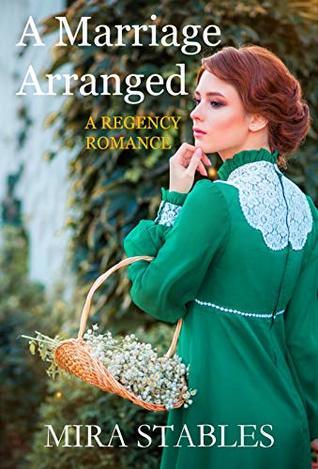 This was a difficult one to rate. I liked the premise, the characters and the fact that there was no out-and-out villain, only some social spitefulness. On the other hand, the romance was understated, nothing remotely surprising happened and the writing style was as dry as dust. I enjoyed it, on the whole, but a bit of sparkle would have made it so much better. When reading, I frequently feel the urge to slap the characters upside the head, but this is the first time I can remember wanting to slap the author upside the head.
Here’s the premise: Julian (unknown surname) has been deprived of his ancestral home by his father’s profligate ways and sheer spitefulness. Even though he knew that Julian could bring it back into good order, and wanted to do so, he deliberately sold it. So when he dies and Julian inherits the barony, and is wealthy enough in his own right to buy back Wellasford, he makes the journey there to try his luck. The new owner, Mr Morley, won’t sell, but although he’s restored the house to its former glory, he’s been less successful in managing the estate. He realises that Julian has that skill, in spades. And Julian is unmarried, and Morley has a daughter, Anna… And so a marriage is arranged.
So far, so conventional. But both Morley and his daughter are very far from conventional. He’s a historian, who makes his daughter dress up in various historical costumes for his own pleasure, and although she doesn’t mind it and in fact rather relishes being different, it’s still a pretty weird thing to do. He’s paranoid about her health, too, feeding her up and insisting she drinks a ton of milk, so that she’s overweight. He also has never let her ride side-saddle, only astride, although that’s fairly illogical. When in history did women ever ride astride? But that’s perhaps beside the point. Anna agrees to the marriage, but she insists on some conditions. She wants a season in London to compensate for her less-than-successful previous season, she wants to lose weight first and she wants a fair degree of freedom, so the marriage won’t be consummated until after all this is accomplished.
Julian sees no reason not to agree to all this, but the reader can easily foresee the sort of problems which might (and do) arise. The plot ran on rails from this point onwards, and it could have been a much more exciting book with a bit of effort from the author. Or it could have been heart-rending, perhaps, as the two protagonists spiral into unhappiness. But no, because the book is written in such a flat narrative style that it lost a great deal of its drama and all of its emotional depth. It was frustrating that such good potential was largely wasted, and the ending was too abrupt for words. I’m not a huge fan of long, schmaltzy epilogues, but a cutoff the instant they kiss is too short. In other circumstances, I might have gone for three stars for this, but I still enjoyed it and was invested in the characters, and I’m a Mira Stables fan so she gets the benefit of the doubt, and four stars.


August 13, 2021
Review: A Poor Relation by Carola Dunn (1990)
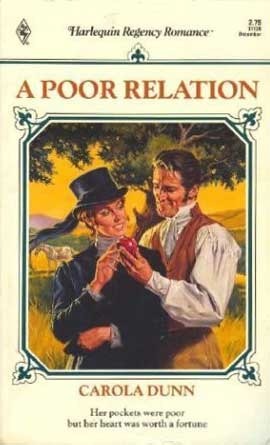 This is one of those books that shouldn’t have worked at all, because it fell into such well-worn ruts that it was a wonder it was able to scramble its way out of them, but somehow it did, and I loved it.
Here’s the premise: Rowena Caxton receives some bad news from her lawyer – the estate her father left her, and which she has been quite happily managing to keep in good order, has been subsumed by debts, and must be sold. Rowena is penniless, and must throw herself on the mercy of her aunt and uncle. Her uncle is easy-going but distant, and her aunt is happy to take her on as companion and chaperon to the spoilt, wilful and beautiful Millicent, around whom the household revolves. Millicent delights in putting Rowena down at every opportunity, but Rowena makes a friend of Anne, the plain younger sister. Meanwhile, Major Christopher Scott, who has been escorting his injured friend, Captain Bernard Cartwright, back from the wars, is astonished to find that he has inherited an earldom, complete with run-down estate and no wherewithal to improve it. And right next door lives the incomparable Millie, with a sizable fortune…
Now, the cliches here just jump off the page. The poor relation heroine… check. The unexpected nobleman… check. The impoverished estate with the need to marry an heiress… check. The selfish and petulant ingenue… check. The charming (but interestingly injured) sidekick… check. The uncaring relations… check. And naturally the first few times the hero and heroine meet, it’s under difficult circumstances, when he treats her like a servant (because she looks like one) and she thinks he’s too rude for words (because he is). And naturally they are thrown together at every turn and slowly learn to appreciate each other.
So yes, the plot runs on well-worn rails, but the trick is in the execution, and it’s here that Dunn’s talent shines. Both hero and heroine (and the minor pairing) are lively characters, very likable. Rowena is a teeny bit subversive without veering into outright rebellion. The major is rather charming beneath the briskly military exterior. They bond over apples, which is seriously original (she tells him how to manage his orchards, which are his main crop). The minor characters, even those who are merely there as foils for the principals, are quirky rather than over-the-top pantomime characters. And needless to say, the writing is superb.
The romance develops nicely, and isn’t forgotten about until the last page, although I could have done without the final foolish obstacle and the (frankly silly) resolution of it, but I still enjoyed this enormously. Five stars.
Review: Eugenia by Clare Darcy (1977) [Trad]
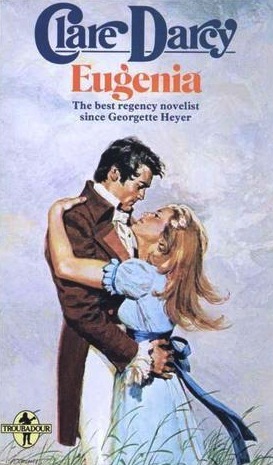 I’ve been hearing for so long that Clare Darcy was one of the best of the old-school Regency authors, but finally a bunch of her books are out on Kindle, and I can say it myself – yep, she’s definitely one of the best. This is very much in the Georgette Heyer style of a romp, the pages filled with wildly eccentric (but very funny) characters, an over-the-top (but very funny) plot and a great deal of stylish (but very funny) writing. Did I like it? I loved it!
Here’s the premise: Miss Eugenia Liddiard is leaving Miss Bascom’s Select Academy for Young Ladies in Bath to return to her guardian’s estate. The Earl of Chandross inherited her three years earlier when her father died, whereupon she became just another indigent relation dependent on his lordship, and living at Mere. But now Eugenia is old enough to be fired off into society, to marry and no longer be a charge on her guardian. She has a much more comfortable plan of her own, however. She will marry the neighbour from her old home in Kent, Tom Rowntree, since he’s a childhood playmate, they get on like a house on fire and he’s the brother of her best friend. But on the journey from Bath, she has an unexpected encounter with a previously unsuspected cousin, Richard Liddiard, who’s too ill to resist being scooped up in one of Eugenia’s daring schemes – he’s the spitting image of another cousin, Gerry, so she’ll take him to Mere to recuperate, where he’ll pretend to be Gerry. Which plan goes along swimmingly until Bow Street Runners arrive, looking for Gerry to arrest him for killing a man in a highway robbery gone wrong.
Eugenia is delightfully creative, however, so she devises one plan after another to keep Richard safe from the law, and Gerry, too, when he turns up, not hesitating to involve her friend (Tom’s sister, Muffet), her old nurse and coachman, Tom and his family, and the glorious Lady Brassborough, an actress and all-round strumpet gone more or less respectable, having married one of her many admirers. Here’s a glimpse of her style: ‘Upstairs in her bedchamber Lady Brassborough, […]was being assisted by Hortense, her ancient dresser, into a toilette that was warranted to astound all beholders, consisting of a crimson brocade gown, a turban of crimson satin shot with gold and embellished with a plume of curled ostrich feathers, a tinsel shawl, spangled Spanish slippers, and the Pontowski emeralds, which mounted her majestic bosom in heavy splendour to fall in an unbelievable cascade to her non-existent waist.’
The finale to these shenanigans is so wonderful, I’m not going to spoil it by revealing any of the details. Suffice it to say that Heyer herself could not have concocted anything more perfect. Or perfectly absurd, perhaps. Now, a great many reviews lament that Clare Darcy is not Georgette Heyer, despite some similarities, which is obviously true. Like Jane Austen, Heyer is incomparable and anyone who reads this book expecting to find a faithful imitation of Heyer will be disappointed. But Darcy has her own magnificent style, and although she was clearly influenced by Heyer (as many authors were), she very much puts her own stamp on her own creation.
The romance suffers, as many of the era do, from subservience to the needs of the over-active plot, and from the lack of the hero’s perspective. Nevertheless, the hero is not the overbearing, domineering sort (and all the better for it), and their final denouement is managed with determination, if not a great deal of finesse on his side. But thank heavens for a couple who know their own minds and don’t have to be cajoled into a betrothal, or, which is worse, have their own feelings pointed out to them.
I really enjoyed this, and will be looking out for more by Clare Darcy. Highly recommended for traditionalists. Five stars.
Review: Eugenia by Clare Darcy (1977)
I’ve been hearing for so long that Clare Darcy was one of the best of the old-school Regency authors, but finally a bunch of her books are out on Kindle, and I can say it myself – yep, she’s definitely one of the best. This is very much in the Georgette Heyer style of a romp, the pages filled with wildly eccentric (but very funny) characters, an over-the-top (but very funny) plot and a great deal of stylish (but very funny) writing. Did I like it? I loved it!Here’s the premise: Miss Eugenia Liddiard is leaving Miss Bascom’s Select Academy for Young Ladies in Bath to return to her guardian’s estate. The Earl of Chandross inherited her three years earlier when her father died, whereupon she became just another indigent relation dependent on his lordship, and living at Mere. But now Eugenia is old enough to be fired off into society, to marry and no longer be a charge on her guardian. She has a much more comfortable plan of her own, however. She will marry the neighbour from her old home in Kent, Tom Rowntree, since he’s a childhood playmate, they get on like a house on fire and he’s the brother of her best friend. But on the journey from Bath, she has an unexpected encounter with a previously unsuspected cousin, Richard Liddiard, who’s too ill to resist being scooped up in one of Eugenia’s daring schemes – he’s the spitting image of another cousin, Gerry, so she’ll take him to Mere to recuperate, where he’ll pretend to be Gerry. Which plan goes along swimmingly until Bow Street Runners arrive, looking for Gerry to arrest him for killing a man in a highway robbery gone wrong.
Eugenia is delightfully creative, however, so she devises one plan after another to keep Richard safe from the law, and Gerry, too, when he turns up, not hesitating to involve her friend (Tom’s sister, Muffet), her old nurse and coachman, Tom and his family, and the glorious Lady Brassborough, an actress and all-round strumpet gone more or less respectable, having married one of her many admirers. Here’s a glimpse of her style: ‘Upstairs in her bedchamber Lady Brassborough, […]was being assisted by Hortense, her ancient dresser, into a toilette that was warranted to astound all beholders, consisting of a crimson brocade gown, a turban of crimson satin shot with gold and embellished with a plume of curled ostrich feathers, a tinsel shawl, spangled Spanish slippers, and the Pontowski emeralds, which mounted her majestic bosom in heavy splendour to fall in an unbelievable cascade to her non-existent waist.’
The finale to these shenanigans is so wonderful, I’m not going to spoil it by revealing any of the details. Suffice it to say that Heyer herself could not have concocted anything more perfect. Or perfectly absurd, perhaps. Now, a great many reviews lament that Clare Darcy is not Georgette Heyer, despite some similarities, which is obviously true. Like Jane Austen, Heyer is incomparable and anyone who reads this book expecting to find a faithful imitation of Heyer will be disappointed. But Darcy has her own magnificent style, and although she was clearly influenced by Heyer (as many authors were), she very much puts her own stamp on her own creation.
The romance suffers, as many of the era do, from subservience to the needs of the over-active plot, and from the lack of the hero’s perspective. Nevertheless, the hero is not the overbearing, domineering sort (and all the better for it), and their final denouement is managed with determination, if not a great deal of finesse on his side. But thank heavens for a couple who know their own minds and don’t have to be cajoled into a betrothal, or, which is worse, have their own feelings pointed out to them.
I really enjoyed this, and will be looking out for more by Clare Darcy. Highly recommended for traditionalists. Five stars.
Review: The Girl With Flaming Hair by Natalie Kleinman (2021) [Trad]
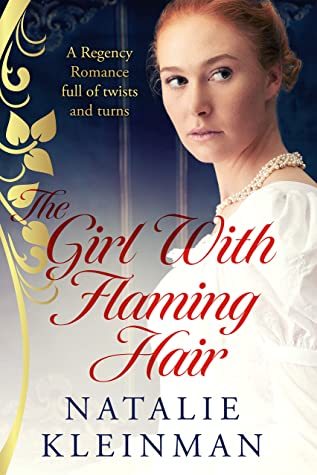 I quite enjoyed the first book by this author (The Reluctant Bride), although I found the characters a bit flat and the plot verging on dull. This one started out much, much better and for perhaps two thirds of its length, I thought it was headed for five stars. But then the plot disintegrated, and the last few chapters became a schmaltzy love-fest. The writing style is awesome, however (oh, the bliss of an author who can write ‘whomsoever’ without flinching!) and for traditionalists looking for a tale built around the season and Almack’s and rides in Hyde Park, and properly brought up Regency characters who are never consumed by passion, this is an author to watch.
Here’s the premise: Rufus, the Earl of Luxton, is driving his curricle one day when he comes upon the unconscious form of Sophie Clifford, a neighbour, who has fallen from her horse. He takes her to his mother, Lady Luxton, and sister Lydia, who nurse her back to health, realise that she’s the sequestered neighbour who never goes anywhere and invite her to London for Lydia’s come-out. And a lovely time is had by all, although there are disquieting rumours about Sophie, on account of her bright red hair. And one day, she meets a man in Hyde Park who seems to know her, and he, too, has bright red hair. I find it ironic that the hero of this story is called Rufus, a name associated with red hair, when it’s actually the heroine who is so endowed, but I digress.
We very quickly discover that the man with red hair is her biological father, a man who wanted to marry her mother but she was forced to marry Lord Clifford instead. Sophie was conceived after the marriage. Now here is where I began to have some qualms. Sophie sets about getting to know her real father, and even calls him ‘Papa’, and distances herself from Lord Clifford. This is very provocative behaviour. In law, and in every way that mattered, Lord Clifford was her father, and it would have been quite scandalous to treat him in this way, or to cosy up to the man who cuckolded him.
The way society reacts to the public revelation of Sophie’s Big Secret is pretty realistic. She isn’t cold-shouldered overnight. There are just gradually fewer invitations. She realises that she’s affecting Lydia’s prospects, so she moves out, first to a mutual acquaintance, and then by setting up her own household, with a female companion. And again, I’m wondering what sort of Regency is this where a young, unmarried woman could do such a thing. It would have been a huge scandal, absolutely huge. And another issue: when she goes north to find her mother’s family, Rufus accompanies her, with only a companion for propriety. Again, scandalous, when he’s not a relation of some sort.
The family up north turn out to be vastly wealthy from trade, but very welcoming once they were sure Sophie was truly their granddaughter. I was a bit bemused by this part, since Sophie’s blood father recognised her from a single glance in Hyde Park, because she looked so like her mother. Her mother’s parents, however, don’t recognise her at all, and have to be convinced by jewellery and a birthmark. A bit of a contradiction there.
I haven’t yet mentioned the romance, but that’s because for most of the book it takes a back seat to Sophie’s journey of discovery. Unlike in the previous book, the hero’s feelings are much more obvious, and he even makes a mismanaged proposal mid-book. But there was no real passion between the protagonists, and, worse, the romance was sewn up by the three quarters point, after which there was a mild bit of drama and then a great deal of hugging and tearful reunions, a wedding and other schmaltzy stuff that felt more like an extended epilogue than anything else. My main complaint with this author is that most of the characters are just too nice. Apart from one or two villains, and the vague ‘society’ which sways between approval and disapproval according to the whims of Lady Jersey (why do so many Regency authors fall back on her as the arbiter of approval?), everyone is kind and tolerant and understanding and too, too perfect. I prefer a little grit in my characters, frankly.
A historical error: Lydia is the daughter of an earl, so she should be Lady Lydia Solgrave, not Miss Solgrave. And an oddity: a cousin has a ‘minor title’, whatever that may be. It seemed to be a plot device to allow the cousin to have a coat of arms, but since any member of the gentry can have one, it hardly seems to be necessary.
I really liked the interesting plot line in this one, although I didn’t always approve of Sophie’s actions, or Rufus’s, for that matter. They both seemed to drift too close to the edge of impropriety for my liking. But the author’s writing is impeccable, the evocation of society flawless and the questionable antics of the principals never interrupted my enjoyment. I really would have liked more rounded or quirky characters to enjoy, though, so for me that keeps it to four stars.
Review: The Girl With Flaming Hair by Natalie Kleinman (2021)
I quite enjoyed the first book by this author (The Reluctant Bride), although I found the characters a bit flat and the plot verging on dull. This one started out much, much better and for perhaps two thirds of its length, I thought it was headed for five stars. But then the plot disintegrated, and the last few chapters became a schmaltzy love-fest. The writing style is awesome, however (oh, the bliss of an author who can write ‘whomsoever’ without flinching!) and for traditionalists looking for a tale built around the season and Almack’s and rides in Hyde Park, and properly brought up Regency characters who are never consumed by passion, this is an author to watch.
Here’s the premise: Rufus, the Earl of Luxton, is driving his curricle one day when he comes upon the unconscious form of Sophie Clifford, a neighbour, who has fallen from her horse. He takes her to his mother, Lady Luxton, and sister Lydia, who nurse her back to health, realise that she’s the sequestered neighbour who never goes anywhere and invite her to London for Lydia’s come-out. And a lovely time is had by all, although there are disquieting rumours about Sophie, on account of her bright red hair. And one day, she meets a man in Hyde Park who seems to know her, and he, too, has bright red hair. I find it ironic that the hero of this story is called Rufus, a name associated with red hair, when it’s actually the heroine who is so endowed, but I digress.
We very quickly discover that the man with red hair is her biological father, a man who wanted to marry her mother but she was forced to marry Lord Clifford instead. Sophie was conceived after the marriage. Now here is where I began to have some qualms. Sophie sets about getting to know her real father, and even calls him ‘Papa’, and distances herself from Lord Clifford. This is very provocative behaviour. In law, and in every way that mattered, Lord Clifford was her father, and it would have been quite scandalous to treat him in this way, or to cosy up to the man who cuckolded him.
The way society reacts to the public revelation of Sophie’s Big Secret is pretty realistic. She isn’t cold-shouldered overnight. There are just gradually fewer invitations. She realises that she’s affecting Lydia’s prospects, so she moves out, first to a mutual acquaintance, and then by setting up her own household, with a female companion. And again, I’m wondering what sort of Regency is this where a young, unmarried woman could do such a thing. It would have been a huge scandal, absolutely huge. And another issue: when she goes north to find her mother’s family, Rufus accompanies her, with only a companion for propriety. Again, scandalous, when he’s not a relation of some sort.
The family up north turn out to be vastly wealthy from trade, but very welcoming once they were sure Sophie was truly their granddaughter. I was a bit bemused by this part, since Sophie’s blood father recognised her from a single glance in Hyde Park, because she looked so like her mother. Her mother’s parents, however, don’t recognise her at all, and have to be convinced by jewellery and a birthmark. A bit of a contradiction there.
I haven’t yet mentioned the romance, but that’s because for most of the book it takes a back seat to Sophie’s journey of discovery. Unlike in the previous book, the hero’s feelings are much more obvious, and he even makes a mismanaged proposal mid-book. But there was no real passion between the protagonists, and, worse, the romance was sewn up by the three quarters point, after which there was a mild bit of drama and then a great deal of hugging and tearful reunions, a wedding and other schmaltzy stuff that felt more like an extended epilogue than anything else. My main complaint with this author is that most of the characters are just too nice. Apart from one or two villains, and the vague ‘society’ which sways between approval and disapproval according to the whims of Lady Jersey (why do so many Regency authors fall back on her as the arbiter of approval?), everyone is kind and tolerant and understanding and too, too perfect. I prefer a little grit in my characters, frankly.
A historical error: Lydia is the daughter of an earl, so she should be Lady Lydia Solgrave, not Miss Solgrave. And an oddity: a cousin has a ‘minor title’, whatever that may be. It seemed to be a plot device to allow the cousin to have a coat of arms, but since any member of the gentry can have one, it hardly seems to be necessary.
I really liked the interesting plot line in this one, although I didn’t always approve of Sophie’s actions, or Rufus’s, for that matter. They both seemed to drift too close to the edge of impropriety for my liking. But the author’s writing is impeccable, the evocation of society flawless and the questionable antics of the principals never interrupted my enjoyment. I really would have liked more rounded or quirky characters to enjoy, though, so for me that keeps it to four stars.
July 21, 2021
Review: The Reluctant Bride by Natalie Kleinman (2021) [Trad]
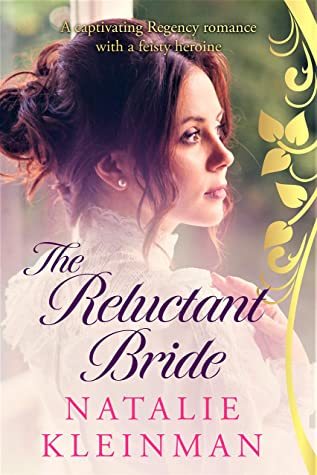 This appears to be the author’s first full length Regency, and as such it’s a literate, not to say elegant, piece of work. It’s not the most lively book I’ve ever read, however, and although it’s completely chaste and the characters are pleasantly likable, it never steps beyond the well-worn ruts of the genre and so fell a bit flat for me. The subtitle has it as a ‘captivating Regency romance with a feisty heroine’, a description I would quibble with. Publishers, can you please leave these judgements to readers?
Here’s the premise: Charlotte Willoughby has been forced into marriage with a much older man so that her father can be relieved of some financial difficulties. Being a dutiful daughter, Charlotte marries the Earl of Cranleigh, and finds, to her surprise, that he’s a gentlemanly sort of man, and marriage to him isn’t nearly so unpleasant as she’d feared. Unfortunately, after just six weeks of marriage, her husband has a riding accident and she finds herself a widow. The story picks up just as she emerges from her mourning period, as she and her younger, unmarried sister and a spinster cousin prepare to embark on the London season.
I have to confess that I got off on the wrong foot with this one. Since the earl had no son, his heir turns out to be a cousin of some sort – who happens to be a duke. My pedantic soul was immediately intrigued by this. How could an earldom be inherited by a duke? I promptly whiled away an inordinate amount of time trying to devise family trees where this could happen, although I’m still not convinced that it’s actually possible (unless the dukedom was a very recent creation, which seems implausible, somehow). But never mind.
Charlotte, her sister Harriet and cousin Esther begin to enjoy the delights of the season. Harriet is immediately drawn to a possible suitor, and Charlotte finds herself the focus of two different suitors. One is a kindly man she regards as a friend, and in fact they are soon on first name terms (surely a breach of protocol?). When he proposes, she is astonished, but makes him a gentle refusal.
The other is a man, Lord Roxborough, with whom she feels uneasy but without quite knowing why. We are several times told that he behaves impeccably but still, he feels slightly off to her. There are several meetings where he behaves with perfect correctness, as the author is at pains to point out, and Charlotte knows nothing to his detriment, yet when he proposes to her, she is downright rude to him.
In the middle of all this is the duke who inherited Charlotte’s husband’s estate, the Duke of Gresham. Charlotte finds him high-handed and aloof, and is often at odds with him, even though he takes the three women under his wing and is (to my mind) nothing but kind to them. Yet she is aware that they are, in may ways, on the same wavelength, and as time goes by, they get on better. It is obvious to the reader that Gresham is the hero, yet there is never any point where I felt he was seriously in love with her. Attracted, yes, and latterly it was clear that he was putting himself out for her, but there was no passion there at all.
And this is perhaps my biggest criticism of the book, that I never really felt the characters’ emotions. Everything was flat, somehow, and despite bouncing around in the heads of multiple characters, their feelings were told rather than shown. Not to mention that everyone was a paragon of virtue (except the one villain). The characters were likable, but a little bit saccharine for my taste. Since the plot ran on very familiar rails, it was all a little bit dull.
Despite all this, there was much that I liked. The author has a real feel for the Regency, and I only spotted one historical glitch – the mention of wedding rings (plural) during the ceremony (men wearing a wedding ring didn’t become commonplace in England until roughly the 1960s). As I mentioned at the start, the writing is beautifully literate, and I cannot tell you what a joy it is to see such an abundance of properly constructed sentences. The characters bounced around the country rather, but at least I always knew where they were, with the counties made explicit, in the Jane Austen tradition.
It was disappointing that the hero was a duke. Lord, I am so tired of dukes! It would have made far more sense to me if he had simply inherited the Earl of Cranleigh’s title and estates. I wasn’t quite sure why Charlotte got to keep the earl’s town house in London, but I presume it was part of her widow’s jointure. I would have liked some more explicit details of the time of year, because I got confused over it. Being told that the season was in full swing when it seemed to be autumn had me scratching my head (the Little Season, possibly?). Traditionally the season is in spring, Easter to June or July.
The blurb says that this book is ‘For fans of Georgette Heyer, Mary Balogh, Jane Aiken Hodge and Jane Austen.’ Sadly, it doesn’t have the sparkling dialogue and lively plot of Heyer, nor the incisive wit of Austen, nor the intensity of Balogh, but then few authors rise to those heights. It is, however, a very readable traditional Regency which I enjoyed despite some wobbles. I’m torn between three and four stars, but I always allow some leeway to debut books and the writing is so elegant that I’ll go with four stars.
Review: The Reluctant Bride by Natalie Kleinman (2021)
This appears to be the author’s first full length Regency, and as such it’s a literate, not to say elegant, piece of work. It’s not the most lively book I’ve ever read, however, and although it’s completely chaste and the characters are pleasantly likable, it never steps beyond the well-worn ruts of the genre and so fell a bit flat for me. The subtitle has it as a ‘captivating Regency romance with a feisty heroine’, a description I would quibble with. Publishers, can you please leave these judgements to readers?Here’s the premise: Charlotte Willoughby has been forced into marriage with a much older man so that her father can be relieved of some financial difficulties. Being a dutiful daughter, Charlotte marries the Earl of Cranleigh, and finds, to her surprise, that he’s a gentlemanly sort of man, and marriage to him isn’t nearly so unpleasant as she’d feared. Unfortunately, after just six weeks of marriage, her husband has a riding accident and she finds herself a widow. The story picks up just as she emerges from her mourning period, as she and her younger, unmarried sister and a spinster cousin prepare to embark on the London season.
I have to confess that I got off on the wrong foot with this one. Since the earl had no son, his heir turns out to be a cousin of some sort – who happens to be a duke. My pedantic soul was immediately intrigued by this. How could an earldom be inherited by a duke? I promptly whiled away an inordinate amount of time trying to devise family trees where this could happen, although I’m still not convinced that it’s actually possible (unless the dukedom was a very recent creation, which seems implausible, somehow). But never mind.
Charlotte, her sister Harriet and cousin Esther begin to enjoy the delights of the season. Harriet is immediately drawn to a possible suitor, and Charlotte finds herself the focus of two different suitors. One is a kindly man she regards as a friend, and in fact they are soon on first name terms (surely a breach of protocol?). When he proposes, she is astonished, but makes him a gentle refusal.
The other is a man, Lord Roxborough, with whom she feels uneasy but without quite knowing why. We are several times told that he behaves impeccably but still, he feels slightly off to her. There are several meetings where he behaves with perfect correctness, as the author is at pains to point out, and Charlotte knows nothing to his detriment, yet when he proposes to her, she is downright rude to him.
In the middle of all this is the duke who inherited Charlotte’s husband’s estate, the Duke of Gresham. Charlotte finds him high-handed and aloof, and is often at odds with him, even though he takes the three women under his wing and is (to my mind) nothing but kind to them. Yet she is aware that they are, in may ways, on the same wavelength, and as time goes by, they get on better. It is obvious to the reader that Gresham is the hero, yet there is never any point where I felt he was seriously in love with her. Attracted, yes, and latterly it was clear that he was putting himself out for her, but there was no passion there at all.
And this is perhaps my biggest criticism of the book, that I never really felt the characters’ emotions. Everything was flat, somehow, and despite bouncing around in the heads of multiple characters, their feelings were told rather than shown. Not to mention that everyone was a paragon of virtue (except the one villain). The characters were likable, but a little bit saccharine for my taste. Since the plot ran on very familiar rails, it was all a little bit dull.
Despite all this, there was much that I liked. The author has a real feel for the Regency, and I only spotted one historical glitch – the mention of wedding rings (plural) during the ceremony (men wearing a wedding ring didn’t become commonplace in England until roughly the 1960s). As I mentioned at the start, the writing is beautifully literate, and I cannot tell you what a joy it is to see such an abundance of properly constructed sentences. The characters bounced around the country rather, but at least I always knew where they were, with the counties made explicit, in the Jane Austen tradition.
It was disappointing that the hero was a duke. Lord, I am so tired of dukes! It would have made far more sense to me if he had simply inherited the Earl of Cranleigh’s title and estates. I wasn’t quite sure why Charlotte got to keep the earl’s town house in London, but I presume it was part of her widow’s jointure. I would have liked some more explicit details of the time of year, because I got confused over it. Being told that the season was in full swing when it seemed to be autumn had me scratching my head (the Little Season, possibly?). Traditionally the season is in spring, Easter to June or July.
The blurb says that this book is ‘For fans of Georgette Heyer, Mary Balogh, Jane Aiken Hodge and Jane Austen.’ Sadly, it doesn’t have the sparkling dialogue and lively plot of Heyer, nor the incisive wit of Austen, nor the intensity of Balogh, but then few authors rise to those heights. It is, however, a very readable traditional Regency which I enjoyed despite some wobbles. I’m torn between three and four stars, but I always allow some leeway to debut books and the writing is so elegant that I’ll go with four stars.
Review: A Question of Duty by Jayne Davis (2021)
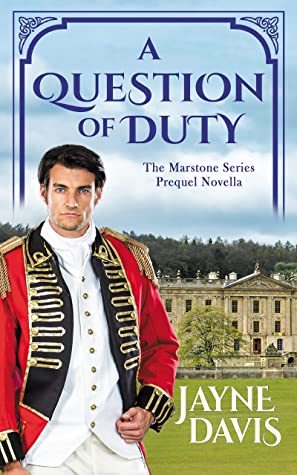 Another lovely novella from one of the most reliable of recent Regency authors, and a prequel to the fascinating Marstone family saga.
Here’s the premise: Captain Jack Stanlake is sent home from the Colonies as his father is ill, and he is asked to escort the Colonel’s wife and daughters who are also returning to England. Their purpose is to find husbands, and the girls’ mama is ambitious for them. She sees Jack, the younger son of an earl, as a potential target. He can’t afford a wife, though, and although he’s drawn to Clara, the elder daughter, he knows his father would never approve a marriage to a merchant’s niece. She’s drawn to him, too, but she’s not sure she wants to be tied down to a husband when there’s a whole world to explore.
When they arrive in London, they go their separate ways, she to the frivolity of the London season and he to his father’s deathbed and an unexpected and most unwelcome complication – an arranged marriage. Jack has to scramble to extricate himself from his brother’s machinations. The title of the book suggests that there’s a serious dilemma for Jack to solve, but it seemed to me that he made his decision rather easily. I think in reality he might have hesitated a little more. But there again, brother Charles is such a piece of work that maybe he forfeits any right to expect Jack to respect his duty to the family.
The romance ends in appropriate style, aided and abetted by various members of Clara’s family, and thank goodness for that. So many Regencies seem to be populated entirely by dysfunctional families that it makes a refreshing change to meet one that seems normal and perfectly benign. Davis’ writing is, as always, note perfect, and the crossing of the Atlantic was beautifully evoked. I could almost hear the creaking of the ship and the slap of the sails, and taste the salt in the air. Wonderful stuff. And there’s never any need to worry about historical correctness with Davis. I was pleased that when Jack writes to Clara, he does so through the medium of her uncle, as is proper.
A lovely tale, and as it’s a prequel to the whole Marstone saga, it makes me want to rush off and reread the rest of the series (which is now available in a handy boxed set, I discovered). Five stars.
June 29, 2021
Review: The Unforgiving Eye by Beth Andrews (2021) [Trad]
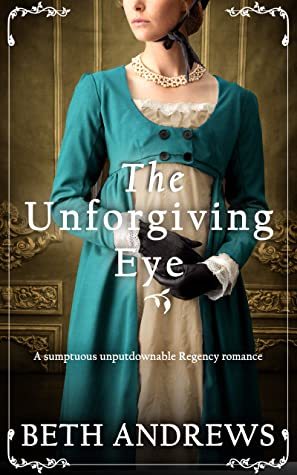 As with the first in this series, the subtitle of this book is a complete sham. It describes itself as ‘a sumptuous unputdownable Regency romance’, and the only part of that to be unequivocally true is ‘Regency’. It is certainly not sumptuous (whatever that means in the context of a book – a TV show may be sumptuous, or a meal or furnishings, but a book?). It may, possibly, be unputdownable (opinions may vary). What it most assuredly is NOT, however, is a romance. The first in series could, at a stretch, be described so, but not this one. It’s a cosy murder mystery set in the Regency era.
Having got that gripe out of the way, here’s the premise: our low-key couple from the first book, John and Lydia Savidge, are on their way home from their honeymoon when they are diverted to a house where there just happens to have been a murder. Can they solve it in three days? Well, what do you think? Our intrepid duo set about their task with vigour. Who had a motive for killing Sir Benedict Stanbury? Who even knew he would be at the place where he was murdered, and at midnight, too? Did he really intend to change his will? If the murderer wasn’t the stable hand, the lover of Sir B’s niece, could it be the solicitor? Or the niece herself? Or the timid governess? Everyone has secrets, yet no one seems to be a likely murderer.
I’m going to be honest here and say that I spotted the murderer at a very early stage, and everything that happened afterwards served to confirm it. Not the most difficult puzzle to solve. It was fun watching John and Lydia investigate, but it got a bit wearing at the end when they seemingly couldn’t see what was right in front of their noses. A whole chapter was devoted to them telling each other that no, they couldn’t crack it, it was just impossible to work out and they would have to admit defeat… They were practically out of the door before the vital hint appeared to nudge them in the right direction.
Despite all that, this was an enjoyable read, whimsical and charming, with as eccentric a bunch of characters as anyone could wish for. It’s technically clean (no onscreen sex), but everyone seems to be having affairs so there is a lot of discussion of the subject. Unlike the first book, the author has got the names right this time, and I only spotted one place where some dialogue was wrongly attributed to Lydia instead of the niece. This wasn’t quite as much fun as the first book, but it felt like a more assured work, the murder unravelling was given centre stage, without the distraction of a faux romance, and I might well read future books in the series. If only the publisher could refrain from hyperbole in the subtitle! Four stars.