Mary Kingswood's Blog, page 21
April 7, 2022
Review: A Season At Brighton by Alice Chetwynd Ley (1971)
 The third book in this series picks up another few years further on, and follows the rejected suitor from the previous book, Lord Pamyngton, and a new family, the Denhams, who have an abundance of daughters to be married off. Heroine Catherine (Katie) first meets Lord Pamyngton when she is in dire straits, having run away from home and fallen into the clutches of a none too respectable man. Lord Pamyngton rescues her, and discovers to his surprise that he himself is blamed for her predicament. Keeping his identity a secret to learn more of this situation, she confides in him and is later mortified to realise who he is, and that he practised such subterfuge on her.
So begins, rather awkwardly, their acquaintanceship, although I have to confess that it seems odd they never met before when they are close neighbours and the viscount even bears a family resemblance to his parents. But I’m always prepared to allow a book its initial premise, however unlikely, so let it pass.
The story then shifts to Brighton, where the married sister lives and where Lord Pamyngton has also gone, and once again Katie gets herself into scrapes of one sort or another, whether more from innocence or foolishness, it’s hard to say. I’m not a great fan of heroines who do incredibly stupid things (like running away and forgetting to take any money, for instance), and Katie is particularly stupid in that way. However, given the era in which it was written and the influence of Georgette Heyer, who loved to have her very young heroines scampering about the countryside, I suppose it works.
It’s fortunate that our hero, Lord Pamyngton, is sensible enough both to know his own mind and also to know Katie’s proclivity for getting into scrapes, so he helpfully keeps watch over her, enabling him to be on hand to rescue her with rather more plausibility than is usual in this kind of tale. The plot unravels in a fairly predictable and melodramatic way, but the writing is as amusing as ever and I enjoyed it all enough to give it four stars.


Review: The Toast of the Town by Alice Chetwynd Ley (1968)
 Another pleasantly undemanding read, light-hearted and very much in the Regency romp style of Georgette Heyer. This follows on from The Clandestine Betrothal, and although it isn’t essential to have read the previous book, it does make it a little more enjoyable to have some understanding of the background.
Here’s the premise: it’s four years after Hugh Eversley married Susan Fyfield, and they’re in anticipation of their second child. Hugh’s lively sister, Georgiana, an old school friend of Susan’s, is now twenty-one, the eponymous toast of the town, and has already turned down six different suitors. She’s a restless spirit, and Susan is sure that all she needs is a husband and children to settle her down. Accordingly, she has filled their house with guests to try to get Georgiana successfully paired off. Among the eligibles are Lord Pamyngton, a gentlemanly but dull viscount, and Henry Curshawe, brother to George Eversley’s very boring betrothed.
Georgiana is bored by this dull house party. She doesn’t like any of the Curshawes, and doesn’t take Lord Pamyngton’s gentle pursuit of her seriously. But one day she decides to take out Hugh’s curricle and matched pair for a spin, and her high spirits get her into trouble, throwing her (literally!) into the path of perhaps the one man who’s unimpressed by the very beautiful Miss Eversley, Dr John Hume. He ticks her off soundly and when she retaliates in kind, the stage is set for each of them to deeply dislike the other. So much so, that when the youngest Eversley brother, Freddy, challenges Georgiana to make the doctor fall in love with her, she accepts at once.
After this, things hum along nicely, and I really enjoyed the banter between the two, plus Georgiana’s ingenious attempts to entrap the good doctor into a declaration. But of course things don’t quite go to plan, and Georgiana has to suffer a great deal before she begins to understand her own heart and reaches her happy ending. The other members of her family as well as her two suitors act as facilitators or obstacles along the way.
I did have a couple of grumbles. One is Georgiana’s brother George (and what sort of family has a George and a Georgiana, anyway?). George is betrothed to the World’s Dullest Girl ™ and seems to have a very cavalier attitude towards her, looking forward to the time when they’ll be married so that he doesn’t have to pay her much attention, for instance. I kept expecting him to see the light and realise that she was the WDG ™, but he never did. George was rather sweet in The Clandestine Betrothal, so it was a sad comedown for him.
The other grumble was the good doctor’s cousin, who’s perfectly qualified to be a doctor’s wife, is desperately in love with him, the whole family expects them to marry and he ends up chasing after the entirely unsuitable and above his station Miss Eversley. And poor Anne isn’t even given the sop of a secondary romance to heal her broken heart. There was a throwaway line about her being young and meeting someone else in the future, and that’s all the thought she gets. I was very sad on her behalf. Georgiana’s other suitor, the gentlemanly Lord Pamyngton, gets his moment of glory in the next book, so his broken heart will be mended.
All in all, an enjoyable read in the old-fashioned style. A solid four stars.
Review: A Clandestine Betrothal by Alice Chetwynd Ley (1967)
 This was an unexpected delight. I’ve seen Alice Chetwynd Ley’s books bobbing around for a while now, but this is the first time I’ve read anything of hers. It’s a fairly slight story, but given its age (55!) it’s worn remarkably well. Ley’s writing career overlapped with that of the great Georgette Heyer, so it’s inevitable that her writing is heavily redolent of Heyer, but it’s none the worse for that.
Here’s the premise: Susan Fyfield is, at seventeen, finally leaving school. But what does her future hold? She’s an orphan, although a wealthy one, and dependent on her aunt’s kindness for a home. She knows very well what she would like her future to hold – one Hugh Eversley, dashing older brother of her best friend, Georgiana Eversley. She’s heard everything Georgiana can tell her of Hugh, and glimpsed him once or twice. She even stole away from school to see him when she heard he was to visit a house nearby, and was very embarrassed when she was discovered hiding in the shrubbery, whereupon he very kindly drove her back to the school.
But when Susan returns to her aunt’s home and finds out that her gloating cousin Cynthia is triumphantly betrothed, she takes a step too far – she tells them that she’s secretly betrothed. And when Hugh takes pity on her at his sister’s ball, and Susan gets a bit tipsy, she blurts out her most secret dream to her aunt – that her betrothed is in fact Hugh Eversley himself. The aunt doesn’t entirely believe her, but she feels she’s going to have to confront Mr Eversley herself to make sure of the truth, so Susan naturally feels she has to rush round to his lodgings to warn him. Whereupon he takes pity on her again and suggests going along with the secret betrothal for a while.
So far, so not very believable. He’s a leader of society, a notorious rake (aren’t they all?) and determined avoider of matrimony, and she’s a chit of a girl barely out of the schoolroom. To be honest, pretty much everything up to this point becomes a matter of conscious suspension of disbelief. Not so much Susan’s daydreams and childish impulsiveness, because she’s very immature, as young girls leading sheltered lives tended to be in those days, but that a man like Hugh Eversley would take any interest whatsoever in her defies credibility. And yet… despite the rakishness and society gloss, he’s actually a very nice man at heart, who sees Susan’s vulnerability and wants to spare her more pain. And of course, he’s only twenty-seven himself, so not exactly the jaded older man so beloved of Heyer. A ten year age gap isn’t at all unusual in the Regency, so it’s quite easy to believe that he’s attracted to her right from the start, while telling himself he’s just taking a brotherly interest in his sister’s friend.
From this point, anyway, the plots runs on swimmingly, with the discovery that Susan isn’t her aunt’s niece after all, but a foundling of some sort, and the story becomes largely about finding out just who she is and why she was handed over to her ‘aunt’ at all. Needless to say, it’s Hugh who beetles about trying to find answers and discovering along the way that he’s very much in love, without quite knowing what to do about it.
The author neatly sidesteps some of the hackneyed plot devices so beloved of Regency romances. So Susan runs away, but to a very safe harbour, and (apart from that brief visit to Hugh’s lodgings, which would have been quite beyond the pale) is never unchaperoned with Hugh. She even grows up visibly, which makes Hugh’s feelings even more credible. And Hugh? Ah, I do love me a sensible hero. I wasn’t much enamoured of his continued pursuit of the actress, and although this sort of comes right in the end, I would still have liked him to acknowledge the wrongness of loving one woman while chasing another, however platonic the chase might have been.
Like all Regencies of the era, it’s short on passion and long on mannerly restraint, but the writing is impeccable, the Regency atmosphere is faultless and the book is dripping with charm. I only knocked a star off for a degree of incredulity in the early chapters and that lack of passion. Four stars.
March 9, 2022
Review: The Devil You Know by Sophia Holloway (2017)
 Such a frustrating book – beautifully written in every way, and near perfect up to roughly the 75% mark, and then things went a bit pear-shaped. It didn’t ruin the book for me, and I’ll certainly look out for more by this author, but it was disappointing.
Here’s the premise: Kitty Elford’s half-brother is about to marry, and his bride wants Kitty out of the family home at once if not sooner. Kitty is given an ultimatum – leave penniless to make her own way in the world, or marry the notorious rake the Earl of Ledbury. Kitty’s not unwilling – the earl is handsome, after all, and she sighed over him as a debutante, but she knows his reputation all too well having seen him about his seductive business one evening. But it’s better than being penniless, and the earl is happy to have Kitty’s generous dowry to fund his race horses (the sister-in-law really, really wants her out of the way), so married they are.
The wedding night is a disaster, but we see nothing of it because this is a traditional Regency. Despite the fact that a large part of the book is about sex, whether the hero’s pre-marital shenanigans, the wedding night fiasco or the long wait for hero and heroine to reach an accommodation in that direction, there’s nothing graphic about it at all. There’s no reason why this should feel odd, and I’ve written marriage of convenience stories myself that keep all the sex offstage, but the abrupt transition felt uncomfortable. One minute, the hero is fortifying himself to do his duty by his bride with brandy, and the next she’s waking alone in bed, and for a moment I wondered if perhaps he hadn’t come to her room at all. I don’t know how else it could have been done but somehow it all seemed understated. The jump deserved something more – a new chapter, perhaps?
The interesting question is why a rake, who presumably knows everything there is to know about pleasuring women, should make such a hash of things with his own wife, but perhaps the proffered explanation – that’s he’s never bedded a virgin before – will suffice. Anyway, he decides that he doesn’t like being married, and would rather pretend it’s never happened, especially as his bride sets to with workmen and wallpaper samples to set right the neglected house, and upend his whole existence. So he invites a group of his friends to stay to distract himself with jocular masculine company, which works about as well as you would expect.
Fortunately, one of the friends is Lord Inglesham, a widower and by far the more promising character to play the role of hero. He’s quite wasted as a sidekick, frankly. He offers Lord Ledbury some sound advice, which would have been blindingly obvious to any half-sensible man, and some of it does sink in, for Ledbury and Kitty do start to get onto better terms. He discovers that she’s an accomplished rider, for one thing, which is the one thing guaranteed to soften him towards her, and she’s starting to soften towards him, too.
Now, you’d expect that this would result in a return to the heir-producing efforts so unceremoniously abandoned after that disastrous, but unseen, wedding night, but no. One thing after another conspires to prevent it, and the author has to stretch credulity to snapping point to keep them apart. I confess to getting impatient with the artificiality of it all, and wondering why on earth they didn’t just sit down and discuss it openly, like sensible adults. But no, they have to wait and wait and wait some more, because reasons.
At this point, I was very much comparing the book with Mary Balogh’s The Obedient Bride, a book which takes the same basic premise of a marriage of convenience to a man of casual morals, and follows it with uncompromising honesty. Balogh doesn’t shy away from the sex, but she also creates a very believable transformation in both main characters. Holloway, by contrast, has to resort to some fairly tired old tropes to create the drama at the end which will finally bring the principals together.
And this is where the book veered off the rails for me. It wasn’t the melodrama that sank the final section of the book, but the hero’s response to it. He starts the book as a deeply selfish individual who’s gradually come to see his wife as not merely the funder of his racehorses, or a housewifely nuisance, but someone he values and appreciates in her own right. He even begins to realise that he loves her. But when the crisis comes, he simply runs away – there’s no other way to describe it. And I wanted to slap him upside the head, and tell him not to be so stupid, to go to Kitty and TALK to her, for heaven’s sake. You know, like a grown up. But no, he has to be rescued by his long-suffering friend, the heroic Lord Inglesham, once more. I can’t tell you how deeply disappointing I found this, but on the other side of the coin, if I’d cared less about Ledbury, I’d have been less disappointed. I suppose it’s a testament to the author’s skill that I so badly wanted him to come good at the end.
There’s some more fairly over-the-top melodrama before matters are resolved, but I can’t honestly say I was convinced by Ledbury’s transformation from perpetual rake to faithful husband. Reforming a rake believably is arguably the most difficult challenge a Regency author can undertake, and to be fair, few are truly convincing. The reader wants to believe, though, and maybe that’s enough.
I don’t want this to sound too negative, because for the first three quarters of the book I was breathless with admiration. The language is perfectly of the Regency, I didn’t detect a single anachronism or infelicitous phrase, the main characters have believable depth, and the dialogue is electrifying. The back and forth between Kitty and Ledbury, and particularly Ledbury’s volatile moods are brilliantly realised. I loved every moment of it. It was only that saggy ending that spoilt things for me and kept it to four stars, but I thoroughly recommend it all the same.
Review: The Wastrel’s Daughters by Arabella Brown (2021)
 I knew after reading the first Regency by this author (A Detestable Name) that this one would be different. Arabella Brown is such an original writer that it couldn’t be otherwise, and I was not disappointed. It’s perhaps not quite as witty as the first book, but the glorious writing is present and correct, along with an array of likeable and intriguing characters.
Here’s the premise: Harrogate residents Polly Selby and her sister Anne are left more or less destitute by their father’s death (the wastrel of the title). Discovering that even the house is mortgaged, they let it out and seek employment for themselves. Anne, the much younger sister who’s had some education, becomes a governess. Polly, at thirty-two, becomes a companion to a tartar of an elderly woman, who’s driven off innumerable companions. Both of them find themselves courted by unlikely suitors, and there are a couple of side romances, as well.
Let’s deal with Anne first. Her post is one where the governesses are invariably dismissed within months (or even weeks) because of the husband’s roving eyes. Dismissed she is, but not before she’s made a friend of the rakish Mr Hallam. Seeing the governess sitting in an unobtrusive corner in case she’s needed, he sees her as easy prey, but she understands what he is and gives him a piece of her mind. He agrees to behave properly with her, and in fact rescues her from any harm from the lecherous husband. She’s still dismissed, though, but this is such a regular occurrence that the housekeeper has arranged for her to be looked after until she can be found new employment. The doctor and vicar take turns, seemingly, to look after the dismissed governesses!
Meanwhile, Polly is getting on like a house on fire with the tartar, who turns out to be a great big pussy cat after all. But then Polly receives some bad news, swoons and is carried home insensible by a stranger whereupon she falls into a life-threatening fever for weeks (no doubt channelling Marianne from Sense and Sensibility). Anne is summoned home to nurse her, and take over her duties as companion until Polly recovers.
And here the two unlikely suitors appear fully on stage. Rakish Mr Hallam returns, newly chastened and reformed by Anne’s upbraiding and the ministrations of a friendly Jew running a sponging house in London. A sponging house is a sort of unofficial prison where the gentry go to be locked up until they, or a long-suffering relation, get round to paying their debts. Mr Solomon, the Jew in question, teaches Mr Hallam how to manage his affairs, and with the prospect of clearing all his debts in time and thereafter leading a blameless if boring life, he pays court to Anne with great determination.
And here I have to take issue with him. No gentleman should be courting a lady and trying to win her affections unless he’s in a position to marry, which Mr Hallam isn’t. He might well be, one day, but he’s a long way from that point, so I disapproved very strongly of his actions.
The other unlikely suitor is Mr Ledsham, the gentleman who rescued Polly when she fainted, and became intrigued by the mysteriously insensible lady. After calling every day to enquire after her health, he eventually gets to meet her, and he too begins to pay court to her… or does he? What precisely are his intentions? Polly isn’t at all sure, and frankly, I wouldn’t be either. A more restrained courtship would be hard to imagine. There were times when I wanted to box his ears and tell him just to get on with it – to declare himself, or show a bit of passion. But he never does, until the final pages of the book.
I’m going to be honest here. I love this author, because she can write – boy, can she write! And she thinks outside the (Regency) box. Here we are in Harrogate, getting a fascinating glimpse into the differences between High Harrogate and Low Harrogate, tiptoing round the fringes of the gentry (like the tartar and Mr Hallam’s family) and trade (like Mr Ledsham with his mines). There’s no season here, no Almack’s or Vauxhall’s or Hyde Park, no debutantes or wilful heiresses, no elopements or seductions or kidnappings. Not very much happens, but it’s all interesting.
But the structure of the story is all wrong. Anne goes off to one household to be a governess, then (very briefly) another before returning to Harrogate for good. Those two families are not mentioned again. There’s a wastrel of a brother, whose only purpose seems to be to inflict a debt-collecting heavy on his sisters. He’s then callously written out of the story altogether. I kept expecting him to turn up again like a bad penny, but he never did. It seems he’s gone for good. There’s the mystery of the missing valise, supposedly containing some treasure from the wastrel father which was never found. Instead of trying to find it, the sisters simply shrug – oh well, they say, I guess it’s gone, then. I’d have liked some effort put into actually tracing the father’s movements and working out where the valise might have gone. That would have been far more satisfying.
But my real complaint is with Mr Ledsham and Polly. Honestly, given their ages, I would have thought their romance, or courtship, perhaps, could have been speeded up just a touch. What on earth were they waiting for? Although maybe I’m being unfair, and judging them by the standards of so many modern Regency romances that get into the heavy breathing by chapter three at the latest. Perhaps this is much more the sort of delicate dance that would actually have been the norm in the Regency. It reminded me a little of Anna Dean’s lovely series, where the romance builds inch by cautious inch over four books. Still, I did get quite impatient with both Mr Ledsham and Polly.
The blurb describes this as a chaste novel, and it certainly is that. The romance is incredibly gentle and low-key, so anyone looking for a more emotional story should probably move swiftly on. But if you want an authentic Regency experience, in the unusual setting of Harrogate, with a multitude of well-drawn and almost uniformly kindly characters, this is the one for you. It’s the Lark Rise to Candleford version of the Regency romance, where nothing terribly awful happens, and the pace is stately, but very much one to savour. The unevenness of the plot keeps it to four stars for me.
Review: A Detestable Name by Arabella Brown (2020)
 This is a most unusual book. Most modern Regencies run on rails, with well-worn tropes squeezed for the last drop of creative juice, and unless the writing is exceptional, that can be very boring. But here’s a story that doesn’t run on rails at all. For one thing, the heroine doesn’t even put in an appearance until almost half way through, and the romantic travails of the hero’s two sisters take centre stage. But I love a book that surprises me and this one does that in spades.
Here’s the premise: Lord Newsam returns from war to take up the title after his elder brother dies. So far, so commonplace. But Granville is not your average hero. Feeling himself unequal to the challenge of tackling his temperamental and entirely self-centred mother, he lives in the dower house while she still holds the main house. His two sisters, the timid doormat Amelia and bad-tempered Charlotte, aren’t exactly barrels of fun, but he’s equally non-confrontational with them, too, nor does he reprimand the insubordinate staff. For a soldier, he’s altogether surprisingly restrained.
He finds the family estate, Gomersall, a sad, neglected place. His mother’s insistence that she’s superior to everyone else means that no neighbours come to call. The land is in poor shape, the tenants downtrodden and neglected and the bailiff is set in his old-fashioned ways. Granville finds it all rather daunting, and unlike the army, where he was surrounded by his men, at home he’s alone and unsure of himself and a bit lonely.
Slowly, however, he gets to grip with things. He disposes of the bailiff (although I found it a bit unbelievable that no one knew about it until the wagon went past loaded up with all his furniture. In any small, rural community, word would have been out within five minutes. He would have told his friends, at least, made various arrangements for leaving and settled his accounts with tradespeople- at least, I hope he settled his accounts!). But no matter. Granville finds a replacement rather too easily (and this is a recurring theme in the book, that difficulties are overcome all too easily).
The two sisters form the ‘side’ romances, and again they fall into place somewhat easily, especially Amelia (but then again, I love characters who know their own minds, so I’m not going to quibble). Charlotte’s is a little more of a bumpy road, but her first suitor is rather an interesting character, of a type not often seen — neither villain nor hero, just an ordinary young man enjoying a romantic interlude. Once again, the book surprised me.
But what of the heroine, I hear you ask? Where is the main romance of the story? Good question. There’s a brief conversation early on when Amelia asks Granville whether he’s ever found a woman he could marry, and he tells her, yes, once, but she was married and he never saw her again until recently, finding her widowed and impoverished living nearby, her husband having killed himself when his debts overwhelmed him. She blamed the Newsam family, and wants nothing to do with him. Now, this meeting would have made a fine dramatic prologue. We hear the story second hand, as he describes it colourlessly to Amelia – how he was riding down the lane when the children ran out almost under his horse’s hooves, he just avoided them, discovered the woman he had admired now destitute. He offers her his help, she flings his card back in his face. We really should have *seen* this, and it would have underscored the importance of the widow to the story.
Still, she turns up at last half way through, when Amelia, newly emboldened by her engagement, engineers a meeting and work for her on the estate. And so Mary Thorpe moves into the dower house with her two children, and Granville moves into the main house (finally!), and the two inch towards the inevitable happy ending. There’s no angst in the romance, and we never really find out what’s going on in Granville’s head regarding Mary. He is clearly pursuing her, and they have some fine scenes together (including a delightful interlude with a kite), but there’s nothing particularly romantic in any of it until he proposes, she rejects him (because of the whole husband’s suicide thing and the scandal) and he then goes off to pursue another possible love interest.
Wait, what? Honestly, I wanted to box his ears at this point, because what sort of lover just shrugs and slopes off when the supposed love of his life turns him down? Silly man. I was afraid we were heading into the betrothed-to-the-wrong-girl trope at this point, but the author is more creative than that, happily. And eventually, without too much drama, matters resolve themselves, and there’s a neat twist at the end, just for laughs.
Some minor niggles. The writing style is no-holds-barred head hopping, the point of view leaping merrily from character to character with gay abandon. But at least I never once had to stop to wonder whose head we were in – it was always obvious, and actually it felt remarkably freeing to know everybody’s thoughts like that. Another problem was that I found it difficult to know what the time of year was. Once when something was mentioned as happening in September, I had no idea whether that was a few weeks away or many months. It was a bit disconcerting. Once or twice there was mention of it being cold or warm, and there was one time that was definitely May, but other than that I felt a bit lost, although it was probably just me not paying attention. Also, I didn’t notice any mention of what title Granville holds, so I’ve assumed he’s a baron (but I would have liked to know for sure).
The writing style is so Regency-authentic that it might almost be Georgette Heyer at work, and it’s witty, too, and that means not just funny, but also insightful. I learned some new vocabulary, too. I’m still not quite sure what a betsie is, or a tax-cart, but a sonsy woman is plump, buxom and comely. A lovely word. There’s a heap of northern dialect, which all seemed fine to me, although I’m no expert. I didn’t notice a single historical error or typo, which must be something of a record.
The author has written other books in different genres, but this seems to be her first Regency romance. I already have the second one lined up to read, and I hope she writes many more. This is a wonderfully written story, with a very realistic Regency populated by likeable and believable characters. It’s wildly original, downright quirky, in fact, which is awesome. I can’t tell you how tired I get of stories that cover the same tired old tropes in the predictable ways. This book is the antithesis of predictable. It won’t be for everyone (the head hopping drives some reviewers to distraction), but for anyone who appreciates that oh-so-rare beast, a truly authentic Regency grasp of language with a great deal of wit, this book will be a delight, as it was to me. Five stars.
February 20, 2022
Review: A Susceptible Gentleman by Carola Dunn (1990)
 Well, what can I say? This was meant to be humorous, and I gave it the benefit of the doubt for most of the way through (and it was funny, actually), but the hero just stepped beyond the pale, for me.
Here’s the premise: Sarah Meade is the vicar’s sister, living a quiet life in a country parish and at the age of twenty-four, almost at the point of giving up on the prospect of marriage. Besides, she’s been in love with neighbour Adam, Viscount Cheverell, for years, but he looks on her as a sort of honorary sister. He’s the only son, with four highly-strung sisters, which has made him ultra-sympathetic to female troubles. He’s set up homes for unmarried mothers and schools, and he’s also managed to acquire three mistresses – simultaneously!
Now, some readers will back away at this point, but I like to give a book the benefit of the doubt with its basic premise, however implausible or unheroic, and see how things develop from there. Adam finds himself in difficulties with all three mistresses, so when he’s summoned home to deal with one of his troublesome sisters, the three follow him there. To avoid inflicting them on his rather strait-laced mother, he sends them round to the vicarage, for Sarah and brother Jonathan to deal with. Meanwhile his sisters are determined to see him married off, and descend on him with three candidates. He agrees that he probably ought to get married, and so begins a delicate dance around the three women, while also dealing with his three mistresses.
There’s no doubt that all this is very funny, if the reader can set aside the pearl-clutching that the three mistresses evoke. It’s meant to be light-hearted fluff, and given the date it was written (more than thirty years ago), mores were quite different then and the heroes of Regency romances were expected to be men’s men. Mistresses were just a normal part of the genre, and I don’t mind that (much). What got seriously up my nose is the despicable way Adam treats Sarah. Time after time he says (or thinks), “Oh, Sarah’s a good sport, she won’t mind,” and Sarah herself says at one point, “If he says that one more time, I’m going to scream.” And you can see her point. He treats her *really* badly, he expects her to deal with his mistresses, and then, when he gets himself entangled with all three of his marriage candidates, he expects her to sort that out, too!
Needless to say, it all comes right in the end, but I have to wonder just how faithful a husband Adam would be. He’s just too susceptible to womankind and (frankly) too stupid to avoid future entanglements, and he’s just the sort of idiot to think, “Oh well, it’ll be fine because Sarah will never know about it.” Ugh. So for me this only rates three stars, but it’s very well written, and for anyone less twitchy about male misbehaviour, looking for a light-hearted traditional read, this will probably suit you very well.
Review: The Frog Earl by Carola Dunn (2004)
 This was a whole heap of fun. It’s rather light-heartedly based on the frog prince story, and since it doesn’t belabour the point, it has an unusual degree of charm, with appealing characters and no artificial veering off into melodrama.
Here’s the premise: Simon Hurst is that staple of the Regency romance, the disregarded second son who is unexpectedly thrust into the position of heir. He’s the Earl of Derwent, leaving behind his happy career in the navy, but his father, the Marquis of Stokesbury is far from happy. He asks cousin Gerald, Viscount Litton, to take Simon up to town to add some polish to the rough navy man. Simon hates the stiff formality and constraining clothes of the fashionable world, but there are compensations, like a certain beautiful young lady. It’s only when Simon accidentally overhears said young lady telling a friend that she only wants him for his fortune and rank, and would take him even if he were a frog, that he realises his error. He sets off, incognito, for the estate of an aunt in Cheshire to recover his spirits and learn something of estate management, and there he meets Mimi…
The blurb describes Mimi as ‘half English, half Indian and all mischief’, which hits the nail precisely on the head. She’s always up to some scheme or other, and Simon encounters her catching tadpoles to raise, for various complicated reasons. When she drops her bracelet into the water and Simon recovers it for her, he extracts from her three wishes – to dine with him, dance with him and to kiss him. She has no intention of complying, but he is intrigued and sets about ensuring that she fulfils her side of the bargain.
Mimi and Simon are both delightful characters. He is one of my favourite hero types, a sensible man very much at ease with himself who knows what he wants and sets about getting it with steady determination. And Mimi is such a rare thing in Regencies – a young and mischievous spirit who may get carried away sometimes but is entirely good-hearted and not in the least silly. Gerald, the urbane and dashing man-about-town is not so much a sidekick as another well-rounded hero, and Harriet the vicar’s daughter, who knows her place and isn’t unrealistic, but would so very much like to get married, is lovely too. There is a whole army of minor characters, and frankly I never got most of them straight in my head, but it didn’t matter. The whole book simply oozes charm, and made me smile all the way through.
There are difficulties, of course. For Mimi and Simon, there’s the problem that he is pretending to be a bailiff, and therefore would be viewed as a fortune-hunter if he openly courts Mimi. He wants her to fall in love with him for his own sake, and not just because he’s the heir to a marquisate. And for Gerald and Harriet, there’s the huge disparity of rank, although frankly this is a difficult obstacle to take seriously when half the Regency romances ever written have some form of it. It would be a different matter for a peer’s daughter to ‘marry down’ but men did it all the time (in real life as well as between the covers of books).
I do have one serious grumble, however. The romances chug along rather splendidly for most of the book, developing slowly and rather naturally. And then, bam, the most perfunctory wrapping up you can imagine. I’m not a fan of the elongated and mushy epilogue, but I do like a somewhat more romantic ending than this. Mimi switches without comment from trying to pair Simon off with Harriet (and feeling unaccountably dismal about the prospect) to talking about love, without any sign of a revelatory moment (unless somehow I missed it). And the proposal scenes are brief to the point of brusqueness. Not a happy camper about that. I can only assume the author was given a word limit by her publisher and had a bit of a scramble to fit everything in, but it was all very unsatisfactory.
But with that proviso, this is a lovely and very charming traditional read, amusing and light but with some serious themes of friendship and class beneath the froth. I thoroughly enjoyed it – right up until the final chapter or two, which knocks it down to four stars.
Review: Angel by Carola Dunn (1984)
 I was a bit uncertain of this one at first, since the heroine is a bit of a flighty, act-first-apologise-later sort of girl, but it grew on me, and the hero is lovely, so I totally got why the heroine fell for him. It’s beautifully written, very traditional and set rather splendidly in the Lake District, so bonus points for that (it’s always nice to get off the well-worn London-Brighton-Bath-country-house circuit).
Here’s the premise: Lady Evangelina (or Angel, for short) Brenthaven is the rather spoilt daughter of the Marquis of Tesborough. After eighteen proposals in two years, all of which she’s turned down, she’s tired of the Marriage Mart and being courted for her looks and fortune. When her friend, vicar’s daughter Catherine Sutton, invites her to join them in a stay in the Lakes, Angel decides to assume an alias and enjoy a quiet summer untrammelled by fortune-hunters. But Angel is the sort of person who just draws chaos around her, and so she accidentally (and occasionally deliberately) upends the rather dull lives of her neighbours, the grumpy Earl of Grisedale and his subdued daughter Beth, the earl’s nephew Sir Gregory Markham, Beth’s suitor Lord Welch, and of course the Sutton family. And then there’s the matter of Lord Grisedale’s estranged son, Lord Dominic Markham, who went off soldiering several years ago and hasn’t been heard from since…
There are a lot of characters in this, and I frequently got confused between the men. In addition to Sir Gregory and Lord Welch, there’s also Gerald Leigh, another vicar and suitor of Beth, and it won’t surprise anyone to discover that the missing Lord Dominic does eventually make an appearance. In fact, he is the cause of one of the funniest jokes of the book, for since his father has declared him persona non grata and told him never to darken the doors of the family home again, he returns under an alias, yet an astonishing number of the locals recognise him. Nobody seems to be fooled by his disguise in the slightest.
Dom is, of course, the hero and his scenes with heroine Angel are the best in the book. They have an instant rapport, and they develop a charming but very chaste friendship. He teaches her about wild flowers and she teaches him not to skulk out of sight. The romance develops beautifully and it’s just a pity that Dom has an outbreak of I’m-not-worthy-itis towards the end, but then there really is no other serious obstacle to the match, so the author had trouble slowing down the gallop to the altar.
There are not one but two side-romances along the way, plus a somewhat implausible but nicely developed mystery, which throws up two of the men as possible villains. The author has some trouble maintaining the pretence that both are equally plausible candidates, and she has to make Angel fairly blind to the good/bad qualities of the two to sustain the pretence. Catherine, on the other hand, is much more sensible and a far better judge of character. She and her paramour also have some delightful banter, and their romance progresses far more smoothly than Angel’s.
There’s one moment in the book, though, when both women are desperately in love with their respective men, and yet very much uncertain as to whether their feelings are returned. This must have been such a common problem with real-life Regency women, who lived their lives in a world of decorous and completely meaningless interactions with men who may or may not have any serious intentions towards them. Angel comments that, “It is perfectly horrid to be in love and not to know,” and Catherine replies, “Isn’t it?” I can only sympathise, and be glad to live in a more open age.
I only spotted one error. The Earl of Grisedale’s eldest son (Dom) should have a courtesy title, typically a viscountcy. He would absolutely not be Lord Dominic, which was a title reserved for the younger sons of Dukes and Marquises. I also wondered why the next male heir to the earldom (after Dom) is a baronet (Sir Gregory), another title passed in the male line. That would only be possible if his father had been awarded the baronetcy, which is not impossible but unusual.
On the whole, I really enjoyed this. Some reviewers hated Angel, and I can understand why. She seems very immature, and rushes into things without thinking, but her actions are never malicious, and are often not even selfish, but designed to make things better for other people – which she does, in spades. Even the grumpy Earl miraculously comes round in the end. So although there were wobbly moments when Angel seemed just a little too wild, she was also good-hearted and kind, and in the end she grew on me rather. And Dom – well, he’s a real charmer. This is one of those books that could fall either way, but for me it mostly worked pretty well. Four stars.
January 24, 2022
Review: Runaway Bride by Jane Aitken Hodge (1978)
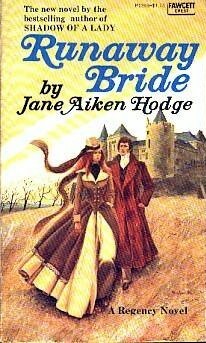 An odd one. This was almost a greatest hits compilation of all my least favourite tropes, it’s oddly written with some pseudo-Regency era language and the romance is very much an afterthought, as was common when it was first published, and yet I still read it avidly, despite all that. Maybe even a sub-par 70’s Regency makes for better reading than much of the modern stuff? Who knows.
Here’s the premise: Jennifer Purchas is a seventeen-year-old heiress whose father’s death leaves her in the hands of her uncle, who seems to be more interested in her fortune than in her welfare. When he informs her that she is to marry a stranger, a friend of her dead brothers who asked him to look after her, she runs away to her friend, who finds her a position as a governess. This goes on swimmingly until the children’s bad-tempered guardian appears, but just when Jenny has persuaded him that a beautiful and hoydenish girl of seventeen is, in fact, a perfectly sensible choice of governess (only in a Regency romance, methinks), her wicked uncle kidnaps her. She runs away again, this time to London, where she finds herself caught up in a riot and fortuitously rescued by the very same bad-tempered guardian, who deposits her with his eccentric grandmother (a duchess!). So Jenny, under a false name, is thrust into the whirlwind of the season, where her beauty and liveliness soon attract swarms of suitors. Of course they do. Sigh.
I almost bailed at this point, but somehow I kept going, wading through the positive swamp of tropes. Let me list some of the principal ones. The beautiful runaway heiress, check. The grumpy hero, check. The great misunderstanding, check (also known as not seeing what was blindingly obvious). The wicked guardian. The wicked rake. The manipulative aunt with a rival daughter. The mass of coincidences. The heroine who doesn’t spot danger (until it’s too late, naturally). The hero who doesn’t bother to tell the heroine that he loves her until the very last chapter. The secret note that draws the heroine to a secluded spot (yawn). And so on and so on.
Now some of this is great fun. I loved the moments where the heroine got herself out of trouble, although I have to confess that her propensity for running away got very tedious. I counted four separate occasions, which is at least two too many. I disliked it when she had to depend on the hero turning up at a vital moment to rescue her (which I think happened twice), but mostly Jenny looked after herself, and managed a certain amount of looking after other people, too. A resourceful lass.
I also liked the period in London, which slips straight into a very traditional form of Regency romance, with balls and masquerades and duels and the whole panoply that Georgette Heyer drew on. The author effortlessly weaves real people and events into the story (again, a Heyer trait), which adds a certain authenticity to proceedings. But the hero is also Heyer-esque, the grumpy, sneering, macho type that is really not my favourite type. I’m more of a Freddy Standen fangirl, myself – give me a gentle, understated hero every day of the week. And the hero’s bad temper gets him into trouble time after time (and gets the heroine into trouble, too).
There weren’t too many historical missteps, although (as so often in Regencies) the author takes liberties with the marriage laws. No, you can’t actually force anyone to marry against their will, not if you want the marriage to be legal, no, a guardian can’t marry off his ward to his own financial advantage, and no, you definitely can’t have anyone marry under a false name – that’s fraud and the marriage would be illegal to boot. But since none of these proposed irregularities actually came to pass, I can let them go.
One that I can’t let go is the question of Jenny’s guardian. It seems her father neglected to name a guardian in his will (or the named guardian had died, not sure about that). That does NOT mean that her uncle would automatically take over the role, and if he did, he wouldn’t have control of her finances as well as her person. There would have been trustees for the fortune and the Court of Chancery would appoint a guardian for Jenny herself. Since she was over 14, Jenny would legally be able to nominate her own choice of guardian. So she would never have been quite so helplessly under the control of her uncle (although of course that would have spoilt the story!).
This was a mixed bag for me. I liked the well-evoked Regency, the deft use of real history and the feisty and resourceful heroine, even if she made some stupid mistakes sometimes. I disliked the grumpily bad-tempered hero who is the very antithesis of Regency restraint. But even though it didn’t entirely work for me, it’s still a well-realised traditional-style Regency that I know many readers will absolutely love. I’d like to give it three and a half stars, but given the sheer weight of unlikable tropes, I’ll settle for three stars. But I’d like to try another of the author’s works that might suit me better.