Tim Patrick's Blog, page 11
February 7, 2017
How to Stop Donald Trump
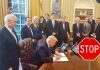
Political tensions have been running high ever since Donald Trump became president just a few weeks ago. Upon entering the Oval Office, Trump immediately began flexing his executive muscles by issuing several stern and controversial presidential proclamations, also known as Executive Orders. Of special concern is Order 13769, “Protecting the Nation from Foreign Terrorist Entry into the United States,” which among other things institutes entry restrictions on new and existing visa holders and permanent residents from seven Middle East and North African countries.
Pop-up protests now litter our airports and federal office buildings. Judges issue restraining orders and stays of implementation. But these are of limited effect. Trump has shown that he is not dissuaded by mass rallies, nor is it a sure thing that the judicial injunctions will withstand Supreme Court scrutiny. If the noise of social media is to be believed, the nation is united in its opposition to the Order, especially where previously vetted Green Card holders are concerned. But what good is noise if you can’t do anything about the core issue?
Fortunately, the American Founders understood the reckless use of power by a national leader, and included appropriate protections within the Constitution. Unfortunately, those protections have been diluted over the centuries. If we really want to prevent Donald Trump or any president from abusing the authority of the Executive Office, we need to understand the powers granted to that office, and the correct way to restrain those powers.
The president is the chief executive officer of the United States, and according to Article II of the Constitution, he is vested with the power and responsibility to “take Care that the Laws be faithfully executed.” There are some other powers granted to him, such as the ability to grant pardons, and with the “Advice and Consent of the Senate, to make Treaties” with other nations. But much of what a president does from day to day involves the faithful execution of the laws as passed by Congress. It’s not always easy, since humans are particularly adept at applying varied interpretations to otherwise plain language, to say nothing of the obscure nuances of legal documents.
Enter the Executive Order, a device of the president which attempts to bring clarity and direction to the implementation of specific laws, especially those that impact bureaucratic agencies already under the direction of the Executive Branch. If you read through Order 13769—and you should—you will see that it is primarily a list of instructions to the Secretary of State, the Secretary of Homeland Security, the Director of National Intelligence, and the Director of the FBI, compelling them to take specific actions, and to provide reports and conclusions back to the president, in line with their congressionally defined duties. The Order concludes that it “shall be implemented consistent with applicable law and subject to the availability of appropriations.”
Executive orders have the power of law, but only to the extent that they are proper interpretations of the actual laws handed down by Congress. If Congress passed a law specifically regulating the sale of chocolate chip cookies, the president could not extend that act to cover vanilla ice cream, as that would implement new law. But the president could have the Office of Cookie Enforcement temporarily suspend its work in an attempt to “take care” that the cookie law was being “faithfully executed.”
It’s this limit on implementing new law that holds the key. If you read through Trump’s Foreign Entry order, you will see that it regularly references sections of the Immigration and Nationality Act (INA), a portion of the US Code that deals with immigration and visas. Section 212 of that act covers “Inadmissible Aliens,” and reads in part:
“Whenever the President finds that the entry of any aliens or of any class of aliens into the United States would be detrimental to the interests of the United States, he may by proclamation, and for such period as he shall deem necessary, suspend the entry of all aliens or any class of aliens as immigrants or nonimmigrants, or impose on the entry of aliens any restrictions he may deem to be appropriate.”
This is the clause that provides the foundation for the Order. President Trump found that the entry of a class of aliens—those from seven selected countries—would be detrimental to the interests of the United States. By proclamation, and for a specific temporary period that he deemed necessary, he suspended aliens within that class from entering the United States as immigrants or nonimmigrants, and imposed restrictions on them as he deemed necessary. It’s possible, perhaps even likely, that his findings of detrimental impact by this class of aliens may be incorrect, perhaps even in violation of the Constitution. But until that is determined, the order is in line with the powers granted to him by Congress through the INA.
As mentioned earlier, an Executive Order cannot make new law, only clarify existing law for implementation by government agencies. If Congress does not want the president to clarify section 212(f) of the INA, it can vote to alter or rescind that section of the law. In fact, this is exactly what Congress should do, not only with this law, but with so many laws that grant nearly unlimited powers to the Executive Branch.
The United States is not a pure democracy, but a republic. It derives its powers not from a king or even a president, but from the people. By constitutional design, the primary means of communicating that power is through the House of Representatives, the body that was intended to be the closest contact between the people and its government. When Congress passes laws, the hope is that it will do so in line with the republican relationship the House (and indirectly, the Senate) has with the constituents from each House member’s district. Those laws must be constitutional in nature, and in my view, that includes the constitutional spirit of the separation of powers. Sadly, laws like the Immigration and Nationality Act in effect transfer legislative control away from Congress—and away from the people—and grant it to the Executive. This advances the Hamiltonian quest to have the United States led by a king, or as other Founders would have derided it, by a tyrant.
I have no problem with an immigration act that allows for temporary restrictions on certain classes of aliens. The problem lies with the transfer of this authority exclusively to the president, to be implemented by his whim, and without recourse from the Congress, or the people. We can get angry at Trump for being mean to refugees, or for playing the religion card. But the fault lies with Congress, and its long-term abdication of power. If we want to stop Trump from behaving badly, it’s time to be The People, and to have our inalienable authority faithfully executed by the House of Representatives.
[Image Credits: White House]


January 31, 2017
The United States of Anger

They say that time heals all wounds. This seems to be especially true when the original trauma is experienced second-hand. Consider the terrorist attacks on the United States back in September 2001. Like the Kennedy assassination nearly four decades earlier, most adults recall where they were when the Twin Towers fell. I walked around in a daze for at least a week, and my employer at the time was very understanding when workers would need to disappear for a few hours to attend some prayer vigil or remembrance.
It’s been more than fifteen years since 9/11, and while my intellectual disgust at the vile act remains, the emotions are largely gone. That’s a good thing, because if I had continued to feel as I did that first week, I would be completely useless as a productive member of society. I have a friend whose brother perished in the World Trade Center attack. His continued anger is understandable. But for those like me who experienced the event primarily through television, it comes as no surprise that the feelings have dissipated.
It’s for this reason that I have trouble understanding the emotions surrounding the recent Women’s March. In my earlier article on that nationwide gathering, I expressed surprise over the event’s lack of stated purpose. Boy was I wrong. If the comments on the article and on Facebook were any indication, the marchers did have a purpose, one of venting anger against Donald Trump. The key frustration revolved around a specific incident, Trump’s recorded quip about his ability, as a famous celebrity, to kiss or grab women anytime he wanted. One commenter whose daughter marched said that she was “protesting a president who has admitted that he was free to sexually assault women because of his power…. There was much solidarity in that position.”
There certainly is much solidarity in that position, and it’s endured for the four months since the recording first came to light. Unlike the feelings surrounding 9/11, which have relaxed as the nation has attempted to confront the key issues, the anger over Trump’s 2005 comments has grown. It’s especially surprising, given that everyone (except for the unidentified women he may have been referring to, and the thirteen women who have stated publicly that Trump made inappropriate advances) experienced the moment second-hand, through an audio transcript more than a decade removed from the actual event. (Even more surprising is the lack of anger against Access Hollywood host Billy Bush, the interviewer in the tape, who is himself heard ogling women, goading Trump into upping the womanizing rhetoric, and proposing that the married Trump go on a date with another female interviewee.)
Anger can be a useful motivator. Take the recent executive order banning refugees and certain visa holders from specific Middle East countries. While most people understand that a certain amount of due diligence is reasonable when dealing with a terror-prone area of the world, the deportation of incoming Green Card holders, who have already gone through “extreme vetting,” was clearly unwarranted. People are angry. And that anger pushed some of them to take appropriate action, bringing the case before judges who had the authority to address the issue. The purpose of the anger, in this case, was directed toward correcting the injustice.
But that’s not what happened with the anger that spawned the Women’s March. Instead, a random conversation between a celebrity and a celebrity reporter became a lightning rod for every modern political hatred. If you listen to the keynote speeches for the event, you will hear references to every form of injustice, as well as the firm belief that America (or at least the part of it where white men live) is the incarnation of those injustices. Far from being a rebuke of Donald Trump for one wayward conversation, the event became an opportunity to yell at everyone for everything.
We’ve always known that rock stars, celebrities, and power politicians engage in immoral behavior. In this post-free-love world of The Bachelor and Fifty Shades of Grey, it’s amazing that anyone is still bothered by things like this. The anger at Trump seems unreasonable given that his actions in that tape have virtually no impact on the lives of the protesters. But perhaps there is an impact. Not from Donald Trump directly, but vicariously through him. Whether they were locker room banter, or the spontaneous confessions of a serial philanderer, Trump’s words may have reminded the protesters of someone else, someone closer who had treated them, or their friends, or their family members in a similarly destructive manner.
As with my friend whose brother died on 9/11, anger from a personal affront is understandable, and the effects from such trauma can be long-lasting. If this is the source of the protesters’ anger, then I hope that venting their frustration through the person of Donald Trump may ease their pain and reduce their anger. Otherwise, if they refuse to either let go of the anger or direct it for a productive purpose, we are all in for a very painful four years.
[Image Credits: flickr/Craig Sunter]
January 24, 2017
The Politics of No Meaning

There is safety in numbers, we are told. And so, on the day after the inauguration of Donald Trump as America’s forty-fifth president, millions of American women marched in safe solidarity. The crowd estimates in Washington, DC, alone surpassed half a million women and others genders, and some sources put the nationwide turnout at nearly three million.
In the keynote address for the event, acclaimed women’s rights advocate Gloria Steinem recognized the burgeoning crowds, noting that “just this march in Washington today required 1,000 more buses than [Trump’s] entire Inauguration.” After pointing out the “mental instability” of President Trump, Ms. Steinem rallied the multitude with calls for unity: “We are the people. We have people power and we will use it…. This is a day that will change us forever because we are together…. We’re staying together. And we’re taking over.”
Gloria Steinem has been giving such speeches for decades, and if the reaction of the attendees was any indication, she lived up to all expectations. But while the address was motivational, it lacked one key element: a goal. The speech included the obligatory demand for “equality,” reminding the world that “women’s rights are human rights.” But beyond these generics, there was no specific demand for action. Instead, the speech ended with the hope that some in attendance might figure out what to do on their own: “Make sure you introduce yourselves to each other and decide what we’re gonna do tomorrow and tomorrow and tomorrow and we’re never turning back.”
The rally from this past Saturday was the latest in a string of events that attempted to replace coherent purpose with a display of numerical might. While it’s not uncommon for the masses to get caught up in a movement they don’t fully understand, recent protests have formalized this phenomenon. The Occupy Wall Street gatherings in the fall of 2011 were famous for having no specific agenda. The “We are the 99%” chant from that event made income inequality a focal point for the demonstrators, but the protests were otherwise generally free of purpose. The Liberty Square Blueprint, a manifesto pushed by some of the most prominent Occupy voices, proposed intentionally nebulous goals, and the core General Assemblies of Occupy Wall Street publicly rejected the competing 99 Percent Declaration because its demands for specific legislation were too obvious and direct. Heather Gautney of the Washington Post called the Occupy protests “a leaderless movement without an official set of demands. There are no projected outcomes, no bottom lines and no talking heads. In the Occupy movement, We are all leaders.”
This weekend’s protests across America were equally unfocused, and seemed to stem in part from an irrational fear that Donald Trump would use his womanizing statements from a decade ago as a starting point for personally accosting every single woman in America. The official web site for the nationwide event did publish a list of “Unity Principles,” including left-wing standards like “worker’s rights” and “environmental justice.” But you would be hard-pressed to find a major news story that put that list at the center. Instead, most reports focused on the size of the crowds, especially in comparison to the inauguration turnout from the previous day. These were quickly joined by “might makes right” reminders of Obama’s 2009 inauguration audience.
Compare these latest rallies with the August 1963, March on Washington for Jobs and Freedom. That’s the event that concluded with Martin Luther King, Jr.’s I Have a Dream speech, and it is remembered decades later as a key moment in the Civil Rights movement. The leaders of that event represented a collection of civil rights’ groups with disparate goals, but they came together with two clear and documented purposes: (1) “to focus nationwide attention on the plight of millions of Negro Americans,” and (2) a meeting with President Kennedy “to discuss the program of the March and plans for its implementation by [JFK’s] administration and Congress.” They achieved both of their goals.
Protests today are less goal-oriented. Instead, thanks to two decades of the Politics of Personal Destruction, the motivations for such gatherings are more individual: destroy Donald Trump, destroy those around him, and destroy everyone who voted for him. For every placard that read, “I Will Not Go Back Quietly to the 1950s”—as if that was ever an option—there were more blunt and ominous signs: “I’m 17—Fear Me!” All and all, such statements are difficult starting points for congressional legislation, or for intelligent conversations between those who disagree about the future of the nation.
Prioritizing numbers over ideas is never a winning strategy, and historically has always led to suffering and even loss of life. Filling the streets in support of a clear goal can help bring that goal to fruition. But calling out the masses with no particular goal in mind makes them perfect pawns for whoever has the authority to direct them. When someone claims that “we have people power, and we will use it,” without stating the intents of that power, the people invariably lose.
[Image Credits: flickr/Mobilus in Mobili]
January 17, 2017
The Wrong Way to Identify Tyranny

In a recent article on “The 15 Warning Signs of Impending Tyranny“, Robert Reich, former U.S. Secretary of Labor under President Bill Clinton, documented the key identifiers of tyrants who are about to assume power and ruin your life. The list includes the assassination of current government officials, death threats against businesses and individuals who express opposition, and a plan to impose martial law on the nation’s citizens.
No, of course it didn’t mention those actual tyrannical things. Instead, Secretary Reich wrote down a bunch of gripes he had with The Donald, put the word “Tyranny” at the top, and pretended that it was a heaven-sent prophecy of a Trump-imposed dictatorship. Far from a true historical analysis of tyranny, Reich bases his list on false ideas, innuendo, and a complete dependence on applying the most tortured, unlikely interpretations to Donald Trump’s words and ideas.
Certainly, some of Trump’s public pronouncements are fodder for those who fear tyranny. His New Year’s Eve tweet, “to my many enemies and those who have fought me,” exemplified the bitterness, anger, and self-focus that laced his 2016 campaign. Reich connects this statement to his core theme, claiming that tyrants “call anyone who opposes them ‘enemies.'” Likewise, he identifies Trump’s practice of schoolyard name-calling as another key indicator, warning that the president-elect’s use of “deceitful” and “scum” to label journalists is an obvious sign of an impending fascist state.
Sadly for Reich, these represent his strongest arguments. From there, the list descends into a laughable rant by someone so frustrated with the election result that it clouds judgment. The most comical is Point Number 5, which claims that tyrants “hold few if any press conferences, preferring to communicate with the public directly through mass rallies and unfiltered statements.” Remember kids, anyone who says exactly what is on his mind, and does so without having it first massaged and interpreted by professional writers is a dictator who will kill you in your sleep.
Most of Reich’s claims are little more than generic statements on the mundane, unlikable things that every politician does regularly: turning every minor win into a mandate, lying to the public, and replacing the political appointees of another party with those who hold an incoming politician’s views.
Some of Reich’s indicators would place favored Democrats in the list of history’s tyrants. Franklin Roosevelt spoke regularly and directly to the American public through his fireside chats, all without vetting the content through media outlets. Kennedy appointed “family members to high positions of authority,” making his own brother the nation’s Attorney General. Trump has appointed “generals into top civilian posts,” most notably James Mattis as Defense Secretary and John Kelly as the head of Homeland Security. Truman did the same, with his placement of George Marshall into not one but two cabinet slots, Defense and State. Trump has issued a toothless threat to deport illegal immigrants, but so did Bill Clinton. And as for the claim that tyrants “tell the public big lies, causing them to doubt the truth and to believe fictions,” if you like your doctor, you can keep him.
History’s view of tyranny is a little different. Actual tyrants are violent aggressors who use and abuse power in direct, obvious, and non-rhetorical ways. Some, like Fidel Castro and Joseph Stalin, engaged in brutal, power-grabbing acts long before they attained political office. Others, like North Korea’s Kim Jong-un, inherited the mantle of power, and engaged in tyrannical acts as a matter of public policy.
If you require a list of actual events that exemplify a tyrant, you need look only to America’s founding document, the Declaration of Independence. In that treasonous work, Thomas Jefferson listed dozens of specific, verifiable acts by Britain’s King George III against the American colonies, “all having in direct object the establishment of an absolute Tyranny over these States.” The list includes disruption and elimination of official legislatures, the illegal control of judges and their decisions, the kidnapping and harassment of ordinary citizens by military forces, and the arbitrary elimination of local laws. Jefferson insisted that the King “plundered our seas, ravaged our coasts, burnt our towns, and destroyed the lives of our people.” That’s a far cry from calling someone “scum.”
Reich’s invective against mock tyranny is yet another sad example of a nation no longer able to deal with the Enlightenment ideas on which it was founded. Instead, every political fight comes down to opposition research, where the lauding or destruction of a specific political leader is more important than the fundamental beliefs embodied in the Constitution and its Bill of Rights. Reich’s list is not only intellectually vapid, but it has the effect of dumbing down an already impoverished electorate. As the public is less able to grapple with deep political concepts, they become ripe for control by true tyrants, an eventuality that benefits no one except those in power. As Reich proclaims in his conclusion, “Consider yourself warned.”
[Image Credits: Donald Trump Caricature by flickr.com/DonkeyHotey (trimmed), under a Creative Commons Attribution-ShareAlike 2.0 Generic license]
January 10, 2017
Why Obamacare Failed
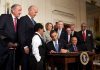
Obamacare failed. I’m sorry to be the one to tell you, but as a solution to the country’s healthcare woes, it fell short in practically every area. It failed in its primary goal of bringing down the cost of medical care and insurance coverage, with even those opting to obtain their coverage through the “exchanges” grumbling about the monthly premiums. Instead, it led to increased underlying costs, double-digit annual increases in policy prices, a reduction in the number of insurance providers, limits on lower-cost alternatives to the standard marketplace, and a greater expansion of the healthcare-industrial complex.
Of course, it wasn’t all bad news. The Affordable Care Act (ACA) did extend medical insurance coverage to more Americans, but it did so with mediocre coverage, access limits to actual healthcare providers, sky-high deductibles and premiums, and pretend price structures that require taxpayers to bear a portion of the cost for both individuals and providers. Obamacare also enabled those with pre-existing conditions to acquire coverage, but as with most government programs, it did this on the backs of poor and middle-class Americans, since they must now bear the costs associated with expensive procedures not previously covered.
Any large government program will help some people, and there are legitimate stories of individuals who benefited from the program. But anecdotes are never a valid means of assessing public policy. Some residents of Pyongyang live relatively stable and secure lives, but no honest observer would claim that such anecdotes were indicative of most North Korean citizens, or represented an appropriate assessment of national policy.
Obamacare failed for three key reasons, all having to do with government intrusion into the healthcare marketplace: (1) the ACA greatly expanded the existing regulatory systems that were already perturbing the driving forces of supply and demand in a setting of scarce medical resources; (2) the goals of Obamacare were political rather than fiscal in nature, attempting to right supposed societal wrongs through the force of government mandate; and (3) the law entrenched a bureaucratic, centrally controlled, healthcare monopoly that encouraged oligarchy and big business, discouraged competition, innovation, and common sense, and made any exit from that system both painful and complicated.
Regulation versus Supply and Demand
Obamacare failed in part because it was designed to work against the very processes that tend to lower prices and increase access by ordinary consumers. The key factor in the pricing of any good or service is supply and demand. Where there is an oversupply of, say, crude oil and not a lot of demand for gasoline or other petroleum-based products, prices for oil go down. If OPEC limits oil production, as they did back in September, prices rise, even if demand remains steady.
The same is true for any other exchange of goods or services, including medical care. If you increase demand for a service, or reduce the supply of that service, prices will increase. Obamacare accomplished both. By forcing insurers to cover a wider range of services on every policy type, and by providing tax subsidies (read: welfare) to a large number of Americans that artificially lowered the cost of insurance premiums, the ACA increased the demand for services by those who previously would have postponed or gone without such services. Likewise, despite a temporary increase in Medicaid payouts to physicians in 2013 and 2014, the law lowered physician reimbursements for those on the lowest-level plans. Since doctors are not required to accept patients from any specific plan, many opted to forgo patients with those lower-paying policies, thereby reducing the supply of services for those patients. Higher demand, lower supply; this combination tells any ECON 101 student that prices will rise. (To be fair, some provisions of Obamacare do attempt to increase the supply of providers. But implementation is on the order of years and decades, so the short-term benefits are limited.)
The use of insurance for routine services also tends to drive up prices, since guaranteed coverage ensures that a limitless pool of funds will chase after a limited supply of general practitioners. If your auto insurance provided unlimited refills of your gas tank, you would drive more, since there would be no financial disincentive to travel as far or as often as you desired.
Government regulations covering the availability and quality of coverage, the licensing and educational requirements for providers, and the specifics of medical insurance policies all impact the cost, and ultimately the fees, associated with medical services. As the costs of implementing those regulatory requirements increase for typical doctors, more and more providers opt to provide services through large hospitals and provider groups, which can better distribute those costs across the organization. This also decreases both supply and competition, and tends to make medical care an assembly line of rudimentary, impersonal service offerings.
The Politics of Medicine
As with any attempt at government-mandated price controls, the announced goals are always laudable: helping the sick and the poor. But as we have experienced, beyond the specific anecdotes analyzed above, the sick and the poor, not to mention the healthy and the rich, have not fared better under Obamacare. That’s because the goals were political. President Obama’s promises to bring “more security and stability” to the healthcare market notwithstanding, the law has actually brought confusion and instability in part because the stated goals differed from the actual goals.
If the purpose of the law was to make healthcare more affordable, it would have increased supply or decreased demand, or both, leading to lower prices. But the goal was to require businesses—those employing insurable people as well as insurance companies—to provide new or increased services at new and increased costs. Those requirements came with penalties for those who did not comply, and therefore represented a political, and not a fiscal, process.
One of those political goals was to provide benefits for lower-income Americans, paid for by the rich who presumably were not already “paying their fair share.” While the costs of basic medical care have gone up well beyond the average inflation rate in recent decades, most other products and services have not seen such increases. Consider, for example, cell phones. Back in the early 1980s, the TV series Hart to Hart showed the typical daily trappings of a fabulously wealthy California business tycoon: a butler named Max, regular involvement in murder investigations, and a Mercedes 450 SL convertible with a tethered cell phone. The ability to make phone calls while driving was the purview of the rich and powerful. Back in 1984, the Motorola DynaTAC cost around $4,000—equivalent to about $9,200 today. Monthly service fees ranged from $100 to $200 (today’s dollars) plus per-minute charges, assuming that your city had cell towers.
Today, a cell phone with a super-computer attached can be obtained for free, when bundled with a two-year plan at much less than $100 per month. Thirty years ago, only Jonathan and Jennifer Hart could afford a portable phone. These days, the typical middle-class family has a phone for every member of the household. This cost decrease has taken place despite high infrastructure costs, enormous increases in phone technology, and rising worldwide demand for phones.
This story can be repeated for all kinds of advances: automobiles, air conditioners, indoor plumbing, and so on. Even luxury services are now available to lower-income members of our society. Long ago, only a millionaire could afford a chauffeur. Today, a few touches on your Uber app brings a driver into your presence within minutes, or within seconds if you live in a large city.
Laws like the ACA attempt to punish the rich, to bring them down to the same level as everyone else in a futile drive toward a more perfect utopian society. Such policies are misguided, and distort the reality that the rich help drive the lowering of costs for any new product or service. Cell phones are cheap today in part because Jonathan Hart and his real-world counterparts were willing to pay $9,000 for one phone. Flat-screen plasma displays and basic desktop computers both used to cost around $15,000. Today, you can walk out of a Best Buy with something even better for under $300, thanks in part to those who were willing to pay $15,000 for the latest technology.
Bureaucracy and Power
One of the worst abuses of laws like the ACA is that they purport to be for the common American, but the biggest beneficiaries are large businesses and entrenched politicians. Policies like Obamacare enable “too big to fail” companies because the regulatory requirements are too costly or time-consuming for sole proprietors. I know this from first-hand experience, as one company I work with had to spend hundreds of hours trying to comply with the reporting requirements of the law, to say nothing of the implementation demands. When confronted with such burdens, some smaller businesses simply give up, or pay high fees to third-party compliance companies, fees that are passed on to customers.
Because large companies are more often driven by issues of efficiency and uniform product offerings, the innovation benefits that come from a highly competitive marketplace dissipate. Politicians love such narrowing within industries because it makes legislation of those markets easier to manage, and provides better opportunities for lobbying interactions. A lone doctor in Wyoming will seldom waste time petitioning the government for redress of grievances. A New York-based HMO with 50,000 providers in its network can petition all day long.
The correct way to lower healthcare costs is to enact limited, sensible regulations that increase the supply of medical services, and allow demand for those services to progress normally based, in part, on what Americans at different income levels can afford. The following regulatory and cultural changes would result in significantly lower healthcare costs for the average American.
Charge consumers directly for medical services and insurance coverage instead of masking those prices through non-catastrophic insurance policies, employer-provided bulk coverage, and tax kickbacks.
Allow insurers to provide national-level policies with a wide range of coverage benefits, and at price points that match those benefits.
Allow medical insurance policies to work like other insurance products: reducing the risk associated with high-cost events instead covering mundane, routine expenses.
Reduce the overall number of regulations to a level that allows an individual provider to offer safe, affordable services while still making a profit.
Modify licensing requirements to permit providers at lower training and education levels to offer lower-cost basic services.
Stop confusing low-price with low-cost by ending the practice of tax rebates, physician reimbursements, and “cost correcting” payments to insurers.
Require providers to make their prices public, including the underlying “chargemaster” rate schedules from which billings derive.
Reduce the cost of a medical education by expanding the number of schools with training programs, and stop trying to force every high school graduate into college, which only serves to bombard the supply of schools with over-demand, and dilutes the educational offerings. (NOTE: Obamacare does attempt to expand provider training, one of its positive aspects.)
Enact meaningful tort reform so that quality providers are not taken out of the market by one angry patient.
In short, stop pretending that medicine is different from any other industry, a magical realm where the normal incentives of business should somehow not apply. These suggestions are broad, and would likely take a decade or more to implement. There would also be some pain in the short-term, as the current generation’s dependence on work-provided unlimited coverage would come to an end. But if we are truly serious about reducing the price of healthcare, we need to start seeing it for what it is: just one more ordinary industry that should not be singled out for government control just because it sounds important.
[Image Credits: White House]
January 3, 2017
The Mediocre Right to Healthcare

Donald Trump is no fan of Obamacare. As stated on his official web site, “On day one of the Trump Administration, we will ask Congress to immediately deliver a full repeal of Obamacare.” While the GOP may salivate over killing the favorite policy of the Obama administration, not everyone is celebrating. President Obama, for one, recommends keeping the Affordable Care Act intact, stressing that “no American should have to go without the healthcare they need.” Other supporters of the law go even further, calling the access to such healthcare programs a “right.”
As Americans, we take our rights seriously, especially since some of those “unalienable rights” were listed as justifications for our initial break with Britain. But is it appropriate to include healthcare among those rights? To answer that, we first need to understand what these rights are.
Life, liberty, and the pursuit of happiness—the three rights listed in the Declaration of Independence—are among the “natural rights” that have been endowed to us “by our Creator.” Philosophers consider such rights to be “negative,” in that others may not “negate” or remove them without due process. In this understanding, the right to life is not the right to live a healthy life, but rather the right not to have your life taken away by another, or by the government. You have a claim on your life and liberty, a claim that the government cannot simply take away just because it wants to. Within a society, there are agreed-upon processes by which a right can be taken away from an individual. For example, a felon may have the right to liberty removed for a time as a consequence of committing a crime. But if there is no legitimate reason for negating a right, citizens may invoke their claim, as the Colonists did through the Revolutionary War.
In addition to these negative rights, philosophers also recognize “positive” rights, those that require some specific positive action on the part of another to make possible. A society may include or exclude such “legal rights” by custom or by law, but they are not the same as natural rights, since we are not endowed with them simply by being human. When people speak of healthcare as a right, they are listing it among the positive rights.
When you exercise a positive right, another person may be obligated to act in a way that denies them a natural right. For instance, you may have the natural right to “pursue” quality healthcare, but the legal right to receive healthcare means by extension that someone else must fulfill that right. Your natural right to liberty exists even if nobody is around to impede you. But the legal right to healthcare is meaningless if no doctors exist. It is the presence of those doctors, and your ability do use their services, that activates the right.
If a positive right is considered a guarantee by society, then, in the event that no one voluntarily offers to fulfill your demand for healthcare, someone must be compelled, by force if necessary, to provide that healthcare. A society may decide that such things are reasonable and important, but it does not make that thing (healthcare) a natural right just because society says so.
Consider babysitting instead of healthcare. Let’s say that you have an important evening meeting, and require babysitting services. If the only babysitter in the neighborhood refuses to take care of your kids that night, what do you do? In a society where babysitting is declared to be a right, you can compel your neighbor to care for your kids, because you have a right to do so that can be invoked, even at the expense of the natural rights of others.
Traditionally, a legal right should not trump the right to freedom, but that is the problem with legal rights. If a society deems them that important, they can trample natural rights, although they shouldn’t. These days, we’ve expanded the list of legal rights to cover virtually every aspect of our daily lives: healthcare, basic housing, a “living wage,” retirement benefits like Social Security, and internet access.
Many of these positive rights are nice things to have, but each of them comes with significant costs, especially in the loss of natural rights like liberty, due process, and self-determination. A society may decide that valuing positive rights over natural rights is worth the cost. But its citizens should not be surprised when they eventually lose both kinds.
[Image Credits: flickr/NESRI]
December 27, 2016
Review of Moscow: December 25, 1991

Twenty-five years ago this week, the Soviet Union came to an abrupt an uneventful end. Six years earlier, in 1985, Mikhail Gorbachev had initiated a series of reforms across the USSR designed to end the economic and political stranglehold that made it the lesser of the two great world powers. By Christmas Day, 1991, the government whose former leader had promised the United States that “we will crush you” slipped into a quiet nonexistence.
The events of that fateful December day are carefully documented in Moscow: December 25, 1991, by Irish Times correspondent Conor O’Clery. As the story of “The Last Day of the Soviet Union” unfolds, the chapters tie each passing hour to the events that led up to the collapse of the biggest Communist nation on earth. Those events are sometimes dramatic, sometimes even violent: Gorbachev’s 1985 speech announcing the policies of glasnost and perestroika; the rise of the blustery Siberian politician Boris Yeltsin, first as mayor of Moscow, and then as president of Russia; and the attempted coup by Communist party leaders in August 1991, where both Gorbachev and Yeltsin were halfheartedly arrested.
The book bills itself as “a chronicle of one day in the history of one city. The day is Wednesday, December 25, 1991. The city is Moscow.” Yet by the time the final day arrives, the focus is no longer on Moscow, but instead on the relationship between Gorbachev and Yeltsin—or rather, on the lack of any cordial relationship at all. Through personal first-hand interviews and deep coverage of the documentation from the closing Soviet era, O’Clery tells the true yet sad tale of two reformers doomed to despise each other.
Gorbachev comes to power in 1985, a breath of reformist fresh air after the sudden deaths of Yuri Andropov and Konstantin Chernenko, the two previous status quo Communist Party General Secretaries. He inherits a broken union, where “corruption and alcoholism were a way of life.” His reforms are met with suspicion by party leaders, but with a bit of hope by the Soviet republics, and by the reform-minded Yeltsin, “the hard-drinking, backwoods Siberian.” When Gorbachev seats Yeltsin as Moscow’s mayor nine months after his own promotion to national leader, he calls Yeltsin “a fresh strong wind,” a wind that eventually blows the Soviet system away.
Throughout the book, Gorbachev is portrayed as enlightened as to the failings of Communism, but completely unaware of its Capitalist counterpart, or of the upheaval that a sudden change from one system to the other will bring, including the loss of his own power. Until the bitter end, even as every vestige of authority is taken from him, he insists that he has a role to play in a top-down, managed system, one where the economy, politicians, and “independent” republics will fall into line. But within 24 hours of his resignation, he is forced out of his state-supplied home, and has to beg for a car to take him and his wife Raisa to their next apartment.
Yeltsin seems equally unsure of the future, presented by O’Clery as an angry, drunk oaf, simultaneous heroic and pathetic. His desire to bring the Communist regime to an end is driven in part by his concerns for Russia, and also for his bitter hatred of Gorbachev. In the final month of the Soviet Union, Yeltsin, along with the leaders of Ukraine and Belarus, decide the fate of the continent without much input from the official national leader. When Yeltsin and Gorbachev do meet on December 23, 1991, to discuss the transition of power, Yeltsin can barely contain his contempt. After that planning session, the two leaders never meet again. Even the final transfer of the chemodanchik—the nuclear football—takes place through military intermediaries.
Like William Shirer’s The Rise and Fall of the Third Reich in 1960, O’Clery’s book excels due to its extensive research, its use of primary sources, and its direct interviews between the author and key figures in the Soviet Union’s downfall. For the typical westerner, most of the names are unfamiliar. But the author makes them familiar to the reader, in part because they are familiar to him. (Vladimir Putin, the current Prime Minister of Russia and Yeltsin’s replacement as President, appears in a minor role, first as a mid-grade KGB operative, and later as a bureaucrat in the St. Petersburg mayoral office.)
From the initial rise of Gorbachev and Yeltsin, to the sad end when the first and last president of the Soviet Union had to borrow a pen from CNN president Tom Johnson to sign his resignation letter, Moscow: December 25, 1991 does at great job at making a major historical event personal.
December 20, 2016
Yes, the Founders Did Anticipate Russian Hackers

Although yesterday’s Electoral College vote clinched the presidency for Donald Trump, the arguments over his legitimacy continue. The latest concern is that Russian computer hackers sponsored by no less than Vladimir Putin himself were able to swing the election to Trump. Some Democrats had called for the Electoral College vote to be postponed, and at least one commentator hoped breathlessly that U.S. courts would invalidate the November 8 election altogether.
The underlying rationale for such hopes is twofold: (1) that hackers interfered with the outcome of the presidential election; and (2) that America’s Founders, with their inability to foresee twenty-first century technology, never anticipated this scenario. The debate over the first point will likely go on for the next four to eight years. But for the second point, there is no argument: the Founders did anticipate exactly this situation.
Of course, James Madison and friends knew nothing about Facebook or internet communication protocols. But those who crafted our Constitution were fully aware that a foreign nation might try to disrupt the government of the United States, or of its individual states. Americans living in the late eighteenth century had just come through a bitter war, one where the key issue was Britain’s interference with the laws and taxes of the individual colonies. They were not keen to repeat the experience.
To help guard against such influence, the Constitution contains several statements that speak directly to the foreign issue, including in its requirements for the presidency. In Article II of the document, which defines the office of the president, Section 1 lists this eligibility requirement:
“No Person except a natural born Citizen, or a Citizen of the United States, at the time of the Adoption of this Constitution, shall be eligible to the Office of President; neither shall any Person be eligible to that Office who shall not have attained to the Age of thirty five Years, and been fourteen Years a Resident within the United States.”
The “natural born Citizen” and “fourteen Years a Resident” clauses were included specifically to guard against foreign influence. John Jay, the Founder who went on to become the first Chief Justice of the Supreme Court, recommended to the constitutional delegates that the new Constitution “provide a strong check to the admission of Foreigners into the administration of our national Government.” By limiting the Chief Executive to life-long citizens, and only to those who had spent the last fourteen years of their lives as active American residents, the Constitution attempts to reduce the understandable influence that would come from having grown up or lived recently in another nation.
Senators and representatives are similarly restricted to only those who have been U.S. citizens for nine years and seven years, respectively, although the “natural born Citizen” requirement applies just to the president. The bar for president is certainly high, a reflection of the concern for power concentrated in an individual that would not apply as much to a larger body like the Senate. (Article III, which documents requirements for the Judicial branch, does not even mention citizenship as an eligibility requirement for judges.)
The Founders were intentional about putting up barriers to foreign influence in the person of the president, but they didn’t extend that to the political process that led up to presidential selection. Perhaps it was an oversight, or a desire to keep the Constitution trim and nimble. But there is nothing in the Constitution that prevents a foreign government from trying to influence an election. In fact, with Britain ready to stir up trouble again in the early nineteenth century, Americans probably expected that other countries would bother our political processes.
The hacking allegations against Russians didn’t involve attacks on voting machines, or on the processes used to count citizen votes. Instead, the fear is that the hackers obtained and released confidential yet fully accurate information to the voting public. There are laws on the books against computer hacking. But they are not designed to protect against this level of foreign influence. Instead, the bulwark against such aggression is supposed to come through an educated citizenry. When voters understand how government works, as well as the things that politicians do to either advance or corrupt government mechanisms, the release of some hacked emails should only help, not hinder, the way in which the voting public approaches each election.
[Image Credits: Wikimedia Commons]
December 13, 2016
The Right Way to Create Jobs in America

Presidents do not create jobs. Well, that’s not completely true. Presidents can create taxpayer-supported government positions. Some of these jobs may be necessary, but they don’t grow the economy. Congress can’t make good jobs, either. And of course, the Supreme Court only has one current job opening.
People wring their hands over what a president might do to society, but according to a Pew Research poll from earlier this year, 84% of voters care primarily about the economy. With the official unemployment rate sitting just below five percent—a level traditionally recognized as “full employment”—there should be ample reason to celebrate. Yet everyone knows instinctively that there’s something wrong with American jobs.
Jobs come from businesses, not the government. But there are actions that the president and the Congress can take that encourage job growth. Over the last few weeks, president-elect Trump announced two such actions, one of which is exactly what is needed to bring jobs, and one that embodies the same, failed policies that got us into this economic mess in the first place.
Let’s start with the bad. On December 1, Donald Trump announced a deal with air conditioner manufacturer Carrier Corporation. As part of the agreement to retain between 800 and 1,400 jobs in the Indianapolis area, the state of Indiana, with encouragement from Trump and his VP Mike Pence, agreed to extend $7 million in tax breaks to the company. Usually, reduced taxes on business is a good thing. Part of the reason that manufacturers have left the United States over the last several decades has to do with our internationally high tax rate on business income, the third highest in the world. Providing across-the-board tax relief to businesses would free up more money for salaries and the type of new business development that leads to more jobs. But offering a tax discount to one specific company is corporate welfare, and useless to the economy as a whole.
Republicans cried foul when President Obama tried the same tactic to advance “green jobs,” including federal loan guarantees that the Department of Energy granted to the now-failed energy company Solyndra. But when an incoming Republican administration announces public incentives for a private corporation, it’s hailed as a victory for hard-working Americans.
It’s not. Carrier was already operating under state-provided tax incentives. As part of their announced move to Mexico, the company planned to repay $1.2 million in past tax breaks, plus $380,000 in state grants. Despite such taxpayer support, Carrier still found that the cost of doing business in America warranted a move across the border.
It’s that last concern that leads to the good thing that Trump did. Less than a week after the Carrier announcement, Trump met with Masayoshi Son, the head of Japan’s SoftBank and majority owner of telecom giant Sprint. According to the Wall Street Journal, Son “had wanted to invest in the U.S. but the regulatory climate was too harsh, so he invested outside the U.S. instead.” His perspective changed after meeting the president-elect, a tête-à-tête that generated a pledge to invest $50 billion in U.S. businesses, leading to at least 50,000 new jobs.
It wasn’t Trump’s promise to shower Son with one-time tax breaks that cemented the deal, and it certainly wasn’t the president-elect’s warmth and charm. Instead, it was his promise to cut corporate taxes in the United States, and to reduce the regulatory burdens that both domestic and overseas companies must deal with when setting up shop here in the States.
Mr. Son expected government regulatory policies to change under a Trump administration. He said that a President Trump “would do a lot of deregulation. I said, ‘this is great.’ The U.S. will become great again.” The push toward lower taxes and deregulation has been a recurring theme in Donald Trump’s campaign. At the earlier Carrier event, Trump said, “We’re going to lower our business tax from 35 percent, hopefully down to 15 percent…. The other thing we’re doing is regulations…. [Great] leaders of industry, and even the small business people who are just being crushed, if they have their choice between lower taxes and a major, massive cutting of regulations, they would take the regulations.”
In this, Trump is doing it right. Businesses create jobs, at least if they have the money to pay people. When you weigh down a business with excessive taxes and hundreds of regulations that offer little help to the common worker, it should come as no surprise that companies would seek a better environment. Regulations suck away money normally used to pay workers, or reserved for business opportunities that would, in turn, generate more jobs. Especially burdensome are labor-related regulations, and if a company has to choose between regulations that seek to destroy it, or technological efficiencies that replace workers but allow for ongoing profitability, of course they are going to choose the latter.
Consider the new Amazon Go experiment, a convenience store that replaces cashiers with radio waves and cameras. While there is a certain wow factor in applying cool technology to traditional business environments, it’s no coincidence that the proposed store also greatly reduces the costs associated with labor. In an environment where investments in labor-replacing technologies didn’t outweigh the regulatory costs of employees, companies like Amazon wouldn’t be so quick to abandon the customer-service advantages of hiring real human beings.
Regulations are especially difficult for small businesses, which lack the capital needed to handle regulatory costs and wage requirements. As a result, more and more jobs move from labor-friendly local firms to more efficient international conglomerates. Those giant corporations have the resources to replace high-cost workers with more efficient alternatives, including lower-priced overseas workers and technology advances. In short, higher American business costs lead to fewer American jobs.
The opening years of the twenty-first century have been filled with misguided attempts to right the supposed wrongs of business by imposing regulations and taxes that at times were well well-meaning, but that ultimately cost jobs. By reinvigorating an atmosphere that encourages companies to hire and use their profits to expand and develop, and by eliminating useless rules that encourage corporations to consider off-shore alternatives, we may finally make that sub-five-percent unemployment rate a real reason to celebrate.
[Image Credits: Steve Buissinne, pixabay.com/stevepb]
December 5, 2016
Five Reasons Why America Won’t End with Trump (And Three Why It Might)

The violent post-election outbursts from the cry-baby subset of Americans may be coming to an end, but a lot of people who rejected Donald Trump as president continue to worry about the future of the country. The concern stems from expectations about what will occur under a Trump administration. Some of the predictions are downright dire, with the most extreme anticipating the end of America, or even the world.
Trump was certainly a loudmouth during the campaign, and showed himself to be an equal-opportunity offender of everyone not named Trump. The vitriol after the election was likewise rough, but there are ample reasons to believe that things will work out just fine for the nation, even with Donald Trump in the Oval Office.
1. Trump Is an Entertainer
Donald Trump is a master showman, something that even his detractors readily admit. In his book, The Art of the Deal, when speaking about publicity and promotion, Trump said, “One thing I’ve learned about the press is that they’re always hungry for a good story, and the more sensational the better…. If you are a little different, or a little outrageous, or if you do things that are bold or controversial, the press is going to write about you.” This exemplifies his brash presidential campaign, and every Trump business campaign that preceded it.
Trump productions are always glitzy: lots of gold color and shine, lots of noise and pomp. But in the end, if you rent office space in Trump Tower, you are renting office space. You pay rent. You have windows. You install desks and phone systems. Life in the Trump Tower may be gilded, but it is not that different from any other comparable upscale business setting. And this should provide hope. Trump loves marketing, but the end product is something that appeals to a general American clientele, be it office towers, golf courses, or steaks.
2. Trump is Not Racist
It’s highly unlikely that Trump is a racist, at least as the word is used it its traditional and correct sense. These days, every Republican is classified as a racist, but as I explained in an earlier article, such claims are preposterous and overblown. As expected, Trump is already showing a preference for diversity in his cabinet and bureaucratic appointments.
Much of the concern stems from Trump’s insistence that “2 million criminal illegal immigrants” should be deported. Of course, such discussions are not new. In his 1996 book, Between Hope and History, President Bill Clinton called for strict enforcement of illegal immigration laws, and boasted, “we have increased our Border Patrol by over 35%; deployed underground sensors, infrared night scopes and encrypted radios; built miles of new fences…. Since 1993, we have removed 30,000 illegal workers from jobs across the country.” Despite espousing these stern immigration policies, there were few, if any, claims that Bill Clinton was racist. Clinton was not a racist, and neither is Trump.
3. America is a Nation of Laws
Even if Donald Trump was a raving bigot, the Constitution, the nation’s laws, the court system, and the electorate will ensure that any policies he issues are restrained. It’s that whole “checks and balances” thing you keep hearing about. Congress makes laws, not the president. Presidents can issue executive orders and selectively enforce specific regulations. Both of these are subject to the approval of Congress, since a legislature with sufficient unity and will can overturn executive orders or issue new laws and regulation guidance.
Beyond federal checks and balances, the states have provided regular input on the national political process. Although the Ninth and Tenth Amendments have been overlooked in recent decades, they nonetheless give the states and the people significant influence over the national conversation, and the people always retain the power to overturn national dictates through elections and amendments.
4. Trump is Bush III
George W. Bush was not a conservative. You probably thought he was since he was a Republican. But like his father before him, Bush-43 was a political moderate, especially when it came to fiscal policy. From the TARP bailout to the No Child Left Behind program, Bush was not afraid to use the financial largess of the government—thank you taxpayers—to ensure that things too big to fail did not, in fact, fail.
Trump is not unlike Bush in this regard. He classified himself as a Democrat for most of his adult life, and approved of programs and public-private relationships in ways that are in line with Democratic Party principles. This is one reason why many Republicans were shocked to see Trump rise so quickly during the primary season, and a major reason why the Democratic freak-out over Trump is severely overblown. If anyone should be worried, it’s those in the GOP.
5. Americans are Passionate
If the US Constitution were to suddenly become the foundation of China’s government, that nation would not turn into America. The institutions, the resources, and most of all the political history of that nation would push it to become vastly different from what the United States is. It’s the people, their culture, and the passion that stems from that culture that make America what it is. The government, while relevant and structurally significant, is not the core of the United States.
The American culture includes a strong sense of right and wrong, stemming from its Puritan upbringing. “Americans will always do the right thing—after exhausting all the alternatives.” While this quote, often misattributed to Winston Churchill, is meant to be humorous, it carries a core truth: the American people will do the right thing. It sometimes takes a while, but it does happen, thanks to the focus being on the people instead of on the government. If some person with clearly evil intent did assume power as president, he would not last, because the people would reject him. The path to that rejection would be bumpy, to be sure. But time and time again, when confronted with issues of lasting import, the majority of the American public eventually unites in common purpose.
Despite these reasons for optimism, it’s not all peaches and cream. Some of this is standard transitional fare; becoming the “leader of the free world” is not an easy task for anyone, no matter how skilled. Take Trump’s latest brouhaha: With more than a month to go before the inauguration, he has already ruffled international feathers by taking a call from the President of Taiwan. This stuff happens in any administration. Think back on Kennedy’s Cuban Missile Crisis, or on the whole Reagan-era Iran-Contra affair. But there are specific aspects to Trump’s personality and policy stances, and of America in general, that make his presidency a time for concern.
1. Trump is a Protectionist
One of Trump’s main campaign messages was the bringing back of jobs to America, primarily through the tool of strong, government-mandated trade conditions. Such protectionist tactics have been tried in America’s past—tried and proved harmful. From Thomas Jefferson’s Embargo Act to the Smoot–Hawley Tariff Act in 1930, protectionism has always had a negative impact on the nation’s economy, especially when it came about through a sudden change in public policy.
While international trade pacts such as the North American Free Trade Agreement have not always been equitable in their impact on the American economy, they still represent a better engine for overall growth than trade barriers. Donald Trump’s plan to withdraw from the proposed Trans-Pacific Partnership is the first step toward his “America First” policy, one that sounds dangerously like the same protectionism that held back American economic success in the past.
2. Trump is a Deal-Maker
Donald Trump’s promise to “drain the swamp” notwithstanding, he has already showed an inclination to use the power of the government in ways that work against the general public, and against small businesses. By negotiating a tax deal with Carrier Corporation, he in effect established a trade barrier not only against foreign firms that might want to sell lower-cost air conditioners in the United States, but also against other American firms looking to do the same. This willingness to use the deal-making power of the government to favor specific companies or industries is exactly the type of public-private relationship that Eisenhower warned us about when speaking of the military-industrial complex.
Sarah Palin called the deal with Carrier “crony capitalism,” and she’s correct. Trump’s background as a business deal-maker may tempt him to use crony relationships as the core of his economic plan. Unfortunately, such schemes lead to everything that Republicans in particular, and Americans in general, most loathe: government growth, political favoritism, corporate welfare, increased government debt, and that strange duplicitous policy of enriching the powerful business elite through key government contracts while simultaneously reviling businesses as the source of America’s failures.
3. Americans are Hysterical
Perhaps the biggest concern with a Trump presidency is in what it reveals about the American populace. During this election cycle, many Americans were content to make their presidential choices based on personality rather than policy, on emotion rather than reason, and on innuendo rather than truth. While elections have always been rough, the 2016 presidential race will certainly be remembered as one of the most wild and contentious political battles in American history.
Jefferson famously wrote, “If a nation expects to be ignorant and free, in a state of civilization, it expects what never was and never will be.” Unfortunately, we have reached a point in the nation’s history where ignorance, at least about policy matters, is the norm. The rise of the permanent anger class has shifted voting away from policy concerns, and toward who can direct the most hatred toward their opponents. It’s a voting method that requires no knowledge of laws or history or civilization, but instead relies on the divisive hatred that has historically allowed corrupt leaders to manipulate nations for their own purposes. It’s a form of hysterical ignorance that always leads to tyranny.
[Image Credits: flickr/futureatlas.com]