
Kenneth C. Davis's Blog, page 53
March 10, 2018
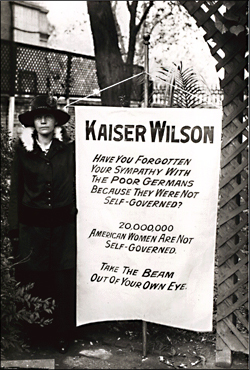
The Spanish Flu, World War I, and Suffrage,
On Friday March 9, 2018, I joined the Brian Lehrer Show on WNYC in New York City to talk about the Spanish Flu, World War I, and their impact on suffrage.
The interview can be heard here.


March 4, 2018
Who Said It?
Abraham Lincoln, Second Inaugural Address (March 4, 1865)

Photograph of Abraham Lincoln’s second inaugural. Lincoln is at the very center of the picture surrounded by dignitaries.
Credit: Image courtesy of American Memory at the Library of Congress.
He now wills to remove, and that He gives to both North and South, this terrible war, as the woe due to those by whom the offence came, shall we discern therein any departure from those divine attributes which the believers in a Living God always ascribe to Him? Fondly do we hope — fervently do we pray — that this mighty scourge of war may speedily pass away. Yet, if God wills that it continue, until all the wealth piled by the bond-man’s two hundred and fifty years of unrequited toil shall be sunk, and until every drop of blood drawn with the lash, shall be paid by another drawn with the sword, as was said f[our] three thousand years ago, so still it must be said “the judgments of the Lord, are true and righteous altogether”
Source and Complete Text: Abraham Lincoln Second Inaugural Address
February 19, 2018
Don’t Know Much About® Executive Order 9066
On this date- February 19, 1942 – a different kind of infamy

Dorothea Lange
In this 1942 Dorothea Lange photograph from the book “Impounded,” a family in Hayward, Calif., awaits an evacuation bus.
Franklin D. Roosevelt famously told Americans when he was inaugurated in 1933:
The only thing we have to fear is fear itself
But on February 19, 1942 –a little more than two months after the attack on Pearl Harbor— President Roosevelt allowed America’s fear to provoke him into an action regarded among his worst mistakes. He issued Executive Order 9066.
The result of this Executive Order was the policy of “relocating” some 120,000 Japanese Americans, and a smaller number of German and Italian Americans, into “internment camps.”
I have written about the subject of the internment of the Japanese American population in the past including one on photojournalist Dorothea Lange, and Ansel Adams, who also documented the period.

Photo: (National Park Service, Jeffery Burton, photographer
Among these resources is a site devoted to the War Relocation Camps –a Teaching With Historic Places Lesson Plan from the National Park Service called “When Fear Was Stronger than Justice.”
February 15, 2018
“Two Societies, One Black, One White”
(Revised post originally published on February 29, 2016)
Once again, it is necessary to repost this piece about the Kerner Commission, formed fifty years ago to address violence in American cities. The latest school shooting only adds to the urgency.
On July 27, 1967, President Lyndon B. Johnson established an 11-member National Advisory Commission on Civil Disorders. He was responding to a series of violent outbursts in predominantly black urban neighborhoods in such cities as Detroit and Newark. (New York Times account.)

Time Magazine cover August 4, 1967
On July 29, 1967, President Johnson made remarks about the reasons for the commission:
The civil peace has been shattered in a number of cities. The American people are deeply disturbed. They are baffled and dismayed by the wholesale looting and violence that has occurred both in small towns and in great metropolitan centers.
No society can tolerate massive violence, any more than a body can tolerate massive disease. And we in America shall not tolerate it.
But just saying that does not solve the problem. We need to know the answers, I think, to three basic questions about these riots:
–What happened?
–Why did it happen?
–What can be done to prevent it from happening again and again?
Source:Lyndon B. Johnson: “Remarks Upon Signing Order Establishing the National Advisory Commission on Civil Disorders.,” July 29, 1967. Online by Gerhard Peters and John T. Woolley, The American Presidency Project.
On Feb. 29, 1968, President Johnson’s National Advisory Commission on Civil Disorders, later known as the Kerner Commission after its chairman, Governor Otto Kerner, Jr. of Illinois, issued a stark warning:
“Our Nation Is Moving Toward Two Societies, One Black, One White—Separate and Unequal”
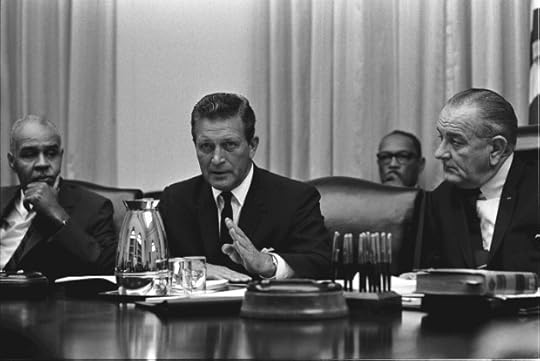
Governor of Illinois Otto Kerner, Jr., meeting with Roy Wilkins (left) and President Lyndon Johnson (right) in the White House. 29 July 1967 Source LBJ Presidential Library
The Committee Report went on to identify a set of “deeply held grievances” that it believed had led to the violence.
Although almost all cities had some sort of formal grievance mechanism for handling citizen complaints, this typically was regarded by Negroes as ineffective and was generally ignored.
Although specific grievances varied from city to city, at least 12 deeply held grievances can be identified and ranked into three levels of relative intensity:
First Level of Intensity
1. Police practices
2. Unemployment and underemployment
3. Inadequate housing
Second Level of Intensity
4. Inadequate education
5. Poor recreation facilities and programs
6. Ineffectiveness of the political structure and grievance mechanisms.
Third Level of Intensity
7. Disrespectful white attitudes
8. Discriminatory administration of justice
9. Inadequacy of federal programs
10. Inadequacy of municipal services
11. Discriminatory consumer and credit practices
12. Inadequate welfare programs
Source: “Our Nation is Moving Toward Two Societies, One Black, One White—Separate and Unequal”: Excerpts from the Kerner Report; American Social History Project / Center for Media and Learning (Graduate Center, CUNY)
and the Roy Rosenzweig Center for History and New Media (George Mason University).
Issued half a century ago, the list of grievances reads as if it could have been written last week.
February 12, 2018
Who Said It? 2/12/18
Abraham Lincoln, First Inaugural Address (Monday March 4, 1861)

Abraham Lincoln (November 1863) Photo by Alexander Gardner
I am loath to close. We are not enemies, but friends. We must not be enemies. Though passion may have strained it must not break our bonds of affection. The mystic chords of memory, stretching from every battlefield and patriot grave to every living heart and hearthstone all over this broad land, will yet swell the chorus of the Union, when again touched, as surely they will be, by the better angels of our nature.
Source and Complete Text: Avalon Project Yale Law School
Abraham Lincoln was born on February 12, 1809.
It is NOT Presidents Day. Or President’s Day. Or Even Presidents’ Day.
So What Day Is it After All?
Okay. We all do it. It’s printed on calendars and posted in bank windows. We mistakenly call the third Monday in February Presidents Day, in part because of all those commercials in which George Washington swings his legendary ax and “Rail-splitter” Abe Lincoln hoists his ax to chop down prices on everything from mattresses and linens to SUVs.
But, it is officially still George Washington’s Birthday –federally speaking that is.
The official designation of the federal holiday observed on the third Monday of February was, and still is, Washington’s Birthday.

I wrote My Project About Presidents in 3rd Grade when I was 9. Even then I was asking questions about history and presidents
But Washington’s Birthday has become widely known as Presidents Day (or President’s Day, or Presidents’ Day). The popular usage and confusion resulted from the merging of what had been two widely celebrated Presidential birthdays in February —Lincoln’s on February 12th, which was never a federal holiday– and Washington’s on February 22, which was.
Created under the Uniform Holiday Act of 1968, which gave us three-day weekend Monday holidays, the federal holiday on the third Monday in February is technically still Washington’s Birthday. But here’s the rub: the holiday can never land on Washington’s true birthday because the latest date it can fall is February 21, as it did in 2011.
There is a wealth of information the First President at Mount Vernon.
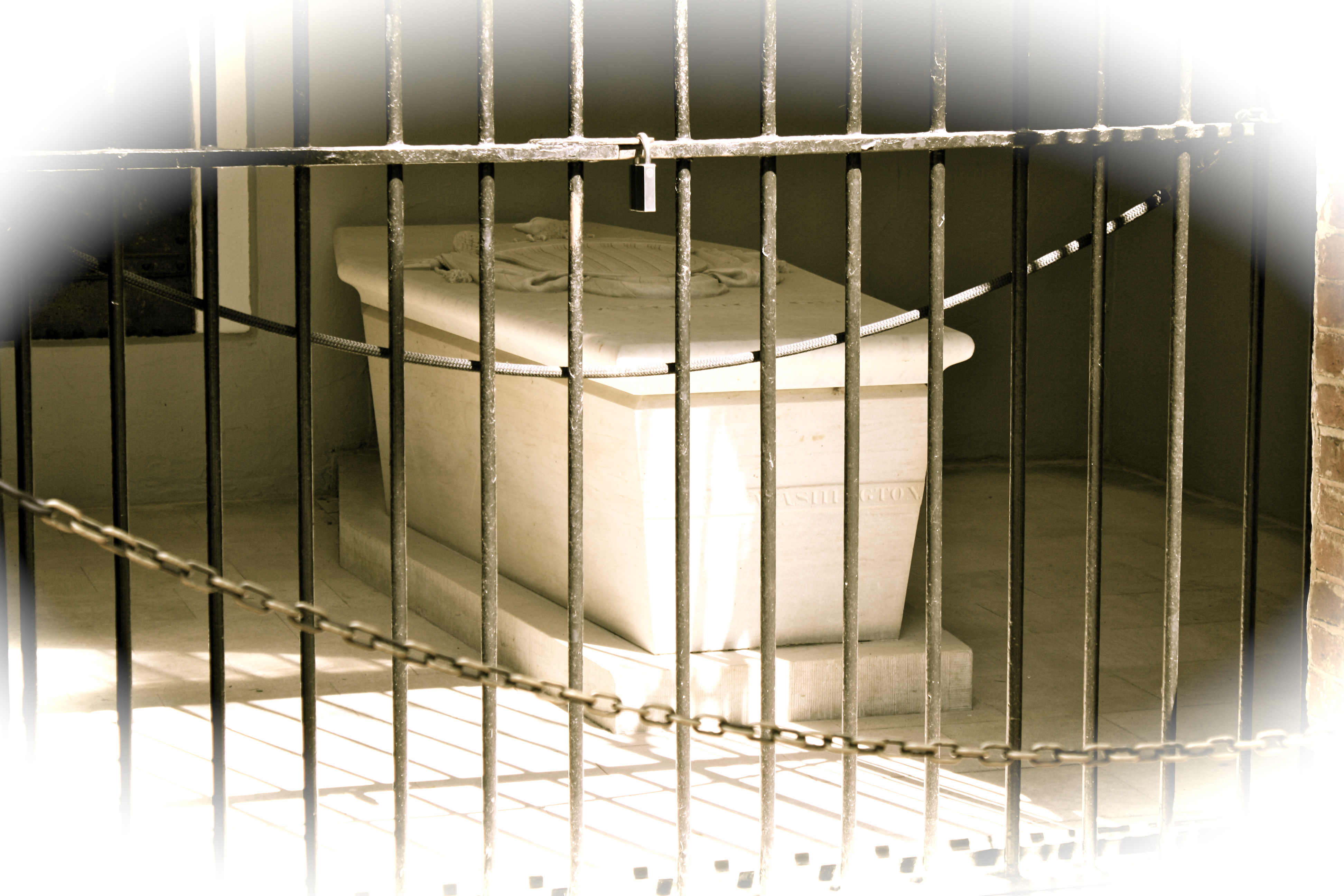
Washington’s Tomb — Mt. Vernon (Photo credit Kenneth C. Davis 2010)
Read More About the creation of the Presidency, Washington, his life and administration in DON’T KNOW MUCH ABOUT® THE AMERICAN PRESIDENTS. Washington’s role in the American Revolution is highlighted Chapter One of THE HIDDEN HISTORY OF AMERICA AT WAR.
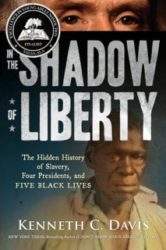
And George Washington’s role as a slaveowner is fully explored in IN THE SHADOW OF LIBERTY: The Hidden History of Slavery, Four Presidents, and Five Black Lives.

The Hidden History of America At War (paperback)
Don’t Know Much About® History: Anniversary Edition
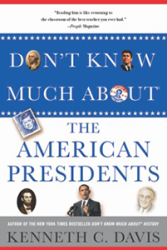
Don’t Know Much About® the American Presidents (Hyperion paperback-April 15, 2014)
January 5, 2018
Who Said It? (1-5-18)
President Harry S. Truman, Annual Message (State of the Union), January 5, 1949
On January 5, 1949, President Truman used his State of the Union address to recommend measures including national health insurance, raising the minimum wage, strengthening the position of organized labor, and guaranteeing the civil rights of all Americans.
Referencing the popular “New Deal” programs of his predecessor, Franklin Delano Roosevelt, Truman styled his reform package the “Fair Deal.” (Source: Library of Congress)

President Harry S. Truman
(Photo: Truman Library)
During the last 16 years, our people have been creating a society which offers new opportunities for every man to enjoy his share of the good things of life.
In this society, we are conservative about the values and principles which we cherish; but we are forward-looking in protecting those values and principles and in extending their benefits. We have rejected the discredited theory that the fortunes of the Nation should be in the hands of a privileged few. We have abandoned the “trickledown” concept of national prosperity. Instead, we believe that our economic system should rest on a democratic foundation and that wealth should be created for the benefit of all.
The recent election shows that the people of the United States are in favor of this kind of society and want to go on improving it.
The American people have decided that poverty is just as wasteful and just as unnecessary as preventable disease. We have pledged our common resources to help one another in the hazards and struggles of individual life. We believe that no unfair prejudice or artificial distinction should bar any citizen of the United States of America from an education, or from good health, or from a job that he is capable of performing.
-Source and complete text: Harry S. Truman Presidential Library & Museum
Read more about Truman’s “Fair Deal” speech at the Library of Congress.
January 2, 2018
Advance Praise for MORE DEADLY THAN WAR-In stores May 2018

More Deadly Than War: The Hidden History of the Spanish Flu and World War I -Coming MAY 2018
In May 2018, More Deadly Than War: The Hidden History of the Spanish Flu and the First World War will be published. I am extremely pleased and gratified to say that the book has just received the following advance reactions from several readers whose work I greatly admire, Deborah Blum, Karen Blumenthal, and Steve Sheinkin.
“More Deadly Than War is a riveting story of the great influenza pandemic of 1918, packed with unforgettable examples of the power of a virus gone rogue. Kenneth C. Davis’s book serves as an important history – and an important reminder that we could very well face such a threat again.”
– Deborah Blum, author of The Poisoner’s Handbook: Murder and the Birth of Forensic Medicine in Jazz Age New York. Deborah Blum is also the Director of the Knight Science Journalism Project at MIT and Publisher of Undark magazine.
“With eye-popping details, Kenneth C. Davis tracks the deadly flu that shifted the powers in World War I and changed the course of world history. In an age of Ebola and Zika, this vivid account is a cautionary tale that will have you rushing to wash your hands for protection.”
—Karen Blumenthal, award-winning author of Steve Jobs: The Man Who Thought Different
“Davis deftly juggles compelling storytelling, gruesome details, and historical context. More Deadly Than War reads like a terrifying dystopian novel – that happens to be true.”
—Steve Sheinkin, author of Bomb and Undefeated
Read more about More Deadly Than War here.
More Deadly Than War: The Hidden History of the Spanish Flu and World War I -Coming MAY 2018
Advance Praise for MORE DEADLY THAN WAR
More Deadly Than War: The Hidden History of the Spanish Flu and World War I -Coming MAY 2018
In May 2018, More Deadly Than War: The Hidden History of the Spanish Flu and the First World War will be published. I am extremely pleased and gratified to say that the book has just received the following advance reactions from two readers whose work I greatly admire, Deborah Blum and Karen Blumenthal.
“More Deadly Than War is a riveting story of the great influenza pandemic of 1918, packed with unforgettable examples of the power of a virus gone rogue. Kenneth C. Davis’s book serves as an important history – and an important reminder that we could very well face such a threat again.”
– Deborah Blum, author of The Poisoner’s Handbook: Murder and the Birth of Forensic Medicine in Jazz Age New York. Deborah Blum is also the Director of the Knight Science Journalism Project at MIT and Publisher of Undark magazine.
“With eye-popping details, Kenneth C. Davis tracks the deadly flu that shifted the powers in World War I and changed the course of world history. In an age of Ebola and Zika, this vivid account is a cautionary tale that will have you rushing to wash your hands for protection.”
—Karen Blumenthal, award-winning author of Steve Jobs: The Man Who Thought Different
Read more about More Deadly Than War here.
More Deadly Than War: The Hidden History of the Spanish Flu and World War I -Coming MAY 2018
December 15, 2017
Bill of Rights Day (December 15)
On December 15, 1791, Virginia ratified the first ten Amendments to the U.S. Constitution: The Bill of Rights took effect.
In 1941, on the 150th anniversary of the ratification, President Franklin D. Roosevelt declared that December 15th would be Bill of Rights Day.
Now it may not be circled red on your calendar, but few events in American history are more important –or the source of more controversy — than the ratification of the Bill of Rights. These Ten Amendments (not Commandments!) are at the heart of the most precious rights guaranteed by the Constitution, including the First Amendment’s guarantees of speech, religion, the press, peaceable assembly and the right to petition. They are also at the heart of some of our most pressing controversies, including the right to bear arms, the rights of the accused under the American system of justice, and the power of the states versus the federal government.
Here is the Preamble to the Bill of Rights:
Congress of the United States
begun and held at the City of New-York, on
Wednesday the fourth of March, one thousand seven hundred and eighty nine.
THE Conventions of a number of the States, having at the time of their adopting the Constitution, expressed a desire, in order to prevent misconstruction or abuse of its powers, that further declaratory and restrictive clauses should be added: And as extending the ground of public confidence in the Government, will best ensure the beneficent ends of its institution.
RESOLVED by the Senate and House of Representatives of the United States of America, in Congress assembled, two thirds of both Houses concurring, that the following Articles be proposed to the Legislatures of the several States, as amendments to the Constitution of the United States, all, or any of which Articles, when ratified by three fourths of the said Legislatures, to be valid to all intents and purposes, as part of the said Constitution; viz.
ARTICLES in addition to, and Amendment of the Constitution of the United States of America, proposed by Congress, and ratified by the Legislatures of the several States, pursuant to the fifth Article of the original Constitution.
The full text and history of the Bill of Rights can be found the site of the National Constitution Center, which also offers an interactive Constitution app.
In Philadelphia, they celebrate Bill of Rights Day at the Constitution Center and you can find some good resources there.
I hope you’ll take some time to read these precious Amendments today. It doesn’t take long and it is well worth the effort.
Happy Bill of Rights Day!


