
Kenneth C. Davis's Blog, page 52
May 6, 2018
Who Said It? (5/8/2018)
President Harry S. Truman May 8, 1945 V-E Day. It was a good day to celebrate his birthday.

President Harry S. Truman
(Photo: Truman Library)
THE PRESIDENT. Well, I want to start off by reading you a little statement here. I want you to understand, at the very beginning, that this press conference is held with the understanding that any and all information given you here is for release at 9 a.m. this morning, eastern war time. There should be no indication of the news given here, or speculation about it, either in the press or on the radio before 9 o’clock this morning.
The radio-my radio remarks, and telegrams of congratulation to the Allied military leaders, are for release at the same time. Mr. Daniels has copies of my remarks, available for you in the lobby as you go out, and also one or two releases here.
[1.] Now, for your benefit, because you won’t get a chance to listen over the radio, I am going to read you the proclamation, and the principal remarks. It won’t take but 7 minutes, so you needn’t be uneasy. You have plenty of time. [Laughter]
“This is a solemn but glorious hour. General Eisenhower informs me that the forces of Germany have surrendered to the United Nations. The flags of freedom fly all over Europe.”
Source: Harry S. Truman: “The President’s News Conference on V-E Day,” May 8, 1945. Online by Gerhard Peters and John T. Woolley, The American Presidency Project.
Harry S. Truman was born on May 8, 1884. Read more about him in this post, Don’t Know Much About® Harry Truman
Learn more about Truman at the Truman Presidential Library


April 30, 2018
Who Said It (4/30/18)
George Washington, First Inaugural Address (New York City, April 30, 1789)

By the article establishing the Executive Department, it is made the duty of the President “to recommend to your consideration, such measures as he shall judge necessary and expedient.” The circumstances under which I now meet you, will acquit me from entering into that subject, farther than to refer to the Great Constitutional Charter under which you are assembled; and which, in defining your powers, designates the objects to which your attention is to be given. It will be more consistent with those circumstances, and far more congenial with the feelings which actuate me, to substitute, in place of a recommendation of particular measures, the tribute that is due to the talents, the rectitude, and the patriotism which adorn the characters selected to devise and adopt them. In these honorable qualifications, I behold the surest pledges, that as on one side, no local prejudices, or attachments; no seperate views, nor party animosities, will misdirect the comprehensive and equal eye which ought to watch over this great assemblage of communities and interests: so, on another, that the foundations of our National policy will be laid in the pure and immutable principles of private morality; and the pre-eminence of a free Government, be exemplified by all the attributes which can win the affections of its Citizens, and command the respect of the world.
George Washington delivered his first inaugural Address at Federal Hall in New York City. Read more at the Library of Congress.
April 27, 2018
Don’t Know Much About U.S. Grant
Born on this date in 1822, the 18th President of the United States, Ulysses S. Grant
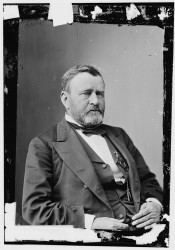
April 27, 1822 Born in Point Pleasant, Ohio
1839-1843 Attended West Point
1843-1853 Served in the Mexican War and a succession of U.S. Army posts, then resigned his commission.
1854-1858 Farmed near St. Louis, Missouri
1860-1861 Clerked in tannery store at Galena, Illinois
1861-1865 Served in Civil War; commanded all Union Armies
1869-1877 18thPresident
1880 Unsuccessful candidate for Republican presidential nomination
July 23, 1885 Died at Mt. McGregor, New York, aged 63
The country having just emerged from a great rebellion, many questions will come before it for settlement in the next four years which preceding Administrations have never had to deal with. In meeting these it is desirable that they should be approached calmly, without prejudice, hate, or sectional pride, remembering that the greatest good to the greatest number is the object to be attained.
This requires security of person, property, and free religious and political opinion in every part of our common country, without regard to local prejudice. All laws to secure these ends will receive my best efforts for their enforcement.
–Ulysses S. Grant, First Inaugural (March 4, 1869
The conquering hero of the Union, Ulysses S. Grant did not look the part. He was short, scruffy, favored enlisted men’s uniforms, and was dogged by reports of his fondness for drink –a somewhat undeserved reputation. Grant clearly was a drinker at times in his life, but the image of him as a stumbling drunk is a caricature. One successor, Theodore Roosevelt later called him, “The Hammer of the North,” and wrote,
“Grant’s supreme virtue was his doggedness….He was master of strategy and tactics, but he was also a master of hard-hitting. …His name is among the greatest in our history.”
There is no question that he was a dogged, determined general whose command skills helped win the war for the Union. Unfortunately, those strengths did not translate into the complexities of leading the large, swiftly growing, and rapidly changing nation. Another of his successors, James A. Garfield, who served on the battlefield under Grant, once said,
“He has done more than any other President to degrade the character of Cabinet officers by choosing them on the model of the military staff, because of their pleasant personal relationship to him and not because of their national reputation and public needs.”
Garfield was right. Personally honest, Grant was notoriously inept when it came to surrounding himself with men who were corrupt, both in private and as president. Some of them blackened his Presidency; others would reduce Grant to bankruptcy. Finally, a third later successor, Woodrow Wilson, once wrote of him, “The honest, simple-hearted soldier had not added prestige to the presidential office. He himself knew he had failed… that he ought never to have been made president.”
One reason that Grant has been positively reevaluated as President, however, was his commitment to achieving the vote for African Americans. In his 1874 Message to Congress, he said:
Treat the negro as a citizen and a voter, as he is and must remain, and soon parties will be divided, not on the color line, but on principle.
Fast Facts
Religion: Methodist (Although raised Methodist, Grant never officially joined a church.)
Education: United States Military Academy (West Point)
Career before Politics: Soldier, farmer, leather shop clerk
Military Service: U.S. Army- Mexican War, Civil War
Political Party: Republican
First Lady: Julia Boggs Dent Grant (January 26, 1826-December 14, 1902) Grant’s best man was West Point classmate James Longstreet, later a Confederate general who attended Lee’s surrender in April 1865.
Children: Frederick, Ulysses S.Grant, Jr. (“Buck”), Ellen (“Nellie”), and Jesse Root Grant
Grant is the first of seven presidents born in Ohio (second-most from one state after Virginia).
At age 46, Grant was the youngest president elected up to that time.
After Grant’s death in 1885, more than 60,000 people marched and one million spectators watched the funeral procession to his burial in New York’s City Upper West Side.
Twelve years later, Grant’s Tomb was dedicated. Built with $600,000 donated by more than 90,000 people, it is the largest mausoleum in North America. Once again, more than one–million people attended the parade and dedication ceremony when Grant was interred in the tomb on April 27, 1897. Grant’s wife, Julia, was also interred –not buried—in Grant’s Tomb, after her death in 1902. It is the site of the General Grant National Memorial (NPS).
April 26, 2018
Who Said It (4/26/18)
On March 30, 1870, the Fifteenth Amendment to the Constitution was ratified and became law. It gave the vote to black men.
Ulysses S. Grant
Special Message
March 30, 1870
To the Senate and House of Representatives:
Promote, then, as an object of primary importance, institutions for the general diffusion of knowledge. In proportion as the structure of a government gives force to public opinion, it is essential that public opinion should be enlightened.
…. I repeat that the adoption of the fifteenth amendment to the Constitution completes the greatest civil change and constitutes the most important event that has occurred since the nation came into life. The change will be beneficial in proportion to the heed that is given to the urgent recommendations of Washington. If these recommendations were important then, with a population of but a few millions, how much more important now, with a population of 40,000,000, and increasing in a rapid ratio. I would therefore call upon Congress to take all the means within their constitutional powers to promote and encourage popular education throughout the country, and upon the people everywhere to see to it that all who possess and exercise political rights shall have the opportunity to acquire the knowledge which will make their share in the Government a blessing and not a danger. By such means only can the benefits contemplated by this amendment to the Constitution be secured.
Ulysses S. Grant was born on April 27, 1822. He died on July 23, 1885. His body was later entombed in New York City and Grant’s Tomb is a National Parks Service National Memorial.

An illustration of blacks in line to vote. Harper’s Weekly Magazine. Source: PBS American Experience http://www.pbs.org/wgbh/americanexper...
More Deadly Than War: The Hidden History of the Spanish Flu and the First World War (Available for preorders)
Scheduled for publication on May 15, 2018 by Henry Holt, this book recounts the story of the most deadly epidemic in modern times, the Spanish Flu pandemic, which struck the world 100 years ago during the last months of World War I.
The book and audio versions are available for preorder and links to online sellers can be found here.

Davis (In the Shadow of Liberty) immediately sets the urgent tone of his forthright chronicle, citing staggering statistics: the Spanish Flu pandemic that began in spring 1918 claimed the lives of more than 675,000 Americans in a single year and left a worldwide death toll estimated at 100 million. The author structures his exhaustive account of the origins, transmission, and consequences of the pandemic within the framework of WWI, underscoring the lethal concurrence of these “twin catastrophes.”
Invisible. Incurable. Unstoppable.
From bestselling author Kenneth C. Davis comes a fascinating account of the Spanish influenza pandemic that swept the world from 1918 to 1919.
With 2018 marking the centennial of the worst disease outbreak in modern history, the story of the Spanish flu is more relevant today than ever. This dramatic narrative, told through the stories and voices of the people caught in the deadly maelstrom, explores how this vast, global epidemic was intertwined with the horrors of World War I – and how it could happen again. Complete with photographs, period documents, modern research, and firsthand reports by medical professionals and survivors, this book provides captivating insight into a catastrophe that transformed America in the early twentieth century.
Listen to a sample of the Audio version coming from Penguin Random House Audio.
I will be writing more about the book and the subject of the Spanish Flu and the “war to end all wars” as we get closer to publication date. In the meantime, I hope you will also read my previous book IN THE SHADOW OF LIBERTY.

In the Shadow of Liberty
While waiting for the arrival of More Deadly Than War (May 15) do check out In The Shadow Of Liberty: The Hidden History of Slavery, Four Presidents, and Five Black Lives
•Notable Children’s Books-2017 ALSC/ALA
•A FINALIST for 2017 Award for Excellence in Young Adult Nonfiction by YALSA — the Young Adult Library Services Association of the American Library Association.
•A selection of the 2018 Tayshas Reading List/Texas Library Association
•Named one of the BEST CHILDREN’S AND YOUNG ADULT BOOKS OF 2016 (Washington Post)
LINKS TO PURCHASE THE BOOK AND AUDIO CAN BE FOUND HERE
Did you know that many of America’s Founding Fathers—who fought for liberty and justice for all—were slave owners?
Through the powerful stories of five enslaved people who were “owned” by four of our greatest presidents, this book helps set the record straight about the role slavery played in the founding of America. These dramatic narratives explore our country’s great tragedy—that a nation “conceived in liberty” was also born in shackles.
BILLY LEE, who became George Washington’s valet and fought in the American Revolution alongside him.
ONA JUDGE, who escaped from Washington’s Philadelphia household—only to be tracked down by the president’s men.
ISAAC GRANGER, who survived the devastation of Yorktown before returning to Thomas Jefferson’s Monticello.
PAUL JENNINGS, who was present at the burning of James Madison’s White House during the War of 1812.
ALFRED JACKSON, who was born into slavery at Andrew Jackson’s Hermitage, survived the Civil War, and lived at the plantation into the 20th century.
These stories help us know the real people who were essential to the birth of this nation but traditionally have been left out of the history books. Their stories are true—and they should be heard.
Some of the hidden history from IN THE SHADOW OF LIBERTY
Five of the first seven presidents, and ten of the first fifteen, were slaveholders or raised in a slaveholding household.
George Washington once bought teeth from enslaved people to be used in his dentures.
For seven years as President Washington knowingly broke a Pennsylvania that freed enslaved people who lived in the state for more than six months.
Dozens of enslaved people from Jefferson’s Monticello, along with seventeen from Washington’s Mount Vernon plantation, were among thousands of African American refugees with the British in Yorktown, Virginia when American and French forces won the last battle in the Revolution.
The first man to write a memoir of working in the White House was formerly the enslaved valet of James Madison who witnessed the burning of the White House during the War of 1812.
Andrew Jackson went into debt to pay for the legal defense of four enslaved men from his Hermitage plantation who were tried for murder.
April 12, 2018
More Deadly Than War: The Hidden History of the Spanish Flu and the First World War
Scheduled for publication on May 15, 2018 by Henry Holt, this book recounts the story of the most deadly epidemic in modern times, the Spanish Flu pandemic, which struck the world 100 years ago during the last months of World War I.
Publisher’s Description:
Invisible. Incurable. Unstoppable.
From bestselling author Kenneth C. Davis comes a fascinating account of the Spanish influenza pandemic that swept the world from 1918 to 1919.
With 2018 marking the centennial of the worst disease outbreak in modern history, the story of the Spanish flu is more relevant today than ever. This dramatic narrative, told through the stories and voices of the people caught in the deadly maelstrom, explores how this vast, global epidemic was intertwined with the horrors of World War I – and how it could happen again. Complete with photographs, period documents, modern research, and firsthand reports by medical professionals and survivors, this book provides captivating insight into a catastrophe that transformed America in the early twentieth century.
I will be writing more about the book and the subject of the Spanish Flu and the “war to end all wars” as we get closer to publication date. In the meantime, I hope you will also read my previous book IN THE SHADOW OF LIBERTY.
March 25, 2018
Advance Praise for MORE DEADLY THAN WAR-In stores May 2018
More Deadly Than War: The Hidden History of the Spanish Flu and World War I -Coming MAY 2018
In May 2018, More Deadly Than War: The Hidden History of the Spanish Flu and the First World War will be published. I am extremely pleased and gratified to say that the book has just received the following advance reactions from several readers whose work I greatly admire, Deborah Blum, Karen Blumenthal, and Steve Sheinkin.
“More Deadly Than War is a riveting story of the great influenza pandemic of 1918, packed with unforgettable examples of the power of a virus gone rogue. Kenneth C. Davis’s book serves as an important history – and an important reminder that we could very well face such a threat again.”
– Deborah Blum, author of The Poisoner’s Handbook: Murder and the Birth of Forensic Medicine in Jazz Age New York. Deborah Blum is also the Director of the Knight Science Journalism Project at MIT and Publisher of Undark magazine.
“With eye-popping details, Kenneth C. Davis tracks the deadly flu that shifted the powers in World War I and changed the course of world history. In an age of Ebola and Zika, this vivid account is a cautionary tale that will have you rushing to wash your hands for protection.”
—Karen Blumenthal, award-winning author of Steve Jobs: The Man Who Thought Different
“Davis deftly juggles compelling storytelling, gruesome details, and historical context. More Deadly Than War reads like a terrifying dystopian novel – that happens to be true.”
—Steve Sheinkin, author of Bomb and Undefeated
March 20, 2018
Don’t Know Much About® the Triangle Shirtwaist Fire
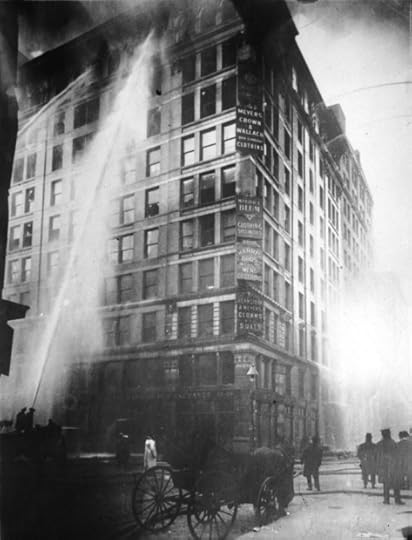
Triangle Shirtwaist Factory fire on March 25, 1911 from front page of The New York World (Source: [Post revised from original on 3/25/2011]Cornell University ILR School Kheel Center © 2011)
[Reposted from original on 3/25/2011]On this date, March 25, 1911, the Triangle Shirtwaist Factory in New York caught fire and 146 people died, most of them women between the ages of 16 and 23.
“Look for the union label.”
If you are of a certain generation, you may recognize those words instantly. They are the first line of a song that became a 1970s advertising icon.
Sung by a swelling chorus of lovely ladies (and a few men) of all colors, shapes and sizes, it was the anthem of the International Ladies Garment Workers Union.
Airing as American unions began to confront the long, steady drain of jobs to cheaper foreign labor markets, the song rousingly implored us to look for the union label when shopping for clothes (“When you are buying a coat, dress or blouse”).
Seeing these earnest women, thinking of them at their sewing machines, made us race to the closet and check our clothes for that ILGWU tag. (“It says we’re able to make it in the USA.”)
The International Ladies Garment Worker Union was born in 1900, in the midst of the often-violent period of early 20th century labor organizing when brutal working conditions and child labor were the norm in America’s mines and factories.
One of the companies the union attempted to organize was the Triangle Shirtwaist Factory at what is now Greene Street and Washington Place in New York’s Greenwich Village. It employed many poor and mostly immigrant women, most of them Jewish and Italian.
A walkout against the firm in 1909 helped strengthen the union’s rolls and led to a union victory in 1910. But the Triangle Shirtwaist Company –which would chain its doors shut to control its workers— earned infamy when a fire broke out on March 25, 1911 and 146 workers were trapped in the flaming building and died. Some jumped to their deaths.
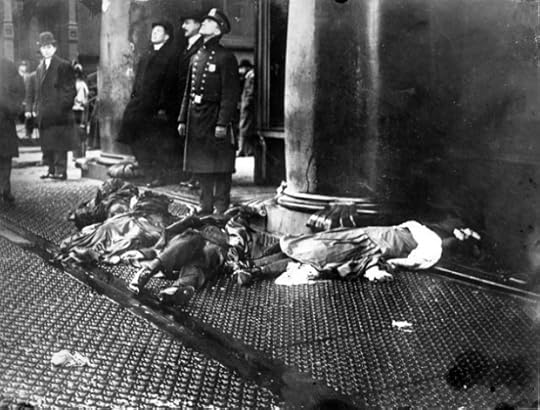
A police officer and others with the broken bodies of Triangle fire victims at their feet, look up in shock at workers poised to jump from the upper floors of the burning Asch Building. (Credit: Cornell University ILR School Kheel Center ©2011)
The two owners of the factory were indicted but found not guilty. The tragedy helped galvanize the trade union movement and especially the ILGWU.
On the 105th anniversary of that dreadful event, it is worth remembering that American prosperity was built on the sweat, tears and blood of working men and women. Immigration and jobs are the issue again today, just as they were more than a century ago.
Cornell University’s Kheel Center for Labor-Management Documentation offers a web exhibit on the Triangle Factory Fire. The Library of Congress also offers resources on the tragedy.
On February 28, 2011, American Experience on PBS aired a documentary film about the tragedy and the period.
The site is part of New York University and a National Historic Landmark.
March 16, 2018
A different Irish parade in New York-Orange Day
(Published March 16, 2017; Updated March 16, 2018)
As New York prepares for the St. Patrick’s Day parade, here is another reminder of the past view of the Irish–especially Irish Catholics– in America: the Orange Riots of 1870 and 1871.

The Orange Riot of 1871 as depicted in Frank Leslie’s Illustrated Newspaper. The view is at 25th Street looking south down Eighth Avenue (Source Wikipedia: https://en.wikipedia.org/wiki/Orange_...)
Long before the nation’s birth, anti-Catholic venom was an accepted American truism –a deep divide with roots in Europe’s deadly wars between Catholic and Protestant. The hatred of all things Roman Catholic was part of America’s Puritan and Protestant roots. In 1844, Philadelphia had been raked by anti-Catholic violence known as the “Bible Riots,” subject of a previous post.
By the middle of the 19th century, waves of Irish immigrants had magnified the hatred and transformed New York’s politics. Political boss William Tweed used their votes to secure power for Tammany Hall and himself. But the growth of Irish Catholic power in New York only deepened ancient animosities.
New York’s virulent anti-Catholic sentiment peaked with the largely overlooked “Orange Riots” of 1870 and 1871. In the first of these, Irish Protestants marched in celebration of the July 12, 1690 victory of the Protestant King William III over Catholic King James II at the Battle of the Boyne. Taunting Irish Catholic workmen as they paraded up Eighth Avenue, the Protestant “Orangemen” went to a park where a pitched battle ensued.
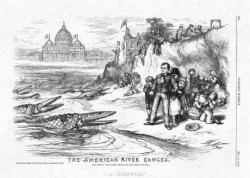
Thomas Nast’s Anti-Catholic cartoon “The American River Ganges snd the Children” Harpers’Weekly September 30, 1871
Eight people died.
Another “Orange Day” march planned in 1871 was nearly banned for public safety reasons. But prominent businessmen and cartoonist Thomas Nast objected vehemently to this affront to Protestant rights. With Boss Tweed guaranteeing protection for the marchers, the 1871 parade stepped off, guarded by some 5,000 policemen and National Guard militia units.
Almost immediately, the marchers were pelted with bottles, bricks, shoes and stones. Pitched battles continued along the parade route. When it was over, the rioting and street-fighting left sixty people dead, most of them Irish Catholic laborers as well as three Guardsmen.
The bloodshed of these “Orange Riots” and Tweed’s failure to secure the parade were crucial factors in breaking his stranglehold on New York politics and government. The city’s newspapers and largely Protestant-controlled business and financial world turned on him. Tweed was deposed, eventually arrested, and later convicted of corruption.
Anti-Irish sentiment in New York and elsewhere continued for decades.


