Chris Chelser's Blog, page 26
July 22, 2015
New Shop: faster, better, easier!
Shopping should be fun. When things get too complicated, they cease to be fun. Therefore, shopping should be easy.
That is why I have decided to move my shop to Gumroad.
Clear overview of all titles and artwork on offer.
More and more versatile products for you to choose from.
It’s simple to place an order.
It has more payment options (no Paypal? No problem!)
It’s faster than the old shop.
In short: it makes for a faster, better and above all easier shopping experience!
You will find my ebooks and artwork there now, and in future more (physical) products will be added as they come available.
Please take a look and let me know what you think!
Cheers!



July 21, 2015
No reviews, but something weird anyway
Circumstances beyond my control kept me from writing this week’s ‘Bare Bones’. In truth, part of those circumstances were my husband and son (okay, and myself0 being in dire need of a breather, so we went to the Mosel area in Germany. The river’s valley is littered with castles and ruins, and it’s in general a beautiful area to visit.
However, what caught my eye was this building along the main road through the village of Treis-Karden: a crooked ‘Amtshaus’ dating back to 1562:

If the walls seems to be bulging like a potbelly, that is because they ARE:
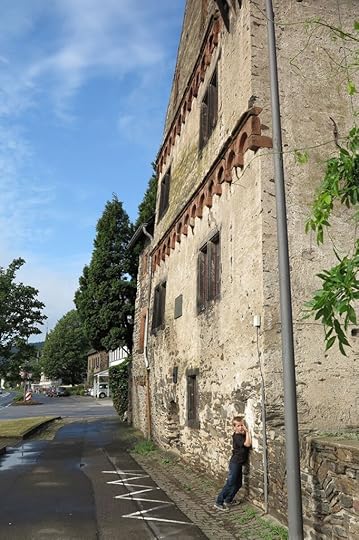
(That little tyke by the wall is my son :D)
Alas the pictures of the garden behind the house’s overgrown gate were too severely underexposed to salvage, but if anything qualifies as a haunted house, this is it!
Gratitute to Hanneke Bijl for making the photos. (Honestly, I wouldn’t know which end of the camera is up…)
July 20, 2015
‘Dark Eyes’ 16 snippet
‘God is not one individual,’ Jean said. ‘This is God.’ The column he had created drifted in front of them once more. ‘I believe you wondered why God would allow a devourer to exist? Devourers exist because God is all of existence. From the rich energy of the diffused souls that shine with the brightest light of unlimited creative potential,’ he cupped the top of the column with his hand, ‘to the darkest souls at the Edge, who see nothing, feel nothing and cannot move but to devour their own souls. All of this is existence. All of this is God.’
July 17, 2015
July 14, 2015
The Bare Bones of…”Solaris” (novel)
What: âSolarisâ by Stanislav Lem.
Why: Itâs intelligent, itâs surreal, itâs about the human psyche, and itâs philosophical sci-fi Whatâs not to love?
Spoiler Alert: Low | Medium | HIGH!
Summary:
Psychologist Kris Kelvin arrives in his spacecraft at the research station Solaris, which hovers over the massive ocean that covers this distant planet.
From the very moment he arrives, it becomes clear to Kelvin that all is not well on board. He meets Snow, one of the three crew members on board, and asks where the team leader Gibarian is. The answer is confused an paranoid. With effort, Kelvin learns that the third man, Sartorius, has locked himself up elsewhere in the station, and that Gibarian is dead.
But research does not brake for death. Kelvin searches Gibarianâs quarters to find out what happened and what the âSolaristsâ have been doing recently. It is Solarisâ task to research the ocean below, which is believed to be sentient. Originally the goal was to learn to communicate with the ocean entity, but all attempts so far have failed. Even the latest experiment, a bold and banned X-ray bombardment, has not yielded the desired results. But since that bombardment, things have gone wrong and the crew all have the feeling they are being watched. Kelvin, too.
With good reason: he sees someone in the corridors of the station. Someone who cannot possibly be there. He learns Snow and Sartorius have seen apparitions, too, and that the same effect drove Gibarian to commit suicide. And the apparitions are real, even to the touch. As real as they are inexplicable.
Soon Kelvin finds Rheya in his room: his wife who died ten years ago. Little things she says suggest that she is not real, but she speaks and she is solid. Kelvin accepts this vision with little resistance, but when he gets the chance, he locks the apparition into one of the shuttles on board and launches it.
After that incident, Snow is more forthcoming. They have all had such âvisitorsâ, significant people from their past. To Kelvin, Rheya was not just his wife: she committed suicide after a messy argument in which he said thing he didnât mean. Snow warns Kelvin that Rheya will come back, unaware of what he has done to get rid of her. The ocean does this, he says. They have what they wanted: contact with the alien lifeform.
Indeed, Rheya comes back. After an small accident that leaves her injured, Kelvin analyses her tissue under a microscope and finds she is not human, but a copy of that is better than the original. In a video conference between the three scientists, Sartorius argues that the âvisitorsâ are a materialised projection of from their minds, but all conclusions they draw are vastly premature.
Unfortunately Rheya overheard what Kelvin about her being a copy. She is confused an insecure, but so are Kelvin and Snow. Sartorius is isolating himself more and more, both physically, socially and professionally: each of the three scientists has his own ideas about how to prevent the âvisitorsâ from manifesting, but they differ greatly on what the effects of the various possibilities will be. What risks are they taking, not just with the alien entity, but with themselves as well? And if the projections are part of the ocean and the ocean is a living being, how moral are their plans?
The next night, Kelvin is visited by an apparition of Gibarian, who warns him that Snow and Sartorius do not trust him. Kelvin cares little, but is apprehensive of what their plans will do to Rheya. But Rheya shows more of her awareness that she âisnât realâ. After an argument, she tries to take her life and Kelvin tries to save her. After what seems a long death struggle, however, she fails to die. Both she and Kelvin realise that despite her appearance, she is not human.
Even so, Kelvin wants to leave with this new version of Rheya. Snow encourages him, but warns that the manifestation will disappear with distance from the planet. It is speculation, so he tell Kelvin they can bring back the vessel which took off with Rheyaâs previous manifestation â see if she still exists or not. Kelvin cannot stomach the thought. He has fallen in love with this version of Rheya and he doesnât want to harm her. But if he and Snow are right, that is exactly what the experiment Sartorius is preparing will do.
They do run the experiment. Nothing happens. For weeks they wait, but find no change. If the ocean responds to the experiment, that response mingles with their dreams and nightmares. The âvisitors are still thereâ. Snow is breaking and locked in his lab, so is Sartorius. The nightmares grow worse, untilâ¦
â¦one morning Rheya is gone. Truly gone. Kelvin panics, but Snow, much more calm than before, explains that Sartorius tried another way and doing so managed to destroy the manifestation. Kelvin is beside himself with anger and grief for losing Rheya all over again. He hates the planet and what it has done, accusing the entity of experimenting on them, regardless of the hypocrisy.
Yet he turns down the chance to evacuate and stays on the station until his allotted time to return to Earth. Â Before he leaves, he makes a trip to the surface of the planet. He contemplates whether gods evolve and learn, and what makes a god in the first place. He has lost all hope of ever seeing Rheya again, or whatever version of her. But he continues to live with a sense of expectation that even he cannot define.
Story Skeleton:
Unlike the typical âWesternâ sci-fi, which thrives on action and technology, the Eastern European and Russian tradition in this genre is far more concerned with human nature and philosophy.
As such, âSolarisâ has no adrenaline-fuelled tension arc to the story. It is a calm read, where after the initial strangeness of the visitors, the complications are introduced and explored gradually and without pomp. Lem also made plenty of space to provide historical background, inside jokes and different philosophical theories, saving what is often considered the ultimate one â what is a god? â for last.
The story doesnât have the urge to explain everything, either. The nature of the ocean entity is never defined, and humans must be content to live with this uncertainty. In this, the story is much truer to life than most space adventures meant for entertainment. There is no quick fix, no matter how much we want there to be one.
For that reason, it is not a casual read: âSolarisâ requires close reading to grasp when the author has written between the lines, and it requires the reader to reflect and form his own opinion. Most of the time, several theories are suggested, but a final answer does not exist.
Lesson learnt:
Like all good literature, âSolarisâ is a vehicle for profound thoughts and concepts first and entertainment second. It does not need to employ cheap emotions to draw a reader in, or ready-made conclusions to deliver a sense of satisfaction. Such stories are rare, but all the more precious for it.
This book a gem to whoever loves stories that encourage its reader to think, and a deliciously wry love story in space for those who donât want to delve that deep.
July 13, 2015
Of Crinolines and other steel cages
Time for a little background information on Mercedes. Over the second half of the 19th century, ladies wore a lot of contraptions underneath their skirts to be fashionable.
Mercedes wears the first, which is by far the least practical of the three. Small wonder she hates it so!

Post origin:
http://autumngracy.tumblr.com/post/124009226090/fashioninfographics-know-your-victorian-looks
July 10, 2015
Last Post at Menin Gate, Ypres
WWI Battlefields on Facebook, July 9th:
Tonight it will be the 30,000th occasion on which the Last Post has been played at the Menin Gate: a very special evening in Ypres.
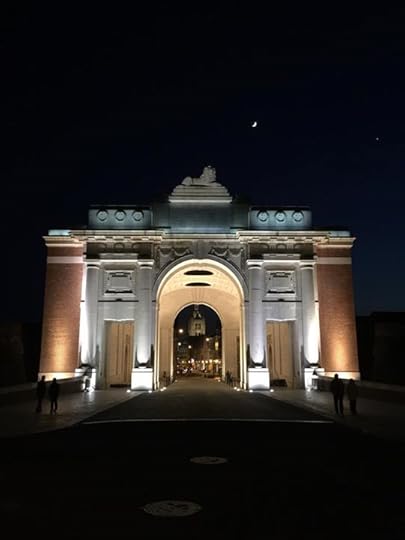
I have attended the Last Port at Menin Gate several times. It never ceases to be impressive and heart-wrenching.
World War I, and especially the Ypres Salient, has always held a special sway over me. It is not the general fascination I have for (military) history, but a much greater impact that I cannot put into words. Not yet, but one day.
Take care,
July 9, 2015
Dark Eyes – first draft snippet
“You cannot trust your own perception of either time or distance. The levels closest to the centre emulate the rules of time and space that you are accustomed to, but the outer levels have little to no concept of either. What can seem days may be centuries, and the other way around. Do not go there. You will not find your way back.”
- Jean (Dark Eyes ch 16, first draft)
July 8, 2015
View from Pont Neuf 1832
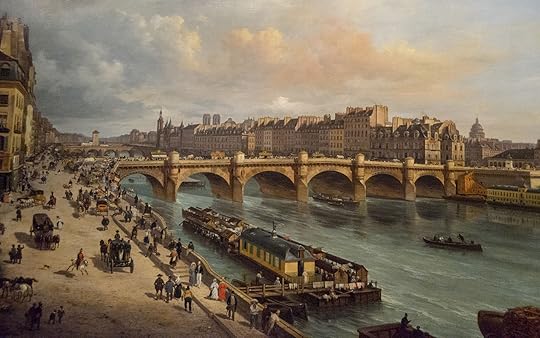
Pont Neuf et la Cité de Paris 1832 – by Guiseppe Canella
35 years before “Dark Eyes” and therefore well before the Hausmann renovations that Mercedes describes, but this painting gives such a good view of the Seine and the Cité, with at the front the Pont au Change (which would be demolished and replaced in 1858-1860) and in the back the Pont Notre Dame with the tower of the pump still featuring prominently. Even the towers of both the Palais de Justice and Notre Dame stand out over the rooftops.
I’m sharing this because we’ll be seeing more of these locations before “Dark Eyes” is finished!
July 7, 2015
The Bare Bones of… “Gethsemane Hall” (novel)
I warned you this book would make it here. Hopefully the ghost of its unsatisfying ending will stop haunting me now.
What: “Gethsemane Hall” by David Annandale.
Why: I hate seeing great story potential crash and burn, and this one is still nagging at me.
Spoiler Alert: Low | Medium | HIGH!
Because the sting is in the tail with this one.
Summary:
“Gethsemane Hall” is a classic haunted-house story where nothing is what it seems, and it’s all real. The cast consists of the owner of the house, now a grieving widower who is falling from faith, his best friend, a paranormal researcher who believes in ghosts (and her assistant), a paranormal researcher who is a sceptic (and his assistant), and a disgraced FBI agent who only wants to clear up the mess and save her career. So what is the mess here?
The house is. It is a massive estate near a small English village. The grounds are said to be where Saint Rose lived and died, so the place literally has a saintly reputation. The owner, Gray, hasn’t been there for years, but after the tragic death of his wife and daughter, he felt drawn to the place.
Unfortunately a man recently killed himself in the house, supposedly scared to death because of the haunting he was investigating. Seeing as this man was a former FBI agent, said agency doesn’t want any publicity linking them to paranormal research and sends a discredited agent to debunk the rumours. To that end, two more paranormal researchers are brought in: one is convinced ghosts are real and that the house is sacred, and the other has put his money on magnetic fluctuations being responsible for it all.
They are both wrong.
A series of hauntings leads to the discovery of a long flight of stairs leading to a cave system below the house. In one of those caves, the group discovers a sarcophagus, which turns out to contain… a flight of stairs. That leads into a cave. With another sarcophagus. And evidence of a bloody cult that thrived on pain and suffering, courtesy of an enormous reptile.
The cult is gone, but the reptile is the house – or at least that is what I understand from the descriptions. It is also a new god, and it draws humans to it to feed on both their pain and suffering, and supposedly their flesh, because no corpse lasts long enough to be discovered, never mind receive a proper burial. Of the cast and the entire village, only the FBI agent survives to become the reptile god’s evangelist. Like Saint Rose was before her…
Story Skeleton:
A typical horror story, I’m afraid. Maybe I’ve been unlucky in my search, but in my experience, horror stories have a slow build-up that needs about one third of the story to introduce the cast and how they connect, one third to introduce the site where the horror will take place, and the last third of the story, where everything escalates and all the featured characters die, except one.
In that respect, Annandale doesn’t break the mould, but he invests serious story time and energy into setting the cast and introducing the house itself. When the hauntings begin in earnest, the story picks up pace and raises interest. It is creepy, it is enticing and I really wanted to know how he would put his story elements to use.
Until the first person dies and credibility is under heavy fire: paramedics are called in, but even though the only access route to the site of the body is almost too narrow for one person to pass through, the paramedics and their equipment effortlessly move down that route. Then it turns out the body has vanished. It had been horrendously mauled and scattered over a wide area, but it has vanished. Without a trace. The paramedics – standing in a cavern with no light and a lot of panicked people – call it a hoax and leave, against effortlessly.
That kind of inconsistency stings. Why not make the scene so that calling the paramedics is evidently futile and doesn’t happen? The story doesn’t stand to lose from cutting the paramedics out.
Immediately after this scene of stairs cave sarcophagus chain of events from before is repeated exactly. If this was meant to be a deliberate pattern, its justification for the story’s sake doesn’t show.
As the story works up to the climax, the characters run up and down the whole route several times. After the first mention of how difficult the path is, it causes no further hindrance and only serves to make the location seem scary and complicated. The result, alas, is neither.
The escalation had an interesting premise, too. The idea that something worse than Hell is the only life after death, is scary in itself, but the reptile god being responsible for waking and slaughtering the whole village without leaving any trace whatsoever is more than my suspension of disbelief can manage.
Lesson learnt:
I love the premise of a house that is actually haunted. I loved the horrific revelation of what lay at the root of the hauntings, but a good premise depends on execution to become a great story. Outrageous escalation such as “Gethsemane Hall” deploys is a genre convention. This I know. Given the many 3 and 4 star reviews, “Gethsemane Hall” meets the expectations of the horror loving population.
However, rules of convention do not mitigate the absence of consistency and storytelling tactics. Still I feel it has far more potential than its ending gives us.