Chris Chelser's Blog, page 28
June 14, 2015
“Kalbrandt Institute” snippet
On top of a scree slope between the valley and the banks of the River Nile, two men wearing turbans and loose-fitting tunics surveyed the site with varying interest.
“Ta-sekhet-ma’at, the Great Field. Do not let its dry appearance fool you. It knows a surprising number of floods, for a desert valley.” Hakon Borgulfson put his sun-kissed hands in his side and glanced at his companion. “What in the world are we doing here, Nasir?”
- Kalbrandt Institute Archives, File no. 9796/N(xxiv)


June 8, 2015
The Bare Bones of… “Waiting for Godot” (play)
What: “Waiting for Godot”, a play by Samuel Beckett, performed by the Sydney Theatre Company (June 2015, Barbican Theatre, London).
Spoiler Alert: Low | Medium | HIGH! Since there is no traditional plot to speak of, really.
Story summary:
The events of this absurdist play are traditionally summed up by ‘Nothing happens. Twice’, but that defies that there is enough going on to keep the audience well occupied for almost 3 hours in all.
The story is about Vladimir (Didi, to his only friend) and Estragon (Gogo), two hapless-looking men who spent their days in the same dreary wasteland of a place, waiting. For Godot. Who promised to come and give them an answer regarding… well, something, since neither men remembers what they asked him. To pass the time, they quibble like an old married couple, make fun of each other’s physical inconveniences and, in the shade of a barren tree, talk about boredom and the possibility of suicide.
A cry breaks their monotony and the baggage-burdened slave Lucky stumbles along, tied with a long rope to his master, Pozzo. Estragon asks Vladimir if this is Godot, but no. Pozzo is a big man, abusive to his slave but civil if condescending to the other two. He tells Vladimir and Estragon that he means to go to the fair to sell Lucky, who is old and no longer serves his original purpose – although it never becomes clear what that purpose was. Lucky says nothing, pants and drools unless he falls asleep where he stands, or whenever Pozzo cracks his whip. But, Pozzo says, the slave can be entertaining and he will make Lucky dance and think to entertain Vladimir and Estragon, as compensation for their company.
But Lucky’s ‘dance’ is a series of jerky movements and strangled gasps. Unimpressed, Vladimir and Estragon say they want to hear him think. And at Pozzo’s order, Lucky does just that: a continuous string of words pours out of his mouth in a single run-along sentence without pause, reason or grammatical coherency. It goes on and on, until the other men are absolutely desperate to stop him. When they do, Lucky collapses in exhaustion. Only resuming the carrying of his master’s belongings gets him back on his feet, at which Pozzo tells Vladimir and Estragon “adieu”. In their wake, Vladimir and Estragon discuss whether or not they have met these men before.
Night falls like a brick and a boy appears. Vladimir seems to recall him, but the boy says he has never seen either men before. He has a message from Mr Godot, though: he will not come tonight, but surely tomorrow. Exasperated, Vladimir and Estragon resign themselves reluctantly to wait in that same place. They should seek shelter for the night, they agree, but neither moves.
Act Two begins with Vladimir noticing that the barren tree now sports no less than three green leaves. It remains unclear whether this is the day after the one of Act One, as Vladimir insists, or a (much) later day, as Estragon argues…for the sake of passing the time only. Neither men remembers, and what they do recall might just as well have been a dream.
They meet Pozzo and Lucky again, although Estragon doesn’t recognise them. This time, Lucky leads Pozzo by a much shorter rope. They fall and both lie motionless on the ground. Vladimir and Estragon debate at great length the pro’s and con’s of helping them. Then they learn that Pozzo is helpless, because he has gone blind, whereas Lucky is now dumb. When? One day, Pozzo says. How long ago? He cannot tell them. Neither does he remember meeting anyone the day before, “but tomorrow I will not remember having met anyone today. So don’t ask me!”
They depart, and while Estragon falls asleep, Vladimir is alone with his thoughts and wonders whether someone else is saying of him that he sleeps. What is real and what isn’t? Night falls and a boy comes. It is the same boy as before, but he says he has never seen the two men before. But he has a message from Godot:Godot will not come tonight, but surely tomorrow.
Vladimir realises, apparently for the first time, the repetitive motive of his life’s events. Exasperation becomes despair, and Vladimir and Estragon contemplate once more hanging themselves from the tree. But, as before, they have no rope. They should bring some tomorrow, they decide, alsonot for the first time, so they can commit suicide tomorrow. Unless Godot arrives, of course.
“Can we go now?” Estragon asks.
“Yes, Gogo. Let’s go.”
Yet like before, neither of them moves as the curtain falls.
Skeleton structure:
The most interesting thing about the story structure of this play is that it doesn’t look anything like a regular story arc. The location is consistent, but time is uncertain, the relationship between the characters is uncertain (do they or don’t they know each other?) and even the basic causality between events is uncertain. So, why does it work?
1) Humour.
The premise of the story is a desperate situation that will never end, but Vladimir and Estragon do play cynical and sometimes bitter jokes on each other. Their interaction with Pozzo and Lucky is mostly downright absurd (which is comical in itself), and the acting choices in this production brought the whole close to slapstick. The story doesn’t make sense, it is not supposed to make sense (according to the writer, Samuel Beckett) and that changes the standards the audience will hold it to.
2) Repetition as structure.
Both acts of the play are structured in the same way, with the same events happening with a few crucial twists. The first act feels like a comedy: weird characters, odd events, great entertainment. So far so good. But in the second act, we see the same event unfold in a different way. These small differences, however, put everything from the first act in a new and tragic perspective: the rut of waiting is so ingrained in these men that they can no longer tell the days apart, or tell what did or didn’t happen and when. They have wasted their lives and still are wasting it. When Vladimir and Estragon finally decide to leave and the curtain falls, the audience knows that this, too, is something that has happened before and will happen again. As Vladimir reflects, habit is a great deadener. Yet even knowing this is not enough for things to change.
3) Relatability.
On a more profound level, we all know people like Vladimir and Estragon, stuck in a life they don’t want because they honestly don’t know what else to do with themselves. They dream, but never act. We all know people like Pozzo, who is arrogant and belligerent yet so very insecure beneath his boastful behaviour. We all know people like Lucky, who work themselves to death because while they know their master is cruel, they prefer to serve the devil they know rather than disobey and face unknown consequences. We all know people who, like all the characters, are inconsistent from one moment to the next, at the drop of a hat and without realising it. If we are honest, we may even admit that we are guilty of all these things ourselves.
Combined, these elements give a surprisingly robust structure and arc to a story that supposedly has no plot or point to it.
Writer’s lesson learned:
What I admire most about this play, is how Beckett alludes to indirect frames of reference (humour, our own experiences) to make us see a structure to the story that isn’t really there. Beckett makes full use of his audience’s perceptions in the ultimate “Show, don’t tell” that I have encountered. It makes for a very personal experience for each individual in that audience.
Of course, with a play more so than a movie, a lot stands or falls with the chemistry between the actors on stage. In this production, the combined tour de force of Hugo Weaving, Richard Roxburgh, Philip Quast and Luke Mullins was phenomenal! Almost a pity I only review the ‘bare bones’ of stories, not the performances.
June 7, 2015
Introducing: “Bare Bones” reviews
When a book or movie comes up at the family dinner table or over drinks with a few friends, I can’t help but disect the story out loud and comment on what elements do or don’t work, and why. I usually get very enthusiastic about that, because there are tons of lessons to be learned there for anyone who likes stories.
Then someone suggested I should write those analyses down.
So I will. Roughly once a week, I’ll devote a long post to a book, movie or story in any other form, taking a closer look at the key elements of its structure and why it works – or not. Like an X-ray of the story, showing the bare bones.
I saw a great play this weekend that will make a good kick-off. Please leave a comment and tell me what you think of the format and what you’d like to see in these Bare Bones reviews!
June 5, 2015
June 1, 2015
Affirmation Cards
Completely off-topic… and yet not entirely.
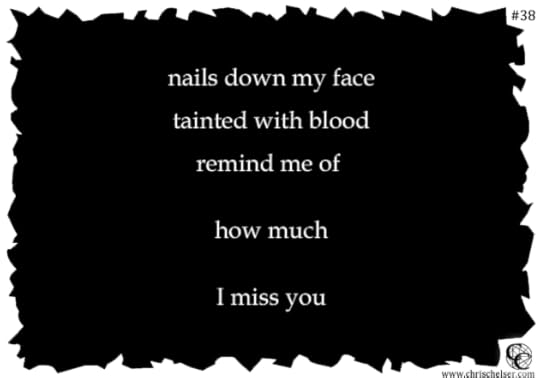
Anyone who knows a little about me (or has seen my Soulles Cries poems), knows that I’m well-acquainted with anxiety and depression. To help myself, I made a set of Affirmation Cards for myself last week. This is what it says on the cover card:
“What is written on these cards is true and feels true. However I see myself at any given moment, THIS is what I AM.”
The worst about depression is how it twists your thoughts, and with it your sense of self. Over the past 15+ years, I have suffered 6 long depressive episodes. In the good periods – like now – I still have countless deep black holes that last ‘just’ a few days, but which I’m just as bitter, full of self-loathing and suicidal as during the episodes that lasts months or years.
To help me through these bad patches and not have to rediscover my value as a person every single time I fall down a dark hole, I wrote these “Affirmation Cards”, a dozen or so at the moment. They are just small index cards on which I have written sentences that start with ‘I am’ or ‘I have’ and which state a positively worded fact about myself.
For anyone interested in this, or maybe considering to make a set of their own, observe these guidelines for maximum effectiveness:
Only positive words! No negations, no moderating adverbs, no mention of anything that is less than positive affirmation. Nouns and adjectives stand out most to our mind, and negations are often ignored. Compare “I’m not weak” to “I’m strong” and I’m sure you notice the difference.
Only facts! Things I know that I am. Things I know that I have. For example: I have a very loving and supportive family. Yes, my son gets on my nerves sometimes and my husband can be self-absorbed at times, but OVERALL I love them, they love me and they are very supportive of me and what I do in life, even through the really, really bad parts. This is a FACT, something I know to be true. So that is a card.
Mean it! I made sure and double-checked that I meant every word I wrote down. This is important, because when I fall down a hole and start doubting myself, I know – and this cover confirms as much – that when I wrote the Affirmation Cards, I wholeheartedly meant what I wrote about myself. That means that when I read it back, I know I can trust myself. I may not trust myself when I feel bad, but I know when I wrote this, I was trustworthy. I meant what the card says. I can trust that. If the card says I’m a good person, strong and reliable, I can trust that I am.
And it’s a stack of loose cards, so if I think of any more affirmations, I write a new card and add it to the stack!
In the darkest moments you need something solid you can trust. These cards are like notes to myself, notes that I know I can trust. That gives me something to hold on to until the storm passes again.
- Chris -
May 31, 2015
Shop news: Digital art now for printing!
I gave it a lot of thought and found no reason why I shouldn’t:
All digital art in the webshop is now suitable for printing!
All files are JPEG’s of 300 dpi, which means you can print it at home or at a copy shop and make you own poster. No copy shop, no printer and still want a tangible copy? The same art is on offer from Society6, too.
To celebrate, I’ve added “St Michael’s Remorse” to the shop as a downloadable A3-sized file: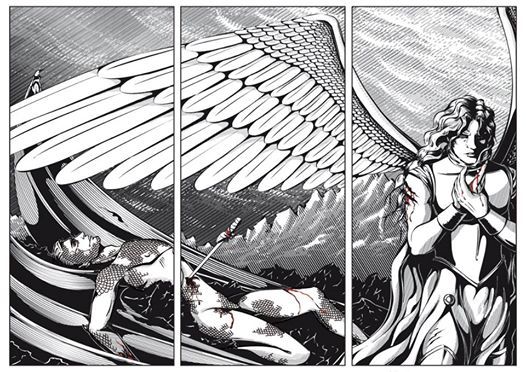
Three days more…
Sunday, bl**dy Sunday.
In three days, I have to defend my thesis. It’s the final stage of my study and I will receive my Master’s degree immediately after. But nothing comes from nothing, as I will be expected to not only explain my thesis but answer any question tmy two professor’s can think of regarding the master classes I took earlier. So I should be studying now: reviewing 6 Master classes as well as whatever I wrote in my thesis.
Yes, I tend to have a good memory, but I already forgot all about my thesis research. Simple facts is that while I love law, I have had more fun things on my mind since. Like plotting chapter 16 of ‘Dark Eyes” now chapter 15 is done and editted, rewriting “the Kalbrandt Institute Archives” and designing its cover.
And preparing for a trip to London next weekend to meet a friend and see a few shows together! I’m very excited about that, but first…
… I’ll go back to reviewing my notes. Three more days.
May 26, 2015
Extra stories added to ‘Short Stories’
In a fit of mental abberration - or something close to it, anyway – I forgot to post the previews of ‘Chalices’ and ‘Pentacles’ to the “Short Story” tab.
This omission is now fixed.
I have several ideas for new stand-alone short stories, but the two big projects are eating all my time at the moment. A good thing, because that means I’m making progress!
- Chris -