Chris Chelser's Blog, page 24
September 4, 2015


September 2, 2015
Whoops! Snippet instead of review.
I have been so engrossed in finishing the last stretch of the first ‘Kalbrandt Institute Archives’ book that this week’s ‘Bare Bones’ fell by the wayside. Again.
On the upside, I started the ‘Bare Bones’ as a filler for slower times, and writing is definitely not slow at the moment! It may be tough – I rarely had a story fight me so hard before settling in the shape the rest of the book needs it to be – but progress is steadier than it has been for the past two months.
To celebrate, here is a sneak preview:
Eva couldn’t resist reading the tags that hung from the folders. Both tags and folders were much newer than the dates on the tags suggested.
“A stupid question perhaps, but how old is the Institute?”
“Well over six centuries,” Jonathan answered from one the cabinet by the door, rummaging in one of its drawers. “The first reports date back to the fourteenth century.”
Eva whistled through her teeth. “Fighting ghosts since the 1300’s.”
“Not exactly. The archaeological and historical research goes back that far. The ghosts didn’t get involved until later.”
“Still pretty impressive.” Despite her weariness, she considered opening her senses to the soundless voices that nudged the edge of her awareness, just to hear if there was anything left to say after all that time. She put her hand on a folder. “May I open them?”
“Only when you’re wearing there.” He had pulled several white gloves from the drawer and waved them as he strode past her to the bookcases with the more recent files, obviously in search of something.
While waiting, Eva pretended to be useful and read some of the tags nearest to her. “These numbers don’t start with a letter?”
“That’s because they’re too old. The first ten thousand reports or so don’t have a prefix, because back then there was no division of specialities.”
“I saw the department names on the index. Why were they in French?”
“That was the Institute’s common language at the time. Working with a team of people from all over the world, you have to decide on a single language for communication. These days we all speak English amongst each other, but for centuries it was French.”
Eva recalled the librarian woman saying something like that. “Before that, it was Latin, right?”
Now on to the finish line!
Cheers,

September 1, 2015
August 29, 2015
August 28, 2015
The art of sharing: new ebook offer on Gumroad
A few days ago, I found an interesting TEDtalk by Amanda Palmer about “the art of asking”. Having listened to it, I prefer to think of what she describes as “the art of sharing”: one gift travels from one person to another, and another gift travels that same road back.
In our economy-driven world, one part of that exchange is almost always money. However, gratitude is a much stronger currency.
I have paid hundreds of euro’s to buy my favourite arist’s CD’s and many times that amount to fly halfway across the world to see him perform live. But all that money combined doesn’t add up to my deep gratitude when I got an unexpected chance to thank him in person for all his art means to me – or his genuine joy that I had taken the effort to tell him this!
With that moment of sharing in mind, I have been rethinking how to share my writing with you. As part of that rethinking, I have changed the pricing of all ebooklets in my Gumroad shop.
Rather than a fixed amount, you will now see each booklet is quoted as “Eu 0 ”. That means “pay what you want”.
So how does this work? It’s very simple: you decide the price of the booklet. Entering ’0′ (zero) will allow you to download the files for free. But the ’ ’ means that if you want to give a little something in return to fund my writing, you can.
You fill in the price before you order, so you decide. And whatever your decision, you have my gratitude for wanting to read my stories.
Don’t I want to get paid for my writing? Of course I do. I need to buy food and pay the rent like everyone else. But I also want to share my writing with whoever wants to read it. I won’t always be able to do that for free, but when I can, I will.
Go have a look. Download. Share! That is what art is for! 
PS. This offer is available in my Gumroad shop only, because no other retailer offers this option.
August 27, 2015
August 25, 2015
A heart-felt rant about creative problem solving
No ‘Bare Bones’ today because I’m working as hard as I can to make up for lost time and have a new ‘Dark Eyes’ chapter up on Thursday. However, I came across this on the internet and practically blew a gasket.
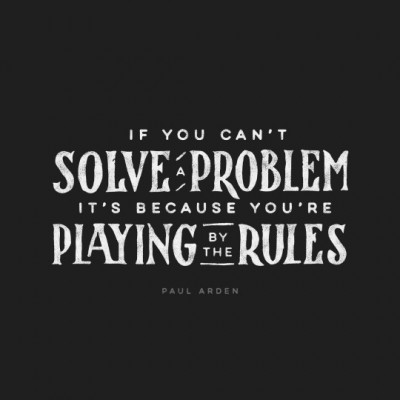
I have heard this quote before, alternatively worded as “Breaking the rules solves everything.” With no disrepect to Paul Arden as a person: screw this.
Also, context is everything, because at face value this advice will skewer you alive. Here’s why:
Any situation consists of constraints. Driving a car? Engine power, road quality, gradient, the car’s weight and half a dozen other elements form constraints on how fast you can physically drive.
Rules are constraints. Yes, the local speed limit is a constraint, too. Does it stop you from driving faster? No, but there will be consequences if you do.
Not all rules are stupid and unnecessary. Man-made rules are generally made to make life easier and safer for the majority of the population. That speed limit is not there to pester you. Break it at your own risk. When you do, the speeding ticket is the least of your concerns. Missing a turn and crashing is a bigger one.
Not all rules are man-made. Gravity is a constraint. Available oxygen is a constraint. Temperature is a constraint. These are called laws of nature. Still rules, but not ones you can chuck at will. Good luck try solving a problem by ignoring gravity.
So let’s say you own a factory and you need to produce 1000 Things by the end of the week. But your machines only have the capacity to produce 500 Thingies in that timeframe. Let’s say you ‘fuck the rules’, ignore the constraints and have the machines run at full capacity 24/7 and produce… 500 Thingies, because that’s simply the most that those machines can do. In the hasty process not all the Thingies came out in sellable condition, the machines overheated, require maintenance and the whole endeavour cost you more than filling the order will make you. That is not a solution, that is a bigger problem.
So breaking the rules to solve your problem doesn’t work.
What Mr Arden (hopefully) meant to say is that when facing a confounding problem, you need to be creative.
Can’t produce more than 500 Thingies? Buy the other 500 from another factory that can produce the rest of the required 1000.
Parachute doesn’t open? Don’t just hang there but try all you can to prise it open and hope it unfolds.
Creative problem solving is important. I am the first to admit that this is true. Creative problem solving can save lives.
If your problem is solved by breaking a speed limit, by all means go right ahead. But if you have a problem that you truly can’t solve, a feasible answer isn’t going to be as straight-forward as simply removing one or more constraints.
So what IS creative problem solving?
It means making the most of a situation given the situation’s constraints. Life is full of them, and you can’t ignore them just because they don’t suit you right now. Well, sometimes you can, but there are always nasty consequences if you do.
However, creative problem solving also means learning when to accept that some problems cannot be solved, and get creative on damage control instead.
Don’t think outside the box. The box is where it has to happen. So make the most use of what is inside that box!
August 21, 2015
August 19, 2015
The Bare Bones of…”IT” (novel)
What: “IT” by Stephen King.
Why: While the movie scared me breathless, the book bored me to tears. How on Earth did that happen?
Spoiler Alert: Low | Medium | HIGH!
Summary:
The first scene of “IT”s movie adaptation is classic. The water-filled gutter, the little boy playing with his toy boat. The toy boat disappears down the drain and when the boy wants to look for it, there is a clown in the drain. A clown with a white face, red nose, red hair and sharp teeth. It’s called Pennywise, it says, just before it lures the boy closer and kills it. How happy I was to see that this scene came directly from the novel. A good start!
In written stories, a lot more information can be conveyed than on screen. A lot. We get endless background details on Pennywise, possibly more than we’d like.
In reality, the creature is a shapeshifter lurking in the town of Derry. Like the boggard from Harry Potter, it takes on whatever form its intended victim is most scared off. A group of children in Derry, friends known as ‘The Loser’s Club’ have all seen it in one form or another. Using an old American Indian ritual, they discover how the creature came to Derry, that it scares children because ‘fear spices the meat’, and they learn of a thing called the ritual of Chüd, which might stop the killing. Bill, who wants to avenge his little brother’s death, manages to find out what the creature really looks like (a giant spider containing a cloud of writhing ‘deadlights’) and wards it off with the help of an elusive force known only as the Turtle.
Following its defeat, the community blames a rather aggressive kid called Henry, one of the ‘Losers’ enemies, for the murdered children and the town goes back to sleep. Only the ‘Losers Club’ swear that they will return to Derry if ‘It’ ever comes back.
Almost thirty years later, Derry is again hit by a series of child murders. Bill calls his own friend up on their oath, and although they have suppressed much of their childhood memories, they come. The only one beside Bill who remembers more details commits suicide rather than face such events again. Also making their way to the town are Bill’s wife, the abusive husband of Beverly, the only girl in the group, and Henry, who escaped the asylum with the help of it.
Because it knows what they are up to and it wants them dead. Most notably, as the ‘Losers Club’ find out when they need to rescue Bill’s wife from its lair, it wants to protect its eggs.
Several confrontations later, not everyone of the ‘Losers Club’ survives, but the eggs are destroyed and Bill has managed to kill the creature through a fresh ritual of Chüd. Is it really dead? Yes. The fact that their fight with it coincided with a massive storm that destroys part of Derry is a sign that the creature indeed died. A rather happy end, as far as horror stories go.
Story Skeleton:
As shown in the Bare Bones of “Gethsemane Hall”, typical horror stories use a relatively slow build, plenty of exposition about the creepy things that are happening, to then climb a quick crescendo to an explosive (and sometimes ridiculous) climax. This kind of suspense requires careful pacing on the part of the writer: how much to show to the readers at each point along the way?
Unfortunately, “IT” spirals out of control. There is a lot of exposition quite early on in the story, and not all of it is important to the plot. Such tangents were we well-known feature in 19th century literature, but have been frowned upon since.
What annoyed me more still was the ‘trilogy of narratives’. Because Pennywise assaults in a recurring pattern, there are various points in history where it can show up and claim its victims. So it does. Such ‘sub-settings’ are then entrusted with their own plots and subplots, like encapsulated short stories within the overall story.
This is an interesting concept in itself, except that every one of these sub-stories are identical: town is peaceful; along comes Pennywise (usually in that form, anyway); unsuspecting people becomes its victim one way or another; everyone is scared. Every story confirms what the reader understands quite early on, namely that ‘it’ is terrifying. However, after several of such confirmations, all not related to the main protagonists of the story, the message dulls.
“Yes, yes, ‘it’ is a scary monster. Okay, we get it. Now are you going to do something about it, Mr King? Or are we going to get another show of how scary it is?”
Not the kind of question I want to be asking myself when reading a horror story.
Lesson learnt:
Too much of anything is dull, even when that ‘anything’ is toe-curling horror. It is why these days we can watch the most inhumane images on the news and shrug unperturbed, and why a movie crammed with jokes ceases to be funny: overexposure.
And like the news channels or the latest Adam Sandler movie, the best of stories can fall into the trap of overexposing its audience to its chief ingredient. The result is at best an audience that no longer cares. At worst, the audience become repulsed.
That is the reason why “IT” comes in an abridged version, too.
August 17, 2015
I feel I should apologise…
… for writing little and posting even less this past month. I really want to, but it is just not happening.
Mind you, I’m not making excuses. I’m all for beating the conspiracies of life that try to keep you from doing what you want to. Unfortunately that fight is that much harder when the obstacles are health related. I’m not stranger to that, but the lethargy pull of depression is a Level 10 foe compared to the fear of a mother for her sick child – or as energy-consuming as taking care of sick child in general. Somehow they watch TV all day and still manage to thwart your every attempt at getting anything done.
Worse is when said sick child passes the bug on. To both parents. Simultaneously. While abroad on holiday…
Since then the fever shot my concentration, and what I did write while dosed to the gills on medication may at best be described as, well, weird. And what doesn’t qualify as weird, is pure drivel.
The only good news is that it is not pneumonia. Yet. All I can hope is that the antibiotics I was prescribed this morning will do what they are supposed to (no guarantees, the doctor said) and haul me back up facing the right way. Then maybe in a few days I can finally start writing decent sentences again. :/
Cheers