Chris Chelser's Blog, page 22
October 23, 2015


October 20, 2015
The Bare Bones of…”Crimson Peak” (film)
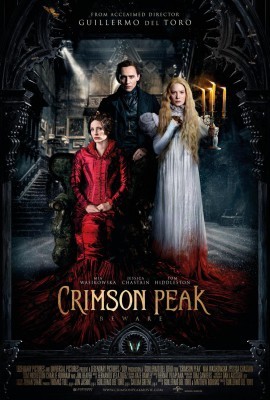 What: “Crimson Peak” (2015).
Why: This is how you make dead-beat genre conventions interesting again. And a lot of genre fiction, on and off screen, could use this treatment.
Spoiler Alert: Low | Medium | HIGH!
Summary:
“Ghosts exists,” Edith Cushing announces in the opening shot. She knows. Always has known. Less than 5 minutes into the story, we do, too.
America, late 19th century. Edith is still a young girl when she loses her mother to cholera. But not long after the funeral, she sees her mother’s ghost: a black skeletal monster that cries at her to “beware of Crimson Peak”. The little girl is scared senseless when grim hands grope her, and is thankful that she doesn’t see the ghost again… any time soon.
Years later, Edith has become an aspiring writer and an all-round nice young lady. Her father is a wealthy engineer and he is called upon by a Sir Thomas Sharpe, an impoverished English baronet seeking funds for a mining machine that should make the Sharpes’ mining in England business solvent again.
Cushing isn’t impressed and outright opposes the young man when a private eye that Cushing hired comes up with incriminating evidence against Sir Thomas and his sister Lucille. When Edith and Thomas nevertheless take a liking to each other, Cushing pays the man to leave the country along with his sister.
But Sir Thomas is not in a hurry and he is there to comfort Edith when the next day she receives news that her father slipped on a wet floor and bashed his head on a sink. Young family friend of the Cushings, Dr McMichael, isn’t too certain about the coroner’s concluding that it was an accident, but by then Edith has already rushes to Sir Thomas’ arms.
A few weeks pass and Edith and Thomas arrive at the Sharpe estate, now husband and wife. The estate is on a bare hilltop in a wet and windy landscape, and the house is near collapse. Literally. A part of the roof is missing; the house groans, is always draughty, and the bright red clay on which it was build is unstable and seeps in through the floorboards. Lucille lives in the house, too, and insists that Edith will feel at home soon enough after a cup of good old English tea.
Yet Edith feels anything but at home: the house is haunted by skeletal ghosts as red as the clay on which the house stands. They warn her to leave or lead her to strange places, like the clay pits beneath the house itself. But Sir Thomas tells her that she cannot leave: winter is coming and they will be snowed in soon. “The ore in the clay colours the snow blood red,” he says. “That is why people call this place Crimson Peak.” Edith recalls her mother’s warning, but knows it is much too late to heed it. As it is, she has begun to cough up blood.
Back in the United States, Dr McMichael contacts the private detective that Cushing had hired and asks after his finding on the Sharpes. What infuriated Cushing was the fact that Sir Thomas is already married and neither divorced nor a widower. Not wasting time, McMichael travels to England to aid Edith.
On the Crimson Peak, a series of small events, some of them of ghostly origin, lead Edith to the same conclusion and more: at least three wives and a baby have preceded her, but they are never mentioned. One of the ghosts lead her to wax rolls, suitable for a gramophone. In the trunk bearing the name of another wife, she finds the player and discovers that one of the wives has left recordings, explaining that the tea Lucille is so keen to pour is poisoned, which drains her strengths and makes her cough up blood.
Alarmed, Edith refuses the next cup she is offered, but to her surprise, Sir Thomas confesses to the poison and urges her not to drink anything his sister offers her. Edith confronts him about the other women, and he doesn’t deny that he married wealthy women without relatives to inherent their money after their death. But he insists that he doesn’t want the same to happen to her.
Lucille, however, has far less scruples, and at last Edith finds out the truth about the ghosts, and about Thomas and Lucille: locked away in the attic all their childhood, they have become ardent lovers who murdered their abusive mother, and later the wives that Thomas took. The dead baby that Edith saw one of the ghosts cradle was not the woman’s but Lucille’s, too inbred to be long for this life.
By this time, McMichael has arrived at the house to intervene, but fails. He only survives because Thomas is careful not to mortally wound him when Lucille orders her brother to kill the man. Edith must die, too, now more than ever because Thomas admits that he has truly fallen in love with her. Lucille, jealous and possessive of her brother, would rather kill him than see him in the arms of another woman, but is delirious with grief when she actually does. In a final showdown, Edith fights Lucille and with the help of Thomas’ ghost, succeeds.
Story Skeleton:
The story itself is a gothic romance in a lovely dark setting, but it is first and foremost a true ghost story: they play decisive roles in the plot development. Much as I love ghost stories, the true pearls of this film are how director Guillermo Del Toro plays or even breaks with the genre conventions that have bogged down ghost stories for far too long:
Ghosts exist. End of discussion – Many ghost stories are mainly about the question “do ghosts even exist?” Del Toro cuts that short in the opening scene by having Edith declare that ghosts exists without a doubt. Later in the film, Sir Thomas confirms that in England people take the matter of ghosts very seriously, so there is no argument over their validity either between the characters or between director and audience. Refreshing.
Ghostly looks can be deceiving – There is a strong genre convention that good ghosts look pleasant and human, whereas malicious ghosts must look like monsters. Del Toro makes use of that expectation, but turns it inside out: all his ghosts look monstrous, but none of them are malicious. In fact, all ghosts want to warn or even help Edith.
Being scared is useless – Of course Edith is initially freaked out by what she sees. But as she learns about the people behind the ghostly appearances, she steps over her fear and interacts with them as if they are – gasp! – normal persons. A deliciously level-headed change from the obligatory paranoia-trope.
Scary house is really just a house – Another genre convention dictates that a ghost story must take place in a house that looks the part. Del Toro does adhere to this convention, but he gives plausible, physical reasons for the constant creaking and cold draughts (roof partially gone), the bleeding walls and floors (red clay seeping in) and the overall dilapidated condition of the estate (there is not enough money). Better still, the story doesn’t deviate from these plausible reasons at any point. Whatever the ghostly activity, the decrepit house is nothing more than just that.
Ghosts needn’t be vanquished – The ghosts are accepted as part of the furnishing, as it were. The story does focus on what the ghosts wants to tell, but there is never talk of banishing or destroying them in any way. Rather the end of the story only adds more.
In addition to turning these tropes inside out, Del Toro proves that he knows his ‘Chekov’s gun’ and isn’t afraid to use it. This rule of storytelling, attributed to the Russian writer Pavlov Chekov, says that if you show a particular object in the story, it must be used in a future chapter. Del Toro plays with this concept.
Throughout the film he prominently show several such objects in a way that has the audience anticipate a certain conclusion about how they will be used. In some cases he meets those expectations (when tea is described as being ‘bitter’, you know it is 99% certain to be poisoned), but more often he twists them (a large traveling trunk bearing the name of one of the dead wives is big enough to contain a body, but inside is only a gramophone). By not catering to the audience’s expectation, Del Toro keeps us on our toes.
Lesson learnt:
A very good way to keep the audience on the edge of their seat is to play with genre conventions and the expectations these have created with the audience even before the story has started. Giving a new twist to a favourite trope is far more satisfying for both the storyteller and his audience than to lazily feed what the audience is already expecting to receive.
October 19, 2015
October 16, 2015
October 13, 2015
October 12, 2015
Revamped PDF’s of ‘Res Arcana’ ebooks
Something new to learn every day! And yesterday I learned how to make decent PDF’s that actually look how I want them to look. Apparently that is crucial if you are sending files to the printer who is going to produce your paperbacks.
After tinkering a bit to that end, I have now replaced ALL instances of the ‘Res Arcana’ PDFs.
Want to have a look? You can download them for free (or a small donation) in my Gumroad shop.