Chris Chelser's Blog, page 14
April 19, 2016
The Bare Bones of…”The Voices” (novel)
What: “The Voices”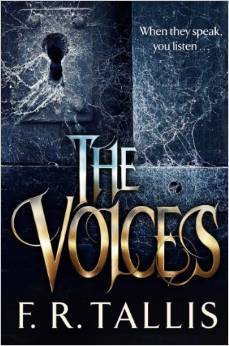 by F.R. Tallis.
Why: Suspenseful horror done right makes me very happy!
Spoiler Alert: Low | Medium | HIGH! since I won’t spoil the fun by going into too much detail.
Summary:
The summer of 1976 is the hottest on record, and the heat in London is stifling. Composer Christopher and his wife, former-model Laura, move into their new Victorian home with their young daughter Faye. The house is beautiful, but the purchase was expensive and Christopher has had little luck landing new commissions for soundtracks, which are his main source of income.
One night, Laura hears voices coming over the baby monitor in Faye’s room, but when she goes to see what is going on, no one is there but her baby daughter, standing in her cod and staring into an empty corner of the room.
Christopher catches similar voices on the recordings he makes in his sound studio in the attic. Various voices. Some he can make out, others speaking languages that aren’t English. And one of them seems to be calling Faye…
As the summer days drags on, Laura gets more and more restless. Her past is catching up with her, while Christopher withdraws from his family to work on a new composition, based on the bodiless voices that have appeared on his tape.
Something is wrong. All the signs are there, but no one knows exactly what it is or how to solve it. It’s a feeling, an intuition. A suspicion, perhaps, from one parent to another. About their work, or lack thereof. About the house, and about the dwindling finances.
Until one day, the very worst happens.
Story Skeleton:
No gore in this horror story, nor does it need any. The suspense is thick as the summer heat of the setting. Everyone’s behaviour seems a little odd, but understandable. Disturbing signs are ignored, because there are weird but not alarming. Not yet. Only when they do become alarming, it is already too late.
A slow build-up of tension leads to a finale that is, ultimately, open for interpretation. Did Laura go crazy, as the authorities imply? Are the ghostly voices responsible for the tragedy? Or was it someone else, someone who had gone unseen all this time? What even really happened that fateful night?
Tallis gives us no answers, only clues. The reader can piece together the ending he or she prefers to believe. All options are open, all solutions equally plausible – or implausible, for that matter. A tantalising ending indeed.
Lesson learnt:
Anyone who has watched the cartoon Scooby Doo knows that any scary story immediately loses its mystery the instant that the threat is revealed and identified (“Let’s see who’s behind the mask!”).
A story’s ending must always give closure, but that doesn’t mean that the conclusion must be final and irrefutable. When it comes to horror stories, it may it much more effective not to reveal the antagonist’s identity.


April 14, 2016
April 12, 2016
Short story: “Bloody Mary”

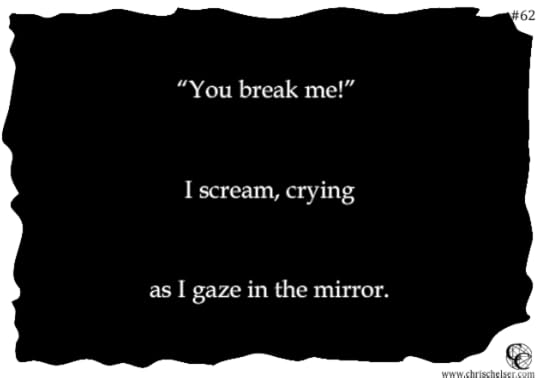
Source: sixpenceee.com (Click image to go there).
After a good laugh, this quote inspired me to write a more sinister version:
My toes curled against the cold of the tiles while I waited for my eyes to adjust to the dark. Faint moonlight shone in through the high window of the bathroom, illuminating my reflection in the mirror above the sink.
I stared into the image of my own eyes and shivered. How precise was the timing of this, anyway? I wanted to check my phone, which lay on the shelf next to the towels, charging. But the light of the screen would ruin my nightvision, so I wrapped my arms around my chest for warmth and waited.
It wasn’t long before the chimes of the neightbours’ grandfather clock echoed through the walls. One, twice, thrice…
“Bloody Mary!” I screamed into the mirror. ”Bloody Mary!” My face contorted with raw despair. ”BLOODY MARY!”
The last syllable bounced off the tiled walls and faded away. I held my breath, ears primed for any sound but that of the blood rushing through my veins.
I so hoped to hear my mother’s voice again, even if it was just to yell at me!
Initially, everything was silent. It seemed that my mother had taken no notice whatsoever of my incantations. And how could she? Such a foolish endeavour. Superstitious at best!
I was about to go back to bed, but the instant I reached for the handle of the bathroom door, I heard it. Scuffling. Like someone was dragging their feet across the carpetted landing on the other side of the door.
My hip hit the edge of the sink as I stumbled backwards. In the moonlight, I saw the door handle jiggle once. Very slowly, it arched down and at click of the releasing lock, the door opened.
I tried to swallow, but couldn’t. My throat was too tight.
There, outlined against the lightless shadows of the landing, stood a young boy. His pale face was gaunt, and his pyjamas sagged on his stick-thin limbs. With sunken eyes marred by dark circles, he glared at me from the threshold.
“Shut up, mom. It’s late and I want to sleep.”
Out of sheer relief, I began to chuckle. But then it hit me.
I didn’t have a child!
April 10, 2016
War Stories #5
“War Stories” is a series of my family’s personal experiences during World War II. Originally collected for and presented to my son’s class of 9-year-olds, this is where I share the non-sanitised versions.
Burning money
The south of the Netherlands was spared the Hongerwinter. While this did not mean that the southern provinces were spared the cruelties of the war, life during the war years was not harsh for everyone.
Piet and Hannie Bijl, my grandparents on my mother’s side, lived in Tilburg, a city not far from the Dutch-Belgian border. To them, the war had been mostly a severe inconvenience. As far as their children know, the couple suffered no scarring trauma in those five years.
Of course, food was rationed throughout the country, but most noticeable was the shortage of firewood: in the last year of the war, Piet and Hannie were forced to break up the wooden floors of the upper storey of their house. During the winter months, those floorboard fed the fire in the hearth and kept them warm. Otherwise, they were spared further hardships during the war years.
In fact, Piet’s most memorable war experience unfolded in the wake of the liberation:
My grandfather was a learned man with a university degree. Apart from being an electrical engineer, he spoke multiple languages, including English and German. This made him a great civil asset to the Allied troops: an interpreter who could translate as the English-speaking army marched into Germany.
So Piet went with the American forces. He did not travel with them all the way to Berlin – he neither had nor desired to have the required military inclination – but he did make it as far as a German village, where the advancing Allied army stumbled upon thousands of Reichsmark bills stored inside a bank building.
As far as the Allied forces were concerned, the money was worthless. The Reichsmark had been the currency of Hitler’s Third Reich, but that ‘reich’ was crumbling and thus its currency had lost its value. However, just the rumour of this large sum lying about, more or less up for grabs, would lead to unrest among the villagers. To them, the money was every bit as valid as it had been before the Americans came marching in.
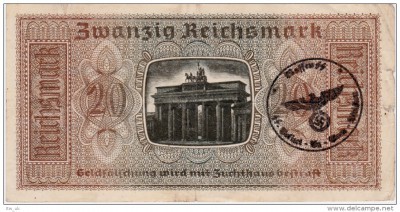
But what to do with it? As it was worthless, the troops couldn’t take the money with them, and since the army was advancing deeper into the country, leaving guards behind at the bank was not an option either.
So my grandfather was ordered to burn the bills.
This seemed simple enough: light a fire in the oven of a nearby bakery and toss in the money. Only paper bills are very light. Even a stack of them may be carried on a whiff of hot air rising from the flames. Thus at the first attempt, the bills didn’t burn, but were blown into the chimney instead – up and out into the open air.
A money-spewing chimney was not acceptable! The ‘damage’ was quickly contained (read: the strewn bills collected and put back with the rest), but it had become clear that the stacks of bills had to be burned one by one.
And so Piet spent two whole days in front of that fireplace, feeding it stack after stack of money with long pliers, holding on to the burning paper until all of it began turning to ash so no recognisable pieces would fly out the chimney.
He described that situation as boring, but also surreal. Normally, destroying money is a crime. Yet here he was, destroying bills that were both a fortune in legitimate currency and at the same time a worthless symbol of a hated regime.
Ultimately Piet was not cut out to be a liaison to a military unit. So shortly after this bizarre event, he returned to the Netherlands and rejoined my grandmother.
But not without a souvenir: the officer Piet had served under had given him a confiscated SS-dagger as a token of appreciation for his help.
Rather than consider it a war trophy, Piet felt uneasy about accepting this unusual gift, but refusing it was not an option under the circumstances. Many years later, long after his five children had left home, he gave the dagger away to an acquaintance. He didn’t want any of his children to inherit this awkward memento of a period in his life that he had abhorred so much.
I had thought this would be the last instalment of “War Stories”,
but an unexpected gift has secured another three parts. See you next week!
April 8, 2016
Ghosts of Vimy Ridge
Today 99 years ago, on April 9th 1917, the Battle of Vimy Ridge started. It would last four days, at the cost of thousands of lives.
This painting by William Longstaff shows the Canadian National Vimy Memorial on the ridge, along with the countless ghosts that still haunt the WWI battlefield to this day.
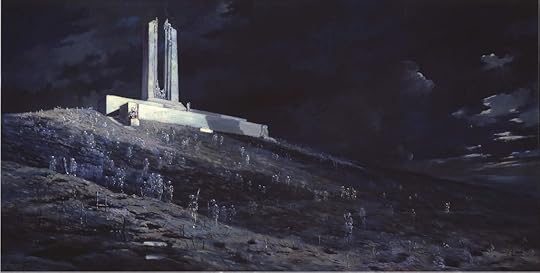
Sometimes I wonder how much Longstaff could see. Because this is no exaggeration: the battlefields of WWI are the most haunted places I have ever visited!
April 7, 2016
April 5, 2016
Writer’s Woes: Entrepreneurial Priorities
Once a month I permit myself to discuss the dark side of being a (self-published) author.
In this month’s post rants about…
Entrepreneurial priorities
The upside of being self-published is that you get to decide everything yourself. No one tells you to change your plot or your characters for “better marketability”, no arguments with a publisher about what should be on the cover of the book, no presentations or obligations you can’t fit in your already too busy schedule.
Bliss!
The downside of being self-published is – you guessed it – making all the decisions yourself.
Find and argue communicate with an editor. Decide on internal formatting. Curse MS Word or InDesign as you Prepare book file for printing. Prepare book file for ebook publication (in as many different formats as you use platforms, regardless of what said platforms promise…). Decide on cover. Get lost on the ‘net trying to Find stockphotos and fonts, or decide on cover artist. Argue Communicate with cover artist. Curse at upload wizards Upload file for printing and ebook format. Decide on shipping, pricing, wholesale discounts, distribution channels, sales platforms.
And the marketing. Let’s not forget about marketing! Social media, blog, blog tours (still have to figure that out), networking, write press kit and press releases. More social media. Promotions, conferences, fairs *gasps for breath* interviews if you’re lucky enough to get one, gather reviews. Still more social media!
Oh, and you’re also responsible for production of the stories themselves.
*headdesks*
Being a self-published author means you’re an entrepreneur from start to finish. In the hustle and bustle, it’s easy to forget that despite running a business, you are a writer first.
So, back to writing! 
The Insecure Writer’s Support Group
A safe haven for insecure writers of all kinds!
April 3, 2016
War Stories #4
“War Stories” is a series of my family’s personal experiences during World War II. Originally collected for and presented to my son’s class of 9-year-olds, this is where I share the non-sanitised versions.
Starvation
The winter of ’44-’45 is known in the Dutch history books as the ‘Hongerwinter’: ‘the Winter of Starvation’. An aptly chosen name, because during this harsh winter not only did the northern provinces of the Netherlands run out of gas, coal, wood and candles, they also ran out of food. Quickly.
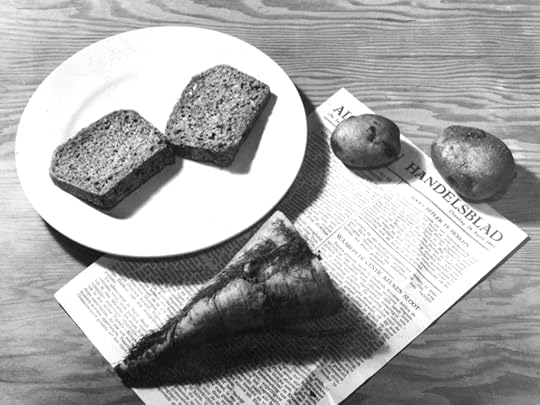
In the autumn of 1944, after the southern provinces had been liberated, the part of the Netherlands that was still occupied by the Nazi regime restricted the already regulated distribution of basic necessities even further.
Families were given food stamps, like the sheet below. Note that this sheet had to last an entire family almost two months (October 1st – November 25th, 1944).
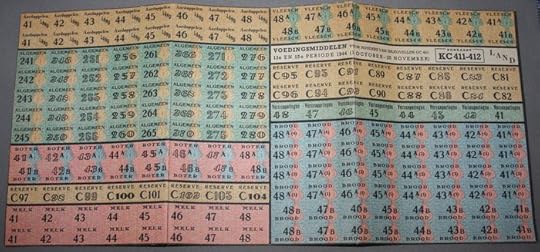
One of the bread stamps on this sheet entitled you to 1400 grams of bread. By December, that amount was brought down to 800 grams per stamp, and by February 1945, one bread stamp would get you to only 400 grams.
That is four slices of gritty rye bread.
To feed a whole family.
For a week.
Potatoes, butter, milk, meat… It just wasn’t available anymore and food supplies had stopped. That situation lasted for another 4 months.
In desperation, people cycled into the countryside, hoping the farmers would share their stock. Some did, some took advantages and asked outrageous payments.
Most of these trips were made by women, because the men would be deported for forced labour if caught. They would load what they could find onto their bicycles and pray that when they returned to the city, the food wasn’t confiscated by the German soldiers, or stolen by people as hungry and desperate as they were themselves.
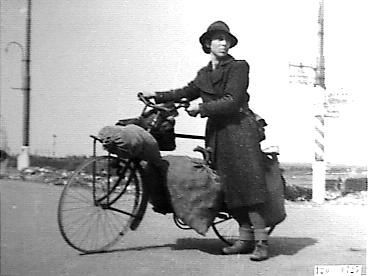
Did you notice that the woman’s bicycle has no tires? Rubber tires had been banned early in the war and people had mounted wooden ‘tires’ on the rims. By now, those make-shift tires had already been burned for warmth.
My grandmother Wil and her sister went out to find potatoes one day. Like the woman in the picture, they cycled from farm to farm and beg for food. But danger came from an unexpected place.
While cycling through the open field, a fighter plane overhead spotted them… and opened fire! Bullets whizzed past the two women, spraying dirt and stones even as they dove into the nearest ditch to take cover.
The plane made a single pass and didn’t turn back. Giggling with nerves, the sisters checked for injuries. By nothing short of a miracle, neither of them had a scratch.
Desperate hunger makes for desperate solutions.
People dug up the bulbs of tulips, narcissuses and similar flowers. It was too cold for the bulbs to bud, but they had some nutritional value. Like an onion.
Jo’s father came home one day, proudly announcing that he and a friend had managed snare a rabbit! They had shared the animal, and so he put the half carcass on the kitchen counter for Wil to prepare. Jo recalled:
“Wil stared at the critter for a few long moments. Then she turned to me, raised a brow and only said ‘meow’. But in all fairness, that cat tasted delicious!”
Their family made it. Emaciated and weakened, but they survived to see spring – and to see the Allied bombers make life-saving food droppings all across the struck provinces when the whole of the country was liberated on May 5th.
But not everyone was that lucky. In Amsterdam, victims of the Hongerwinter were collected in the Nieuwe Kerk (New Church):
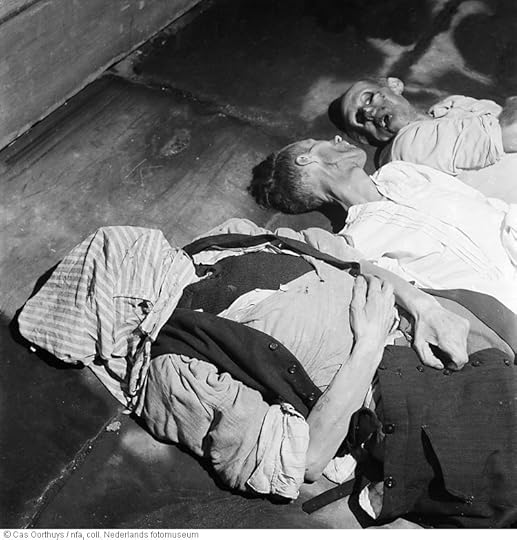
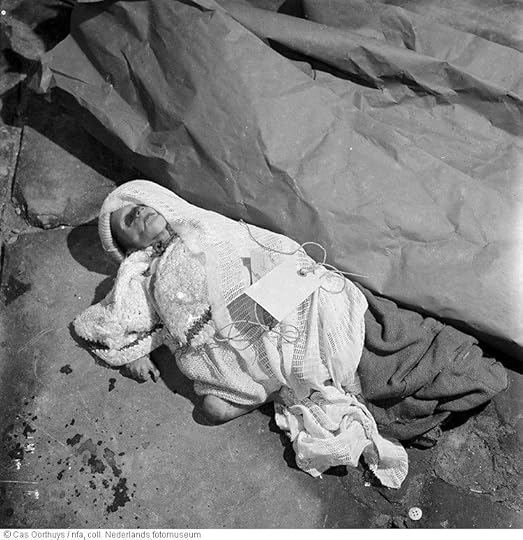
In those last few months of the war, thousands of men, women and children perished of starvation and cold.
The Netherlands were not the only ones to suffer so (the German people living in ruined cities suffered an equally devastating winter in 1946-1947), but this winter had a deep impact on the Dutch population – and on their children. Both my parents were born a few years after the war, but my father, son of Jo and Will, still has physical problems that originate from the fact that his mother was malnourished when she was pregnant with him, now 70 years ago.
I consider myself honoured that my grandfather so readily shared his stories and experiences. Many of his generation were too traumatised to tell their children and grandchildren anything. Often rightly so, but nevertheless it is incredibly important to me that such experiences are handed down to the younger generations.
We, as individuals and as a society, must remember our past while we can, lest we doom ourselves to repeat it too soon.
Next week: hardship is relative.
March 31, 2016
Illustrations for upcoming ‘Res Arcana’ book
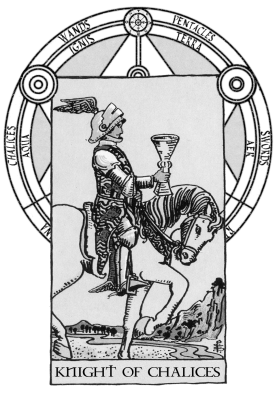
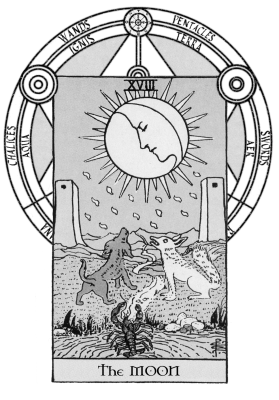
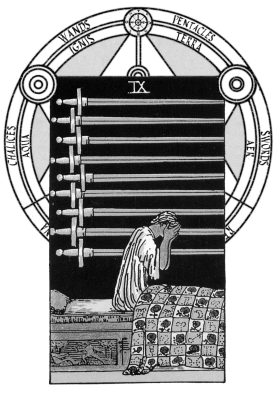
As we speak, I’m working on the last new stories for the Res Arcana paperback that will be released in a few months.
This paperback will be more than a mere collection of the previously published flash fics. Not only will it contain 7 new stories, the completed book will have a story arc of its own – one that is open to interpretation!
I’m currently working on the 27 illustrations that will go with the stories to connect to the Tarot cards that inspired each of them. As you can see, I went with the best-known deck: the Rider Waite. The extra panache is courtesy of the digital brushes of obsidiandawn.com and several hours of “intense negotiations” with Photoshop.
Next week, I will share an exclusive preview with my subscribers!
Not a subscriber yet? Sign up here and have a Res Arcana booklet delivered straight to your inbox!
March 29, 2016
Ask the Author: “What inspires the Soulless Cries?”
Every last week of the month, I’m answering readers’ questions.
Want to ask me something? Click here.
“What inspires the Soulless Cries?”
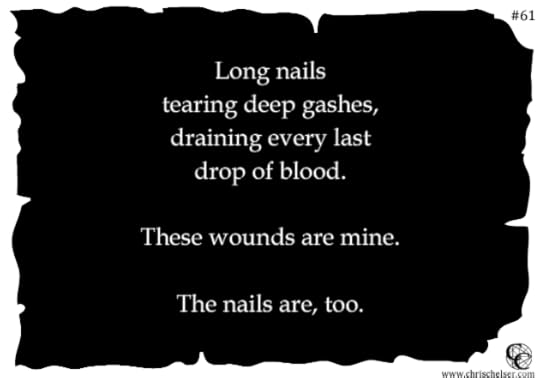
The Soulless Cries have been an outlet for emotions that can barely be expressed in words. They are not classical poetry but rather words, phrases and sentences – sometimes not even coherent – that best fit a particular feeling. If those words come with a specific image, I try to find a photo or visual effect to match and include that.
I won’t go into details of what the underlying causes, although it is no longer a secret that I’ve been diagnosed with chronic depression and PTSD.
Since my teenage years, I have also had a morbid fascination for the Western Front during the Great War (WWI, as we now call it). Not the tactics and strategic side of the war, but the soldier’s life in the trenches, such as it was.
Over the years I visited the trenches; I have been to the battlefields and the cemeteries around Ypres; I have read countless books; I watched dozens of interviews with survivors, recorded in the 1960s and ‘70s. And every time, it felt like I was there.
Those feelings make it the Soulless Cries as well. They may be mine, or I may be vocalising the feelings of someone else. Someone who didn’t survive. Wherever the words come from, I don’t delve into their source. They arrive as they come, intuitively. I only write them down, virtually unedited, and make an image file of them to share.
Thank you for asking!

Have a question you want to ask me? Click here.