Chris Chelser's Blog, page 13
May 6, 2016


May 4, 2016
Remembering WWII
On the exact mark of midnight between the day my country remembers the military and civilian casualties of the Second World War (May 4th) and the day we celebrate our freedom (May 5th), it only seems fitting to link to the series of war stories that finished this week.
These are the experiences of my family during the Second World War:
#1 – Hiding Jews from the Nazis
#2 – Arbeitseinsatz (forced labour)
#3 – The Hungerwinter pt 1
#4 – The Hungerwinter pt 2
#5 – Travelling with the Allies into Nazi territory
#6 – Circumventing food restrictions
#7 – Planes & bombs
#8 – Razzias
May 3, 2016
Writer’s Woes: Contradictory Advice Gives Me A Headache
Once a month I permit myself to discuss the dark side of being a (self-published) author.
In this month’s post rants about…
Contradictory writing/publishing advice gives me a headache!
Be warned, this is an actual rant – unedited and straight from the heart. What triggered it? This quote:

For the record, I AGREE WITH THIS STATEMENT.
I’m a writer, but I’m also a lawyer. Years of experience have taught me how easy it is to just say what the person(s) across the table want to hear.
As a lawyer, I don’t litigate or try cases in court. Still my consultancy clients all compliment me on my ability to explain their situation in such a way that their opposition is flumoxed. Their problems rarely go to court, because we settle them before it gets that far. Speaking as a lawyer, this is simply me doing my job.
As a writer, I want to say what is on my mind. For any author, the stories they write are a reflection of themselves. In order to be true to this, it’s important to write the stories with the most resonance. If a story doesn’t resonate with me, I can’t possibly do it justice.
But then the “indie author advisors” come along. Their advice:
“Rule #1: Don’t write what you think is a good story! You know shit! Do market research instead, and then write what the market wants you to write!”
It gets better when they follow it up with:
“You won’t sell a book if you don’t follow this advice! You’re doomed unless you sell your soul to the highest bidder!”
Because let’s face it, that is exactly what ‘writing for the market’ means. Instead of writing what you need and want to write, you write ‘what sells’, even if you hate it.
“Rule #2: Don’t go off the beaten path! There is a reason everyone is doing the same, and that is because it works! Deviate and die!”
O-kay…
And then they go in for the kill:
“Rule #3: Be unique! Make sure you have found your own voice! If you haven’t, you’re doomed!”
Wait… How exactly can I be unique when I’m doing what everyone else is doing and catering to masses that everyone is trying to cater to?
But these sage advisors never answer that question!
Marketing is not my strong suit. If there is anything in this business that I need help with, it’s with getting my work in front of people who are into ghost stories and psychological horror. Weiting a good story is one thing, getting it out there is another.
Advisors will tell you what you need (grow an email list, develop a ‘platform’, social media presence, host webinars (how does that even work for authors?)), but they never tell you how.
So how about those ”indie author advisors” stop scaring indie authors in believing that they are ‘getting it wrong’ and are dooming themselves and their work? We often have enough self-confidence issues without them adding insult to injury!
Don’t tell me that I should suck the soul out of my writing, and then tell me that I need to be unique as well!
To all indie author advisors: don’t tell us what we’re doing wrong. We’re not stupid and we tend to have a fairly good idea already. Rather show us how to get it right. That isn’t going to make the actual work of us indie authors any easier, but at least it will take us a step in the right direction instead of stunting our potential before it had a chance to bud.
If you’re an author: What are your experiences? What worked for you? Or are you lost in the labyrinth of contradictory advice and strategies that are crammed down your throat?

The Insecure Writer’s Support Group
A safe haven for insecure writers of all kinds!
May 1, 2016
War Stories #8
In a continuation of the “War Stories” I collected for my son, we discovered that great-uncle Mies (Marinus) Vogels wrote down his recollections of war-time life in the rural south-east of the Netherlands.
The Razzias
By 1942, two years into the war, the Arbeitseinsatz had become a serious threat to young Dutch men. Some, like my grandfather Jo, couldn’t avoid deportation to Germany. Those who did – and those who escaped without the help of such providence as my grandfather encountered – fled and went into hiding.
The Vogels family housed many such men, most of whom were still youths. Some stayed only a week before moving elsewhere, others stayed at the farm for months. Life was relatively safe there, which was a shocking relief to refugees who had grown accustomed to nightly bombings and constant danger.
But unlike Grandma Maas, Mies’ family never harboured Jewish refugees, for two important reasons.
The first was that his parents held a view that was common among Catholics at the time:
“In sermons and religious stories, they were depicted as an evil people who first rejected Christ and, in doing so, asked for his blood to come down on their children. Over the centuries, mankind felt justified for making this curse come true. [..] Sure, the organised Underground placed some of them in hiding places, but very few people were willing to put their life on the line to help such an unpopular group of people.”
Jews weren’t universally shunned. In Amsterdam, where the Jewish community was considerable, a city-wide strike erupted on February 22nd and 23rd, 1941. The Nazi troops quelled this civil insubordination with great force and lives were lost. The strike ended for fear of further reprisals on the Jewish inhabitants of Amsterdam. It made little difference, but this act of resistance against what would become the Holocaust was one of the few in Nazi occupied territory.
Unlike the big cities, the rural areas of the south-east had but a small and dispersed Jewish community, and there was no significant protest to the increasing number of deportations. For the most parts, the Jews who managed to escape trains got a cool reception.
This cruel fact was not in the least due to the German policy at the time that people who harboured Jews were shot where they stood if this was discovered. And that would be the second reason why the Vogels family refused to hide Jewish people on their property – as did many, many people throughout the Netherlands and no doubt elsewhere in the occupied territories.
One day in August 1943, the farm was raided by the Gestapo, the feared German Security Force. By sheer luck, both of the young men the Vogels were hiding had left the day before. One had relocated and the other had gone to visit his mother in hospital and had risked staying home for a few days. As a result, the barn, the stables, the house were empty.
Mies and his brothers all had legal paperwork that exempted them from the Arbeitseinsatz. So when the officers declared that Mies’ papers checked out, he announced that he would be out in the field to milk the cows in the pasture.
“I grabbed a pail and walked out there. As soon as I was out of sight, I dropped my pail and hurried over to some neighbours who lived within a half a mile radius to warn them that a raid was on. Most people were hiding someone at one time or another and needed to know about the danger. […] the raid was a flop for the enemy. Not only did out family get out unhurt, but nobody got caught in the whole neighbourhood. The most satisfying part was that, later on, we found out that one of our neighbours was hiding an English pilot. […] On the morning of the raid, being warned, he disappeared into the dense pine woods behind his hiding place.”
No longer after, the Vogels’ farm was raided again, this time because the family itself was breaking curfew by saying their prayers outside on a fine summer’s evening. Two German soldiers came to search for illegals. There was no one hiding at the farm at that time, so the family wasn’t too nervous.
However, they did notice that one of the soldiers was a Dutchman – a traitor, in their eyes.
While the soldiers continued to search outside, the family, having been herded indoors, discussed the situation with some choice words, especially at the address of the Dutch collaborator.
“After a few minutes, we heard the back door being opened and the sound of heavy boots con the concrete floor of the back room. We were sitting around the table and the Dutch guy came straight up to me. He tried to hand me his rifle and said, “Here, shoot me if you think we are so bad.” Even if I had had the intention and the guts to take him up on his offer, the German stood in the doorway of the room with his gun in his hands, severely disturbing the odds.”
Next the soldiers announced that they would take Mies’ father prisoner. Mr Vogels didn’t move, so he was told to get some clothes or they would take him as he was. The whole family remained motionless, stunned.
In the end, it was Mies’ mother who proved to be the one who was thinking on her feet. She left the room, allegedly to find some clothes, but instead she went to the cellar and cut of a sizeable chunk of their semi-legal pork.
The peace offering was no accepted immediately, but in the end, the soldiers took it and left: that chunk of pork would earn at least a month’s normal wages on the black market.
Again, the family got away with their lives and their skin intact, but after that episode, they were particularly careful about what they said out loud, even when it seemed that no one was listening.
1944 saw Operation Market Garden. In his memoires, Mies described the hope and the chaos of this time. Hope because the war was almost over; chaos because even after the liberation, the damage was extensive. Destroyed farmsteads and homes, cattle hit by stray bullets and grenades lying dead in the fields for weeks, a continuing shortage of food, fuel and other basic needs for survival.
Even all bank accounts were frozen by the state, and everyone was given a brand-new 10-guilder note to start off with. All assets were checked and released if found to be ‘clean’. Everyone who had made money on the black market and swindling were taxed 90% of their earnings: a drastic way to more or less even out the chances for everyone before starting the rebuilding of this tiny, devastated country.
This concludes my series of “War Stories” blog posts. Click here to read them all!
April 30, 2016
Story Mechanics: Maintaining Continuity

One of the lessons in my upcoming Story Mechanics Course is about maintaining continuity. Want to know what I mean? Have a look at these stories where continuity went wrong:
April 28, 2016
Mercedes’ Paris
The Flower Market on the Île de la Cité, as Mercedes would have passed it on her way to Anne.
The building at the back, with the towers, is La Conciergerie. That still exists today. Everything else in this photograph was demolished in 1860, as part of the Hausmann Renovations.
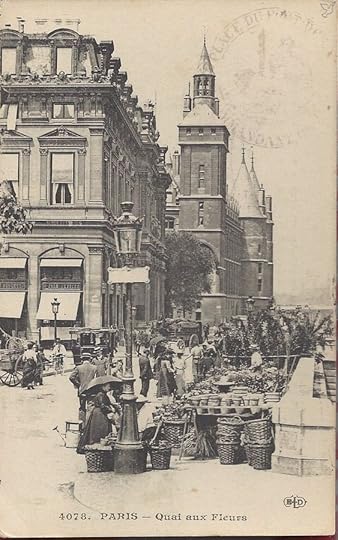
Source: www.cparama.com.
April 26, 2016
Ask the Author: about Cael
Every last week of the month, I’m answering readers’ questions.
Want to ask me something? Click here.
“I read book 1 of the Kalbrandt Institute with much interest, and I feel that even though Cael seems to be a right bastard at times, he is also very charming when he wants to be. Did you completely ‘invent’ him, or is there someone who inspired you to write him the way he is?”
An astute observation!  So, how can I answer your question without letting slip unintentional spoilers for the rest of the series?
Cael was not based on a real-life person. Of course his behaviour and quirks are inspired by my own experiences and that of other people, but contrary to other characters, I have no ‘template’ (like an actor, public figure, etc.) for his looks, his voice or his motoric that I can refer to when writing him.
I created him specifically to tell the story that has now become his story. As the Kalbrandt Institute books continue, it will become clear that his character has developed under unusual circumstances. His behaviour has developed accordingly, which gives him this dualistic edge.
As a result, he sometimes reacts to situations very differently compared to most people. This combined with the lack of a template makes him a real challenge to write. He and I have a true love-hate relationship!
The how and the why of all this, I will leave up to Eva to discover!
Thank you for asking

Have a question you want me to answer? Click here.
April 25, 2016
War Stories #7
In a continuation of the “War Stories” I collected for my son, we discovered that great-uncle Mies (Marinus) Vogels wrote down his recollections of war-time life in the rural south-east of the Netherlands.
Planes & Bombs
During the war years, the Nazis repeatedly bombed London and the British and American air forces relentlessly dropped their payloads on various German cities, day and night. Every squadron of bombers heading east from the British isles passed over the Netherlands.
But not all of the planes made it back home…
“[…] around midnight, my brother John saw everything light up outside. Looking out of his bedroom window, he could see the shadow of our house getting shorter and shorter, and then the burning plane coming over low and making half a circle after which it crashed less than a mile away in a grain field. We went there early in the morning, even before any German were there. What was left of the plane was sitting among the burned grain, in a big puddle of molten aluminium, showing how severely the plane had burned. The crew had apparently bailed out, except for the pilot and the navigator. The charred body of the navigator was sitting upright with his headgear still in place.”
The year was 1943 and over the course of that year, another two aircraft would crash near the Vogels’ house.
Spring brought a Messerschmitt, a German fighter plane. The family had heard the gunshots overhead and saw the pilot deploy his parachute before the fighter crashed into a ploughed field, wet after weeks of rain. The crash site was nothing but a hole in the ground, the high water table quickly filling it up and dousing the flames of the burning wreck. Only a few markings identified it as a German plane before it disappeared under the murky water.
Once the hole had become a puddle, the crash site was far from spectacular, but even so the German forces sent an officer with four soldiers to guard the site – and those men were quartered with the Vogels family!
Initially this seemed like a disaster, having to harbour the enemy. But the officer was a kind man, his soldiers boys no older than seventeen, and they all greatly appreciated Mrs Vogels’ cooking.
“After a few days, these enemies we were supposed to hate had turned into ordinary people who didn’t have much choice but to follow orders.”
The third aircraft was again a fighter. A British one this time. The pilot had bailed, as far as they knew, but the flashes had blinded a horse that stood in the pasture where the plane crashed. Several people went to have a look.
“In a little while, the ammunition that was still in the plane started to pop left and right, but the spectators hardly reacted and it was a miracle that nobody got killed.”
They were lucky, but not everyone in the family managed to survive the planes and bombs unscathed.
By early 1944, the German army started to use V-1 and V-2 rockets to bring Great-Britain to its knees. The devastation such a rocket could cause was immense, but quite a number of them fell short. Some got no further than the Channel or the British coast. Some never even managed that, and landed in Belgium and the Netherlands, where they would explode on impact.
“They sounded a bit like an airplane but the sound was harsher and louder. We could hear them coming over at night. Quite often the noise would wake us up, then sometimes the sound would suddenly stop and we would keep our fingers crossed and hope the thing would crash somewhere else.”
For Mies’ cousin, praying proved insufficient: a V-1 all but flattened her house. She had been sitting near a wall at the moment of impact, which survived the explosion and remained upright. This saved her, but her one-year-old baby girl, playing in the same room, was killed.
Living under the path of rockets and bombers was scary and uncertain. But there was another danger, equally random and equally deadly…
Next week the final instalment of “War Stories”: The Razzias.
April 23, 2016
WWI battlefields…100 years later

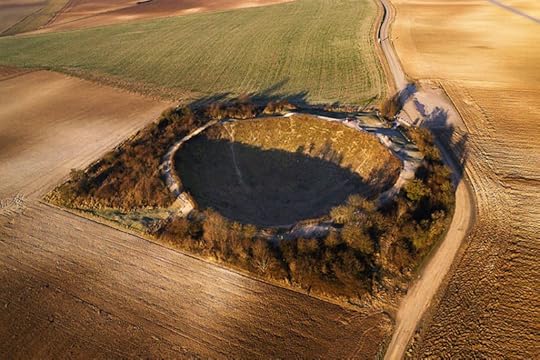

See more, location included, at twistedsifter.com.
April 21, 2016
War Stories #6
Hearing about the “War Stories” I have been posting, my in-laws gave us the memoire of my husband’s great-uncle Mies (Martinus) Vogels. Like my own grandfather Jo, Mies had written down his life’s story, and his recollections of life in the rural south-east of the Netherlands show yet another side of the war in great detail.
Counterfit food
Greatuncle Mies was fifteen when the Nazi army invaded the Netherlands. His family lived on a farm outside of Lieshout, a village in the same region as Deurne, where Grandma Maas lived.
Initially they only heard about the invasion on the radio, but eventually the German soldiers marched into Lieshout as well and took away all that was useful to their troops: the copper church bells (sacrilege in this devout Catholic region), people’s bicycles, tools, and horses.
The loss of a bicycle was more than an inconvenience and the loss of tools a real problem. However, the loss of a horse was a disaster! Most farms in this community were small and as a rule only had one horse. That horse was essential to work the land and make a living as a farmer, so farmers would do anything they could to prevent the invaders taking their animal – even stare down a gun.
Because as the wat dragged on, maintaining the family’s livelihood proved to be key to basic survival of any farmers family.
From 1940 onward, all food in the Netherlands was rationed and even farmers were only permitted to keep a limited amount of their produce for their own needs. Everything else was confiscated to help feed the vast German army.
Prohibit something, and soon the black market prospers. The penalties if caught could be severe, but there was too much profit not to risk that. In 1944, food stamps that would buy you a pound of butter for two guilders (a lot of money!) could be sold to a black marketer for as much as twenty guilders, and the guy would still make a big profit when he sold it to starving city people!
Mies’ father was caught the first time he tried to sell illegal wheat. He got away with a fine, but it cured the family of selling to the black market for the duration of the war!
Threshing grain, making cheese or butchering livestock was controlled by the Nazis. Farmers needed a permit for every food producing action, and a German inspector would supervise and mark the resulting products with the appropriate stamp of approval.
Of course, such a system can be hacked. Mies:
“It wasn’t long before my brother John fashioned an identical stamp out of the heel of an old rubber boot, got the right coloured ink and put the stamp of approval on any illegal addition to our supplies.”
Livestock was counted by inspectors at irregular intervals, and having too few animals would land you into serious trouble. So Mies’ father began by not reporting all piglets that were born, and raising one or two for illegal slaughter. However, piglets squeal, so they soon forgot about the pigs and changed to reporting the occasional still birth of a bull calf – and then raising the calf by hand, keeping it in a pen beneath the straw stack for a couple of weeks until it had grown enough to be butchered. John’s counterfeit stamps did the rest.
Fortunately some inspectors were not as strict as they ought to be. In exchange for a good meal they turned a blind eye to the occassional sack of freshly threshed wheat disappearing from the threshing floor. After all, inspectors need to eat, too.
The Vogels family was careful not to produce so much only-apparently-legal foodstuffs that it would get noticed, but as food got scarcer everywhere and city folk came out to the country side to buy food, they sold or shared what they could. Not on the black market:
“We sold great quantities of food illegally during those years, but only to people who would use it for themselves and only in small portions for a normal price. People would come from the city on bicycle, often dressed in a big wide coat. We would sell them a dozen eggs or two litres of milk, maybe a small bag of grain or half a home-made cheese, and they would hide it under their clothes. We were never caught selling anything that way.”
Two more instalments of “War Stories” to go. Next week: Planes & Bombs!