Theodora Goss's Blog, page 32
September 9, 2012
Country or City?
Honestly, I’m probably too tired to write a blog post tonight. It was a very busy weekend, and I still need to prepare for classes tomorrow, as well as finish a story that is already overdue. But I haven’t written one for a couple of night, and I’m trying to keep up the habit, so here I am. I was originally going to write tonight on the difference between contentment and joy, which is something I’ve been thinking about lately. But I’m going to save that for sometime later this week. Instead, I’m going to write about a question I asked myself today: would I rather live in the country or the city?
I asked myself this question because a friend of mine, the wonderful writer Jeffrey Ford, posted a picture of the vegetables from his garden and the fruit from his apple trees. And I found myself envying him, remembering the days when I used to make a giant pot of apple butter (apples boiled down with cider and spices), and can it for winter. I wasn’t living in the country at the time, but in Larchmont, New York, the small town from which I commuted into Manhattan. But each weekend in the fall I would pick apples in an orchard to the north (where apples were $10 a bag), and I picked so many that there was nothing to do with them but make apple butter. I think it was my way of escaping from corporate law for the weekend.
Most places I’ve lived, I’ve longed for and sometimes actually had a garden. The last time I had the space and time for one, I planted old roses, and hostas and columbines and hellebores, and fritillaries came up in the spring. It’s still a dream of mine to live in the country and have a flower garden, and a vegetable garden, and a small orchard, and herbs. Even chickens (the fancy, pouffy ones). But I also love living in the city. Tonight, as I was walking home from the market, where I needed to pick up apples and potatoes, I took some pictures of some of the lovely old brownstones on my street.
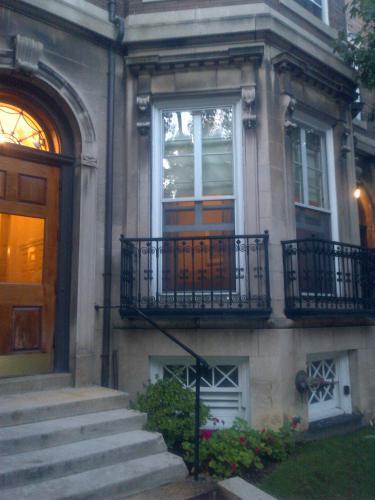
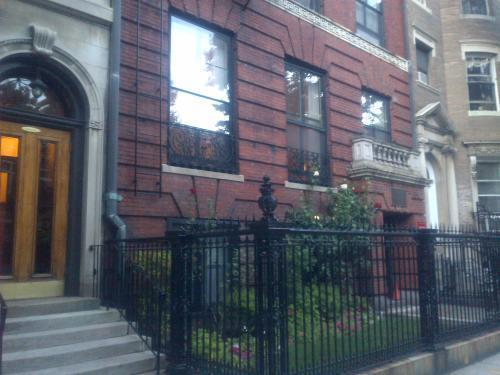
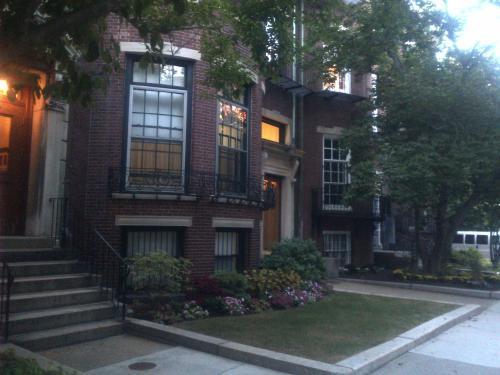
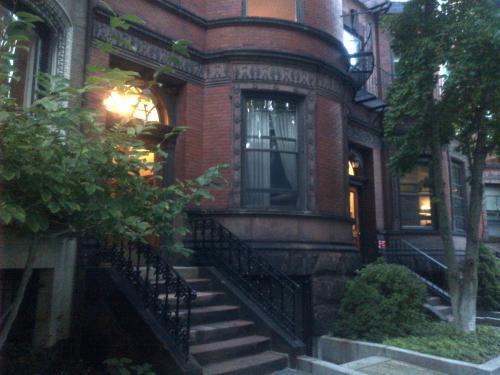

I love walking down this street, particularly in the evening when I’m pleasantly tired of walking all day, because in the city I don’t have a car and I walk all day long, unless I’m taking the T (which is what the subway goes by here). Winter is coming, which means snow and sleet. But it also means the ballet and theater season, and I get cheap or free tickets to so many things through the university. I love the life here, the people on the streets who look so individual, so interesting — I wonder what their stories could be. The beautiful parks, and the river winding through it all like a dark green serpent.
So I don’t know. I think that I would like to live in the city part of the year, and in the country the other part. Is that too silly, too ambitious? Jonathan Franzen lives in New York and Santa Cruz. I know a number of established writers who have homes in two places. I suppose I’ll have to wait and see what it’s like when I’m an established writer — assuming that ever happens! In the meantime, I’m going to enjoy the shows and the street life and the lights of the city in the evening.


September 6, 2012
The Lies We Tell
I was walking by the river today, and I decided to take some pictures of the wild clematis that grows there. It’s all in bloom now, and it grows over the bushes and shrubs at the edge of the water like a scattering of white stars. Its common name is Traveler’s Joy, which I have always liked.
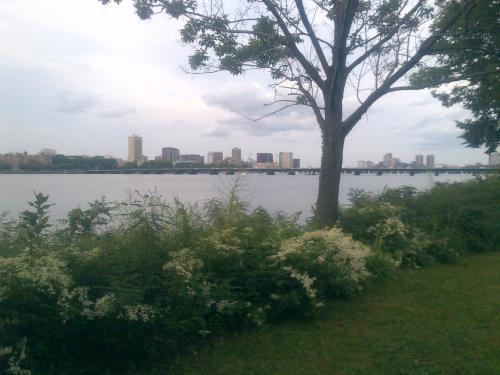
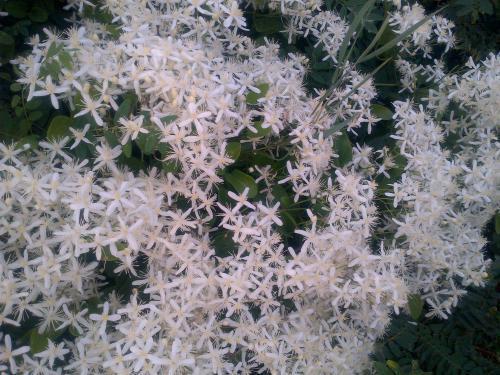
Walking beside the river, with the honey-sweet smell of the Traveler’s Joy in the air, I was thinking of the lies we tell, and of one central truth: Most people lie most of the time.
They don’t necessarily know that they’re lying. And it’s not necessarily verbal. You can see people walking down the street, and without saying a word they’re conveying the message “I’m normal. I’m just like you.” The older I get, and the more I know about people, the more I realize that no one is normal. As soon as you catch a glimpse beneath the surface, you realize that everyone has secret places. Everyone is hiding something. Perhaps I’m talking about this because recently I’ve been writing more, and going more deeply into my writing. And one thing you have to do, as a writer — at least the sort of writer I want to be — is tell the truth. To do that, you need to know the truth, to understand how people lie to each other and to themselves — in ways even they don’t see. Two stories I worked on this summer are first-person, which means that I’m speaking from the perspective of the character. The most important thing to know about your first-person characters is what lies they’re telling themselves — often about themselves.
Once, I met a woman who seemed to have the perfect life: beautiful suburban house; tall, handsome, wealthy husband; three beautiful children. Several years later, she walked out of her house, got into her car, and shot herself in the head. Lies are deadly, I think. Especially the ones that go “I’m normal. I’m just like you. Everything is fine.”
The people who lie least often, in my experience, are artists and writers. If you are trying to capture some sort of truth, it’s very hard to lie, even to yourself. And about yourself — artists and writers are not very good at pretending to be normal, and most of the time they don’t even try.
One reason I’m thinking about this now is that it’s a political season, and politicians seem to lie more than most people. They are the masters of saying “I’m just like you” in convincing ways. And they tap into something that I’m going to call societal lies — these are our clichés. The distinguishing feature of a cliché is self-congratulation. It is a cliché, for example, that all babies are beautiful. Of course most babies are not beautiful most of the time — babies are going through so much, it’s unfair to expect them to be beautiful as well, as though they lived in a perpetual soap commercial. But the societal lie, the cliché, works like this: “All babies are beautiful. It is good to think that babies are beautiful. Therefore, I am a good person.” You can substitute any number of phrases.
I don’t think I’m explaining this particular well, in part because I’m trying to say something complicated. When I create a character, I have to build in these levels of complication. That woman I knew: how long did she tell herself that she was happy? That she loved her house and her husband and her children? Perhaps she did, but if so, that truth was partial — there was a hidden place, a secret in the darkness.
I have met people who achieve a kind of normalcy, who live and believe the clichés. I always find them frightening, because there is so much they have had to not see in order to get there. They have often had to insist on normalcy, in themselves and others. They are not creative — they can be difficult even to talk to, because one does not know what to say. There is only so long one can talk about the latest television shows.


September 5, 2012
Cooking by Instinct
When I lived in the suburbs, I had such a long commute that by the end of the day, I was too tired to cook. That was when I bought a microwave, for the first time in my life. It was so easy, at the end of a tiring day, to put something in the microwave — something that someone else had prepared.
Here in the city, my commute is about ten minutes, so I’m trying to cook again. And you know what? I’ve forgotten how. Cooking is easy — when you know how to do a few basic things, like make a cream soup, you can vary them endlessly. But you have to develop a sort of instinct — it’s the instinct that tells you when the onions are done or a soup is thickened enough. That’s the instinct I seem to have lost. I think it will come back fairly quickly — it’s just a matter of practice.
Yesterday, I made Burnt Cauliflower Soup. It wasn’t actually supposed to be burnt: that happened by accident. I ate it anyway, because I hate throwing away food. But today I made a perfectly lovely cream of zucchini soup for dinner. It looked like this:

The next step is to start baking again, but that will have to wait until the dial on the oven is fixed: the oven is rather old, and the dial on which the temperatures are marked turns around by itself — and wouldn’t be much help anyway since many of the numbers have faded off. As soon as the new one comes, I can start making brownies and cookies and clafouti.
All of these things may sound small and silly, but I’ve come to miss food that has a certain flavor — it’s the flavor of anything made by hand rather than commercially. And it can be very simple — freshly baked bread with butter and sliced ham, along with a mug of tea. But there’s a freshness to it, a flavorfulness that commercial food doesn’t have.
When you can do it by instinct, it becomes a sort of dance, and that’s when it’s best and most fulfilling. Perhaps that’s true of anything: I do my best writing when it’s like a mental dance. I can feel it too, the sensation — as though the words were dancing, or I were dancing with them, and we can both hear the music, and the way the story is supposed to go. We follow the steps of the dance, together — it’s a partnership in which my partner is language itself. That’s when it’s best — and when the story comes out right.


September 4, 2012
Teaching Fairy Tales
I’ve spent all day working on my teaching materials for this semester. One of the classes I’m teaching is called Fairy Tales and Literature, and I thought you might like to see the reading list.
We’re going to start with J.R.R. Tolkien’s “On Fairy Stoires” and then talk about his ideas in relation to Madame de Beaumont’s “Beauty and the Beast” and Angela Carter’s two Beauty and the Beast stories: “The Courtship of Mr. Lyon” and “The Tyger’s Bride.” That will be our introductory section. Then, we’re going to talk about the meaning and method of fairy tales, so we’re going to get into Bruno Bettelheim’s The Uses of Enchantment. That will give us some theories to use when discussing four fairy tales and literary reinterpretations of them. Here’s what the list looks like:
Charles Perrault’s “Little Red Riding Hood” and “Little Red Cap” by the Brothers Grimm, with James Thurber’s “The Little Girl and the Wolf” and Carter’s “In the Company of Wolves.”
“Cinderella” by the Brothers Grimm and “Catskin” by Joseph Jacobs, with Aimee Bender’s “Donkeyskin” and Kelly Link’s “Catskin.”
Perrault’s “Bluebeard” with Joyce Carol Oates’ “Blue-Bearded Lover,” Margaret Atwood’s “Bluebeard’s Egg,” and Carter’s “The Bloody Chamber.”
We’re also going to read what Bettelheim and Maria Tatar have to say about all of these fairy tales. There will be some more theoretical material, including by Marina Warner and Jack Zipes. And then we will get into Jane Eyre, which I’m going to teach as a series of fairy tale structures.
Here are the books we will be using:
My Mother She Killed Me, My Father He Ate Me, edited by Kate Berhneimer
Angela Carter’s The Bloody Chamber
The Classic Fairy Tales, edited by Maria Tatar
And of course the Bettelheim and Jane Eyre.
I will probably be writing about this material as the semester goes on. I decided to teach the class because there was just so much fairy tale stuff coming out: and you know, I wonder why. Why now? Perhaps it has to do with Tolkien’s idea that fairy tales promise us eucatastrophe, the happy ending. We all hope, perhaps against hope, that there is a happy ever after out there somewhere. Me, I believe in happy endings. I think that sometimes we have to make them, but I think they exist. I like that line from The Best Exotic Marigold Hotel: if it’s not happy, it’s not the end yet.
Here is the illustration I’m using for the class website:
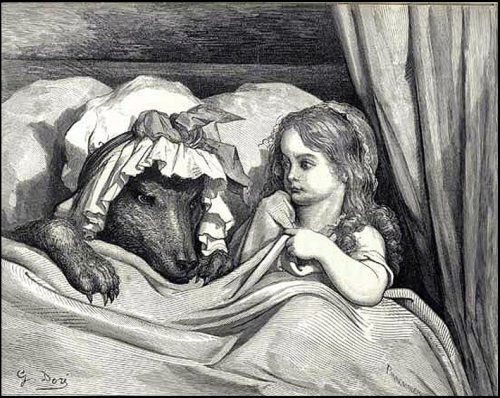
It’s a picture of Little Red Riding Hood and the wolf by Gustave Doré. Of course, not all versions of fairy tales end happily — there is the Little Red Riding Hood who is eaten up! I suppose that’s eucatastrophe for the wolf. But I agree with Tolkien that the happy ending is intrinsic to the fairy tale, perhaps not as it started, but as it has become.
What I’m wondering right now is, what sorts of story ideas will teaching fairy tales give me this semester? I’m looking forward to finding out.


September 2, 2012
Practical vs. Romantic
I spent most of today moving a sofa. It was not a particularly good day to move a sofa. University classes all over Boston start next week, so all over Boston this weekend, students are moving into their dormitories or apartments. The streets are clogged by moving vans, the sidewalks are thronging with parents. It was difficult just getting a van to move it in, and no matter how small a sofa is — and this is a very small sofa, actually a loveseat — you can’t move it in a car.
I’m relieved that it’s been moved, because now that it’s in the apartment, I’m absolutely done with all the furnishing. All I still need to do is hang pictures and put books on the shelves. And I’m glad to be in that position before classes start. But this sofa is actually my second attempt to finish furnishing the apartment, and those two attempts made me think of my practical versus my romantic impulses.
In my first attempt, I bought something quite different: something like a small futon. I thought it would be practical: easier than a sofa to transport and useful because it could be folded out into a second bed. It would also be easy to clean because the cover could be put into the wash. But once I had brought it to the apartment and set it up, I discovered that while it fit — I had measured carefully before buying it, of course — the proportions were completely off. It was too large visually, and there was something shapeless about it — as there is about most futon-like things. I had already spent a significant amount of money on it: $275. And it was all wrong.
So what did I do? Well, right now it’s in a basement, and I’ll see if I can find some other use for it or give it away. But when I saw it in the apartment, I had that feeling in my stomach: the feeling I always have when I’ve made a wrong decision. It’s like being sick. It’s a feeling I had in law school — I recognize it well. It’s the feeling of being on the wrong road. When I’ve made the right decision, I feel happy and free, no matter how impractical that decision is.
I especially regretted my initial decision the next day, when I walked into my favorite Goodwill store and saw a small sofa for only $20. Of course it would cost money to transport, and it was somewhat battered and stained, but I immediately knew that it would fit the space I had perfectly. Underneath the hard use it had experienced, it had good lines. It was a perfectly ordinary sofa, really — but it had grace.
I think things are only worth buying if you fall in love with them.
So I paid for the sofa, and today I transported it to the apartment. The initial purchase had been a mistake, but why compound my mistake by keeping it? Instead, I paid more to fix my mistake — to buy what should have gone into my apartment in the first place. Here’s how the sofa looks now:
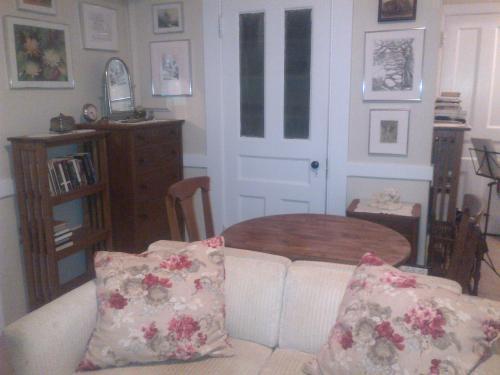
I learned two things from this. First, I learned that I should always trust that sick-to-the-stomach feeling. It tells me what I should not do, and that’s always valuable. Second, I learned that when I follow my practical instincts, I am often wrong, but when I follow my romantic instincts, I am always right. It is when I make a decision out of love and joy, a sense of rightness and freedom, that I end up making the right decision — the one that actually turns out to be the most practical in the end.
I need to remember that, even when it comes to a sofa.


September 1, 2012
The Authentic
I’ve been doing all sorts of things over the last few days: my deadlines have deadlines! But one thing I’ve had to do, because it needed to be done, is refinish a table. There are two pieces of furniture I’ve needed in the apartment, and one is a small table on which I can eat meals and grade papers. The table is all done now. This is what it looks like:
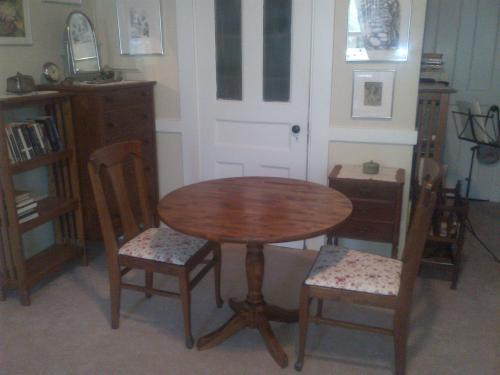
It looks so finished that it’s difficult, even for me, to imagine that several days ago, it was just a disassembled table of unfinished wood. I had help with the assembly, but I did all the staining and finishing myself. It was very simple: just Minwax Golden Oak stain from the hardward store, and then Minwax Antique Oil Finish. And the table itself is not an expensive table, although it is solid wood: alder, a step up from unfinished pine.
But there’s something about it — I don’t know if it’s evident from the picture, although it is to me — that seems authentic. It has an authenticity to it. I think that’s what I look for in just about everything, nowadays: a sense of the authentic. I found it in these teacups and saucers that I bought at Goodwill:
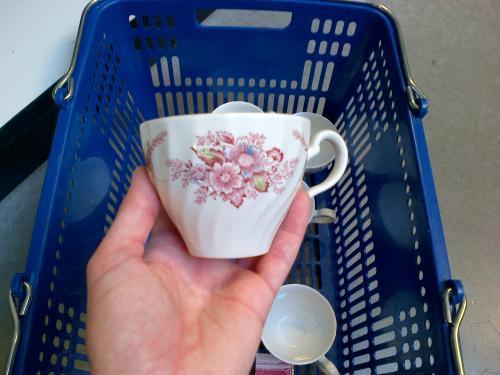
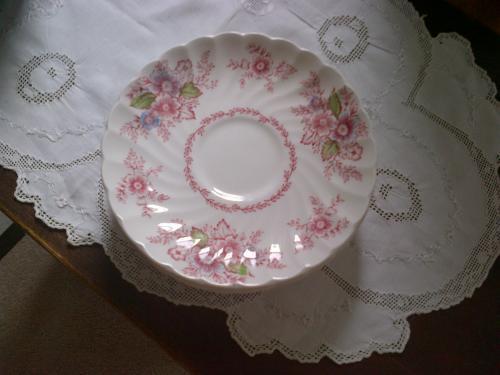
The funny thing is that I found them on different days, first the teacups and then the saucers. I look for that authenticity in furniture, in clothes, in poems. In food, even. So I’m wondering what exactly it is. In part, it has to do with what something is made from. My table is solid wood. It’s held together by wooden dowels and metal screws. There is no plastic in it. The clothes I tend to buy are made of cotton or silk or something else that is real. I try to eat real food, not food that has been processed into inauthenticity — into becoming something that is no longer food.
But there is something more to it than simply materials. I put significant labor into that table. Those teacups and saucers have transferware patterns that were applied by hand. So there is labor, human labor, that went into them. The table itself will become more authentic, more itself, as it ages: as I use it, as it acquires scratches, which are scars on wood. So I suppose age and use made something authentic.
It’s hard to pinpoint, really: why some things seem real and some don’t. But when something is inauthentic, it feels as though it doesn’t belong — as though I need to get rid of it as quickly as possible. It makes me uncomfortable.
What I’m trying for in my writing is always authenticity, but again, I’m not quite sure where it lies. What is an authentic voice? A voice that is itself — and yet it takes a great deal of time and training to find a voice that is authentically your own. You have to get rid of all the other voices first, of the facile writing. If only this writing thing were easier! And yet, I could simply go to Ikea and buy a table. No staining or finishing required. But it would be Ikea furniture: with some pretention to design, but half plyboard. It would feel inauthentic. And so I take the time to create a table that feels authentic — that I can use for the rest of my life.


August 31, 2012
Setbacks and Stumbling Blocks
I read an interesting series of interviews earlier today on the setbacks and stumbling blocks that some science fiction and fantasy writers had encountered during their careers. If you want to read the article, it’s on io9, here: Great SF authors share their biggest writing setbacks — and how they triumphed.
The science fiction authors (some of whom are friends of mine) were interviewed at the World Science Fiction Convention. I wish I could be there, but I’ve made a sort of promise to myself, which is that I won’t spend more on conventions than I actually make from writing. Last year I made significantly more from writing than I spent on conventions, but because I spent a lot of last year working on my dissertation and teaching, I won’t be earning as much this year. (Payments for writing typically come quite a bit after the work is done — usually when the work is published, which can be a year after.) I want to get to a place where I’m earning writing money regularly, which means producing novels regularly. And you know, I’ll get there. But I liked the answers, and liked learning about the various stumbling blocks that writers encounter. Here are a few from the article:
Connie Willis said: “I think my biggest stumbling block as a writer was my own self doubt. I constantly was feeling like, ‘I can’t do this, and nobody wants me to.’ And every single rejection slip seemed to come at that, you know. I was working by myself without any contacts with other writers or other people in the business. So I would just get so discouraged and I would sort of stand in my own way.”
Jo Walton said: “Mine was when my first husband told me that my writing totally sucked and wasn’t worth a damn. And I believed him, because I was 22 and I was in fact pretty bad. And I didn’t write anything for another seven years. So I stopped. People tell you that you’ve got to keep writing and you mustn’t stop. But I stopped writing, and then when I started again, I was better.”
Catherynne Valente said: “The economy crashed in 2008 — you might remember that — and I couldn’t sell a book for a good long time. Had novels, sending them out, nobody took them. I really thought it was over for me. I only had three books out, and I was pretty much ready to pack it in.”
Rachel Swirsky said: “Sometimes I have problems where I get into a mode where even just looking at a page on a screen makes me panic. And getting past that is a really intense thing to do.”
Of course they also talk about how they overcame these setbacks and stumbling blocks. If you want to see how, take a look at the interviews. Of course, the interviews made me think about my own setbacks and stumbling blocks. I think the biggest problem I’ve had as a writer is that, often in my life, I’ve tried to live the life I was told I should be living, rather than a life that supported by writing. The biggest example of that was law school — I was told I needed a stable profession, and that I could write on the side. Well, guess what? You can’t write on the side. (As a corporate lawyer, I barely had enough time to sleep, let alone write.) If you want to write and you have another job, that job has to support the writing. I’m so grateful now that I’m able to teach, and teach writing specifically. Through my teaching, I learn to become a better writer, and it leaves me enough time to do my writing — not as much time as I would like, of course, but enough.
I think it’s one of the most important things I learned — that if you want to do anything creative, you need to ignore how society, and often your family, tell you to live. The model of life they espouse is not the one that will allow you to do what you most want to. You need to create your own life, in a way that enables your art. That’s what I’m doing, now that the PhD is over. That’s the next step.


August 29, 2012
The Otis Library Talk
I know: I haven’t updated for a long time. I’ve been so busy, had so many deadlines to meet. I’m going to try to get back into the habit of writing here again. I want to get back to updating every night.
Tonight, I’m just going to post a few pictures from the talk I gave on Monday. It was at the Otis Library in Norwich, Connecticut. I was invited to speak as part of the Jim Lafayette Memorial Series of Writers of Science Fiction and Fantasy, which is a wonderful speaker series in memory of Jim Lafayette, a young man who was a science fiction and fantasy fan and writer, and who unfortunately died much too young. It’s so wonderful that this speaker series has been set up in his honor. Previous speakers had included writers such as John Crowley, Greer Gilman, and Kaaron Warren, so I felt tremendously honored to be invited.
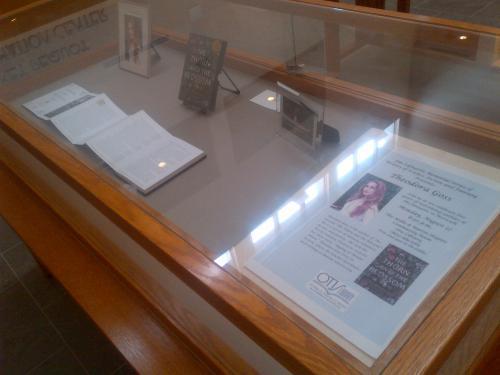
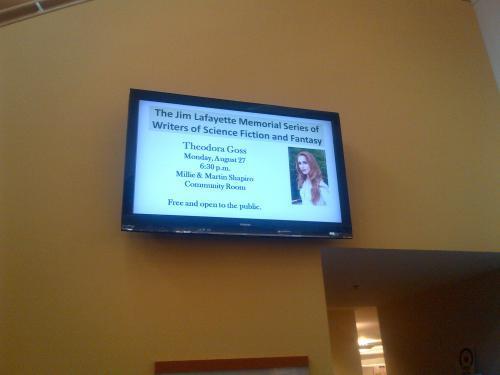
And the library did a wonderful job of publicizing the event. They posted it prominently on the library website, and once I got to the library, there was a poster in the window, and a display in the lobby, and even a picture on a monitor in the lobby. Look and see!
Here is the poster:
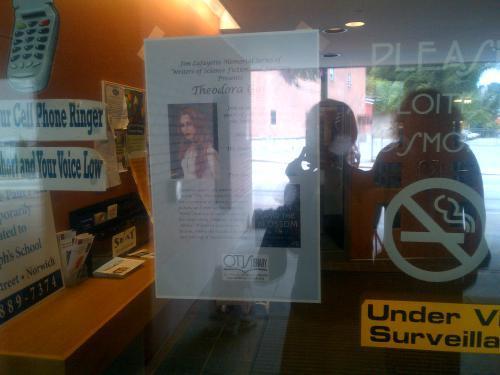
(Those shadows are me and my friend the scholar and writer Faye Ringel, who had invited me to participate in the speaker series.)
And here is the display:
And here is the picture up on the monitor:
And finally, here is a picture of me up at the lectern, just before the reading started:
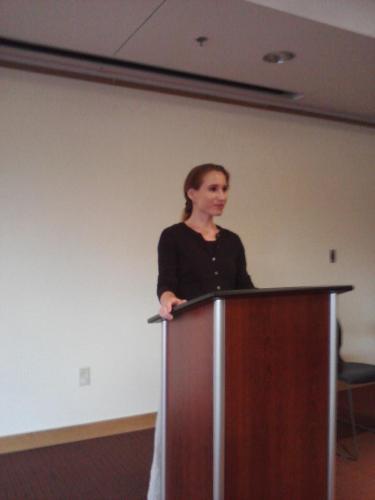
This was taken by my friend and fellow writing group member Claire Cooney. I didn’t take any pictures myself, but I’m happy to report that we had a full room.
On Sunday evening, I drove down to Connecticut with Faye and Greer. I spent the night as Faye’s guest, and stayed up far too late making final adjustments to my talk. But I needed to interest and entertain for about 45 minutes, and you know, that’s a hard thing to do! On Monday morning, I went through the talk again, and in the afternoon we printed it out at the library. Then it was time for the presentation, which went very well. I had dinner with Faye, Greer, and Claire, and then took the train from New London to Boston, arriving about midnight. I hadn’t been on a train in a long time, and it was so wonderful riding on one again — riding by small towns in Connecticut and Massachusetts through the late summer night. I love the sound of trains . . .
Since then, I’ve been working, working, working. I have a short story due by the end of the month, and classes starting next week. Nevertheless, I will try to keep updating this blog, because I do have things coming out that I want to let you know about. I need to update the website as well, because there’s more of my fiction and non-fiction online now, and I need to provide links.
But for now — back to work!
(I’ve been asked if I can post a copy of the talk. I need to make some revisions so it will read as an essay rather than something I presented verbally, but yes — I will be posting a copy soon!)


August 7, 2012
Finding the Magic
So first of all, about me.
My life is crazy right now. I’ve almost been afraid to write a to-do list, because it would have, not so many things on it, but such large things: Write story due by the end of the month. Find criticism I will be teaching this fall. And sometimes, that makes me feel as though I can’t breathe. So I haven’t been very good at posting on this blog, and my website is out of date, and altogether I’m just terribly behind. I think the problem is that being a writer is a full-time job, and being a teacher is a full-time job, so I have two full-time jobs. And I need to try to do both of them well.
Have patience with me. I will get through this, and things will be easier, although I’m honestly not sure when yet.
But there was something I really wanted to write about today, which is a quotation that I saw on a friend’s Facebook page:
“Because there is no cosmic point to the life that each of us perceives on this distant bit of dust at galaxy’s edge, all the more reason for us to maintain in proper balance what we have here. Because there is nothing else. No thing. This is it. And quite enough, all in all.” — Gore Vidal
It was posted after the death of Gore Vidal of course, and I “liked” it, as one does on Facebook, because I think it’s beautifully written. But I don’t think it’s true.
I think that thinking of our material universe, the one we perceive with our sense, as the only thing is not only foolish, it is arrogant. As well as, if I may add, in contradiction to theoretical physics. I believe — I have always believed — that there is meaning and purpose to life, although we may not understand that meaning and purpose. I think we catch glimpses of it here and there, and I honestly think that the universe communicates it to us, if we can listen for it — if our perceptions are finely enough tuned. All my life, I’ve had a strong sense of purpose, of being here for a reason that I might not at that moment understand, but that something, somewhere, understood. The times I’ve been unhappy in my life are when I’ve gone off the path, when I’ve realized that I made a choice taking me away from the way I was supposed to go. I remember what it was like to go to law school and to feel, so deeply that it went to my core, as though I was in the wrong place, as though I had stepped off the path. The path itself feels narrow and rocky, sometimes. Sometimes it feels as though I’m walking along a gulley, or a high cliff with winds. But it feels like a path, as though I’m going somewhere.
I don’t know how to talk about this except by saying that we have instincts, and our instincts tell us these things, and we have to trust them.
I think part of my purpose in this life is to talk about magic, and to make it. Because we’ve lost the idea of magic — we feel like Vidal, in a wholly material universe that has no meaning, and that is a terrifying place to be. But we are like children terrifying ourselves with stories that aren’t true, or even very interesting. The problem with finding the magic is that I think you have to believe it’s there to find it.
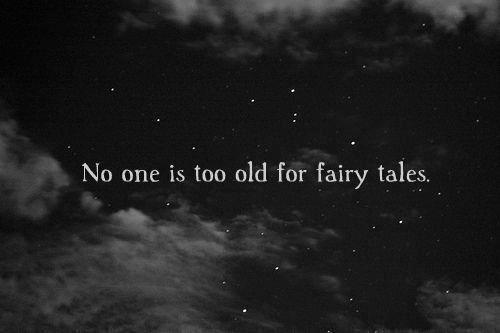
That’s a bit of a rant for tonight, so I’ll leave you with an image:


August 4, 2012
Magical Decorating
As I may have mentioned, I’m in the middle of decorating an apartment. It’s going to take a while, because I want the end result to be magical. And I mean that in a very specific sense: I want it to look as though it could appear on Grace Nuth’s blog Domythic Bliss, which is one of my design influences. It’s a particular challenge in this space, because it’s a faculty apartment and can’t be painted. It’s also quite small. But I do have several things in my favor: it’s in a nineteenth-century building, so the layout is eccentric, and it has plenty of nooks and crannies. It also has plenty of light. Those are good things. I don’t understand people who like wide open spaces in their houses. How do you arrange furniture in a wide open space? It feels, to me, like being in a sort of blank. I like walls and corner and closets.
I’m going to include a few pictures of how it’s going so far, and I’ll post more as the decorating progresses. It’s going to take a while.
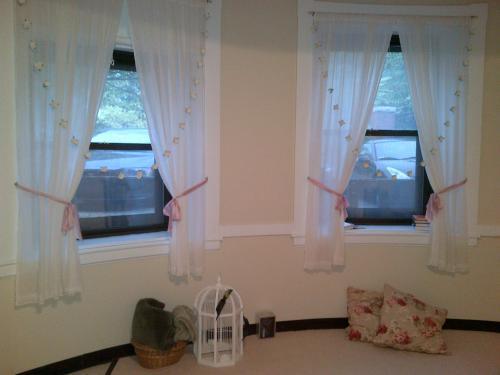
The apartment has two large windows. I’ve put up curtains, and over the curtains I’ve strung garlands of paper flowers that I found at Ten Thousand Villages, which is one of my favorite stores. The tie-backs are lengths of pink silk ribbon that I bought at Paper Source. Each one is about two yards. Yes, I’m still waiting for some furniture. And yes, that is a birdcage. It’s eventually going to hang from a bracket on one of the window frames.
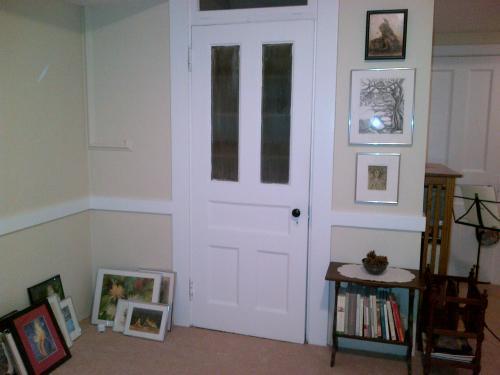
I’ve started putting up paintings, but you can see a stack of them against the wall. I bought the little table and the bowl that’s sitting on top of it at Goodwill, then put pinecones I had collected into the bowl. I think it looks quite nice there. The key to magical decorating seems to be creating a series of vignettes, and this is one.
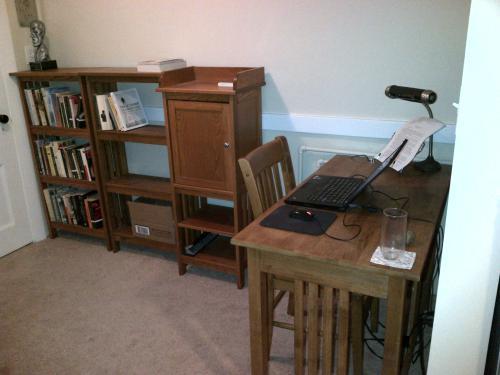
The apartment has a small alcove in which I have put my writing desk and some bookshelves. I need to finish filling and organizing the shelves, and of course there will eventually be pictures on these walls as well. The printer stand is awaiting its printer.
And finally, one can’t forget the bathroom. This one happens to be pink, which I think is rather nice. I’ve put low white shelves into it, and I checked today to make sure that the type of basket I want to put into them fits. It does, so now I need three more baskets, and I need to paint them white to match the shelves. But I’ve already put a silver tray on top for perfume. Every bathroom should have a silver perfume tray, don’t you think?
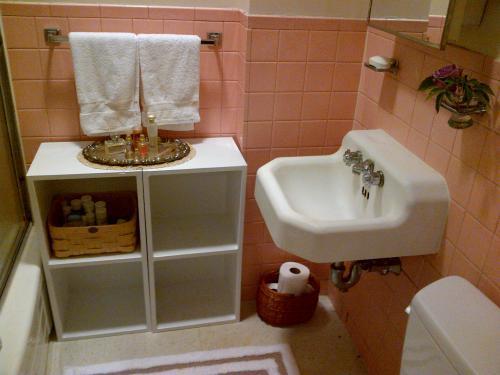
Notice, by the way, that the toothbrush holder is instead holding what Crate and Barrel tells me is a cocktail glass, in which is a rose. I will use that glass for flowers. After all, what else is one to do with a toothbrush holder, nowadays?
As you can tell, there’s a lot more to be done. But I want to continue in this somewhat whimsical vein. I think that once I’m done, the apartment will be a lovely space. At least, I hope so.