Jim Baumer's Blog, page 21
May 3, 2018
Never Far Away
Life goes on. At least that’s what they tell us. Actually, by repeating the phrase back at other people, it helps make them feel better about you that you are feeling better—but you’re not. You’re just moving with the flow, swept up in the momentum of life moving forward.
In the fall, I found out a private school nearby needed people to come in at night and help some of their students during a time slot called “guided study.” I told the director a bit of my story and how I would try to make it through the first week, but that there were “no promises.” I did. And then, I made it through the next week, and the week after that. We are now in the month when the students I’ve met across weeks numbering in the 30s are looking forward to the end of the trimester and going home. I did better than I thought I would.
Maybe the reason I managed to do the “life going on” dance had to do with a young man I met my second week of tutoring. He needed help with his statistics assignment. I hadn’t done statistics in decades, especially statistical word problems that required solutions relevant to terms like median, standard deviation, mode, and variance. I had to draw “pictures” to figure them out. He said to me, “why are you drawing pictures?” We both learned that he was visual and this offered us a window into understanding his learning style.
The next night, I was asked if I wanted to work with him one-on-one. I said I’d give it a shot. We’ve been meeting four nights a week (and Sunday nights, too) since late September. I’ve learned that he likes order and routine. I’ve tried to create that five nights a week.
My days are spent working on other things. I’m writing a book. A week ago, I drove to Waterville and then, Oakland, and offered a new seminar I’ve developed, The ABCs of Medicare. I began my week by sending out another newsletter for the Mark Baumer Sustainability Fund. Yes, life goes on. But you are never far away.
Springtime has dawdled this year, taking its sweet time getting here. Those of us who live in the Northeast have learned patience with the seasons—those who haven’t must contend with their constant carping (that does nothing to speed along seasonal change). At the very least, they’re always going to be disappointed. I’ve learned that life can be disappointing. Grief and loss are excellent instructors.
Spring is also a time of year that reminds me of all the previous beginnings of baseball dating back to the time when I was probably five or six and learning that baseball seasons all have starting points. These always correspond with spring’s arrival.

These (spring) memories are never far away.
Mark was a son-come-true for a baseball-loving dad like me. He never disappointed me, not once from when he first tentatively gripped a bat to the afternoon in Appleton, Wisconsin, after his Wheaton teammates battled but lost in the final game of that spring’s Division III College World Series. That was 2006, 12 springs ago. On that day in May, just prior to graduation, I watched him walk out of and away from his baseball chapter. Writing, poetry, an MFA, and all sorts of other things were waiting for him, like walking across the country, once and then, one more time.
Most days, I’m okay as long as I’m busy writing (although writing intensely about the memories you’ve left me with is never easy), or trying to figure out how to be successful selling insurance, or thinking about what I’m going to work on that night during my tutoring session. But you are never far away.
This morning, I tried to sit still again and not let my mind run in disparate directions. I’m up to five minutes now. Nothing compared to what you were able to do with your meditation, even when you were out walking each and every day—until you weren’t.
When my timer went off and I could open my eyes and give in to the busyness of the day, I paused and decided I’d read a few poems from the book I’m working my way through. It’s by a man named Zapruder. I wish we could talk about him.
Reading poetry always makes me think of you. I love the rhythm that comes from saying the words aloud. I can feel them in my mouth and on my lips when they pass.
You are never far away.


April 27, 2018
The Essential Vice
There is a tendency for many of us to think we’re smarter, more evolved—superior, really—than others. Whatever we’re doing at the moment, including what we know, the way we live our lives—we consider to be on a higher plain than the other “deluded” mortals. They call that hubris, I think.
I’ve started meditating. I already know some of you are going, “kooky.” That’s fine.
Whenever I set aside time to for this practice, my mind sets off running in a myriad of directions, like it always does when I try to slow it down and locate space away from the “white noise” of daily life.
“Why don’t others meditate?” my thoughts often communicate back to me with smugness. That pride thing.
Actually, others do meditate. Mark embraced meditation over the last four years of his life. He let me know he meditated, but he never made me feel inadequate because I didn’t (and “couldn’t”) for the longest time.
Hearing Dan Harris on a podcast, talking about his own reluctance and even, skepticism, towards meditation piqued my interest enough to investigate and begin taking small, tentative steps towards cultivating the practice in my own life.
One of the countless things I loved about Mark was his gentle and uncritical ways. He didn’t preach, but modeled his behavior.
When he became plant-based, he sent Mary and me a book at Christmas in 2015. How Not To Die: Discover The Foods Scientifically Proven To Prevent and Reverse Disease sat on the shelf gathering dust for most of the following year. Then, in October, just prior to leaving on his final walk, I began reading Gregor’s book. I was convicted by my own surety at one time that eating copious amounts of meat was the way to go. Before being plant-based, I was into Paleo.
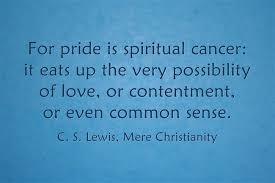
Hubris is problematic.
C.S. Lewis, an influential 20th century Christian writer and thinker identified pride as “the great sin.” In his best-selling work, Mere Christianity, Lewis wrote that Christian teachers considered pride to be “the essential vice, the utmost evil…Unchasity, anger, greed, drunkenness…” were mere “flea bites” in comparison when placed up against pride.
Lewis went on to say that “it is Pride which has been the chief cause of misery in every nation and every family since the world began.”
The problem with thinking that we know better than others do about the ways of the world is that we might be wrong, and often are. When we inflict our own error on others, it creates division and strife. We’re seeing this writ large on the stage of politics.
Rather than inflict his own ways on his parents, Mark simply walked his talk. He would gently share with us where he was in his life at the time, but never in an “I’m better than you,” smug kind of way.
It’s that trait that endeared him to so many.
When I look back over my own life, I cringe at all the times I’ve been dead wrong about a host of things. One of the best examples of this was our foray into fundamentalism and embracing the error of Jack Hyles. This one experience illustrates why I’m working at being better at not getting all “puffed up” with pride.
April 23, 2018
Newspaper Reading
I have a vested interest in people’s ability to read—I’m a writer, for God’s sake! And while the model of books and publishing has been turned on it’s head by digital technology, print still offers us a route to the future, I think (at least, I hope it does).
A week ago Saturday, I drove into Portland for a book event. Author Steve Almond was in town at Longfellow Books. He was slated to be paired with local writing star, Ron Currie Jr. It promised to be an evening worth leaving the house for during a season when it felt (at least a week ago) that spring’s been detained somewhere else..
Unfortunately, Currie had a personal matter that kept him from facilitating the discussion, but a rising Maine legislative star, Ryan Fecteau, was pressed into action on short notice. He performed admirably. All this to say that Almond’s new book and provocative discussion around the idea that we’re telling each other the wrong or “bad stories” has been on my mind since.
People who once occupied prominent space in my life recognized the importance of stories and maybe better—reading. My son, Mark, comes immediately to mind. But unlike others who have dropped out of my orbit (by choice), he walked his talk. I’ll always remember the years we spent a fall Saturday in Copley Square at yet another Boston Book Festival, and the year he ended the day toting two overflowing canvas grocery bags that must have weighed about 75 pounds each, overflowing with books. We have a bookshelf in our house that’s filled with books he had at his Providence house. Mark had “de-cluttered” his life in a Marie Kondo-esque manner, but he still kept books. I’d say that 3/4 of the things we carted back to Maine when we emptied his room after he was killed were books. I still marvel at his reading lists.
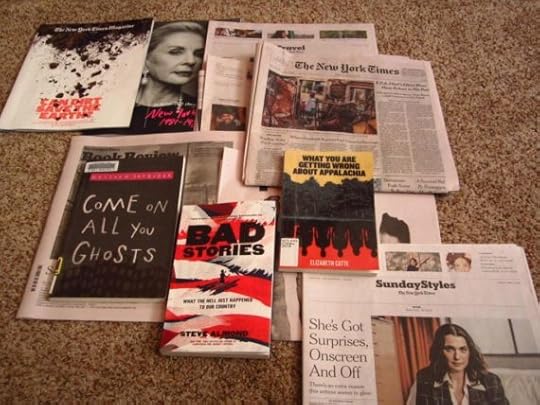
Weekend reading.
I miss having a “real” Sunday newspaper. The Maine Sunday Telegram is a shadow of its former self. In Maine that’s all there is if you want Sunday morning news with your coffee. Yes, you can pick up the Boston Globe, but distribution is spotty and even the Globe isn’t what it once was. With print being hollowed out by Facebook and the decision by many to not keep up subscriptions any longer, this isn’t particularly surprising. Papers require advertising and advertisers expect eyeballs and a return on their investment.
Over the past few months, I’ve gone against that trend. An interest in New York magazine got me to subscribe. I miss The New Yorker, so I’ll probably add that to my list of publications arriving at the house. My newfound enjoyment of museums and an interest in knowing more about what makes for “good” art found me reading ARTNews at my local library. I found each “letter” from the publication’s editor, Sarah Douglas, fascinating and informative. So much so that I went through all the back issues on the shelf and read them. Realizing that a publication that’s well-written, informative about a topic I’m interested in, not to mention a pedigree dating back to 1902 is worth supporting—well you guessed it—another publication coming to me via the USPS.
But my Sunday mornings haven’t been the same for awhile. Maybe finding my way back to the paper—a real paper with actual news not the assorted crumbs from the press wire—would revive a former practice I’ve missed.
In this corner of New England, many older, literate residents (as well as the summer crowd) are known to subscribe to (or drive into town) for the Sunday New York Times, the gold-standard for Sunday morning paper-reading.
Opting for a weekend subscription (which gets dropped at the end of my driveway, too), I’m now in week two of receiving the New England version of of newspapers. I’m enjoying being a print subscriber (I have a digital subscription included in the deal).
Two days of reading through the various sections about books, politics, The New York Times Magazine, and even sports while sitting out on the deck greeting Spring’s return was a tonic to my soul. I enjoyed reading an investigative piece on Scott Pruitt’s corruption, an OpEd by Maureen Dowd on Barbara Bush, and an article in sports on the son’s of three former big leaguers: Dante Bichette, Craig Biggio, and Vladimir Guerrero—all playing for the New Hampshire Fisher Cats in the Eastern League. I still have more reading to get through, too.
Almond talked about settling for stories that come up short, or “bad” ones in his parlance. What if we don’t know the difference because we lack the ability to discern?
In an article written last year in, you guessed it, The New York Times, Daniel Willingham, the author of The Reading Mind: A Cognitive Approach to How the Cognitive Mind Reads wrote that our ignorance as Americans stems from comes from “poor reading.”
Don’t malign publications as “fake news” if you’ve never spent any timne reading them from front-to-back. Doing so puts you in the same class as our orange leader, Donald Trump who doesn’t read, yet proudly flaunts his ignorance for all to see. As this article in Der Spiegle spells out, reports about the “Old Gray Lady’s” demise might be premature, especially thanks to Der Trumpster.
April 19, 2018
Who Taught You To Live Like That?
When I was typing out the title to this post, I accidentally pecked out “who taught you to lie like that.” I had to chuckle because I was thinking that very thing this morning while ruminating about a certain president who resembles a Cheeto, and the prevaricators who carry his water.
But I don’t want to write about him (today).
I blogged about emotional intelligence the other day. Another topic that remains in heavy rotation in my thinking.
Canadian bands and artists have colored my musical palette for quite some time. I think it dates back to a trip to Montreal that our unit of three made back in the early 1990s. I ended up finding a cassette tape by The Tragically Hip (RIP Gord Downie). I became a fanboy from then on for their north-of-the-border take on classic rock.
I finally got to see “The Hip” play live at The State Theater. There were probably 500 people there on a hot August night in ’98 to see Canadian rock royalty perform. The show wasn’t heavily promoted. Mary and I learned about it when a plane flew over Old Orchard Beach pulling a streamer that said, “Tragically Hip at State Theater” that night. I said to her, “we should go.” And we did. It’s probably one of five shows we’ve attended together in our 35 years of marriage. What our pursuit of live music lacks in quantity, I think it more than makes up for in quality, though: Cheap Trick (with UFO opening), Dave Mason, The Grateful Dead, Lucinda Williams (The Bottle Rockets), and The Tragically Hip.
On May 5, Sloan hit the stage at Empire in Portland. Another Canadian band, much like TTH, who deserve way more attention stateside than they’ve received, at least from fans—they remain the darlings of music writers at places like Pitchfork and Paiste. I’ll be there and I’m excited to hear their amazing power pop, new songs from their 12th album, and Beatle-esque back-catalog.
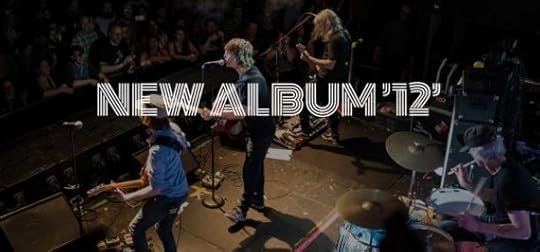
Sloan: still going strong.
I found an article about the band titled, “The 11 Keys to Keeping the Band Together,” about them. This was fascinating in the sense that they talk about things that bands rarely touch on. Even more intriguing to me, with a few tweaks, it’s a great rundown on how to be a good human being and enhance your EQ, as they’ve obviously been doing over the past 27 years of being band mates. Heck, I think our current president could learn a thing or two about getting along with others in reading this piece.
Not only do music writers dig Sloan, but some of my favorite radio stations appreciate the band’s prodigious talent, like KEXP in Seattle, with DJ Cheryl Waters gushing about the band, calling herself the “President of the KEXP Sloan Fan Club,” when the band came through Seattle and dropped by for a live set at the station.
All this talk about music of late got me to pull out my acoustic guitar on Sunday. The good news is that I haven’t forgotten how to play. In fact, I’m happy to say I’m playing as badly as ever!
And like the chorus from the opening song in the KEXP set, I’ve learned that the only way through tough times is to “keep swinging.” I love how Sloan as a band has certainly been doing that for 27 years.
April 13, 2018
What’s Your EQ?
From time-to-time, I’ll review blog topics I’ve brushed up against. Partly, I do this to ensure I don’t duplicate posts or topics (except posts about topics that I think need to be highlighted).
What surprised me was that while I’ve been thinking (and talking) about the topic of “emotional intelligence” a lot lately, I only have one post with that tag. That one was written last March, and only briefly touched on the topic. I mentioned it after I came across an (obscure) book written about the grief and loss associated with losing an adult child.
One thing that is all-too-clear to me is that we are being affected by leaders deficient in this crucial capability. And if you haven’t experienced the fallout yet, I’m sure you will at some point in the future, rest assured.
Mark cultivated the traits of an emotionally healthy, attuned adult. What are these?
According to The Dictionary of Psychology, written by Andrew Colman, he posits that emotional intelligence (EQ) is characterized by the “capability of individuals to recognize their own emotions and those of others, discern between different feelings and label them appropriately, use emotional information to guide thinking and behavior, and manage and/or adjust emotions to adapt to environments or achieve one’s goal(s).”
There’s much more to this topic than this brief snippet. I will commit to coming back to it, I promise.
Do you know what your EQ (emotional intelligence) is? Probably not. Our emotional capacity often gets short shrift, when stacked against IQ, or the intellectual side of our humanity. But our EQ is very important, as Howard Gardner, an influential Harvard theorist and psychology professor notes. “Your EQ is the level of your ability to understand other people, what motivates them and how to work cooperatively with them,” says Gardner. Here’s a brief list of traits that emotionally intelligent people present:
The social skills piece is something I’ve been closely aligned with, especially given my workforce background experience. These various skills, which run the gamut from persuasion and the ability to communicate clearly, to conflict management, the ability to build bonds with others, leading through collaboration and cooperation—would fall
Gardner actually believed that having “multiple intelligences” was essential for success. According to his theory on this, limiting everything to the intellectual (or perhaps, logical) severely limits our potential.

EQ is in short supply these days.
I’m curious what kind of score someone like Waterville mayor, Nick Isgro, would come up with, or our governor, or even the gang of representative in DC who can’t agree on anything. I won’t bother considering what President Trump might score. He wouldn’t take the test, and then, he’d brag, “I’m the most emotionally intelligent president in U.S. history.” He’d expect us to take him at face value. Actions speak louder than words, though.
The reason I’m touching down on EQ today is that shortly after waking, I read a note I’d received from a young writer who is working on an essay. He shared that he drew upon Mark’s example and his willingness to reveal himself and be emotionally present to people in his life. While this writer didn’t know my son, he obviously recognized this from his videos and writing, from the walk, and things he knew about Mark as a writer, prior.
One approach might have been denying the emotions that flooded my life after Mark was killed. Instead, I chose to write about them on this blog. From here, I’ve also been working on a book-length treatment of what losing an adult son feels like, from a father’s perspective. In order to capture the emotions I think are relevant to something I consider important, I’ve worked to find that space (or approximate it as closely as possible) where Mark was living during his final walk. What was he thinking about, reading (or listening to)? Much of this is available in the abundant work he left behind—an amazing digital record of his final days on Earth.
Rather than remain emotionally closed off from a life-changing event, I’ve faced-off with conflicting emotions and the attendant pain and fall-out, full-on. Mary’s done the same thing, approaching it in a different manner than I would, as a writer. I admire her for this and it’s only strengthened what had already been a strong bond between life partners.
Mark was a practitioner of meditation. For some reason, I remained resistant to it while he was alive and even over the past year after his death. While he never was pushy or preachy about any of his practices, I know it had changed him and deepened him, emotionally. I have an email from him with links and suggestions he sent me while he was out walking, when I asked him for guidance about how to start.
Last week, I listened to the Rich Roll Podcast, episode 346. His guest was Dan Harris. Harris, who self-describes himself to be the most unlikely candidate to embrace meditation. Harris shared his own reservations and how he overcame them. This interview resonated with me.
Harris has written a book about it. I’ve ordered it. More important to me, I began taking a few minutes each day (and try to remember to do this at least one other time) to quiet myself and center using simple techniques that have been around from time immemorial.
Meditation is an important practice, especially in our always-connected world of technology and incessant white noise. I’ve already recognized benefits in doing this.
I’ll plan to come back to this topic, later. Maybe report out on Harris’s book after I read it.
April 11, 2018
Conned by Casein
We are living in the age of the con. Our president serves as our “con-artist-in-chief,” a tour guide of sorts in the art of deception.
One thing I should have learned in life—but I still seem to require regular reminders—is that if something becomes popular, everyone wants to jump on the bandwagon and extract their own element of profit. Nowhere is this more evident than in food.
As someone who has lost (and gained) significant amounts of weight on my mesomorphic frame, I’ve yo-yoed back and forth on the scale. I’ve also been on all manner of wacky diets—like the time I was pounding protein in the form of bacon and steak, with very few vegetables or fruit items. It’s only been the last few years where I’ve focused on eating healthier foods, while eliminating as much processed junk as possible.
In the fall of 2016, just prior to Mark leaving on his final walk, I decided to become a plant-based vegan. I have no regrets about that choice, and I’m glad Mark knew his mom and dad had become healthier humans prior to his death.
I still have a tendency to eat more calories than I need and if I’d simply stick to non-processed foods, I probably wouldn’t be carrying around an extra 10 pounds. I’m optimistic about summer and more activity for helping me with some of that.
The other day, I assumed that a cheese product was vegan. With the name Go Veggie, I was duped into believing that it was a brand of non-dairy cheese that was entirely plant-based. I was wrong.
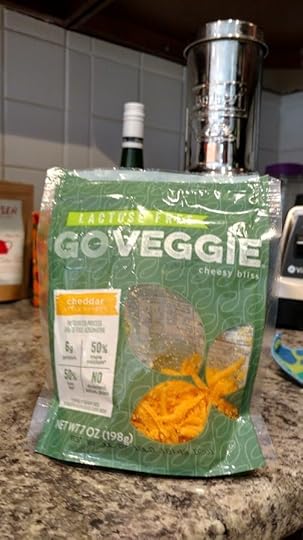
Veggie, not vegan.
I don’t remember why I decided to check the label the day after we used the product for delicious quesadillas, but when I did, I noted that their cheddar-style shreds contained casein. Casein is a milk protein commonly found in processed foods. Since it’s derived from milk, it’s not vegan. Actually, “duped” isn’t a term that’s fair to the company and brand. They do have some vegan options, I just need to be sure that what I buy is entirely dairy-free and labeled as such (but I’ll still look at the label, too).

Always check the label.
Having “veggie” in your name makes you attractive to anyone looking for plant-based options. And it you’re a vegetarian, the Go Veggie we used would be fine (as long as you don’t have a dairy allergy).
Next time, I’ll be sure to check my ingredients and also look for labeling indicating it’s vegan. Many food manufacturers are now doing this with their plant-based, vegan products.
April 3, 2018
A Month of Poems
April is National Poetry Month. Thirty days for celebrating words, wordsmiths, and the poets who subvert the status quo.
Do you think Donald Trump reads poetry? Maybe he should put the Twitter down and pick up some Walt Whitman. Whitman wrote,
This is what you shall do: Love the earth and sun and the animals, despise riches, give alms to every one that asks, stand up for the stupid and crazy, devote your income and labor to others, hate tyrants, argue not concerning God, have patience and indulgence toward the people, take off your hat to nothing known or unknown or to any man or number of men, go freely with powerful uneducated persons and with the young and with the mothers of families, read these leaves in the open air every season of every year of your life, re-examine all you have been told at school or church or in any book, dismiss whatever insults your own soul, and your very flesh shall be a great poem and have the richest fluency not only in its words but in the silent lines of its lips and face and between the lashes of your eyes and in every motion and joint of your body.
Mark was a poet, an award-winning one. While he was out walking across America for something bigger than himself, he was writing poems, like this one:
sheep death
The earth / died / a little / today / it dies / a little / every day / because / I think / there are too many / ways / for people / to make / death / without / realizing / they’re making death / yesterday / I saw / a sign / next to a pasture / of / sheep / it said / be careful / there’s a gas pipeline / in the dirt / the sheep / didn’t/ seem to understand / they just looked / at the sign / and/ waited for whatever / form / of / death / was next
Take some time this month to read some poetry. Let it slow you down, open your mind, and drop rhymes into that space.
I just discovered George Watsky. I’m richer for that. If you don’t like Whitman, maybe you’ll dig Watsky.
April 1, 2018
Easter: Just Another Sad Holiday
Today is Easter Sunday. Some of you got up and went to a sunrise service. I used to like these. Being outside, in nature, helped connect theology to Earth. Of course, many Christians don’t care about Earth because they’re fixated on heaven.
I’m not a practicing Christian these days, whatever that means. When I was 21, I was naïve. I didn’t know any better. Thirty-five years ago, I simply accepted the false notion that “Christians aren’t perfect,” to excuse the abhorrent behavior I found inside “the fold.”
When you embrace something new, there is always a honeymoon period. Having been raised Catholic, I was attracted to the enthusiasm for scripture I found in many other believers during my initial Protestant foray. I loved the freedom that came from reading the Bible for myself, not having it spoon-fed to me by a priest.
For the Catholics I knew, Jesus wasn’t seen as a revolutionary or renewing figure in their brand of religion. That’s not to say that Catholics don’t believe in Jesus, just that salvation is a different process than “simply believe and be saved,” as I came to understand Christianity back in 1980.
My born-againism “lit a fire” in me, enough so that I left school at UMaine and walked away from my second love (Mary was my first), baseball. But, it doesn’t take long for this initial zeal to cool, or get squashed. Or, in my case, moved to another location. In this instance, it was Crown Point, Indiana, and Hyles-Anderson College.
My experiences at Hyles-Anderson have been documented and here, as well in one of my essays in the previous book I put out, The Perfect Number: Essays & Stories Vol. 1. Things in the Hoosier State didn’t turn out as expected.
Indiana ended up being where our unit of three began and a special bond developed. As a young father and primary provider, it was hard to realize that the God I’d trucked nearly halfway across the country to follow and serve, wasn’t the same deity that the leaders at Hyles-Anderson College and First Baptist Church in Hammond worshiped. Actually, the true deity in that post-industrial region where I ended up being “shipwrecked” in—the object of worship for the fundamentalists I was now part of—was a man named Jack Hyles.
Like countless “preacher boys” and older men who ended up in Crown Point and Hammond, Hyles managed to dupe and betray them into believing that his sermons and other diatribes emanating from the pulpit at First Baptist in the early 1980s, as well as pulpits across the country, were coming from a man totally “sold-out” to God. Like so many charlatans and con men, he was convincing to a fault.
There are several places where you find a good portion of the real story about who Jack Hyles really was prior to his death in 2001. I remember finding out that he died a year afterwards, while searching for him online, and I cried. Why, I don’t know. He’d caused me a great deal of pain and second-guessing. That’s what happens to those who become members of a cult and manage to get out. Getting out was a good thing, but it took me years to get over the trauma and self-doubt that follows being part of a cult. I’d taken on believing Hyles to be something he wasn’t. His son-in-law followed him as pastor in Hammond. Jack Schaap is now sitting in prison, charged with child molesting, having taken a 17-year-old girl across state lines and engaged in sex with her on several occasions.
We left Indiana and returned to Maine, with our faith in tatters. That was fine. Faith in false prophets and a fairy God plus 25 cents won’t even buy you a cup of coffee these days, and it didn’t in 1987, when we pulled the U-Haul truck into the driveway of Mary’s parents in Durham. It was August and Mark was 3 ½-years-old. He got to grow up with knowing both sets of grandparents and his extended family. I think that was a good thing for him.
There was one last, ill-fated attempt to “believe” in some manner of a traditional sense. This time, an evangelical pastor’s (at a Vineyard church) support for the Iraq War in 2002 was the last straw for me and organized religion. I began calling myself a post-Xian, which is what I consider myself these days.
*****
Mark was a fan of Rich Roll. Roll, the accomplished vegan ultra-endurance athlete, had been a high-powered entertainment lawyer. He now admits that prior to his reinvention, he’d been overweight and on a path where he might have ended up having a heart attack from being unhealthy and over-stressed. After what he calls a “moment of clarity” the night prior to his 40th birthday, he decided it was time for a change. Since then, Roll’s been on a mission, becoming a full-time wellness and plant-based nutrition advocate, a motivational speaker, as well as the father to four children, along with his wife, Julie Piatt.
Mark really liked Roll’s podcasts. He was always after me to listen, as these were part of his day while out walking across the country. I was slower coming to the podcast thing, but during the fall of 2016, while Mark was on his final walk, I sought out and listened to my first Rich Roll Podcast. The guest was Dr. Neil Barnard. I was captivated.
The two of us discussed this via email as he was out walking, and we spoke by phone. Both his parents had become plant-based vegans. We now had a reason to begin appreciating the gift of Roll’s book, The Plantpower Way: Whole Food Plant-based Recipes and Guidance for the Whole Family. We have a signed copy because Mark had taken the train to Boston to hear Rich and Julie speak and he met Roll. This was in 2015, I think. Roll recounted his meeting Mark when he offered a heartfelt tribute to our son at the beginning of Pocast #342.
I have been listening to podcasts during lunch most days, usually while riding my stationary bike, looking out over the cove. It’s a good way to get some exercise, take a break from writing, and in the case of Roll’s podcasts, connect with provocative thought leaders, people like Rob Bell. I mentioned the first podcast where Roll had Bell on as a guest. The podcast I listened to this week, was recorded two weeks ago. This time, Bell, along with filmmaker Andrew Morgan sat down with Roll for a captivating two-hour discussion that ranged across topics related to story, filmmaking, what happens when people oppose your ideas, etc. I wish I could better articulate how deeply Bell’s positive message (along with Morgan’s) resonated with me.
If you don’t know Bell, here is the $3 version.
He was a rock star pastor of a nondenominational megachurch near Grand Rapics, Michigan. He founded Mars Hill at the age of 28 and as the teaching pastor, had a key role in the church’s remarkable growth, where Sunday services routinely drew 5,000 people in the mid-2000s. While there are competing theories, Bell eventually left, mainly due to fallout resulting from his disavowal of many traditional, conservative tenets of evangelical theology. A significant one was Bell coming out and saying that he no longer held the belief that there was a literal place called hell, a place of eternal torment.
An article in The New Yorker is often cited as representative of what happened at Mars Hill. But often, there’s another side to the story. Bell offered a bit more about that period of time in another interview, which offers additional insight into his exit from the church he’d founded 11 years prior, and the congregation he’d grown into one of the largest in America.
Bell admitted that tensions had been building at Mars Hill as his reputation grew outside the church. He said that people were thinking, “how do we interact with him and his voice in the larger world?”
“Then, I release a book that creates a tremendous amount of ambient drain for the church,” Bell said.
While the church was supportive, according to bell, he realized it created a conflict and there was another book coming in 18 months.
In 2011, he spoke with church leaders about the “pull” he was feeling to take his teachings to more people via television. Church leaders were “reluctant,” but recognized this was where Bell was heading with his ministry.
“Lots of people said to us (he and his wife, Kristen), ‘We’re surprised but we’re not surprised. You need to go do this.’”
Bell knew that after 12 years, “his season at Mars Hill had come to an end.”
Weirdly, while outside the “evangelical news cycle” at this point in time, I’d heard about Bell. It was probably Sanneh’s piece that looped me into the Rob Bell orbit.
Before I’d walked away from traditional religious (and mainly, evangelical) constructs, I’d often thought that there had to be a “better way” than bringing outsiders into a strange context where they knew little of the culture and odd ways of church people, and somehow, expect them to be comfortable with that. Even churches like those in the Vineyard denomination (where Mary and I last ended up in 2001), with less formal worship styles and contemporary music, were still stuck in the 19th century when it came to theology and views on issues like gay marriage, war, and politics.
It’s easy to see from outside this bubble that Bell’s decision was a wise one. He has become a bestselling author, his tours routinely sell-out venues across the country, as well as in Europe. Time profiled him as one of 2011’s hundred most influential people. Perhaps more important for him (and others), he is reaching people with a contemporary and transformational message rooted in Christian tradition, but also very different than what usually comes from a church pulpit.
*****
Mark must have wondered about his spiritually-conflicted parents. He was born a Hoosier mainly because his father was following some kind of “call from God,” or so his dad thought. Then, after finding out that the God People that we’d moved 1,000 miles away from home and family to throw our lots in with weren’t who we thought they were, it was back across the country in the U-Haul, back to Maine.
In 2001, when 9/11 made all of us stop and assess who we were and wonder about the deeper things of life, we ended up back in church on Sunday mornings. Mark went to a Christmas service that year. We got him a Bible. He read some of it.
At some point in 2002, a Vineyard pastor stood up in the pulpit and preached that the war in Iraq was “a just war.” I looked at Mary and we both knew it was over for us in that place. Prior to that, I’d had arguments with members of the small group Bible study I was leading about immigration and many of the New Mainers settling in the area. I wanted to reach out to them. I was told by leadership that this wasn’t the plan. Like when racism raised it’s ugly head in Indiana at Jack Hyles’ church, it was “de ja vu all over again” (to quote Yogi Berra).
While Mark was out crossing America’s highways, on his own spiritual journey and quest of sorts, he’d emailed me and asked about Rob Bell. “Hey dad, do you know who Rob Bell is?”
He’d heard the first podcast with Roll where Bell was a guest. I told Mark a bit about Bell from what I knew. He thought the discussion was interesting and he found Bell different than he’d expected him to be. Bell has that effect on people.
I’d listened to the podcast while at work one day. I emailed him about it, two days before Mark was killed.
Listening to podcast with Rich Roll/Rob Bell. Very interesting. Glad you told me about it.
I wonder if Bell got up in most churches, if people would really “hear” him? I doubt it. I’m sure that’s one of the reasons he goes outside the confines of the church to do what he does (funny, kind of like Jesus!). I’ll have to check out one of his books at some point.
-Dad
Roll had Bell back and I listened to the podcast. Along with Bell was Andrew Morgan, a documentary filmmaker. Bell gave Morgan unrestricted access to him and his life for two years and Morgan just came out with The Heretic.
Bell mentioned in the podcast that he wasn’t thrilled with the title, but Morgan chose it because someone he knows used that term about Bell when she found out he was making a film about him, as in Rob Bell, “oh, he’s a heretic.”
Being heretical probably isn’t a bad thing, especially in church circles. I say this because evangelicals—at least the kind who believe that politics, rather than God, is the solution to man’s shortcomings—have unequivocally supported a man in Trump who is the antithesis of everything that Jesus stood for.
When I was going through Mark’s videos last fall into the winter, re-watching all 100 of them, daily, one year out from when they were made, I wrote this while watching his video from Day 91. Each one of my daily writings has a title. This one is titled, “Hey!! I’m Jesus!” Mark is walking from Chattahoohcie, Florida to Sneads. It’s January 11, 2017, 10 days before he dies. I recount some of the geography of his surroundings, and then riff about Mark and Jesus. Like the people who hate on Rob Bell and protest whenever he shows up for one of his speaking engagements, this will probably rankle some people. I don’t care what these people think. I’ve bolded Mark’s dialogue:
Today, he’s passing a point on the map where the Chattahoochie River (a fairly famous American River, see Alan Jackson [you can Google “Chattahoochee” and the country artist’s name and see what I mean]) flows into a giant lake named Lake Seminole (a famous Florida Native American tribe), which then branches into the Apalachicola River (maybe not as famous, but still a cool name), which is all part of the Apalachicola River Basin. Like I said, I dig geography, especially when I can “see” where Mark is at in much greater detail.
Mark is walking west towards his demise, he has fun with a sacred cow, someone who I thought at times he resembled. Did you say, “Johnny Appleseed?” No, Jesus. What?
As Mark is walking west on Route 90, he finally admits to his audience who he really is. He’s Jesus, come back to America to save us all, and take us back to heaven, or something like that.
Actually, this is what he says, just so I can get it right for the record, and for the people pissed off that Mark can be playful, and doesn’t have a stick pushed so far up his ass that he can’t have fun with any topic, taboo, or not.
“I didn’t want to have to bring this up, but I don’t know any other way to reach people. I don’t know how to reach everyone in the world than to admit the fact I’m Jesus. I’m Jesus. I’ve returned to Earth. I’ve returned to Earth to save it. Jesus has arrived. Where are y’all. Where is everyone? I’m here. I’m back on Earth.”
“Doesn’t he know I’m Jesus? Why’s he driving so fast? He should have stopped and said, ‘hey’! Hey, I’m Jesus. Stop and hang out.”
This dialogue that Mark has with himself, one of the many snippets from videos that are pure genius in terms of being a poet, who had the capacity to bring his poetry to life in the form of walking his poems—performance art, for want of a descriptor—developed (I think) from an exchange that he captures just a small part of earlier, when he’s talking to a guy named Dave Money, who is a Christian. He captures part of the conversation (from his blog):
A man stopped and said, “Hey you’re the barefoot man. The world is going to burn. There’s nothing you can do to stop it. Jesus is going to return. All the animals will die.”
Mark had so many of these interactions with people naming the name of Christ (Jesus), and to take these and condense them into 26 seconds tells anyone who is “woke” all they need to know about Johnny Appleseed/Jesus/Mark Baumer.
Crossing into Jackson County, Mark has officially entered the Central Time Zone. This was a milestone of sorts for him, I think. Maybe he was thinking about geography like his father always did. And eventually, he’d die in Central Time.
And just so people don’t forget that Mark wasn’t just some jester, or poet of the absurd, he gets passionate with a rant at the end, about the town of Johnson, Rhode Island, which sold its water to a corporation back in his home state, so they can “build a power plant and ruin the Earth.” Mark is pissed and I love that we get to see my son in his totality in these videos.
Mark closes out yet another video I didn’t appreciate enough the first time, by singing some made up song with the lyrics, “not going home tonight.” Mark wasn’t going home ever again.
One thing that comes across when listening to Rob Bell is his humility. When he talks about something, he’s not doing in from a doctrinaire perspective. When he says he’s willing to change what he believes if data and facts contradict what he currently holds as truth, this is refreshing. It’s different than people hunkering down in positions that they can’t support, refusing to budge.
I believe that Mark found Bell intriguing because he felt an alignment with him. Both of them had tapped into a wellspring that we’re desperately in need of in this nation, if we’re going to be able to get through the next few years and beyond—a place where love, compassion, and empathy, and a whole lot more of the things that emanate from emotionally intelligent people. I agree with Bell when he said that “if you think about the religion that’s risen in Jesus’ name, it is anti-what-Jesus-was-talking-about.”
Today is another anniversary without Mark. This is Easter #2 sans our only son. It’s hard not to feel heartsick today, missing him. We’re his parents, the two people most affected by his death. And like we’ve done now more times than not, we’re alone today with the memories, and our thoughts, wishing we were sitting around with Mark, sharing a vegan feast with him, or listening to him talk about something he was excited about, or get to hear him say to us, “I love you.”
Here is the trailer to Andrew Morgan’s new film about Bell.
March 21, 2018
Grief in the Light
While it’s okay to talk about trivial matters—food, beer, and what restaurants we like; songs and bands; maybe why Tom Brady is better than Ben Roethlisberger—some argue, we mustn’t discuss the weightier issues confronting us—like death and the attendant fall-out from grief and loss.
There was a tacit understanding when I was coming up that certain topics were notably off-limits in mixed company—the old adage, always refrain from “politics and religion.”
Apparently that’s not the case any longer. Political thoughts are offered with little regard to how well-framed and supported they are by logic or fact. Then, there is no shortage of those ready to offer (inflict?) prayers on your behalf (even if they never seem to be “answered”). So, the old taboos no longer apply—unless it’s talking about death and the subsequent way it affects the lives of those left behind. At least that’s how it seems to me, more than a year out from the event that changed the lives of Mary and me.
A few weeks ago, I heard a track on Jeffrey Davison’s Saturday morning “Shrunken Planet” program on WFMU. It was by a band listed on the playlist as Bipolar Explorer. Something about the song, “Lost Life,” was evocative and then Davison mentioned how the album where he pulled the cut from, was a reflection on the death of their singer, Summer Serafin.
The band has the requisite page on Bandcamp and they’re on Wikipedia. I found additional information about them and Summer. She was a beautiful and talented actress who died all-too-young. Her band mate and love of her life, Michael, has soldiered on, making music that recognizes how grief and loss leaves those who loved the person who is gone, forever affected (and afflicted). It’s about death and what follows for those left behind, yet, I don’t find the music of Bipolar Explorer morbid, or in any way, shape, or form. In fact, I ordered “Sometimes in Dreams,” and it is a haunting and profound exploration of lost love in musical form.
As I ponder the belief held by some people who take issue with public displays of grief, I’ve come to believe that holding this position mostly means you’ve never been left feeling bereft and out of sorts after having a hole opened up in the middle of your life you’ve been living after losing someone special. Or, lurking on the periphery, clinging to a heroic stoicism. Existential ruminations always work much better when conducted at a safe distance. You also might be under the mistaken belief (having been taught, wrongly) that you’re supposed to suffer in silence.
Phil Elverum lost his wife when he was 36. It will be two years in July. She died of pancreatic cancer. Elverum is a singer-songwriter who played out as the Microphones, and now records under the moniker of Mount Eerie.
Geneviéve Castrée was a well-regarded comics artist. Later, after marrying Elverum, she began releasing music under the name, Woelv. Her works have been published by Drawn & Quarterly.
He’s written and recorded two records post-loss. The first one, A Crow Looked At Me, was begun two months after Geneviève died. Some might call many of the songs, stark. Stark is a great term in the abstract. It feels different when it’s hitting you in the head and in the gut, while rending your heart, leaving it in pieces.
Comedian/writer/podcaster Marc Maron interviewed Elverum in 2017. It’s brutally honest (from both ends, interviewer/interviewee), which is why I found it meaningful. Perhaps you will, also.
Michael Serafin-Wells continues with Bipolar Explorer, as well as blogging about his love, Summer. He hasn’t “moved on,” whatever the fuck that means. Just like Phil Elverum hasn’t forgotten someone he’d known for 13 years, then lost her.
Mary and I had Mark for 33 years. Over the last 12 years of his life, we rarely saw him daily, save for the times he came home for an extended visit, or we drove down to Providence for a weekend. But when we did spend time in his presence, it was an occasion to savor and now, cling to those memories, holding them tightly. You don’t just stuff those years into a box in the basement, like you do with personal effects. No, we’ll continue to be affected for years, yea, for the rest of our lives.
March 16, 2018
Letter From a Dad
There is a website called Chicks on the Right, founded by two conservative women, Amy Jo Clark and Miriam Weaver. The site is similar to many that promote only one side of the spectrum, politically and ideologically. I don’t really care about that.
What I do care about is that earlier in the week, while doing a Google search about Mark and something I was thinking about, I came upon this post, first. The writer, someone writing under the pseudonym of “Miss CJ,” called my late son a “hippie moron.” Then, in trying to get back to the post, I discovered this one.
Can you imagine missing your son each and every day, and then reading someone saying she wasn’t even sorry about his death, even going as far as to gloat about it? This is the kind of hater BS that makes me angry and close to being crazy. You never stop loving your son and wanting to protect him, even after he’s been killed.
I thought I’d write today’s post in the form of letter to the two founders, appealing to their compassion and empathy, and perhaps, their “better angels.” But this is likely an exercise in futility, akin to reasoning with the unreasonable.
Here goes:
Hello,
I’m Jim Baumer, Mark Baumer’s dad.
The name may not register with you. Mark is my late son—the one that your writer, Miss CJ, called a “hippie moron” during the fall of 2016, when he was out walking, prior to being hit and killed by an SUV the following January. Not only did this writer totally mischaracterize my late son, but she employed common stereotypes directed towards anyone not playing by her narrow parameters of what is “right and good.”
I have found a number of disturbing things written and posted about my son on the web over the last year, following his death. Usually, I try to address them, but I obviously missed these.
If you have children, a part of me would like to think that there’s an ounce of compassion under your ideological certainty, but I can’t say for sure that there is—at least based upon the tenor of the content on your site. As editors, by allowing falsehoods like this the light of day—especially about a young man who was a kind and committed soul who can’t defend himself from the grave, it leads me to the judgment that you are both deficient in basic human decency and empathy.
Try to summon a shred of compassion and decency (if you can) and imagine what the last year has been like for my wife and I, having lost an only son. Mark was 33 when he was killed.
To read someone calling him a “hippie moron” made me angry. Admittedly, he was a hippie, if being a hippie meant not having a car, walking or running wherever he went in Providence, Rhode Island where he lived, and having the smallest carbon footprint of anyone I’ve ever met. But to call him a moron—this made me ugly. You never stop being a dad, even when your child becomes a man. In that regard, I’m kind of old-school. I believe in standing up for those I love. And Mark was a voracious reader, an able thinker, and committed to growth in a way that very few people are. If that’s being a moron, count me in!
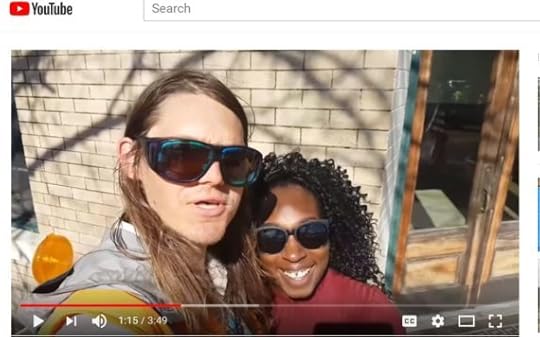
Mark interacting on his walk, MLK Day, 2017.
In what was probably the best of many articles written about Mark here in America and even in Europe, Anna Heyward in The New Yorker, found my son to be an intriguing figure—not someone to be mocked or characterized in a reductive manner.
Better, Ms. Heyward, doing what journalists should do, looked deeper than what was obvious to get at some of the motives for Mark’s walk—these were not due to a lack of intelligence (as your hack of a writer found), but, a walk taken for reasons that even I haven’t been able to fully ascertain, even after watching each one of his videos beginning a year after he began and watching all 100 of them. My notes on the walk and what I observed the second time through is about 65,000 words worth. Like Heyward, I was trying to find some of the foundational reasons why a young man who owned a house and had a job that many would envy, would take to crossing the country, as pilgrims before him had.
From The New Yorker:
Since November 9th (2016), many Americans have been searching for ways to incorporate political activism into their everyday lives, to get out of the echo chambers that keep them among only like-minded people. Baumer was an eccentric model for both, someone for whom activism was both a life style and a form of self-expression. He walked through tiny highway-side towns and filmed himself interacting with locals, and often spoke on his feeds about how surprisingly good the people he encountered were.
In returning to the site and finding the second post by this same writer after Mark was killed, I was stunned and then angry. What she wrote was so beyond the pale that it is hard for me restrain how I really feel about her, without expressing it in most direct and visceral way. How do you gloat about another human being killed, referring to him as “pavement putty”? I’m going to refrain from expressing how I really feel about someone who hides behind a moniker—it’s probably best, writing the hateful drivel that she produces. It’s also what Mark would have told me to do, as in, “hey dad, just let it go. It doesn’t matter. Some people you just can’t reach.”
I miss Mark. His compassion and his genuineness as a human is rare in a country where many people simply want to throw rocks at one another, or worse.
Mark’s walk was many things. A sort of personal vision quest, the physical embodiment of his writing and poetry, a performance, and the actions of a committed activist seeking to bring greater attention to the issue of climate change. Mark was also offering us a critique of our country, a nation that long before he began walking, had lost its way and no longer was attuned to its soul, if arguably, it ever had one.
There was always a narrative present (if you cared to see it or looked just below the surface, like Heyward did) where Mark’s walk countered everything around him. The juxtaposition of being human and walking as we were built to do was interspersed with cars—hunks of metal and powerful machines with lethal capabilities.
Mark was none of the vile things that your writer tried to portray him as—anyone that knew anything about my son knows that he was a kind, loving, and sweet young man, in addition to being an award-winning poet, a committed activist, and a devoted family member, as well as a compassionate friend to so many. I was touched by this man’s assessment of Mark, a guy named Rich Roll, who got what Mark was trying to do (start listening at 01:50). He totally saw the “performance art” aspect of his zaniness that comes across clearly in these videos (and on his blog).
Where your writer (who must have your approval and your okay to write this filth) saw a hippie moron, not worthy of even feeling sorry after he was killed, many others saw a physically and psychically strong human being. A courageous one. Some of your commenters thought it was “easy” to walk barefoot. I’d like to see them spend an hour walking around town barefoot, let alone 100 days. This is characteristic of your tribe, though. People without any evidence of toughness and resilience, but regularly talking shit.
My wife and I have had our lives altered forever. But we’re both demonstrably resilient people. Instead of allowing pain and sadness to swallow us, we’ve launched a foundation in Mark’s name and memory to carry on his legacy and support the things he cared about, as well as funding important community projects that raise awareness about the environment, promote social justice, as well as involving under-served populations directly in renewing their communities. These were the issues and causes that fueled Mark’s passions and were part of his philosophy of life—love, kindness, and working towards building a better world.
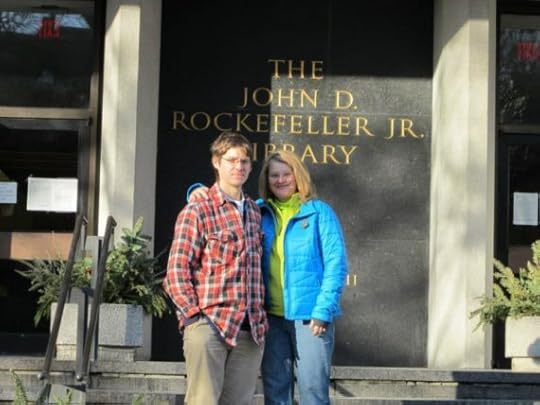
Mark with his mom (who he loved) in 2013, in front of his place of work, Rockefeller Library/Brown University.
But you and your writer obviously missed that and only saw what your ideological blinders allowed you to see.
I wish you’d take those two posts down from your site—that would be the right and compassionate thing to do. But I won’t hold my breath waiting for you to do the right thing.
In grief and loss,
-Jim Baumer
If you want to counter hate and hopelessness and honor the spirit of what Mark was doing when he was killed, think about making a contribution to the Mark Baumer Sustainability Fund. Our mission is focused on tangible steps towards creating a more just and humane world, one that counters division and hate.