Jim Baumer's Blog, page 23
February 1, 2018
Fire, Then Fury
Michael Wolff has made a career of skewering powerful people, newsmakers like Rupert Murdoch. That is his journalistic M.O. You can look it up. To expect anything different from him re: President Trump, is mistake number one in your thinking.
A profile of Wolff was written back in 2004 for New Republic. The writer, Michelle Cottle, wrote that he “is the quintessential New York creation, fixated on culture, stye, buzz, and money, money, money.” Perhaps better, Wolff might be a quintessential American creation of sorts, mirroring America’s obsession with flash, trash, and cultural detritus. A writer “willing to dish the dirt.” Of course, it’s dangerous to hold the mirror up to others—especially if the mirror reveals their idol/president/emperor is a cartoon cutout. It pisses them off, too. Say what you will about Mr. Wolff: he’s been laughing all the way to the bank for a while.
Since Wolff’s pretty well-known in what he does, the fact that the current handlers of Mr. Trump, and Trump himself, must have known that Wolff was going to write what he saw and what he thought he saw. And yet, they feign indignation. Didn’t something tip you off when he was playing a fly-on-the-wall, talking to a gaggle of inner-circle cronies? He spoke to Trump, too, for God’s sake!
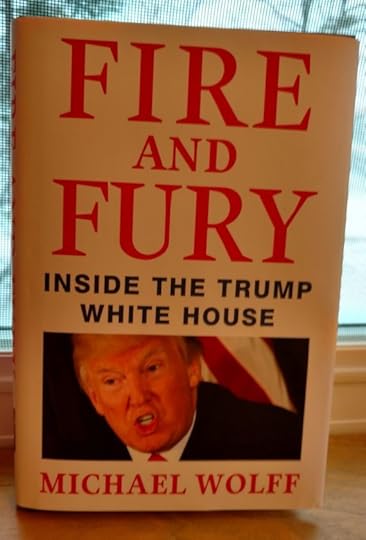
Michael Wolff on the Trump White House.
That’s why for me, it rings incredibly disingenuous when ideological Kool-Aid-drinkers get indignant about Wolff’s book. Kind of lame, in my way of thinking.
Here’s what you need to know. The administration provided Wolff with a blue press badge. What’s with the color-coding? Well, most of the press people covering the White House have grey badges. These get them into press events, like Sarah Huckabee Sanders’ daily lie-session, but they don’t get to camp out on a couch in the West Wing and have carte blanche in terms of access. Wolff had this.
Also, Steve Bannon, Trump’s brain and chief handler until the president sandbagged him, signed off on Wolff’s work. Whatever Bannon’s reason for wanting this information to come out, he clearly knew that the release of Wolff’s Fire and Fury was going to be “a thing.” A very, very big thing. And it has been.
I’ve read the book. The first third reads well because there’s so much shit about Trump and the rubes running things that you just sit there incredulously turning the pages and thinking, “we’re so fucked,” at least if you haven’t polished off the last drop of conservative Kool-Aid.
After awhile, however, Wolff’s book begins to drag. Kind of like the daily drumbeat of Trump’s lies, obfuscations, and the flood of swamp water sloshing out onto your living room carpet from consuming any of the usual suspects—MSNBC, CNN, and even Fox News. Trump is good for ratings, if for nothing else.
Most Americans don’t read. Some of those non-readers have ordered and read Wolff’s book. Maybe Wolff will launch a renaissance of reading and critical consumption of information. That’s highly unlikely.
Sorry if you were expecting a traditional book report from me. If you require a blow-by-blow on Wolff’s presidential assessment, might I recommend this one?
We are living in the midst of the worst presidency in recent memory. The first president I vaguely recall was Johnson and the nightly news death totals from the Vietnam War. Then, of course, came Nixon. I realize that with our two-second attention spans, it’s possible that even people my age don’t really remember Watergate. Young people have no clue about any of that period of time. It was well-documented. There have even been books, like Rick Perlstein’s excellent chronicling of Nixon’s perfidy. I’m guessing that Perlstein’s book sold fractionally, compared to Wolff’s barnburner.
The other night, when Trump was standing behind the podium with Republicans genuflecting before his hypocrisy, dodging the lies falling out of his mouth, I couldn’t help thinking about what I’d just finished reading. Of course, I read a lot, and Wolff’s book was simply a detour from the usual assortment of books I prefer that have a bit more intellectual rigor and tend to be more deeply-researched. That’s not a boast, it’s a fact.
As I’m typing this out, I’m listening to the archive of David Pence’s Radio Junkdrawer show, broadcast yesterday, on WMPG. He’s covering the musical career of the Fall’s Mark E. Smith. Smith died a week ago on Wednesday. Those of us who’ve been followers of indie rock dating back to the days of Reagan know who Smith was and what his work with the Fall meant to the young, suburban kids who formed their own Fall-influenced bands, like Pavement, Archers of Loaf, and others.
Reagan (along with Britain’s Thatcher) and Nixon were so much more interesting historical figures than our two-bit carny barker of a president. What they all have in common, however, is a disdain for people like me and other members of the hoi polloi, who they masterfully manipulate to reach the pinnacle of power that becomes their defining epoch. Thatcher’s Britain actually spawned many other artists besides Smith and the Fall. The fertile 1980s underground music scene in the U.S. was fueled by solidarity against and even hatred, for Reagan. What will Trump be credited for being a catalyst for? Who fucking knows at this point!
In my opinion, Smith’s long career of producing cutting-edge music (four decades worth), a certain “sartorial sense,” and that unique voice (as Pence said, “he wasn’t a great singer, but he was a great vocalist”) were spades more interesting than our current president/emperor being paraded around, sans clothing, by Wolff and others.


January 29, 2018
Some Have It—Most Don’t
There is this strange phenomenon. Maybe it’s uniquely American. We demand that others behave in a manner that’s more ethical, honest, and consistent than the way we live our own lives.
We’ve all heard this ad nauseum: “All politicians lie.” Well, according to Robert Feldman, whose studied how often people lie, we all lie quite a bit.
Then, there is this idea that while others fold like a “cheap tent” when pressure is applied, that you’d be the one righteous man/woman who would be willing to “stand in the gap” for truth. Bullshit!

Do You Have Integrity?
America has elected a pathological liar as president. So what if you didn’t vote for him? Donald Trump is now president and you are going to face the consequences for the actions of 62 million people who decided to inflict their anger and concerns about losing their white privilege, on all of us.
If you are a resident of Maine like I am, we’ve lived through seven years of petulance masquerading as leadership. Like the decision by our governor to withhold training funds because he didn’t get his own way. And for the people who are harmed by this, he doesn’t care.
As frustrating as this is to witness, there are still good people out there, who refuse to “go along to get along,” or become complicit in wrongdoing, or even evil.
Last Wednesday I had the good fortune to be in attendance when a close friend was feted by the nonprofit he’s worked for since 1999. His efforts to make a difference and provide opportunities for others while working inside the state’s workforce system is a testament to doing good and having a conscience. Not everyone is a moral coward, or simply doing whatever is necessary to collect a paycheck.
As I sat in the room and listened to stories from co-workers, saw photos flash up on the screen that represented the past 20 years of my friend’s life, I was thinking of those who were the total opposite of my friend, Paul.
I thought about a woman who I once worked for at an employment newspaper. When I was working for the Central/Western Maine Workforce Investment Board, we stayed in touch, usually meeting quarterly for lunch. We’d talk about our families, she’d ask about Mark and I’d ask about her son. Like Mark, he was an only child.
Later, when she was going through a transition in her life, I shared a little of my own journey at the statewide HR conference at the Samoset in Rockport. This was in May of 2012. I’d recently left full-time employment and was entering the free agent phase of my career. We agreed to “have lunch” to continue our conversation. That planned lunch never happened.
Not long after our conversation, I read that she’d accepted a deputy director’s position in the state’s Department of Labor. In her role and then later as commissioner, I was taken back by the change that had taken place in her. Or perhaps she was simply being who she always was, but had masked that cold, calculating behavior. Now, she was just another bureaucrat carrying out the governor’s ideological agenda, Maine workers be damned!
None of us are perfect. We all have areas that are stronger than some others. The honest person also knows their own weak spots and works at them. People like Paul (and my late son, Mark), have always been committed to being better human beings. This has been evident ever since I met Paul in 2006, two weeks after Bryant Hoffman named me as his business services advisor.
Last January, the bottom fell out of my world. Mark, a noble poet, activist, and performance artist, was hit and killed while walking across America to raise awareness about climate change.
When things like that happen in your life, you immediately learn who your real friends are. You also learn a lot about those people who don’t step up and offer something as simple as condolences.
Paul and his partner, Carla, were at our house the week following Mark’s death. Paul went shopping at Whole Foods and figured out what foods were appropriate for his two plant-based vegan friends, and he and Carla brought us lunch one day and sat with us after, during a particularly trying week. I’m sure he didn’t know exactly what to say, but he stepped up and showed up for us (as did Carla). That speaks louder than anything that he’d ever been prior, as a friend—and he was a damn good friend before then. I’ve never as much as gotten an email from the person I once worked for. There are plenty of others just like her that I could highlight.
I see many people going through their lives, doing whatever they have to do in maintaining the status quo. At work, on the boards where they serve, and presidents of a major universities discount claims of sexual harassment, while enabling (and sheltering) predators like Larry Nassar.
This is what Charles Pierce wrote for Sports Illustrated. I can’t say I find anything objectionable in this quote:
Burn it all down. That is the calm and reasoned conclusion to which I have come as one horror story after another unspooled in the courtroom. Nobody employed in the upper echelons at USA Gymnastics, or at the United States Olympic Committee, or at Michigan State University should still have a job. If accessorial or conspiracy charges plausibly can be lodged against those people, they should be prosecuted to the full extent of the law. Those people should come out of civil courts wearing barrels. Their descendants should be answering motions in the 22nd Century. In fact, I can argue convincingly that none of those three institutions should continue to exist in its current form. USA Gymnastics and the USOC should lose their non-profit status forthwith. Michigan State should lose its status within the NCAA for at least five years. American gymnastics is no longer a sport. It’s a conspiracy of pedophiles and their enablers.
Hypocrisy doesn’t have to be the norm. You don’t have to lie, steal, and hurt others just to get ahead. If you do, then own that you aren’t a very good human being.
While Paul’s always been there for me, there are many out there who knew me well and knew who my son was. By not acknowledging what’s happened to me (and my wife), I see you for who you really are, and probably who you’ve always been.
Truth, honesty, and living a life of integrity can’t be faked. At some point, we find out who you really are.
January 22, 2018
Saving Earth
In case you missed it, the Trump administration announced a proposal that opens up large areas along the coastline of the East Coast, which includes Maine, to oil and gas drilling.
I don’t know how many Mainers know that we have 3,478 miles of coastline—that’s more than California (3,427), and over 5,000 miles of coast if you include all of the islands as well. Only Florida and Louisiana (mostly bayou) have more miles of coastline.
The Earth looks better without drilling rigs. [Old Orchard Beach, ME]
I thought that there was going to be an opportunity to offer public comments at the Augusta Civic Center today. I was planning to attend.
This morning, I found out that members of the public wouldnt’t be allowed to speak at this “listening session hosted by the Bureau of Ocean Energy Management (BOEM). Instead, advocates, like Friends of Casco Bay are urging activists and other concerned parties to submit comments via the BOEM website set-up for that purpose.
There will be future opportunities to speak and “lend our collective voices,” as well as other actions. In the meantime, I’d urge you to submit your own comments.
For now, here are my comments I submitted this morning, while also attaching my OpEd that was published in Friday’s Portland Press Herald:
[Comments submitted to the BOEM website for public comment on the Notice of Availability (NOA) of the 2019-2024 Draft Proposed Outer Continental Shelf (OCS) Oil and Gas Leasing Program and Notics of Intent (NOI) to Prepare a Programmatic Environmental Impact Statement (EIS)]
Good morning,
I am the father of a 33-year-old son, Mark Baumer. Mark was a poet and activist who was making a barefoot walk across America in 2016-2017 to raise awareness about climate change, as well as the effects of the proliferation of oil and gas pipelines, as well as the consumption of fossil fuels continues to raise the levels of CO2, which is one of the major causes of human-induced climate change.
Mark was hit and killed by a driver who, given what I’ve been able to gather, proably shouldn’t have been behind the wheel of a SUV—at the very least, she did not maintain her lane and hit and killed our son on January 21, 2017, a year ago. This was devastating for my wife and me, as Mark was our only son.
In order to create some sliver of meaning from his death, we’ve launched the Mark Baumer Sustainability Fund. It is a 501c3 foundation intent on making sure that Mark’s wish for a world that no longer relied on non-renewable energy to fuel it becomes possible.
Unfortunately, the decision by President Trump and his administration to lift the ban on offshore oil and gas drilling is the wrong policy, it’s short-sighted, and also, not something that bodes well for the future of Earth. It’s also something that is the opposite of what Mark wanted for the planet.
Mark posted 100 videos, one for each day he walked. He was killed on Day 101. He was pretty clear about the motives of our current president in terms of the environment and protecting Earth. President Trump does not care!
Our own state, the state of Maine, has 3,478 miles of coastline – more than California (3,427), and over 5,000 miles of coast if you include all of the islands as well. Only Florida and Louisiana (mostly bayou) have more miles of coastline. Unfortunately, Governor LePage, like President Trump, still thinks it’s 1950 and that oil and gas is the energy plan for the future. Mark mentioned leaders like these, who seek “profit as the world burns.”
Mark didn’t have a “woe is me” mindset. On his final walk, he had to push through pain, dealing with cold (in Ohio), and a host of other challenges. Yet, he got up every morning for 101 days and showed us a way forward. If not for the actions of a driver in Florida, I have no doubt Mark would have finished this epic walk. He left behind videos, blog posts, and poems from his trip. Better, I think he provides a way for us to #resist the actions of climate-deniers like Mr. Trump.
I implore you not to despoil the beautiful coastline that borders much of our nation, including the coastline here in Maine.
I have attached the OpEd I wrote and had published in the Portland Press Herald on Friday, January 19, 2018. My position and that of the Mark Baumer Sustainability fund is very clear on the matter of offshore drilling for gas and oil.
Respectfully,
Jim Baumer
Father, writer, and president of the Mark Baumer Sustainability Fund
January 15, 2018
Another Day, One Year Removed
According to this website, Martin Luther King Day is a federal holiday held on the third Monday of January. It celebrates the life and achievements of Martin Luther King Jr., an influential American civil rights leader. He is most well-known for his campaigns to end racial segregation on public transport and for racial equality in the United States.
On MLK Day a year ago, Mark was watching a parade in Chipley, Florida. He had six more days of walking ahead of him before he’d be hit and killed walking westward, along U.S. 90.
I started watching Mark’s videos back in October. This was just prior the beautiful event that Brown (Mark’s library co-workers and members of the school’s literary arts department) held on a perfect fall day that also happened to be Josiah Carberry Day.
Each day I watched and wrote through the fall, as I was navigating Medicare’s Annual Enrollment Period as an insurance rep, trying to supplement my income, selling Medicare Advantage insurance. I made several trips down the coast and back, working on a story about Bucksport and the closing of its mill. I began tutoring in September at Hyde School, a private boarding school nearby where Cher’s son attended, as well as Michael McDonald’s (of The Doobie Brothers) son.
We passed from one season into the next. Winter brought snow and bitter cold. Mark’s parents experienced their first Thanksgiving without him, his birthday, then Christmas, New Years. Interspersed with this, we made an important and meaningful trip to California, and we buried the remains of our son on Memorial Day weekend. This Saturday, we’ll experience the first anniversary of his death. I note all of this to say that life goes on after a loved one dies, but the emotional pain and hurt never leaves. You find a way to carry on, but your heart aches each and every day.
Time doesn’t bring healing, or a lessening of the pain. Actually, I think the passing of time simply drives home the reality that your loved one is never coming back.
I just finished reading a book about a family that lost their 18-year-old son. The loss devastated the parents and their daughter, who was very close to her brother, three years older than she was. Rather than face the death of their son directly, the parents retreated into a cocoon of religious extremism, and neglected their daughter, who was entering high school and womanhood. Her weight dropped down to 85 pounds because she wasn’t eating.
, was a book that I found somewhat enjoyable, for reading’s sake, but it also made me consider the approach that Mary and I have taken following Mark’s death. We didn’t retreat into despair, couched in religious veneer like Smith’s parents did. We haven’t tried to drown our sorrows, or medicate them away. If there were ever two people who had an excuse to quit and crawl under a rock, it would be us. But we haven’t. Why have we continued to face this thing head on and not give up?
Other people have talked about us being “heroic.” Why is it considered extraordinary to keep on keeping on?
All last week, I couldn’t help but notice the hand-wringing on social media. Yes, we have an awful human being as president. So what? Life sucks—move on! For some reason, I kept hearing the old Wobbly refrain, “Don’t Mourn, Organize” in my head. For Mary and me, maybe we can alter it to, “Mourn (for Mark), but Organize.” That seems to work (for us).
Come on people—suck it up! We’ve got work to do and our team is down a key member, and he’s not coming back. How about redoubling our efforts in Mark’s honor and memory?
Mark certainly modeled pushing through adversity each and every day on his final walk. In re-watching these videos, that’s been apparent to me. He just didn’t have any quit in him.
On Saturday, we hope to be with FANG and some of Mark’s fellow activists in Providence. They’ll be remembering Mark, and taking part in a march for a better world. Mark would have been there if he’d made it back home from his walk.
This is a tough week. Just like the other 51 weeks have been, since Mark’s death.

Mark with a fellow Earth-lover, in Chipley, FL on MLK Day, 2017.
January 8, 2018
Barefoot Man Walking Across America
One year ago, a barefoot man (who was a son) was walking through Florida. Something out beyond the horizon kept pulling him westward, past tiny towns, abandoned historic buildings, and swamps and forests. On this particular night, his footsteps would be illuminated by the super moon. Days ahead, a woman driving an SUV would be waiting for him.
Back home, his father followed his progress via the GPS device he purchased: he didn’t want his parents worrying (as much as they did the first time). Emails went back and forth. Each day, the father waited for a video and a new blog post.
The barefoot man (who was a son) decided it would be better to sleep outside, rather than within shabby enclosures named “motel.” He kept walking, making videos, and writing poetry. He wrote this poem on Day 089, somewhere near Gretna, Florida.
A Poem (from Day 089)
The dirt / used to be / named / after /some old white guy /named jeff / he liked / to do / all the things / old white guys / named jeff / like / to do / including / violence / and / oppression / people / got tired / of / being reminded / of / violence / and / oppression / whenever / they looked / at / the ground / so / one day / everyone / asked / the trees / and / the skies / what the ground / should / be called / and / the trees / and / the skies / voted / for / dirt / over / other options / like / pasta sauce / and / crack
The father thought he’d like to listen to this guitar player while he was walking. The man walking barefoot (who was a son) emailed his father saying he was listening to the man playing the guitar. His father imagined his son listening to “Highway Anxiety” and “Country of Illusion,” while walking, bathed in moonlight.
One year later, the father watches each video again (sometimes two or three times) and wishes that his son (who was the barefoot man) was back in Providence, working in the library. Even though he can see his son inside the videos, read the words he wrote—a part of him wants to believe his only son is still alive, somewhere, out there and maybe he’ll be able to find him—he knows that’s not possible and must return to reality.
The man (who now lives without a son) wishes he didn’t have to accept reality.
January 1, 2018
A Year of Books (about grief)
An annual habit of mine since I’ve been blogging has been to compile an end-of-year reading recap. Each year I’ve done it differently: some years I got really involved with my reading recap blog post. Other times, like last year (2016), I simply “dialed it in” because I wasn’t really feeling much enthusiasm for that writing “assignment.” My reading recap in 2014 still stands as “the bomb” in terms of detail, depth, and length.
Keeping a reading list is another lesson I learned from Mark Baumer. He thought it was important to keep track of the books he read and he encouraged his parents to do the same. Like him, I had a website, so I incorporated my annual reading compendium into my blog/website. Like son—like father. Mary kept her list in a journal/notebook, as well as noting it on the Goodreads site.
When Mark was killed in January, I couldn’t read for most of the next month following his death. Grief affects you in a host of ways, and I experienced a sort of cognitive dulling that made following a narrative difficult, if not impossible. This concerned me, especially if it meant that something essential in my life like reading would get snatched away from me, just like Mark had.
I was grasping (and gasping) for understanding without much success in the days and weeks following Mark’s death. This was when I picked up a book written by a friend and someone I had worked with (as had Mark) in helping her publish that book. Linda Andrews wrote a beautifully-honest book about coping with the death of her husband, Jim. Her own experiences with many people’s inability to cope with what you are going through was oddly comforting. Coming back to Please Bring Soup To Comfort Me While I Grieve offered me a much richer appreciation for what she accomplished in writing that book. It also offered me the ability to make my way back to an important practice of reading.
Grief and an existential sadness have become daily companions during 2017, the year I’d soon like to forget (Mark was killed on January 21), or perhaps be offered some kind of do-over. I spent the final 11 months looking for other books that might offer solace and support. My experience became one where books offering insight and understanding of my new landscape of grief and loss and a world turned upside-down weren’t as readily available as I would have thought they would be. Maybe a better way of articulating that is to say that the kinds of books that spoke to me, personally, weren’t something I could just look up online or pick off the bookshelf at the local library. Finding them necessitated work and investigation. I’m still not sure why. Maybe it’s that the books that dot the self-help section dealing with grief and loss simply aren’t addressing the kinds of things I’m living through. Also, as much as we try to apply a one-size-fits-all approach to “healing” the grieving, everyone grieves differently. I’m not looking to simply compartmentalize my feelings, or to make others more comfortable in my presence, which is often how it seems like we’re expected to process death in America. At times, feeling like I had to measure up to this unrealistic expectation made me angry.
For instance, I read Sheryl Sandberg’s popular book (written with Adam Grant), Option B: Facing Adversity, Building Resilience, and Finding Joy. Sandberg lost her husband, suddenly. It was obvious she was deeply affected by his death. Yet, her book did little or nothing for me. I think because it played into the American manner of pushing through grief and loss like it’s just another roadblock along the road to success. It’s not (at least it’s not for me), and I’m not looking to “build resilience” or any of the other skills so important to high-powered corporate “thought leaders” like Sandberg and Grant. For me, moving through grief requires more than a return to “normalcy,” whatever that means.
That’s not to say that my persistence in seeking these kinds of “deeper” reads haven’t delivered a handful of especially rewarding books—the kind that address grief, doing it in a way that captures something much deeper and profound. Not settling for something reductive to “fix me,” or “move on” from an emotionally-wrenching experience has taught me a lot. I hope these efforts might allow me to help others going through something similar. Maybe the most profound learning from this has been recognizing that unlike the need to compartmentalize everything in order to get on with the task of being a good little worker bee in an exploitative system, grief isn’t linear, and there aren’t five neat little “stages” to pass through, sooner, rather than later. No disrespect intended to Elizabeth Kubler-Ross and her work.
At the core of what I’m looking for in books and writing by others is their ability to offer up an experience and process that touches on the intensity of my own emotions, as well as the other physical and psychological aspects of losing the son who I loved more than life itself. I don’t think you can “fix” that, no matter how often others think that’s what you need to be whole again.
Joan Didion’s The Year of Magical Thinking was recommended by someone who had begun following Mark. His recommendation was perfect. Even though I’d read Didion’s well-known book before, it spoke to me in an entirely different and unique way this time.
Didion is an amazing writer, someone I’ve been influenced by. The way she approached the death of her husband, John Gregory Dunne—like she was reporting out on death and grief—worked for me.
But I wasn’t interested only in reading self-help books, or works focused on death, either. The world marches on and at some point, my curiosity of living in that world—even one altered forever by Mark’s death—returned.
By summer, my thinking was coming back to well-worn places where it had travelled before. My interest in history, theology, the need to find a sociological explanation for how people act, piqued my curiosity yet again. This began a stretch where I wanted to learn more about Dorothy Day, the Catholic Worker co-founder and activist who had a profound influence on future activists and warriors for social justice (like Mark). Being born into a Catholic family with a significantly different way of practicing their faith also played into my Day fixation during the summer months.
Rebecca Solnit offered me some of my most compelling reading of the year. I always thought she was an amazing writer when I ran across her essays or magazine work (she writes regularly for Harper’s). However, I’d never actually read one of her books until this past summer. How had that happened?
At the time, I was trying to find some small glimmer of hope. Living during a time like nothing I’ve ever seen, with a president like Trump, and those in power happy to keep us all paralyzed by hopelessness necessitated something profound. Solnit delivered that for me, helping me feel like maybe, just maybe, I could push back against the despair and an ideology built upon individualism and hate, contrasted with Solnit’s (and Mark’s) worldview offering up love, and the belief that we’re all in this together, every boy, girl, woman, and a man
Solnit’s Hope in the Dark: Untold Histories, Wild Possibilities was an antidote of sorts to falling down into the abyss of despair. After reading it, I began recommending that others I knew who knew Mark (and were feeling lost, too) seek it out and commit to reading it.
Two things about Solnit’s book really stayed with me. One is that in the biblical Song of Solomon, the writer offers up that there is “nothing new under the sun.” I think that we have to remember history. There have always been times in the past when things seemed dark, dire, and beyond repair. Yet, movements formed, people stepped up, and things changed.
Solnit’s other gift proferred was pointing me back to events and movements. Maybe because she is a movement activist herself, she understands why this is essential.
Her reminding me of the Zapatistas in Chiapas, Mexico, working as an anarchist collective, “culture-jamming,” often using words (especially poetry) and theater to subvert, provided a needed tonic, and reminded me of Mark in a rich, beautiful way.
Mark was a hopeful person. He’d rarely allow me to sink too low without offering something to consider, or simply acknowledge how I felt and then suggest an activity designed to restore some hopefulness. Solnit helped me draw on his own legacy, while I was working my way through her book.
Finding Melanie Brooks’ book, Writing Hard Stories: Celebrated Memoirists Who Shaped Art From Trauma at Barnes & Noble in Augusta while passing through, drumming up some Medicare insurance business in October, was fortuitous. I say “fortuitous” because it was during the summer when I began writing intensely about Mark, his death, and how it’s affected me deeply as his father. This “writing into grief” is much deeper (and draining) than anything I’ve written here on the blog.
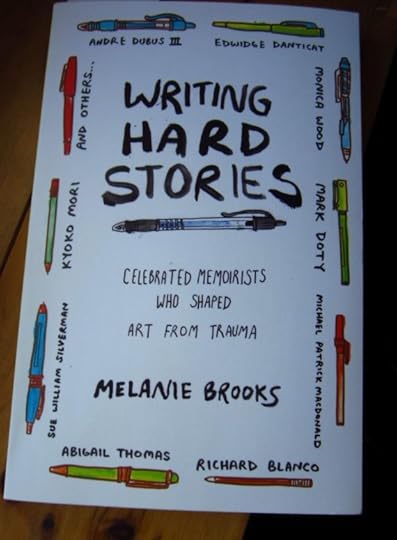
Writing Hard Stories
I recognize that Mark’s story is unique. It’s also not the norm that his father just happens to be a writer. Those two things didn’t necessarily fill me with optimism or offer up a ready-made book concept. I might still be inadequate for this “assignment.” I was also feeling terrified, thinking that my writing would all be for naught in the end.
Brooks’ book beautifully captures a writer facing her own concerns about writing that kind of “big story” when she doubts her ability and capacity to make it happen. Somehow, she finds the guile and courage to track down (and actually get them to agree to be interviewed) some of the biggest names in the memoir market—writers like Edwidge Danticat, Andres Dubus III, and others who’ve written tough stories—many of them touching on grief and loss.
What her interviews did for me is to show that even big-name writers who’ve written best-selling books about their experiences doubted their ability to “step-up and deliver” on something so deeply personal. It helped to understand that much of the reticence I was feeling was probably normal.
Reading about Brooks working through her own doubts and facing demons provided me with validation and kept me going into the fall. She is currently in-process on her own memoir about father—a prominent general and thoracic surgeon who was infected by HIV from contaminated blood during open-heart surgery. He died of a heart attack at age 42.
I’m eagerly awaiting her book when it comes out.
Mark was a poet. I am not one. Poetry has always eluded me.
Undeterred, I set out for the space where Mark was writing in. I know I’ll never approximate it, but I felt like I had to come nearer to where he was as a writer in attempting to write and tell my own story about him.
The two years he was at Brown completing his MFA program is the period that I know the least about in his life. He kept that time at an arm’s-length from his parents for own personal reasons. Yet, over the past year or so prior to his death, he was opening up more about this and we’d have some of our most interesting and personal conversations about this time and writing in general, especially in terms of craft.
Coming across Steph Burt’s book about poetry, The Poem is You: 60 Contemporary Poems and How to Read Them was an important find. The book really aided me in locating a “space” where Mark’s writing was living after completing his MFA program and getting out into the world as a writer. Burt also just “happened” to write about C.D. Wright, a prominent poet and a key figure for Mark during his time in Brown’s MFA program. Both John Cayley and Joanna Howard (professors in Brown’s literary arts department) had mentioned to us that C.D. was “fond of Mark” as a student. Others told me that C.D. saw Mark’s potential as a poet and considered his writing “impressive.”
Wright died slightly more than a year prior to Mark being killed. Her death devastated the Brown community. Burt wrote a beautiful elegy about her and what a “giant” she was in the world of poetry that Burt considered important (and Mark did, too). This really opened up an avenue of understanding for me and I’ve continued reading poetry at the end of the year.
The book I’ve been looking for all year though, is The Long Goodbye, by Meghan O’Rourke. Not a new book (it came out in 2011), O’Rourke is equal parts Didion, memoirist in the best sense of writing deeply personal stories (about grief), and refreshingly honest about how fucked up losing someone you love makes you. Oh—and she doesn’t tell us we need to move on, or find some deep well of resilience, either.

Avoiding the cookie-cutter in writing about grief.
O’Rourke lost her mother to cancer when her mom was only 55 years old. I’ll be 56 in January.
O’Rourke’s remarkable work offers validation about the personal things I’ve been experiencing since January. She also doesn’t offer platitudes or prescriptions for “fixing” you. By pulling back the curtain on her own psychic pain (and physical affectations), you locate a fellow traveler and guide to accompany you in continuing the difficult journey through grief.
Sixty books read in 2017. I blasted way past my goal of 36 that I set for my baseline.
Maybe I need to up that number for 2018.
I wish I could share and compare it with Mark. Not being able to hurts and is just one more thing I’ll have to get used to living without.
December 19, 2017
Birthday blog-34
[Note: I spent much of the weekend thinking and writing about the bond Mark and I shared around writing. We certainly bonded around sports and simply from spending time together when he was in his formative stage. But that doesn’t always guarantee a closeness later in life.
The driver who hit and killed Mark robbed his parents of many things. She robbed me of my only son, and a relationship I’ll never replace. She also took the brightest of personalities, one with passion (and compassion) from a world sorely in need of people like him.
As difficult as 2017 has been, one of the things that keep us going is knowing that Mark had a passion for Earth, other people (and bringing them together), and of course, writing. We founded the Mark Baumer Sustainability Fund earlier this year. We’re happy to announce that we are now a 501(c)3 nonprofit. We also have a brand new website that just went live. Check it out. Also, today would be a great day to remember Mark by making a contribution to the fund. It’s now tax-deductible and a great end-of-year gift to give for a cause that will support causes and organizations that cultivate traits that were part of Mark’s philosophy of life—love, kindness, and working towards building a better and more equitable world for all people.-jb]
Birthday Blog, Thirty-four (34)
-1-
Developing any craft requires diligence, attention to it, and maybe more than anything else—a dogged determination in cultivating it—regardless of how many people flock to your doorstep. I think this an apt application for both writing and music, too.
I’m not a musician, but I’ve had a passion for various kinds of rock-rooted musicology dating back nearly 50 years. I know a thing or two about it, and what I don’t know experientially, I’ve gleaned from a longstanding tradition of reading what once was known as “rock journalism.” While no longer as prevalent as it once was given the demise of print, there are still outlets where this genre of writing resides.
Since we’re on the topic of writing, I think I can weigh-in on this with definite ink stains on my hands, or perhaps better, a worn keyboard on my laptop. It was 2001—I had read Stephen King’s On Writing: A Memoir of the Craft. Afterwards, I decided not to be some occasional dabbler. I set a goal—I wanted to get published. Following King’s prescription, I got up early before work and wrote something every day. After a year of doing this, I got an essay published in Casco Bay Weekly just like King said would happen. I’d really become a writer.
My approach to writing and Mark’s had similarities, but our styles were very different. Yet, we talked a lot about craft and working at it. We also both knew that there were writers that didn’t share the same working man’s commitment to being a writer. Mark didn’t care at all about this. Once he showed up at Brown in 2009, he was on a mission to hit his own personal writing goals, and the rest of the world be damned! Like me, he believed that writers don’t talk about writing—writers write.
If you’ve been following the story thus far, you know that Mark’s writing journey, his commitment to activism and the way he brought a certain physicality to his craft—in a way that few writers have done—ended on January 21, 2017. One can only speculate where he would have taken all of it if the woman driving an SUV east on U.S. 90 had managed to stay in her lane and avoided killing him. But what’s done is done.
Since October 13, a Friday, exactly one year to the day when Mark commenced walking west with the target being, once again, a crossing of America on foot, I’ve been watching a daily video and re-reading that day’s blog post. This has become a regular ritual: a priority in my life. I’m not serving as a stenographer, transcribing the videos or simply rehashing content.
Maybe a better way of explaining this is that it’s like I’m living in a time machine of sorts, working at finding the space where Mark was walking in exactly one year ago. The problem with this is that on days like today, I’m twisted around and it makes me feel disoriented. Without getting too technical for the reader, I am writing these daily entries exactly a year into the future from when Mark posted his video and blog post. If you look at the calendar of 2016 and 2017, side-by-side, you’ll see that Mark’s birthday in 2016 was on Monday. The date of his birthday, as always, was December 19. The 2017 calendar for the third Monday in the month shows December 18. We’ll “celebrate” Mark’s 34th birthday today, except he won’t be around. But I watched the video yesterday (and read the blog post) where he was talking about walking on his birthday.

Look what Mary found!
All this to say that this practice serves as a prompt for writing into his life and sorting through grief. I am capturing a trip cut short, through the eyes of a father who also happens to be a writer. And it hurts every day to do this.
-2-
I think many writers embrace writing for one reason and one only—because they have a notion about writing. A romantic ideal that they’ll write “The Great American Novel” or some version of a bestseller. Then, life will be champagne and private jets thereafter. This might also be why guys (and some girls) pick up a guitar, a bass, or some drumsticks and start “kicking out the jams.”
But for every writer and musician who finds fame and fortune, the metaphorical sides of the highway are strewn with the remains of those who never realized anything close to financial success. To endeavor to create with this as your endgame is akin to believing that buying a ticket will result in your winning the lottery.
So, why write? That’s a question I’ve asked myself over and over for 15 years. If fame and fortune is such a crapshoot, then what’s the purpose? Maybe writing for writing’s sake. I think if you call yourself a “writer” and truly are one, then a characteristic quality (or curse?) is that you are compelled to write. If you don’t, you simply can’t live, or live in a way that imbues your life with a shred of meaning. And yet, while offering some reason for living, creativity also exacts a psychological cost from those who stay with their art or craft.
I think if you got into writing or playing music because you had to—because if you didn’t, you probably wouldn’t be able to live or at least live with your soul left intact—then you’re likely to just keep keeping on, regardless of whether your book project gets picked up by a publisher, or your band gets signed to a major record deal.
It’s interesting how little definitive material is available to peg what “success” means for a writer. There is the number floating around that “the average book sells less than 500 copies,” that according to Publisher’s Weekly, in 2006.
Having published four books, three of them selling above that threshold—one blowing way past that—and one falling below it, I can tell you that selling 500 books (or even 5,000) won’t put you in anything close to the penthouse. No, it leaves you scrambling around looking for side gigs that allow you to keep writing. You’ll also likely have to learn to live with the walls of doubt pressing inward and pressuring you to turn aside.
Selling music (like selling books) these days is a risky proposition. An article I read this fall about a favorite musician of mine, Ted Leo, details this well. As articulate and talented as Leo is, the past few years have been a struggle. But struggle or not, he perseveres.
Patterson Hood, of another favorite band of mine, the Drive-By Truckers, offers a thoughtful assessment of the music side of things, documenting his early struggles pre-DBT in this interview with Chuck Reece of The Bitter Southerner. Yet, he (and longtime bandmate, Mike Cooley) have stayed at it for more than three decades, now (with 20-plus of those years slogging along with DBT). Both the Leo piece in Stereogum and Hood’s interview are standards for what remains of true musical journalism.
-3-
Birthdays with Mark tended to be understated affairs, especially later in his life. When he was a pre-teen, however, Mary always made a big deal of the day.
One of my best remembrances of these celebrations from the past was the one that happened when he was seven. Because his birthday occurred the week before Christmas and could get lost in the madness leading up to the days prior to the holiday, Mary began having a “1/2-year birthday” for Mark, usually in July.

Following Mark’s birthday, there was Christmas.
In 1990, we had just moved into our house in Durham the prior fall. The lawn was still coming in, and there are details in the old photos that remind me of what it felt to be experiencing home ownership for the first time.
Mark and his buddies whooped, hollered, and shot at each other with cap guns. The bedlam was much-too-much for our overly-sensitive sheltie, Bernie. He disappeared, and we got a call from Mary’s parents who lived just down the road from us. Apparently, our dog had made his way through the woods (or down the side of busy Route 9), and ended up waiting for them to find him on their front steps.
But back to the present.
When Mark struck off on yet another one of his walks last October, never in my wildest dreams (or struggles to keep irrational fear at bay) did I imagine it would end as it did, with his hopes and dreams crushed like his body was, along the side of a lonely stretch of highway in rural Florida.
As his father, I’ve tried to place myself in a space just prior to the crash. What was he thinking of, who was he longing for, and did he know what was about to happen just prior to his death? We’ll never know, and if there are ways to piece together fragments of his last minutes on earth, they disappeared along with his cell phone. We never got it back.
Last December, on his 33rd birthday, Mary and I shed tears most of the day knowing he was out on the road, all alone. We wanted to be there, celebrating with him. I’d have given anything to have found a place on the map up ahead of him and a place to cook him a vegan feast to share with him after a long day of slogging along the highway.
We spoke to him on the phone and shared some of our sadness, but not all of it. We didn’t want to bring him down. We also wanted to let him know that we were sorry not to be there with him on the day. The weariness following moving 26 years of our life from the house we sold in November to a new place alongside a beautiful tidal cove left us exhausted in the days leading up to December 19.
I sent him the following email, with the subject line consisting simply of the numbers signifying his age, “33”:
——————
Hi Mark,
Today is your birthday. Where did 33 years go? I know you’ve heard me say it more than you probably care hearing, but it does seem like yesterday (or maybe a few years ago) that your Mom and me were heading to St. Margaret’s in Hammond, Indiana, knowing we were going to be having a baby.
It’s a scary feeling knowing that you are going to be a father. How will I measure up? And, I hope the baby is healthy. That and all kinds of other uncertainties that come with being young and a parent.
Fast forward to the present, I’m proud of the adult you’ve become. I’m sure I’ve had some role in all of this, but you’ve obviously been cognizant of things that have shaped and molded you into the adult Mark that we have at the moment.
I’m not sure birthdays are that big of a deal once you reach a certain age. Often, it’s just a reminder that you are a year older and closer to that final hour of life. Not to sound morbid, but I think most people rarely think that the things that they spend the most time on in this life, rarely are things that they’ll feel excited about when they know their days are coming to a close.
I’m glad that you are doing something that matters to you. Having a thing that gets us up in the morning and motivates us to the next stop is important. I’m not sure I have that at the moment, but I’m sure I’ll figure something out that’s new and better than before (or maybe not).
I don’t want to simply ramble for rambling’s sake, however.
I love you. I wish I could see you today, but you have miles to walk and a place on the horizon that you’re moving towards.
Know that I love you in that special way that fathers love their sons (or should love them), and I wish you a great day filled with positive energy.
-Dad
Mark’s response, like so many from the road back to me was simple, minimal, but spoke volumes. While Mark had always been stoic in nature, there were regular indications of his heart and he shared it from the road with those he loved and cared about regularly, while chewing up the miles, as well as the bottom of his feet.
——————
Thank you for being so supportive. It would mean more than anything to see you and mom today but I feel fortunate to be doing what I’m doing. I’m happy just knowing you’re thinking about me.
-4-
I thought about him every day, at all hours of each day, and often at night. During the walk, I’d often wake up from a deep sleep with a start. “Is Mark okay?” I’d immediately think.
Downstairs I’d go, turn on my laptop, and check his GPS link he’d provided us to keep track of where he was. Every single time this happened, I’d be okay once I saw that he was some place along his route and I’d often go into Google Maps and look at images available to make an assessment about the geography where he was probably sleeping during those early morning sessions, worrying about my son.
January 21 changed all that. My life (and life of Mark’s mom, Mary) will never be the same. No more birthday wishes to send his way on yet another Zodiac spinning around, no more thoughts about what to get him for a present. Mark didn’t want much for his birthday (or Christmas), but there were always things we could do for him. Many years, once he was ensconced in Providence, we simply charged his buying card at Fertile Underground, where he liked to shop when he lived on the city’s west side.
Last year, it was a contribution made to FANG to show him we supported him in more than words. I know it meant a lot to him. He truly appreciated having parents that allowed him to be who he was meant to be, and showed that support as tangibly as we could.
Now, he’s gone, we’re still reeling, and today is just the shittiest of days imaginable.
-5-
We’ve tried to put on as brave a face as possible. We both want to honor his life because we think his life mattered. That’s why we launched the Mark Baumer Sustainability Fund.
If you got our latest email via TinyLetter, then you know how tough this time of year is. You’d also know that we’ve incorporated and are now a Section 501(c)(3) nonprofit. We’ve been working diligently here at the end of the worst year of our lives to make that happen because we recognize that being a nonprofit allows us greater opportunities for partnership, as well as growing the scope of what we want to do in keeping Mark’s memory and vision alive.
None of this is easy. Simply grieving his death and what that loss means to us as parents ought to be enough. For some parents, it probably would be, but we don’t want to be the “normal” kind of parents. Heck, we’re the parents (and always will be) of a true vegan superhero, so we’ll do our best Mark to live up to the standards you set for us, as a son.
You could honor Mark today on his birthday by heading over to the brand new website and making a donation in his honor and memory. We think Mark was worthy of that kind of remembrance today, a year out from leaving his work incomplete on the side of the highway.
We promise you that we’ll be the best stewards we can be of that support, always transparent about what we’re up to.
Happy Birthday, Mark!

Mark just after birthday #3.
December 7, 2017
SEO, Googlebots, and Still Missing Mark
I don’t really know what to write this morning. I’ve been spending time each day, writing about Mark, using his videos from a year ago as writing prompts. This process of “writing into grief” is never easy.
Sometimes when I look at my blog stats, I want to stop blogging. Then, I’d become just another vacant and boarded-up storefront on the interwebs.
Mark would tell me, “don’t pay attention to your stats, dad.” He gave me lots of advice. Most of it was spot-on.
The other day I stumbled across a blog post from a local marketing firm that calls itself a brand collective. Not sure what the hell a collective of brands does. Well I do, but it doesn’t really jive with my own vision of what a collective should be about.
Given that my blog stats have returned to the paltry level they once were before Mark was killed, I decided to read one of their posts titled, “What is SEO?” for shits and giggles. According to the blogger, I’d fallen down in cultivating a warm relationship with the friends of SEO, the GoogleBots. I guess if I want people crawling all over my content, then I need to get cracking on my keywords. Keywords are the key to capturing eyeballs. Or something like that, I think.
I kind of got fixated on this for a bit longer than I intended. Let me share just a bit more, something that this collective of brands doesn’t really deserve here on my own personal site that I created as the antithesis to this kind of SEO-craven way of writing, blogging, and branding.
According to Little Miss SEO:
Once you’ve got your site in order, create some killer content. Content your viewers will actually love. Is it useful to them? Does it make them laugh, cry, or even better, give you their money? Content doesn’t always mean words in a blog, it can include video tutorials, pretty visuals, and free tools/help. Just make sure your content is wow -worthy.
Perhaps I should apologize that my content since last January 21 has been centered on Mark and his death. I guess I haven’t been doing enough in posting honest content straight from a heart that feels like it’s been ripped from my chest to make people “laugh, cry, or even better, give me their money” in the way that she means.
Contemplating grief and loss and honestly sharing my experiences relative to losing my only adult child has certainly made me cry. But perhaps I should be more sensitive to the need that people need to laugh, and to reach into their pockets and send me their money.
*****
This morning, I returned home from swimming at the Bath Y. I drove into the garage and realized today is Brunswick’s curbside pick-up day. I wheeled the trash can down to the end of the driveway and put out the recycling.
Walking back towards the house silhouetted against the early December morning sky, my thoughts traveled back a year. We’d just moved to this new house and would have been a week into a new place to call home. For a moment, I was in a space where it was December, 2016, and Mark was still alive.
“Was it one year ago?” I thought. Then, it hit me like a baseball bat to my midsection and I almost wanted to double over. I’ll never be able to consider him alive again. Tears welled up and I was wracked with grief.
In the house, our cat, Lucy, was there to greet me. She’s a good friend and she senses our hurt, I think.
There was a morning music show on WMPG and the music was a mix that I enjoy and isn’t always the type played during the early AM shows on the station. More electric guitars, rather than the hammered dulcimers of folk and bluegrass. Not crazy electric music, but American-tinged rock and post-rock. And then, Warren Zevon’s “Keep Me In Your Heart Again” came on and I lost it. I was wrecked and crying while fixing my breakfast.
This was Zevon’s parting gift to his family and fans just prior to his own death, from cancer. It’s a powerful song and I’ve heard it now twice in the morning on ‘MPG since Mark’s death and each time, it hits close to home.
In his Day 057 video from last year, Mark walked 30 miles, mainly on dirt back roads. He talks to the cows and sheep he passes along the way. He got lost. He had to walk through snow and sub-freezing cold. He arrived at the motel after 3:00 in the morning.
Mark gave me lots of advice about blogging, writing in general, but better, how to live. I doubt the collective of brands’ posers can bottle and pass it off as their own the kind of content that emanated from the soul of someone like Mark. His mission in life wasn’t about SEO, posting keywords for Googlebots, or getting people to buy the latest gadget of his that will end up clogging some landfill somewhere.
Here are two poems Mark wrote while walking and posted on his blog from Cambridge, Ohio.
sheep death
The earth / died / a little / today / it dies / a little / every day / because / I think / there are too many / ways / for people / to make / death / without / realizing / they’re making death / yesterday / I saw / a sign / next to a pasture / of / sheep / it said / be careful / there’s a gas pipeline / in the dirt / the sheep / didn’t/ seem to understand / they just looked / at the sign / and/ waited for whatever / form / of / death / was next
a man
A man / asked me / where I was going / I pointed / he didn’t understand / I looked / at / the / thing / I pointed / at / it was / a mirror / a few seconds / passed / the man said / ohhhh / I get it / then he said / “deep” / part of me / wished / someone would / break down the door / and / save / this / poem / but / even if someone / did / break down the door / they probably / wouldn’t be able / to save this / poem / maybe / they would / whisper / no / I / can’t / sorry
I will keep you in my heart forever, dear boy.
December 1, 2017
Making Stories
A year ago in August, I was contacted about writing an article. The woman who emailed me read my Biddeford article for the “big city paper,” The Boston Globe. She liked it and thought I had what it took to tell her story. It was about a town that had stopped making paper.
In 2016, I was in a funk. I told Mark that “maybe I should quit” the writing game.
Part of this was self-pity. But part of it was also feeling like my writing was going nowhere. At the time, it wasn’t.
Mark’s response was, “keep doing what you’re doing, dad.”
I told the woman that I couldn’t do it.
Then, Mark was killed.
In January (and February, March, and April), writing didn’t seem to matter. Yes, I was blogging. This was more about simply pouring out my pain associated with loss and grief. I was shocked that people actually read my posts.
A decision was made to reconnect with the woman who reached out to me in 2016. She was pleased to hear from me. She was also sorry about Mark.
One year after she first contacted me, I made my first trip down the coast. I’d make several more.
I talked to people in the town. The town had lost a mill. A mill that had been making paper since 1930. I also met a man with big ideas about logs not needed for making paper.
The little town by the river without a mill anymore still has a bookstore and books. That’s a good thing, in my book. I found an amazing book of gathered stories and poems, edited by a poet. Poetry’s been in my heart, lately.
All things come to an end. Even making paper.
This morning, I sent some words out over the internet to an editor. My article was done, at least the article he was waiting on. I was happy with the story I’d made.
When I do this kind of writing, I have to go to the place I’m writing about. This sometimes means miles behind the windshield and the hum of tires on asphalt. I listen to music on the way, and think about people I’m meeting, have met, and of course, the son I’ve lost.
My tendency is to gather far more than I’m able to use at the moment. I don’t think this a bad thing. But, in the age of Twitter, it’s hard to pack history, personal stories, and lives disrupted by the march of capital into a tidy, little capsule. Minimalism isn’t my strong suit.
There’s a bigger story. I’m not sure if I’ll write it, or even, if I’ll get to write it. I’d have to find a different kind of magazine or publication for it.
I carried my camera with me on some of my trips. Here are some photos.
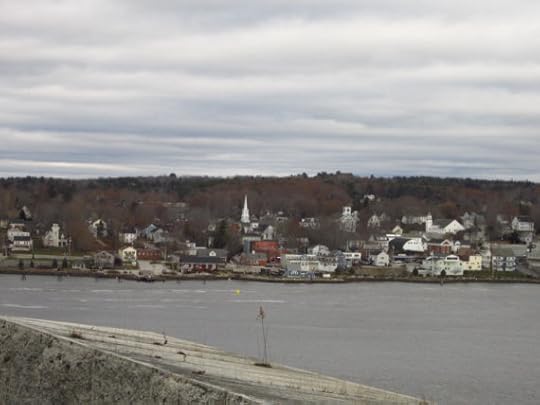
A town without a mill, anymore.
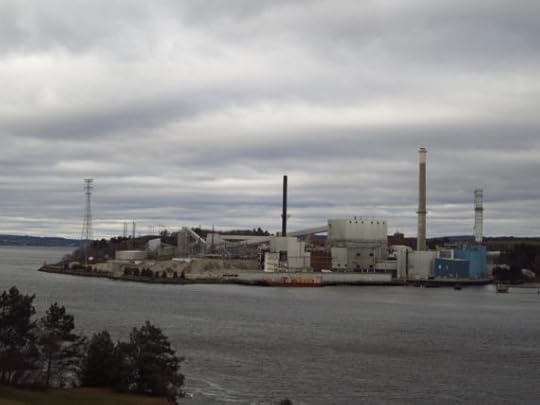
A mill, a silent sentry.

Logs in the log yard.

Taking the bark off logs.
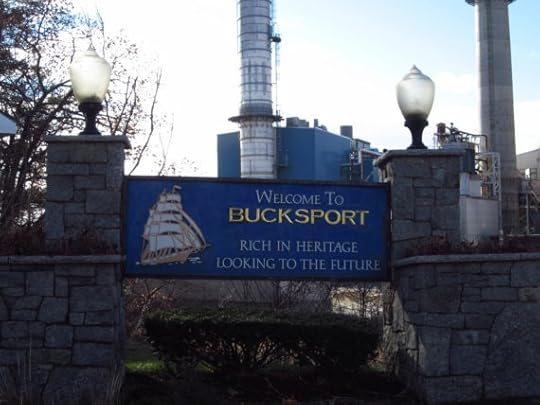
Town sign.
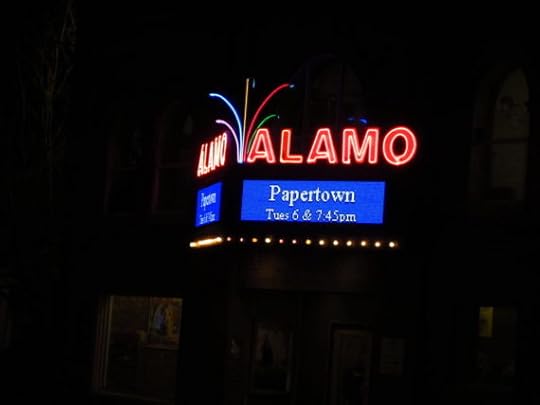
Movies about mills that go away.
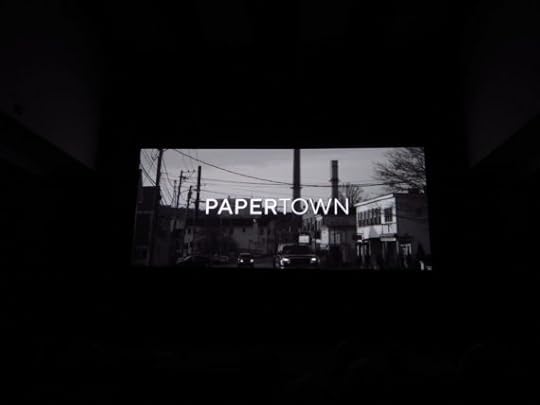
“Papertown,” by Sam Russell (Alamo Theater in Buckport, 11.21.17)
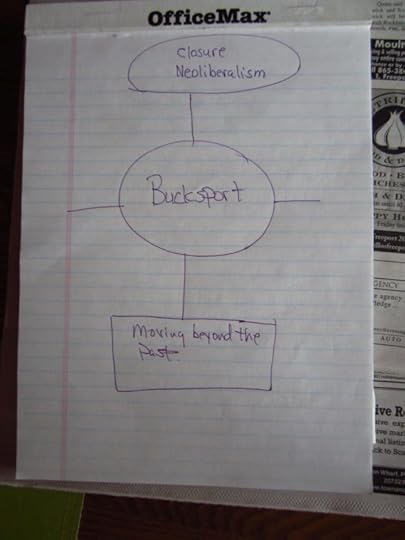
The sketch needed to arrange 1,500 words.
November 22, 2017
No More Turkey
America thrives on the superficial. Nothing screams “superficial” like the holidays. Never a fan of this particular season and its excess, my tolerance this year is at its lowest ebb.
Last fall at this time, Mark was out walking and was more than a month into his final trek. As Thanksgiving approached, we were sad that Mark wouldn’t be with us. We were also stressed knowing that in less than a week, we would be moving 26 years of stuff to a new house, having just closed on our house in Durham.
It’s only Tuesday, yet I’ve already heard three separate media outlets doing a version of “how to cook a turkey.” Are there no cooks left? Just this morning, NPR had Bon Appétit’s Adam Rapoport in to talk about getting through the next few days “fueled by anxiety,” as you choreograph the perfect family gathering around the bird. My suggestion for the person from Rhode Island hosting 27 people at her house—dump the anxiety and order out for pizza or Chinese.

One big, happy family.
If you’re not invested in maintaining the facade, then in my way of thinking, the holidays are likely a time of dissonance and even angst. The most noble attempts at down-sizing and disconnecting from “the Christmas machine,” or something like daring to eat differently only deepens this sense of alienation from friends and family. Mark’s death has done nothing to dull the usual holiday malaise creeping in pre-Turkey Day. In fact, his being killed has only heightened it.
Mark’s life at the end found him on a personal quest beyond empty consumption and the spiritual void at the center of American life. He also happened to be less cynical than I was (and am).
No bird for us this year. Even if Mark was coming home and spending the holiday with us, we’d be doing up a plant-based feast of some type. But, that’s not an option this year and I doubt that it will be ever again. While we have a standing invitation from a family member to have dinner with them and their extended family, I can’t muster the energy required to make the usual happy-talk expected. “How’s your year been?” answered with, “a fucking nightmare” makes people uncomfortable. And we all know, it’s more important for people to be comfortable (and dead inside) than actually open to the realities that grieving people live with on a daily basis.
There’s never a shortage of drivel to read about how to “navigate the holidays after losing a loved one” out there. One suggestion I found that wasn’t half bad is to “start a new tradition.”
That’s what Mary and I are going to do. We’re getting out into nature again. We’ll be hiking at a mountain that’s just a bit more than an hour away from us. Neither of us has hiked here before. Our efforts will be rewarded with beautiful views, offered from the top, of Penobscot Bay.
Then, we’ll drive home and enjoy a simple meal and try not to be too blue as we think about past years when Mark was here with us.