Jim Baumer's Blog, page 20
June 9, 2018
The Death of Anthony Bourdain
I’m not sure when the fetishization of food began, a place in our culture where watching others cook and especially eat became a thing. I found an article that does a good job of capturing the hoopla around food. It’s especially fitting given the death of Anthony Bourdain, who the writer called “the Elvis of bad boy chefs.”
I watched Bourdain’s various shows on Travel Channel over the years, especially “No Reservations.” He was an interesting dude. I always thought I’d enjoy meeting him. I loved the time he was hanging in the desert with his buddy, Josh Homme, of Queens of the Stone Age.
Bourdain’s programs and writing were much more than food. Like how he captured what made Joshua Tree and the dessert something otherworldly. I know, I was there a year ago, and it is unlike any other place I’ve ever been. I could have easily have run into Homme (or Bourdain) while we were out there. If you’ve never read, Kitchen Confidential: Adventures in the Culinary Underbelly, you should.
There are many similarities between playing music and the industrial athleticism of cooking. The latter is probably tougher, with opportunities for all-too-few to “star” like Bourdain and others got to. It’s probably why a lot of musicians work in kitchens.
Bourdain’s death will be talked about, no doubt. It should be. I think it speaks to something larger in America, but I’ll let you decide.
I thought Jeffrey Davison’s tribute of sorts to Bourdain was spot on this morning on his “Shrunken Planet” program on WFMU. Davison worked in a kitchen for 20 years and he captured Bourdain’s importance and why his death (and any death) matters.
MP3 of AnthonyBourdainRIP


June 7, 2018
A Better Pope
I was raised Catholic. At some point, Catholic theology became irrelevant to me and my life.
Later, I got into born-again-ism. That was okay for a time. Then it wasn’t. Something about Brother (Jack) Hyles not liking blacks riding on his First Baptist Church buses.
Mary and I were 23 with a son who wasn’t quite two when I realized that moving nearly half-way across the country to follow God had been a mistake. Jack Hyles was a phony. That was part of Mark’s history, too.
I wrote a bit about my Catholic experience in a previous book of essays. The essay was called “The Altar Boy.” My family of origin didn’t really like it. What I wrote was true, though. And I really don’t give a damn what people who’ve abandoned me time-and-time again think. I didn’t then, I don’t now.
Last night, Mary and I began what will be a new chapter in our lives of grief and loss without Mark. Periodically, we’re going to get out of the house and do something a bit different during the week. Like going to see a movie.
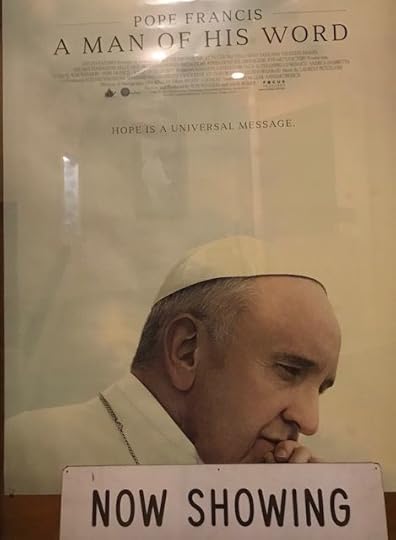
At the movies: Pope Francis
The Eveningstar Cinema, a place where we’ve both been seeing films since it opened in 1979 has undergone a makeover. New seats, carpeting, and a digital marquee out front (not the old climb-a-ladder-to-post-a-film-announcement signage that’s been there forever) make it seem a bit more 2018 (or at least less pre-Reagan). I’m pleased that Barry’s still in the movie business. All of us film buffs are better for it, even if his demographic seems to be getting older all the time.
The new Wim Wenders documentary about Pope Francis was playing on the big screen. We’d seen previews when we were last there two weeks ago, prior to watching Tully.
Pope Francis: A Man of His Word is described by New York Times critic Glenn Kenny thusly:
Mr. Wenders’s singular focus on Pope Francis is born of sincere admiration, but it also constitutes a canny strategy. This pope is a controversial one, and this portrait plucks him out of the context of debated opinions to let him speak without argument. “The world is mostly deaf,” he says at one point. He continues to describe his approach when traveling the world and meeting its leaders: “Talk little. Listen a lot.” Nevertheless, in this film the pope is given his say, at length.
I’m not sure why Francis is seen as being “a controversial one” as a pope. Is Kenny talking about here in America? If so, then I might be able to understand the descriptor—his concern about the poor, admonitions against consumerism, and concern for “Mother Earth” runs counter to the Trump and conservative rhetoric that’s popular with those Catholics and Evangelicals who put ideology ahead of Jesus’ teaching. That the pope has taken Francis as his given “Pope moniker,” as in St. Francis of Assisi is all you need to know about him. Look him up. He’s got a Wikipedia page.
I’m no longer a Xian. I call myself a post-Xian. But I still find I have an affinity for religious types like the Pope, Rob Bell, and John Pavolvitz to name just three who seem to have some hold on who I think Jesus was and what his teaching means for today.
Actually, much of what Mark was doing on his walk had a Francis-like quality about it. A real stark contrast to the Trumpian narcissism that poisons the daily news cycle and too much of our discourse.
I especially liked being reminded of Pope Francis’ encyclical on the environment. For the TLDR crowd, here are key excerpts from it. This element of the film really resonated with both Mary and me. It also brought a few tears, remembering Mark’s own love for Earth. It’s what he gave his life for.
I’m not going back to Catholicism, and I’m well aware of criticisms of the Church. However, as popes go, there ware worse ones than Francis. And in a world where compassion, care for Earth, and concern for going to the frontiers of poverty and for those on the margins seems to be dwindling in many circles (especially among Republicans and conservatives), having someone on the world’s stage saying “pay attention,” and “we are humans not machines” makes me feel a little bit better and warrants my acknowledgement and respect.
On polarization, Francis said, “it is the people themselves who are divided, living an isolated and siloed existence in their own spheres, depending on different sources of information, and distrustful, if not dismissive, of the other group and their sources of information.” Doesn’t this capture our current cultural milieu of everyone having their own ideologically “pure” source of information, perfectly?
My memory runs back to a saying my uncle used to utter often that I think is pertinent to today’s post: “Rome wasn’t built in a day.”
June 4, 2018
Is It Summer Yet?
I don’t know for sure if summer arrived on Saturday. It seemed like it did. 85 and abundant sunshine felt like summer.
Officially, summer doesn’t show up on the calendar until June 21, 2 ½ weeks away. Today’s 50-degree dampness and rain makes Saturday seem like I may have dreamed it. But I know I didn’t. I was there.
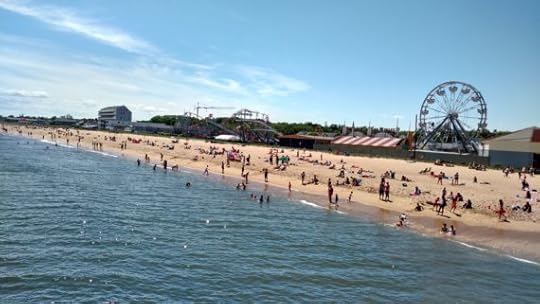
The White Sands of OOB mean summer’s here!
The flowers we planted are doing well. My two trips to Laurel Hill last week to water them helped. Going to the cemetery no longer seems weird. It’s now a part of my life and Mary’s. I usually bring poems to read to Mark. On Saturday, I read Matthew Zapruder’s “Graduation Day.” It seemed fitting after being at the Hyde School graduation the week before. The young man I’ve worked with since last September graduated.
For the past five summers, I was out umpiring every weekend. It was a good gig at the time. Grief and loss dictate changing things up once-in-awhile. Mary and I are planning on adding kayaking to our summer menu. Maybe more trips to OOB and sitting on the pier, listening to music, too.
What are you planning this summer?
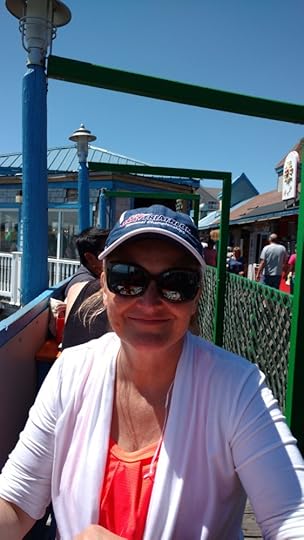
My summer partner-in-crime.
May 30, 2018
No Imagination
At some point, you simply give up on (some) people. I’m talking about the ones who regularly offer up the most perfunctory responses response to me (or Mary) when they learn about Mark’s story and how our 33-year-old son was killed. How many times am I going to have to hear “I can’t imagine”?
Americans are nothing if not superficial. If they are able to muster a shred of empathy and support during a tough patch, they rarely are capable of sustaining it for long. We’re a country where sliding glibly over the horrific and returning to our happy, positive thoughts is akin to taking a drug. Of course, speaking of drugs, there’s a pharmaceutical for everything, especially ones designed to numb any pain. Then, did you see this? Apparently, psychedelics are a thing again.
I never liked reading or hearing about the death of a son or daughter, preceding their parents. Being a father, I never had difficulty summoning empathy for them. I simply imagined how I’d likely feel if I ended up in their shoes. I’m wearing them now and it hurts worse than I imagined it would.
While there are people in my life who I’ve simply moved on from, there are still some—many of them people who knew Mark and who have “adopted us” as his parents—who send beautiful notes, call, get me out to shows, offer to hike with me: all of this demonstrates the veracity of their words right after Mark’s death. Their expressions of sorrow and sympathy were more than mere platitudes. I am grateful for them. I consider them friends. It’s obvious that they continue to remember Mark and care about him. By extension, they care about us, too.
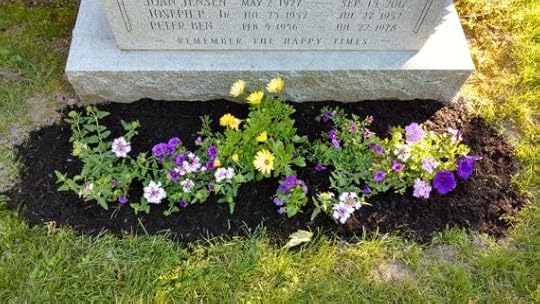
Planting flowers for Mark and others.
In a few weeks, it will be 17 months since Mark was killed. Mary and I drove to Saco and planted flowers last weekend, the day before Memorial Day. We had Laurel Hill Cemetery to ourselves and our sorrow with “Sunday morning coming down.” Yes, “there’s something about a Sunday…”
We dug a bit and placed the annuals in front of the shared gravestone that is engraved on the back with our family information, including the dates spanning Mark’s all-too-brief life. I read some poems like I usually do. We cried a bit. Then, we sat in our portable chairs and watched the abundant life all around us, especially the birds, flying over the Saco River.
Imagine learning your son or daughter has been tragically taken from you. It’s not that hard. Then, imagine knowing that act will remain with you every single day for the rest of your lives. It doesn’t go away, or get easier, and you never come to accept it.
Imagine that!
May 25, 2018
America (Never Been)
I’m a fan of Car Seat Headrest. I have been for a couple of years.
When Mark was out on his final walk, I emailed him about the band during October, early in his trip:
Hi Mark,
Did you think the story about Yo La Tengo and the Mets was funny? I did and got such a laugh reading it last night.
Mom and I have been reading at night, and not watching much TV. Can’t say I miss it at all.
Last night, was reading, while also listening to some Car Seat Headrest from their show they did at KEXP in 2014, I think.
They have so many great songs. Will Toledo is one of those prolific songwriters who got his start making music in his bedroom and releasing it on Bandcamp at first.
The song “America” made me think of your trip. Will’s writing from the perspective of seeing the country from life on the road, most likely in a tour van. The first line goes,.
“You can drive across the whole thing in four days…if you want it,” which again is the time when you’re driving. Still, there’s this sense of America being out there if you really want to see it, which you are doing on foot, literally!
Anyways that’s some of my “wisdom” or at least thoughts, this morning.
Nearly four weeks meat and dairy-free. God, I feel so good physically and my mind seems clearer. Really enjoying Michael Greger’s How Not To Die. Reading about eggs and chicken and the risk of salmonella in the chapter, “How Not To Die from Infections” last night was like a jolt—chicken and eggs exponentially increase your risk of salmonella, which is a serious infection that can kill you. He also talks about plants and how they boost your immunity. Great stuff!!
Mom says you are speaking at a school? That’s awesome!
Well, godspeed to you today as you journey forward.
Love you!
-Dad
Mark’s response back to me:
Car Seat Headrest sort of got me back into music. They’re good.
Here’s the song. And if you like words, they’re here. And yes, they are good!
May 18, 2018
Musical Fruit
There was a bus trip to Jay in 1978, to an away football game. We’d smuggled a cassette recorder and a bulky, homemade speaker aboard. Once we rolled out of the parking lot, we hit play and began blasting Robin Trower Live and Fresh by Raspberries (no definite article, either) on the ride up. Me and my friends were the only ones who appreciated the tunes. But man, oh man, did we love Raspberries (Trower was pretty good, too).
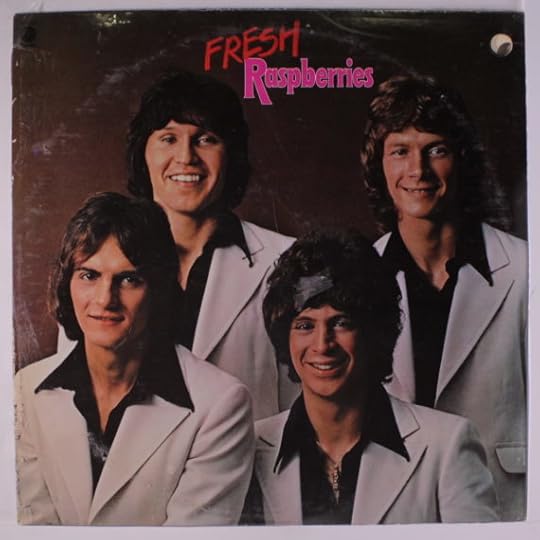
The Raspberries were a 1970s thing.
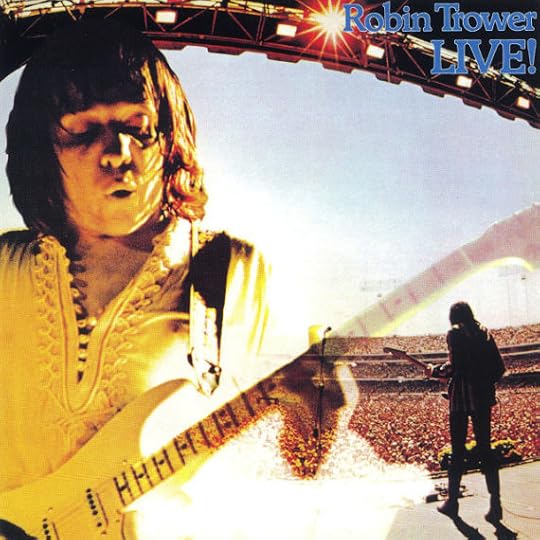
Too Rolling Stoned.
It wasn’t our fault that most of LHS has no taste in early 70s rock, or for that matter, something other than the AOR schlock that got played to death on the radio at the time. I was always happy getting a steady diet of the kind of power pop that Eric Carmen and the boys put out from 1970 to 1975. Raspberries weren’t obscure by any means: they had hits—but like so many bands from that era (think Big Star’s #1 Record,) their record company never quite got the marketing and distribution ironed-out.
On Tuesday afternoon, after yet again being reminded that I no longer have a son, I had to find a way to get through that time between noon and 7:00 when I leave to tutor. For some reason, this is always the tough part of the day.
WFMU has been a musical friend for a long time, dating back to 2004 and happier times. It’s amazing that this freeform, community radio mainstay has managed to survive in a world where corporations have sucked most of the life out of music-making, extracting value that should be distributed mainly to the artists who craft the product, but alas, capitalism is ruthless in terms of leaving all but few artists out in the cold. Actually, that’s always been the way it’s been for most bands, although it’s worse now than ever before.
I have a stable of personal favorite DJs, all of them volunteers, who I return to weekly, marveling at their ability to craft diverse playlists. Many of them have been with ‘FMU for more than a decade.
Depending on my penchant on a particular day, I can click on their program guide, and three hours of music curated by a human being (with real musical tastes) becomes available. It’s restorative knowing that there are still places where humans rather than computers decide what gets played.
An archived show from last fall by Todd-o-phonic Todd featured Raspberries and a five-part interview with the band’s leader, Eric Carmen. Being a longtime fan, this was like heaven, if heaven is a place where you are surrounded by music that offered up something more than corporately-choreographed tunes like Taylor Swift’s greatest hits.
Hearing selections from across the band’s all-too-brief history, coupled with Carmen’s astute observations, recollections from the past, and some musical “inside baseball” that music geeks like me never grow tired of, provided a needed tonic for my afternoon blues.
Hard to pick a favorite, but this one always reminds me of when life was simpler and my problems were centered in male, adolescent angst and whether or not my acne was under control.
“Overnight Sensation” wasn’t their biggest hit, but the song always spoke to my own wish of being “bigger and better” than I was. And the term “overnight sensation” often gets applied to bands and artists who have a hit, the connotation being that they just stepped from the shadows into success. In most cases, “overnight” often means years of slogging it out in the back of a van, playing small venues, schlepping merchandise and being forced to schmooze with another group of fans in a different town who say and ask the same things. Back in the Raspberries’ day, you rode the endless PR merry-go-round machinations of radio interviews with DJs at the local station where you were playing that night. Then, “when your hair’s combed right and your pants fit tight, it’s gonna’ be all right,” and something clicks and you have that “hit” you’ve been looking for. This song captures the aspirational element of playing music as well as any song out there. Yes, overnight indeed!
I found a live version of the song, done during a Raspberries reunion tour during the mid-2000s. I actually think this was from the two NYC shows they did, but I might be wrong. Carmen was looking good and the rest of the band, slightly older and seasoned, sounds fine.
May 16, 2018
Happy Enough
First, let me put out this disclaimer: I am no authority on matters of happiness and especially, mindfulness meditation. Now that I’ve dispensed with that, let me share a bit about the last four weeks in my life, or better, “How I Learned to Meditate and Become Slightly Happier.”
I don’t think happiness is a great motivator. Everyone wants to be happy, but the problem with wanting to “be happy” is that happiness is often difficult to define.
Four weeks ago, I heard Dan Harris share his own story and personal skepticism towards meditation on The Rich Roll Podcast. Like me, Harris never thought much about meditation. I touched down briefly respective to Harris in a post about EQ, a month ago. Consider today’s post my progress report, four weeks out.
Actually, in my case, I knew that my son, Mark Baumer, meditated, but for a variety of reasons, I always had difficulty incorporating meditation into my daily practice. Perhaps I thought I had to sit still for 20 or 30 minutes. No way I could do it two years ago. Even now, after four weeks, I’m able to handle six or seven minutes, tops. I try to do this two times each day, although my goal is simply to manage one session. Here’s how I got started, and you can, too.
Sit with your back straight and your eyes closed.
Notice the feeling of your breath coming in and out.
Notice how your mind goes off on all kinds of tangents: refocus and come back to your breath.
Am I happier? Actually, while Harris’ goal was to be “10 percent happier,” I’m not so worried about happiness. I’m simply trying to find a way to “center” each and every day.
For you, maybe that’s not a problem. But if my observation of the world around me is accurate, it seems like there’s way too much “white noise,” people reacting rather than reflecting (think of our president, on Twitter), and agitation has run amok.
But it’s up to you. Take my suggestion or leave it. The choice is yours.
This short video is helpful and everything you need to get started on your own personal path to being a bit more mindful (and maybe, happier).
May 15, 2018
Ambition
Sufjan Stevens once set out to record 50 albums about all 50 U.S. states, at least he made an announcement about his intent. According to an interview, this was all a “promotional gimmick,” a joke of sorts, and one he didn’t have any inclination of completing. He did finish two of them.
The first time I heard about Stevens’ ambitious proposal was from Mark. Stevens may have been the genesis of his own ambitious plan to publish “50 books in 50 weeks” project. He actually completed his.
Project success, or not, I still like Stevens as an artist. I think Illinois (2005) is one of my favorite discs in my collection. “Casimir Pulaski Day” is one of the saddest songs I’ve ever heard. It’s even sadder, now.
From the Bible of the music world I live in, Pitchfork, Stevens’ music is described this way, from a review of his latest records, “Carrie & Lowell” (the names of his mother and stepdad),
Stevens has always written personally, weaving his life story into larger narratives, but here his autobiography, front and center, is itself the grand history. The songs explore childhood, family, grief, depression, loneliness, faith, rebirth in direct and unflinching language that matches the scaled-back instrumentation. There are Biblical references, and references to mythology, but most it is squarely Stevens and his family.
Maybe the reason I like his music is because it’s about life.
Oh, and Pitchfork gave it a 9.3 (on a scale of 10). Others like narratives drawn from life, too.
May 14, 2018
The Sociological Thread
Mary was going through some old boxes that had cards, letters, and other assorted paperwork. She has resumed efforts at downsizing that began prior to our move back in 2016.
Some of the boxes contained letters from her mom, sent during college. When we were both off at school back in the day, letters (not text or social media) were how parents communicated with their children who were off at school if they cared about remaining in-touch.
Yesterday was yet another sad holiday. I felt inadequate, knowing her sense of loss as a mother whose son was killed: she also lost her mom last fall, so the day was particularly tough for her. I’ll experience something similar on Father’s Day. Life is never the same for parents who’ve lost an adult child, and not everyone is celebratory on days like these.
An item Mary dug out related to me was an old book report. I’m not sure what I wrote it for (most likely a freshman English class at UMO). It was on Huckleberry Finn, by Mark Twain.
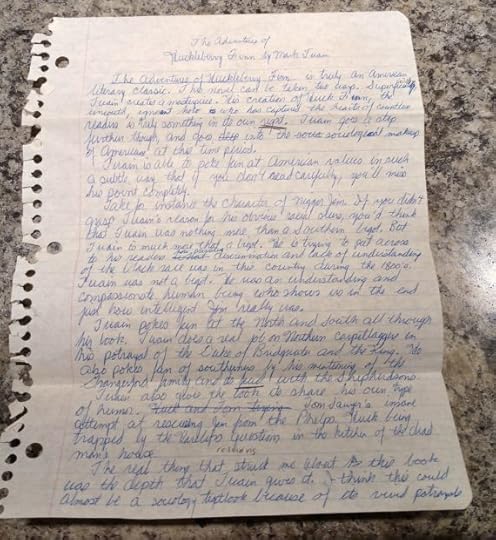
Reporting out on “Huckleberry Finn” (circa 1980 or 1981)
Reading through my writing from the past was interesting. It doesn’t quite match up to my writing today, but there were signature items in this 300-word review that made me smile.
In the report, I managed to report-out on the “sociological thread” running through Twain’s signature work. Apparently, my interest in that method of analyzing writing was present back in 1980 or 1981.
I wrote this:
His (Twain’s) creation of Huck Finn, the uncouth, ignorant character at the heart of the book, captured the hearts of countless readers. This is something in its own right. Twain goes a step further, though, and delves into the sociological makeup of Americans at this time period.
I’d rewrite this paragraph today so that it reads a bit “smoother,” but I obviously had cultivated an eye for the “sociological,” because it was there, back in my late teens.
May 12, 2018
Dances With Bears
I’d argue that books and reading (can) open us up to the wider world. While it’s counter-intuitive, social media seems to be making us smaller.
In a recent blog post, I shared about my subscribing to a real newspaper—in this case—The New York Times.
I am reading Witold Szablowski’s book about dancing bears after reading the review that appeared in last week’s Times’ Book Review section.
A fascinating book about how humans often hearken for things they shouldn’t, but do, because it supposedly makes their lives easier.
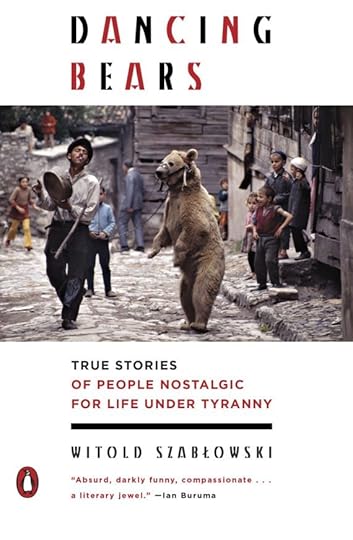
A book about “the good-ole days” of authoritarian rule.
The book’s introduction starts this way:
The guy with the wacky hair and the crazed look in his eyes did not appear out of nowhere. He was already known to them. Sometimes he said how great they were, and told them to go back to their roots: if need be, he threw in some highly unlikely but madly alluring conspiracy theory. Just to get them to listen. And to give them a fright. Because he’d noticed that if he scared them, they paid him more attention.
Who is Witold Szablowski talking about? Donald Trump? No, actually, authoritarian leaders in Eastern Europe. The people he alludes to in “Regime-Change Land” are Poles, Serbs, Hungarians, and Czechs—all of them with long histories of falling for men who always over-promise and time after time, they under-delivered, and much worse.
Szablowski, a Polish journalist (and award-winning one at that), tells stories about gypsies and dancing bears but maybe better—people in places that were once under authoritarian rule (in countries with names like Bulgaria and Cuba), but are now free. Yet, they hearken back to a time in the past, flush with nostalgia.
Kind of like our own “make America great again” flourish and following a man with malicious designs and an authoritarian bent.