Jim Baumer's Blog, page 17
October 21, 2018
Medicare (for all)
We are slightly more than two weeks ‘til the midterms. Will the Democrats gain the House (and Senate), or will the Kavanaugh nomination drive Republicans to the polls in higher than usual numbers? Then, there are the myriad of issues sliding past the lips of candidates. One of them I’ve heard and care about is the term “Medicare for all.”
Despite continued opposition from almost every candidate on the right, Democrats recognize that voters do favor something more radical than President Obama’s plan for health insurance. While “Obamacare” is far from the ideal, all “the party of no” can come up with is continued cuts to Medicaid and even the specter that they’ll at some point gut Medicare.
If you look at polling, the landscape clearly shows that more than half of the country (and 70 percent of those polled who vote Democrat) want some form of single-payer healthcare, which is what Medicare is. More than half of America’s doctors also favor it. So why won’t our elected leaders do something about it?
I’ve written about passing my insurance exam and being licensed as a life/health agent in Maine. Last fall, I passed my CMS certification to sell Medicare. My first year representing Medicare Advantage plans found my sales to be minimal. But I was happy that I got to make this step forward as an agent. What I learned is that most people age 65 (or heading there fast) know little or nothing about Medicare. Worse, they don’t know how to maximize their healthcare benefit options.
This year, I passed my certification exam with flying colors and added two additional carriers. I now am contracted with Aetna (like last year), as well as United Healthcare, and Humana. My goal heading into my second Medicare season was to double my options. I now have three different carriers and their various HMO and PPO advantage plans. All of this took about a month to complete. I didn’t receive a dime of compensation, either.
Selling Medicare isn’t easy. Certification is difficult and time-consuming. Then, during Medicare’s Annual Enrollment Period (AEP), there is a small window for beneficiaries to sign-up, or make changes to their current plans. This window runs from October 15 through December 7. I will be doing several “Welcome to Medicare” seminars in October and November, and hopefully, meeting with a host of potential beneficiaries.
While there are people who think insurance salesmen are shysters, when it comes to Medicare, I can’t imagine someone crooked (ala Donald Trump) ever going through the rigmarole required to pass certification with CMS and then, each individual carrier. If there are disreputable insurance agents, I don’t think they’re selling Medicare—it’s much too tightly regulated and the bar for entry is set quite high. Plus the commissions for other products are more lucrative.
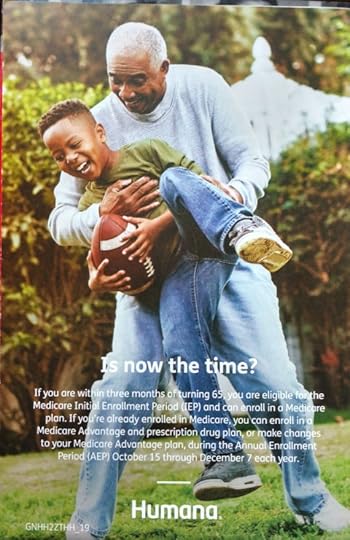
Medicare for everyone?
As I consider the idea that all Americans could have access to the same kind of health coverage that seniors can access when they turn 65, I am in favor of it. I see the kind of plans that I have available to offer to the people I meet with: why shouldn’t all Americans have something similar?
Of course, this gets back to some fundamental aversion that people like Donald Trump, someone who is a sociopath, has about others having a fraction of the perks he’s had in his gilded lifetime. His Republican colleagues in Congress, a cruel and heartless group akin to Dr. Suess’s Grinch character, are equally stingy about their constituents having health plans that actually provide benefits, without bankrupting the farm.
Interestingly, while Republicans are called “the party of the rich,” data and facts (those pesky things) reveal the opposite. At least at the state level, 18 of the 19 poorest states have legislatures where both chambers are Republican-controlled.
I recently began reading a book by Bruce Cannon Gibney, A Generation of Sociopaths: How the Baby Boomers Betrayed America. I’d read a piece about a few months back in The Baffler and made a note to order it from my local library. Then I forgot about it until last week.
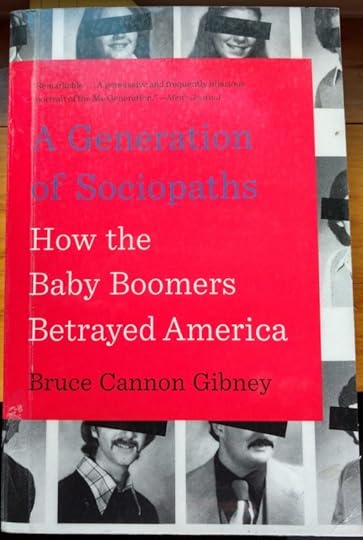
Boomers as sociopaths.
The book indicts the demographic group that I’m on the outer fringes of. He defines Boomers as those born between 1946 and 1964. Boomers are in the White House (and have been for awhile), Congress, and make up the Supreme Court. They run companies, hedge funds, and they are the ones making sure they get what they think is owed them, while bankrupting the future for anyone younger than 54.
I’ve listened to my fellow Boomers malign and complain about Millennials for a long time. I remember hearing employer-after-employer during my LWIB days bemoan how “younger workers” were worthless.
I didn’t see it that way then, and I certainly saw something much different in Mark. After he was killed, meeting many of his former classmates at Brown gave me encouragement, as they were an amazing cohort of younger Americans.
Since last fall, I’ve been spending five nights a week tutoring youth aged 14 to 18 (and 19) at a private boarding. I am now subbing in the public schools two or three days a week, too. I think the world that Boomers are doing their damned-well-best to destroy would be better in their hands. Remember the Parkland students, post-shooting?
Gibney does an amazing job in his book of looking at history, things like Vietnam, discussing it as a “defining experience,” and illustrating the sociopathy of Boomers. Of course, since I’m guessing that 99 out of 100 of those stumbling across the JBE while surfing the web looking for pictures of smartphones are not interested in me and my nuance when it comes to healthcare. Most prefer to rage against “the government takeover of healthcare,” or positing that healthcare is a “fundamental right.” As today’s First Words column in The New York Times Magazine spoke to, nuance is now seen as weakness in this time framed by Twitter.
Thanks to Maximillian Alvarez, here is Gibney’s Boomer indictment in a mere 115 words. Why bother to read a 400-page book?
How can we explain this calamitous, pathological selfishness at the root of the sustained crisis of Boomer mismanagement? Leaning heavily on the fifth edition of The Diagnostic and Statistical Manual of Mental Disorders (DSM-5), Gibney insists that Boomers, as a whole, are self-evident sociopaths “characterized by self-interested actions unburdened by conscience and unresponsive to consequence, mostly arising from non-genetic, contextual causes.” Boomers have repeatedly put the gratification of their own immediate, generationally specific desires above consideration for the long-term consequences doing so would have for them, the country, and their children. Their manifest sociopathy distinguishes them as a singularly antisocial group, devoid of the lowest-common-denominator feelings of collective responsibility for maintaining a livable society for all.
Gibney’s clearly onto something, though: America’s rot is pervasive. We may have reached the zenith in terms of sociopathic governance, too.
The era we are in the midst of is one characterized by diminishment. I’ve detailed our national circling of the drain before, preferring George Packer’s descriptor, “The Great Unwinding.” Boomers have presided over our country’s race to the bottom. Yet pointing the finger of blame likely won’t do anything to change things.
Perhaps it’s simply history running its course. I think Chris Hedges “end of empire” narrative is fitting in that regard.
Of course, it’s easier to yell across at Republicans (if you’re a Democrat), and if you are an angry white male whose had the best of life in America, it’s getting as much as you can before you die, ala Gibney. That’s truly sociopathic.


October 17, 2018
A Pillar of Salt
Perhaps some future race of aliens will come across this blog. I hope this video makes them wonder about us. What sort of people made videos like this? A creative, multi-faceted group of people (even if those sorts comprise a minority of people not craven to white supremacist, authoritarian buffoons who employ tanning beds).
Indie rock is becoming a fading Polaroid in the pantheon of a music landscape turned to crap. When the “weeping” electric guitar is going the way of the dinosaur, those in the know recognize that we’re on life-support and it’s time to prepare for manning the lifeboats.
If the death of indie rock isn’t a herald of what’s to come, the craven political tilt of the church in America lends portent, also.
A Pillar of Salt
The Thermals
We were born to sin
We were born to sin
We don’t think we’re special sir
We know everybody is
We’ve built too many walls
Yeah, we’ve built too many walls
And now we gotta run
A giant fist is out to crush us
We run in the dark
We run in the dark
We don’t carry dead weight long
We send them along to heaven
I carry my baby
I carry my baby
Her eyes can barely see
Her mouth can barely breathe
I can see she’s afraid
She could see the danger
We don’t want to die or apologize
For our dirty God, our dirty bodies
Now, I stick to the ground
I stick to the ground
I won’t look twice for the dead walls
I don’t want a white pillar of salt
I carry my baby
I carry my baby
Her eyes can barely see
Her mouth can barely breathe
I can see she’s afraid
That’s why we’re escaping
So we won’t have to die, we won’t have to deny
Our dirty God, our dirty bodies
Songwriters: Hutch Harris / Kathleen Michelle Foster
October 16, 2018
In Praise of Short Stories
The short story has been a neglected writing style in my reading. This summer, I made a point of addressing it when I read Ottessa Moshfegh’s excellent collection, Homesick For Another World. After I finished, I vowed to read more similar collections.
A perk of working with high school-age youth is having the chance to revisit writers and writing that you were equally clueless about when you were the same age as these young charges assigned to you.
Of course, being a tutor, sometimes you must scramble in reacquainting yourself with said writing from the past. A few of those writers? Try James Thurber, J.D. Salinger, George Orwell, and Shirley Jackson. Orwell and Salinger haven’t been tough. I read The Catcher in the Rye last year and have read it several times over the last decade. Ditto for Orwell, and in fact, I made a habit of annually rereading 1984 during the 2000s and the Bush presidency. Thurber and Jackson are less familiar.
A week ago, I was time-traveling back to Thurber’s “The Catbird Seat,” and dull little (or so we think!) Mr. Martin. Admittedly, I have never loved Thurber like some literary types have.
On Sunday, I was co-reading Shirley Jackson’s short story, “Charles,” and helping a student craft a paragraph about parents not recognizing flaws in a child. The discussion that ensued was meaningful to me on several levels.

Shirley Jackson, American writer (seen in this April 16, 1951 AP photo)
Save for “The Lottery,” few people who travel in non-literary circles know Jackson’s work. This New Yorker article is worth reading if you’d like to know more about a wonderfully (weird) and “haunted” writer.
“Charles” wasn’t particularly strange or odd. It was a story that had humor and was what might be called an “unsentimental” look at life as a mother during a particular time in America. In Jackson’s case, this would be the 1940s, a very different time period than our own. As a writer, Jackson shaped it with sly parental incredulity and humor, too.
Apparently, the story was published in Mademoiselle and later, was included in her collection, The Lottery/The Adventures of James Harris.
It begins thus:
The day my son Laurie started kindergarten he renounced corduroy overalls with bibs and began wearing blue jeans with a belt; I watched him go off the first morning with the older girl next door, seeing clearly that an era of my life was ended, my sweet-voiced nursery-school tot replaced by a long-trousered, swaggering character who forgot to stop at the corner and wave good-bye to me. . . .
Like the parents Jackson is writing about, most think their child is the best. Love compels you to want to feel this way. This also opens the door to the possibility that you’ll overreach and have unrealistic expectations, too.
Of course, it’s special when parents of a child get to witness an adult who validates the faith they had in him or her.
October 10, 2018
Day Exploring-Boba and Bánh Mì
One
For a year, I wrote a monthly feature for the Lewiston Sun-Journal. It was called Explore. I’d spend a day in a Maine community and write about the place and the people who lived there. I’m not sure if they’re still online or not but I have some of them posted on my writing site. I especially liked this one on Wilton. The places became sources to write something more than the usual “town in the news” hack pieces. At least that was always my goal.
A bonus of these assignments was getting to work with a stellar editor in Mark Mogensen. Most local dailies don’t pay freelancers enough and I was forced to take my writing elsewhere. It was my Sun-Journal piece on Biddeford that led me to believe I could pitch it to a bigger paper. I did and my more involved feature landed on the pages of the Boston Globe nearly three years ago.
The practice I developed back then: spending the better part of a day in a particular place informed this post. As I was out and about in Lewiston last Friday, the thought of doing something like this on a semi-regular basis held some appeal. We shall see.
My initial thought was to go into detail and provide some personal history about me and Lewiston. Like being a seven-year-old second grader with a teacher who was overly demanding about my penmanship. It was 1969 and teachers had way more leeway in how they marshaled their young troops back then.
In the case of Mrs. D, it meant imposing her iron will on a young boy who was hyper and with no interest in mastering cursive writing. She died in 2006. I remember seeing her obituary and not feeling sad at all.
My Franco-American grandmother lived in Lewiston. My family visited her nearly every Sunday. My aunt who never married lived with her.
Immigrants like my grandmother were proud of their city. Her Catholic faith was important and a central element for her and most francophones and fellow French-Canadian settlers in Lewiston. If there is any doubt about the role of the Church in French-Canadian life in Lewiston, St. Peter and Paul Basilica, which sits like a sentry overlooking Lewiston (and neighboring Auburn) should tell you that religion was important to them. They made sure to leave a memorial to their faith. Funding for the church came from thousands of small donations given by Lewiston residents, especially the Franco-American community.
There is a lot more history about the Basilica I could cover, but I’m not really interested in doing so. Other family members have mined that vein if people are interested.
Two
Lewiston is the second-largest city in Maine. There are slightly more than 36,000 residents living there. Franco-Americans came to the city looking for a better life at the end of the 19th century and at the beginning of the 20th. Lewiston more recently has attracted another group of people looking to improve their lives. During the tail-end of the 20th century, significant numbers of mainly ethnic Bantu refugees from Somalia began arriving in the U.S. Word spread among them that Lewiston was a special place. Somalis began a secondary migration from other states to the former mill town.
Back to my grandmother for a moment.
My Memiere lived most of her life in apartments scattered across the city. Like many renters, you live somewhere for awhile and then, the rent goes up, things change, and for a host of other reasons, you need to move.
My father was usually involved in the move. He’d borrow a truck from my uncle who owned a local business. My father would recruit me to add what little muscle I could provide at eight or nine. I hated these moves because it meant moving stuff up and down stairs from a second or third floor apartment on College Street, or Pierce, or Sabattus, or a host of other streets in Lewiston that I still know like the back of my own hand.
One place I recall with a great deal of fondness is the apartment that my grandmother had on College Street. Our Sunday visit meant candy provided by my aunt, usually soda (which we rarely had at home), playing store in the hallway pantry where my grandmother kept a supply of cans and other dry goods.
My Franco-American grandmother never learned English. I can still hear her and my mother (and aunt) conversing in French. Certain words I’d recognize, and there would be occasional English words mixed in. Sometimes they’d laugh. Oddly, I never learned to speak French.
Then, it would be time to make the return trip to Lisbon Falls. When I was in Mrs. D’s second grade class, my stomach would clench and then hurt all the way home. I was thinking ahead to class the next day and had begun steeling myself for a week of her haranguing me in front of classmates about my penmanship and all manner of other tasks where I wouldn’t measure up to her overly-strict expectations of a young boy with too much energy and not much patience for practicing penmanship.
Three
Similar to other mill towns in Maine like Waterville and Biddeford, the economy of Lewiston ebbed and flowed according to the health of the textile mills. These mills began closing during the 1950s. New England, once the center of cotton textile manufacturing in the world, once had the corner on more than 80 percent of global production. In 1954, U.S. market share had shrunk to about 20 percent. First, Southern labor and other advantages found owners moving operations below the Mason-Dixon divide. Then, textile production went overseas. Bosses always look for the cheapest labor option.

The former Continental Mill-Lewiston, ME
I was hired by one of Maine’s Workforce Investment Boards in 2006. The office was located within the confines of one of Maine’s CareerCenters on Mollison Way. This wasn’t far from where the old Lewiston Raceway had been located.
That period in the mid-2000s was a significant one for the city. Economic development and growth were taking place and the city was infused with a new civic optimism. Downtown was in the throes of experiencing revitalization for the first time in decades. There were now places worth visiting again along Lisbon Street. The former Bates Mill was being redeveloped.
Things weren’t perfect. Many refugees struggled accessing employment. We ran several New Mainer training programs at B-Street Community Center in the heart of what had been neighborhoods once teeming with French-Canadian mill workers. I never spent time there without being reminded of those Sunday afternoon visits to my grandmother’s apartment decades before. It wasn’t unusual for me to park near one of the tenements (if it was still there) where my grandmother had lived. I’d get out and spend time walking around talking with some of the new residents. This allowed me to experience the new rhythms and changes wrought in the place.
Four
The fall of 2018 is shaping up to be a busy time for me. After successive summers of sitting home alone, it feels good to have places to go and people to see. But accelerating from slightly above zero to 60 on your personal speedometer requires some adjustment. I think I’m still getting re-acclimated.
A week of tutoring, subbing, and tending to insurance tasks found me with plans to take Friday off. I tutor Sunday through Thursday nights, so Thursday could be my new Friday. But why Lewiston and why last week? It was mainly about the Bánh Mì.
People who know me well know that I’m a fan of Yelp. At least I have been a fan. I’ve used it exclusively over the past 10 years to get a sense about restaurants (mainly) and other services from reviewers-on-the-street, which is what I am. Recently, I’ve also been using Trip Advisor, too.
Yelp put an unlikely take-out restaurant in Lewiston on my food radar. I’ve been meaning to have lunch there. So, why not last Friday?
Never will Lewiston be mistaken for a foodie Mecca like Portland to the south. I have it from a reliable source that most hipsters fear turning into pillars of salt if they brazenly dare leave the city’s gilded confines. So they don’t. That’s a shame because I know they’d like Boba.

Wall at Boba
This nondescript eatery, what I’d call a “take-out joint,” is centered on the flavor profiles originating in the countries of Southeast Asia. The location where chef Zach Pratt is now plying his culinary magic is in a former neighborhood variety store, just off Pleasant Street. Use your GPS to find it.
His “new” location is a step-up from when he began as a five-seater in the corner of a former gas station. Don’t let the locale and simplicity fool you. Pratt is the real deal. He recently made an appearance on The Food Network’s “Chopped.” I predict he won’t be in Lewiston forever.
Stepping inside from Scribner Boulevard, a cavalcade of delicious aromas washed over me. My mouth commenced to watering. “Where am I?” Was I really in Lewiston, “the dirty Lew?” I’m sorry. That wasn’t kind. I know many locals hate that descriptor. Back to food reviewing.
Boba has a wealth of menu options: Pho, dumplings, sandwiches, appetizers. Pratt was out back, an artist working his magic; he and a co-worker were trying to stay ahead of multiple Friday take-out orders waiting to be picked up. The line was moderate and getting deeper. It would be a few minutes before I would get close enough to place my order. I’d opt for one of the Bánh Mì options. If you aren’t familiar, these are Vietnamese sandwiches served with pickled carrot, daikon radish, a secret aioli, cilantro, onion, on a toasted French baguette. There is a vegan option, which was Kosher Mi, with marinated tofu and a vegan aioli.

Menu at Boba.
Zach asked if I was a vegan and said that the sandwich might be a bit “dry” so he slipped in a small container of a ginger chili sauce for dipping. I would have been fine without it, but this little addition was like “bam!!!” in terms of ramping up my first experience at his restaurant/eatery.
While take-out is king here, there are three tables (I think?) and stools to eat along the wall.
The combination of flavors in the Bánh Mì created a perfect flavor symphony in my mouth. The cilantro was fresh, and the baguette roll was flavorful and crunchy. The pickled veggie/daikon combo suited the perfectly marinated and fried tofu. I could have been happy with the tofu and my dipping sauce, alone. Together—well, perfection!!
Pratt told me that he and his partner are looking for a bigger place nearby. Check the website and apps like TripAdvisor to be sure you are headed to the right place.
Five
My goal post-SI joint dysfunction is 150 minutes of exercise per week. I swim at least two days each week, so there’s an hour or slightly more. I try to mix in a few walks, and some time on my bike. Friday, I needed to walk. I decided to park by Simard-Payne Park and tackle the Riverwalk. I’m glad I did.
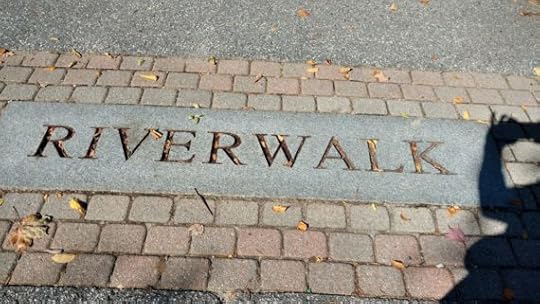
Hitting the bricks in L-A: the Riverwalk.
Friday was a fall-like 60 degrees, ideal for walking. Just after lunch, there were precious few pedestrians on the paved path tracing the shore of the Androscoggin back towards the falls on the Auburn side of the river. I walked and reminisced. Memories from childhood up through recent years and experiences in Lewiston—like my involvement with Grow L+A in 2015/2016, washed over me. I could see the L.L. Bean call center where I’d worked the winter I was writing my first book in 2005. I’d return for subsequent seasons through 2014. I think the last time I’d been on this path was during a 4th of July fireworks celebration, 15 years ago. Actually, during our second Dempsey Challenge, I remember Mary and I cycling across the Grand Trunk Railroad trestle into the park and being cheered by people lining the bridge. Mark walked with his Aunt Dianne. Mary’s mom was with us that day. Memories of better times and people no longer here.
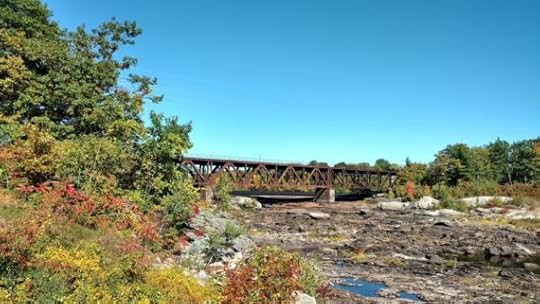
Walking towards my destination: train trestle between Auburn and Lewiston.
Lewiston and places like it will continue facing challenges as a city. Cut-government-no-matter-what doesn’t bode well for community and people. Many of the strip malls that bled business from downtown have empty storefronts. The Promenade Mall’s parking lot is a mess. The once vibrant retail center is now a shell of its former self.

This mall’s seen better days.
Bull Moose, on the other side of Lisbon Street in the Lewiston Mall, is expanding. In addition to CDs, records, and DVDs, they are going to become a bookseller, also. Their Scarborough store has already made the transition. Since Mr. Paperback closed and Bookland before it, Lewiston has been without a full-service bookstore. With Bates students and I’m guessing enough people who still read, this seems like a good move. They’ll be the anchor tenant in a mall that needs more traffic. Perhaps the holidays will bring some pop-up stores, too.
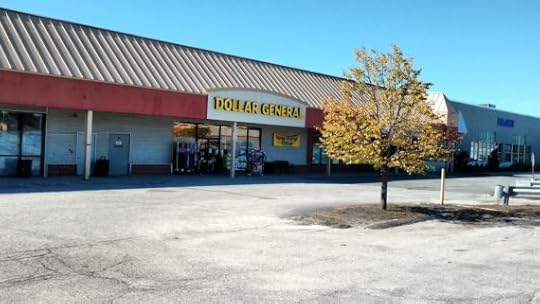
Will Maine become a state of donuts and Dollar Stores?
Lisbon Street continues its Phoenix-like reinvention. Fuel, the amazing French bistro that was one of the first new places to open downtown signaling its rebirth, recently closed. I’m not sure how that will affect that end of the street.
Lewiston has leveraged its past and some of its industrial infrastructure (like the Bates Mill) to get to the place where it now finds itself. I still think there is some confusion about how the city sees itself in terms of its brand. People who live there might disagree. I’m fine with that.
I’ll be back again, even if it’s just to try some of Zach Pratt’s unique and delicious fare. Baxter is a favorite beer of mine, and some Saturday during winter’s slower season, visiting their tap room is something to consider. Lunch at Guthrie’s is never hard to take. There’s also Museum LA, Bates College, and a host of other attractions worthy od one’s attention.
October 5, 2018
Better Days
During the summer of 2017, and even at times, this past summer, recovery from grief and loss seemed improbable. Losing a son like Mark assured me my spot in line, stuck in a position and place I never asked to be in.
Life is now pockmarked by sad anniversaries. These will be forever oriented around an event that turned lives upside-down: the last time we saw Mark; the start of his final walk; his birthday, Christmas, his death…and on and on the calendar turns.
When I returned from my Father’s Day road trip in late June, and with July’s swelter, once more I was moored in sadness and hopelessness. The odds that things might dramatically improve were not any that a successful gambler would take.
We’re fortunate to have an exceptional grief counselor. At an appointment prior to summer, in May, she reframed how I was feeling as “moving through grief.” Her suggestion and semantic reorientation from “moving beyond grief” worked for me.
I’m not dismissing that my physical malady and SI joint issue contributed to the darkness I experienced most days. Sitting at home with nothing to do and with no prospects of anyone intervening dropped a veil of interminability over July.
My walking partner and friend, Paul, was also experiencing back issues. Both of us had dusted-off our tennis games during the summer and fall of 2017. This tennis season, neither of us was capable of swinging a racket, or chasing balls on the baseline—we were simply struggling to remain upright.
August forced me to dig into my Medicare certification requirements. I wasn’t eager for this three to four-week period of completing modules in order to pass the federally-mandated certification exam that allows agents little wiggle room. You basically have to know your stuff if you want to sell this type of health insurance. On top of these strict federal mandates, each plan imposes additional requirements before being deemed “ready to sell.” The good news for me this year is that I’m contracted with three plans, instead of last year’s solitary option.
Tutoring at the private school nearby may have saved me in 2017. No matter how dark and difficult things felt, I knew I had to gather my wits about me late every afternoon in preparation for the student I was assigned to work with.
Driving onto the stately grounds of the school replete with a 19th century mansion always managed to enhance my mood and remind me that it was time for me to “perform” for two hours. And that’s what I did beginning in September through early December when the students left for Christmas break.
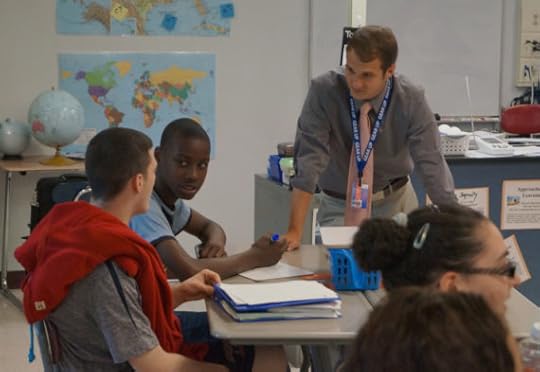
Teaching and tutoring are noble endeavors.
Then, I was back in January and helped a young man I’d been working with one-on-one to the finish line and his graduation in May. During my time working with Chris on his graduation speech, I recognized that the skills I’d gathered and honed while doing workforce training, teaching writing classes, working on my own journey of reinvention, and remaining committed to personal self-improvement dating back to 2005 were actually transferable to the work I’d now drifted into.
On top of that, there were four summers of coaching a group of college-level baseball players for three months. I spent two to three nights a week with them, and most of the day on Sunday when we played doubleheaders. I’d always been able to cultivate relationships with my players. I’m grateful that Mark wanted to play for his dad and that I got to see him do his thing on the baseball diamond countless times.
All this to say that I’d arrived at a place I never planned to be. Tutoring, mixed with a bevy of transferable skills germane to education helped me to see that there might be additional opportunities for someone like me.
I’d read in one of our local free papers, I think it was The Forecaster, that all the surrounding communities within 20-25 miles of where I was living were struggling to find substitute teachers. They’d even “bumped-up” the pay above a subsistence wage. Not that I was looking to get rich and in fact, money wasn’t what motivated me to inquire about what was required to sub in Brunswick (where I’m living) and at another school district nearby.
An application, my college transcript, and some references got the ball rolling. I had to get fingerprinted and agree to a background check. None of this was prohibitive in the least.
Yesterday, I subbed for a high school English Arts teacher. I spent most of my day talking about writing, literature, George Orwell, and why words matter. I got paid for doing something I’d probably do for free! At the same time, the past 20 months following Mark’s death has been a lean financial stretch for a freelancer like me.
Two days ago, someone called me to ask if I could help them out on the insurance side of things. It’s a well-respected agency down the coast. In November and December, I’ll be working with some of their clients, helping to meet their insurance needs during open enrollment. This will likely be a day or two each week.
At one point in July, I looked at Mary and said, “can someone throw me a bone?” What I meant is, could someone recognize I was in a bad place and just needed a hand up?
I don’t know why when nothing’s happening, it’s nearly impossible to generate momentum. But once you find yourself moving, no matter how slowly, opportunities begin to present themselves. At least that’s been my experience.
My fall is going to be really busy, I think. I’m not complaining at all about it. I’m sure other things I’ve set in motion during the difficult days of summer will hit at some point and I’ll be able to announce bigger and better things down the road.
There are times when I’m thinking about Mark that I can hear him say, “just keep doing what you’re doing, dad.” I’m trying, Mark.
October 2, 2018
Falsehood and Deception
Most of us know, deep down, what’s wrong and what’s right. As we get older, we find all a myriad of mechanisms that we employ to begin lying to ourselves. Eventually, we find it difficult if not impossible to honor truth in our lives.
One avenue I could take in a post like this is to illustrate how American culture allows us to become comfortable with all the lies of omission we tell ourselves, without even touching on the other side of the coin—outright deception and peddling falsehood.
For years I’ve had a blog. On my blog I’ve invested effort and energy in writing regular posts ranging between 500 to 1,000 words, often topping 1,500 and even much longer pieces on a host of topics: American dysfunction, books, writing, politics, history, indie music, reinvention, religion—and lately, the fallout that accompanies tragedy, which is grief, loss, and mourning. I’ve always tried to write honestly, with conviction, and I’ve prided myself in writing things that could be verified and validated by fact. If not filled with factoids and research, they were rooted in personal experience.
Facebook has made it all-too-easy for people to denigrate fact-based dialogue. It’s the digital equivalent of spending an afternoon at the beach, building an ornate sand castle, and then, someone coming along and destroying it, and laughing in your face. Maybe even going, “na, na, na, na, na—I ruined your sand castle.” Far too many counter thoughtful writing with a few words, a couple of sentences, and then, purposely or because they lack the ability to think and reason, fail to follow along with even the simplest responses to their inanity. The poster child modeling this is now president of the United States.
For months, I’ve entertained “blowing up” my social media accounts, especially Facebook. But instead, I’ve persisted in trying to have reasoned dialogue with people who are unreasonable. Yes, I’ve used it to post links to my blog posts, but in truth, it hasn’t dramatically boosted my blog stats.
This afternoon, I’ve made the decision to step away from it.
I’m tired of the back and forth that never ends. I’m tired of the time it robs me of that would be better served reading, exercising, or doing something else—anything would be better, and make me feel less crappy than time spent on Zuckerberg’s bulldozer.

Done running from Zuckerberg’s bulldozer.
People will read this and wonder, “is Jim okay?” They are often the very same people who feign friendship and concern when it involves nothing more than a mouse click or pushing a button on their smartphone, but never,ever think to use the same device to call or send me an email, much less visit.
For the small tribe of people in my life that do care and have been there for me over the past 20 months, I’m actually doing pretty well. The fall’s off to a positive start. I’m back tutoring, gearing up for another Medicare Annual Enrollment Period, and spending another day or two weekly doing something brand new that relates to education and trying to positively impact youth. I also may even be conducting defensive driving training in the near future.
I miss Mark each and every day. There will always be times when I’m overwhelmed with losing him. I’ll never get over that. But he would want me to go on with my life, I think. That’s what I’m working on and moving through the aftermath of losing a one-in-a-million kind of son.
Perhaps I’ll come back to Facebook at some point. I’m not sure.
If you are someone I care to remain connected with, you know where to find me.
September 27, 2018
Anita Hill 2.0
Today is the “big day” on Capitol Hill. Brent Kavanaugh will have to answer to and about the allegations made against him. Several women have alleged that he at best, acted in an aggressive and sexualized manner towards them. At worst, he was/is a sexual predator.

Mark Peterson photo/Courtesy of The New Yorker
Since Mark was killed, I boomerang between days and weeks where life seems like it’s returned to “normal.” I go off and do one of my various freelance activities, or I’m working on one of the one or two articles I turn and get paid for by the auto trade magazine I’ve written for since the summer of 2015. The activity allows me to push aside the pain that comes with losing someone central to my life.
Inevitably, something becomes a trigger, and I can go from “nearly normal,” to freefalling into an angry funk. When this occurs, it’s hard to want to care about anything for a day, or longer. I’m angry at the woman who hit and killed my son. I’m angry at people who seem to be so self-centered and oblivious about others and their pain. I’m sick of thinking about how I’m going to scrounge up some additional income, and a host of other emotions related to grief and loss. This week, it was something that someone who I thought had my back, said. This person once again indicated what an absolute shit they are and have been since Mark’s death upended my life and Mary’s. But it’s always about them and always has been. I must remind myself of that and breathe.
Last night, I returned from the private school where I’ve been tutoring since September, 2017. The impressive campus, replete with a mansion is 10 minutes away. “Falling” into my role as a tutor makes me realize that I’ve always had a knack for this. At least the skills I’ve been cultivating since my reinvention in 2004-2005 are transferable to tutoring and even substitute teaching. Who knows—perhaps I’ll spend time getting yet another certification tacked onto my resume? Medicare, a teaching certificate, and another possible certification to teach defensive driving courses could be my ticket to retirement riches. Maybe I won’t need to pick up bottles on the side of the road after leaving the workforce when I’m 75 or 80.
There are family members who have abandoned Mary and me. Yet, the two of us continue drawing upon a reserve of resilience we didn’t know we had. We move through the landscape of grief and mourning the only way we know how. Neither one of us are perfect and we’ve both acknowledged this to each other numerous times over the past 20 months. Yet, here we are, our unit of three reduced to two. We’re still standing, we’ve launched a foundation in Mark’s memory and we’ll be holding our fourth board meeting on Sunday. Two friends who have been there since Mark’s death have come along side of us to support us in a board capacity, and we’ll continue working in a tangible way, making a difference in Mark’s memory, and championing the causes he cared about: the environment, promoting social justice, as well as involving under-served populations directly in renewing their communities.
In July, Mary and I celebrated 36 years of marriage. We’ve actually been together for longer than that. We weathered some pretty difficult terrain in Indiana, early on in our marriage. At the time, we were duped into sitting under a racist, who excused his own son’s sexual predation. But we had the inner strength to call “bullshit” on something that many others didn’t and we left while others similar to us remained. We also did this without family nearby, offering support or validation.
Mary is the kind of partner that every man should have the privilege of spending their lives with. I don’t know how she’s been able to go back to work and deal with the never-ending barrage of tasks that she’s required to perform. This after enduring grief that only a mother knows. She’s also served as the administratrix of Mark’s estate. Grieving and the subsequent mourning that follows the death of an adult child who you loved more than life itself seems more than enough, without having to deal with the stress of maintaining the tenuous economic hold that most Americans have, while staying afloat in these days of corporate capitalism run amok.
We were supposed to go to the Finger Lakes Region and wine country for our anniversary. Instead, SI Joint Dysfunction found me on my back and out of commission. I know she was disappointed, but we got through July and early-August together. We did make it to Cape Cod for a wonderful weekend, spending it with one of Mark’s Brown MFA colleagues and friend, and her family. Maybe next year we’ll make it to upstate New York.
I’m not sure why, but while Mark was on the road, five weeks before he was hit and killed in Florida’s Panhandle region, I emailed him about something that had happened at the University of Maine at Orono when I was a freshman. It happened a few doors down from the dorm room I was living in, at Gannett Hall. It was supposed to be a “quiet dorm,” at least my section of the first floor. I chose the location because I was intent on studying, and playing baseball.
Gannett Hall, in the fall of 1980, could have been used as the set for Animal House. Students were drinking and out-of-control all hours of the day and night. My first weekend, I was forced to lie awake until three in the morning, while on the other side of my wall, a drunken party was taking place, replete with blasting music, yelling, and the sound of breaking glass.
A month into my freshman term, the door across the hall on the bathroom got torn off the hinges during Parents Weekend. When I went out into the hall on Saturday before the door got ripped from its moorings, the father of a student, drunk off his ass told me to “fuck off” when I asked a hall mate if he could turn his music down.
During the first week of school, this happened. I related it in an email to Mark on December 3, 2016:
I hated my time at UMO. The administration totally sucked. I think I told you about my roommate leaving school because a girl was basically gang-raped outside our door, just down the hall. They called it a “gang bang,” but what kind of guy participates in this? I remember telling the guy next door how I thought it was bullshit, and he basically called me a “fag,” because somehow, not participating in the public humiliation of a female made me less of a man. Just one memory of the school and I don’t think things are much better up there. Sorry to digress.
The administration were all weasels, trying to get me and my roommate to make our roommate seem like he was “mentally unstable.” It’s a long story, but something I haven’t forgotten (obviously).
I’ve never forgotten that incident. The sounds, the guys coming out and laughing, and then hearing the young woman leaving, having to make the catwalk past a bunch of drunken predators, telling them all to “fuck off.”
She was a year older than I was. She came from a small town similar to where I grew up in Lisbon Falls. A young man from her high school played on my intramural basketball team. Weeks later, while the story was circulating across the campus, he told me she was academically-gifted. She left UMO at the end of the semester. I don’t know what happened to her. I never forgot her and I wished somehow I could have done more, but I honestly didn’t know what to do.
Mark responded to my email with this:
I don’t think you’ve ever told me about your roommate leaving school. If you did I might not have been as receptive to the story as I am now. A lot of who I am today obviously stems from how you raised me and I think you did a good job teaching me to respect women. I still think I have room to grow and learn. One area where I would like to grow is being a better ally for women, minorities, and LGBTQ people. I think a good way to be an ally is to talk to other men about ways they can be better allies. I guess my point about all this is that I would like to hear more about this experience at UMO and have it lead to more conversations about our role as men in current society.
I loved my son. I still love him, but that love hurts too much sometimes. I also recognize, in light of how society still holds regressive views about women and sexual violence towards them, we need young men like Mark, who respected women and was open to being an ally and supportive as a partner. If he were still alive, I know I’d be having conversations with him. He’d probably be joining actions in Providence, showing support for Dr. Kristen Blasey Ford and the other women.
Mark knew I wasn’t a perfect father, that I was flawed. He loved me anyways. However, the young man he became, and the way he lived right up to his last breath on earth validated that I was a father who was always there for him and that I loved him unconditionally.
What happened the fall of 1980 in Gannett Hall also traumatized one of my two roommates.
Bob D. was a redhead, who had been raised by his widowed father an island off the Maine coast near Mount Desert Island. His dad was a caretaker of an estate. Looking back, I recognize that he was most likely homeschooled, or had elements of non-traditional education.
I remember he was an outdoors-ey type, with a set of the Foxfire books, an axe, and was going to major in forestry—that was until he found out what college was really like for a sensitive, committed young man who didn’t think it was okay to sexualize women.
Rumors were everywhere that there was going to be freshmen hazing. I know this really weighed on Bob’s mind. Unlike Bob, I was figuring out how I’d adapt and fight off the attackers, if necessary. I’m guessing my other roommate, also named Jim (who was the son of an Irish cop, from Jamaica Plain) was thinking the same.
Then, a week following the “Gannett Janet” incident happened, Bob had a meltdown in our room. He grabbed his axe and said, “I’m ready if anyone comes through that door.” Jim and I had to calm him down. This happened Saturday night/early Sunday morning.
By Sunday afternoon, Bob had packed up his stuff, and he left school after a mere two weeks. Nothing Jim and I could say to him would convince him otherwise.
Bob went back home. His father wrote a scathing letter to the president, and Jim and I got hauled into one of the administrative offices to “give our side of the story.”
I remember basically being pissed and telling them to figure it out on their own. I was angry that a quality human being was forced out of the college he had been looking forward to attending. I was also anti-authoritarian enough to not be cowed by administrative types. To Jim’s credit, he also wasn’t willing to help these assholes paper over the seriousness of what had happened.
I don’t know what happened to Bob. Maybe he attended school somewhere else, Perhaps he took over from his father and is now a caretaker of some palatial estate, I don’t know. I also wonder about Janet.
All of this was prompted after experiencing the back-and-forth related to today’s hearing, and the statements coming from Donald Trump, Lindsay Graham, Mitch McConnell, and others.
UMO wasn’t a pleasant experience for me. I thought it mostly had to do with a combination of my baseball career coming to an end, being in love, and also, the pull of religion taking me in a different direction. It might have been partly due to those things that I left after three semesters. I now realize that the culture of drunken young men, seeing women as nothing else but a means to their own violent, sadistic sexual fantasies, factored into my decision to leave the school in the spring of 1982. I’m sure things like this are still going on at Orono and that the administration continues to turn a blind eye to it.
I’m sure some will accuse me of “virtue signaling” with this post, or worse. I am not. I’m simply relating some of my own experiences with men, and how they act towards women.
Honestly, often, I’m ashamed to be a white man. I’m old enough to know that the Brett Kavanaughs of the world get free passes for their behavior, while men who don’t come from privilege end up behind bars. I saw this firsthand when I worked at a prison in Indiana.
I’m also of an age to know that things have shifted. Since I’ve been in the workforce, sexual harassment training has become mandatory. Certain behaviors are no longer tolerated in the workplace. I also know that men like McConnell, Graham, Trump, and older ones like Orrin Hatch and Chuck Grassley, come from a time that seems prehistoric, even to me, someone who is halfway to a century.
None of us know how today’s hearing will go. I fear that even in the aftermath of #metoo, things haven’t changed enough. Too many men are only intent on preserving their weakening hold on power, privilege, and to a time when women weren’t respected, and having the courage to come forth with an allegation, even 30 years later, gets treated different than when men do the same.
September 15, 2018
Books and Reading: An Antidote
I’ve written about subscribing to a “real American newspaper.” The paper that gets dropped at the end of my driveway every Saturday and Sunday is one of the “failing” papers that our always-aggrieved president regularly runs down for its “fake news.”
To call journalism “fake” exposes our bloviator-in-chief for the shallow huckster and carnival barker that he is at his essence. A man with small hands, a smaller heart, and who is totally clueless about the history of the nation he threatens to run into the ditch once and for all. For him, news is always “fake” when it’s not intended to flatter behaviors that are unflattering at best.
To malign reading and intellectual breadth and depth as “elitism,” is a solipsistic sleight-of-hand employed by lazy, shallow dolts who don’t, won’t, or can’t read. Bringing facts to these types is like arriving at a gunfight with a knife or worse: a sheet of paper.
But, to be well-read opens up a well-lit vista that is ever-expanding, rather than the world of the those striving at nothing. For the latter, their realm is a darkened square where the walls continue constricting, forcing out necessary oxygen.
I don’t expect every Saturday (or Sunday) to be a banner news day or one where The New York Times Book Review is bursting with books I want to run out and pick-up. Today, however, was a day when my book supplement had me jotting down notes and making plans to add to my ever-growing pile of “books to read.”
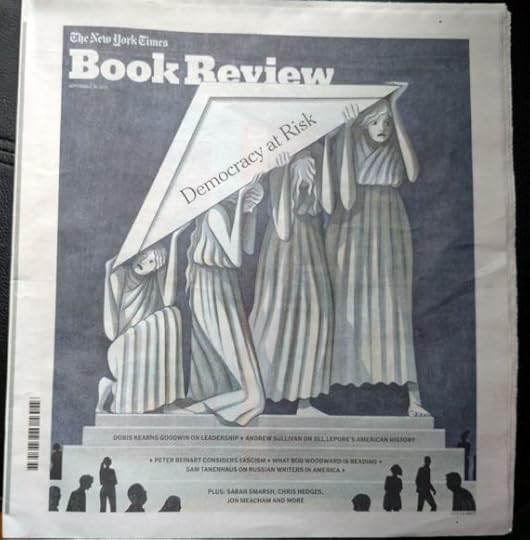
Saturday newspaper reading.
A full-page ad for the new novel by first-time writer Stephen Markley had me at its description as “A descendant of the Dickensian ‘social novel’ by way of Jonathan Franzen.” Ohio: A Novel is definitely fiction I plan to acquire and read.
Andrew Sullivan is arguably one of our most astute writers and social critics. A conservative in the classical sense of the term, prior to the word becoming the domain of fundamentalist Christians and “emotionally arrested Randians.” I don’t always agree with everything he writes, but if I see his name bylining an article or review, I’m going to read it.
He reviews Jill Lepore’s new book on the American past, These Truths: A History of the United States, opening with this: “It isn’t until you start reading it that you realize how much we need a book like this one at this particular moment.” He grabbed me with his lead sentence, but I read his 1600-word review in its entirety because Sullivan can write and I was enthralled with the rest of the review.
As a longtime reader of Sullivan, I know he isn’t some sycophant who lauds other writers and thinkers unless he respects their work and considers them worthy of his effort to read and understand their work. Lepore isn’t a conservative—neither is she a liberal apologist, either. But, having read her work in The New Yorker over the years, I know her politics didn’t perfectly align with Sullivan’s. I almost expected a negative review. It wasn’t.
Living in this age of digital truncation, a perusal of Facebook or Twitter makes it painfully evident that many read very little and think even less about what they read. Understanding our world doesn’t have to be an exercise in binary reduction, but it often is at its social media best.
Do you want to trumpet the political prowess and leadership of the president? Fine. Demonstrate to me that you have something beyond a second grade understanding of history and show some evidence that you’ve passed Economics 101. If you can, I’ll cede a point or two in argument. But you can’t and you won’t. That would mean work and heavy-lifting that you long ago gave up on. So, just fall back to your usual default response and logical fallacies.
I was pleasantly surprised to see that another writer/thinker I admire and have gleaned so much from, Chris Hedges, has a new book. Better, it was also reviewed on the pages of the NYTBR by Thomas B. Edsall.
Hedges’ book, America: The Farewell Tour, continues Hedges’ orientation towards characterizing America as an empire in decline. Edsall quotes Hedges on America, “The American Empire is coming to an end…The death spiral appears unstoppable, meaning the United States as we know it will no longer exist within a decade, or at most, two.”
Back to Sullivan on Lepore. While Hedges’ writing might be a jeremiad, Lepore offers us a panoramic sweep of our past and since the past helps us understand the future, a sense of where we are at the moment. And like Hedges, it’s not comfort for comfort’s sake.
Sullivan writes that Lepore offers us a book that we need. He describes it as “a classic tale of a unique country’s astonishing rise and just-as-inevitable fall.” He indicates that Lepore frames our present in terms that most resemble “the late 1850s and early 1860s.”
This was just prior to the Civil War, when America was wrought with division and political strife.
From Lepore:
“A sense of inevitability fell, as if there were a fate, a dismal dismantlement, that no series of events or accidents could thwart.”
It seems like we’re back there, again.
September 14, 2018
The Eye of a Storm
When disaster hits, it’s a good time for all of us to take stock. If you are in the path of a storm or a hurricane—like the people along the Southeastern coast of the U.S.—then your primary concern simply becomes survival, or at the very least, finding the strength to make it through weeks and possibly months of disruption of your ordinary and usual routine.
Natural disasters have wide-ranging effects on individuals and their communities. Loss of specific resources (e.g., household contents, job) following a disaster haven’t been rigorously studied, even though a great deal of attention is given to front-loaded activities like preparedness efforts and then, post-disaster interventions like utility restoration, clean-up, and rebuilding.
One study undertaken after Hurricane Ike utilized random-digital-dial methodology to recruit hurricane-affected adults from Galveston and Chambers, TX, counties one year after Ike devastated the region. Data from 1,249 survivors were analyzed to identify predictors of distress, including specific resource losses. Symptoms characteristic with PTSD were noted, associated with sustained losses, hurricane exposure and socio-demographic characteristics. Depressive symptoms were also evidenced by researchers. Together, these findings suggest risk factors that may be associated with the development of post-hurricane distress should be factored-in with preparedness efforts and post-hurricane interventions.
Those watching Florence unfold can observe tragedy from a perch of safety in their living rooms, a “perk” that television and technology affords. It’s all-too-easy for the misery of other people to become a form of entertainment for the people not in the bulls-eye of disaster. Like the rubbernecking that occurs as motorists pass a wreck on the highway, it takes effort to look away.

Storm surge near Atlantic Beach, N.C. (AP photo)
Compelling stories will develop. News organizations will remain at ground-zero for days and perhaps a week afterwards. Then, they’ll pack up and prepare for the next disaster and tragedy. We’ll all see the affected, those who’ve had their lives uprooted and material possessions destroyed. There will be residents who will lose that which cannot be replaced: when loved ones and friends become victims of nature’s force.
Sometimes this prompts us to wonder, “how would I hold up in a similar circumstance?” But the truth is, you never know what your capacity for self-reliance is until you are forced to draw on that reserve after tragedy strikes.
Empathy is actually a learned behavior, although its capacity is inborn and likely, genetic. It’s highly unlikely that our current president will ever be mistaken for an empath.
This is a good time, if watching from afar, to cultivate empathy in your life. There are organizations that are always on the front lines during a disaster. If you can, donate what you can afford. You’ll be glad when it’s your time to receive similar support.
September 12, 2018
Don’t Dissemble
Certain words ring true at particular times in our lives. We might be living through something, or feeling under siege, and you come across a word that elicits that Charlie Brown response from one his infamous sessions with Lucy: “That’s It!!!” he shouts, bowling Lucy over, after she offers her diagnosis to poor ole’ Chuck.
The word this week (and perhaps this month) for me is “dissemble,” as in feigning, concealing, or tamping down one’s true feelings. This is often done for some gain: personal, financial, social. The dissembler might even experience dissonance in the midst of their dissembling.
I actually came across the word in an article in New York magazine, about Rudy Giuliani. Hard to know that Rudy has any other purpose at the moment than to “dissemble” or equivocate about our current pathological president. But Rudy’s getting divorced. Did you know that?
Divorce happens. I get it. But I am proud of staying married for 36 years when both of us had the opportunity to bail. Now, I often turn around and find one person in my corner—my better half, my wife and best friend, Mary. But I’m not one of the powerful people like Giuliani and Trump. I’m just one of the hoi polloi and proud of it.
In the article, the former mayor’s wife, Judith, explains the difference between “the Rudy she married and the Rudy she is divorcing.” She contrasts the former “straight-talking mayoral past with his current presidential-lawyer habit of “dissembling,” to put it kindly” Boom! There’s the word.

The Mayor at Ground Zero. He’s since been “dissembling” about the woman to his left (Hillary Clinton)-New York Magazine photo
Dissembling keeps you on the inside (most times), safe, protected, but more-often-than-not, you betray yourself and your values and beliefs (if you have any).
I miss Mark each and every day. But I remember him with pride and a love that will last forever. He was true to himself (and to the people in his life), right up until the last breath he took on this earth. Too bad more of us can’t look to people like him, rather than dissemblers like Giuliani and Trump, or those individuals in our lives that are utter phonies and frauds. Better yet, weed them out of your life.
Sometimes it gets lonely, but it’s better to be yourself (by yourself), or with a small contingent of honest and truthful people in your corner.